SILVER RECOVERY FROM SPENT IPA USING SOLID LIQUID EXTRACTION
KHAIRUL AFIF BIN MOHAMMAD SUPERVISOR: AZIZAN BIN RAMLI
Report submitted in partial fulfilment of the requirements for the award of the degree of Bachelor of Chemical Engineering
Faculty of Chemical & Natural Resources Engineering UNIVERSITI MALAYSIA PAHANG
ABSTRACT
Perhaps the most challenging field in environmental engineering practice at the present time is the treatment and disposal of industrial and hazardous wastes. Isopropyl alcohol (IPA) is an organic solvent that widely use as a cleaning agent in electronic industry, particularly for solder paste cleaning of defective electronic products. The spent IPA consist of solder paste can cause a serious problem in term of storage and pollution since it contains high concentration of heavy metals. There are few possible alternatives to treat this waste and one of the ways is to recover precious metal such as silver. In this study, a sample of waste IPA is taken from one electronic company in Pahang which consume almost 100kg of IPA every three weeks. This company use IPA as a cleaning agent. Solid-liquid extraction (leaching process) is used in this study to extract the silver because of its simplicity, environmental friendly, lower cost and provides high purity of product. In order to get better understanding in this study, few parameters such as type of leaching agent, concentration of leaching agent and retention time were investigated. Based on the result obtain, it can conclude that all the parameters affect silver leaching. Most of leaching agent that been used in this study show the potential on silver leaching because of the existence of free chloride ions produce by HCl and form silver chloro complexes with Ag+ ions. The percentage of silver leaching also high which is up to 90% due to the effect of leaching agent concentration. This study is believed to be the first attempt to extract silver from spent IPA.
ABSTRAK
Mungkin bidang yang paling mencabar dalam bidang kejuruteraan alam sekitar pada masa sekarang adalah rawatan dan pelupusan sisa industri dan berbahaya. Isopropil alkohol (IPA) pelarut organik yang digunakan secara meluas sebagai agen pembersihan dalam industri elektronik, terutamanya untuk pembersihan pes pateri cacat produk elektronik. Sisa IPA terdiri daripada pes pateri boleh menyebabkan masalah yang serius dalam jangka penyimpanan dan pencemaran kerana ia mengandungi kepekatan logam yang tinggi. Terdapat beberapa cara alternatif untuk merawat sisa ini dan salah satu cara adalah dengan mendapatkan kembali logam berharga seperti perak. Dalam kajian ini, sampel sisa IPA diambil dari sebuah syarikat elektronik di Pahang yang menggunakan hampir 100kg IPA setiap tiga minggu. Syarikat ini menggunakan IPA sebagai agen pembersihan. Pengekstrakan pepejal-cecair (proses larut lesap) digunakan dalam kajian ini untuk mengekstrak perak kerana kemudahan, mesra alam, kos yang menjimatkan dan penghasilan ketulinan produk yang tinggi. Dalam usaha untuk mendapatkan pemahaman yang lebih baik dalam kajian ini, beberapa parameter seperti jenis ejen larut lesap, kepekatan ejen larut lesap dan masa telah dikaji. Berdasarkan keputusan, boleh disimpulkan bahawa semua parameter mempengaruhi larut lesap perak. Kebanyakan ejen larut lesap yang digunakan dalam kajian ini menunjukkan potensi pada larut lesap perak kerana kewujudan ion klorida bebas yang dihasilkan oleh kompleks perak HCl dalam bentuk chloro dengan Ag + ion. Peratusan larut lesap perak juga tinggi iaitu sehingga 90% disebabkan oleh kesan kepekatan ejen larut lesap. Kajian ini dipercayai sebagai percubaan pertama untuk mengestrak perak dari sisa IPA.
TABLE OF CONTENTS Page SUPERVISOR’S DECLARATION STUDENT’S DECLARATION ACKNOWLEDGEMENTS ABSTRACT ABSTRAK TABLE OF CONTENTS LIST OF TABLES LIST OF FIGURES LIST OF SYMBOLS LIST OF ABBREVIATIONS CHAPTER 1 INTRODUCTION 1.1 Research Background 1.2 Problem Statement 1.3 Research Objectives 1.4 Research Scope
1.5 Rationale and Significance
CHAPTER 2 LITERATURE REVIEW
2.1 IPA 2.2 Silver
2.1.1 Uses of Silver
2.3 Liquid-liquid Extraction (LLE)
2.3.1 LLE of Silver Using Dithizone
2.3.2 Physical and Chemical Properties of Dithizone 2.3.2 Effect of pH on LLE of Silver Using Dithizone
ii iii iv v vi vii ix x xi xii 1 2 2 2 3 4 5 7 7 8 8 9
2.4 Solid-liquid Extraction (Leaching) Process 2.4.1 Effect of Leaching Agent Types
2.4.2 Effect of Leaching Agent Concentration 2.5.3 Effect of Retention Time
2.4 Atomic absorption spectrophotometer (AAS)
CHAPTER 3 METHODOLOGY
3.1 Raw Material and Equipment 3.2 Sample of waste IPA
3.3 Reagent and Materials 3.4 Apparatus
3.5 Leaching agent
3.6 Solid-liquid Extraction (Leaching) Experiment
CHAPTER 4 RESULTS AND DISCUSSION
4.1 Sample Characterization and Observation 4.2 Effect of Leaching Agent Types
4.3 Effect of Hydrochloric Acid Concentration 4.4 Effect of Sodium Chloride Concentration
4.5 Effect of Hydrochloric Acid in Sodium Chloride Concentration 4.6 Effect of Retention Time on HCl Leaching System
CHAPTER 5 CONCLUSION AND RECOMMENDATION
5.1 Conclusion 5.2 Recommendations REFERENCES APPENDIX 10 11 12 12 13 15 16 17 17 17 18 21 22 23 24 25 26 27 28 29 32
LIST OF TABLES
Table Title Page
2.1 2.2 3.1 3.2 3.3
Physical & Chemical Properties of IPA Top 20 Silver Producing Country List of Chemical
List of Equipment
Experimental conditions of different sets of leaching experiment
5 6 15 15 19
LIST OF FIGURES
Figure Title Page
2.1 2.1 2.3 3.1 3.2 4.1 4.2 4.3 4.4 4.5 4.6
Tautoric forms of dithizone
Equilibrium reactions involved in the silver extraction using dithizone
Polarized Zeeman Atomic Absorption Spectrophotometer (Model Z-5000 Series)
Collected sample of concentrated resudual of waste IPA Grafical view of leaching process
Observation the changes on spent IPA
Effect of leaching agent types on the extent of silver leaching Effect of leaching agent types on the extent of silver leaching
Effect of HCl concentration on the extent of silver leaching Effect of NaCl concentration on the extent of silver leaching Effect of HCl - NaCl concentration on the extent of silver leaching Effect of retention time on the extent of silver leaching
9 9 14 16 20 21 22 23 24 25 26
LIST OF SYMBOLS
AgCl Argentum Chloride Cl- Chloride ion Ag+ Silver ion
AgCln-(n-1) Silver chloro complexes
AgHDz Silver dithizonate H2Dz Dithizone
CuO Cuprum oxide Ag2S Argentite
AgBr Argentum Bromide AgNO3Argentum Nitric
Kd Acid dissociation constant of dithizone
% Percentage pHeq pH at equilibrium
pHo Initial pH
LIST OF ABBREVIATIONS
IPA Isopropyl Alcohol
AAS Atomic Absorption Spectrophotometer EDAX Energy dispersive x-ray analysis PCB Printed circuit board
LLE Liquid-liquid Extraction
CHAPTER 1
INTRODUCTION
1.1 Research Background
Isopropyl alcohol (IPA) is a solvent which is largely use as a cleaning and dehydrating agents in electronic and precision machinery industry. Other than that, in semiconductor manufacturing process, IPA is widely use in multiple and variety stages of water surface washing and cleaning. On that purpose, IPA is used for cleaning Printed Circuit Board (PCB). PCB is a main component in electrical appliances which is consisting of various precious metals like gold, silver and palladium (Young & Derek, 2009). In Malaysia, one of the companies which are use IPA as cleaning agent is Alps Electronic Malaysia Sdn. Bhd. In producing and manufacturing electrical component for variety of uses, the company use IPA to clean the metal plate and the metal mask from the solder paste in order to use it again. The solder paste consists of three percent of silver together with other substance like stanumn, 96.5% and cuprum oxide, CuO, 0.5%. The silver metal possibly introduced into the waste IPA during the cleaning process. Thus due to high concern on valuable metal such silver is wasted, recovery of silver from spent IPA using solid-liquid extraction is conducted. As the development of the technology nowadays, silver consumption also increases. The demand of silver can be describe in three major categories which is in industrial uses, photography and jewelry & silverware. Based on that, silver price had raised rapidly from year to year. The silver price nowadays is US$1.16 per gram and will be always increase compared to its price during 1970’s which was US$0.07 per gram (The Silver Institute, 2011).
1.2 Problem Statement
Silver consumption nowadays is rapidly increased due to the emphasis and development of the technology. As the result, the main silver source which is at earth’s crust is exhausted. Thus, recovery of silver from spent IPA is important in order to introduce a new alternative way of recycling this precious metal. Variety of method had been developed and studies in order to recover silver from different sources such as processing waste and metal scrape. As stated by Mat and Seng (2006) in their study, many potential and most common method for silver recovery like flotation technique, pyrometallurgical process, biological process, electrometallurgical process hydrometallurgical process, liquid-liquid and also solid-liquid extraction process. There were few factors that may affect on the yield and selectivity in solid-liquid extraction process. In this research, in order to get high selectivity of extraction, the effect of leaching agent type, concentration of leaching agent and the retention time of stirring were studied.
1.3 Research Objectives
The objectives of this research are:
a) To study the effect of effect of leaching agent type on Silver extraction b) To investigate the effect of retention time on Silver extraction.
c) To analyze the effect concentration of leaching agent on Silver extraction
1.4 Research Scope
In order to achieve the objective, some boundary or scope need to be specified. This research covers the recovery of silver using solid-liquid extraction method. The solid-liquid extraction method is chose because of it advantages and simplicity. Firstly, the spent IPA is taken from the Alps Electronic Malaysia Sdn. Bhd. located at Lot 3, Industrial Estate Phase 2, Bandar Pusat Jengka, Pahang. Secondly, this research is run with several experiments using solid-liquid extraction method. Thus, the certain parameter will take place in order to achieve the objective. The parameters consist of:
a) The type of leaching agents.
b) The retention time of the silver extraction c) Concentration of the leaching agent
1.5 Rationale and Significances
The content of heavy metals in waste is primarily a consequence of the intended use of heavy metals in industrial application. Alps Electronic Malaysia Sdn. Bhd located at Bandar Jengka Pahang consumes almost100kg of waste (IPA) every three weeks and spent over RM 5000.00 per year in order to manage this schedule waste. There are few possible alternatives to treat this waste and one of the ways is to recover precious metal such as silver. In this study, a sample of waste IPA is take from the electronic industry (Alps Electronic Malaysia Sdn. Bhd) and an attempt to extract the silver is made using solid-liquid extraction.
This research is carried out because of the increasing of silver price out weight the gold price. Silver demand on solar energy, medical and water purification expected to be increase by 400 percent next ten years. On the other hand, in the photographic and jewelry industries, there were also had rising of silver demand up to 7200 this year (M. Pistil 2011). Other than that Silver make our modern life become more efficient. In side switches, silver contact, computer, keyboard, automobile dashboard, washing machine’s control panel and many other electrical appliances had silver to operate smoothly. There are many type of separation technique that can be done in order to recover silver from spent IPA. This research is carried out with leaching technique as well known as solid-liquid extraction technique rather than using other separation technique which is consist of precipitate, ion-exchanger, or leaching. The reason using solid-liquid separation technique because it has lot of advantages like simple method, environment friendly, less energy intensive and provide high purity of product (Mat & Seng, 2006).
CHAPTER 2
LITERATURE REVIEW
2.1 IPA
Isopropanol or Isopropyl Alcohol (IPA) is also known as rubbing alcohol. Sometimes, IPA is also called 2-propanol because of it tendency to being an isomer of an inorganic compound known as propanol. IPA is classified as a simple secondary alcohol with chemical formula C3H8O. In room temperature, IPA is a clear and flammable liquid
with odor resembles that of a mixture of ethanol and acetone. It is also widely used as cleaning and drying agent in manufacture of electronic part, for metals and photographic films, in glass cleaners, detergent, and in aerosol. The characteristic shown that IPA has high concentration over 65% because it is an important waste solvent generated in the semiconductor manufacturing process besides other organic pollutants and strong color (Lin & Wang, 2004).
According to the Chemical Land website, IPA has many other uses include coupling agent, coolant in beer manufacture, dehydrating agent, polymerization modifier in the production of polyvinyl fluoride, foam inhibitor, de-icing agent, preservative and heat-exchange medium. IPA also may harm human body if it is over exposure or not conducted in well condition. It may cause symptoms like nausea, dizziness and fatal whereas a long term can cause defatting of the skin (Said, 2008). Besides that, based on Occupational Safety and Health Guideline for Isopropyl Alcohol, acute exposure to IPA cause eye and mucous irritation and may cause narcosis. Because of the hazardous of IPA the control
measure in order to decrease the possibility to harm human body like personal hygiene procedures, storage and respiration protection should be applied.
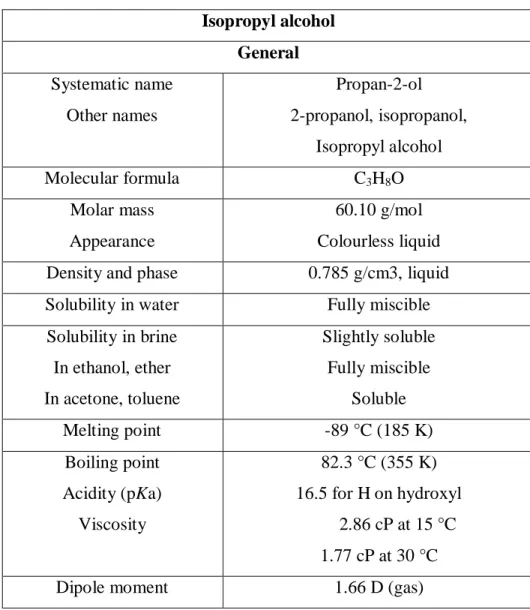
Table 2.1: Physical & Chemical Properties of IPA.
Isopropyl alcohol General Systematic name Other names Propan-2-ol 2-propanol, isopropanol, Isopropyl alcohol Molecular formula C3H8O Molar mass Appearance 60.10 g/mol Colourless liquid Density and phase 0.785 g/cm3, liquid Solubility in water Fully miscible Solubility in brine In ethanol, ether In acetone, toluene Slightly soluble Fully miscible Soluble Melting point -89 °C (185 K) Boiling point Acidity (pKa) Viscosity 82.3 °C (355 K) 16.5 for H on hydroxyl 2.86 cP at 15 °C 1.77 cP at 30 °C Dipole moment 1.66 D (gas)
Source: Said, (2008)
Mankind has discovered silver a long time ago since the Pre-Historical times and estimated to be found after copper and gold. The word Silver was derived from the Anglo-Saxon, [seolfor], compare Old German silabar. Ag is the symbol for silver and possibly from Latin name, Argentum or [Argyros]. The symbol of circle was gave by the Egyptians to gold because it is a perfect metal and silver was given the symbol of a semi-circle since it was closest to gold in perfection (Refiker 2005). Silver also include in the platinum group metals which is consist of platinum, palladium, rhodium, iridium, osmium and ruthenium together with gold. This group of metal is also well known as precious metal due to their economic value as well as their rare occurrences.
Argentite (Ag2S) is the main silver mineral which is usually occurs together with
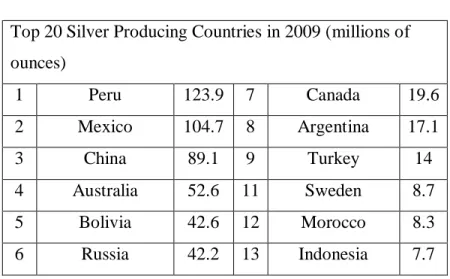
other sulfides as cooper and lead sulfide in earth crust. According to The Mineral & Gemstone Kingdom (2011), silver is very malleable, ductile and very easy to work with but silver can’t resist to pressure and easily bend. Because of that, to increase its toughness and durability, silver is alloyed with other metal. Table 2.2 below shows the most top 20 countries which is producing silver in year 2009 (The Silver institute, 2011).
Table 2.2: Top 20 Silver Producing Country
Top 20 Silver Producing Countries in 2009 (millions of ounces) 1 Peru 123.9 7 Canada 19.6 2 Mexico 104.7 8 Argentina 17.1 3 China 89.1 9 Turkey 14 4 Australia 52.6 11 Sweden 8.7 5 Bolivia 42.6 12 Morocco 8.3 6 Russia 42.2 13 Indonesia 7.7
2.2.1 Uses of Silver
Some uses of silver are as follow:
a) as sterling silver for jewellery and silverware b) in photography (AgBr, AgNO3),
c) in dental alloys,
d) in solder and brazing alloys, e) for electrical contacts,
f) in high capacity silver-zinc and silver-cadmium batteries, g) in some paints which are used for making printed circuits, h) in mirror production,
i) as AgI for seeding clouds to produce rain and j) as coinage metal
2.3 Liquid-liquid Extraction (LLE)
Liquid-liquid extraction is an important separation technique which is largely use in industry including chemical industry. LLE also play significant role in separation technique due to its lower energy cost and more gentle treatment compared to distillation and other separation techniques (Hashem, 2006).
Based on Geankoplis (2003) in LLE, the separations of two phases are chemically quite different, which is lead to separate the component according to physical and chemical properties. In other word, LLE is a separation process that removes the solutes from the liquid by adding the aqueous solution. The aqueous solution referred to immiscible or partially miscible liquid normally called diluents or solvent. The equilibrium process can simply describe as the following reaction.
The metal M is firstly will transfer from an aqueous phase to the organic phase by the organic solvent or also known as extractant, E. Then it will form as complex ME. After that, because this is an equilibrium process, the reaction will reverse it back which means the metal is transferred from organic phase to an aqueous phase (stripping stage). So, basically the LLE just needs the simple operation that requiring only a shift in the equilibrium process (Mat & Seng, 2006).
2.3.1 LLE of Silver Using Dithizone
There had been several studies carried out to extract silver from much kind of sample and condition such as in chloride solution, from waste water sample and many more. A part of that, the type of extractant use is also various. A comprehensive study of dithizone properties by Irving and Pearson showed that the most suitable extractant for silver is dithizone. Besides that, Thiagarajan and Subbaiyan (1992) stated that dithizone is more stable if it is dilute in chloroform. From aqueous solution, dithizone was employed to form neutral metal-dithizone complexes with heavy metal ions to extract them ( Ursula & Anna 2009).
2.3.2 Physical and Chemical Properties of Dithizone
Dithizone is a sulfur organic compound. The IUPAC name for dithizone is (1E) - 3-anilino-1-phenylimio-thiourea and the other name is Diphyenylthiocarbazone. The pure dithizone apprearance in dark brownish (black) powder having molecular weight of 253.3 gmol-1 and the density of 1.35gml-1. This material is stable under normal temperature and pressure. The condition that must be avoided is excess heat, dust generation and incompatible materials. Dithizone has very high solubility in chlorinated paraffin but very low in water make it suitable for extraction process.
Figure 2.1: Tautoric forms of dithizone
Source: Mat & Seng (2006)
In acidic solution silver will react with dithizone to form the primary dithizonate Ag(HDz) and will give yellow solution if dissolves in CCl4 or CHCl3 (Mat & Seng 2006).
But, in neutral or basic medium, the red-violet secondary dithizone (AG2Dz) is formed and
insoluble in CCl4. It has been reported that complexing agents like EDTA may to be added
in the aqueous solution in order to prevent the co-extaction of other elements.
2.3.3 Effect of pH on LLE of Silver Using Dithizone
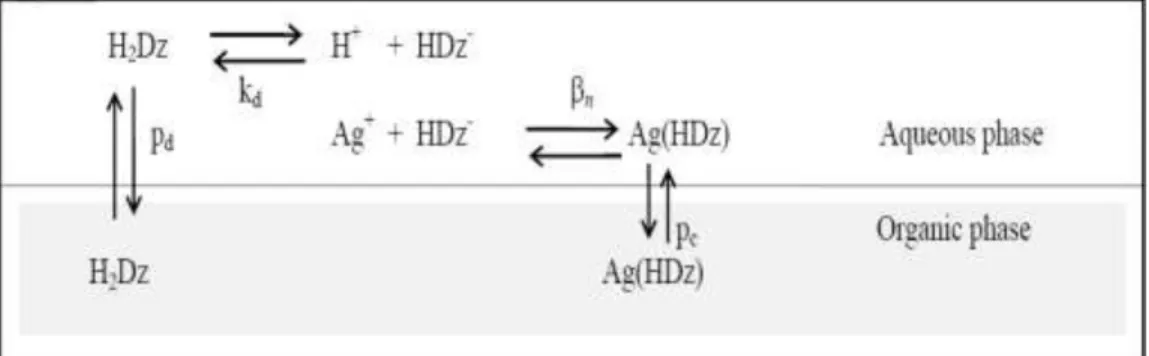
There equilibrium reaction occurs between primary silver and dithizone in LLE can be simplified describe in figure 2.3:
Figure 2.2: Equilibrium reactions involved in the silver extraction using dithizone
The fundamental equation for silver extraction using dithizone is given by:
Ag+ + H2Dz (org) Ag(HDz)(org) + H+
Kex = =
Based on the equation 2.1, Kex which is the equilibrium constant will be increase as
the ionization of the chelae in the aqueous phase is decreasing and will increase the partitioning into the organic phase, increase the ionization of the chelating agent and its increase partitioning into the aqueous phase (Mat & Seng 2006).
2.4 Solid-liquid Extraction (Leaching) Process
Nowadays, several of studies on the recovery of silver have been done due to increment of silver consumption all over the world. Many technologies can be applied to recover silver from any kind of sources such as ion-exchange, biosoprtion, liquid membrane, solvent extracting, solid-liquid extraction and many more. In this study, the focus of the research is using solid-liquid extraction or also called leaching process due to the simplicity and environmental friendly. Solid-liquid extraction is a process where the required metal is dissolves into solution from a solid substance.
Technically, the leaching process involves three different steps. Firstly, the solute (metal substance) will change its phase as it dissolves in the solvent. Then, it’s diffuse through the solvent in the pores of the solid to the outside of the particles and lastly, the transfer of the solute from the solution in contact with the particles to the main bulk of the solution (Mat and Seng, 2006). Solid-liquid extraction involves similar principal with solvent extraction (liquid-liquid extraction) but differ in technology aspect (Charlesworth, 1981). The solid phase in solid liquid extraction plays the role of solvent in liquid-liquid
[Ag(HDz)]o[H+] [Ag+][H2Dz]o
pckd βnpd
extraction process. The mechanism of the system is slightly the same but the solid and liquid phase make it different in term of reactivity and ion formation.
2.4.1 Effect of Leaching Agent Types
There were many type of leaching agent that can be use in the extraction process as reported in the literature. To ensure good solver leaching can be achieved, the selection of leaching agent is very important. As reported in literature, there were several potential leaching agents include thiourea, cynide acids and chloride. These types of leaching agents have their own ability to gain formation with heavy metal ions and give the effect on leaching efficiency. A lot of studies have been accomplished in studying the potential of silver leaching using chloride-leaching agent. These include the studies of the Ag-FeCl3 / CuCl2-HCl system (Kolodziej, 1988), Ag2S-FeCl3-HCl system (Dutrizac, 1994) and AgCl-FeCl3-HCl system (Dutrizac, 1994). In this study, the main sources of chloride ions are came from HCl solutions which have been used as one of leaching agents. This free chloride ions that produce by HCL can increase the solubility of AgCl and Ag by forming silver chloro complexes. The reaction of the aggressive formation of silver chloro complexes can be described by following reaction (Mat and Seng, 2006),
AgCl + nCl- → AgCln+1-n
Ag + nCl- → AgCln-(n-1) + e
Based on previous studies, HCl is the best and strong leaching agent that can provide high leached of silver. However, there might be the limitation on the performance of HCl as leaching agent for silver extraction. Sometimes, HCl will give low percentage of silver leaching due to the limitation of the available free chloride ions contribute by HCl. This occurs because the chloride ions might be reacting with other metal compounds that coexist in the sample. In this study, the chloride ion can be reacting with copper ions to form copper chloro complexes.
2.4.2 Effect of Leaching Agent Concentration
The efficiency of leaching process is very depends on how well the leaching agent can perform and thus give the high result on the silver leached or other heavy metal. One of the factors that would affect the efficiency is the leaching agent concentration. Leaching process involve the reaction between the leaching agent and the heavy metal inside the solid substance. Therefore, when more leaching agent is introduce into the leaching system, it will produce more rapid and effective leaching behavior that can affect the efficiency and the yield of extraction of heavy metal.
Based on previous study by Yuliusman et al (2006), they found that silver leaching increases fairly gradually when the concentration of leaching agent (HCl) is at 2.0 M. they stated that, the increment of silver leach is proportional to the increasing oh HCl concentration. As the concentration of HCl is increase, the existence of chloride ions also increase. The aggressive formation of AgCl ions is the result from above behavior.
2.4.3 Effect of Retention Time
Besides the concentration of leaching agent, the retention time of leaching process also can affect the efficiency of a leaching system. The kinetic behavior of leaching process can be described using the time needed to achieve an equilibrium condition. The reaction of formation between the ions would occur if the system achieves the equilibrium condition. Some system got low equilibrium condition that makes the reaction take some time to occur. If the system can achieve high equilibrium condition, then the reaction would occur so fast and the leaching system will give the leached of silver faster.
In the other hand, based on previous study on waste water system by Mat & Seng (2006), the relation between retention time and the percentage of silver leach is directly proportional to each others. When the mixing time is increased, the percentage of silver leached also increase. It is because the leaching process of silver might be control by the diffusion of some species through the liquid boundary layer adjacent to the surface of the
stirred particles or the diffusion of product species out from the surface. As the result, the rate of silver leaching would be increase.
2.5 Atomic absorption spectrophotometer (AAS)
Atomic absorption spectrophotometer (AAS) is an analytical technique that measures the concentration of heavy metal. AAS is so sensitive that it can measure down to parts per billion of a gram in a sample. The basic principle of AAS is use of the wavelengths of light specifically absorbed by an element. From one energy level to another energy level, the energy needed by the electron is promoted to the much higher energy level (Levinstonson, 2011). It has many uses in different area of chemistry such as in clinical analysis, environmental analysis, pharmaceuticals, industry and mining. In environmental analysis, AAS is used to monitor environment conditions by finding out the levels of various elements in rivers, seawater, drinking water, air, petrol, and so on.
The process of (AAS) requires a liquid sample to be aspirated, aerosolized, and mixed with combustible gases. The example of combustion gasses that have always been used are acetylene and air or acetylene and nitrous oxide. After that, the mixture is ignited in a flame whose temperature ranges from 2100 to 2800 oC.. So, to provide element specific wavelengths, a light beam from a lamp whose cathode is made of the element being determined is passed through the flame. Thus, a device such as a photomultiplier can detect the amount of reduction of the light intensity due to absorption by the analyst, and this can be directly related to the amount of the element in the sample (Ma and Winson, 1997).
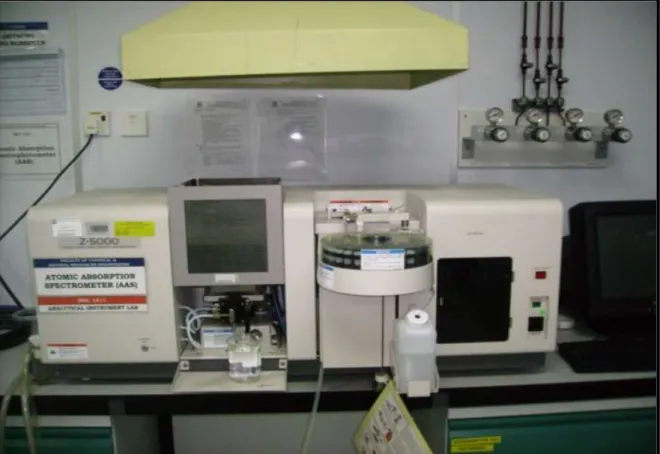
In this experiment, a Polarized Zeeman Atomic Absorption Spectrophotometer (Model Z-5000 Series) (Figure 1) will be operating for water/wastewater analysis. The main unit consists of a lamp chamber, burner, graphite atomizer furnace, monochromatic, detector, mechanisms and electrical circuits. In addition, it is provided with a gas controller used to control various gases in flame analysis, power supply for graphite furnace atomization and auto sampler.
Figure 2.3: Polarized Zeeman Atomic Absorption Spectrophotometer (Model Z-5000 Series)
CHAPTER 3
METHODOLOGY
3.1 Raw Material and Equipment
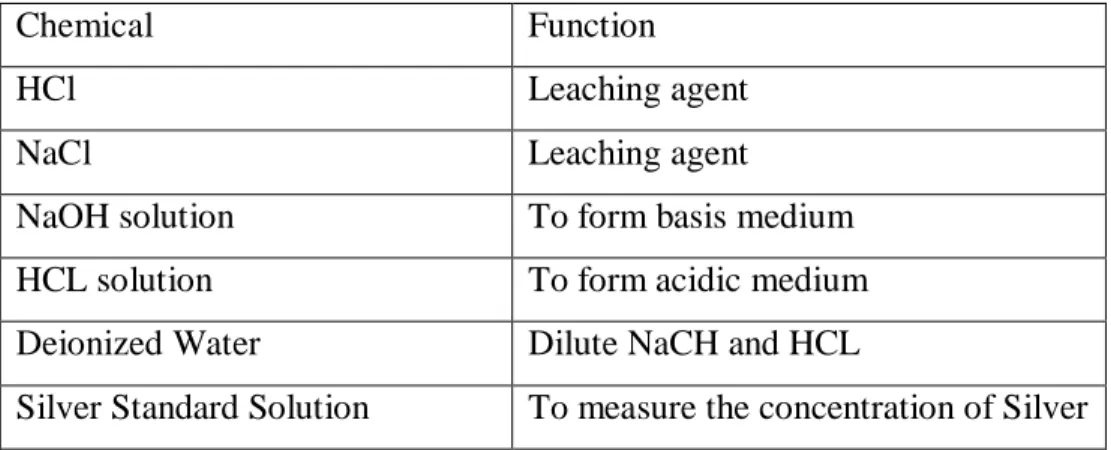
The materials and equipment used in this experiment are listed in table below:
Table 3.1: List of Chemical
Chemical Function
HCl Leaching agent
NaCl Leaching agent
NaOH solution To form basis medium HCL solution To form acidic medium Deionized Water Dilute NaCH and HCL
Silver Standard Solution To measure the concentration of Silver
Table 3.2: List of Equipment
Equipment Function
Centrifugation Remove precipitate Mechanical shaker Shaken the mixture Atomic Adsorption Spectroscopy,
AAS