Dottorato di Sistemi Informativi Aziendali
XXII Ciclo
Libera Università degli Studi Sociali
“Guido Carli”
Roma
Human Resource Information
Systems and the performance of the
Human Resource Function
Tesi di dottorato
Table of Contents
Preface... 4
Chapter I... 6
1.1 Introduction to HRIS ... 6
1.2 Historical overview – From transactional HR to Strategic HR ... 10
1.3Benefits and Drawbacks ... 14
1.3.1 Security and controls ... 19
1.4 Empirical studies in HRIS ... 20
Chapter II ... 24
2.1 Elements of current technology in HRM... 24
2.1.1 HR IS, the complexity of the IT challenge ... 24
2.1.2 Structure of HRM processes in the ICT age ... 27
2.2 Trends in the HR technology... 39
2.2.1 The IT legacy in HR ... 39
2.2.2 Evolution of the HR Application Market... 41
2.3 Impact of the HR integrated model ... 48
2.3.1 Emerging roles... 48
2.3.2 The demand for integration... 50
2.4 HR specialist systems in the back-office ... 52
2.4.1 HR Administration... 52
2.4.2 Reward... 53
2.4.3 Organization Management... 65
2.4.4 Learning and development... 66
2.4.5 Resourcing ... 68
2.4.6 Assessment and evaluation ... 70
2.4.7 Flexible work tools ... 72
2.5 Self-Service and Shared Service Systems ... 73
2.6 The integrated management of HRIS ... 75
2.6.1 Single Supplier Approach ... 76
2.6.2 Best-of-breed approach... 77
2.6.3 Single supplier versus best-of-breed – Some conclusions ... 78
Chapter III... 80
3.1 Research Model... 80
3.1.1 Model for HRIS success ... 82
3.1.2 Model for HRIS effectiveness ... 88
3.1.3 Information-Based Model ... 95
3.2 Rational and Design ... 102
Chapter IV... 108
4.1 Discussion and further research... 108
4.1 Conclusion... 109
Alla mia famiglia in Italia, och till min familj i Sverige
Preface
The objectives of this thesis are: to present a comprehensive literature review of human resource information systems (HRIS) and to explore the impact of infor-mation systems on HR performance. Extensive research has been done to ad-dress the benefits in the introduction of HRIS. Little investigation, instead, is available to measure the effects of HRIS on HR performance.
This study is important in that it defines HRIS, examines the current status of HRIS empirical research, and proposes an architectural model to explain the in-tegration of different human resource processes into a single management sys-tem. In the proposed framework, integration is presented not only as the ability of the HR function to respond to cost cutting plans, but also as its capability to evolve into a service centre where time is spent on firm’s competitiveness issues. Our research question, in particular, is as follows: how do we measure HRIS effectiveness and what factors determine HRIS overall success? Researchers and consulting firms have developed models to assess HRIS either through attitude, belief and behaviour variable (Haines and Petit model) or through progression and cost effectiveness of implemented HRIS (Watson Wyatt model). However what their outcomes suggest is that the first model lacks a “hard” performance basis whereas the second one does not confirm any direct correlation between higher HRIS progression and better HR performance. This also implies that im-plementation effectiveness may be a necessary but not sufficient condition for HRIS effectiveness. While these models offer a point of departure for research-ers, clearly more work is needed in developing a causal model of HRIS success. By matching the two previous models and integrating them with Ostermann’s concept of environment maturity and HR value generation and other relevant studies on the measurement of HR performance, we propose a conceptual model for investigating what HRIS practice produces the best results in an organization. In the last part of this work, a prediction on how HRIS will continue to develop
in the future and its likely impact on the human resources function form another chapter of this thesis. We conclude with suggestions for further research.
Chapter I
1.1 Introduction to HRIS
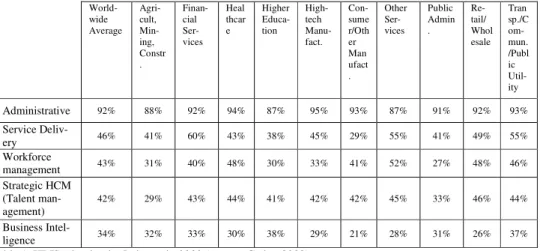
In the present context of globalization, employing organizations and their envi-ronments have become increasingly complex. Managers in these organizations face growing difficulties in coping with workforces that may be spread across various countries, cultures, and political systems. Given such trends, manual HR systems management is completely inadequate (Beckers & Bsat, 2002). On the other hand information technology has considerable potential as a tool that man-agers can use, both generally, and in human resource functions in particular, to increase the capabilities of the organization (Tansley & Watson, 2000). Those managing the human resource functions have not ignored such potential, and a widespread use of human resource information systems (HRIS) has occurred (Cedar, 2009-2010). World-wide Average Agri-cult, Min-ing, Constr . Finan-cial Ser-vices Heal thcar e Higher Educa-tion High-tech Manu-fact. Con-sume r/Oth er Man ufact . Other Ser-vices Public Admin . Re-tail/ Whol esale Tran sp./C om-mun. /Publ ic Util-ity Administrative 92% 88% 92% 94% 87% 95% 93% 87% 91% 92% 93% Service Deliv-ery 46% 41% 60% 43% 38% 45% 29% 55% 41% 49% 55% Workforce management 43% 31% 40% 48% 30% 33% 41% 52% 27% 48% 46% Strategic HCM (Talent man-agement) 42% 29% 43% 44% 41% 42% 42% 45% 33% 46% 44% Business Intel-ligence 34% 32% 33% 30% 38% 29% 21% 28% 31% 26% 37%
Table 1. HRIS adoption by Industry in 2009 (source: Cedar, 2009)
HR executives are looking to technology and the information it provides to help them drive decisions that will lead to success of the organization as a whole (Wilcox, 1997). Snell, Stueber, and Lepak (2002) observe that HR can meet the challenge of simultaneously becoming more strategic, flexible, cost-efficient,
and customer-oriented by leveraging information technology. They point out that IT has the potential to lower administrative costs, increase productivity, speed response times, improve decision-making, and enhance customer service all at the same time. The need for cost reduction, higher quality services, and cultural change are the three main forces that have driven firms to seek IT-driven HR so-lutions (Yeung & Brockbank, 1995).
The rapid development of the ICT during the last two decades has boosted the implementation and application of electronic human resource management (e-HRM) (Strohmeier, 2007). Surveys of HR consultants suggest that both the number of organizations adopting HRIS and the depth of applications within the organizations are continually increasing (CedarCrestone, 2005). Many experts forecasted that the PC would become the central tool for all HR professionals (Kovach & Cathcart, 1999). These predictions find today empirical confirmation in several surveys carried on by academic research and consulting companies (Cedar, 200)9).
Given these preliminary evaluations, how can we define a HRIS? According to Broderick and Boudreau (1992) a HRIS is the composite of databases, com-puter applications, hardware and software necessary to collect/record, store, manage, deliver, present, and manipulate data for human resources. Similarly Tannenbaum (1990) defines a HRIS as a system that is used to “acquire, store, manipulate, analyze, retrieve, and distribute information about an organization’s human resources” (p. 27). Kovach and Cathcart (1999) used a similar definition of HRIS as any system for “collecting, storing, maintaining, retrieving and vali-dating data needed by an organization about its human resources” (p. 275). Strohmeier (2007), instead, uses the expression e-HRM when describing the ac-tivity of planning, implementing and applying information technology for both networking and supporting at least two individual or collective actors in their shared performing of HR activities.
Other authors point out that, as is the case with any complex organizational in-formation system, a HRIS is not limited to the computer hardware and software
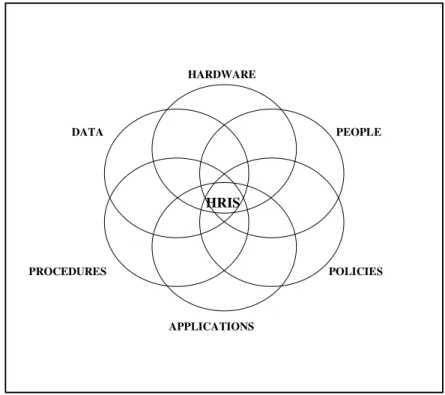
applications that comprise the technical part of the system. According to this view, Hendrickson defined a HRIS as a socio-technical (integrated) system (see figure 1) whose purpose is to gather, store, and analyze information regarding an organization’s human resources department comprising of computer hardware and applications as well as the people, policies, procedures and data required to manage the human resources function (2003).
Figure 1. Components of a Human Resource Information System
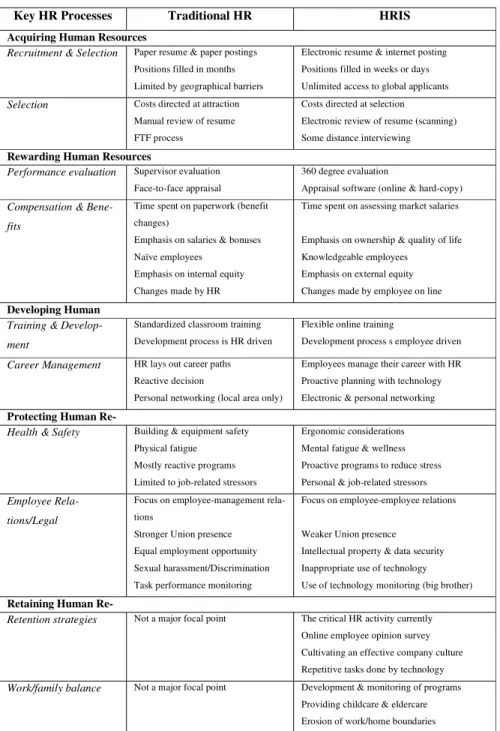
A common assumption for all these researchers is that a HRIS can have a wide range of uses. It can range in complexity from simple spreadsheets, enabling complex calculations to be performed easily, to comprehensive HRIS solutions. Similarly a HRIS has been addressed as a tool that organizations use to solve and manage a variety of issues and processes connected to the management of peo-ple. On the one hand, technology may be used for different purposes within par-ticular HR functions - for recruitment and selection, performance evaluation, compensation and benefits, training and development, health and safety, em-ployee relations and legal issues, retention and work-life balance (Enshur,
HARDWARE PEOPLE POLICIES APPLICATIONS PROCEDURES DATA HRIS
Nielson, & Grant-Vallone, 2002). On the other hand, a company that uses a complex mix of HRIS solutions enables the HR function to manage its human resources as well as employees’ information flow in an integrated approach across the entire employment cycle of each individual, thus shifting the attention from a process-centered HR function to a customer(employee)-centered HR management.
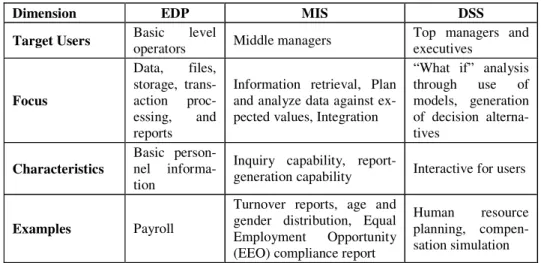
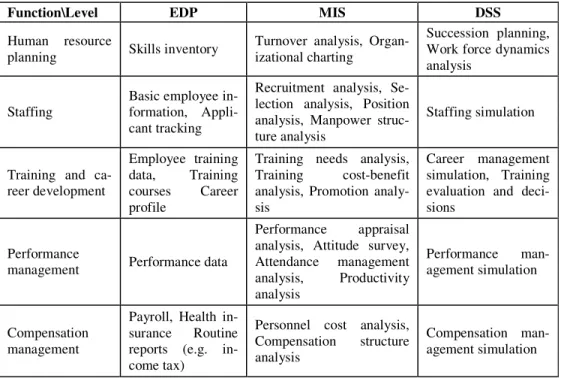
Martinsons (1994) distinguished between “unsophisticated” use of technology in HR, such as payroll and benefits administration, and “sophisticated” use such as recruitment and selection, training and development and performance ap-praisal. Other authors, instead, highlight the devolution occurring in certain or-ganizations where, thanks to advanced HRIS, HR services are extended directly to managers and employees via the Internet or Intranet, through self-service sys-tems.
Another benefit of HRIS is that it enables the creation of an IT-based work place (Othman & Teh, 2003). Advances in IT hold the promise of meeting many of the challenges of the HRM area in the future such as attracting, retaining and motivating employees, meeting the demands for a more strategic HR function and managing the “human element” of technological change (Ashbaugh & Miranda, 2002). Over the past 10 years, the use of technology in human re-sources has increased dramatically and is now a vital aspect of many personnel-related decisions such as collecting job information, recruitment, employee se-lection, training, and performance management (Chapman & Webster, 2003). Human Resource Management (HRM) could support technological innovation to achieve high performance while technology innovation could serve as an ap-proach to enable HR function to focus more on value-added activities in order to realize the full potential of technology and organizational strategy (Shrivastava et al., 2003).
The biggest benefit to organizations of using IT in HRM is the freeing of HR staff from intermediary roles so that they can concentrate on strategic planning in human resource organization and development (Pinsonneault & Kraemer, 1993).
Similarly Broderick & Boudreau (1992) observe that IT can automate routine tasks such as payroll processing, benefits administration and transactional activi-ties so that HR professionals are free to focus on more strategic matters, such as boosting productivity. Increased use of human resource information systems (HRIS) allows professionals to achieve improved performance and thus facilitate participation in internal consultancy activities (Bussler & Davis, 2001).
In latest research, Hussain, Wallace, and Cornelius (2007) observed that for senior HR professionals, strategic use of HRIS is increasingly the norm, irrespec-tive of company size and this had led to the HR profession providing a value-add for the company. According to them strategic use of HRIS enhances the per-ceived standing of HR professionals within their organizations, a view however, not shared by their senior non-HR executives colleagues. In fact, the current problem that HRIS success faces is that despite the fact that HRIS has already started to revolutionize the HR function, the implications for the HR function are not yet fully visible. The main challenges are the alignment of processes in the HR function according to the future e-business challenge (Svoboda & Schröder, 2001) and a stronger awareness of the explicit and implicit benefits of having a working HRIS.
1.2 Historical overview – From transactional HR to
Strategic HR
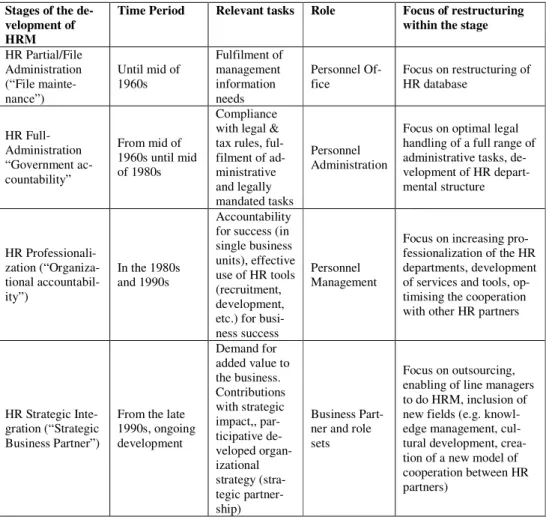
HRIS has grown in popularity since the 1960s (Cascio, 2005) in parallel with the grow of a new awareness of the personnel function from being a compiling of-fice to a company strategic partner (see table 1).
Stages of the de-velopment of HRM
Time Period Relevant tasks Role Focus of restructuring within the stage
HR Partial/File Administration (“File mainte-nance”) Until mid of 1960s Fulfilment of management information needs Personnel Of-fice Focus on restructuring of HR database HR Full-Administration “Government ac-countability” From mid of 1960s until mid of 1980s Compliance with legal & tax rules, ful-filment of ad-ministrative and legally mandated tasks Personnel Administration
Focus on optimal legal handling of a full range of administrative tasks, de-velopment of HR depart-mental structure HR Professionali-zation (“Organiza-tional accountabil-ity”) In the 1980s and 1990s Accountability for success (in single business units), effective use of HR tools (recruitment, development, etc.) for busi-ness success
Personnel Management
Focus on increasing pro-fessionalization of the HR departments, development of services and tools, op-timising the cooperation with other HR partners
HR Strategic Inte-gration (“Strategic Business Partner”)
From the late 1990s, ongoing development Demand for added value to the business. Contributions with strategic impact,, par-ticipative de-veloped organ-izational strategy (stra-tegic partner-ship) Business Part-ner and role sets
Focus on outsourcing, enabling of line managers to do HRM, inclusion of new fields (e.g. knowl-edge management, cul-tural development, crea-tion of a new model of cooperation between HR partners)
Table 1. Stages of the Human Resource Management view
The ongoing development process, which started with the massive restructur-ing of organizations in the 1990s, sees today two parallel phenomena: on the one hand a large-scale outsourcing of transactional HR activities (payroll, benefits administration, some types of training); on the other hand the re-integration of those activities into a single, internal information/service system that, thanks to intranet platforms, enables employees to manage themselves in a variety of “self service” HR activities.
The difference between today and 1990s approach consists in an enriched in-terest in the social part of the socio-technical view of HRIS. According to Cascio (2005), if transactional activities are being eliminated, then the survival of
in-house HR talent depends on a demonstrated ability to add value to the business. In order to do that, a number of key competencies are necessary. These include proficiency in areas such as the following:
• An organization’s business model. How the company competes for business in
the product or service markets in which it operates. This also includes under-standing the constraints that managers face, as well as the needs of internal and external customers. A HR professional can acquire this competency by working with managers and employees responsible for operations and also by serving on a management team with other executives to gain experience and exposure;
• Basic business literacy (corporate finance, marketing, accounting, information technology, and general management);
• Functional areas within HR (legal requirements, recruitment, staffing, training and development, performance management, compensation and benefits, la-bour and employee relations, occupational safety and health);
• Listening skills, as well as the courage to raise difficult issues with senior ex-ecutives based on what has been learnt by listening;
• Skills as a strategic business partner (creating an overall talent or people mind-set; creating an HR strategy that aligns people, processes, and systems; devel-oping human capital metrics that are aligned with the strategy of the company; acquiring the ability to assess talent especially during challenging organiza-tional changes; ensuring that ethical standards are actually practiced).
Strategic business partnership is an important role for HR professionals to play, for it demonstrably adds value to any organization, but in and of itself it is insufficient. The role of a HR Business Partner encompasses strategic business partnerships, but also requires HR professionals to understand and identify the key drivers of individual, team, and organizational success that are consistent, or aligned with, the strategy of an organization. Those drivers become the basis for human capital metrics to assess work-unit or organizational performance. The
mere existence of metrics is not enough, however. The challenge is to link the human capital metrics to customer behaviour and important financial outcomes of the business, and to build a coherent information management system around the entire process (see figure 1).
Figure 1. The chain of relationships that links management practices to long-term profitability and growth
Some authors have suggested that the introduction of HRIS brings about such an opportunity for the HR departments to evolve from cost centers into profit centers (Bussler & Davis, 2001; Cascio, 2005; Groe, Pyle & Jamrong, 1996; Hannon, Jelf & Brandes, 1996; Yeung, Brockband & Ulrich, 1994).
Research has shown that most organizations still appear to actuate technology merely to automate routine administrative tasks (Ball, 2001; Groe, Pyle & Jam-rong, 1996; Kinnie & Arthurs, 1996; Yeung & Brockband, 1995) however, re-search evidence also suggests that larger organizations and those with an estab-lished HR department are more likely to use their system strategically (Burbach & Dundon, 2005; Kavanagh, Gueutal & Tannenbaum, 1990; Kinnie & Arthurs, 1996).
A survey conducted in 1998 (Ball, 2001) shows that 60 percent of Fortune 500 companies use the HRIS to support daily human resource management (HRM) operations. Drives Drives Drives Effective Management Practice Employee Sati-sfaction Customer Sati-sfaction Long-Term Profita-bility & Growth Execution Innovation
Others have advocated that IT has the ability to revolutionize the HR function and to transform it into a strategic business unit (Broderick & Boudreau, 1992; Kovach et al., 2002; Lepak & Snell, 1998).
Evaluating the usage of the information/knowledge generated by HRIS for the benefit of the organization requires system-level thinking and consideration of multiple stakeholders’ needs and claims (Groe, Pyle & Jamrong, 1996; James, 1997). A number of authors advocate that capital investments in IT alone cannot guarantee its strategic application (Davenport, 1994; Miller & Cardy, 2000; Por-ter & Millar, 1985). According to OsPor-termann et al. (2009) the main reasons for that are:
• HR practitioners’ lack IT skills;
• Senior management’s lack of commitment to capitalize on system capabilities;
• Lack of employee involvement in the HRIS implementation process as a
bar-rier to full HRIS utilization and satisfaction with the existing HRIS.
1.3Benefits and Drawbacks
As an HRIS can be used in such a wide variety of ways and can represent a large investment decision for companies of all sizes, a convincing case must be made to persuade decision makers that the benefits outweigh the costs. Ngai and Wat (2004) observed that organizations need to be convinced of the benefits of HRIS for their company before they implement such a system. Therefore, an analysis of the potential benefits of technology in HRM has been one of the main issues both for HR practitioners and academics in this area. An examination of the lit-erature suggests that the impact of technology in HRM falls into two main ar-eas—the impact on the efficiency of the delivery of HR processes and the impact on the role of the HR function itself.
In terms of the efficiency of the HR processes, a typical argument is that a HRIS helps organizations reduce process costs. Enshur et al. (2002), in
particu-lar, discuss in some detail the impact of technology on the processes of acquir-ing, rewardacquir-ing, developacquir-ing, protecting and retaining human resources and con-clude that the shift from traditional HR to e-HR can lead to “substantial reduc-tions in cost and time for many HR activities” (p. 238).
Snell, Stuber, and Lepak (2002) have also noted that IT may potentially enable HR to lower administrative costs, increase productivity and reduce response times. Likewise, Lengnick-Hall and Moritz (2003) suggested that HRIS, not only reduces process and administrative costs, but can speed up transaction process-ing, reduce information errors and improve the tracking and control of human re-source actions. Lengnick-Hall et al. (2003) also note that many of these effects are likely to be realized early in the implementation of a HR information system, and so providing compelling evidence of the benefits of such a system to stake-holders.
Other common benefits of HRIS frequently cited in studies include improved accuracy, the provision of timely and quick access to information, and the sav-ings of personnel costs (Tetz, 1973; Wille and Hammond, 1981). Lengnick-Hall and Moritz (2003) discuss that fewer human resource professionals are needed because HRIS eliminates the “HR middleman”. Furthermore, HRIS speeds up transaction processing, reduces information errors, and improves the tracking and control of human resource actions. Thus, on the one had HRIS improves ser-vice delivery (Lengnick-Hall and Moritz, 2003). On the other hand, it proves very important in the timeliness of HRIS in terms of operating, controlling, and planning activities in HR (Lederer, 1984).
Similarly Kovach et al. (2002) list several administrative and strategic advan-tages to using HRIS. In addition, Beckers and Bsat (2002) point out at least four reasons why companies should use HRIS. These are that HRIS can:
• Increase competitiveness by improving HR operations;
• Produce a greater number and variety of HR-related reports;
• Reengineer the entire HR function of companies.
Broderick and Boudreau (1992) examine how HRIS can contribute to cost re-ductions, quality/customer satisfaction, and innovation. Sadri and Chatterjee (2003) noted that HRIS can fasten HR decision making but also strengthen an organization’s character. Most organizations that adopt HRIS rely on available, accessible and tangible measures to make a business case for the investment. Some metrics that are used to justify HRIS include: the average cost of an HR transaction, number of inquiries to the service centre, cycle times, headcount changes, employee satisfaction, and financial metrics, such as the return on in-vestment or payback period (Anonymous, April, 2002). In their 2002 HRIS sur-vey, Watson Wyatt found that the top four metrics used in formal business cases supporting HRIS were: productivity improvements within the HR organization, cost reduction, return on investment, and enhanced employee communication.
Many of these cost reductions and efficiency gains are likely to be realized early in the implementation of a HRIS, so they provide compelling evidence when it is needed to get a project up and running. In fact, the payback period, or the time it takes to recoup the investment, can be as short as one to three years (Lego, 2001). However, while it may be possible to identify many of the relevant costs (e.g. software and hardware), it is more difficult to quantify the intangible benefits to be derived from a HRIS.
Beyond cost reductions and productivity improvements, HRIS also has the po-tential to fundamentally affect revenue channels. However, establishing direct and objective measures of these benefits is more difficult to achieve. For exam-ple, HRIS may improve employee productivity, employee morale, decision mak-ing, and information sharing; it may enhance innovation; and it may speed up time-to-market for products. In addition, HRIS can fundamentally change the way individuals relate to one another and to their organizations through various communication media. This may improve the flow of information and expertise through the organization enhancing firm’s strategic capabilities. While a logical
case can be made that these consequences of HRIS affect an organization’s bot-tom line, an empirical case is more challenging to develop.
On the other hand, there are costs associated with implementing a HR infor-mation system. For example, “wiring the work force” (ensuring that everyone has access to the HRIS), requires providing personal computers and internet connections for all the employees. Moreover, to capitalize on all the possibilities of HRIS, workers need to have personal computers and internet connections at home as well as at work (including work “on the road”). Some companies facili-tate this outcome by providing employees computer discount programs to en-courage home usage. In addition to “wiring the work force”, there are inevitably transition costs associated with moving from a more traditional information sys-tem to a HRIS, including slowdowns, mistakes, and other consequences of changing from old to new – from legacy systems to integrated suites. Hardware costs for servers and software costs for application programs entail sizeable ini-tial expenses and continuing costs over time as better technology becomes avail-able (Lengnick-Hall and Moritz, 2003).
According to Bussler and Davis (2001), security is another factor to consider for HR and IT professionals, as with any software system. Human Resources by its very nature deals with very confidential data and companies need to be con-scientious in managing that data. Although vendors offer high security and are aware of its priority, HR professionals should never let their guard down.
Another bigger factor may be resistance to change, employees like the feeling of safety in the old paper system (Ostermann et al., 2009). Thus, change man-agement is another issue for HR and it might be the most serious one. Most or-ganizations greatly underestimate the cultural impact of technology on their em-ployees. HR needs to spend as much time with employees on “change” as they do on the training and implementation software. They will have to assess the level of the employees’ skills and acceptance of technology, whether the PC or a kiosk system. HR can set up training and mentoring programs within staff groups to help stressed employees. Better yet, employees should be involved in the
de-velopment of the HR system (Bussler and Davis, 2001-2002, Ostermann et al., 2009).
While many companies are adopting HRISs and acknowledging their benefits, other are taking a “wait and see” attitude before embarking on such an expensive and time-consuming change. Some firms prefer to adopt a soft approach, by in-troducing less complex forms such as “publishing information”, before attempt-ing to transform their HR departments. And for those who have already adopted HRIS, many have yet to realize its full benefits. For example, a survey by Tow-ers Perrin found that 80% of respondents said employee self-service can lower HR costs, but only 5% said they fully achieved this objective, another 35% said they have only partially achieved that objective, and only 3% said it was acceler-ating HR’s transformation into to a strategic partner.
According to Towers Perrin's recent HR Service Delivery Survey of over 330 global organizations:
• 21% of organizations plan to increase their HR technology spending this year. • 43% will maintain their current level of investment.
• 36% do intend to decrease their budget.
While some organizations reported a modest cutting of planned technology in-vestments, it is clear that companies no longer view HR technology as a discre-tionary cost to be held during tough times. Instead, the prevalent view seems to be that HR is a needed partner, able to help the business identify cost savings and position the organization for future success. Despite some caution about spend-ing, companies see a proven value in HR technology and are willing to make the investments needed to sustain organizational effectiveness, workforce planning and long-term growth (2009). This is why learning from the experiences of pio-neering companies in the world of HRIS can be valuable.
1.3.1 Security and controls
Given the confidential nature of HR data, it is evident that effective security is a major requirement of HR SSC technology, which must support the organiza-tion’s compliance with data protection principles.
The first one is that only relevant data should be captured. By controlling the capture of data within legitimate HR processes, the technology can be used to ensure that only relevant data are captured. Branches can be applied within the processing logic to further refine this. For example, if an employee is not entitled to a particular benefit, meaning that certain data items should not be recorded in their case, HR systems can be configured to prevent such input.
Secondly, data should be accurately maintained. Various facilities exist to help keep data up to date and accurate: validation rules can be applied to input screens to prevent inaccurate data entry; self-service can be used by employees and man-agers to inspect and where appropriate change data; audit reports are available to provide a record of what has been changed; reports can be run for data verifica-tion purpose.
A third rule is that data should be retained for no longer than necessary. By means of processes or reports, HR systems are able to highlight data which are about to become too old to be retained, so that a decision can be made as to whether they should be deleted or archived off the database.
A fourth rule implies that data are used for legitimate purposes. Again, by con-trolling the capture of data within specified HR processes, the technology can be used to ensure that data are only used for legitimate purposes.
Another features required to help achieve compliance with the data protection principles is that access to data is controlled. Various features are available to en-sure that system access is confined to authorized users, and that the nature of their access is appropriate: telephony and CRM systems prevent unauthorized callers gaining access to personal HR data; this can be extended to ensure that authorized callers only get access to data to which they are entitled. For example,
the agent could confirm that the manager on the phone is responsible for the em-ployee who is the subject of their call; HR systems offer secure ID and password logon facilities.
If multiple systems are in use, they should comply with generic access stan-dards so that appropriate access across all systems is granted to users via a single sign-on; stringent technical security provisions can be applied, for example, en-cryption of passwords, secure web data transfer protocols (HTTPS) and so on; powerful security management facilities should be available for use by system administrators, for example, password resets, setting up and changing user groups and so on; access within systems should be confined to appropriate trans-actions (for example, being able to update all new starter details except payroll) and data (for example, managers are only given access to their own staff’s data); finally a periodical report could show which user carried out each data update.
The last principle is that data must be disposed of safely. HR systems should offer effective data archiving facilities so that, after an agreed period (and per-haps prompted by the system as mentioned above), data can be archived into se-cure off-line storage or deleted with absolute certainty.
1.4 Empirical studies in HRIS
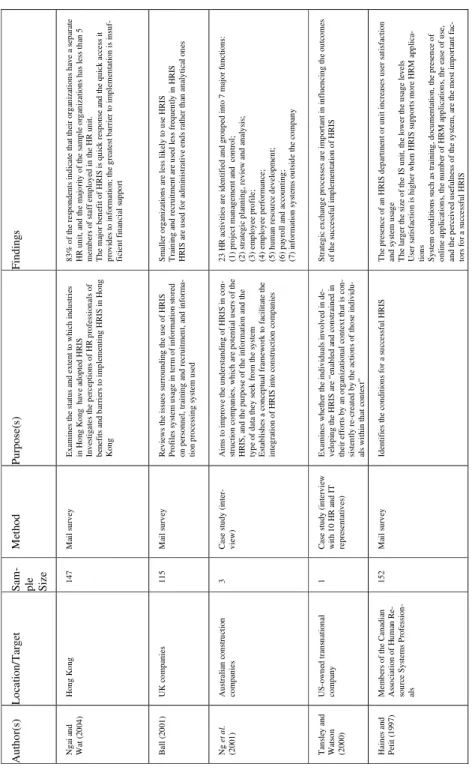
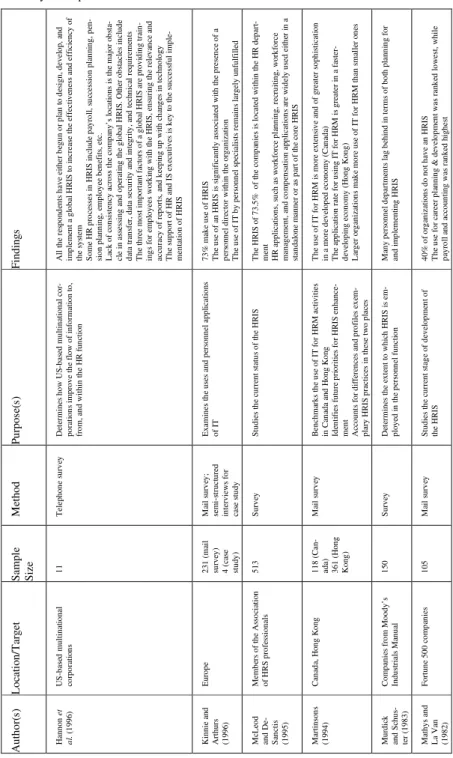
A number of studies related to HRIS can be found in various HR Journals. Many of them are conceptual or non-empirical studies. Based on a comprehensive search of the literature, Table 1 summarizes, in a structured format, previous em-pirical studies that use either a qualitative or quantitative approach. The earliest empirical study we found was conducted by Mathys and LaVan (1982). They conducted a survey to examine stages in the development of HRIS. Nearly 40 percent of the surveyed organizations did not have a computerized HRIS. Other survey results similarly revealed a relatively low implementation of HRIS (Mur-dick and Schuster, 1983). Later DeSanctis (1986) also surveyed the status of HRIS and assessed its operation and relationships to the management
informa-tion system (MIS) funcinforma-tion. Martinsons (1994) compared the degree and sophis-tication in the use of IT for HRM between Canada and Hong Kong. In a recent study, Ball (2001) conducted a survey of the use of HRIS in smaller tions. Her study and the one of Martinsons (1994) show that smaller organiza-tions are less likely to use HRIS.
It is noted that the majority of studies have focused on the status of the use of HRIS and on the HR applications/features that have been integrated as part of HRIS (see tables 1 and 2).
Table 1 – Summary on empirical studies on HRIS F in d in g s 8 3 % o f th e re sp o n d en ts i n d ic at e th at t h ei r o rg an iz at io n s h av e a se p ar at e H R u n it , an d t h e m aj o ri ty o f th e sa m p le o rg an iz at io n s h as l es s th an 5 m em b er s o f st af f em p lo y ed i n t h e H R u n it . T h e m aj o r b en ef it o f H R IS i s q u ic k r es p o n se a n d t h e q u ic k a cc es s it p ro v id es t o i n fo rm at io n ; th e g re at es t b ar ri er t o i m p le m en ta ti o n i s in su f-fi ci en t fi n an ci al s u p p o rt S m al le r o rg an iz at io n s ar e le ss l ik el y t o u se H R IS T ra in in g a n d r ec ru it m en t ar e u se d l es s fr eq u en tl y i n H R IS H R IS a re u se d f o r ad m in is tr at iv e en d s ra th er t h an a n al y ti ca l o n es 2 3 H R a ct iv it ie s ar e id en ti fi ed a n d g ro u p ed i n to 7 m aj o r fu n ct io n s: (1 ) p ro je ct m an ag em en t an d co n tr o l; (2 ) st ra te g ic p la n n in g , re v ie w a n d a n al y si s; (3 ) em p lo y ee p ro fi le ; (4 ) em p lo y ee p er fo rm an ce ; (5 ) h u m an r es o u rc e d ev el o p m en t; (6 ) p ay ro ll a n d a cc o u n ti n g ; (7 ) in fo rm at io n s y st em s o u ts id e th e co m p an y S tr at eg ic e x ch an g e p ro ce ss es a re i m p o rt an t in i n fl u en ci n g t h e o u tc o m es o f th e su cc es sf u l im p le m en ta ti o n o f H R IS T h e p re se n ce o f an H R IS d ep ar tm en t o r u n it i n cr ea se s u se r sa ti sf ac ti o n an d s y st em u sa g e T h e la rg er t h e si ze o f th e IS u n it , th e lo w er t h e u sa g e le v el s U se r sa ti sf ac ti o n i s h ig h er w h en H R IS s u p p o rt s m o re H R M a p p li ca -ti o n s S y st em c o n d it io n s su ch a s tr ai n in g , d o cu m en ta ti o n , th e p re se n ce o f o n li n e ap p li ca ti o n s, t h e n u m b er o f H R M a p p li ca ti o n s, t h e ea se o f u se , an d t h e p er ce iv ed u se fu ln es s o f th e sy st em , ar e th e m o st i m p o rt an t fa c-to rs f o r a su cc es sf u l H R IS P u rp o se (s ) E x am in es t h e st at u s an d e x te n t to w h ic h i n d u st ri es in H o n g K o n g h av e ad o p te d H R IS In v es ti g at es t h e p er ce p ti o n s o f H R p ro fe ss io n al s o f b en ef it s an d b ar ri er s to i m p le m en ti n g H R IS i n H o n g K o n g R ev ie w s th e is su es s u rr o u n d in g t h e u se o f H R IS P ro fi le s sy st em u sa g e in t er m o f in fo rm at io n s to re d o n p er so n n el , tr ai n in g a n d r ec ru it m en t, a n d i n fo rm a-ti o n p ro ce ss in g s y st em u se d A im s to i m p ro v e th e u n d er st an d in g o f H R IS i n c o n -st ru ct io n c o m p an ie s, w h ic h a re p o te n ti al u se rs o f th e H R IS , an d t h e p u rp o se o f th e in fo rm at io n a n d t h e ty p e o f d at a th ey s ee k f ro m t h e sy st em E st ab li sh es a c o n ce p tu al f ra m ew o rk t o f ac il it at e th e in te g ra ti o n o f H R IS i n to c o n st ru ct io n c o m p an ie s E x am in es w h et h er t h e in d iv id u al s in v o lv ed i n d e-v el o p in g t h e H R IS a re “ en ab le d a n d c o n st ra in ed i n th ei r ef fo rt s b y a n o rg an iz at io n al c o n te x t th at i s co n -si st en tl y r e-cr ea te d b y t h e ac ti o n s o f th o se i n d iv id u -al s w it h in t h at c o n te x t” Id en ti fi es t h e co n d it io n s fo r a su cc es sf u l H R IS M et h o d M ai l su rv ey M ai l su rv ey C as e st u d y ( in te r-v ie w ) C as e st u d y ( in te rv ie w w it h 1 0 H R a n d I T re p re se n ta ti v es ) M ai l su rv ey S am-p le S iz e 1 4 7 1 1 5 3 1 152 L o ca ti o n /T ar g et H o n g K o n g U K c o m p an ie s A u st ra li an c o n st ru ct io n co m p an ie s U S -o w n ed t ra n sn at io n al co m p an y M em b er s o f th e C an ad ia n A ss o ci at io n o f H u m an R e-so u rc e S y st em s P ro fe ss io n -al s A u th o r( s) N g ai a n d W at ( 2 0 0 4 ) B al l (2 0 0 1 ) N g e t a l. (2 0 0 1 ) T an sl ey a n d W at so n (2 0 0 0 ) H ai n es a n d P et it ( 1 9 9 7 )
Table 2 – Summary on empirical studies on HRIS F in d in g s A ll t h e re sp o n d en ts h av e ei th er b eg u n o r p la n t o d es ig n , d ev el o p , an d im p le m en t a g lo b al H R IS t o i n cr ea se t h e ef fe ct iv en es s an d e ff ic ie n cy o f th e sy st em S o m e H R p ro ce ss es i n H R IS i n cl u d e p ay ro ll , su cc es si o n p la n n in g , p en -si o n p la n n in g , em p lo y ee b en ef it s, e tc . L ac k o f co n si st en cy a cr o ss t h e co m p an y ’s l o ca ti o n s is t h e m aj o r o b st a-cl e in a ss es si n g a n d o p er at in g t h e g lo b al H R IS . O th er o b st ac le s in cl u d e d at a tr an sf er , d at a se cu ri ty a n d i n te g ri ty , an d t ec h n ic al r eq u ir em en ts T h e th re e m o st i m p o rt an t fa ct o rs o f a g lo b al H R IS a re p ro v id in g t ra in -in g s fo r em p lo y ee s w o rk in g w it h t h e H R IS , en su ri n g t h e re le v an ce a n d ac cu ra cy o f re p o rt s, a n d k ee p in g u p w it h c h an g es i n t ec h n o lo g y T h e su p p o rt o f H R a n d I S e x ec u ti v es i s k ey t o t h e su cc es sf u l im p le -m en ta ti o n o f H R IS 7 3 % m ak e u se o f H R IS T h e u se o f an H R IS i s si g n if ic an tl y a ss o ci at ed w it h t h e p re se n ce o f a p er so n n el d ir ec to r w it h in t h e o rg an iz at io n T h e u se o f IT b y p er so n n el s p ec ia li st s re m ai n s la rg el y u n fu lf il le d T h e H R IS o f 7 3 .5 % o f th e co m p an ie s is l o ca te d w it h in t h e H R d ep ar t-m en t H R a p p li ca ti o n s, s u ch a s w o rk fo rc e p la n n in g , re cr u it in g , w o rk fo rc e m an ag em en t, a n d c o m p en sa ti o n a p p li ca ti o n s ar e w id el y u se d e it h er i n a st an d al o n e m an n er o r as p ar t o f th e co re H R IS T h e u se o f IT f o r H R M i s m o re e x te n si v e an d o f g re at er s o p h is ti ca ti o n in a m o re d ev el o p ed e co n o m y ( C an ad a) T h e ap p li ca ti o n r at e fo r u si n g I T f o r H R M i s g re at er i n a f as te r-d ev el o p in g e co n o m y ( H o n g K o n g ) L ar g er o rg an iz at io n s m ak e m o re u se o f IT f o r H R M t h an s m al le r o n es M an y p er so n n el d ep ar tm en ts l ag b eh in d i n t er m s o f b o th p la n n in g f o r an d i m p le m en ti n g H R IS 4 0 % o f o rg an iz at io n s d o n o t h av e an H R IS T h e u se f o r ca re er p la n n in g & d ev el o p m en t w as r an k ed l o w es t, w h il e p ay ro ll a n d a cc o u n ti n g w as r an k ed h ig h es t P u rp o se (s ) D et er m in es h o w U S -b as ed m u lt in at io n al c o r-p o ra ti o n s im p ro v e th e fl o w o f in fo rm at io n t o , fr o m , an d w it h in t h e H R f u n ct io n E x am in es t h e u se s an d p er so n n el a p p li ca ti o n s o f IT S tu d ie s th e cu rr en t st at u s o f th e H R IS B en ch m ar k s th e u se o f IT f o r H R M a ct iv it ie s in C an ad a an d H o n g K o n g Id en ti fi es f u tu re p ri o ri ti es f o r H R IS e n h an ce -m en t A cc o u n ts f o r d if fe re n ce s an d p ro fi le s ex em -p la ry H R IS p ra ct ic es i n t h es e tw o p la ce s D et er m in es t h e ex te n t to w h ic h H R IS i s em -p lo y ed i n t h e p er so n n el f u n ct io n S tu d ie s th e cu rr en t st ag e o f d ev el o p m en t o f th e H R IS M et h o d T el ep h o n e su rv ey M ai l su rv ey ; se m i-st ru ct u re d in te rv ie w s fo r ca se s tu d y S u rv ey M ai l su rv ey S u rv ey M ai l su rv ey S amp le S iz e 1 1 2 3 1 ( m ai l su rv ey ) 4 ( ca se st u d y ) 5 1 3 1 1 8 ( C an -ad a) 3 6 1 ( H o n g K o n g ) 1 5 0 1 0 5 L o ca ti o n /T ar g et U S -b as ed m u lt in at io n al co rp o ra ti o n s E u ro p e M em b er s o f th e A ss o ci at io n o f H R S p ro fe ss io n al s C an ad a, H o n g K o n g C o m p an ie s fr o m M o o d y ’s In d u st ri al s M an u al F o rt u n e 5 0 0 c o m p an ie s A u th o r( s) H an n o n e t a l. (1 9 9 6 ) K in n ie a n d A rt h u rs (1 9 9 6 ) M cL eo d an d D e-S an ct is (1 9 9 5 ) M ar ti n so n s (1 9 9 4 ) M u rd ic k an d S ch u s-te r (1 9 8 3 ) M at h y s an d L a V an (1 9 8 2 )
Chapter II
2.1 Elements of current technology in HRM
2.1.1 HR IS, the complexity of the IT challenge
The development of human resources is bound inextricably to the technology that serves it. The HR function has faced a succession of demands for changes to the way in which it delivers transactional services ranging from the development of more effective, integrated end-to-end processes to the development of knowl-edge-based centres of excellence.
In the end, however, the ability of the HR function to deliver step changes in performance is dependent on its capability to manage administrative tasks, which in turn demands a firm grasp and control of HR processes and data. For instance even the frequent request for simple headcount figures raises issues in the pro-duction and interpretation of data, thus making difficult to grasp the complexity of fast-moving HR information, even after they may have invested considerable sums of money in systems to try to raise the capabilities of the HR function.
The clue to the problem lies in the phrase itself: an employee headcount is rarely a ‘simple figure’. For example, producing an accurate headcount often demands a clear definition of parameters:
• Does the figure include staff on maternity leave or career breaks? • Does it count individual people or full-time equivalents (FTEs)?
• Does it include contractors, temporary and agency staff (regardless of how much of a permanent fixture they may be)?
• Given the fact that resourcing is a highly dynamic process, what day of the month is this figure taken from?
Once these questions are considered, it becomes apparent that seemingly sim-ple data such as headcount in fact define a process for tracking an employee population. Further complications may arise when the headcount data are com-pared to similar figures produced by other systems. HR staff have often to suc-ceed in reconciling their headcount figures with those of payroll or pensions, who may be using subtle variations on the parameters selected by HR. Similarly, finance operations may confound the issue further by viewing the organization differently from HR. Clearly when cost centres don’t line up in an obvious way with organization structures, then aligning headcount with staff costs becomes a complicated task. These issues make many organizations wonder where the promised efficiency savings come from.
The situation is no simpler around the management of integrated HR proc-esses. For example, the benefits of an integrated HR and payroll operation, whilst well documented, are still frequently unrealised. A lack of integration around legacy systems frequently shows up in HR as separate HR and payroll systems.
Consequently the organization and delivery of HR and payroll services is de-fined not by what works best for the customer/employee, but by where the boundaries of the software lie.
Interfaces between systems too often define the divisions between depart-ments, for example where HR data on employee movements are passed summa-rily across to payroll, causing the process to wade through and requiring manual intervention, recalculation and double entry of data.
Such data and process management problems and resultant inferior service quality have been a recurring historical problem in HR that has, arguably, been a contributing factor in the inability of the function to participate fully in the stra-tegic agenda.
Against this background of struggling to make technology deliver, HR is now facing a new challenge in terms of the way its services are organized and deliv-ered. The separation of administrative/operational activity into shared service
centres, together with the development of the role of the HR business partner to deliver strategic advice and support directly to the business, have set new stan-dards of process and data management for HR to achieve.
However, there is unlikely to be much tolerance for HR failing to deliver benefits from the new HR model and blaming the historic problems on poor technology. Many organizations are pushing the operational effectiveness agenda hard, motivated by clear success stories around shared services in different or-ganizations. In some sectors, such as government, the objectives have been for-malized – for example demanding fixed levels of operational improvement in a given timescale (Cedar, 2009).
The move to more effective HR operations and technology is not simply inspi-rational; it is a clear demand from the business. This demand is given added edge as, for many organizations, the development of HR shared services is simply one option, with the other being to source such services from commercial external providers.
An increasing number of organizations approach the transformation of HR op-erations with an open mind as to whether the solution should be ‘built’ or ‘bought’ (Raymond, 1985). The implications for HR are clear: delivery of HR services needs to make a change in performance to keep pace with demand from stakeholders and shareholders, or be considered a prime target for outsourcing. Against this background, reliance on legacy technologies with their inherent problems and high cost is simply not going to cut it.
The HR technology architectures that support our proposal of a new HR model illustrate how organizations can best leverage technology to serve the process of HR change.
We will look at the implications of this HR model in terms of new users’ roles and their needs. In particular, the model will help illustrates how the HR infra-structure can evolved to accommodate the needs of HR business partners, centres of excellence and HR shared service centres. This model will serve for us to
ex-plain the integration of different HR processes into a single management system that supports the HRIS transformation process.
Before introducing the model, it is of primary importance to take an in-depth glance at the new HR processes structure resulting from the interrelation between ICT technology and work/information flow.
2.1.2 Structure of HRM processes in the ICT age
HRIS emerged from the confluence of several important changes in society and business. First the nearly universal availability of personal computers was neces-sary to provide managers and employees with the hardware needed to conduct human resource transactions on line. PCs provided an important part of the infra-structure on which HRIS could build. Second, widespread computer literacy was necessary for employees and managers to take advantage of the opportunities that advances in technology offered. It is not enough to have requisite technol-ogy. People must know how to use it. Third, the Internet provided the means for linking personal computers and computer literate employees and managers in real time. Connecting people and data removed many of the physical barriers that previously hindered interactions and slowed business processes. Fourth, enter-prise resource planning software and its various derivates made it possible to link people working in the same business operation together. ERP provided the model – and sometimes the software – for linking often disparate databases into a seamless whole for a real time transaction processing and decision making. Fifth, human resource professionals along with information technology special-ists created software and systems that moved HR information and decision mak-ing from file drawers to computers (Lengnick-Hall and Moritz, 2003).
According to Lengnick-Hall and Moritz (2003), HRIS has developed through three major forms. The simplest and easiest to implement is publishing informa-tion. More involved forms of HRIS included automated transactions. Finally, the
most complex forms of HRIS transform the way HR is conducted in the organi-zation.
The first form of HRIS is simply publishing information. This involves one-way communication from the company to the employees or managers. This form of HRIS typically uses intranets as the primary information delivery medium. Earliest information publishing efforts involved generic content (e.g. company policies and procedures; benefits; directories of services; current events, etc). This was often followed by the introduction of personalized content (e.g. job openings tailored to individuals).
Simply publishing information on the web provides several benefits to the or-ganization. Expensive printing costs can be virtually eliminated. Changes in pub-lished information can be made immediately and users can be easily and quickly notified of those changes. Users (managers and employees) can get current, rele-vant information whenever they need it and from wherever they have access to computers with linkages to the internet. Of course, issues of web design, infor-mation quantity and quality, and inforinfor-mation control could limit the utilities of these efforts, but the best designed and the best implemented systems produce noticeable benefits.
The second, higher-level form of HRIS involves the automation of transac-tions, workflow, and even supply-chain integration. This form of HRIS typically uses intranets along with extranets, and frequently combines several different application programs. In this form of HRIS, paperwork is replaced by electronic input. Managers and employees can access databases, update information, search for needed information, and make decisions. For example, employees can access a back-end database that provides employee-specific data for enquiries such as: paid time-off accruals and balances, current benefit coverage, personal demo-graphic data, work schedules, and retirement plan balances. Procedures that re-quired much time, paperwork passing among staff, and multiple approvals, can now be accomplished by end users without face-to-face administrative support. Workflow applications enable users to complete an entire process with built-in
checks to assure compliance with organizational policies. Furthermore, func-tional processes (e.g. finance, accounting, purchasing, etc.) which may maintain separate databases and applications, are integrated into user-friendly presenta-tions for end users. The higher level of automation occurs with supply chain in-tegration, which allows organizations to coordinate human resource processes (e.g. assuring quality by using similar performance appraisal processes) among suppliers and distributors, improving efficiency and effectiveness along the en-tire value chain.
The third, and highest-level form of HRIS involves transformation of the hu-man resources function. From information to automation to transformation, HRIS begins to move beyond its more traditional focus. In the transformation form, HRIS liberates the human resources function from its operational focus and redirects it toward a strategic one. Walker (2001) identifies three types of work for human resources in this transformation form: strategic partnering with the line businesses; creating centres of expertise; and service centre administra-tion. Getting non strategic tasks done faster, cheaper and with less reliance on HR staff, creates the opportunity to focus on new ways to add value to the or-ganization. HR can play a more active role in fostering the organization’s intel-lectual capital (know-how, skills and capabilities), developing the organization’s social capital (the connections between people that leverage productivity and in-novation) and facilitating the flow of knowledge (knowledge management) in order to create new products and services, improve efficiencies in serving cus-tomers, and develop capabilities that lead to new sources of value creation.
Another classification of HRM information systems is based on the advance-ment of the tools it uses, in comparison with traditional HR. This distinction has been expressed in three generations of HRIS (Evans et al., 2002), namely:
• 1st Generation of HRIS: It involves initial attempts to exploit HRIS. Those are predominantly transactional, using Intranet or electronic means to speed up service delivery or to reduce costs. Examples of this are payroll processing
and providing of training information so that people can satisfy their skill de-velopment needs on a real time basis.
• 2nd Generation of HRIS: It involves qualitative changes and improvements in
the way HRM services are offered. For example, when 360o feedback is per-formed online, new possibilities for multiple appraisals open up. Another ex-ample is e-recruitment and the potential for Intranet-assisted open job markets. Such tools allow one to undertake things that were not feasible previously, such as benchmarking the functional competencies of the firm.
• 3rd Generation of HRIS: It means using technology to do things that could not be done before. An example would be the possibility to measure, on a regular basis, the energy that people put into their work.
The above categorizations can be presented using two dimensions: generation of HRIS, signifying the extent of change/improvement it brings upon HRM in general, and the level of automation it allows to transactions. Table 1 presents the above categorization of e-HRM.
Three Generations of HRIS 1st Generation of
HRIS: speeding up
2nd Generation of HRIS: qualitative changes &
im-provements
3rd Generation of HRIS: things that could not be
done before
Publishing of information
HRIS major function is the publishing of information and the speeding up of this process compared to traditional HR
HRIS major function is the publishing of information & bring-ing upon qualitative changes in the way information is pub-lished (content of in-formation communi-cated)
HRIS major function is the publishing of information and allowing HRM to do things in the communication of info that were not possible before (public reached)
Automation of transactions
HRIS major function is the automation of transactions which are sped up, compared to prior traditional HR (time effective)
HRIS major function is the automation of transactions to which it has brought upon qualitative changes (fewer mistakes and better handling of data)
HRIS major function is the automation of transactions. It allows doing things that could not be done before (e.g. allows employees to choose from several benefit schemes) F u n ct io n o f H R IS Transformation of HRM HRIS allows HRM to take up a more strate-gic role, through the substantial savings in time it achieves
HRIS allows HRM to take up a more strategic role, through better quality
HRIS allows HRM to use tools it did not have before, in order to support the strate-gic function
Table 1. Suggested typology of HRIS (elaboration of Evans et al., 2002)
From the literature we can summarize several factors facilitating the adoption of HRIS. First, comes the organizational culture. The effect of organizational culture on the successful adoption of HRIS has been discussed in relation to the emphasis that companies put on intense, face-to-face services (Legnick-Hall & Moritz, 2003). Another related issue is the effect of culture on the change man-agement that the transition to ICT tools entails, as performance-oriented cultures are more likely to accept change, and consequently to adopt electronic tools (Jackson & Harris, 2003).
Employee’s IT skills and their familiarization with the electronic tools benefit HRIS adoption. This can be affected by past experience, since past usage deter-mines perceived ease of use of an information system (Shrivastava & Shaw, 2003). Moreover, the crucial role of communication to employees as a facilitator in HRIS implementation is underlined in many studies (Ruta, 2005). This is why the HRM function needs to invest in IT training and communicate the benefits of
employees’ participation and involvement in HRIS services (Panayotopoulou, et
al., 2007).
Collaboration of HRM and IT has also been identified as a crucial success fac-tor in HRIS adoption and use. This collaboration can ensure successful integra-tion of technology into HRM processes, aiming at responding to the need for quality HRM services (Panayotopoulou et al., 2007).
Finally, the industry/sector, in which the company operates, plays an impor-tant role in HRIS adoption. For example, companies in high-technology sectors, such as telecommunications, use more elaborate HR information systems. Previ-ous research has shown that image is a reason for earlier adoption of HRIS in technology intensive sectors (Galanaki, 2002). Companies in IT want to show early adoption of IT tools from fear of staying behind, as this does not match their image. Also, having already introduced technology for customers (e.g., e-banking) positively affects internal customers’ attitude toward technology.
As HRIS enables HR departments to supply their services to their internal cus-tomers with a capability and degree of interaction not previously possible (Al-leyne et al., 2007), it is important to consider their views on the system’s suc-cess. One of the most widely used measures of the success of information systems in general is considered to be user computing satisfaction. Huang et al. (2004) argue that the employees’ needs and preferences are important considera-tions in designing and managing a business-to-employee system. Moreover, both the internal marketing and IT literature on satisfaction regard customer involve-ment as an important part of the satisfaction outcome (Alleyne et al., 2007).
While some organizations may take an evolutionary approach to implementing HRISs (moving from publishing information to automating transactions to formation), others may opt for a more radical change and move directly to trans-forming the HR function. Since HRIS is both time-consuming and expensive for most organizations, the first step is to convince decision makers that the benefits are greater than the costs and that thanks to the mediation of HRIS HR could have a direct role in employee performance in support of business results..
According to Townsend and Bennett (2003), for most organizations there was little significant development of the HR or as, it was then more commonly known, the ‘Personnel’ function prior to the 1960s, and the focus sat mainly with the administration of core activities such as payroll or timesheets.
Rapid changes in the industrial relations landscape in the 1960s and 1970s put HR in a new role of police officer to the labour relations process. It was not until the early 1980s that new approaches to the function gave rise to the concept of human resource management (HRM), which drew on two themes in the 1980s, both of which carry relevance today.
The first was an early attempt to link HR activity with business outcomes through the work of Fombrum, Tichy and Devanna (1984), who developed a model of the HR cycle to show how key HR policies and activities could be linked to the delivery of business strategy. Although relatively unsophisticated
by today’s standards, the approach demonstrated that HR could have a direct in-fluence on employee performance in support of organizational strategy.
The second view to emerge was the Harvard model, led by the work of Mi-chael Beer (1984), which shifted the focus towards the consideration of the em-ployee as a ‘human resource’, where the focus was shifted away from HR proc-esses and systems and towards a model that sought to manage through developing high commitment amongst employees. This approach attempted to align employee commitment at an individual level with the goals and strategies of the organization.
The implication of both approaches was that HR had the means to improve or-ganizational performance, which, in turn, extended the range of activities that HR might legitimately become involved in and the information they demanded to manage such processes effectively. From the systems and data perspective the emphasis moved, for the first time, away from payroll processing and manpower modelling towards consideration of the employee performance cycle and how that supported the delivery of organizational objectives. This period gradually saw the emergence of a lifecycle of activity against which HR could start to iden-tify demands for data and system functionality to support new ways of working (see Figure 1).
Business Strategy HR strategy & policy Manage the organisation Resource the orga-nisation Develop employee Reward employee Manage employee well being Organisation Design Job evaluation Employee Administration Key position holders
Health & Safety
Communication & Change Employee Relations Payroll Compensation & Benefits Benefit Scheme Admin Absence & Terminations Manage Resources Recruitment International assignments Training admin Performance Management Personal development Career & Succession
Planning
Figure 1. Performance cycle and demands on HR system (personal elaboration of Fombrum et al., 1984)
The development of HR ‘levers’ to manage employee behaviours in support of organizational objectives highlighted a need for much improved management in-formation and supporting processes in several areas.
Managing the organization: The human resource management vision first de-mands knowledge of what the organization needs to fulfil its objectives. This gives rise to an increased focus on the organizational structure and the demands of specific roles within it; job evaluation gives more information about the job content of specific roles, whilst competency profiles can set out the precise be-havioural demands of a successful employee in the role. From a systems perspec-tive, this demands a significant new set of information to be held in an organiza-tional record, distinct from that of the employee. This in turn can be used to drive several processes in HR as well as inform related processes outside HR (for ex-ample, the sharing of organizational hierarchy data can be used to inform both financial planning and procurement processes).
Resourcing the organization: The rise of HRM also gives focus to the resourc-ing process. Whilst, historically, HR holds responsibility for the mechanics of recruitment, the discipline of resourcing demands knowledge of how the re-quirements of the organization are made up and where those demands can best
be sourced. Thus organizations starts to focus on their own resource pools and, from a systems perspective, see the emergence of requirements to match em-ployee capability to demands in the organization; specifically to focus on the ‘gaps’ between an employee’s personal competency profile and the demands of a specific role. At the same time, the recruitment function starts to develop admin-istrative systems that can support the manually intensive mechanics of the proc-ess, such as producing correspondence, processing CVs and assessing the effec-tiveness of different providers in the process, as well as the ever growing statutory demands around the monitoring and recording of workforce composi-tion statistics.
Developing the employee: The process of highlighting where employees per-formance currently lay in relation to their roles and addressing any gaps then be-comes a primary occupation for HR. Performance appraisal, performance man-agement and training and development activity to bring employees to the levels of competence required for their roles becomes the principal levers for aligning employee performance with the objectives of the business. This in turn creates new demands on systems to hold data on the employee development process. As well as maintaining a competency profile, systems are needed to cope with the process of measuring employee performance. The appraisal process grows more formalized and time critical as it becomes imperative to complete the appraisal cycle to meet other development goals in the HR calendar. At the same time, as with recruitment, managing administration of the process becomes burdensome unless systems can be developed to support the distribution of forms and corre-spondence and to collate and analyze results.
Rewarding the employee: Whilst not exclusively so, the performance lifecycle is frequently tied to reward management as the link between performance aligns with business objectives and the contents of the employee’s pay packet. Opera-tions & Maintenance related payments have been common since the beginning of the century and hence provided little technical challenge to payroll systems. However, the need to extend this approach to a new generation of
cleri-cal/managerial activities highlights the need for HR systems that operate in a fully integrated manner to support the performance cycle.
This means that all of the processes identified above needed to operate in a seamless manner, with data from one part of the process fully available to the next stage of the process without the need for re-inserting data or guiding data through a weak set of technical interfaces. As a minimum, systems are required to provide a clear, auditable trail showing the basis on which employees are re-warded, which in turn demanded a single view of the HR process and data and a level of integration between the component parts of the HR system that has sel-dom been seen before.
As we have analysed the shift from traditional HR to integrated HR through the means of technology, drawing from recent literature and empirical studies, we can sum it up in overarching trends.
The first trend is that the time and money spent on certain HR processes have decreased significantly thanks to technology and the internet. Specifically, we can notice cost reductions in relation to the functions of recruitment, compensa-tion and benefits, performance evaluacompensa-tion, training & development, and career management. However, technology has created new challenges for functions such health and safety, and legal issues such privacy in employee relations.
The second major trend is that various HR functions previously administered by HR (e.g. training and development, benefits, personnel records) are now ad-ministered y employees themselves, with the aid of technological tools. This shift has freed up HR employees to focus on more strategic, value-added activi-ties. Less administrative paperwork for HR personnel is definitely perceived as one of the major benefits.
A third trend is the increased involvement by employees in HR practices, and the increased knowledge that they have about HR issues. One effect of this dis-tributed knowledge is that HR professionals must consistently keep up to speed with new developments in their own HR processes. Where information regarding benefit options and salaries were once private domain of the HR department, the