STI 2018 Conference Proceedings
Proceedings of the 23rd International Conference on Science and Technology Indicators
All papers published in this conference proceedings have been peer reviewed through a peer review process administered by the proceedings Editors. Reviews were conducted by expert referees to the professional and scientific standards expected of a conference proceedings.
Chair of the Conference Paul Wouters
Scientific Editors Rodrigo Costas Thomas Franssen Alfredo Yegros-Yegros
Layout
Andrea Reyes Elizondo Suze van der Luijt-Jansen
The articles of this collection can be accessed at https://hdl.handle.net/1887/64521
ISBN: 978-90-9031204-0
© of the text: the authors
© 2018 Centre for Science and Technology Studies (CWTS), Leiden University, The Netherlands
Ma Tingcan*, Li Ruinan*, Ou Guiyan* and Yue Mingliang*
*[email protected]; [email protected]; [email protected]; [email protected]
Wuhan Documentation and Information Center, Chinese Academy of Sciences, Wuhan (China)
Introduction
As one of the most fundamental units in scientific activities, research team has drawn lots of attentions in many scientific processes, e.g., scientific evaluation, discipline planning and construction, expert team formation and problem solving, etc. Consequently, finding and identifying research teams (from large sets of researchers) becomes an essential task (Yan & Ding 2010, Li et al. 2014).
Generally, research team refers to a set of closely related researchers that always cooperate with each other. Based on the notation, many team identification methods have been developed. Most of the methods take co-author network as input, identify team boundary based on network reachability, and use co-authorship time (number of co-authorships) as threshold to represents the concepts of closeness to identify core team member (Shen et al. 2013, Perianes-Rodríguez et al. 2010, Borner et al. 2010, Calero et al. 2006). Others may further consider the structure of the network by restricting the network features like network denseness, node closeness and betweenness, and so on (Ren & Zhou 2015, Li et al. 2017, Qiu & Wu, 2011).
Those methods can find actual teams in many cases, however, there are still some aspects can be improved. First, to the authors’ best knowledge, when referring to closeness, only productivity is considered by the methods. The time perspective is rarely considered. However, an ordinarily recognized team should satisfy both output and time stability: a set of researchers that cooperate for considerable time duration and have considerable outputs. Second, although certain restrictions on network features (or, network statistics) are given, outliners may still exist in the result team. For example, in a considerably dense network, a team member may only connect to one other team member -- conflict with the intuition that team members should cooperate with several other members to some extent.
Focusing on the problems, in this paper, we propose a research team identification method based on relationship analysis. We first define weak/strong relationship by considering both cooperation length (years) and outputs (papers), and then define research team based on the relationships. Further, we propose an algorithm that efficiently goes through the co-author network and output the research teams. At last, we verify the method with teams identified
1 This work is supported by the National Natural Science Foundation of China under grant (No. 71603252).
STI Conference 2018 · Leiden
based on the co-author network constructed from bibliographic data of Computer Sciences from Science Citation Index Expanded (SCI-EXPANDED) database.
Research team: Definition
We aim to find such team that, in considerable time duration, each team member cooperates with several other team members and has considerable outputs based on the cooperation. We first induce the length and output restrictions in the definition of Strong/weak Relationship as follows.
Suppose we have a set of authors and their publications. Let Tij={t1,t2,…,tn} be the set of publication years of the papers co-authored by author Ai and author Aj. Let Tmax and Tmin be the latest year and the earliest year in Tij respectively. Then Time Stable is defined as follows.
Definition 1 Time Stable Given two thresholds λ>0,γ∈(0,1), the cooperation between Ai
and Aj is Time Stabile,if
max min
,
1 ij ij
T T
T T
λ γ
≥ ≥
− + , where D denotes the cardinal number of a
set.
λ here is to convey the meaning that two authors should co-author for at least λ (say 3) years, whereas γ requires that the authors should cooperate for at least γ (say 0.3 ) times of their cooperative career. For example, suppose Tij={2002,2003,2011}, then we can say Ai and Aj satisfy the condition of time stable if we set λ=3,γ =0.3 , since Tij =3 and
3
0.3 2011 2002 1− + = .
Further, let Pi and Pj be the set of publications of Ai and Aj respectively, Pij be the set of publications co-authored by Ai and Aj. We define Output Stable as:
Definition 2 Output Stable Given two thresholds τ >0,ξ∈(0,1), the cooperation between Ai
and Aj is Output Stabile,if ,
max( , ) ij ij
i j
P P
P P
τ ξ
≥ ≥ , where max( , )⋅ ⋅ returns the larger one of
two numbers.
From the definition we can see, two authors are said to satisfy output stable if they co-authored at least τ papers, and the number of co-authored papers should greater than ξ times of the number of publications of either author. For example, suppose Ai published 10 papers, Aj published 15 papers, and they co-authored 6 papers, then we can say Ai and Aj satisfy the condition of output stable if we set τ =5,γ =0.3, since 6 5, 6 0.4 0.3
max(10,15)
> = > .
Definition 3 Strong/Weak Relationship Given two authors Ai and Aj who have co-authored with each other, we say Ai has Strong Relationship with Aj, if the cooperation between Ai and Aj is both Time Stable and Output Stable. On the opposite, we say Ai has Weak Relationship with Aj if the cooperation does not satisfy Strong Relationship.
Definition 4 Research Team Given a set of authors R={A1,A2,…,At}, two positive integers M and N, R is a Research Team, if 1) ∀A Ai, j∈R, Ai is reachable to Aj within the co-authorship network with regard to R; 2) ∀ ∈Ai R,∃RSW ⊆R R, SW ≥N, then SW,
j
A R
∀ ∈ Ai has strong or weak relationship with Aj; 3) ∀ ∈Ai R, ∃RS ⊆RSW, RS ≥M , then S,
j
A R
∀ ∈ Ai has strong relationship with Aj.
Following definition 4, we can know that every member in a team at least has co-authored with N other team members, and has strong relationship with M other members. Next, we introduce the team identification algorithm, so that research teams can be efficiently acquired from large set of authors.
Team Identification
Suppose that the input data are tuples formatted as <paperID; authorID List; Publication Year>, e.g., <P1; A1, A2, A3; 2010>, which means author A1, A2 and A3 co-authored paper P1 at year 2010. Please note that the information can be very easily acquired based on bibliographic data (downloaded from SCIE database). The only problem is that authors should be carefully recognized before authorID can be assigned. We will discuss data collection and refinement process in the next section.
STI Conference 2018 · Leiden
edge cutting, the algorithm traversal the sub-network and determine the node (author) satisfy Definition 4 Condition 1 and 2 or not (Line 14-20). And the sub-networks that at last survive the test are the output research teams2.
Case Study
In this section, we verify the proposed method with teams identified based on the co-author network constructed from bibliographic data of Computer Sciences from Science Citation Index Expanded (SCI-EXPANDED) database.
Data
We use SU="computer science" and PY=2008-2017 as search strategies to search and download bibliographic data from SCI-EXPANDED database. The data relates to 344098 research papers. We use data later than year 2008 since after 2008 authors and their address (institutions) are carefully matched in the database. This property can greatly benefit the data refinement process.
Data refinement
Authors should be carefully recognized before teams can be identified. Two problems are commonly encountered in author recognition: homonymy (two authors with the same name) and synonymy (the existence of different variations on an author’s name) (Antonio, Carlos & Félix, 2010). Same as Antonio et al., we adopt the idea given by the SCImago group to obviate those difficulties: avoiding homonymy by combining author and institution and synonymy by combining author and paper.
Results
After data collection and refinement, the teams are identified using the proposed algorithm. The experimental setting are: λ=3,γ =0.3,τ =3,ξ=0.3,M =1,N =3. The algorithm finds 121 research teams that involve 688 authors. Each team contains 3-30 members, with average 5.69 members. The average team density is 0.883. The statistics (on team size and density) signify that the identified research teams meet the consensus of a traditional research team that members cooperate tightly with each other in their academic career. It may not be intuitive that only 121 teams (with 688 authors) are found in more than 300,000 papers. We will refer to this problem latter in the next section. Now we give some survey results of teams whose information were verified through the Internet.
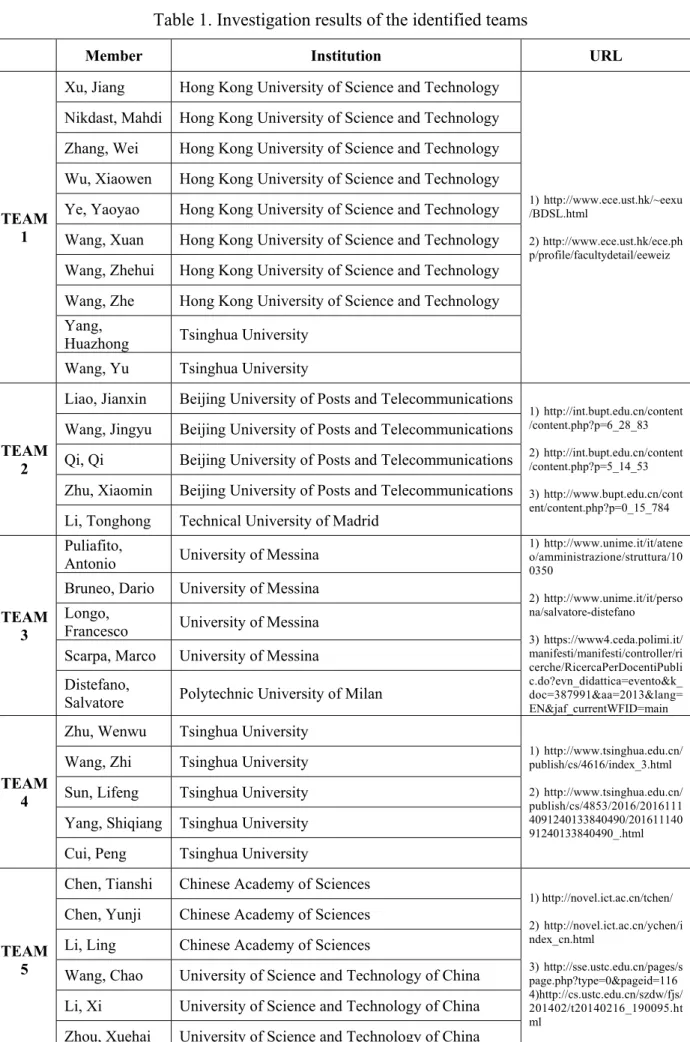
During the verification, many authors’ homepages are hard to find. Only their personal pages in academic social networks like LinkedIn can be found. This kind of pages cannot provide information that is reliable and plentiful enough for verification. For some other authors, even their formal homepages can be found; their team information is not included in the page4. After investigation, five teams whose members’ physical relations can be clearly recognized are exemplified here for demonstration (Many other teams can also be recognized however will not be demonstrated here due to the space limitation).
2 Please note that during the edge cutting, the original connected sub-network may split into many disconnected
sub- networks (teams).
3 Network Density is defined as d=2L/N(N-1), where N is node number and L is edge number. d∈(0,1), the
closer d is to 1, the more connections among network nodes. Edges in this paper are weak or strong relationships.
4 Please refer to http://www.utko.feec.vutbr.cz/~herencsar/ for this situation. The team members recognized by
Table 1. Investigation results of the identified teams
Member Institution URL
TEAM 1
Xu, Jiang Hong Kong University of Science and Technology
1) http://www.ece.ust.hk/~eexu /BDSL.html
2) http://www.ece.ust.hk/ece.ph p/profile/facultydetail/eeweiz Nikdast, Mahdi Hong Kong University of Science and Technology
Zhang, Wei Hong Kong University of Science and Technology
Wu, Xiaowen Hong Kong University of Science and Technology
Ye, Yaoyao Hong Kong University of Science and Technology
Wang, Xuan Hong Kong University of Science and Technology
Wang, Zhehui Hong Kong University of Science and Technology
Wang, Zhe Hong Kong University of Science and Technology Yang,
Huazhong Tsinghua University Wang, Yu Tsinghua University
TEAM 2
Liao, Jianxin Beijing University of Posts and Telecommunications
1) http://int.bupt.edu.cn/content /content.php?p=6_28_83 2) http://int.bupt.edu.cn/content /content.php?p=5_14_53 3) http://www.bupt.edu.cn/cont ent/content.php?p=0_15_784 Wang, Jingyu Beijing University of Posts and Telecommunications
Qi, Qi Beijing University of Posts and Telecommunications
Zhu, Xiaomin Beijing University of Posts and Telecommunications
Li, Tonghong Technical University of Madrid
TEAM 3
Puliafito,
Antonio University of Messina
1) http://www.unime.it/it/atene o/amministrazione/struttura/10 0350 2) http://www.unime.it/it/perso na/salvatore-distefano 3) https://www4.ceda.polimi.it/ manifesti/manifesti/controller/ri cerche/RicercaPerDocentiPubli c.do?evn_didattica=evento&k_ doc=387991&aa=2013&lang= EN&jaf_currentWFID=main Bruneo, Dario University of Messina
Longo,
Francesco University of Messina Scarpa, Marco University of Messina
Distefano,
Salvatore Polytechnic University of Milan
TEAM 4
Zhu, Wenwu Tsinghua University
1) http://www.tsinghua.edu.cn/ publish/cs/4616/index_3.html 2) http://www.tsinghua.edu.cn/ publish/cs/4853/2016/2016111 4091240133840490/201611140 91240133840490_.html Wang, Zhi Tsinghua University
Sun, Lifeng Tsinghua University
Yang, Shiqiang Tsinghua University Cui, Peng Tsinghua University
TEAM 5
Chen, Tianshi Chinese Academy of Sciences
1) http://novel.ict.ac.cn/tchen/ 2) http://novel.ict.ac.cn/ychen/i ndex_cn.html 3) http://sse.ustc.edu.cn/pages/s page.php?type=0&pageid=116 4)http://cs.ustc.edu.cn/szdw/fjs/ 201402/t20140216_190095.ht ml
Chen, Yunji Chinese Academy of Sciences
Li, Ling Chinese Academy of Sciences
Wang, Chao University of Science and Technology of China
Li, Xi University of Science and Technology of China
STI Conference 2018 · Leiden
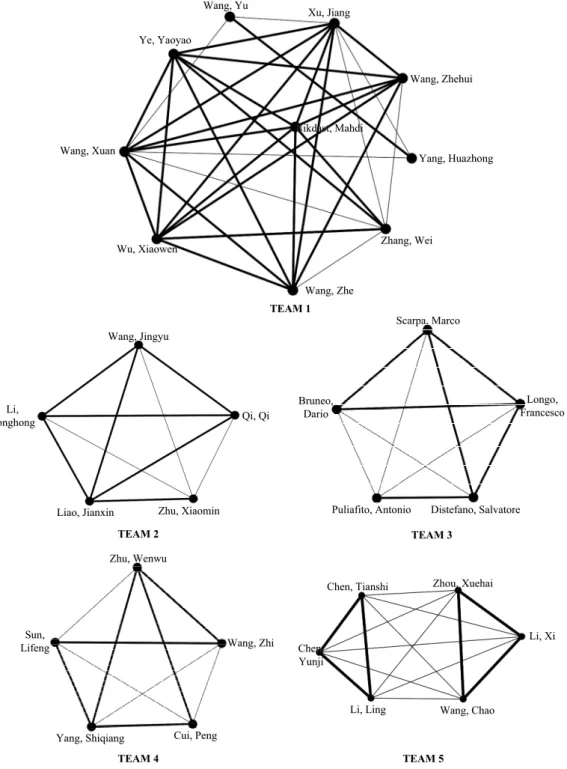
Figure 1: Relations among the team members
Wang, Yu
Xu, Jiang
Wang, Zhehui
Yang, Huazhong
Zhang, Wei
Wang, Zhe Wu, Xiaowen
Wang, Xuan
Nikdast, Mahdi Ye, Yaoyao
Chen, Tianshi
Chen, Yunji
Li, Ling Wang, Chao Zhou, Xuehai
Li, Xi Wang, Jingyu
Li, Tonghong
Liao, Jianxin Zhu, Xiaomin Qi, Qi
Zhu, Wenwu
Wang, Zhi
Cui, Peng Yang, Shiqiang
Sun, Lifeng
TEAM 2 TEAM 3
Scarpa, Marco
Bruneo, Dario
Puliafito, Antonio Distefano, Salvatore Longo, Francesco TEAM 1
TEAM 4 TEAM 5
at Department of Electronic & Computer Engineering, HKUST -- same as Xu, Jiang (TEAM 1, URL 2); Li, Tonghong was graduated from Beijing University of Posts and Telecommunications and has tight cooperation with Liao, Jianxin (TEAM 2, URL 2 and 3); Distefano, Salvatore works (worked) at both University of Messina and Polytechnic University of Milan (TEAM 3, URL 2 and 3); Wang, Zhi was Prof. Yang, Shiqiang’s PhD student (TEAM 4, URL 2)5. 4) For TEAM 5, Chen, Tianshi; Chen, Yunji and Li, Ling are from the a team of Chinese Academy of Sciences, Wang, Chao; Li, Xi and Zhou, Xuehai are from the other team of University of Science and Technology of China. As we can see in Fig. 1, TEAM 5, if we consider on the team level, only weak relationships exist between the two (sub-)teams. That is, the situation can be easily avoided by adopting a post-verification process to the algorithm that removes all the weak links to see whether the team is still connected. If it is, then all the members belong to one team. If not, each connected component that fulfils Definition 4 is an independent team6.
From the case study we can see that the algorithm can properly find research teams with members actually cooperated (are cooperating) with each other in their academic careers.
Discussion and Conclusion
It is easy to see that parameters used in the algorithm can influence the result teams in a very great manner. In general, the larger λ γ τ, , and ξ are, the less strong relationships are (and in turn the less teams can be found). Meanwhile, the larger M and N are, the more connections a team should have, the less teams can be found. That is exactly why only 121 teams are found in our case study: the bibliographic data only covers 10 years; it is a bit hard for authors to cooperate in 3 different years. Besides, as we can see, the average team density is as high as 0.88, which makes the qualified teams become even less. One can control the parameters to get the kind of teams they need. Actually, if we only set τand leave other parameters as 0, the proposed method then degenerates to the traditional (mere) co-author based method: only numbers of co-authorships is considered. Under such setting, the team number will increase dramatically, and almost all the authors can be included into a certain team.
The other thing is that, the members in a research team may need to have the same (or similar) research interests. The problem does not exist in this paper since all the papers are come from Computer Sciences. However, the proposed scheme can be easily extended to involve research interests, by adding a relationship type that describing the similarity on research interests between authors, and requiring each pair of authors in a team should be connected by the relationship (with similarity larger than a given threshold). Besides adding conditions, the restriction defined in this paper can also be modified (strengthened or relaxed). For example, suppose we have adequate bibliographic data, we can further strengthen the time and output stable, by requiring the (least) consecutive cooperation years should be longer than γ times of their cooperative career, and at least having p papers published on each of the cooperation year.
5 Chinese names: Liao, Jianxin (廖建新), Wang, Jingyu (王敬宇), Qi, Qi (戚琦), Zhu, Xiaomin (朱晓民),
Zhu, Wenwu (朱文武), Sun, Lifeng (孙立峰), Yang, Shiqiang (杨士强), Cui, Peng (崔鹏), Chen, Tianshi (陈天石), Chen, Yunji (陈云霁), Li Ling (李玲), Wang, Chao (王超), Li, Xi (李曦), Zhou, Xuehai(周学海)
6 By doing so, the two members from Tsinghua University, Yang, Huazhong and Wang, Yu, should be removed
STI Conference 2018 · Leiden
In conclusion, in this paper we propose a research team identification method that can efficiently go through the co-author network and output the research teams. The result teams are verified through Internet and proven to be real. The formalization makes the scheme easily extended to involve other restrictions like members having the same research interests.
References
Awerbuch, B. (1985). A new distributed depth-first-search algorithm. Information Processing Letters, 20(3): 147-150.
Börner, K., Dall'Asta, L., Ke, W., & Vespignani, A. (2010). Studying the emerging global brain: analyzing and visualizing the impact of co‐authorship teams. Complexity, 10(4): 57-67.
Calero, C., Buter, R., Valdés, C. C., & Noyons, E. (2006). How to identify research groups using publication analysis: an example in the field of nanotechnology. Scientometrics, 66(2): 365-376.
Li G., Li C. & Li X. (2014) The Identification of Research Teams Based on Social Network Analysis. Library and Information Service, 58(7): 63-70, 82.
Li, G., Liu, M., Wu, Q. & Mao, J. (2017) A Research of Characters and Identifications of Roles Among Research Groups Based on the Bow-Tie Model. Library and Information Service, 61(5): 87-94.
Perianes-Rodríguez, A., Olmeda-Gómez, C., & Moya-Anegón, F. (2010). Detecting, identifying and visualizing research groups in co-authorship networks. Scientometrics, 82(2): 307-319.
Qiu, J. & Wu, C. (2011) Study on the Co-Author Relationship of Informetrics Based on Social Network Analysis. Document, Information & Knowledge, 6: 12-17.
Ren, N. & Zhou, J. (2015) The Discovery and Evaluation of Research Team Under the Mode of Weighted Co-Author Network. New Technology of Library and Information Service, 9: 68-75.
Shen G., Huang S. & Wang D. (2013) On the Scientific Research Teams Identification Method Taking Co-authorship of Collaboration as the Source Data. New Technology of Library and Information Service, 1: 57-62.