Incident heart failure and cognitive decline: The Atherosclerosis
Risk in Communities Study
Jan Bressler, Ph.D.a, David S. Knopman, M.D.b, A. Richey Sharrett, M.D., Dr.P.H.c, Rebecca F. Gottesman, M.D., Ph.D.d, Alan Penman, M.B., Ch.B., Ph.D., M.P.H.e, Patricia P. Chang, M.D., M.H.S.f, Wayne D. Rosamond, Ph.D.g, Eric Boerwinkle, Ph.D.Aa,h, and Thomas H. Mosley, Ph.D.e,*
aHuman Genetics Center, School of Public Health, 1200 Pressler Street, University of Texas
Health Science Center at Houston, Houston, Texas, 77030 USA
bDepartment of Neurology, Mayo Clinic, 200 1st Street SW, Rochester, Minnesota, 55902 USA
cDepartment of Epidemiology, Johns Hopkins Bloomberg School of Public Health, 615 North
Wolfe Street, Baltimore, Maryland, 21205 USA
dDepartment of Neurology, Johns Hopkins University School of Medicine, 600 North Wolfe Street,
Baltimore, Maryland, 21287 USA
eDepartment of Medicine, Division of Geriatrics, University of Mississippi Medical Center, 2500
North State Street, Jackson, Mississippi, 39216 USA
fDepartment of Medicine, University of North Carolina School of Medicine, 160 Dental Circle,
Chapel Hill, North Carolina, 27599 USA
gDepartment of Epidemiology, University of North Carolina Gillings School of Global Public
Health, 137 East Franklin Street, Chapel Hill, North Carolina, 27514 USA
hHuman Genome Sequencing Center, Baylor College of Medicine, 1 Baylor Plaza, Houston,
Texas, 77030 USA
Abstract
Background—Cognitive impairment is found in a significant proportion of patients with heart failure (HF). While cognitive impairment may be a consequence of HF, early signs of cognitive impairment may also indicate subclinical vascular disease, and thus a risk factor for future cardiovascular events.
*To whom correspondence should be addressed: Thomas H. Mosley, Department of Internal Medicine, Division of Geriatrics,
University of Mississippi Medical Center, 2500 N. State Street, Jackson, Mississippi, 39216. Telephone: (601) 984-6197; Fax: (601) 815-3422; [email protected].
Publisher's Disclaimer: This is a PDF file of an unedited manuscript that has been accepted for publication. As a service to our
customers we are providing this early version of the manuscript. The manuscript will undergo copyediting, typesetting, and review of the resulting proof before it is published in its final citable form. Please note that during the production process errors may be discovered which could affect the content, and all legal disclaimers that apply to the journal pertain.
HHS Public Access
Author manuscript
J Card Fail
. Author manuscript; available in PMC 2018 January 01.Published in final edited form as:
J Card Fail. 2017 January ; 23(1): 47–55. doi:10.1016/j.cardfail.2016.11.002.
A
uthor Man
uscr
ipt
A
uthor Man
uscr
ipt
A
uthor Man
uscr
ipt
A
uthor Man
uscr
Methods and Results—The Atherosclerosis Risk in Communities Study is a prospective cohort study of the development of atherosclerosis. Cox proportional hazards regression was used to examine the association between mean 6-year change in cognitive function and incident HF in 7,962 white and 1,933 African-American men and women aged 46 to 70 years and free of clinical stroke. Scores were obtained for the Delayed Word Recall Test (DWRT), the Digit Symbol Substitution Test (DSST), and the Word Fluency Test (WFT). There was a significantly increased risk of developing HF during the mean 12.6 year-follow-up period after adjustment for age, gender, race, and education for those in the quartile with the greatest decline in DSST scores (hazard ratio (HR)=1.17, p=0.009), and in the quartile with the lowest baseline DSST scores (HR=1.43, p<0.001).
Conclusions—The results suggest that relatively low performance on a test of information processing speed may serve as an indicator of HF risk in middle age.
Keywords
epidemiology; cognition
Introduction
Heart failure (HF) is a major cause of hospitalization and mortality in the United States,
estimated to affect over 6 million adults in 2010.1 The lifetime risk of developing HF for
both men and women was reported to be 1 in 5 at 40 years of age in the Framingham Heart
Study.2 Major risk factors for HF include coronary heart disease, hypertension, left
ventricular hypertrophy, abnormal heart valves, diabetes, cigarette smoking, obesity, and
lack of physical activity.3,4
An estimated 25 to 50% of patients with HF have cognitive impairment, with decreased attention and executive function, reduced processing speed, and memory loss as the most
frequent deficits.5–7 In a systematic review of mostly cross-sectional studies including 2,937
patients with HF and 14,848 controls, the odds ratio for cognitive impairment was 1.62 (p<
0.0001) for individuals with HF.8 Cerebral hypoperfusion secondary to reduction in cerebral
blood flow is suggested as the primary physiological mechanism linking HF and impaired
cognitive function.9
While cognitive impairment may be a downstream consequence of HF, early signs of cognitive impairment may also be an indication of subclinical vascular disease, and thus a risk factor for future clinically apparent cardiovascular disease. In a previous investigation carried out in the ARIC study, Elkins et al. tested the hypothesis that poor performance on tests of cognitive function may be used to identify individuals who are particularly susceptible to developing myocardial infarction and stroke and found that lower cognitive
scores predicted a greater risk of cardiovascular events over a 6.4 year period.10 Similar
results have recently been reported for 5,292 participants in the Whitehall II study where lower scores on tests of vocabulary and verbal and mathematical reasoning were associated
with an increased incidence of coronary heart disease during 6 years of follow-up,11 and in
the Health and Retirement Study and a study of Swedish men where lower scores on tests of delayed word recall or executive function, respectively, were shown to predict risk of
A
uthor Man
uscr
ipt
A
uthor Man
uscr
ipt
A
uthor Man
uscr
ipt
A
uthor Man
uscr
incident stroke.12,13 The aim of the current study was to determine whether performance on three neurocognitive tests administered at baseline or change in cognitive function measured over 6-years were associated with incident HF in white and African-American participants in the ARIC study.
Material and Methods
The Atherosclerosis Risk in Communities Study
The ARIC Study is a prospective longitudinal investigation of the development of atherosclerosis and its clinical sequelae in which 15,792 individuals aged 45 to 64 years were enrolled at baseline. A detailed description of the ARIC study has been reported
previously.14 At the inception of the study in 1987–1989, the participants were selected by
probability sampling from four communities in the United States: Forsyth County, North Carolina; Jackson, Mississippi (African-Americans only); the northwestern suburbs of Minneapolis, Minnesota; and Washington County, Maryland. Four examinations were carried out at three-year intervals (exam 1, 1987–1989; exam 2, 1990–1992; exam 3, 1993– 1995; exam 4, 1996–1998), and subjects are contacted annually to update their medical histories between examinations. A fifth clinical examination has recently been completed (2011–2013). Cognitive testing was performed at visits 2, 4, and 5 in all participants. Individuals were not included in this analysis if they were neither African-American nor white (n = 48), were African-Americans from the Minnesota or Maryland field centers due to the small numbers of individuals recruited from these sites (n = 55), had a history of physician-diagnosed stroke (n = 272) or unknown history of stroke (n = 31) prior to visit 2, did not attend visit 2 (n = 1,432), did not attend visit 4 (n = 1,769), had HF (n = 530) or an unknown history of HF (n = 233) at the first clinical examination, or developed HF prior to the second clinical examination (n = 71) or between exams 2 and 4 (n = 631). Additional exclusions were made for incident definite or probable stroke verified by ARIC clinicians from medical records between visit 2 and 4 (n = 365), missing cognitive data for all three neuropsychological tests at either visit 2 or visit 4 (n = 287), if hospitalized for dementia prior to visit 4 and identified using ICD-9 codes (Alzheimer’s disease (331.0); vascular dementia (290.4); or other forms of dementia (290.0, 290.1., 290.2, 290.3, 290.9, 294.1, 294.2, 294.8, 294.9, 331.1, 331.2, 331.8, 331.9) (n = 6), for missing information concerning the highest level of education completed (n =16), or for missing covariates (n = 151). The final study sample consisted of 7,962 white and 1,933 African-American men and women. Written informed consent was provided by all study participants, and the study design and methods were approved by institutional review boards at the collaborating medical centers.
Cognitive Tests
Cognitive function was assessed by three neuropsychological tests at the second and fourth
clinical examinations that have been described previously15: 1) The Delayed Word Recall
Test (DWRT) is a test of verbal learning and recent memory in which the participant is required to use each of 10 common nouns in a sentence. After a 5-minute delay in which another test is given, the participant is asked to recall the 10 nouns. The DWRT score is the
number of correct words recalled (range 0 – 10)16; 2) The Digit Symbol Substitution Test
(DSST) is a subtest of the Wechsler Adult Intelligence Scale-Revised involving timed
A
uthor Man
uscr
ipt
A
uthor Man
uscr
ipt
A
uthor Man
uscr
ipt
A
uthor Man
uscr
translation of numbers to symbols using a key with paired symbols and digits and measures
psychomotor performance.17, 18 The total number of correct translations within 90 seconds
determines the score (range 0 – 93)17; and 3) The Word Fluency Test (WFT) is a measure of
executive function. In three separate 1-minute trials, the subject is asked to generate as many
words as possible beginning with the letters F, A, and S.18 The score is the combined total of
correct words produced.19 The tests were administered by trained interviewers in a
standardized order and were given in a single session. The testing sessions were monitored by tape recorder and a sample of sessions was evaluated to confirm that there were no systematic differences in mean test scores obtained by different interviewers.
For all of the neuropsychological tests, lower scores indicate a lower measure of cognition. Six-year change in cognitive function was analyzed as the difference between the test score obtained at the later of the two clinic visits and the test score obtained at the earlier examination for each neuropsychological test.
Clinical and Laboratory Measurements
The clinical and laboratory measurements used for this study were assessed during the second clinical examination with the exception of education which was evaluated at the baseline examination. Education was included as a covariate in regression models as an ordinal variable based on the highest level attained (≤ 11 years; 12 −16 years; > 17 years). Incident HF was defined as the first HF hospitalization (ICD-9 code 428 in any position), or any deaths where the death certificate included a HF code (code 428, ICD-9 or 150, ICD-10, in any position). Exclusion for HF was based on self-reported current medication use for HF, or having manifest HF as defined by Gothenburg criteria stage 3. The Gothenburg criteria are based on a cardiac score (i.e., history of coronary heart disease, angina, or atrial fibrillation), pulmonary score (i.e., history of asthma or bronchitis), and therapy score (i.e., treatment with diuretics or digoxin). To be classified as stage 3 an individual must have at
least 1 point from each category.20,21 Prevalent coronary heart disease was defined based on
evidence obtained at the first clinical examination of previous myocardial infarction by electrocardiogram, a history of myocardial infarction that was diagnosed by a physician, or a prior coronary bypass or angioplasty procedure, or if the same events occurred between the first and second clinical examination.
Plasma total cholesterol and triglycerides were measured by enzymatic methods,22,23 and
LDL-C was calculated.24 High density lipoprotein cholesterol (HDL-C) was measured after
dextran-magnesium precipitation of non-HDL.25 Blood pressure was measured three times
while seated using a random-zero sphygmomanometer and the last two measurements were averaged for analysis. Hypertension was defined by diastolic blood pressure of ≥ 90 mm Hg, systolic blood pressure of ≥140 mm Hg, or use of antihypertensive medication. Fasting serum glucose was measured by a standard hexokinase method on a Coulter DACOS chemistry analyzer (Coulter Instruments, Fullerton, CA). The prevalence of diabetes was defined using a fasting glucose level ≥ 7.0 mmol/L, a nonfasting glucose level ≥ 11.1 mmol/L, and/or self-reported physician diagnosis or treatment for diabetes. Body weight and other anthropometric variables were measured by trained technicians according to
standardized protocols. Body mass index (BMI) was calculated as weight in kilograms/
A
uthor Man
uscr
ipt
A
uthor Man
uscr
ipt
A
uthor Man
uscr
ipt
A
uthor Man
uscr
(height in meters)2. Information on cigarette smoking and alcohol consumption was obtained using an interviewer-administered questionnaire, and smoking and drinking status were classified as current, former, or never. Airflow obstruction was measured by spirometry
and was defined as forced expiratory volume in 1 second (FEV1)/forced vital capacity (FVC)
< 0.7.26 Serum creatinine was measured using a Jaffe method and calibrated to nationally
representative estimates as previously described.27 GFR was estimated based on serum
creatinine using the Chronic Kidney Disease Epidemiology Collaboration (CKD-EPI)
equation (eGFRCKD-EPI) with eGFRCKD-EPI<60 mL/min/1.73m2 defined as chronic kidney
disease.28
Statistical Analysis
All statistical analyses were performed using Stata 9 software (StataCorp, College Station, TX, USA). Proportions, means, and standard deviations were calculated for cardiovascular risk factors for individuals categorized by incident HF status. Groups were compared using chi square tests for categorical variables and t-tests for continuous variables. Quartiles of cognitive test scores at baseline or of 6-year change in cognitive test scores were generated
that correspond to the 25th, 50th (median), and 75th percentiles of the distribution. In the
primary analyses, Cox proportional hazards models were used to estimate hazard ratios (HR) for HF occurring after visit 4 for those in the quartile with the greatest cognitive decline between visits 2 and 4 or the lowest cognitive scores at baseline compared to study participants in all other quartiles for each cognitive test. In a secondary analysis, Cox proportional hazards models were also used to estimate HRs when individuals in quartiles two through four for the DSST were compared to those in the top quartile. For the analyses of incident HF through 2011, follow-up time intervals were defined as the time between visit 4 and the date of the first HF event. For participants without HF, follow-up continued through the date of last contact, or the date of death if the date of last contact had occurred within one year. Study participants were followed for a mean of 12.6 years. Two
multivariable models were used to evaluate the relationship between cognitive function and incident HF; model 1 was adjusted for age, gender, race and years of education, while model 2 included the covariates in model 1 with the addition of established risk factors for HF including diabetes and hypertension case status, body mass index (BMI), current smoking, current alcohol intake, and prevalent coronary heart disease. A third model was used to further adjust for clinical variables (HDL-C, total cholesterol, airflow obstruction, and
chronic kidney disease) that can affect both cognition and risk of HF,29 and were
significantly different at baseline when individuals who developed HF were compared to those who did not. In secondary analyses, effect modification by race and gender of the association between cognitive function and incident heart failure was examined. Cox regression models were adjusted for the same covariates used to assess main effects and also included multiplicative interaction terms for gender by cognitive status or race by cognitive status. Analyses stratified by race and gender were performed to further evaluate possible interactions. Proportional hazards assumptions were met except for the Cox regression model used to test for interaction between race and performance on the WFT at baseline, the race-stratified analysis for whites for the WFT at baseline, and in the comparisons of quartile one with quartiles two through four for the WFT at baseline (model 1, model 2, and model
3).30 A two-sided p-value <0.05 was considered statistically significant.
A
uthor Man
uscr
ipt
A
uthor Man
uscr
ipt
A
uthor Man
uscr
ipt
A
uthor Man
uscr
Results
The clinical and demographic characteristics of the study sample are summarized in Table 1. There were 1,228 cases of incident HF among 9,895 study participants (12.4 %). The cases and comparison group without HF differed significantly for all demographic variables or cardiovascular risk factors examined. ARIC study participants who developed HF were older, more likely to be male, African-American, a current smoker, and to have diabetes, hypertension, prevalent coronary heart disease, airflow obstruction, or chronic kidney disease but less likely to consume alcoholic beverages than those without HF. The cases also had a higher body mass index, higher total and LDL cholesterol, lower HDL cholesterol, and higher systolic and diastolic blood pressure. In addition, the mean 6-year change in scores attained on the DWRT and DSST but not the WFT differed significantly between cases and non-cases (Table 2), with greater decline found for those individuals who were hospitalized for HF.
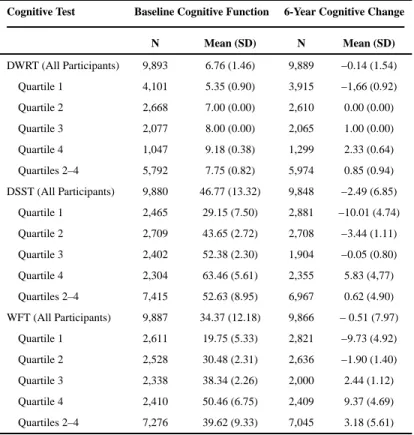
Subjects who were in the quartile with the greatest decline in scores for the DSST were compared to those in quartiles two through four in order to define a group who were performing less well than their peers in middle age when only small changes in cognitive status are expected. Mean cognitive scores for each quartile for each test, and for the individuals in quartiles two through four combined are shown in Table 3. There was a significantly increased risk of developing HF after adjustment for age, gender, race, and level of education (hazard ratio (HR) = 1.17, 95% confidence interval (CI) = 1.04 –1.32, p =0.009) (Table 4) that was only slightly attenuated after inclusion of diabetes, hypertension, smoking, alcohol consumption, and prevalent coronary heart disease as additional covariates in the analysis models (model 2), or after further adjustment for HDL-C, total cholesterol, airflow obstruction, and chronic kidney disease (model 3). There was also an increase in susceptibility observed for those who were in the quartile with the lowest scores for the DWRT (HR = 1.16, 95% CI = 1.03 – 1.30, p = 0.012) and the DSST at the baseline cognitive examination (HR =1.43, 95% CI =1.24 – 1.66, p < 0.001). In contrast to the results for the DSST, the association was no longer significant for the DWRT in the fully adjusted models. In a secondary analysis, the hazard ratios for quartiles two through four for the DSST were also compared to those for quartile one to determine whether the risk for HF decreased in a step-wise fashion as mean cognitive test scores increased or mean change in cognitive test scores decreased (Table S1 (models 1 and 2) and S2 (model 3)). This pattern was observed for the DSST at baseline but not for 6-year change on the DSST. Individuals in the third quartile had a higher risk of HF than study participants who were in either quartile two or four using both the minimal and fully adjusted Cox regression models.
In secondary analyses in which the association between cognitive change and incident HF was examined separately by gender (Table 5), the association between cognitive function as assessed by all three neurocognitive tests and incident HF did not appear to be modified by gender (all p interaction > 0.07). In stratified analyses, there was a marginally significant increase in risk for both men and women with the greatest decline in DSST scores using the minimally adjusted Cox regression model, while this association was no longer statistically significant after further adjustment for a panel of risk factors for HF. Both men and women in the quartile with the lowest DSST scores at baseline incurred a significantly increased risk
A
uthor Man
uscr
ipt
A
uthor Man
uscr
ipt
A
uthor Man
uscr
ipt
A
uthor Man
uscr
of HF over the follow-up period. Race-specific analyses were also carried out (Table 6). There was evidence for effect modification by race of the association between the risk of HF and change in DSST scores using both regression models, and for change in DWRT and WFT scores using the fully adjusted model (all p interaction < 0.05), while no significant statistical interaction between baseline cognitive status and race was found. Further support for the interaction between DSST score change and race was provided in the stratified analyses. In white participants, there was a significant association between risk of incident HF and 6-year change in DSST scores while this was not found for African-Americans using both the minimally adjusted and fully adjusted Cox regression models. For white study participants analyzed at baseline there was a significantly elevated risk of HF for those with the lowest DSST scores, as well as increased risk of HF for those with the lowest DWRT scores only after application of the minimally adjusted model. For African-Americans, there was increased susceptibility for the development of HF if the individual was in the quartile with lowest baseline DSST scores using the minimally adjusted model while this
relationship was no longer significant after further adjustment for the panel of risk factors for HF.
Discussion
In this study, ARIC study participants in the quartile with the lowest cognitive scores for the DSST at baseline, and the quartile with the greatest 6-year change in scores for the same test, predicted a significantly greater risk of subsequent incident HF. All of the analyses were adjusted for age, gender, self-reported race, and years of education, and the associations were largely independent of established risk factors for HF including diabetes, hypertension, current smoking alcohol intake, and prevalent coronary heart disease when these were added to the regression models. There was no significantly increased risk of developing HF observed for those with the poorest performance on either the DWRT or WFT after taking into account the effects of covariates and possible confounders. These observations are in accordance with a previous report in which baseline scores on the Mini Mental State
Examination (MMSE),31 a global screening test of cognitive function, were significantly
associated with hospitalization for congestive HF over a 56-month follow-up period in
patients with prior cardiovascular disease or diabetes.32 To our knowledge, the study
reported here is the first conducted to date in which change in cognitive function was evaluated as a determinant of incident HF.
Performance on the DSST has previously been demonstrated to decline with normal aging.18
Relatively lower scores on the DSST have also been shown to be associated with increased mortality over a 5- or 6-year follow-up period in participants in the Cardiovascular Health
Study,33 the ARIC study,34 and the Western Collaborative Study.35 There is also evidence
that poor performance on the DSST predicts the occurrence of myocardial infarction and
stroke.10 Since slowing of psychomotor speed has been demonstrated to be associated with
the presence and severity of subcortical white matter lesions,36 we speculate that poor
cognitive function assessed by the DSST may be an early sign of vascular damage that precedes the development of clinically apparent HF. Accordingly, lower performance on tests of processing speed has been observed in patients with HF in several previous cross-sectional studies, as well as at baseline in longitudinal studies of change in cognitive
A
uthor Man
uscr
ipt
A
uthor Man
uscr
ipt
A
uthor Man
uscr
ipt
A
uthor Man
uscr
function.5–7, 37–41 For example, patients with stable HF scored significantly below age- and education-adjusted norms on the Trail Making Test Part A when given the Repeatable
Battery for the Assessment of Neuropsychological Status (RBANS).38 Similarly, in a
relatively young group of 279 patients, nearly 60% of the sample had scores on the DSST that were below the mean at the outset of the study, and also performed significantly worse on tests of attention and memory when compared to subjects with average processing speed. There was little change in these patterns of cognitive function over the 6-month study
period.41 It has also previously been suggested that poor performance on the DSST may be a
marker for generalized acceleration of aging of the central nervous system.35 Alternatively,
although the absolute change in neurocognitive test scores was relatively modest, decreased attention and processing speed could possibly affect compliance with treatment for
cardiovascular risk factors such as diabetes and hypertension which when uncontrolled can
contribute to the onset of HF.42–45 Finally, the results reported here also provide support for
the hypothesis that since HF is a disorder involving vascular compromise, the reverse interpretation may also be valid and generalized vascular disease that is not confined to the brain could be associated with cognition.
The strengths of the study include a large well-phenotyped cohort with cognitive assessments repeated at multiple time points using the same standardized protocols. However, there are also limitations. While many risk factors that may have an impact on both cognition and the risk of developing HF were included in the regression models, some
conditions were not assessed at the baseline clinical visit such as depression,29 so there may
be some residual confounding of the reported associations. Since HF was defined using hospital International Classification of Diseases (ICD) codes in this study, participants with HF who did not seek medical attention or who had died of other causes before developing HF for which they may have been hospitalized would not have been identified. It is also possible that some participants may have had HF diagnosed in an outpatient setting or subclinical HF at the time cognitive function was assessed. Furthermore, a large number of participants were excluded from the analysis including those who did not have a second cognitive assessment at visit 4 (n = 1,769). When these individuals were compared to those who were included in the study, scores on all three cognitive tests were significantly lower at baseline (all p < 0.001, data not shown) so that the effects of cognitive function on HF risk may have been underestimated. Since the relationship between change in cognitive function and HF has so far not been widely examined using neuropsychological tests, the current study adds to our understanding of the nature and extent of cognitive decline in a large population-based sample of middle-aged adults, and suggests that both relatively low performance on a test of processing speed as well as repeated measurements of cognitive function may serve as an indicator of HF risk.
Acknowledgments
The Atherosclerosis Risk in Communities Study is carried out as a collaborative study supported by National Heart, Lung, and Blood Institute contracts (HHSN268201100005C, HHSN268201100006C, HHSN268201100007C, HHSN268201100008C, HHSN268201100009C, HHSN268201100010C, HHSN268201100011C, and HHSN268201100012C). The authors thank the staff and participants of the ARIC study for their important contributions.
A
uthor Man
uscr
ipt
A
uthor Man
uscr
ipt
A
uthor Man
uscr
ipt
A
uthor Man
uscr
References
1. Heidenreich PA, Trogdon JG, Khavjou OA, Butler J, Dracup K, Ezekowitz MD, et al. Forecasting the future of cardiovascular disease in the United States: a policy statement from the American Heart Association. Circulation. 2011; 123:933–944. [PubMed: 21262990]
2. Lloyd-Jones DM, Larson MG, Leip EP, Beiser A, D’Agostino RB, Kannel WB, et al. Lifetime risk for developing congestive heart failure: the Framingham Heart Study. Circulation. 2002; 106:3068– 3072. [PubMed: 12473553]
3. Ho KK, Pinsky JL, Kannel WB, Levy D. The epidemiology of heart failure: the Framingham Study. Journal of the American College of Cardiology. 1993; 22:6A–13A. [PubMed: 8509564]
4. Gottdiener JS, Arnold AM, Aurigemma GP, Polak JF, Tracy RP, Kitzman DW, et al. Predictors of congestive heart failure in the elderly: the Cardiovascular Health Study. Journal of the American College of Cardiology. 2000; 35:1628–1637. [PubMed: 10807470]
5. Pressler SJ. Cognitive functioning and chronic heart failure: a review of the literature (2002-July 2007). The Journal of cardiovascular nursing. 2008; 23:239–249. [PubMed: 18437066]
6. Bennett SJ, Sauve MJ. Cognitive deficits in patients with heart failure: a review of the literature. The Journal of cardiovascular nursing. 2003; 18:219–242. [PubMed: 12837012]
7. Petrucci RJ, Truesdell KC, Carter A, Goldstein NE, Russell MM, Dilkes D, et al. Cognitive dysfunction in advanced heart failure and prospective cardiac assist device patients. The Annals of thoracic surgery. 2006; 81:1738–1744. [PubMed: 16631665]
8. Vogels RL, Scheltens P, Schroeder-Tanka JM, Weinstein HC. Cognitive impairment in heart failure: a systematic review of the literature. European journal of heart failure. 2007; 9:440. [PubMed: 17174152]
9. Vogels RL, Oosterman JM, van Harten B, Scheltens P, van der Flier WM, Schroeder-Tanka JM, et al. Profile of cognitive impairment in chronic heart failure. Journal of the American Geriatrics Society. 2007; 55:1764–1770. [PubMed: 17727641]
10. Elkins JS, Knopman DS, Yaffe K, Johnston SC. Cognitive function predicts first-time stroke and heart disease. Neurology. 2005; 64:1750–1755. [PubMed: 15911803]
11. Singh-Manoux A, Sabia S, Kivimaki M, Shipley MJ, Ferrie JE, Marmot MG. Cognition and incident coronary heart disease in late midlife: The Whitehall II study. Intelligence. 2009; 37:529– 534. [PubMed: 20161539]
12. DeFries T, Avendano M, Glymour MM. Level and change in cognitive test scores predict risk of first stroke. Journal of the American Geriatrics Society. 2009; 57:499–505. [PubMed: 19175440] 13. Wiberg B, Lind L, Kilander L, Zethelius B, Sundelof JE, Sundstrom J. Cognitive function and risk
of stroke in elderly men. Neurology. 2010; 74:379–385. [PubMed: 20124202]
14. The ARIC investigators. The Atherosclerosis Risk in Communities (ARIC) Study: design and objectives. American journal of epidemiology. 1989; 129:687–702. [PubMed: 2646917]
15. Cerhan JR, Folsom AR, Mortimer JA, Shahar E, Knopman DS, McGovern PG, et al. Correlates of cognitive function in middle-aged adults. Atherosclerosis Risk in Communities (ARIC) Study Investigators. Gerontology. 1998; 44:95–105. [PubMed: 9523221]
16. Knopman DS, Ryberg S. A verbal memory test with high predictive accuracy for dementia of the Alzheimer type. Archives of neurology. 1989; 46:141–145. [PubMed: 2916953]
17. Wechsler, D. The Adult Intelligence Scales - Revised. New York: Psychological Corporation; 1981. 18. Lezak, M. Neuropsychological Assessment. Oxford: Oxford University Press; 1995.
19. Tombaugh TN, Kozak J, Rees L. Normative data stratified by age and education for two measures of verbal fluency: FAS and animal naming. Archives of clinical neuropsychology : the official journal of the National Academy of Neuropsychologists. 1999; 14:167–177. [PubMed: 14590600] 20. Eriksson H, Caidahl K, Larsson B, Ohlson LO, Welin L, Wilhelmsen L, et al. Cardiac and
pulmonary causes of dyspnoea- -validation of a scoring test for clinical-epidemiological use: the Study of Men Born in 1913. European heart journal. 1987; 8:1007–1014. [PubMed: 3665952] 21. Loehr LR, Rosamond WD, Chang PP, Folsom AR, Chambless LE. Heart failure incidence and survival (from the Atherosclerosis Risk in Communities study). American journal of cardiology. 2008; 101:1016–1022. [PubMed: 18359324]
A
uthor Man
uscr
ipt
A
uthor Man
uscr
ipt
A
uthor Man
uscr
ipt
A
uthor Man
uscr
22. Siedel J, Hagele EO, Ziegenhorn J, Wahlefeld AW. Reagent for the enzymatic determination of serum total cholesterol with improved lipolytic efficiency. Clinical chemistry. 1983; 29:1075– 1080. [PubMed: 6851096]
23. Nagele U, Hagele EO, Sauer G, Wiedemann E, Lehmann P, Wahlefeld AW, et al. Reagent for the enzymatic determination of serum total triglycerides with improved lipolytic efficiency. Journal of clinical chemistry and clinical biochemistry Zeitschrift fur klinische Chemie und klinische Biochemie. 1984; 22:165–174. [PubMed: 6716056]
24. Friedewald WT, Levy RI, Fredrickson DS. Estimation of the concentration of low-density lipoprotein cholesterol in plasma, without use of the preparative ultracentrifuge. Clinical chemistry. 1972; 18:499–502. [PubMed: 4337382]
25. Warnick GR, Benderson J, Albers JJ. Dextran sulfate-Mg2+ precipitation procedure for quantitation of high-density-lipoprotein cholesterol. Clinical chemistry. 1982; 28:1379–1388. [PubMed: 7074948]
26. Li J, Agarwal SK, Alonso A, Blecker S, Chamberlain AM, London SJ, et al. Airflow obstruction, lung function, and incidence of atrial fibrillation: the Atherosclerosis Risk in Communities (ARIC) study. Circulation. 2014; 129:971–980. [PubMed: 24344084]
27. Manjunath G, Tighiouart H, Ibrahim H, MacLeod B, Salem DN, Griffith JL, et al. Journal of American cardiology. 2003; 41:47–55.
28. Levey AS, Stevens LA, Schmid CH, Zhang YL, Castro AF III, Feldman HI, Kusek JW, et al. Annals of internal medicine. 2009; 150:604–612. [PubMed: 19414839]
29. Tripsokiadis F, Giamouzis G, Parissis J, Starling RC, Boudoulas H, Skoularigis J, et al. Reframing the association and significance of co-morbidities in heart failure. European journal of heart failure. 2016; 18:744–758. [PubMed: 27358242]
30. Grambsch PM, Therneau TM. Biometrika. 1994; 81:515–526.
31. Folstein MF, Folstein SE, McHugh PR. "Mini-mental state". A practical method for grading the cognitive state of patients for the clinician. Journal of psychiatric research. 1975; 12:189–198. [PubMed: 1202204]
32. O’Donnell M, Teo K, Gao P, Anderson C, Sleight P, Dans A, et al. Cognitive impairment and risk of cardiovascular events and mortality. European heart journal. 2012; 33:1777–1786. [PubMed: 22551598]
33. Fried LP, Kronmal RA, Newman AB, Bild DE, Mittelmark MB, Polak JF, et al. Risk factors for 5-year mortality in older adults: the Cardiovascular Health Study. JAMA : the journal of the American Medical Association. 1998; 279:585–592. [PubMed: 9486752]
34. Pavlik VN, de Moraes SA, Szklo M, Knopman DS, Mosley TH Jr, Hyman DJ. Relation between cognitive function and mortality in middle-aged adults: the atherosclerosis risk in communities study. American journal of epidemiology. 2003; 157:327–334. [PubMed: 12578803]
35. Swan GE, Carmelli D, LaRue A. Performance on the digit symbol substitution test and 5-year mortality in the Western Collaborative Group Study. American journal of epidemiology. 1995; 141:32–40. [PubMed: 7801963]
36. Selnes OA, Vinters HV. Vascular cognitive impairment. Nature clinical practice neurology. 2006; 2:538–547.
37. Almeida OP, Tamai S. Clinical treatment reverses attentional deficits in congestive heart failure. BMC geriatrics. 2001; 1:2. [PubMed: 11604103]
38. Bauer L, Pozehl B, Hertzog M, Johnson J, Zimmerman L, Filipi M. A brief neuropsychological battery for use in the chronic heart failure population. European journal of cardiovascular nursing : journal of the Working Group on Cardiovascular Nursing of the European Society of Cardiology. 2012; 11:223–230.
39. Tanne D, Freimark D, Poreh A, Merzeliak O, Bruck B, Schwammenthal Y, et al. Cognitive functions in severe congestive heart failure before and after an exercise training program. International journal of cardiology. 2005; 103:145–149. [PubMed: 16080972]
40. Okonkwo OC, Cohen RA, Gunstad J, Tremont G, Alosco ML, Poppas A. Longitudinal trajectories of cognitive decline among older adults with cardiovascular disease. Cerebrovascular diseases. 2010; 30:362–373. [PubMed: 20693791]
A
uthor Man
uscr
ipt
A
uthor Man
uscr
ipt
A
uthor Man
uscr
ipt
A
uthor Man
uscr
41. Riegel B, Lee CS, Glaser D, Moelter ST. Patterns of Change in Cognitive Function over Six Months in Adults with Chronic Heart Failure. Cardiology research and practice. 2012; 2012:631075. [PubMed: 22928145]
42. Salas M, In’t Veld BA, van der Linden PD, Hofman A, Breteler M, Stricker BH. Impaired cognitive function and compliance with antihypertensive drugs in elderly: the Rotterdam Study. Clinical pharmacology and therapeutics. 2001; 70:561–566. [PubMed: 11753273]
43. Okuno J, Yanagi H, Tomura S. Is cognitive impairment a risk factor for poor compliance among Japanese elderly in the community? European journal of clinical pharmacology. 2001; 57:589– 594. [PubMed: 11758637]
44. Sinclair AJ, Girling AJ, Bayer AJ. Cognitive dysfunction in older subjects with diabetes mellitus: impact on diabetes self-management and use of care services All Wales Research into Elderly (AWARE) Study. Diabetes research and clinical practice. 2000; 50:203–212. [PubMed: 11106835] 45. Nguyen HT, Grzywacz JG, Arcury TA, Chapman C, Kirk JK, Ip EH, et al. Linking glycemic
control and executive function in rural older adults with diabetes mellitus. Journal of the American Geriatrics Society. 2010; 58:1123–1127. [PubMed: 20722846]
A
uthor Man
uscr
ipt
A
uthor Man
uscr
ipt
A
uthor Man
uscr
ipt
A
uthor Man
uscr
A
uthor Man
uscr
ipt
A
uthor Man
uscr
ipt
A
uthor Man
uscr
ipt
A
uthor Man
uscr
ipt
T ab le 1Clinical and Demographic Characteristics Stratif
ied by Incident Heart F
ailure Status
Characteristic
P
articipants with Incident HF
(N=1,228)
P
articipants without
Incident HF (N = 8,667)
N N (%) N N (%) p Male 1,228 594 (48.4) 8,667 3,762 (43.4) 0.001 African-American 1,228 304 (24.8) 8,667 1,629 (18.8) <0.001 Education 1,228 8,667
≤ 11 years
347 (28.2)
1,349 (15.5)
<0.001
>11 years and ≤ 16 years
493 (40.2) 3,732 (43.1) >16 years 388 (31.6) 3,586 (41.4) Current smok er 1,228 320 (26.1) 8,667 1,556 (18.0) <0.001
Current alcohol use
1,128 642 (52.3) 8,667 5,264 (60.7) <0.001 Hypertension 1,228 605 (49.3) 8,667 2,391 (27.6) <0.001 Diabetes 1,228 313 (25.5) 8,667 839 (9.7) <0.001 Pre v alent CHD * 1,228 118 (9.6) 8,667 237 (2.7) <0.001 Airflo
w obstruction (FEV
1 /FVC<0.7) 1.205 328 (27.2) 8.551 1.632 (19.1) <0.001 CKD (eGFR CKD-EPI <60 ml/min/1.73m 2) 1,200 62 (5.2) 8,618 200 (2.3) <0.001 N Mean (SD) N Mean (SD) p Age (years) 1,228 59.4 (5.3) 8,667 56.3 (5.6) <0.001 BMI (kg/m 2) 1,228 29.4 (5,9) 8,667 27.4 (4.9) <0.001 T
otal chol,, mmol/L
1,227
5.50 (1.04)
8,648
5.39 (0.98)
0.001
LDL chol., mmol/L
1,203
3.54 (0.97)
8,526
3.42 (0.92)
<0.001
HDL chol, mmol/L
1,223 1.20 (0.40) 8,621 1.31 (0.43) <0.001 T rig., mmol/L 1,227 1.68 (1.01) 8,646 1.46 (0.88) <0.001
SBP (mm Hg)
1,228
127.0 (19.0)
8,667
118.7 (16.9)
<0.001
DBP (mm Hg)
1,228 72.5 (10.2) 8,667 71.7 (9.7) 0.004 F ollo
w-up time (years)
1,228
8.2 (4.0)
8,667
13.3 (3.0)
<0.001
A
uthor Man
uscr
ipt
A
uthor Man
uscr
ipt
A
uthor Man
uscr
ipt
A
uthor Man
uscr
ipt
CHD, coronary heart disease; FEV
1
, forced e
xpiratory v
olume in 1 second; FVC, forced vital capacity; CKD, chronic kidne
y disease; eGFR
CKD-EPI
, Chronic Kidne
y Disease Epidemiology Collaboration
(CKD-EPI) equation; BMI, body mass inde
x; chol., cholesterol; LDL, lo
w-density lipoprotein; HDL, high-density lipoprotein; SBP
, systolic blood pressure; DBP
, diastolic blood pressure; HF
, heart f
ailure;
N, number; p, p-v
alue; SD, standard de
A
uthor Man
uscr
ipt
A
uthor Man
uscr
ipt
A
uthor Man
uscr
ipt
A
uthor Man
uscr
ipt
T
ab
le 2
Cogniti
v
e T
est Scores and 6-Y
ear Score Change Stratif
ied by Incident Heart F
ailure Status.
Cogniti
v
e T
est
P
articipants with
Incident HF (N =1,228)
P
articipants without
Incident HF (N =8,667)
N
Mean (SD)
N
Mean (SD)
p
1
Baseline DWR
T
1,228
6.44 (1.49)
8,665
6.80 (1.45)
<0.001
DSST
1,224
41.59 (13.26)
8,656
47.51 (13.17)
<0.001
WFT
1,225
31.78 (11.94)
8,662
34.74 (12.17)
<0.001
6-year change DWR
T
1,228
−0.22 (1.59)
8,661
−0.13 (1.54)
0.050
DSST
1,215
−3.07 (6.93)
8,633
−2.41 (6.84)
0.002
WFT
1,224
−0.84 (7.58)
8,642
−0.46 (8.02)
0.123
HF
, heart f
ailure; D
WR
T
, Delayed W
ord Recall T
est; DSST
, Digit Symbol Substitution T
est; WFT
, W
ord Fluenc
y T
est; HF
, heart f
ailure; N, number; SD, standard de
viation; p
1, unadjusted p-v
A
uthor Man
uscr
ipt
A
uthor Man
uscr
ipt
A
uthor Man
uscr
ipt
A
uthor Man
uscr
ipt
Table 3
Cognitive Test Scores and 6-Year Score Change by Quartiles
Cognitive Test Baseline Cognitive Function 6-Year Cognitive Change
N Mean (SD) N Mean (SD)
DWRT (All Participants) 9,893 6.76 (1.46) 9,889 −0.14 (1.54)
Quartile 1 4,101 5.35 (0.90) 3,915 −1,66 (0.92)
Quartile 2 2,668 7.00 (0.00) 2,610 0.00 (0.00)
Quartile 3 2,077 8.00 (0.00) 2,065 1.00 (0.00)
Quartile 4 1,047 9.18 (0.38) 1,299 2.33 (0.64)
Quartiles 2–4 5,792 7.75 (0.82) 5,974 0.85 (0.94)
DSST (All Participants) 9,880 46.77 (13.32) 9,848 −2.49 (6.85)
Quartile 1 2,465 29.15 (7.50) 2,881 −10.01 (4.74)
Quartile 2 2,709 43.65 (2.72) 2,708 −3.44 (1.11)
Quartile 3 2,402 52.38 (2.30) 1,904 −0.05 (0.80)
Quartile 4 2,304 63.46 (5.61) 2,355 5.83 (4,77)
Quartiles 2–4 7,415 52.63 (8.95) 6,967 0.62 (4.90)
WFT (All Participants) 9,887 34.37 (12.18) 9,866 − 0.51 (7.97)
Quartile 1 2,611 19.75 (5.33) 2,821 −9.73 (4.92)
Quartile 2 2,528 30.48 (2.31) 2,636 −1.90 (1.40)
Quartile 3 2,338 38.34 (2.26) 2,000 2.44 (1.12)
Quartile 4 2,410 50.46 (6.75) 2,409 9.37 (4.69)
Quartiles 2–4 7,276 39.62 (9.33) 7,045 3.18 (5.61)
A
uthor Man
uscr
ipt
A
uthor Man
uscr
ipt
A
uthor Man
uscr
ipt
A
uthor Man
uscr
ipt
Table 4
Risk of Incident Heart Failure for Top Quartile of Cognitive Function
Cognitive Test (Top Quartile) Heart Failure
N HR 95% CI p
Model 1a
Baseline*
DWRT 9,893 1.16 1.03, 1.30 0.012
DSST 9,880 1.43 1.24, 1.66 <0.001
WFT 9,887 1.12 0.98, 1.28 0.084
6-year change†
DWRT 9,889 1.04 0.93, 1.17 0.484
DSST 9,848 1.17 1.04, 1.32 0.009
WFT 9,866 1.04 0.92, 1.18 0.504
Model 2b
Baseline* 9,893 1.11 0.99, 1.25 0.075
DWRT 9,880 1.34 1.16, 1.55 <0.001
DSST 9,887 1.08 0.95, 1.24 0.230
WFT
6-year change†
DWRT 9,889 0.99 0.89, 1.11 0.905
DSST 9,848 1.15 1.02, 1.30 0.020
WFT 9,866 1.01 0.89, 1.14 0.887
Model 3c
Baseline*
DWRT 9,631 1.11 0.98, 1.25 0.095
DSST 9,620 1.34 1.16, 1.56 <0.001
WFT 9,625 1.09 0.95, 1.25 0.198
6-year change†
DWRT 9,627 0.98 0.87, 1.10 0.764
DSST 9,589 1.14 1.00, 1.29 0.044
WFT 9,605 0.99 0.88, 1.13 0.929
DWRT, Delayed Word Recall Test; DSST, Digit Symbol Substitution Test; WFT, Word Fluency Test; N, number; HR, hazard ratio; CI, confidence interval;
a
p-value adjusted for age, gender, race, and education;
b
p-value adjusted for risk factors for heart failure (covariates for model 1 + BMI, hypertension, diabetes, current alcohol consumption, current smoking, and prevalent heart disease);
c
p-value adjusted for covariates for model 2 + total cholesterol, HDL, airflow obstruction, and chronic kidney disease;
*
comparison of quartile with lowest scores at baseline to all other quartiles;
†
A
uthor Man
uscr
ipt
A
uthor Man
uscr
ipt
A
uthor Man
uscr
ipt
A
uthor Man
uscr
ipt
T ab le 5Risk of Incident Heart F
ailure for T
op Quartile of Cogniti
v
e Function by Gender
Cogniti v e T est Heart F ailur
e (Model 1)
Heart F
ailur
e (Model 2)
N HR 95% CI p 1 p 3 N HR 95% CI p 2 p 3 Baseline
* All
Interaction DWR
T 9,893 0.97 0.77, 1.22 0.784 9,893 1.05 0.84, 1.32 0.685 Interaction DSST 9,880 0.80 0.64, 1.01 0.066 9,880 0.96 0.76, 1.22 0.746 Interaction WFT 9,887 0.84 0.66, 1.06 0.146 9,887 1.02 0.80, 1.29 0.884 Baseline
* Male
D WR T 4,355 1.16 0.98, 1.37 0.079 4,355 1.13 0.96, 1.33 0.155 DSST 4,347 1.30 1.06, 1.59 0.011 4,347 1.22 1.00, 1.49 0.053 WFT 4,351 1.08 0.89, 1.30 0.427 4,351 1.09 0.90, 1.32 0.358 Baseline
* Fem.
D WR T 5,538 1.16 0.99, 1.37 0.070 5,538 1.10 0.93, 1.30 0.249 DSST 5,533 1.54 1.24, 1.92 <0.001 5,533 1.47 1.18, 1.83 <0.001 WFT 5,536 1.17 0.97, 1.40 0.103 5,536 1.08 0.90, 1.30 6-year change
† All
Interaction 0.409 D WR T 9,889 1.03 0.82, 1.29 0.789 9.889 1.07 0.86, 1.35 0.541 Interaction DSST 9,848 1.03 0.81,1.31 0.808 9,848 1.02 0.80, 1.29 0.897 Interaction WFT 9,866 0.98 0.77, 1.26 0.886 9,866 1.01 0.79, 1.29 0.939 6-year change
† Male
A
uthor Man
uscr
ipt
A
uthor Man
uscr
ipt
A
uthor Man
uscr
ipt
A
uthor Man
uscr
ipt
Cogniti
v
e T
est
Heart F
ailur
e (Model 1)
Heart F
ailur
e (Model 2)
N
HR
95% CI
p
1
p
3
N
HR
95% CI
p
2
p
3
6-year change
† Fem.
D
WR
T
5,536
1.03
0.88, 1.20
0.748
5,536
0.96
0.82, 1.13
0.652
DSST
5,519
1.17
0.99, 1.38
0.063
5,519
1.15
0.97, 1.36
0.102
WFT
5,532
1.06
0.89, 1.26
0.507
5,532
1.01
0.84, 1.20
0.944
D
WR
T
, Delayed W
ord Recall T
est; DSST
, Digit Symbol Substitution T
est; WFT
, W
ord Fluenc
y T
est; W
, white; AA, African-American; N, number; HR, hazard ratio; CI, conf
idence interv
al; p
1, adjusted
for age, race, and education; p
2, adjusted for risk f
actors for heart f
ailure (co
v
ariates for model 1 + BMI, h
ypertension, diabetes, current alcohol consumption, current smoking, and pre
v
alent heart disease);
p3, multiplicati
v
e gender by cogniti
v
e test score interaction term;
* comparison of quartile with lo
west scores at baseline to all other quartiles;
† comparison of quartile with greatest cogniti
v
A
uthor Man
uscr
ipt
A
uthor Man
uscr
ipt
A
uthor Man
uscr
ipt
A
uthor Man
uscr
ipt
T ab le 6Risk of Incident Heart F
ailure for T
op Quartile of Cogniti
v
e Function by Race
Cogniti v e T est Heart F ailur
e (Model 1)
Heart F
ailur
e (Model 2)
N HR 95% CI p 1 p 3 N HR 95% CI p 2 p 3 Baseline
* All
Interaction DWR
T 9,893 0.91 0.70, 1.18 0.476 9,893 0.93 0.71, 1.21 0.572 Interaction DSST 9,880 0.77 0.56, 1.04 0.089 9,880 0.78 0.58, 1.07 0.121 Interaction WFT # 9,887 9,887 Baseline
* W
D WR T 7,961 1.15 1.01, 1.32 0.038 7,961 1.12 0.98, 1.27 0.107 DSST 7,954 1.41 1.19, 1.66 <0.001 7,954 1.36 1.16, 1.61 <0.001 WFT # 7,958 7,958 Baseline
* AA
D WR T 1,932 1.19 0.94, 1.51 0.151 1,932 1.11 0.88, 1.41 0.380 DSST 1,926 1.36 1.00, 1.84 0.052 1,926 1.25 0.92, 1.70 0.151 WFT 1,929 1.21 0.92, 1.58 0.164 1,929 1.12 0.85, 1.46 0.416 6-year change
† All
Interaction DWR
T 9,889 0.79 0.60, 1.02 0.076 9,889 0.76 0.59, 1.00 0.047 Interaction DSST 9,848 0.64 0.47, 0.85 0.003 9,848 0.70 0.52, 0.94 0.018 Interaction WFT 9,866 0.79 0.59, 1.05 0.107 9,866 0.75 0.56, 1.00 0.049 6-year change
† W
A
uthor Man
uscr
ipt
A
uthor Man
uscr
ipt
A
uthor Man
uscr
ipt
A
uthor Man
uscr
ipt
Cogniti
v
e T
est
Heart F
ailur
e (Model 1)
Heart F
ailur
e (Model 2)
N
HR
95% CI
p
1
p
3
N
HR
95% CI
p
2
p
3
6-year change
† AA
D
WR
T
1,931
0.89
0.71, 1.12
0.318
1,931
0.85
0.67, 1.07
0.157
DSST
1,909
0.82
0.63, 1.06
0.134
1,909
0.86
0.66, 1.12
0.266
WFT
1,919
0.88
0.69, 1.14
0.349
1,919
0.83
0.64, 1.07
0.143
D
WR
T
, Delayed W
ord Recall T
est; DSST
, Digit Symbol Substitution T
est; WFT
, W
ord Fluenc
y T
est; W
, white; AA, African-American; N, number; HR, hazard ratio; CI, conf
idence interv
al; p
1, adjusted
for age, gender
, and education; p
2, adjusted for risk f
actors for heart f
ailure (co
v
ariates for model 1 + BMI, h
ypertension, diabetes, current alcohol consumption, current smoking, and pre
v
alent heart
disease); p3, multiplicati
v
e race by cogniti
v
e test score interaction term;
* comparison of quartile with lo
west scores at baseline to all other quartiles;
† comparison of quartile with greatest cogniti
v
e decline to all other quartiles;