MULTIDIMENSIONAL PARTY COMPETITION:
STABILITY AND CHANGE IN EUROPEAN PARTY SYSTEMS
Jelle Koedam
A dissertation submitted to the faculty of the University of North Carolina at Chapel Hill in partial fulfillment of the requirements for the degree of Doctor of Philosophy in the
Department of Political Science in the College of Arts and Sciences.
Chapel Hill 2019
© 2019 Jelle Koedam
ABSTRACT
JELLE KOEDAM: Multidimensional party competition: Stability and change in European party systems
(Under the direction of Gary Marks.)
This dissertation develops a unified framework for studying political contestation in advanced industrial democracies. It contests a notion widely held in the literature that polit-ical parties continuously change their policy positions, arguing instead that parties are ide-ologically quite constrained at the dimensional level. Building on insights from a variety of literatures, including spatial modeling and sociology, it advances a novel theory that accounts for the role of salience for party change by distinguishing between a party’sprimaryand sec-ondarydimension.
ACKNOWLEDGMENTS
Although I am listed as the sole author of this dissertation, many people contributed to its successful completion. First and foremost, I am forever grateful to Gary Marks, my ad-visor, and Liesbet Hooghe for their guidance, advice, and support. It may sound like a clich´e, but I truly would not be where I am today without them. Gary and Liesbet were the first ones to suggest that I pursue my PhD in the United States, when we met in Amsterdam, and they encouraged me to step outside my comfort zone and take on a new challenge. Following their advice, and subsequently moving to Chapel Hill, was one of the best decisions I have ever made. Their mentorship knows no bounds, and it is no surprise—though no less admirable— that they maintain such a tightly-knit network with their former students in the US, Europe, and beyond. I am so thankful that they made me feel appreciated from the beginning, and I cherish the relationships that I have built with their friends and colleagues along the way. Consequently, I also want to thank Jan Rovny, Jonathan Polk, Seth Jolly, and Ryan Bakker for making me feel welcome and for providing valuable feedback on my work. I am excited to see what collaborations might develop in the future.
I used to jokingly say that I got settled in Chapel Hill in less than a week, but that statement is actually not far from the truth. Thanks to my amazing friends, my time at UNC has been a wonderful experience that has changed me for the better—and part of me is cer-tainly sad to move on. Steven Sparks, Serge and Stefanie Korepin, Claire Dunn, Gabriele Magni, Claire Greenstein, Chelsea Estancona, Amy Sentementes, Ryan Williams, Dave At-tewell, Emily Carty, Derek Epp, and many, many others: Thank you for providing me with a home away from home.
TABLE OF CONTENTS
LIST OF TABLES . . . viii
LIST OF FIGURES . . . ix
CHAPTER 1: INTRODUCTION . . . 1
CHAPTER 2: STABILITY AND CHANGE IN EUROPEAN PARTY POSITIONS . 4 A theory of party change and stability . . . 7
On the formation of party systems and legacies . . . 8
Party strategy in a multidimensional environment . . . 10
Data & method . . . 13
Dependent variables . . . 14
Independent variables . . . 16
Control variables . . . 18
Model specification . . . 20
Analysis . . . 21
Discussion . . . 26
CHAPTER 3: POSITION BLURRING IN A MULTIDIMENSIONAL CONTEXT . 29 Why do parties blur? . . . 31
How do parties blur? . . . 34
Data & method . . . 39
Analysis . . . 43
Discussion . . . 48
CHAPTER 4: LEFT-RIGHT DIVERSITY AMONG REGIONALIST PARTIES . . . 50
The economic left-right dimension . . . 54
Data availability . . . 57
Analysis . . . 58
The case of the Scottish National Party . . . 65
Discussion . . . 67
APPENDIX 2.1: CATEGORIZATION OF MARPOR ISSUE AREAS . . . 70
APPENDIX 2.2: CORRELATION MATRIX FOR INCLUDED VARIABLES . . . . 71
APPENDIX 2.3: ALTERNATIVE OPERATIONALIZATIONS . . . 72
APPENDIX 2.4: PARTY CHANGE ON DIMENSIONS VS. ISSUES . . . 75
APPENDIX 2.5: PARTY CHANGE AS A RATIO . . . 78
APPENDIX 3.1: DESCRIPTIVE STATISTICS FOR INCLUDED VARIABLES . . 80
APPENDIX 3.2: CORRELATION MATRIX FOR INCLUDED VARIABLES . . . . 81
APPENDIX 3.3: BLURRING STRATEGIES BY GROUP . . . 82
APPENDIX 3.4: AVOIDANCE BY PARTY TYPE . . . 83
APPENDIX 4.1: CATEGORIZATION OF MARPOR ISSUE AREAS (L-R) . . . 84
APPENDIX 4.2: EPAC SURVEY QUESTIONS . . . 85
LIST OF TABLES
Table
1 Operationalization of (in)dependent variables . . . 15
2 Descriptive statistics (Chapter 2) . . . 19
3 Regression analysis of absolute party changes, 1999-2014 . . . 22
4 Overview of hypothesized conditional relationships . . . 38
5 Regression analysis of expert uncertainty, 1999-2017 . . . 44
6 MARPOR issue areas (left-right, GAL-TAN) . . . 70
7 Correlation matrix (Chapter 2) . . . 71
8 Regression analysis of absolute party changes (MARPOR), 1999-2014 . . . . 72
9 Regression analysis of absolute party changes (CHES), 1999-2014 . . . 74
10 Party change on dimensions vs. issues . . . 75
11 Regression analysis of absolute party changes (ratio), 1999-2014 . . . 79
12 Descriptive statistics (Chapter 3) . . . 80
13 Correlation matrix (Chapter 3) . . . 81
14 Descriptive statistics of blurring strategies . . . 82
LIST OF FIGURES
Figure
1 Expert placements of German and Dutch parties on left-right, 1999-2014 . . . 5
2 Histograms for measurement of party change byideological dimension . . . . 16
3 Salience of Left-Right to GAL-TAN byparty family . . . 20
4 Marginal effects of salience on party change byvote share . . . 23
5 Marginal effects of salience on party change bygovernment participation . . . 24
6 Marginal effects of salience on party change bydistance from center. . . 25
7 Expert uncertainty on European integration byparty family . . . 33
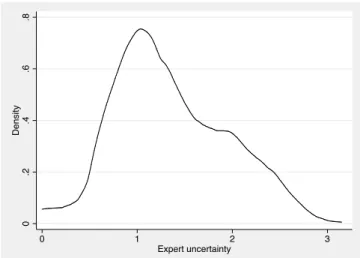
8 Expert uncertainty on European integration (density) . . . 40
9 Marginal effects ofavoidanceon expert uncertainty . . . 46
10 Marginal effects ofambiguityon expert uncertainty . . . 47
11 Marginal effect ofalternationon expert uncertainty . . . 48
12 Ideological cohesiveness by party family, 1999-2014 . . . 51
13 Avoidance of left-right (MARPOR, 1999-2017) byparty family . . . 59
14 Position blurring on left-right (CHES) byparty family . . . 60
15 Avoidance of left-right (MARPOR) byregionalist parties . . . 60
16 Party change on left-right byfamily & dimension . . . 62
17 Regionalist party distance to voter positions on left-right (EPAC, 2017) . . . . 63
18 Regionalist party and voter positions on left-right (EPAC, 2017) . . . 64
19 Party change on European integration by salience . . . 76
20 Party change on individual issues by salience . . . 77
21 Avoidance of European integration byparty age, size, and government status . 83 22 Regionalist party-level salience by dimension . . . 86
CHAPTER 1: INTRODUCTION
The study of party strategy and political contestation is moving in an exciting new direction. Until recently, much of the literature in this field retained a parsimonious, but artifi-cial, unidimensional view of party competition. Increasingly, however, scholars have begun to embrace the inherent complexity and dynamism of the ideological landscape in which parties compete for votes. This dissertation follows this new perspective and deals with the complica-tions of multidimensional democratic representation head on. In particular, it presents a series of chapters that enrich our understanding of party competition with insights from more histor-ical, sociological approaches, all the while generating empirical predictions that are compati-ble with, and directly contribute to, the mainstream literature on party behavior.
The first chapter, entitled “A Change of Heart?,” provides a stepping-stone for the sub-sequent dissertation papers, and develops a novel framework that intimately connects party strategy to the relative importance, or salience, of political issues and dimensions. The domi-nant view of party competition has long been that political parties continuously and strategi-cally alter their policy positions at a dimensional level. At the same time, however, scholars have stressed the historical stability of European party systems, as they reflect deeply-rooted socio-economic divisions in society. This chapter provides one of the first attempts to recon-cile these two perspectives.
measure of the relative salience of an ideological dimension, I show that a party’s reputation and durable ties with its supporters on its more salient dimension limit positional flexibility, while strategic policy shifts are possible on issues outside of its core agenda. This finding not only has important implications for our general understanding of democratic representation, it also predicts why new challenger parties face fewer ideological constraints than mainstream parties when altering their appeals in response to the changing preferences of the electorate. In the second chapter, “Disentangling Blurring,” I explore the interplay between mul-tidimensionality and salience by arguing that parties may, at times, have a strategic incentive to avoid taking clear policy positions at all. Although scholars typically assume that position avoidance is costly, I argue that it could be a viable strategy for a party looking to alleviate potential disagreement among internal party factions or with supporters, especially on issues outside of its main agenda. Building on a growing literature on position blurring, I propose that parties can obfuscate their positions by means of three strategies: avoidance, ambigu-ity, and alternation. I map a party’s strategy by analyzing the content of its manifesto. Re-sults across 14 Western European countries from 1999 to 2017 confirm that all three blurring strategies produce expert uncertainty on the issue of European integration, but that their effec-tiveness is conditioned by a series of party-level characteristics. This chapter has fundamental implications for our understanding of party strategy. In particular, it sheds light on how parties try to manipulate the dimensional structure of party competition.
CHAPTER 2: STABILITY AND CHANGE IN EUROPEAN PARTY POSITIONS
Political parties are the crucial mediator between citizens and their government. In order to properly relay the preferences of their supporters, parties ought to be responsive to changes in public opinion and update their programs accordingly. Undeniably, representa-tive democracy implies a dynamic relationship (Stimson, Mackuen & Erikson 1995). Conse-quently, the current, dominant understanding of parties is that these are adaptive organizations that continuously alter their ideological positions (see Adams 2012).
Examples of such party shifts are plentiful. Observers have noted, for example, how the populist radical right has moved to the ideological center, as exemplified by its embrace of welfare chauvinism (De Lange 2007, Schumacher & Van Kersbergen 2016)—Dutch Prime Minister Mark Rutte even went so far as to claim that the anti-immigrant PVV was now more economically left-wing than the Socialist Party.1 By contrast, many mainstream right-wing parties have moved in the opposite direction, away from the center, on cultural issues (Meguid 2005, Mudde 2013) and European integration (Rohrschneider & Whitefield 2016) in response to the recent surge of these populist challengers. The British Conservative Party, notoriously divided on the European issue, has also grown considerably more Euroskeptic over time (Bale 2006). While Margaret Thatcher’s criticism of the European project once expedited her ouster as Prime Minister (PM) and party leader, PM David Cameron actively campaigned on the promise of a Brexit referendum because he saw no other alternative, stating “What else can I do? My backbenchers are unbelievably Eurosceptic and UKIP are breathing down my neck.”2 All of these examples signal strategic action in a competitive environment that is ever in flux.
However, despite spatial theory’s assumption of “costless spatial mobility” (Adams
1“Rutte: kans op samenwerking met PVV is nul,”NRC, 15 January, 2017.
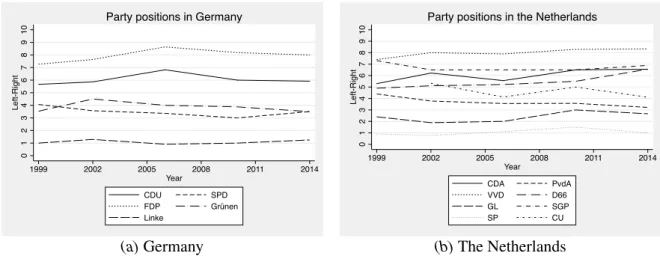
et al. 2006), there is ample reason to believe that parties cannot always move freely (Dalton 2016, Rovny 2015). Consistent and reliable party labels are said to be an essential element of representative democracy, as well (Adams 2001, McKelvey & Ordeshook 1986); they provide a crucial heuristic for vote choice (Downs 1957) and party identification (Campbell et al. 1960) in a context of uncertainty and limited information. Moreover, cleavage theory stresses the resilience of mass-elite linkages and the long-term commitments of parties (Lipset & Rokkan 1967). Finally, the notion of stability also permeates party competition research be-cause Downs’ contemporary successors share his implicit expectation, or even desire, to iden-tify an equilibrium in party positions (Adams 2012, Adams, Merrill & Grofman 2005). In-deed, voter and expert placements of party positions have proven remarkably stable (Adams, Ezrow & Somer-Topcu 2011, Dalton 2016, Dalton & McAllister 2015). For example, Fig-ure 1 depicts party change in Germany and the Netherlands, two systems with differing levels of party system fragmentation.3 Despite Rutte and Cameron’s observation of shifting party positions, the absence of dramatic fluctuations demonstrates that, in the minds of political sci-entists, party profiles are relatively durable.
Fig. 1:Expert placements of German and Dutch parties on left-right, 1999-2014
0 1 2 3 4 5 6 7 8 9 10 L e ft -R ig h t
1999 2002 2005 2008 2011 2014 Year
CDU SPD
FDP Grünen Linke
Party positions in Germany
(a)Germany 0 1 2 3 4 5 6 7 8 9 10 L e ft -R ig h t
1999 2002 2005 2008 2011 2014
Year
CDA PvdA
VVD D66
GL SGP
SP CU
Party positions in the Netherlands
(b)The Netherlands
Can these two opposing perspectives be coalesced? This paper posits that we can ex-plain this apparent contradiction between stability and change in European party positions by embracing the multidimensionality of the policy space in which parties compete (Bakker,
Jolly & Polk 2012, Rovny & Polk 2018). Specifically, and in line with Meguid’s seminal work (2005, 2008), I argue that we need to account for the role of salience, as positional stability is most likely observed on a party’sprimary, most important dimension, while party change is largely confined to issuessecondaryto its core agenda. Building on cleavage theory, I as-sume that parties are born out of, and rooted in, underlying social conflicts and have histori-cally come to represent specific issuesandvoters. As a result, they have a reputation to up-hold and defend on the ideological dimension deemed most salient to them and their sup-porters (Hooghe & Marks 2018). At the same time, by remaining ideologically true to their voters’ primary concerns, parties are able to strategically shift on issues of lesser salience. These shifts allow parties to maximize their vote share without alienating core constituents. Arguably, the aforementioned examples of parties’ changing ideological stances indeed con-cern issues and dimensions that are less important to them, from the populist radical right’s economic agenda to the mainstream’s position on European integration.
I test my hypothesis that positional change is more likely on a party’s secondary di-mension by using cross-sectional time series analysis on novel trend file data from the Chapel Hill Expert Survey (CHES) covering fourteen Western European countries from 1999-2014 (Bakker et al. 2015, Polk et al. 2017).4 Manifesto data (MARPOR) is used to develop a ra-tio measure that gauges the relative salience of an ideological dimension to a party (Volkens et al. 2015). The results confirm my expectations, indicating that party change increases as an ideological dimension’s party-level salience decreases, and vice versa, particularly for small to medium-sized and non-governing parties. Alternative operationalizations of the depen-dent and independepen-dent variables, which rely on various configurations of manifesto and expert survey data, produce similar results (see Appendix 2.3-2.5). Although this paper focuses on Western Europe for reasons of data availability, my findings should travel to most established democracies with a history of programmatic politics.
Given the pivotal role of political parties for democratic governance, it is essential to accurately map the ideological profiles of these political actors. For example, how do
ologically constrained parties respond to discontent among their supporters or the rise of new populist challengers? This paper advances our theoretical understanding of party strat-egy and democratic representation by moving away from unidimensionality, thus enhancing our spatial models with realistic insights from both salience and cleavage theory. If party positions are, in fact, more constrained than commonly assumed, this has important impli-cations for our understanding of mass-elite linkages, especially in a time when public dis-affection is believed to be widespread and at an all-time high across Western Europe (e.g. Hay 2007, Mair 2008, Putnam 2000).
A theory of party change and stability
The study of how political parties compete has a rich and impressive tradition in the field of comparative politics. Since Downs’ (1957) classic work on the median voter theo-rem, political scientists have made major advances in understanding how parties locate them-selves in the political landscape and what factors lead them to alter their ideological positions. Spatial models—which view party competition through a positional lens, with parties offer-ing alternative policy proposals to the electorate—have become increasoffer-ingly sophisticated and comprehensive (see, e.g., Adams, Merrill & Grofman 2005, Budge 1994, Lin, Enelow & Dorussen 1999, Schofield 2007). Similarly, recent empirical studies now account for a wide range of phenomena, including the office and policy-seeking behavior of parties, the multi-facetedness of voter preferences, and the transformative nature of the policy space (B´elanger & Meguid 2008, Hooghe, Marks & Wilson 2002, Kriesi et al. 2006, Meguid 2005).
this view is not exclusive to academic literature; in popular media, too, we are used to reading about flip-flopping politicians, increasingly polarized legislatures, and an ever-growing gap between parties and their (alienated) supporters.
Unsurprisingly then, change is the norm in contemporary models of party competition, not stability. Especially in longitudinal work, theory and data come together to paint a picture of party systems operating in a constant—or even increasing (Chiaramonte & Emanuele 2017, Hern´andez & Kriesi 2016)—state of flux.
On the formation of party systems and legacies
Yet, for all the attention given to what makes parties move, relatively few studies have been devoted to what makes them stay put.5 An alternative perspective exists, however, that stresses the relative durability of party-voter commitments. Cleavage theory is based on the assumption that party systems reflect the underlying social conflicts in society, shaped (and upset) only by infrequent critical historical junctures. While not addressing party competition directly—at least not in the way we typically think of it, as a dynamic system of action and reaction in a competitive environment—this framework nevertheless raises valuable insights for the study of party strategic behavior, in particular by highlighting the causal factors that promote stability and constraint in party positions.
In their pivotal work, Lipset & Rokkan (1967) trace the origins of party system de-velopment to persistent tensions in society between socio-economic, religious, and politi-cal groups, produced by the transformative nature of the national and industrial revolutions. Although not all of these divisions proved equally resilient, or shaped national politics to the same degree across Western Europe, their theory crucially points our attention to the underlying—dimensional—structure of party competition.
Indeed, most scholars of European politics now agree that “multidimensionality
not be evaded in political practice” (De Sio & Weber 2014, 870).6 A second, or even third, dimension needs to be added to the ubiquitous economic left-right divide.7 While going by many different labels, the meaning of this second dimension typically encompasses cultural issues, including (though not limited to) immigration, law and order, and environmental poli-tics (Hooghe, Marks & Wilson 2002, Inglehart 1990, Kitschelt 1994, Kriesi et al. 2012).8
As such, cleavage theory draws two major conclusions, namely that (1) the politi-cal space in Western European democracies is arguably best described by more than one di-mension, and (2) parties emerge from specific cleavages in society and are, thus, the primary representatives of distinct voter groups. Parties develop meaningful and lasting issue reputa-tions over time, and these historical legacies can produce strong linkages with their support-ers. In the words of Lipset and Rokkan, “parties do not simply present themselvesde novo to the citizen at each election; they each have a history and so have the constellations of al-ternatives they present the electorate” (Lipset & Rokkan 1967, 2). What is more, such repu-tations can be revived or strengthened over time, e.g. through a party’s performance in gov-ernment, and these long-standing images can crucially shape party competition (B´elanger & Meguid 2008).9 In fact, salience theory argues that competence can become the fundamental criterion by which parties compete for the electorate’s vote (Stokes 1963; see also Budge & Farlie 1983, Egan 2013, Petrocik 1963).
Nevertheless, whether it is by virtue of deeply-rooted societal divisions or less distant track records in office, both cleavage and salience theory shed light on the importance of
his-6For a counter-argument, see Van der Brug & Van Spanje (2009).
7Different cleavages have been said to constitute a third dimension of political contestation, e.g. on the in-clusiveness of polity (or ‘group’) membership (Kitschelt & Rehm 2014), or European integration (Bakker, Jolly & Polk 2012), but these three-dimensional accounts of party alignments are less common.
8It is important to note, however, that the cleavage structure of party competition is ultimately national in nature, and additional dimensions may come to shape politics in a given country—in fact, the dominant dimen-sion might be of a third kind, such as the center-periphery cleavage. In countries such as Belgium and the United Kingdom, for instance, territorial issues have increasingly come to shape domestic politics. But my focus is on the two dimensions that can be found in every Western European country, namely the economic and the cultural axes of contestation.
torical reputations for political contestation. By shaping a party’s public profile, party legacies can inform expectations among (potential) supporters and influence their voting behavior. In contrast to the strategic interactions in a Downsian framework, these party-voter linkages are expected to be durable and to foster stability over multiple election cycles.
Party strategy in a multidimensional environment
How can we integrate these opposing perspectives of party change and stability? I propose an ontology of party competition that unites the two schools in a unified framework and accounts for the limitations on parties’ strategic actions. Rather than seeing the two ap-proaches as mutually exclusive, the Downsian and Rokkanian models of party behavior can complement each other (Rovny 2015). In a multidimensional competitive environment, par-ties encounter ideological dimensions with varying levels of salience. This relative salience differential produces aprimaryand asecondarydimension, and will inevitably inform a party’s strategic behavior. In the words of Schattschneider, a party is “a coalition of inferior interests held together by a dominant interest” (1960).
Building on cleavage theory, parties are expected to be rooted on their primary dimen-sion. Not only does a party place more salience on its related issues, it has a core constituency of voters with whom they are connected through a given cleavage and the durability of this linkage is self-enforcing (Hooghe & Marks 2018).10 Party activists and future leaders are recruited from this very cadre of supporters, they share a common sense of belonging, and they are part and parcel of the intra-party decision-making process. To the extent that they are policy-seeking, which might depend on the internal balance of power between leaders and ac-tivists (Schumacher, De Vries & Vis 2013), party change could be perceived as “selling out” the party’s policy objectives for short-term electoral gains (Adams et al. 2006). The degree of ‘rootedness’ may vary, but every party will experience relative immobility on its primary dimension, which at best allows it to seek out local maxima to secure votes. Parties have a
reputation to uphold and defend, and this makes positional change far more risky, undesirable, and, thus, less likely.
But how do parties act on their secondary dimension? Interestingly, most studies of party competition today still rely on a unidimensional framework (e.g. Ezrow et al. 2011, Tomz & Houweling 2008), not only to aid in the parsimoniousness of their models but, like Downs, in order to abstract an equilibrium in party positions (Adams, Merrill & Grofman 2005, De Sio & Weber 2014). Yet, as mentioned before, a simple, unidimensional model of party competition does not capture and explain the positional differences between parties. Moreover, recent research has shown that the use of a two-dimensional strategy is common-place in Western Europe, as most parties actively engage with their secondary dimension (Elias, Sz¨ocsik & Zuber 2015, Rovny 2015).
Hence, in recent years a growing number of studies has come out that analyzes party change in a context of multidimensionality (e.g. Rovny 2012, Rovny & Edwards 2012).11 While parties are undeniably more rooted and vested in their primary cleavage, they cannot fully ignore the other dimensions of the policy space. That said, they are not without agency, either (Elias, Sz¨ocsik & Zuber 2015). Specifically, one would expect fewer positional con-straints on a party’s secondary dimension, as it is not burdened by long-lasting party-voter linkages. As Elias, Sz¨ocsik & Zuber put it (2015: 841), “a party’s reputation and its goal to gain and defend issue ownership limit its strategic flexibility on its primary dimension. In contrast, parties have more strategic flexibility on their secondary dimension” (see also Alonso 2012).
Consequently, this leaves room for parties to attempt to increase their vote share. A range of strategies has been identified in the literature, such as moderating one’s position, zigzagging ideologically, changing course only when faced with electoral losses, or
ing and capitalizing on the largest party’s gains (Laver 2005).12 All of these alternatives ul-timately serve to maximize electoral support and alleviate internal and external pressures on the party leadership.13 A party could, for instance, approach the median voter on its secondary dimension in an attempt to broaden its appeal to include more centrist voters. Moreover, if parties are not unitary actors but rather are internally factionalized, party change can be used to assuage intra-party dissent (Budge, Ezrow & McDonald 2010).
Taken together, the above theoretical framework asserts that the constellation of par-ties is neither invariably volatile nor persistently static. The party systems of Western Europe are certainly not frozen, and change is possible, both through the entry of new parties and the (strategic) positional shifts of existing ones. However, neither should we expect the complete fluidity and inevitability of disequilibria that is so often assumed to stem from multidimen-sionality (Arrows 1951, De Sio & Weber 2014, Laver & Sergenti 2012). This leads me to for-mulate the following hypothesis:
Hypothesis: The greater the relative salience of a party’s position on its focal dimension, the less flexible its position on that dimension.
Although the hypothesized relationship between salience and party change is relevant for understanding the behavior of all parties, its predicted effect is expected to be strongest for a particular subset of parties. First, larger parties are likely to have broader issue agen-das (Wagner & Meyer 2014), potentially making the difference between their primary and secondary dimension smaller. Second, parties in government have no reason to upend the sta-tus quo by introducing new patterns of conflict (Van Heck 2018), nor can they avoid taking clear policy stances (Rovny 2013). Relatedly, government participation is arguably the most effective way for a party to establish issue ownership, including on issues outside of its core agenda, which makes its program less narrow and diminishes the difference between a party’s
12Typically, only one of the identified strategies has stability at its core. So-called “stickers” are not interested in the dynamic interactions with voters or rival parties, and they will stay true to their original position.
primary and secondary dimension (Greene 2016). Finally, as extremist parties might empha-size their non-centrist positions (Wagner 2012), this could produce more pronounced and specialized issue appeals, resulting in more constraint on their primary dimension yet more flexibility on their secondary dimension. This does assume that extremist parties have broad enough platforms to address both dimensions, including issues outside of their core agenda, which might not always hold true (see, e.g. Bischof 2017).
Data & method
The above hypothesis is tested using pooled time-series analysis on novel trend file data from the Chapel Hill Expert Survey (CHES) spanning five waves from 1999-2014 (Bakker et al. 2015, Polk et al. 2017). The ideological positions of close to one hundred parties from fourteen Western European countries are included here: Austria, Belgium, Denmark, Ger-many, Greece, Finland, France, Ireland, Italy, the Netherlands, Portugal, Spain, Sweden, and the United Kingdom.14 The dataset contains expert evaluations of political parties and their ideological positions on a range of issues and dimensions, including the economic left-right dimension and the cultural GAL-TAN, or Green/Alternative/Libertarian-Traditional/ Authori-tarian/Nationalist dimension (both ranging 0-10).
The validity and reliability of party position data has been debated extensively over the years. I opt to use expert data, because this data source has been rigorously tested, cross-validated, and shown to perform as well as, if not better than, other measures, such as mass survey and manifesto data (Marks et al. 2007, Steenbergen & Marks 2007). Existing survey data unfortunately do not allow me to effectively study how voters evaluate the multidimen-sional positions of political parties over time, but expert and voter placements of party posi-tions have been shown to be strongly correlated (Dalton & McAllister 2015), which not only adds to the reliability of my study but also its relevance, as the positional shifts discussed here are also picked up by voters. While it has been argued that experts are more prone to detect continuity in party positions than other observers (McDonald, Mendes & Kim 2007), as they
‘merely’ update their perceptions of party reputations, using expert survey data is neither an overly optimistic nor a decisively conservative test because I am ultimately analyzing both stability and change in party positions. Finally, although the main alternative data source, manifesto data, is widely considered to be a valid and direct measure of the importance of is-sues for political parties, it has received criticism for conflating salience with position (Geme-nis 2013; see also M¨older 2016). Consequently, I use manifesto data to measure salience (see below). Multiple robustness checks using alternative measures for the dependent and indepen-dent variables, including party positions based on manifesto data, confirm the main finding of this paper (see Appendix 2.3-2.5).
Having introduced my main dataset, I will now discuss the measurement of my key variables. A complete overview of their operationalization can be found in Table 1.
Dependent variables
In order to test my hypothesis, I need a measure of party position change so as to map ideological flexibility on different dimensions. Because I am not interested in the direction of change, I use theabsolutedifference in the average expert evaluation of a party’s position from one wave to the next—both on the economic left-right and the non-economic GAL-TAN dimension.15 In other words, the higher a party’s score on the dependent variable, the greater its positional change on this dimension as compared to the previous time point—regardless of the direction of change. I run separate models for each dependent variable.
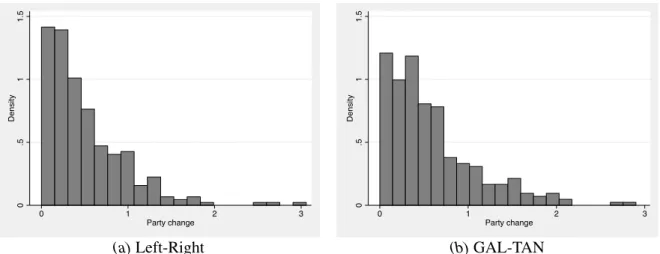
Figure 2 presents the histograms for both dependent variables. Overall, party change is more substantial on GAL-TAN than left-right, as the former’s distribution is less skewed towards zero. However, the statistics for both measures are similar despite the distinctiveness of the two dimensions, with the economic left-right dimension being ubiquitous and coherent across Europe, whereas GAL-TAN is generally considered to be more of a theoretical con-struct that encompasses a wide range of issues. This is a welcome finding, as it suggests that party behavior on left-right and GAL-TAN is more comparable than anticipated.
Fig. 2:Histograms for measurement of party change byideological dimension
0
.5
1
1.5
D
e
n
si
ty
0 1 2 3
Party change
(a)Left-Right
0
.5
1
1.5
D
e
n
si
ty
0 1 2 3
Party change
(b)GAL-TAN
Independent variables
So how can one best distinguish between a party’s primary and secondary dimensions? For this paper, the focus is on salience, or the relative importance of a given issue or dimen-sion to a party, as its relationship with cleavages is well established in the literature (see, for example, Hooghe & Marks 2018). The most straightforward strategy would be to rank the two dimensions by salience for each individual party. For some parties this might be a straight-forward exercise, but for others parties it can be more challenging to make this assessment. For instance, GAL-TAN is certainly the primary dimension for Green and populist radical right parties, but what about for the Christian democrats? Certainly, part of their conservative image comes from their positions on social issues, but their economic profile is often clearly pronounced, as well. As a result, I propose to identify the primary and secondary dimension of a party using quantitative means. Not only is this method more transparent, but also it al-lows for more variation. Instead of creating a strict dichotomy between a party’s primary and secondary dimension, one can measure the relative ‘primariness’ of each dimension and its relationship with party change.
importance of an issue area to a party (as a percentage of the entire manifesto). By aggregat-ing (most of) these categories into clusters, the salience of entire ideological dimensions can be mapped.
The exercise of abstracting ideological dimensions from party-level data is a con-tentious one. Ultimately, the policy space in which parties compete is not directly observable, meaning that no ‘true’ map exists. Yet, following the recommendations of Benoit & Laver (2012), we can use oura prioriassumptions to guide us in the estimation process. Thus, I ab-stract two dimensions from the 56 MARPOR categories. The employed categorization can be found in Table 6 (Appendix 2.1), which builds on existing work (e.g. Spies & Franzmann 2011, Stoll 2010). However, because I am not limited to directional items only, my coding scheme is more inclusive, with 20 issue categories per dimension. Each category carries equal weight in my calculations, as weighting methods are inherently focused on the party system and not the individual party (cf. Bakker & Hobolt 2013). I use the ratio between the two di-mensions to gauge relative salience at the time of the most recent national election, with the variable ranging from 1 (manifesto solely about left-right) to -1 (all about GAL-TAN). For example, if Party A devotes 70% of its manifesto to left-right issues and only 30% to GAL-TAN, it would receive a score of 0.40, which, because it is positive, indicates that economic issues are relatively more salient to the party than cultural issues.16
Finally, since a party does not have full control over its own issue agenda, as other par-ties also shape the public debate (Green-Pedersen & Mortensen 2010), I account for ‘systemic salience’ by subtracting the party system average from the above score, excluding the party’s own salience score.17 A positive score means that a party puts relatively more emphasis on economic issues than the other parties, while a negative score indicates that cultural issues are relatively more salient.
16(70−30)
(70 + 30) = 0.40
Control variables
I include multiple control variables in my model. I expect larger parties, measured by vote share in the last national election, to be less mobile, because significant electoral success leads to a more complex and professional organization whose ideological course is harder to change. Similarly, ‘older’ parties should have more established reputations and, thus, less flexible positions. Next, I account for participation in government. Wielding executive power binds a party by its actions in government, because voters hold them accountable. Moreover, from a Rikerian perspective, a party has less of an incentive to alter the status quo when it en-joys frequent access to government. Instead, political losers who are excluded from office do seek to promote new conflict in an attempt to turn their electoral fortunes around. Both factors should limit party change on the primary and secondary dimensions for government parties. An indicator variable records whether a party was in government during the previous wave. Because parties operating at the fringes of the political landscape have more room to maneu-ver, I control for the effect of ideological extremism, assessed by a party’s distance from the center.18 In addition, there is an extensive literature on the relationship between party organi-zation and positional change. That is, leadership-dominated parties are assumed to be more strategic, office-seeking, and ideologically flexible than organizations in which the balance of power is tipped in favor of policy-seeking activists (Schumacher, De Vries & Vis 2013). I include a control variable for party organization (Rohrschneider & Whitefield 2012), with higher scores indicating leadership dominance in setting party policy. Finally, as discussed, several of the above control variables have the potential to moderate the effect of salience on party change. For that reason, I include interaction effects that model the relationship between salience and party size, government status, and ideological extremism, respectively.
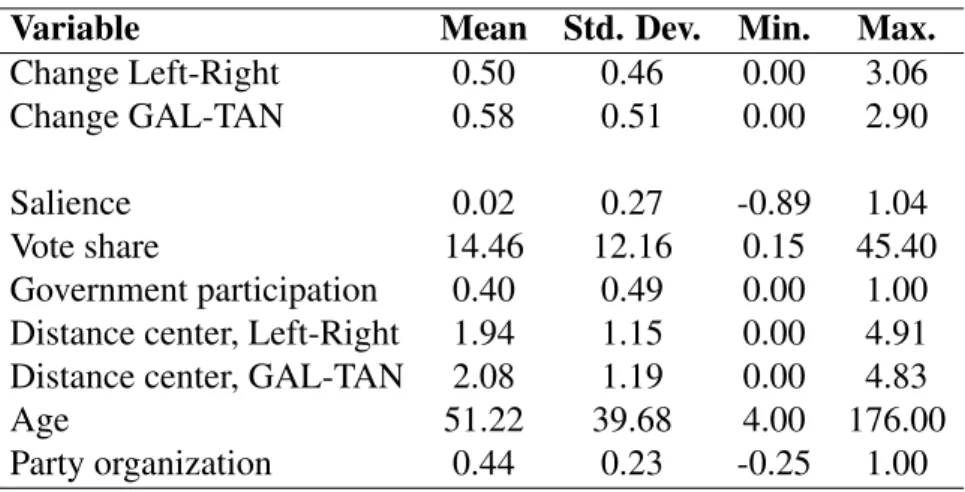
Table 2 presents the summary statistics for my dependent and independent variables. As noted above, my two dependent variables produce very similar statistics. These results could be interpreted to mean that party positions are more stable on ideological dimensions compared to individual issues due to the level of aggregation. That is, party change could
pear less likely when adopting a dimensional approach because of the clustering of a multi-tude of issues, with positional changes canceling each other out. It turns out, however, that party change across aggregated dimensions and individual issues is highly comparable.
Table 2:Descriptive statistics (Chapter 2)
Variable Mean Std. Dev. Min. Max.
Change Left-Right 0.50 0.46 0.00 3.06
Change GAL-TAN 0.58 0.51 0.00 2.90
Salience 0.02 0.27 -0.89 1.04
Vote share 14.46 12.16 0.15 45.40
Government participation 0.40 0.49 0.00 1.00 Distance center, Left-Right 1.94 1.15 0.00 4.91 Distance center, GAL-TAN 2.08 1.19 0.00 4.83
Age 51.22 39.68 4.00 176.00
Party organization 0.44 0.23 -0.25 1.00
The main independent variable, which gauges the party-level salience ratio of left-right to GAL-TAN issues, varies considerably, despite being anchored by the party system average. The highest score (1.04) belongs toNea Dimokratiain 2014, as it devoted most of its manifesto to economic issues while the average across the other included Greek parties was slightly negative (-0.15). The lowest three scores, on the other hand, are all held by theDansk Folkeparti(≤ −0.79), as it places great emphasis on GAL-TAN issues, especially compared to the other parties. Figure 3 shows the average salience scores by party family. As expected, radical right and green parties focus primarily on cultural issues, while the economy takes precedence for most mainstream parties as well as the radical left.
Conserva-tive Party’s 176 in 2014.19 Finally, few included parties are strongly activist-dominated, as indicated by both the mean (0.44) and the range (-0.25, 1.00). This means that, typically, the party leadership is dominant in determining the organization’s course. A correlation matrix for all included variables can be found in Table 7 (Appendix 2.2).
Fig. 3:Salience of Left-Right to GAL-TAN byparty family
GAL-TAN -.5 0 .5 Left-Right
Salience Socialist
Radical left Conservative Christian democrat Regionalist Liberal Green Radical right
Model specification
I run a cross-sectional time series analysis with party-year as the unit of observation. My dependent variables are first-differenced, tracking party change on each dimension from one wave to the next. This allows me to analyze the direct effect of a dimension’s salience level onY. The generalized model can be specified as follows:
|∆positioni,t|= α+β1saliencei,t +β2controlsi,t + i,t (1)
It is important to note that while my dependent variables are differenced, my main in-dependent variable is not. That is, I use thelevelof a dimension’s salience during the most re-cent national election prior totto explain party change (t−t−1), not thedifferencein salience
betweentandt−1. The reason for this is that I expect a party to consistently move around
more on a dimension that is less salient, even when the level of salience of that dimension does not change. Put differently, complete stability on the independent variable can lead to great fluctuations on the dependent variable, especially when there is a clear salience differen-tial between left-right and GAL-TAN.
Tests show that the residuals at timet−1 are a good predictor of the residuals att,
indi-cating a problem with serial correlation, specifically of the panel-specific AR(1) type. Instead of using the traditional correction that leads one to include a lagged dependent variable on the right-hand side, I use the Prais-Winsten solution, as recent work has shown that the former approach can lead to bias and wash out the effect of the variables that are of theoretical inter-est (Pl¨umper, Troeger & Manow 2005).20 Finally, tests also indicate that my data suffer from panel-level heteroskedasticity. This is perhaps not surprising, given the multitude of parties, nested within countries, that compose my dataset. I therefore use corrected standard errors in my analysis.
Analysis
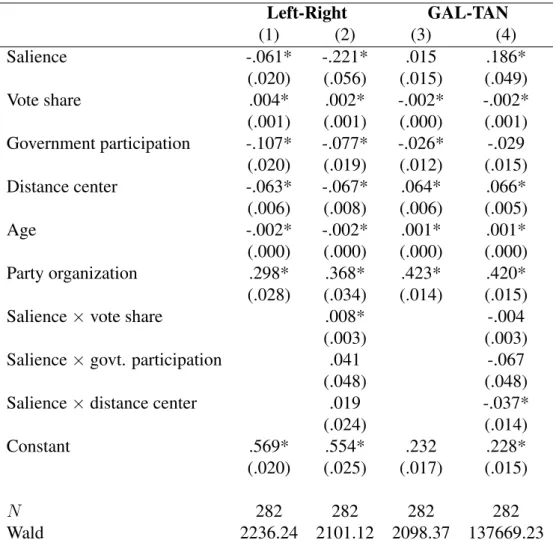
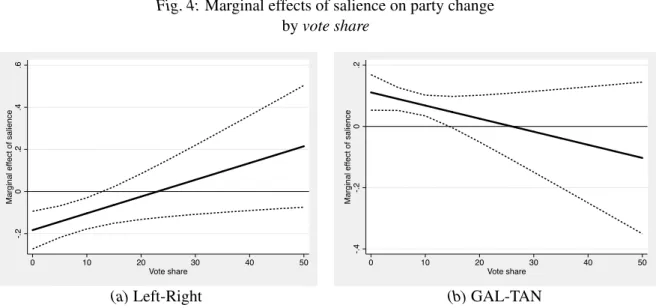
Table 3 presents the results of my analyses for both dependent variables. Models 1 and 3 provide a baseline for my main specifications of interest, models 2 and 4. These full models include the interaction terms with vote share, government participation, and ideological ex-tremity to study the conditional effect of salience on party change. Starting with the left-right dimension, we see that as the relativesalienceratio of economic to cultural issues increases in comparison to the party system average, positional change decreases. The effect is reversed on the GAL-TAN dimension. That is, party change becomes less likely when a dimension’s salience increases. The coefficient estimate for salience is consistently smaller in the baseline models, and only statistically significant for party change on the left-right dimension. This is not surprising, however, as these models do not account for the conditioning effect of the
interaction terms. A party’s vote share and participation in government, in particular, are ex-pected to abate the effect of salience on party change.
Table 3:Regression analysis of absolute party changes, 1999-2014
Left-Right GAL-TAN
(1) (2) (3) (4)
Salience -.061* -.221* .015 .186*
(.020) (.056) (.015) (.049)
Vote share .004* .002* -.002* -.002*
(.001) (.001) (.000) (.001) Government participation -.107* -.077* -.026* -.029
(.020) (.019) (.012) (.015)
Distance center -.063* -.067* .064* .066*
(.006) (.008) (.006) (.005)
Age -.002* -.002* .001* .001*
(.000) (.000) (.000) (.000)
Party organization .298* .368* .423* .420*
(.028) (.034) (.014) (.015)
Salience×vote share .008* -.004
(.003) (.003)
Salience×govt. participation .041 -.067
(.048) (.048)
Salience×distance center .019 -.037*
(.024) (.014)
Constant .569* .554* .232 .228*
(.020) (.025) (.017) (.015)
N 282 282 282 282
Wald 2236.24 2101.12 2098.37 137669.23
Table entries are Prais-Winsten regression coefficients corrected for panel-level
heteroskedasticity and standard errors (in parentheses).
∗indicates significance atp <0.05
Of the included control variables,vote shareandagehave statistically significant co-efficients, but with effect sizes that are marginal and not of substantive interest. Interestingly, while ideologically extremist parties are more likely to change position on GAL-TAN, they are actually less likely to do so on the left-right dimension. This is an intriguing finding that warrants further exploration. Finally, the effect of party organization on positional change is very convincing, with leadership-dominated parties being far more likely to alter their ide-ological positions than their more activist counterparts. This is true on both dimensions and corroborates the findings of recent studies (e.g. Schumacher, De Vries & Vis 2013).
Fig. 4:Marginal effects of salience on party change byvote share
-. 2 0 .2 .4 .6 Ma rg in a l e ff e ct o f sa lie n ce
0 10 20 30 40 50
Vote share (a)Left-Right -. 4 -. 2 0 .2 Ma rg in a l e ff e ct o f sa lie n ce
0 10 20 30 40 50
Vote share
(b)GAL-TAN
Al-though this may seem low, well over half of my party-year observations fall below this thresh-old, meaning that the marginal effect of salience is not statistically significant for relatively large parties.
Next, Figure 5 graphs the marginal effect ofsalienceon party change by government participation for each dimension. As before, the other interacting variables, vote and distance from center, are set at their respective median values, 8.1 and 2. Once a party enters govern-ment, it inevitably needs to expand, and concede partial control over, its own issue agenda. This reduces the salience differential between a party’s primary and secondary dimension and decreases its marginal effect on party change—or, in the case of the GAL-TAN dimension, makes it statistically indistinguishable from zero.
Fig. 5:Marginal effects of salience on party change bygovernment participation
-. 2 -. 1 5 -. 1 -. 0 5 0 Ma rg in a l e ff e ct o f sa lie n ce 0 1 Government participation (a)Left-Right -. 1 -. 0 5 0 .05 .1 Ma rg in a l e ff e ct o f sa lie n ce 0 1 Government participation (b)GAL-TAN
with a narrow platform, thus reducing the effect of a dimensional salience differential. Alter-natively, perhaps there is a ‘ceiling effect’ that prevents extremist parties from moving fur-ther away from the center (Somer-Topcu 2015), which would also lead to a decrease in the marginal effect of salience on party change. Nevertheless, this is an interesting finding that warrants further investigation.
Fig. 6:Marginal effects of salience on party change bydistance from center
-. 3 -. 2 -. 1 0 .1 Ma rg in a l e ff e ct o f sa lie n ce
0 1 2 3 4 5
Distance from center
(a)Left-Right -. 1 0 .1 .2 .3 Ma rg in a l e ff e ct o f sa lie n ce
0 1 2 3 4 5
Distance from center
(b)GAL-TAN
turn, explain my findings. The correlation between party change and the standard deviation in expert evaluations is weak, however.21 Together, these robustness checks increase my confi-dence in the main finding reported in this study.
Discussion
The study of party competition is crucial for our understanding of representative democracy. While much of the party competition literature has focused on the causes and magnitude of party change, voter and expert placements of parties have drawn attention to the perceived stability in parties’ ideological positions. Building on insights from cleavage theory, this paper has attempted to provide a reasonable solution to reconcile these opposing per-spectives. By accounting for the multidimensionality of the policy space in Western Europe and the pivotal role of historical party legacies, we can distinguish between a party’sprimary andsecondarydimension, and we can start to assess their importance for the study of party change. Parties cannot always reposition themselves without effort, cost, or punishment, as formal theorists typically assume (Adams et al. 2006). Rather, they are expected to be rooted on their primary dimension, as their reputation and relatively strong party-voter linkages put considerable limitations on ideological flexibility, whereas fewer constraints exist on their sec-ondary dimension, allowing for more strategic, vote-maximizing behavior. Certainly, parties can and do change positions on their core dimension (Adams et al. 2006, Ezrow et al. 2011), but I have argued that such (potentially high profile) policy shifts are relatively less common and auspicious.
The results of my analyses are robust across a variety of alternative operationalizations and confirm the hypothesis that party change becomes less likely as the party-level salience of an ideological dimension increases. Indeed, on the left-right dimension for instance, the three largest positional shifts in my data set were all made by populist radical right parties (party change>2), namely the DutchPartij voor de Vrijheid, the FrenchFront National, and the AustrianFreiheitliche Partei ¨Osterreichs—parties for whom the GAL-TAN dimension
was considerably more salient than left-right compared to the rest of the party system. On the other hand, the three smallest positional changes between waves on the economic dimension (change<0.02) all concerned mainstream parties: The SpanishPartido Popular, the Swedish Socialdemokraterna, and the DutchPartij van de Arbeid.
Theoretically, this paper follows a line of recent research that has started to test and expand on some of the most fundamental assumptions on which our models of party compe-tition rest (Hobolt & De Vries 2015, Rovny 2013, Schumacher, De Vries & Vis 2013). Al-though these assumptions have served us well, this paper moves the literature in a new direc-tion. It is by no means unique in its endeavor to join spatial and salience theory (e.g. Meguid 2005), but it is one of the first attempts to formulate a concrete set of predictions grounded in both Downsian and Rokkanian insights (Rovny 2015). Its focus on multidimensional-ity and the subsequent salience differential provides a new lens for studying party strategy across ideological dimensions that have varying levels of importance. This paper has made a methodological contribution to the field by utilizing the strengths of two widely used mea-sures of party behavior, namely expert survey and manifesto data. MARPOR data (Volkens et al. 2015) provided a valid measure of dimensional salience and its importance for explain-ing the positional shifts of parties, tracked usexplain-ing CHES data (Bakker et al. 2015, Polk et al. 2017).
CHAPTER 3: POSITION BLURRING IN A MULTIDIMENSIONAL CONTEXT
Citizens choose. They vote. [. . . ] Politicians also choose. [. . . ] They choose sometimes to highlight their acts by seeking publicity for them. At other times, they obscure them by acting quietly, perhaps by taking positions that are contra-dictory or confusing.
— Erikson, MacKuen & Stimson (2002, 9)
In 1997, the British Conservative Party devoted roughly one in every fifteen quasi-sentences in its manifesto to the European Union and its relationship with the United King-dom (UK). Its position on European integration was by no means unambiguous, however. On the one hand, the party called for a “flexible Europe” and supported “the aspirations of the Poles, Czechs, Hungarians and others to join the European Union.” At the same time, it ar-gued that “a nation’s common heritage, culture, values and outlook are a precious source of stability,” and it would therefore “retain Britain’s veto and oppose further extension of qual-ified majority voting in order to [. . . ] prevent policies that would be harmful to the national interest.” This mixed message was perhaps best summarized by the adage: “We want to be in Europe but not run by Europe.” More recently, observers have called out the contradictory positions of the Labour Party on Europe in the wake of the Brexit referendum, as its leader, Jeremy Corbyn, stated that he “favoured remaining in a customs union to preserve the free movement of goods and a soft border within Ireland, but rejected staying in the single market because of its neoliberal aspects.”22
Why would a political party adopt an equivocal position? Although scholars typically assume that position blurring is costly (Bartels 1986, Franklin 1991, Shepsle 1972), a grow-ing literature suggests that, at times, party leaders have an incentive to deliberately eschew from clear position taking, especially on issues they are less invested in (Elias, Sz¨ocsik &
Zuber 2015, Rovny 2012, Rovny 2013). For instance, a party could opt to shun an issue on which its voters are divided or, alternatively, it might try to broaden its support by reaching out to opposing ideological camps through otherwise inconsistent policy statements. Recent work has therefore started to examine the relative uncertainty about parties’ ideological po-sitions, because it could be a product of their attempts to manipulate the structure of political competition (Rovny & Edwards 2012).
It is unclear, however, how a party blurs its positions. This study breaks new ground by analyzing the ways in which a party seeks to create uncertainty about where it stands on an issue, and their relative effectiveness. I show that three distinct blurring strategies can be identified—avoidance, ambiguity, and alternation—but that their desirability and feasibility vary by party. Cross-sectional time series analyses across fourteen Western European democ-racies from 1999-2017 confirm that issue evasion, conflicting positions, and altered policy appeals all increase uncertainty about party positions on European integration.23 Yet, avoid-ance is a less effective strategy when a party has a more established reputation, for example because it is electorally successful or part of a government coalition, while ambiguity is of limited use to a party that is ideologically moderate or leadership-dominated. Finally, alterna-tion is more appropriate when an issue is less salient to a party. I use expert disagreement as a proxy for voter uncertainty, which, if we assume that experts are the most informed observers, provides a conservative test of my predictions.
Globalization, European integration, socio-economic developments, immigration, and a new information environment are dramatically transforming European society and poli-tics. Voting behavior is now less predictable (Knutsen 2005, Thomassen 2005), party-voter linkages are weakening (Mair 2008, Mair & Van Biezen 2001), and individual issues are in-creasingly shaping politics (Green-Pedersen 2007). While some scholars have focused on the opportunities that a changing political landscape, and its new lines of conflict, can offer to especially the losers of the existing status quo (Carmines & Stimson 1986, Hobolt & De Vries 2015, Riker 1986, Van de Wardt, De Vries & Hobolt 2014), there is an increased
ness for the uncertainty and risks involved with multidimensional party competition. This study contributes to the position blurring literature by showing how, and under what condi-tions, ‘blurring’ strategies can produce ‘blurred’ outcomes.
The policy promises of political parties and candidates are an essential component of democratic representation and responsiveness, because policymakers are expected to do what citizens want them to do (Dahl 1989, Huber & Powell 1992). Political parties are the interme-diary that responds to public opinion (Adams et al. 2004, Stimson, Mackuen & Erikson 1995) and, in return, citizens vote for the party that is ideologically most proximate to them (Downs 1957, Enelow & Hinich 1984, Tomz & Houweling 2008). Although position blurring is not new, nor is theorizing about politicians’ motivations to do so (Alesina & Cukierman 1990, Aragon`es & Neeman 2000, Callander & Wilson 2008, Meirowitz 2005), it has become a more useful and attractive strategy for party leaders in a time when party competition is increas-ingly volatile, unpredictable, and multidimensional. In this context, it is important to under-stand how a party may use position blurring to insulate itself from political accountability and electoral punishment.
Why do parties blur?
this perspective, obfuscation is logically expected to be costly, if not downright detrimental, to a party’s electoral fortunes (Bartels 1986, Franklin 1991, Shepsle 1972).
Yet, the political environment in Western Europe has changed dramatically since the 1970s, as politics has become more volatile (Knutsen 2005, Mair 1997, Thomassen 2005) and new cross-cutting cleavages now structure the relationships between citizens and elites (Hooghe & Marks 2018, Hooghe, Marks & Wilson 2002, Inglehart 1990, Kitschelt 1994, Kriesi et al. 2012). Although multidimensionality is still frequently avoided in party competi-tion research (e.g. Adams & Somer-Topcu 2009, Budge, Ezrow & McDonald 2010, Ezrow et al. 2011), it is clear that the policy space in which parties compete is no longer fixed. Rather, it is in flux and diversifying the political agendas of voters and parties alike. This presents party leaders with a challenging question: how to position the party on policy issues that fall outside of its core agenda?
As scholars have begun to analyze how parties try to manipulate the increasingly fluid structure of political contestation in their favor (Green-Pedersen & Mortensen 2010, Rovny & Edwards 2012), two different perspectives are worth highlighting here. First, one can identify a more aggressive, risk-seeking approach that aims to promote conflict on an emerging issue to divide a party’s competitors while strengthening its own position. Extending the seminal work by Riker (1986), an exciting body of research explores how new issues and dimensions can be exploited by a party to upend the status quo (see also Carmines & Stimson 1986). The introduction of a new axis of political conflict can be beneficial especially to the current losers of party competition, such as niche parties (Meguid 2005, Meguid 2008), opposition parties (Van de Wardt, De Vries & Hobolt 2014), or issue entrepreneurs (De Vries & Hobolt 2012, Hobolt & De Vries 2015).
to address only those issues on which it enjoys a competitive edge over its rivals (Budge & Farlie 1983, Petrocik 1996, Robertson 1976), while muting the salience of less important is-sues (Rovny 2012, Rovny 2013). Thus, position blurring aims to distort a party’s reputation or ideological profile on an issue or dimension with the specific intent to create uncertainty (Lo, Proksch & Slapin 2016, Rovny 2012, Rovny 2013).
Fig. 7:Expert uncertainty on European integration byparty family
0 1 2 3
Expert uncertainty Radical left
Green Regionalist Radical right Conservative Christian democrat Socialist Liberal
CHES 1999-2017
Although a modicum of uncertainty is of course inevitable when assessing a party’s position, the underlying assumption of the position blurring literature is that not all of this noise is stochastic. Rather, party leaders purposively choose to produce part of this uncer-tainty (Br¨auninger & Giger 2018, Elias, Sz¨ocsik & Zuber 2015, Han 2018). And, given the prevalence of multidimensionality in European politics and its ensuing salience differen-tial across different issues, this approach should not be exclusive to a subset of parties or countries (Rovny 2012). Indeed, scholars have identified position blurring behavior not only among the populist radical right (Rovny 2013), but also regionalist parties (Alonso, Cabeza & G´omez 2015, Basile 2015), and even the political mainstream (Elias, Sz¨ocsik & Zuber 2015). Looking at the issue of European integration, Figure 7 confirms that expert uncertainty is not limited to the positions of a subset of parties.24 Mainstream families, such as liberal,
ist, and Christian democratic parties, show lower degrees of expert uncertainty than the greens and radical left, but considerable variation also exists within all these groups of parties.
How do parties blur?
The above section makes clear that in an increasingly unpredictable and multidimen-sional political environment, party leaders may have compelling incentives to obfuscate their policy stances. But how is position blurring achieved? This section develops a theoretical framework to explore systematically the different strategies that parties employ to produce un-certainty, and it formulates specific hypotheses about their predicted use and effectiveness. A useful starting point for identifying the key strategies available to a party is Rovny’s oft-cited definition, which states that “position blurring can [. . . ] appear as either a lack of a position, as concurrent multiplicity of positions, or as positional instability over time” (2013, 6). Thus, one can distinguish between three distinct strategies: avoidance, ambiguity, and alternation.25 I discuss each of these strategies in more detail below.
Avoidance. First, a party can simply try to evade an issue that it considers too risky and contentious. This is arguably the way in which observers most commonly approach po-sition blurring. A party might be concerned about an issue’s polarizing potential, as it could internally divide the party and its (potential) supporters. The example of the British Conserva-tive Party in 1997, introduced earlier, certainly fits the bill here. The leadership was concerned about infuriating the party’s Europhiles and therefore adopted a “best not mentioned” strat-egy (Bale 2006). Similarly, during the first few decades of its existence, the Scottish National Party (SNP) shunned clear position taking on economic issues, worried that a more outspo-ken agenda could endanger its demand for independence (Newell 1998). Indeed, the party was sidelined in the late 1970s, following ideological factionalism over its center-left identity (Lynch 2002). So, avoidance is a party’s initial attempt to prevent developing a clear profile on issues outside of its core agenda on which it could be vulnerable.
Ambiguity. Second, a party can create uncertainty about its profile by taking up am-biguous, or inconsistent, positions on an issue. By sending out mixed signals, it can attempt to placate different party and voter groups, and preserve the coalition’s unity. In fact, an ambigu-ous strategy could potentially serve as a two-pronged approach, meant not only to keep all factions on board, but also to reach out to new voters. Consider, for instance, the Dutch Chris-tian Democrats’ (CDA) 2012 proposal to implement a flat tax in the Netherlands. This reform would simplify the current tax system and promote economic growth, which was expected to resonate with its more right-leaning supporters. Yet, simultaneously, the party acknowl-edged that this system is often associated with increased income inequality, which would undoubtedly fuel concern among leftist voters. To deflect such criticism, the party therefore suggested a flat tax with an additional “solidarity levy” on wealthier individuals to promote burden sharing—two measures that are at best an unusual fit, if not mutually exclusive, and would likely lead to uncertainty about the CDA’s economic profile. Yet, by adopting language that could prime and galvanize opposing ideological camps, it might actually serve to broaden the party’s electoral appeal (see also Somer-Topcu 2015).
Alternation. Third, as opposed to ambiguity, which concerns concurrent inconsistency, a party can distort its profile by frequently shifting its position on an issue over time. This strategy is reminiscent of ideological zigzagging, as identified by Budge (1994), which can be used to appease the various internal factions fighting for dominance within a party. Al-though ‘flip-flopping’ is typically assumed to tarnish a party’s reputation and trustworthiness (Bernhardt & Ingerman 1985), at times it might go unpunished and actually benefit a party or candidate. For example, President Trump recently reversed course when he announced his support for a continued United States military presence in Syria, continuing a pattern of oscil-lation on foreign policy that dates back to his presidential election campaign.26 Although one might reasonably expect that alternating between isolationist and hawkish policy preferences would harm President Trump’s approval ratings, recent research suggest that he is shielded from such a negative outcome through voters’ partisanship and entrenched political attitudes
(McDonald, Croco & Turitto 2019). Thus, temporal positional inconsistency is expected to produce uncertainty about a party’s platform, including in the context of European politics. The above strategies all intend to lead to the same outcome, namely positional uncer-tainty. I formulate the following hypothesis:
Hypothesis 1: Avoidance, ambiguity, and alternation increase expert uncertainty about a party’s position.
Position blurring is not uniformly adopted across the party system, however, as its de-sirability and feasibility vary by party. For one, more established parties are likely unfit to blur, because their “long-standing histories, organizational apparatuses, core constituencies, and well-entrenched ideological images” prevent them from doing so (Rovny 2013, 6). This is why, for instance, populist radical right parties have a competitive edge over their mainstream rivals, as they lack both a well-defined reputation and a hierarchical organization in which ac-tivists could obstruct the party’s agenda-setting process. Consequently, I argue that additional hypotheses need to be formulated about the use and effectiveness of each strategy.
First, one would expect that distorting one’s reputation through avoidance is partic-ularly effective for a party that has not yet built a strong public image on an issue. I identify three characteristics that are likely to increase a party’s overall exposure, making avoidance less likely to be a worthwhile strategy. Specifically, older parties have had more time to con-struct an explicit and broader platform, whether purposively or not; larger, more successful parties tend to receive more attention from opponents, the media, and voters alike, and will find it harder to prevent clear position taking; and government parties need to formally pro-pose, support, and implement a policy agenda, which makes position blurring far more diffi-cult, if not impossible.
Hypothesis 2: Party age, size, and government status condition the effect of avoidance on expert uncertainty about a party’s position.
at-tempts to broadcast inconsistent policy statements, and (2) ambiguity can still produce uncer-tainty about a party’s position on an issue. However, I do expect that other moderators con-dition the effectiveness of this strategy, namely intra-party characteristics and ideological ex-tremism.
To start with the latter, although inconsistent, contradictory statements are still pro-grammatic in nature, which means that it is necessary to account for a party’s ideological po-sition in the political landscape. Specifically, I expect that a party with a more pronounced, or extreme, platform can create uncertainty more effectively through ambiguity. Compared to a more moderate party, its inconsistent statements are more likely to be diametrically op-posed instead of a sign of ideological centrism, which increases uncertainty about its position. Alternatively, it is possible that a more extremist party is constrained in the extent to which it can reasonably release conflicting statements, but this would limit the use, not necessarily the effectiveness, of an ambiguity strategy. Next, this strategy is less likely to be effective for a leadership-dominated party, because (1) its leaders are less constrained in their behavior, as activists lack the influence to shape the party’s course, and they can therefore more unilater-ally determine party policy, and (2) given the leadership’s powerful position, experts are less likely to encounter mixed statements from party officials and, if they do, these will not carry sufficient weight to truly create uncertainty about a party’s profile. Relatedly, increased inter-nal dissent is likely to lead to more ambiguity, because different factions are competing for dominance and need to be appeased, and part of this struggle over party policy will be played out in public. Thus, internal dissent is expected to increase the conditional effect of ambiguity on expert uncertainty.
Hypothesis 3: Ideological extremism, leadership-dominance, and internal dissent condition the effect of ambiguity on expert uncertainty about a party’s position.
behind the use and effectiveness of an alternation strategy.
Hypothesis 4: Salience conditions the effect of alternation on expert uncertainty about a party’s position.
The combined expectations of hypotheses 2-4 about the conditional effect of avoid-ance, ambiguity, and alternation on expert uncertainty are presented in Table 4.
Table 4:Overview of hypothesized conditional relationships
Age Size Government Extremism Leadership Dissent Salience
Avoidance X X X
Ambiguity X X X
Alternation X