Housing Wealth Effects Mechanism and the Monetary Policy Transmission in
Turkey
Mustafa Haluk Guler
A dissertation submitted to the faculty of the University of North Carolina at Chapel
Hill in partial fulfillment of the requirements for the degree of Doctor of Philosophy in
the Department of Economics.
Chapel Hill
2012
Approved by:
Richard T. Froyen
Neville R. Francis
Lutz A. Hendricks
Jonathan B. Hill
c
2012
Abstract
Mustafa Haluk Guler: Housing Wealth Effects Mechanism and the Monetary Policy
Transmission in Turkey
(Under the direction of Richard T. Froyen)
It is commonly presumed that significant movements in wealth can often have wider
eco-nomic impacts in consumer spending. This study first investigates the impact of
hous-ing wealth on aggregate consumer spendhous-ing in the context of Turkey ushous-ing a Vector
Er-ror Correction Method (VECM) under the structural break with quarterly data for the
1991Q1-2011Q1 period. Furthermore, to improve the robustness to instability in the
long-run relationship between the variables, we also estimate an alternative econometric
model based upon Carroll (2004). Both the VECM and Carroll’s method suggest that
permanent changes in housing wealth have considerable effects on aggregate
consump-tion after 2001 while there is no significant financial wealth effect for the same period.
Since our VECM results indicate that housing wealth does play a role in determining
consumption, the next step is to find out whether there is a linkage between monetary
policy and housing wealth and if so, how this relationship operates. For this purpose,
we employ a kind of counterfactual experiment. Our results show that interest rate
af-fects the housing market considerably and house prices play an important role in the
Acknowledgments
I would like to express my sincere gratitude to a number of people who provided valuable
assistance and support through my academic journey.
First, I wish to express my appreciation to Dr. Richard Froyen, my committee
chair-man and advisor. Throughout the period I have been writing my dissertation, he has
provided very valuable advice and support.
Second, I would like to thank Drs. Lutz Hendricks, Neville Francis and Jonathan
Hill for providing me the benefit of all their experience in guiding my research.
Finally, my sincere gratitude goes out to my friend M. Aykut Attar for his
Table of Contents
List of Tables . . . .
ix
List of Figures . . . .
x
Chapters
1 Introduction . . . .
1
2 Wealth Effects on Consumption: An Empirical Study on Turkey . . . .
6
2.1 Wealth Effects: Housing Wealth and Financial Wealth . . . .
7
2.2 Theoretical Background . . . .
9
2.3 Estimation Methodology . . . 12
2.3.1
Johansen (1988) Estimation Procedure . . . 13
2.3.2
Estimation of the Cointegrating Vector under the Structural Break 15
2.4 Empirical Literature on Turkey . . . 18
2.5 Empirical Analysis . . . 21
2.5.1
Background of Turkish Economy . . . 21
2.5.2
Data . . . 26
2.5.3
Testing for Cointegration . . . 27
2.5.4
Estimation Results . . . 29
2.6 An Alternative Approach to Estimate Welfare Effects . . . 31
2.6.2
Carroll’s Method with Structural Break . . . 35
2.6.3
Estimation Results for Turkey Using Carroll’s Method . . . 36
2.7 Conclusion . . . 37
3 House Prices and the Monetary Policy Transmission in Turkey . . . 39
3.1 MTM and the Role of Housing Prices in the Economy . . . 42
3.2 Review of the Empirical Studies . . . 44
3.2.1
Housing Prices-Interest Rate Linkage . . . 45
3.2.2
Housing Prices-Consumption and Residential Investment Linkage
46
3.2.3
House Prices and MTM . . . 47
3.3 Model . . . 49
3.4 Estimation Methodology . . . 49
3.5 Data and Their Properties . . . 50
3.5.1
Data . . . 50
3.5.2
Testing for Cointegration . . . 51
3.6 Estimation . . . 52
3.6.1
Identification of the Structural Shocks . . . 53
3.6.2
Impulse Responses and Counterfactual Experiment . . . 54
3.7 Results. . . 56
3.7.1
Results of Benchmark Model . . . 56
3.7.2
Counterfactual Experiment . . . 58
3.7.3
Robustness . . . 59
3.8 Conclusion . . . 60
4 Conclusion . . . 62
Appendix A Tables . . . 64
Appendix C Data Sources . . . 106
List of Tables
Table A.1 Annual % Change in Real House Prices for Some Countries . . . 64
Table A.2 Unit Root Tests (Chap. 2) . . . 65
Table A.3 Information Criteria (Chap. 2) . . . 66
Table A.4 Cointegration Test Results (Chap. 2). . . 67
Table A.5 VECM Results for Case 1 . . . 68
Table A.6 VECM Results for Case 2 . . . 69
Table A.7 LR Tests for Case 1. . . 70
Table A.8 LR Tests for Case 2. . . 71
Table A.9 Diagnostic Test Results for Case 1 (Chap. 2) . . . 72
Table A.10 Diagnostic Test Results for Case 2 (Chap. 2) . . . 73
Table A.11 Restricted Cointegration Vectors for Case 1 (Chap. 2) . . . 74
Table A.12 Restricted Cointegration Vectors for Case 2 (Chap. 2) . . . 74
Table A.13 Restricted VECM Results for Case 1 . . . 75
Table A.14 Restricted VECM Results for Case 2 . . . 76
Table A.15 Diagnostic Test Results for Case 1 (Restricted) . . . 77
Table A.16 Diagnostic Test Results for Case 2 (Restricted) . . . 78
Table A.17 Unit Root Tests (Chap. 3) . . . 79
Table A.18 Information Criteria (Chap. 3) . . . 80
Table A.19 Cointegration Test Results (Chap. 3). . . 81
Table A.20 Diagnostic Test Results (Chap. 3) . . . 82
List of Figures
Figure B.1 Ratio of Consumer Credit with Housing Collateral to Total . . . 84
Figure B.2 The Comparison of Real Floor Cost and Real Rent . . . 85
Figure B.3 The Comparison of House Price and Rent . . . 85
Figure B.4 Time-Series Data (Chap. 2) . . . 86
Figure B.5 Monetary Transmission Mechanism . . . 88
Figure B.6 Time-Series Data (Chap. 3) . . . 89
Figure B.7 IRFs for Int. Rate Shock (Benchmark Ordering, pre-2001) . . . 91
Figure B.8 IRFs for Int. Rate Shock (Benchmark Ordering, post-2001) . . . 92
Figure B.9 IRFs for Int. Rate Shock (Benchmark Ordering, 1991-2011) . . . 93
Figure B.10 IRFs for House Price Shock (Benchmark Ordering, pre-2001). . . 94
Figure B.11 IRFs for House Price Shock (Benchmark Ordering, post-2001). . . 95
Figure B.12 IRFs for Int. Rate Shock (Counterfactual Exp., Bench. Ord., pre-2001). 96
Figure B.13 IRFs for Int. Rate Shock (Counterfactual Exp., Bench. Ord., post-2001) 97
Figure B.14 IRFs for Int. Rate Shock (Alternative Ordering 1, pre-2001) . . . 98
Figure B.15 IRFs for Int. Rate Shock (Alternative Ordering 1, post-2001) . . . 99
Figure B.16 IRFs for Int. Rate Shock (Counterfactual Exp., Alt. Ord. 1, pre-2001) . 100
Figure B.17 IRFs for Int. Rate Shock (Counterfactual Exp., Alt. Ord. 1, post-2001) 101
Figure B.18 IRFs for Int. Rate Shock (Alternative Ordering 2, pre-2001) . . . 102
Figure B.19 IRFs for Int. Rate Shock (Alternative Ordering 2, post-2001) . . . 103
Figure B.20 IRFs for Int. Rate Shock (Counterfactual Exp., Alt. Ord. 2, pre-2001) . 104
Chapter 1
Introduction
Household consumption is a function of not only income but also wealth, such as
hous-ing and stock ownership. When the prices of houses or financial assets increase, the
own-ers’ wealth increases and this can spur aggregate consumption, even as income remains
the same. Such change in consumption due to a change in housing or stock prices is called
‘wealth effect’.
With respect to the wealth effect of housing, the last decade has witnessed dramatic
rise in house prices, followed by substantial price collapse. From 1995-2006, housing
wealth soared globally, with an acceleration after 2000 supported by the combination
of lower interest rates and abundant liquidity. Between the mid 1990s and 2006, the
growth rate of real house price rises in many mature economies reached double-digit
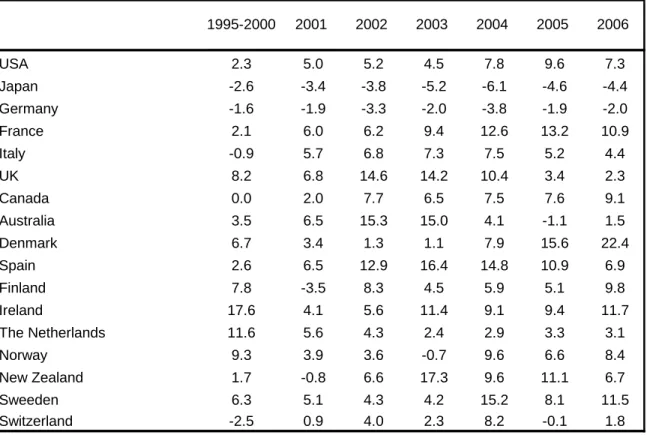
figures (Table A.1).
As the favorable conditions for housing ended with the tightening of monetary policy
in response to global inflationary pressures, housing markets, especially the subprime
mortgage market in the US, came under severe stress. Combined with deficiencies in
the mortgage industry, house prices started to fall dramatically. As measured by the
Standard & Poor’s Case-Shiller index, average home prices in the U.S. were down 32.2
percent as of March 2009 after a peak in the second quarter of 2006. As the subprime crisis
intensified in the US, it damaged the broader economy and eventually triggered a
global output contracted worst since the Great Depression (G-20 Progress Report, 2009).
Since consumption is inherently connected with households’ saving decisions which
could affect price levels and output, in the light of the recent global developments in
housing, it is vital for monetary authority to understand the relationship between
hous-ing wealth and consumption as well as the channels through which such a link might
operate.
Overview of Selected International Studies
There have been numerous academic and government researches that examine
hous-ing wealth effects, particularly for advanced economies. Most, but not all, studies indicate
consensus that rising house prices stimulate consumers to spend more than they would
without such price increases (Case et al. (2005), Ludwig and Slok (2004), Girouard and
Blondal (2001), Carroll et al. (2004)). However, the empirical literature is inconclusive
about the estimates of the marginal propensity to consume out of housing wealth. These
estimates vary substantially across studies. The dispersion in the findings with respect
to the magnitude and timing of the wealth effects stems from the use of different types
of consumption and wealth data and
/
or different estimation techniques that are used to
test the wealth effects. The differences may also stem from the unstable nature of wealth
effects over time.
In recent literature, Case et al. (2005) did a pioneering work in assessing the wealth
effects. The study covered measures of housing wealth for both a panel of 14 developed
economies for the period of 1975-1999 and a panel of all US states from 1982 through
1999. The results of the study suggest that housing wealth effect on consumption is
sta-tistically significant and it is rather large compared to financial wealth for both panels of
data. For the US, the estimate of the elasticity of consumption to housing wealth is found
around 0.04-0.06 while for the international panel, it is about 0.11-0.14. The authors
re-port that the estimated effects for the US are substantially stronger after the mid 1980s
Another multi-country study is conducted by Ludwig and Slok (2004) for the IMF
examining a panel of quarterly data from 1960 through 2000 for 16 OECD economies
divided into bank-based (e.g. Germany, Italy) and market-based (e.g. US, UK) credit
market systems. The authors estimated a larger effect of financial wealth than that from
housing wealth with an MPC of about 8 percent which is twice as large as the elasticity of
house prices. However, due to the use of a single equation approach and data deficiencies
for some countries in the data set, the results are cautioned to be at best, tentative.
Among the studies that have found a role for housing wealth, Girouard and Blondal
(2001) also suggest positive effect of housing wealth for the period 1970-1999 for the US,
the UK, Japan, France as well as Canada with MPCs ranging from 0.02 for the US to 0.18
for Canada, whereas the authors found negative effect of housing wealth for Italy.
Considering the potential instabilities in an economic environment, Carroll et al.
(2004) introduces a new methodology based on the sluggishness of aggregate
consump-tion growth to measure wealth effects for shorter period of time. This method
distin-guishes between immediate (next-quarter) and eventual wealth effects. According to
Car-roll et al.(2004)’s estimation of stock and non-stock wealth effects on consumption for the
US through 1960-2003, while ‘immediate’ wealth effects on consumption are very small
with an MPC out of housing wealth around 2 cents, ‘eventual’ effects are much larger
after several quarters with an MPC amounting to 9 cents.
The Case of Turkey
Although there is a wide range of empirical work, the vast majority of empirical
evidence, refers to advanced economies, particularly the US. However, considering the
increasingly deregulated and deepened financial systems, the accelerated aggregate
con-sumption as well as rising property values in emerging economies, extending the existing
literature to assess the inter-relationship between housing and consumption is critically
important.
housing wealth in Turkey is first motivated by the very high rates of homeownership
and the predominance of housing in total household wealth. The earlier experiences of
very high inflation and shallow financial markets have made the housing asset one of the
most preferred forms of wealth accumulation in Turkey. In addition to that, real price
of housing and the housing stock have followed an increasing trend. Between 2001 and
2011, housing wealth increased approximately 10% annually in real terms. Furthermore,
as the country’s macroeconomic environment has become more stable after 2001, there
has been an expansion of financial products including long-term housing credits. More
importantly, there is a growing interest in mortgage lending which led to the passage of
the new Mortgage Law by the Parliament as of 2007. This legislation is expected to
in-crease the share of housing wealth in wealth composition via raising either the housing
stock (home ownership ratio) or housing prices, ceteris paribus. Due to the recent
devel-opments, future housing wealth effects in Turkey are likely to become more pronounced.
However, to our knowledge, there are only a few contributions which study the
Turk-ish case in depth. Employing weak empirical methodologies and bad proxies for housing
asset value which is due to the lack of data on house stocks and house prices, existing
studies on the housing wealth effect has generally produced poor results. Even more
im-portantly, none of the studies take the structural change in Turkish economy during the
2001 crisis into account.
Chapter II of this dissertation aims to improve the deficiencies of the methodologies
employed in earlier studies by using a system approach that takes the structural break
into consideration, namely the Vector Error Correction Model (VECM), and introduces
a new proxy for housing wealth. Examining the effect of housing wealth as well as
finan-cial wealth upon aggregate consumption in Turkey for the period 1991Q1-2011Q1, our
study indicates that disposable income is the major factor that determines consumption
in Turkey in the long run. However the effect of disposable income decreases after the
2001 crisis whereas the long-run consumption effects of housing wealth get stronger in
crisis while it gets insignificant after the crisis. Furthermore, as an alternative to the
coin-tegration approach, we employ Carroll (2004)’s methodology for the post-crisis period
(after 2001) for estimating the short term and medium term wealth effects on
consump-tion, which does not require stability in cointegrating vectors. The results based on
Car-roll (2004)’s method conclude that both in the short term and medium term, income
and housing wealth have sizeable impacts on consumption whereas no significant effect
is found for financial wealth. The findings of the cointegration approach and Carroll’s
methodology are found to be parallel.
Since consumption is affected by housing wealth, as shown for the Turkish case in
Chapter II, and house prices are influenced by interest rates, there is a channel of
mone-tary policy transmission through house prices and it is important to search how this link
operates. In this regard, Chapter III examines such linkage between monetary policy
and housing wealth and to investigate the role of house prices in monetary transmission
mechanism in Turkey for the period 1991Q1-2011Q1. For this purpose, we employ a
kind of counterfactual experiment. The results show that house prices do play a
consid-erable role in consumption and residential investment in only the medium term (2 year
period) before 2001 whereas they play a crucial role in only the long term (five year
pe-riod) after 2001. Our study suggests that before 2001, following a contractionary interest
rate shock, the increase in house prices is responsible for almost all decreases seen in
con-sumption and residential investment in the medium term. During this period, a house
price change has no long-term effects on consumption and residential investment. After
2001, in response to a contractionary interest rate shock, a decrease in house price has
long-term effects accounting for 33 percent of the fall in consumption and 75 percent of
the fall in residential construction.
The final chapter of this dissertation explores the implications of the findings of
Chapter 2
Wealth Effects on Consumption: An Empirical Study on Turkey
It is commonly presumed that significant movements in wealth can often have wide
economic impacts in consumer spending. This chapter examines the effect of
hous-ing wealth and financial wealth upon aggregate consumption in Turkey for the period
1991Q1-2011Q1 by using a system approach, namely the Vector Error Correction Model
(VECM). The study includes the structral break in the model and improves on the
methodologies presented in previous studies which mostly employed Engle-Granger
sin-gle equation estimation. Having reviewed the earlier methods’ deficiencies to measure
housing wealth, this study also introduces a new measure as a proxy for housing wealth.
The results of the paper indicate that disposable income is the major factor determining
consumption in the long run for Turkey. Also, in the long run, consumption effects of
housing wealth and financial wealth are both found to be positive before 2001. After
the 2001 crisis, housing wealth effect gets larger whereas financial wealth effect becomes
insignificant.
This chapter is organized as follows.
Section 1 reviews the possible
wealth-consumption transmission channels and the arguments on the differences between
hous-ing and financial wealth with respect to their consumption effects. Section 2 briefly
re-views the theoretical framework. Section 3 discusses the estimation methodology while
Section 4 summarizes the empirical literature on Turkey. Section 5 and 6 provide the
2.1 Wealth Effects: Housing Wealth and Financial Wealth
In modern literature, deriving from the permanent income hypothesis developed by
Friedman (1957) and the lifecycle model, developed by Modigliani and Ando (1960) and
Ando and Modigliani (1963), consumption theory suggests that the level of household
consumption is a function of permanent income, demographic variables and physical
wealth that includes both housing and financial wealth. As suggested by the standard
life-cycle model, in response to an unexpected increase in the value of a household’s assets
such as stocks or housing value, a household will increase its spending.
This basic idea and theoretical link between wealth and consumption have been
ex-tended in a number of directions to obtain a more realistic view of consumption
behav-ior. In particular, the so-called collateral effect, which implies an increase in borrowing
capacity, is considered to be an important channel through which accumulated wealth
can stimulate consumer spending. Given the asymmetric information about borrowers
that requires them to provide collateral in credit markets, when there is a rise in wealth,
it will increase the value of the collateral. This will potentially leads to more borrowing
to finance extra consumption using the appreciated asset as collateral. In other words, the
increase in financial wealth or housing wealth can lead to higher consumption by
increas-ing the borrowincreas-ing capacity of previously credit-constrained households. This collateral
channel underpins much of the empirical work on the consumption and housing wealth
link for developed countries like the US and the UK where there is easy access to
mort-gage lending and home equity loans. However, this effect is also becoming significant in
emerging countries like Turkey as the mortgage market and relevant financial products
are developing rapidly, which may be interpreted from Figure B.1
.
According to Figure
B.1, the share of consumer credit with housing collateral in total consumer credits has
risen dramatically in recent years. This may show that the collateral effect of housing
wealth has begun to play an increasing role on consumption behavior of households.
the precautionary motive for saving. Households may choose to hold some assets as a
precaution against negative income shocks. However, when households experience an
increase in wealth, this will lead the value of their “buffer-stock” of wealth to rise and
will allow such households to increase their spending.
In the standard life-cycle view, it is argued that housing and financial wealth effects
are about the same in the long-run. However, this argument is being challenged with the
idea that housing and financial wealth may have different implications for spending. One
of the reasons why the effects could differ is that housing wealth is considered less liquid
than financial wealth because of the high transaction costs with trading in the housing
market. As homeowners are less likely to liquidate their houses in response to a house
price increase, the housing wealth effect on consumption tends to be smaller than the
financial wealth effect.
Another key difference results from the bequest motive which is more important for
housing wealth. For many households, homeownership may be an end in itself due to the
physiological value they attach to the housing asset and their intent to leave their houses
as bequests. Such homeowners who plan to live in their house also obtain a service from
their homes in addition to using their housing assets to accumulate wealth. For them,
a rise in the price of their housing assets may make them to feel wealthier, but this is
not automatically followed by a rise in their consumer spending as the implicit cost of
consuming housing has also increased and they still need housing services in the future.
1Also, many homeowners usually appear to be reluctant to trade down into less expensive
houses. Furthermore, for those who intend to buy a house or who are renters, there will
be a negative effect on their wealth as a result of rising house prices. The net housing
wealth effect would depend on the relative share of these categories of population and
the relative size of their responses to changes in house prices; thus, housing wealth could
be more ambiguous and potentially weaker as compared to the financial wealth effect.
One other reason for a more modest effect of housing wealth on consumption relative
to that of financial wealth relies on the idea that changes in stock prices more clearly
indicates future increases in a country’s productivity potential whereas a rise in house
prices may be experienced simply due to supply-side constraints which clearly does not
indicate that the overall economy is better off (Mishkin, 2007).
Despite these theoretical arguments which suggest a smaller impact of housing wealth
on consumption, several empirical studies have found greater consumption effects of
housing wealth. One of the reasons behind these findings is the above mentioned
collat-eral effect. Since housing is by far the most important collatcollat-eral asset for most households
due to the more evenly spread homeownership compared to the ownership of financial
assets which is highly concentrated in a certain population segment, housing wealth can
have stronger impacts on consumption. Moreover, as changes in house prices are much
less volatile than changes in stock prices, the housing wealth effect tends to be more
permanent than financial wealth effect; thus, its impact on spending could be relatively
greater.
2.2 Theoretical Background
The key theoretical link between wealth and consumption, the so-called lifecycle model
developed by Ando and Modigliani (1963) suggests that households use their wealth to
keep their consumption in its planned level. However, it is crucial to solve the nature of
the contemporaneous correlation between changes in wealth and consumption in order
to assess the long-run implications of changes in asset prices.
Following Campbell and Mankiw (1989), Lettau-Ludvigson (2001) first formalized
the idea that consumption, income and wealth move together in the long run. They
that if consumption growth and returns on wealth are stationary, then the log
con-sumption, wealth and labor income should be cointegrated. Following Lettau-Ludvigson
(2001), we present the theoretical framework of this cointegration with the accumulation
of wealth equation, in other words the budget constraint:
W
t+1= (
1
+
R
w,t+1)(
W
t−
C
t)
(2.1)
where
W
tis aggregate wealth,
C
tis consumption and
R
w,tis the net return on
ag-gregate wealth. Campbell and Mankiw (1989) showed that if the consumption to wealth
ratio is stationary, taking the first Taylor approximation of this equation gives the
follow-ing;
∆
w
t+1≈
k
+
r
w,t+1+ (
1
−
1
/
p
w)(
c
t−
w
t)
(2.2)
where lowercase letters denote log variables,
p
w=
1
−
exp
(
c
−
w
)
,
k
is a constant and
r
=
log
(
1
+
R
)
. Solving this equation forward, the consumption wealth ratio may be
written as;
c
t−
w
t=
∞X
i=1
p
iw
(
r
w,t+i−
∆
c
t+i)
(2.3)
We can also take this term’s conditional expectation and express it as;
c
t−
w
t=
E
t∞
X
p
wii=1
(
r
w,t+i−
∆
c
t+i)
(2.4)
Total wealth can be written as;
W
t=
F W
t+
Y
t+
HW
t(2.5)
as a proxy in the literature. Thus, we can approximate the logarithm of wealth as follows:
w
t=
γ
f w
t+
θ
y
t+ (
1
−
γ
−
θ
)
hw
t(2.6)
where
γ
,
θ
and
(
1
−
γ
−
θ
)
are respectively the steady state shares of financial wealth
(
F W
/
W
), disposable income (
Y
/
W
) and housing wealth (
HW
/
W
) in total wealth.
Then, return to aggregate wealth can be expressed as
(
1
+
R
w,t+1) =
γ
(
1
+
R
f w,t+1) +
θ
(
1
+
R
y,t+1) + (
1
−
γ
−
θ
)(
1
+
R
h w,t+1)
(2.7)
where
RW
tis the return of total wealth,
RF W
tis the return of financial wealth,
RY
tis the return of human wealth and
RHW
tis the return of housing wealth. Taking logs of
both sides and linearizing around the means give;
r w
t=
γ
r f w
t+
θ
r y
t+ (
1
−
γ
−
θ
)
r hw
t(2.8)
If we insert Equations (2.6) and (2.8) to the Equation (2.4), we get;
c
t−
γ
f w
t−
θ
y
t−
(
1
−
γ
−
θ
)
hw
t=
E
t∞
X
p
wii=1
(
γ
r f w
t+i+
θ
r y
t+i+(
1
−
γ
−
θ
)
r hw
t+i−
∆
c
t+i)
(2.9)
The equation above shows that the consumption to wealth ratio (left hand side of the
equation) is a function of expected returns and expected changes in consumption (right
hand side of the equation). We can assume that consumption growth (
∆
c
t+i) and the real
returns of the wealth components (
r f w
t+i,
r y
t+iand
r hw
t+i) are stationary. Since the
right hand side of the equation is presumed stationary, the consumption to wealth ratio
should also follow a stationary path, in other words, consumption and wealth should be
short run according to the expected changes in the right hand side variables. However,
this equation does not tell us whether consumption or wealth changes in the long run for
the correction of the long run disequilibrium.
2.3 Estimation Methodology
Following Lettau-Ludvigson (2001), recent macroeconomic studies have analyzed the
consumption function using logarithmic approximation of the budget constraint and
searched for the cointegration relationship between consumption, income and wealth
that is shown in Equation (2.9). The steady state share coefficients
γ
and
θ
in the
equa-tion also give the long run elasticities of consumpequa-tion with respect to different forms of
wealth. This in turn helps to derive the marginal propensity from the given values.
In the short run, it is more likely to have some deviations from the long-run
rela-tionship. Thus, the system moves to restore the equilibrium. In order to investigate the
short-run dynamics that include the variables’ adjustments to restore the long run
equi-librium and the time taken in this process, the Engle-Granger single equation estimation
method (ECM) is often used by researchers.
The Engle-Granger approach is applied in two steps. In the first step, the long run
re-lationship is identified. Using this long run rere-lationship in the second step as one of
the regressors, a short run function of one of the endogenous variables is estimated.
In the literature, the Engle-Granger method is used to estimate the consumption
func-tion by assuming that both income and wealth variables are weakly exogenous. In other
words, it is assumed that only consumption is affected from the disequilibrium and it
performs the adjustment while income and wealth do not. However, this is not always
the case and it is also not supported by the theoretical framework (Lettau and Ludvigson,
2001). Equation (2.9) gives no guidance about how the adjustment occurs. If in reality,
than the Engle-Granger method, we should use a framework that allows for the
possibil-ity that any or all variables perform this adjustment. Thus, we assume that all variables
are endogenous and estimate them in a system of equations, namely the VECM.
2.3.1 Johansen (1988) Estimation Procedure
In order to formulate the VECM, first we write the VAR model assuming that the
VAR(m) model only contains
m
endogenous I(1) variables;
y
t=
µ
1y
t−1+
µ
2y
t−2+
...
+
µ
ky
t−k+
ǫ
t(2.10)
where "
ǫ
t"s are unobservable i.i.d. zero mean white noises with
ǫ
i t∼
(
0,
σ
2ǫi t
)
and
Σ
ǫtǫ′t
=
V
. The model can be reparameterized by subtracting
y
t−1from both sides. By
rearranging them, we get the following VAR model;
∆
y
t= Π
y
t−1+ Γ
1∆
y
t−1+
....
Γ
p+1∆
y
t−p+1+
ǫ
t(2.11)
where
Π =
p
P
i=1
µ
i−
I
mand
Γ
i=
−
p
P
j=i+1
µ
j.
If there are stationary linear combinations of the
m
endogenous non-stationary
vari-ables, in other words, if the non-stationary variables are cointegrated, then;
|
I
m−
µ
1λ
1−
µ
2λ
2
−
....
−
µ
kλ
k|
=
0
(2.12)
for
λ
=
1. Since the endogenous variables are cointegrated, then the rank(
Π
)
=
r
<
m
,
thus,
Π
can be decomposed as
α
, adjustment coefficients, and
β
, cointegration
coeffi-cients, where both are
mx r
full column rank matrices. Thus, the model can be
reinter-preted as VECM where cointegration relationship
β
′y
t−1(error correction term) is one
of the regressors in the system;
The variables in
β
show the long-run relationships among the endogenous variables
whereas
α
measures the impact of deviations from this long-run equilibrium in the short
term.
Π
can be estimated from Equation (2.11) directly by using OLS. However, in order
to estimate the elements of
Π
;
α
and
β
separately, we need to have some identifying
restrictions. In this regard, we follow Johansen (1988, 1991) by using the restrictions that
β
includes eigenvectors, in other words, the cointegrating vectors that are orthogonal to
each other.
In Johansen’s algorithm two set of regressions are estimated;
∆
y
t=
Π
ˆ0+
Π
ˆ1∆
y
t−1+
ˆΠ
2∆
y
t−2+
...
+
ˆΠ
p−1∆
y
t−p+1+
ˆu
t(2.14)
y
t−1=
ˆΨ
0+
Ψ
ˆ1∆
y
t−1+
ˆΨ
2∆
y
t−2+
...
+
ˆΨ
p−1∆
y
t−p+1+
ˆv
t(2.15)
where
Π
ˆiand
Ψ
ˆidenotes
(
nxn
)
matrices of OLS coefficient estimates. Next step is to
calculate the sample variance-covariance matrices of the OLS residuals
u
ˆtand
v
ˆt;
ˆ
Σ
u u= (
1
/
T
)
T
X
t=1 ˆ
u
tu
ˆ′t(2.16)
ˆ
Σ
vv= (
1
/
T
)
T
X
t=1 ˆ
v
tv
ˆ′t(2.17)
ˆ
Σ
uv=
Σ
ˆv u= (
1
/
T
)
T
X
t=1 ˆ
u
tv
ˆ′t(2.18)
From these variance-covariance matrices, the eigenvalues of the matrix
ˆ
Σ
−1vv
ˆ
Σ
v uΣ
ˆ −1u u
ˆ
Σ
uv(2.19)
are found with the eigenvalues ordered. After these calculations, maximum likelihood
2.3.2 Estimation of the Cointegrating Vector under the Structural Break
As known, the cointegration approach comes from the log-linear approximation to the
consumer’s intertemporal budget constraint that we have written before as
c
t−
γ
f w
t−
θ
y
t−
(
1
−
γ
−
θ
)
hw
t≈
0
(2.20)
where
γ
,
θ
and
(
1
−
γ
−
θ
)
are respectively the steady state shares of financial
wealth, disposable income and housing wealth in total wealth. As seen, this equation
is preference-free since it is derived simply from the budget constraint. In order to have a
stationary consumption-wealth ratio, some fundamental parameters that determine this
cointegration relationship should not change permanently over the time frame for which
the relationship is examined. However, if there are major changes in some of those
funda-mental parameters such as taxes, productivity growth, demographics, financial structure,
etc., the theory implies no such stability.
2Thus, such breaks may lead to misspecification
of the long-run properties of a system and may result in an inadequate estimation.
The Johansen (1988) model we discussed above does not include a potential shift in the
cointegration vector. If there is a break between the varibles in the cointegration vector,
we should estimate that cointegration vector with another framework that accounts for a
break. Andrade et al. (2005) deals with this type of a problem in the context of a one-time
change in the cointegration vector at a known date. Along the lines of Johansen (1988),
they rewrote the model in the following form;
∆
y
t=
1
t¶t0[
α
0β
′0
y
t−1] +
1
t>t0[
α
1β
′1
(
y
t−1−
y
t0)] + Γ
1∆
y
t−1+
....
Γ
p+1∆
y
t−p+1+
ǫ
t(2.21)
whete
t
0is the date of break which does not occur at the limit points of the sample
and, 1
t¶t0and 1
t>t0determines the regime that currently runs at date
t
. When
ing the cointegration vector, Andrade et al. (2005) distinguished two cases; in the first
one, only the loading coefficients are unchanged across two regimes whereas in the
sec-ond case, the loading coefficients and the cointegration space may both change. In their
algorithm, three set of regressions are estimated;
∆
y
t=
Π
ˆ0+
Π
ˆ1∆
y
t−1+
ˆΠ
2∆
y
t−2+
...
+
ˆΠ
p−1∆
y
t−p+1+
ˆu
t(2.22)
1
t¶t0y
t−1=
ˆ
Ψ
0+
Ψ
ˆ1∆
y
t−1+
ˆΨ
2∆
y
t−2+
...
+
ˆΨ
p−1∆
y
t−p+1+
ˆv
t(2.23)
1
t>t0[
y
t−1−
y
t0] =
ˆ
Υ
0+
Υ
ˆ1∆
y
t−1+
ˆΥ
2∆
y
t−2+
...
+
ˆΥ
p−1∆
y
t−p+1+
ˆµ
t(2.24)
where
Π
ˆi,
Ψ
ˆiand
Υ
ˆidenote
(
nxn
)
matrices of OLS coefficient estimates.
First Case: Cointegration Vector Changes while Loading Coefficients do not
Change
In the first case, where the loading coefficients do not change, the residuals
in Equation (2.22) are regressed by the residuals in Equations (2.23) and (2.24) in order to
get the
ε
ˆt, estimate of the error term in Equation (2.21);
ˆ
u
t=
α
nx1[
β
′ 0β
′ 1
]
1x2n
ˆv
t ˆµ
t
2nxT+
ε
ˆtt
=
1, 2....,
T
(2.25)
Next step is to calculate the sample variance-covariance matrices of all these OLS
residuals
u
ˆt,
v
ˆt,
µ
ˆtand
ε
ˆt;
ˆ
Σ
εε= (
1
/
T
)
T
X
t=1 ˆ
ε
tε
ˆt(2.26)
ˆ
Σ
u u= (
1
/
T
)
T
X
t=1 ˆ
u
tu
ˆt(2.27)
ˆ
Σ
uv= (
1
/
T
)
t0
X
t=1 ˆ
ˆ
Σ
uµ= (
1
/
T
)
T
X
t=t0+1
ˆ
u
tµ
ˆt(2.29)
ˆ
Σ
vv= (
1
/
T
)
t0
X
t=1 ˆ
v
tv
ˆt(2.30)
ˆ
Σ
µµ= (
1
/
T
)
T
X
t=t0+1
ˆ
µ
tµ
ˆt(2.31)
From these variance-covariance matrices, we find the eigenvalues of the matrix
ˆ
Σ
−1/2εε
ˆΣ
uv ˆΣ
vv −1 ˆΣ
′ uv+
ˆΣ
uµ ˆΣ
µµ −1 ˆΣ
′ uµ
ˆΣ
−1/2εε
(2.32)
with the eigenvalues ordered. After these calculations, maximum likelihood estimates
of the parameters (e.g.
α
,
β
0,
β
1) can be derived.
Second Case: Both Cointegration Vector and Loading Coefficients Change
In the
second case, different from the first case, the residuals in Equation (2.22) are regressed by
the residuals in Equations (2.23) and (2.24) separately for the two regimes in order to get
the
ε
ˆt, estimate of the error term in Equation (2.21);
ˆ
u
t=
α
0β
′ 0ˆ
v
t+
ε
ˆtt
=
1, 2, ..
t
0(2.33)
ˆ
u
t=
α
1β
′ 1ˆ
µ
t+
ε
ˆtt
=
t
0+
1, ..
T
(2.34)
From the calculated variance-covariance matrices in Equations (2.26)-(2.31), the
eigen-values of the matrix
ˆ
Σ
0 −1/2u u
ˆ
Σ
uv ˆΣ
vv −1 ˆΣ
′uv
ˆ
Σ
0 −1/2u u
(2.35)
ˆ
Σ
1 −1/2u u
ˆ
Σ
uµ ˆΣ
µµ −1 ˆΣ
′uµ
ˆ
Σ
1 −1/2u u
(2.36)
are found for the estimation of
α
1and
β
1where
ˆP
0
u u
is the variance-covariance matrix
of the period
t

t
0and
ˆP
1
u u