1 Investigating Cooperativity of Non-covalent Networks via Acyl-Transfer Catalysis Using
β-Hairpin Scaffolds Billy Treacy
2 Project Goals
The primary goals of this project are to design, synthesize, and purify a small library of β-hairpin peptides that can act as catalysts for a model acyl-transfer reaction to elucidate
structure function relationships. Based off of knowledge from previous studies,1,2 we hypothesize that a peptide containing a cooperative hydrogen bonding network of histidine residues in
tandem with a hydrogen bond donor will yield a highly efficient acyl-transfer catalyst. Further characterization of these peptide catalysts through 2D NMR will allow important structure function activity relationships to be determined. We can then iteratively build upon our findings to design new peptide sequences that can achieve even higher rates of acyl-transfer catalysis via these optimized non-covalent networks driving catalysis.
Introduction
3 and complexity of proteins and enzymes as they contain a multitude of globally affecting non-covalent interactions all dictating structure and function. It would therefore be advantageous to design small synthetic peptide systems which can be more easily characterized and interrogated for catalytic applications and subsequent structure activity relationship elucidation.
4
Figure 1: a) Ribbon representation of hairpin structure and cross-strand contacts of the
β-hairpin used in the experiment.1,2 b) PDB structure of the enzyme paraoxonase.6 c) Active site of paraoxonase.6
To elucidate the reactivity of these peptide catalysts, kinetic studies can be used to determine how quickly an acyl transfer can occur within this model system. We have designed a system that can be monitored using UV-vis spectroscopy. A model substrate 4-nitrophenyl 2-methoxyacetate can be esterolyzed to generate 4-nitrophenol or 4-nitrophenoxide, both of which are UV-vis active. Based on the previous studies,
a peptide with a non-covalent network of
histidines at positions 2,9, and 11 equipped with a hydrogen bond acceptor at position 4 (figure 1a) can be implemented to provide rapid acyl transfer.1,2 The catalytic cycle (scheme 1) can be regenerated by using an alcohol such as 2,2,2-trifluoroethanol, TFE, to complete the acyl transfer cycle and regenerate the unbounded terminal histidine.
Scheme 1: Proposed mechanism of the acyl transfer reaction being studied using imidazole as
5 Using the information obtained from this system, one could further target residues on peptides or proteins that have the hydrogen bonding network consisting of this network of
histidines, a hydrogen bond acceptor, and a terminal nucleophile such as cysteine or histidine and examining how this cooperative system affects rates of catalysis or how it affects selectivity. Non-canonical amino acids may also be incorporated into this scaffold to determine how they interact with other residues in peptides and proteins.
Experimental
Peptides were synthesized by solid-phase peptide synthesis using CEM’s Liberty Blue peptide synthesizer using protected amino acids on rink amide resin. Activation of amino acids was performed with ethyl cyanohydroxyiminoacetate (oxyma) in the presence of
6
Figure 2: LCMS of the HWHH peptide demonstrating the purity of each peptide. Synthesis of the ester substrate, 4-nitrophenyl 2-methoxyacetate, was done in accordance with the literature,8 but the solvent was changed to tetrahydrofuran instead of ethyl acetate. The product was recrystallized multiple times in toluene to remove any impurities from the sample, and the excess water in the sampled was removed by vacuum.
Scheme 2: Synthesis of 4-nitrophenyl 2-methoxyacetate.
NMR results were acquired using a Bruker 600 MHz NMR spectrometer with a cryoprobe. NMRs for the ester were obtained in CDCl3 and in CF3CD2OD, d3-TFE for the peptides. Histidine residues within the peptide were deprotonated using stoichiometric equivalents of trimethylamine.
7 2,2,2-trifluoroethanol, TFE, was pre-treated with 3 Å molecular sieves that were dried under vacuum at 120°C for two hours and anhydrous potassium carbonate.9 The TFE was then distilled and collected for experimentation.
Results
In order to further corroborate the results obtained previously,1,2 computational studies were performed by members of Dr. Dean Tantillo’s Group at UC-Davis. Their work investigated how both the number of imidazoles in a chain and if in the presence in a variety of hydrogen bond donors affected the methyl cation affinity of the terminal histidine residue (figures 3 and 4). From these studies, we can observe that the acetate and phosphate groups acting as hydrogen bond donors produce the greatest methyl cation affinity (table 1). We also see that there is an upper limit to the methyl cation affinity as we increase the length of the imidazole chain (figure 5).
8
Table 1: Computational results obtained by varying the terminal X group on the above system.
Terminal Group (X)
None Benzene Toluene SH Acetic Acid OH Thiourea Urea Acetate Phosphate
Gas
EE 0 2.3 2.5 3 3.8 4.1 7.2 9.3 71 64
H 0 2.7 3.6 4 5 5.4 7.8 10 70 65
Water EE 0 0 -0.3 -0.7 -0.2 -0 1 1 2.9 -3.4
Figure 4: Modeling set up to investigate how the length of imidazole chains affects the methyl cation affinity of the terminal histidine.
Figure 5: Results showing how the length of imidazole chain affects methyl cation affinity. 130 135 140 145 150 155 160 165 170
0 1 2 3 4 5 6
Me th y l C atio n A ff in ity ( k ca l/m o l)
9 Combining these two factors, we can design peptide sequences of the form AcNH-L-X-V-X-V-p-G-L-X-V-X-V-CONH2 where the underlined positions are the residues that form the non-covalent network. For simplicity, we denote the sequence AcNH-L-H-V-W-V-p-G-L-H-V-H-V-CONH2 as HWHH. To investigate the trends seen by the computational studies, we set out to synthesize the peptides HWHH, WWWH, HHHH, and HDHH to complete the published Trp-His series, obtain consistency between studies,1 and determine the role the hydrogen bond donor plays. We hypothesize that a peptide with an aspartate group as the hydrogen bond donor and three histidines, called HDHH, would provide the highest krel of any peptide sequence with this 12 residue structure consisting of only natural amino acids, based off the computational analysis.
One aspect of this project that has provided sign challenges was generating and
10 however, to our dismay once again the free based peptide could not be readily characterized using NMR methods due to solubility issues and low resolution within the NMR.
The final method used was to generate the base in situ using a base such as triethylamine (TEA). For these experiments, the order of addition is important since you want to pre-mix the triethylamine and peptide to generate the free base and TEA+/TFA- salt. The amount of TEA needed to completely deprotonate the histidinium protons can be determined by an NMR titration of the peptide in d3-TFE. Complete deprotonation was observed at 2.5 µL of TEA (figure 6), which is 1.3 equivalents per histidine in the peptide. It is important not to add any excess TEA since it can also catalyze the acyl transfer reaction and result in an inaccurate relative rate constant.
Figure 6: NMR titration of the HWHH peptide with triethylamine.
11 products are generated in the reaction, so we determined the isosbestic point of 4-nitrophenol/4-nitrophenoxide by taking a standard solution of 4-nitrophenol in TFE and titrating in both trifluoroacetic acid and then triethylamine and examining the resulting UV-vis spectrum (figure 7a). The isosbestic point was located at 336 nm, and using this wavelength, we created a
calibration curve in order to determine the amount of product in the esterolysis reactions (figure 7b).
a) b)
Figure 7: a) Isosbestic point determination of nitrophenol. b) Resulting calibration curve of 4-nitrophenol in TFE at 336 nm.
As we are interested in calculating increases in the acyl transfer reaction rates in the presence of our catalytic peptides, it is first necessary to characterize the background rate of the reaction without the peptide catalyst present. The uncatalyzed reaction – conducted solely with TFE and ester – has the rate law: Rate = kuncat[TFE][Ester], and the catalyzed reaction –
conducted in the presence of peptide – has the rate law: Rate = kcat[Peptide][Ester]. To determine the rate of the reaction, we used the method of initial rates.11 The lowest recorded background rate of trifluoroethanolysis of the substrate in TFE was 5.92x10⁻⁷ mM/s at a substrate
concentration of 0.1 mM. Since the molarity of trifluoroethanol is 13.7245 M (molar mass = 100.04 g*mol-1, density = 1.373 g*ml-1), the rate constant for the uncatalyzed reaction, kuncat, is
y = 5.9614x - 0.0052 R² = 0.999
-1.00E-01 0.00E+00 1.00E-01 2.00E-01 3.00E-01 4.00E-01 5.00E-01 6.00E-01 7.00E-01
0 0.05 0.1
12 4.3x10⁻⁷ M-1*s-1. The rate constant for the peptide catalyzed reaction, kcat, can be found by
dividing the initial rate by both the peptide concentration and substrate concentration. For example, for HWHH, the rate is 7.1x10⁻⁶ mM/s (figure 8). Given the catalyst concentration of 0.28 mM and substrate concentration of 0.1 mM, kcat is 2.56 M-1*s-1. The relative rate constant, krel, can be found by dividing kcat by kuncat, which for the example HWHH gives 5.9x10⁶.
Figure 8: Initial rate data for the HWHH peptide used to calculated kcat.
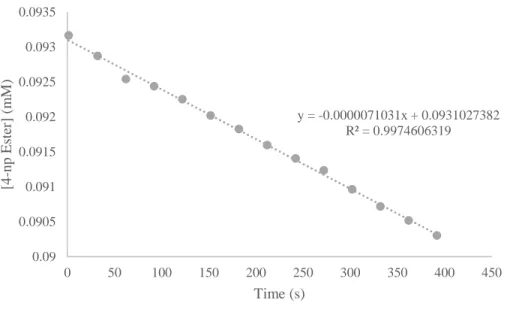
One difficulty of the experiment has been obtaining data that aligns with the previous experimental data. As the previous kinetics data was obtained in d3-TFE using NMR studies,1,2 there will be differences within the reactions due to the different trace impurity profiles of the deuterated and the proteo TFE. The extent to which they are different, however, cannot be readily determined. Different methods to purify the TFE such as using sodium bicarbonate as a base or using fractional distillation have been attempted, but there was no advantage over regular distillation or using anhydrous potassium carbonate. Using UV-vis spectroscopy has been
determined to be a reliable method since the same experiment was conducted with d3-TFE and yielded a very small background rate of esterolysis (figure 9). The reported kuncat is 3.30x10⁻⁹ M
-y = -0.0000071031x + 0.0931027382 R² = 0.9974606319
0.09 0.0905 0.091 0.0915 0.092 0.0925 0.093 0.0935
0 50 100 150 200 250 300 350 400 450
13 1*s-1,1 but the smallest kuncat that we have obtained is 4.3x10⁻⁷ M-1*s-1. These differ by a
magnitude of 130 and some of this can be attributed to the kinetic isotope effect,12 but we hypothesize that there must be a residual impurity within the proteo TFE that is not present within the deuterated TFE. Unfortunately, this impurity cannot be determined by
gas-chromatography mass spectrometry methods or by NMR. Regardless, we believe that we can still glean structure and function relationships using this method even though the krel will not be as high as in previous studies.1,2 However, there is a significant increase in conversion between the HWHH peptide, the uncatalyzed reaction in TFE, and the uncatalyzed reaction in d3-TFE (figure 9).
Figure 9: Entire kinetics run for HWHH (blue), uncatalyzed reaction in TFE (orange), and uncatalyzed reaction in d3-TFE (gray).
Conclusions
While further studies need to be conducted, the computational studies have shown that as we increase the number of the imidazoles in the non-covalent network, we have a more basic terminal histidine that can effectively shuttle protons faster to generate higher rates of catalysis.
0 0.05 0.1 0.15 0.2 0.25 0.3 0.35 0.4
0 2000 4000 6000 8000 10000 12000 14000 16000
Ab
so
rb
an
ce
(AU
)
14 Previous results also corroborate these computational findings.1 We have also optimized a
synthetic system that allows us to test peptides that can allow us to glean structure function information from the results. Once the uncatalyzed reaction issues have been resolved, we can test the peptides HDHH, WWWH, and HHHH as they are already synthesized and purified.
Using this assay, we can assess how the computational predictions align with
experimental results, and from here we can test a wider array of peptides that can then give us further insight into the reactivity and degrees of cooperativity within peptides that have different hydrogen bond donors or terminal nucleophiles. This will allow us to extrapolate this data and predict trends in regards to reactivity in proteins and other peptides.
Acknowledgements
I would like to thank both Professors Gagné and Waters for the support they have provided and for the collaborative environment that they foster within their groups. Thanks to Dean Tantillo and his group for producing the computational results, and special thanks to both the Gagné and Waters groups, notably Tim Schwochert for his mentorship and former member Dr. Masaomi Matsumoto for his assistance in providing specific details on parameters in regards to the project.
References
1. Matsumoto, M.; Lee, S. J.; Waters, M. L.; Gagné, M. R. A Catalyst Selection Protocol That Identifies Biomimetic Motifs from β-Hairpin Libraries. Journal of the American
Chemical Society2014, 136 (45), 15817–15820. https://doi.org/10.1021/ja503012g.
2. Matsumoto, M.; Lee, S. J.; Gagné, M. R.; Waters, M. L. Cross-Strand Histidine–Aromatic Interactions Enhance Acyl-Transfer Rates in β-Hairpin Peptide Catalysts. Org. Biomol.
15 3. Dodson, G. Catalytic Triads and Their Relatives. Trends in Biochemical Sciences1998, 23 (9),
347–352. https://doi.org/10.1016/S0968-0004(98)01254-7.
4. Davidi, D.; Longo, L. M.; Jabłońska, J.; Milo, R.; Tawfik, D. S. A Bird’s-Eye View of Enzyme Evolution: Chemical, Physicochemical, and Physiological Considerations.
Chemical Reviews2018, 118 (18), 8786–8797.
https://doi.org/10.1021/acs.chemrev.8b00039.
5. Dinner, A. R.; Lazaridis, T.; Karplus, M. Understanding β-Hairpin Formation. Proceedings of
the National Academy of Sciences 1999, 96 (16), 9068–9073. https://doi.org/10.1073/pnas.96.16.9068.
6. Harel, M. Aharoni, A, Gaidukov, L, Brumshtein, B, Khersonsky, O, Meged, R, Dvir, H,
Ravelli, RB, McCarthy, A, Toker, L, Silman, I, Sussman, JL, Tawfik, DS. "Structure and
evolution of the serum paraoxonase family of detoxifying and anti-atherosclerotic
enzymes". Nature Structural & Molecular Biology. 11 (8): 412–19.
https://doi.org/10.1038/nsmb767.
7. Subirós-Funosas, R.; Rafei Prohens, R. B.; Ayman E.F.; Albericio, F. Oxyma: An Efficient Additive for Peptide Synthesis to Replace the Benzotriazole-Based HOBt and HOAt with a Lower Risk of Explosion. Chemistry - A European Journal 2009, 15, 9394-9403. https://doi.org/10.1002/chem.200900614.
8. Gagliano, R. A.; Knowlton, R. C.; Byers, L. D. Methylimidazole-Catalyzed Ester Hydrolysis: Nonlinear Kinetics. The Journal of Organic Chemistry1989, 54 (22), 5247–5250. https://doi.org/10.1021/jo00283a015.
16 10. Srinivasan, N.; Yurek-George, A.; Ganesan, A. Rapid Deprotection of N-Boc Amines by
TFA Combined with Freebase Generation Using Basic Ion-Exchange Resins. Molecular
Diversity2005, 9 (4), 291–293. https://doi.org/10.1007/s11030-005-4386-8.
11. Jacobson, H.; Dubno, H. A Steady-State at Initial Concentration Method of Studying Reaction Rates. The Journal of Physical Chemistry1964, 68 (11), 3437–3438. https://doi.org/10.1021/j100793a509.
12. Yamataka, H.; Tamura, S.; Hanafusa, T.; Ando, T. Kinetic Isotope Effect Study of the Borderline Solvolysis of Isopropyl Β-Naphthalenesulfonate. Journal of the American