A comparative study of the effects of problem-solving
skills training and relaxation on the score of self-esteem
in women with postpartum depression
Saeideh Nasiri1, Masoumeh Kordi2, Morteza Modares Gharavi3
A
BSTRACTBackground: Self-esteem is a determinant factor of mental health. Individuals with low self-esteem have depression, and low self-esteem is one of main symptoms of depression. Aim of this study is to compare the effects of problem-solving skills and relaxation on the score of self-esteem in women with postpartum depression.
Materials and Methods: This clinical trial was performed on 80 women. Sampling was done in Mashhad healthy centers from December 2009 to June 2010. Women were randomly divided and assigned to problem-solving skills (n = 26), relaxation (n = 26), and control groups (n = 28). Interventions were implemented for 6 weeks and the subjects again completed Eysenck self-esteem scale 9 weeks after delivery. Data analysis was done by descriptive statistics, Kruskal–Wallis test, and analysis of variance (ANOVA) test by SPSS software.
Results: The fi ndings showed that the mean of self-esteem scale scores was 117.9 ± 9.7 after intervention in the problem-solving group, 117.0 ± 11.8 in the relaxation group, and 113.5 ± 10.4 in the control group and there was signifi cant difference between the groups of relaxation and problem solving, and also between intervention groups and control group.
Conclusions: According to the results, problem-solving skills and relaxation can be used to prevent and recover from postpartum depression.
Key words:
Key words: Postpartum depression, problem-solving skills training, relaxation, self-esteem
1Department of Midwifery, School of Nursing and Midwifery,
Mashhad University of Medical Sciences, Mashhad, Iran and Instructor of Midwifery of Kashan University of Medical Sciences,
2Department of Midwifery, School of Nursing and Midwifery,
Mashhad University of Medical Sciences, Mashhad, Iran, 3Research
Center of Psychiatry and Behavioral Sciences, Department of Psychiatry, Mashhad University of Medical Sciences, Mashhad, Iran
Address for correspondence: Prof. Masoumeh Kordi,
Department of Midwifery, School of Nursing and Midwifery, Mashhad University of Medical Sciences, Mashhad, Iran. E-mail: [email protected]
Submitted: 22-Jun-13; Accepted: 16-Aug-14
Self-esteem is a psychological phenomenon that has a definite effect on the emotional and cognitive dimensions of an individual.[4] The individuals with a high self-esteem
tend to perceive themselves worth being respected and approved, important and beneficial. On the other hand, the individuals who have a negative idea about themselves or who have low self-esteem tend to perceive themselves as not very important, lacking lovability, and with no comfort in themselves and their capabilities.[5] High self-esteem is
considered important because it is associated with higher levels of psychological health and functioning and low level of self-esteem is undesirable because it is associated with lower levels of psychological health and functioning.[6]
One of the major reasons for researchers’ interest on self-esteem is its effects on health. Damaged self-esteem makes it impossible to endure the harsh conditions of everyday life and produces adverse physical and psychological outcomes. One of the unintended consequences is depression.[7]
In the postpartum period, the woman needs the mental conformities and reorganization of interpersonal relations occurs. Therefore, there is always the risk of appearance of mental disease in the postpartum period.[8] The
I
NTRODUCTIONS
elf-esteem is literally defined by how much value people place on themselves.[1] Self-esteem meansfinding oneself positive, worth appreciation, and liking. Self-esteem is an important state of mind which allows individuals to accept themselves as they are and be self-confident.[2] Rosenberg (1965) considered self-esteem
as the positive or negative attitude of an individual toward himself. If an individual has a positive attitude in self-assessment, his self-esteem would be high; if he has a negative attitude, then his self-esteem would be low.[3]
Original
postpartum depression is a disorder of non-psychosis depression according to the study of Hendrick et al. As per the American Psychiatric Association [Diagnostic and Statistical Manual of Mental Disorder-IV (DSM-IV)], its onset is during the first 4 weeks after delivery.[8-10]
Brown et al. reported that about 50% of women are affected by depression at the first 3 months after delivery, whereas one-third of them are affected by depression after 3 months of delivery.[11]
Although several factors influence depression, the psychosocial factors play a strong role in prediction of this disorder. Self-esteem is one of the variables that affects deleteriously on t he pregnancy outcomes and postpartum period. The finding of Jomeen et al.’s study showed that self-esteem may be a useful predictor of disorders such as anxiety and depression.[12]
Depression and self-esteem tend to be highly correlated with each other.[13-15] It has been accepted that depressed people
think in a negative manner and report lower self-esteem than non-depressed people.[16] Sowislo found that decrease
in self-esteem was predictive of increase in depression. But she found only minimal evidence for depression decreasing self-esteem. “The robustness of the effect also strengthens the potential importance of self-esteem interventions,” said Sowislo. She believes that treatments aimed at reducing depression by way of improving self-esteem could provide not only short-term gains for clients but also long-term protection from depression for those most at risk.[17]
It was found that individuals who have effective and positive social problem-solving approach have a high self-esteem.[18]
The individuals with high self-esteem generally have more confidence in their initial approaches to the problems and, therefore, they seek less information before offering solutions and making decisions.[19] But low self-esteem
creates dysfunction. Problem-solving approach is a cognitive behavioral process. By means of problem-solving skills, people can identify and recommend the effective strategies to face stressful situations in everyday life.[7]
Social problem solving can be viewed as an important conformity mechanism that serves to increase behavioral competence and it leads to decrease in psychological distress. D’zurilla suggested that self-esteem may play an important role in the relationship between self-appraised social problem-solving ability and psychological adjustment.[20]
Also, McCabe et al. found that social problem solving was predicted by self-esteem and depressive symptoms.[21] In
Aylward’s study, self-esteem emerged as the most important predictor of social problem-solving model. Some evidence was found to link the relationship between self-esteem and problem-solving skills.
In the study of Mahmoudi Rad” entitled The role of social problem solving and communication skills training on enhancing self-esteem level and its relationship to mental functioning and academic achievement of students,” it was found that self-esteem scores of the two groups showed significant difference before and after intervention. The researchers stated that the findings suggest a direct effect and positive role of training of communication skills and social problem-solving abilities when a person faces social and personal problems. Also, self-esteem could be boosted by interventions.[22]
The study of Abuhamzeh entitled “The effect of problem solving training on increasing the self-esteem of students in school” showed that training of problem solving significantly increases overall, academic, social, and family self-esteem in the intervention group than in the control group. This effect remains for up to 2months after the education.[23]
In the study of Sharifi, it was found that problem-solving training positively affected the self-esteem of students with behavior problems. Problem-solving technique with healing of self-esteem could reduce behavioral problems.[24] Based on studies, we can conclude that with
higher problem-solving skills and social problem solving, we can increase a person’s self-esteem and decrease the depressive symptoms.[25]
Several studies showed that low self-esteem is associated with increased anxiety and depression. Rees conducted an exploratory study of the effectiveness of guided imagery protocol with relaxation on reducing anxiety and depression and increasing self-esteem in primiparas during the first postpartum month.[26]
Not only relaxation and imagery decrease stress, pain, and anxiety, but also they generate a more positive understanding and a more strong feeling about well-being. With relaxation, the person can attach importance to herself and she can perceive everything that she needs. This develops self-appraised process which is the first important step toward self-esteem.[27] Reynolds stated that relaxation
could improve self-concept and self-esteem.[28]
Although there is little evidence about the effect of relaxation on self-esteem, its positive effect is somewhat proved. The relaxation training is simple technique and easy to practice at home; it can increase the self-esteem and decrease psychological problems.
Relaxation and problem-solving training are behavioural– cognitive interventions that help to decrease depressive symptoms and increase self-esteem; also, the self-esteem
of depressed women is low during postpartum period. Hence, a study should be performed for determining the more effective and simpler technique. This study was done with the aim of comparing the effects of problem-solving skills training and relaxation on the self-esteem of women in postpartum period.
M
ATERIALSANDM
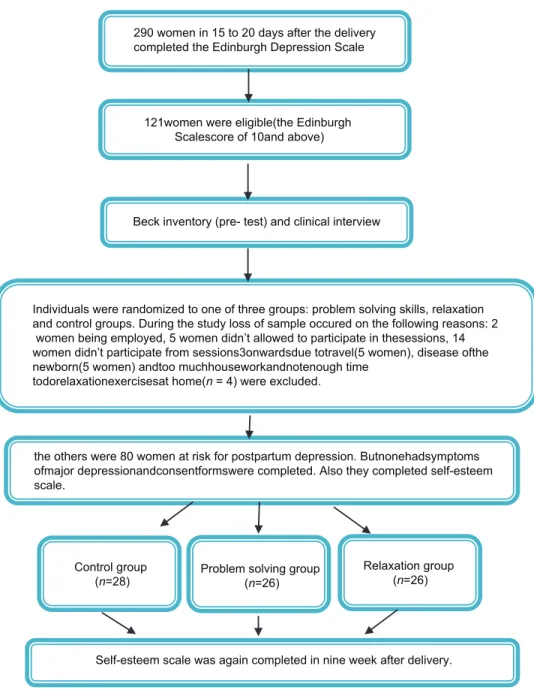
ETHODSThis was a clinical trial with a control group in 3–9 weeks in postpartum period and was conducted after getting permission from the ethics committee of Mashhad University of Medical Science. All women on days 15–20 after delivery who referred to Mashhad health centers from December 2009 to June 2010 participated in the study after completing the consent form. The researcher designed a socio-demographic questionnaire for women. The inclusion criteria were: Literate women, 18–35 years old, with the term neonate, singleton, healthy infant, the history of lack of chronic medical illness, without history of previous depression, and no smoking. At first, Edinburgh postnatal depression scale (EPDS) was completed by the subjects. Women whose get score 10 or above, completed Beck depression inventory (BDI). Those who obtained a score of 14–28 and confirmed to be depressed by a clinical interview conducted by a psychologist (based on DSM-IV criteria) in the health centers were divided into three groups randomly: Problem-solving training (n = 26), relaxation (n = 26), and control group (n = 28) [Figure 1]. Eysenck self-esteem scale which has seven items and a score of 140 was completed by the women at the onset of research.[29] Interventions in the two groups of
problem solving and relaxation were performed by a researcher (midwife). The researcher had been taught by a clinical psychologist and after gaining the skills, she received a certificate of performance of relaxation and problem solving skills. A pilot study had been done on depressed women in Ebne-sina hospital in Mashhad before conducting the main study. Interventi ons in two groups of intervention were performed individual.
Intervention in the problem-solving group
Intervention was performed in the problem-solving group, which consisted of six sessions weekly in the healthy centers. The researcher notified the appointment by telephone to the research units before the intervention. In the problem-solving group, at the first session which lasted 1 h, the participants were trained in five skills of problem solving (general orientation, problem definition and formulation, generation of alternatives, decision making, and verification). In the next sessions which lasted 45–50 min, depressive symptoms of women were studied according to the Beck inventory; different solutions were
presented by women and the best solution was selected for performing until the next session. The recording checklist of problem-solving sessions was completed by the researcher in each session.
Intervention in the relaxation group
In the relaxation group, the first two sessions of relaxation were performed in the health center, and each session lasted about half an hour; the other sessions took 10–20 min. In the first session of relaxation training, the causes of postpartum depression and the ways of controlling it were discussed and the relaxation purposes were explained. Also, women were trained about how to contract and relax their 16 groups of muscles similar to Jacobson’s method,[30] and
the practice was demonstrated by the researcher. Then the practice was repeated once in the presence of a researcher by a training mother. In the second session, progressive muscle relaxation technique was performed once again by a mother in the presence of the researcher and after correction and ensuring the accuracy of the technique, the CD of progressive muscle relaxation was given to the women to perform the exercise daily at home. In the next four sessions, in addition to the exercises of relaxation performed at home, the imagery techniques (forest visualization, beach, pilgrimage sits, and green space with good climate) were performed by the researcher. The relaxation exercise was performed by the women at home for about 20 min daily. The form of recording the exercises performed at home was given to women and it was emphasized to bring it along with them in each session. At the beginning of each session, the positive and negative experiences of women were considered and they asked about how they could perform relaxation techniques.
Control group
The control group recoursed to health center weekly and they bring the recording checklistof postpartum depressive symptoms with themselves and routine care after delivery is performed for them according to the booklet of safe mother. Nine weeks after delivery, each of the three groups completed the Eysenck self-esteem scale again as a post-test. In this research, the instruments of data collection included the Edinburgh depression scale, Beck depression inventory-II, Eysenck self-esteem scale, the socio-demographic questionnaire, recorded checklist of depressive symptoms, and recorded checklist of problem-solving sessions. The Edinburgh scale is a standard instrument for screening depressive women in the postpartum period. This instrument assesses the feeling of women in the past 7 days and it has 10 items and each item has a score of 0–3.[31]
The Beck depression inventory-II has 21 items. It assesses the feeling of women in the past 1 week and its answers are scored between 0 and 3. The minimum score is zero and the maximum sore is 63.[32,33]
Eysenck self-esteem scale has 7 items and each item has a score of 0–20. The total score is between 0 and 140.[29]
The socio-demographic questionnaire had three sections. The first two sections included 20 questions about personal characteristics, pregnancy, and recent childbirth, which were completed before implementing interventions and its two questions were completed on referring to patients’ files. The third section included four questions that collected information on the availability of someone to help at home,
sleeplessness difficulties, and breastfeeding, and it was completed 9 weeks after delivery.
The content validity was used for determination of validity of the data collecting instruments. Previously, the validity of Edinburgh scale was confirmed by Khodadoostan.[33]
The validity of Beck depression test was confirmed by Mohammad Khani in Tehran,[34] and in this study, the alpha
coefficient was 0.827.
The data obtained in this study were analyzed using descriptive statistics, analysis of one-way variance, Chi-square test, and Spearman correlation coefficient by SPSS software. The normality of data was assessed by one sample Kolmogorov–Smirnov test.
290 women in 15 to 20 days after the delivery completed the Edinburgh Depression Scale
121women were eligible(the Edinburgh Scalescore of 10and above)
Beck inventory (pre- test) and clinical interview
Individuals were randomized to one of three groups: problem solving skills, relaxation and control groups. During the study loss of sample occured on the following reasons: 2 women being employed, 5 women didn’t allowed to participate in thesessions, 14 women didn’t participate from sessions3onwardsdue totravel(5 women), disease ofthe newborn(5 women) andtoo muchhouseworkandnotenough time
todorelaxationexercisesat home(n = 4) were excluded.
the others were 80 women at risk for postpartum depression. Butnonehadsymptoms ofmajor depressionandconsentformswere completed. Also they completed self-esteem scale.
Control group
(n=28) Problem solving group (n=26)
Relaxation group (n=26)
Self-esteem scale was again completed in nine week after delivery. Figure 1: Chart of sampling process
R
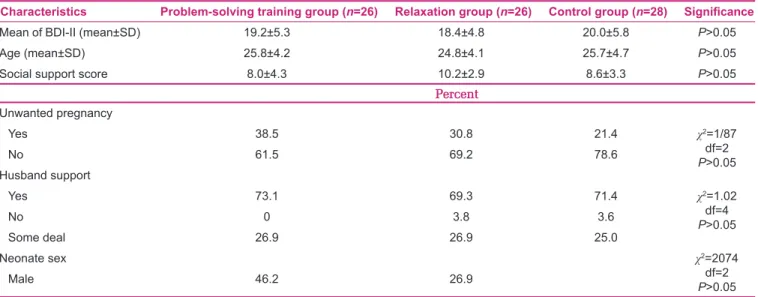
ESULTSEach of the three groups showed no significant statistical differences regarding their age (P = 0.680), husband support (P = 1.000), satisfaction in marital life (question by Likert scale) (P = 0.506), unwanted pregnancy (P = 0.392), neonate sex (P = 0.253), social support (Cassidy Social Support scale) (P = 0.078), self-esteem (P = 0.145), and the score of Edinburgh depression scale (P = 0.258) [Table 1]. In this study, 53.8% women had high, 42.5% had moderate, and 3.8% had low self-esteem.
The mean of self-esteem score was 103.7 ± 21.6 before intervention in the problem-solving group that increased to 117.9 ± 9.7 after the intervention. Also, in the relaxation group, the mean of self-esteem score was 112.1 ± 16.7 before the intervention, which increased to 117.0 ± 11.8 after the intervention. In the control group, the mean of self-esteem score was 111.8 ± 13.1 in the beginning of the study and it changed to 113.5 ± 10.4 at the end of the study. By means of self-esteem scale, the self-esteem levels in each group were obtained. In our study, the self-esteem of relaxation group was moderate (42.3%) and high (57.7%) before the intervention and reached a moderate level in 23.1% and a high level in 76.9% of the cases after the intervention. Results showed relaxation can increase moderate self-esteem to high self-esteem. In the present study, the self-esteem score was low in 11.5%, moderate in 34.6%, and high in 53.8% of the problem-solving group before the intervention, which became moderate in 15.4% and high in 84.6% of the cases after the intervention. In the ninth week after delivery at which the intervention of relaxation and problem-solving training groups was
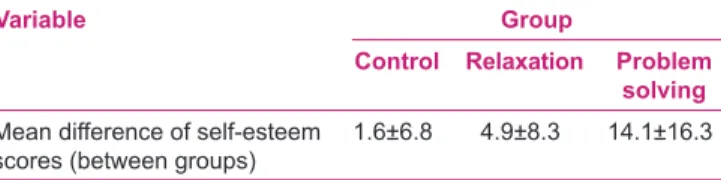
completed, the statistical results of one-way variance analysis showed that the three groups had no significant differences at the end of study (P = 0.288). But according to the mean difference of self-esteem score before and after the intervention (by one-way ANOVA test), it was found that there was significant difference among the three groups [Table 2]. The Tukey test showed that the two groups of relaxation and problem solving had significant difference (P = 0.018). Also, the intervention groups had significant difference compared to the control group (P = 0.000) [Table 3].
D
ISCUSSIONGenerally, the three groups showed a significant difference regarding the mean difference of self-esteem score. In this study, both the interventions of relaxation and problem solving could increase the self-esteem score, while the control group showed no increase in self-esteem score. These findings indicate that both types of training (problem solving and relaxation) can produce a positive change in the overall self-esteem and improve the behavioral problems of women later in the postpartum period.
Ress’s study showed that relaxation increases self-esteem and decreases depressive symptoms.[31] Findings and the
methods used in the study of Ress are similar to those of our study. Unfortunately, no other study has been found that examined the effect of relaxation on self-esteem. Aylward et al. found that self-esteem is the most important predictor of social problem-solving model and high self-esteem plays a major role in the relationship between problem-solving ability and psychological balance.[30] The
study of Abuhamzeh showed that training of problem solving significantly increases the overall self-esteem in the Table 1: Descriptive characteristics of problem-solving training, relaxation, and control groups before intervention
Characteristics Problem-solving training group (n=26) Relaxation group (n=26) Control group (n=28) Signifi cance
Mean of BDI-II (mean±SD) 19.2±5.3 18.4±4.8 20.0±5.8 P>0.05
Age (mean±SD) 25.8±4.2 24.8±4.1 25.7±4.7 P>0.05
Social support score 8.0±4.3 10.2±2.9 8.6±3.3 P>0.05
Percent
Unwanted pregnancy
Yes 38.5 30.8 21.4 χ2=1/87
df=2
P>0.05
No 61.5 69.2 78.6
Husband support
Yes 73.1 69.3 71.4 χ2=1.02
df=4
P>0.05
No 0 3.8 3.6
Some deal 26.9 26.9 25.0
Neonate sex χ2=2074
df=2
P>0.05
intervention group than in the control group. Although Abuhamzeh worked on healthy students, the method of performing problem-solving skills is similar to our study. Also, Sharifi showed that problem-solving training could increase the self-esteem in students with behavioral problems. These students and their parents could face the problems and their self- esteem improved. The present study showed similar results, but Sharifi performed problem solving in 9 weeks, each session lasting 90 min, and we performed six sessions of 45–60 min duration each. In addition, although the type of instrument used to evaluate self-esteem and the sex (male and female) and number of individuals were different in this study compared to our study, the results of both studies showed the effectiveness of this type of training in increasing the self-esteem score. We observed that the training of problem-solving skills increases the self-esteem score of depressed women more than relaxation training in the postpartum period. Although problem solving had more effect on self-esteem, the relaxation method is simple and easily practiced at home. Relaxation is accepted by most people and no need to haunt or many facilities. While in problem-solving method, an average of 214 min per patient visit with a psychiatrist or a general practitioner is required, and thus is time consuming. However, no study is found that compared the effect of relaxation and problem solving on self-esteem.
Although relaxation technique is simpler than the procedure of problem solving, the constitution of the classes and meetings for women can increase the self-esteem of subjects because women reach better understanding of the problem and solve it, while the relaxation technique was performed at home in a shorter time (20 min vs. 45 min sessions). In addition to the above studies, the study of Stephens in Southern Connecticut State University shows problem-solving
training can boost the self-esteem of the participants. In this study, problem-solving training was conducted for 3 months and for 1 h weekly. Self-esteem scores were measured by a scale rating 21 questions before and 3 months after intervention. The average of self-esteem score increased after the intervention (from 1.76 before intervention to 3.53 after intervention). The results of study showed that this type of training can increase the self-esteem scores in men, as well as in special occasions such as domestic violence and mental health problems such as postpartum depression.[34]
Overall, the findings of the present study confirm that relaxation training and problem solving are successful as they can have an effect on a person’s self-concept and increase his/her self-esteem. Also, women with postpartum depression often use dysfunctional problem-solving styles in stressful situations. The styles and techniques of treatment that are representative of the style of problem solving including cognitive behavioral therapy are fit and advantageous for the treatment of psychiatric and behavioral problems and can help women suffering from postpartum depression. Because of the importance of self-esteem during pregnancy and postpartum period, it is recommended that these two types of training programs are performed in pregnancy and the postpartum period with longer follow-up period.
Since the midwife as a primary carer in the postpartum period could play a role in the prevention and promotion of self-esteem in women with depression, it is recommended to consider and apply both types of training programs in health centers by trained midwives.
One of the study limitations was the time limit for performing this research in the pregnancy period. Also, this study was not practical as a double-blind method; the researcher herself was responsible for training the women.
In addition, the relaxation technique was performed at home on a daily basis and so careful control by the researcher was not possible. So, we attempted to ensure that these techniques were performed on a daily basis only with repeated phone calls and by encouraging women, as well as by providing educational CDs.
Also, it was not possible to use from clinical interview by psychiatrist due to high costs during two stages (before and after the intervention); therefore, such as similar studies, only depression was measured using a standard questionnaire.
The strengths of this study is performance in three groups randomly and at various health centers. Due to the lack Table 2: Comparison of mean difference of self-esteem scores
in three groups before and after intervention
Variable Group
Control Relaxation Problem
solving
Mean difference of self-esteem scores (between groups)
1.6±6.8 4.9±8.3 14.1±16.3
One-way ANOVA: P=0.000; f=8.9; df=2 (between groups)
Table 3: Comparison of three groups based on Tukey test
Groups Relaxation Problem solving Control
Problem solving P=0.018 - P=0.000
of bias in the results, this research can be extended to a larger community. Consideration of postpartum depression using two questionnaires in the first step and confirmation by the clinical psychologist in the next phase of the study is another strong point.
C
ONCLUSIONBased on the results of this study and the relationship of self-esteem with depression and the major role of problem-solving skills in improving the self-esteem score, we suggest that this simple technique is performed in the health centers by midwives for increasing the self-esteem and decreasing the depressive symptoms, and thus improving the mental health.
Also, relaxation was effective in increasing self-esteem. Therefore, relaxation is proposed as an auxiliary or replacement method along with other methods in increasing the self-esteem.
A
CKNOWLEDGMENTThe study is parts of a research thesis approved by Vice Chancellor for Research at Mashhad University of Medical Sciences, Mashhad, Iran (code: 88361).We would like to thank the university for the financial support.We also express our deepest gratitude to the subjects, who participated in this study.
The trial is registered at IRCT.ir, number IRCT138810152956N2.
R
EFERENCES1. Baumeister R, Campbell J, Krueger J, Vohs K. Does high self-esteem cause better performance, interpersonal success, happiness, or healthier lifestyles? Psychol Sci Public Interest 2003;4:1-44.
2. Yorukoglu A. Gençlikça I. Youth Age. Ankara: OzgurYayinlari; 2000.
3. Rosenberg M. Society and the Adolescent Self-Image. New Jersey: Princeton University Press; 1965.
4. Amin Shokravi F, Memarian R, Hajizadeh E, Moshki M. The roll of Enhancing self esteem educational program on self -esteem promotion of the girl students in Tehran Primary Schools. Ofogh-e-Danesh journal 2007;13:74-81.
5. Temel ZF, VeAksoy AB. Ergenve Geliimi: The First Step in the efficacy competence. Ankara: Nobel Broadcasting Distribution; 2001.
6. Glaus K. Measuring self-esteem. Ann Arbor, MI: Edwards Brothers; 1999.
7. Mohammadi F, Sahebi A. Styleofproblem solvingindepressed patientsand normal subjects. Psychol Sci J 2001;1:24-42.
8. Ivy M. Coping with depression. In: Shams G, editor. 2nd ed.
Tehran: Growth publication; 2003.
9. Cutron CE. Nonpsychotic postpartum depression: A review of recent research. Chrocal Psychol Rev 1982;2:487-503. 10. Dolatian M, Puladi M, Alavi Majd H, Yazdjerdi M. Relationship
between mode of delivery and postpartum depression. Reprod Infertil J 2006;7 (3):260-8.
11. Jannati Y, Khaki N. Psychiatry in Midwifery. 1st ed. Tehran:
Community based; 2005.
12. Jomeen J, Martin CR. Self-esteem and mental health during early pregnancy. Clin Eff Nurs 2005;9:92-5.
13. Tashakori A, Shanesaz A, Rezapour A. Assessment of some potential risk factors of postpartum depression. Pak J Med Sci 2009;25:261-4.
14. Karlson JK, Esenstat A, Ziporin T. Women’s Mental Health. In: Abolmaali KH, Saberi H, Latifi J, Banab M, editor. 1st ed. Tehran:
Salavan; 2000.
15. Mayberry LJ, Horowitz JA, Declercq E. Depression symptom prevalence and demographic risk factors among U.S women during the first 2 years postpartum. J Obstet Gynecol Neonatal Nurs 2007;36:542-9.
16. Ross R, Zeller R, Srisaeng P, Yimmee S, Somchid S, Sawatphanit W. Depression, stress, emotional support, and self-esteem among baccalaureate nursing students in Thailand. Int J Nurs Educ Scholarsh 2005;2:25.
17. Sowislo JF, Orth U. Does low self-esteem predict depression and anxiety? A meta-analysis of longitudinal studies. Psychol Bull 2013;139:213-40.
18. Hamarta E. A Prediction of Self-Esteem and life satisfaction by social problem solving. Social behavior and personality. An Int J 2009;37:73-82.
19. Weis H, Knight P. The Utility of Humility: Self-Esteem, Information Search, and Problem-Solving Efficiency. Organ Behav Hum Perform 1980;25:216-23.
20. D’Zurilla TJ. Problem solving therapy: A social competence approach to clinical intervention. New York: Springer; 1986. 21. McCabe RE, Blank stein KR, Mills JS. Interpersonal sensitivity
and social problem solving: Relations with academic and social self-esteem, depressive symptoms, and academic performance. Cognit Ther Res 1999;23:587-604.
22. Mahmoudi Rad M. The Role of Communication Skills and Social Problem Solving Training on Self- Esteem and IQ in Third Grade Students. journal of rehabilitation 2007;1 (29) 69-74. 23. Abuhamze F. The effect of problem solving training on
increasing the self-esteem of students in school. 2012. Available from: http://www.kiau.ac.ir.[Last accessed on 2013 Apirl 03]. 24. Sharifi-Daramadi P. The effect of problem solving training on
self-esteem of students with behavior problems in school. J Educ Innov 2005;4:38-63.
25. Aylward B. Depression, anxiety and self-esteem: Relations with social problem solving and decision making. Thesis of MSc Applied Psychology, School of Psychology. 2009.
26. Rees B. Effect of Relaxation with Guided Imagery on Anxiety, Depression, and Self-Esteem in Primiparas. J Holist Nurs 1995;13:255.
27. Miyagawa L. The link between relaxation and self-esteem. 2011. Available from:http://www.Ezine articles.com/expert/. [Last accessed on 2010 June 29].
28. Reynolds W, Coats K. A comparison of cognitive-behavioral therapy and relaxation training for the treatment of depression in adolescents. J Consult Clin Psychol 1986;54:653-60. 29. Abedini S. A comparative study of social support and marital
satisfaction in women with and without postpartum blues. Mashhad: Mashhad University of Medical Sciences; 2005. 30. Jacobson E. Progressive relaxation. Chicago: University of
Chicago Press; 1938.
depression scale in an iraniansample. Arch Womens Ment Health 2007;10:293-7.
32. Dobson E, Mohammad-khani P. Psychometric coordinates Beck Depression Inventory -2 in patients with major depressive disorder in partial remission periods. J Rehabil 2007;29:82-8. 33. Khodadustan M. A study of some of the factors related to
postpartum depression. Isfahan: University of Medical Sciences; 1997.
34. Stephens SM. The effect of assertiveness and problem solving training on self-esteem: School of Social Work and Human
How to site: Nasiri S, Kordi M, Gharavi MM. A comparative study of the effects of problem solving skills training and relaxation on the score of self esteem in women with postpartum depression. Iranian Journal of Nursing and Midwifery Research 2015;20:105-12.
Source of Support: This work was supported by Mashhad University of Medical Sciences vice-presidency for research, Conflict of Interest: Nill.
Services. ProQuest Dissertations and Theses. Southern Connecticut State University 1991.