THE VERSATILITY OF HETEROAGGREGATION IN
MICROGEL SYSTEMS
Azwan Mat Lazim
[a]Keywords: homoaggregation, heteroaggregation, particles, microgels, external effects
Many researchers have studied aggregation of microgel particles; however, the majority of these studies have been limited to single-component system in which homoaggregation is observed. On the other hand, less attention has been given to multi-single-component systems whereby heteroaggregation is seen. As such, heteroaggregation is not only important in various applications but is interesting from a fundamental point of view. In such a way, aggregation is driven not only by attractive electrostatic interactions, but also the presence of repulsive forces. Therefore this review discussed on the theoretical background, external effects on heteroaggregation and their potential applications.
Corresponding Authors Fax: +60389215410 E-Mail: [email protected]
[a] School of Chemical Sciences & Food Technology, Faculty of Science & Technology, Universiti Kebangsaan, Malaysia, 43600 Bangi, Malaysia
Introduction
There is considerable interest in developing methods to aid in phase separation and recovery of colloidal systems with as little energy expenditure as possible. Traditional methods such as ultracentrifugation, variation of pressure, temperature, solvent evaporation and antisolvents have been used for many years but are energy intensive.1 Traditional adsorbents include activated carbon, persimmon tannin gel, ion-exchange resins, tannin and fungal biomass.2 Unfortunately, they are often ineffective at removing nanoparticulate inorganic and small-molecule impurities. Consideration of the environmental impact of these techniques is also now much more important and so alternatives are being sought.2 Thus, it is a challenge to fabricate a sustainable procedure with very low environmental impact in conjunction with control over colloid ‘instability’ and ‘stability’.
Over the last two decades, there has been much interest in the generation and properties of colloidal microgels, with new and exciting developments being driven by subtle and sophisticated methods. Due to their flexiblity and ease of handling, many useful materials have been developed; this has led to a wide spectrum of creative approaches to combine them with organic and inorganic compounds. Microgels have many significant applications such as sensors3, pharmaceuticals4, catalyst carriers5 and for environmental clean-up.6
For many years, research has focused on developing monodisperse microgel systems, with many studies devoted to the synthesis of colloidal particles with diameters in the range 100-1000 nm. However, the majority of these studies have been limited to single-component systems. To date, there is currently considerable interest in the preparation and application of mixed microgel systems and their colloidal heteroaggregation. Microgel dispersions are generally
stable; however they can also exhibit aggregation in the swollen state due to a low effective Hamaker constant.7 The aggregation process composed by different particles is known by three different names: heteroaggregation, heterocoagulation or heteroflocculation. These terms are interchangeable but each definition pertains to a specific process. Heterocoagulation is generally used to describe irreversibility of aggregation due to permanent contact between particles. A coagulated aggregate separates out by sedimentation if it is denser than the medium, or form a creamy phase (creaming) if its density is less than that of the dispersion medium. Heteroflocculation refers to reversible or temporary contact between particles, whilst heteroaggregation is a general term which refers to particle aggregation.8
Interestingly, systems made from a mixture of anionic and cationic particles can be modified to meet certain requirements. Heteroaggregation occurs when there is an attractive interaction between the different particles of a mixed dispersion, which is at least as strong as the attraction between particles of the same type. According to Islam et. al.8 an ideal heteroaggregate structure forms when there is only an attractive interaction between different particle types. This is most frequently achieved by mixing dispersions of particles with opposite charges.
The dispersion and aggregation of microgel particles can be manipulated by external stimuli such as temperature, pH or presence of electrolytes. Such materials also offer many promising applications with controllable ‘on’ and ‘off’ systems. This review focuses on the heteroaggregation of microgels and discusses the background, techniques and the parameters that cause destabilisation. The development of significant experiments will be discussed, including structural characterizations along with a description of the properties and applications of heteroaggregation.
General theory of aggregation
adhesion of dissimilar particles in the presence of electrolytes. Using a non-linear equation developed from Poisson-Boltzmann theory, the interactions between spherical particles with unequal potentials at constant force was solved. This model was then simplified by Hogg et. al.10 by combining the Poisson-Boltzmann linear equation with Debye-Huckle theory. This finding is applicable to spherical particles with unequal surface charges. However, approximations must be made when particle sizes and surface potentials are very small. In order to solve this problem, the Derjaguin approximation has been used in cases where the value of the electrical double layer is smaller than the particle size and surface potential.9
In systems which undergo aggregation, the number of clusters involved depends on the aggregation of small particles and their combination with the existing clusters. 14-16 The first order of cluster aggregation depends on the concentration of small species, whilst the second order is directly related to the concentration of particular clusters. Puertas et. al.11 studied the heteroaggregation kinetics for different charged particles. They suggested a general approach in dilute systems, which consider only binary collisions. The aggregation kinetics can then be described by: , ( ) , , 1 ( ) ( ) ( ) m
i j i t m m k k
i j k
dn t
k n n t k n t i j m dt
(1)
where nm is the concentration of aggregates with a
configuration m, and the summations are over configurations. The first summation describes the formation of m-clusters, from any two clusters that can produce the final configuration m (i ⊕ j = m). The second term rationalizes the disappearance of aggregates. Finally, for every aggregation reaction between two clusters, i and j, the reaction constant must be specified, ki,j.
Fundamental techniques for heteroaggregation
analysis
Light scattering, either static light scattering (SLS) or dynamic light scattering (DLS), usually being used to measure the heteroaggreagtion rate constant especially at early stage of aggregation. The Rayleigh-Debye-Gans (RDG) approximation is usually applied to calculate the rate constant from light scattering.
Ryde and Matijevic18 have successfully explored RDG theory to support their light scattering data and reported that absolute heteroaggregation rate constants can be determined by analyzing time-dependent multi-angle static light scattering (SLS). Using the RDG theory, Galetto’s group have focused on the time resolved simultaneous static and dynamic light scattering (SSDLS) of larger and complex particles.17 More recently, they reported detailed heteroaggregation rate constants of amidine latex particles, sulfate latex particles, and silica particles using different ionic strengths and surface charge densities based on SLS and DLS based on DLVO theory.13
Clusters are formed as a result of interactions between soft particles and hard particles. Reversibility was studied by
Vincent et. al.19,20 and an aggregation mechanism was proposed by determining the fractal dimensions of the aggregates. The basis of the mechanism was postulated to be the competing osmotic and elastic contributions regarding the ‘soft’ character of the microgel particles. Owing to the organic side chains (hairy nature) of the microgel surface, the minimum in the potential energy has a restricted depth.21 As a further approach, by combining DLS and Brownian dynamics simulation, they studied the heteroaggregation kinetics of two polymers with opposite charge densities. They observed faster diffusion aggregation in cases of high ionic concentrations and suggested reversibility was controlled by a secondary minimum aggregation. Multi-angle light scattering is very useful in enhancing the single-angle approach, especially in interpreting the kinetic interaction of dissimilar particles. This technique however is limited to particles of radii and refractive indices below certain critical values. In a review by Kim et. al.22 the
physical effects of changing temperature, ionic strength, pH and kinetic stimulation of the clusters in heteroaggregation were discussed in detailed.
Another approach to determine heteroaggreagtion of colloidal particles is turbidimetry. The changes in turbidity reflect changes in the system stability. Thus, the observed state of aggregation/stability is the result of a complex balance between diffusion effects (Brownian motion), repulsive and attractive and van der Waals forces. This also takes into account the influence of the environment of microgels, their relative concentrations, surface charge potential and charge density under a particular set of experimental conditions.21
Recently Snowden et. al.21 determined the dispersibility (n) of a mixed anionic and cationic microgel system by setting a value (2) as an approximate boundary between dispersed and aggregated systems (Figure 1) at various pHs, temperatures and media which developed from previous experimental procedures.23 They deduced that the relative effect of concentration could be used as a trigger for aggregation at a temperature under the volume phase transition temperature (VPTT). It was noted by varying pH that the charge density of the cationic microgels became a major factor in controlling the overall dispersity of the system. The limitation of this technique however arises when it is difficult to explain heteroaggregation, which is dependent on large relative size particles, charge density and also surface charge potentials.21 Furthermore the results are somewhat inaccurate given the estimations and assumptions made.
Extensive experiments for microgels
heteroaggregation
As ‘smart’ polymers, microgels respond to external stimuli such as temperature, pH and electrolytes. This section will discuss the effect of different postulate parameters that induce microgel polymers to undergo heteroaggregation.
Variable temperature
Usually, materials expand on heating owing to thermal energy increase. In contrast, this behaviour is not applicable to all polymers in aqueous solution. Islam et. al.24reported the interactions between a cationic microgel and anionic latex as a function of temperature and electrolyte presence at approximately equal particle concentration. Heteroaggregation occurs in mixed microgel systems when the temperature increases above the VPTT. At room
Adjustable pH
Preparation of pH responsive microgels usually comprises either acidic or basic monomers or incorporation with co-monomers. Such poly(vinylpyridine-costyrene)28, poly(methyl methacrylate-co-methacrylic acid)29, PNIPAM-co-4-vinylpyridine (P4VP)21 are among pH responsive microgels with comonomers that have been commonly studied. In the case of microgel complexes, which exhibit thermoresponsive and pH responsive behaviour, the swelling properties of these microgels are strongly dominated by the distribution of the pH-sensitive co-monomers.30
This can be seen in a heteroaggregation study of mixed colloidal dispersions of anionic (PNIPAM) and cationic (PNIPAM-co-4VP) microgels reported by Snowden et. al.21 at different relative concentrations. The authors obtained similar results at pH 3 and pH 7 where the system aggregated at equal +ve/-ve concentration. Furthermore, Stark et. al.31 have reported encouraging results for reversible functionalized silica particles (PAA and PEO) triggered by pH. The authors reported that heteroflocculation occurred in the pH range 3.0 - 4.5 but beyond pH 5 the system re-dispersed (Figure 2). This supported their early hypotheses that heteroaggregation could be induced reversibly by changing the pH, which then alters the number of hydrogen bonds, thus controlling the interactions between different types of particles.
Figure 2: Photograph of heteroaggregation of PAA−PEO mixtures at changable pH.31
Another interesting demonstration of using pH-triggered formation of heteroaggregate gels prepared from mixed pigment/polystyrene (PS) dispersions was reported by Hui et.
al.32 They found that pigment/PS dispersions have two critical pH values (pHcrit) which were 1.9 and 3.45 respectively. At low pH, heteroaggregate particles gels are formed due to pH-triggered electrostatic attractions between oppositely charged particles. Therefore these findings provide some insight into the adjustable pH windows for transitions from liquid to gel forms for further applications.
Electrolytes
The surface charges for anionic/cationic microgel particles are associated with the initiator used in their preparation. The dispersions have been found to remain colloidally stable in electrolyte concentrations up to approximately 1.0 mol dm-3.21 Particles in the de-swollen state are electrostatically stabilized against aggregation, can however undergo aggregation when sufficient electrolyte is added due to interparticle van der Waals attractions. When they swell, the influx of solvent increases and hence reduces the van der Waals attraction between the particles: at high enough salt concentrations, swollen microgel particles eventually become stable to aggregation. For swollen particles, the van der Waals attraction is eliminated as the particles are predominantly water and as such the Hamaker constant is equivalent to the surrounding fluid. In contrast, for oppositely charged mixtures, the swollen microgel particles will possibly undergo heteroaggregation, although the electrolyte concentration is low with regard to inter particle electrostatic attractions.32,33
Using multi-angle SLS and DLS, Lin et. al.13 studied the heteroaggregation rate constants as a function of ionic strength. Results showed that the heteroaggregation rate constants slowly increased with a decrease in ionic strength. This behaviour was explained using a model based on DLVO theory. In other work, DLS was used by Puertas et. al.19,20 to study the critical coagulation concentration (C.C.C.) at different electrolyte concentrations, a parameter which influences heteroaggregation between oppositely charged colloidal particles. A very low electrolyte concentrations produced extremely fast aggregation and simultaneously the rate constant decreased sharply. However, it was noted that the diffusion controlled kinetics value was reached only above the C.C.C.
The fractal dimension of heteroaggregates produced from oppositely charged or similarly sized particles can be controlled by electrolyte concentration, which alters the range of electrostatic interactions between particles. Experimentally, the time evolution of the size, structure and porosity of oppositely charged colloids has been investigated by Snowswell et. al.34 By adjusting the electrolyte concentrations, they were able to control the aggregation time, giving a series of desired pore sizes and morphologies.
Applications of microgels undergoing
heteroaggregation
water purification35 also utilizes the principles of heteroaggregation. Using modified responsive polystyrene latex, easy to use pregnancy test kits have been developed. The probe was built based on heteroaggregation of human chorionic gonadotropin (HCG) that has been successfully incorporated with polystyrene latex.36
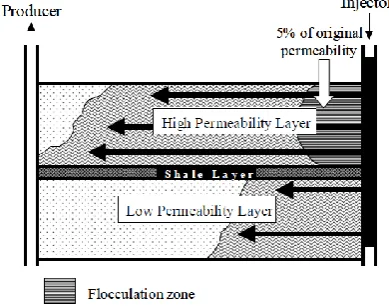
In early ceramic processing colloidal clays and animal dung were used as aids. To date, due to their intrinsic chemical and physical characteristics, microgels have been used as alternative aids in modern ceramic processing. When heated, heteroaggregation occurs in the system and the aggregates remain in the ceramic body, forming bridges which result in much stronger adhesion after evaporation of the solvent.8,25 Microgels have also been successfully exploited in oil recovery.21 Due to the thermosensitivity of poly(N-isopropylacrylamide) (PNIPAM), these microgels have been designed to enhance the efficiency of crude oil recovery. The systems exist as stable dispersions under the VPTT however flocculate once injected into the ground. This is achieved due to the acute response to the high temperatures prevalent in oil-bearing rock (above VPTT) and the presence of highly concentrated electrolyte in the pumping material, e.g. seawater. Figure 3 shows the schematic process of oil recovery by manipulating heteroaggregation. Microgel aggregation can consequently block off channels of high permeability, thus enabling the oil in the less permeable areas to be mobilised. This process however depends on the strength of the aggregates, which must bear huge shear forces resulting from the high pressure. Therefore mixed charge microgel particles are the best choice to demonstrate stronger and more robust heteroaggregation characteristics compared to homoaggregated systems.
Figure 3: Schematicshowing how microgels may be used to block a portion of high permeability rock therefore forcing a greater amount of the injected water through the low permeability layer which in turn forces out more oil.21
Conclusions
This review has discussed the versatility of microgel heteroaggregation, which is much richer from a conceptual point of view because of the inherent asymmetry originating from the two surfaces of the different particles. Heteroaggregation occurs when there is an attractive interaction between oppositely charged particles in mixed dispersions. Although the heteroaggregation process is more complicated compared to homoaggregating dispersions, a
substantial understanding of colloidal interactions in these systems has emerged and been developed. There are many strategies for designing and preparing multifunctional microgel systems that can be employed to control the outcomes by manipulating responses to external stimuli.
Heteroaggregation of colloidal microgels has mainly been studied as a function of temperature, pH and electrolyte concentration. Therefore, for each kind of stimulus involved, procedures including physical and chemical methods that led to heteroaggregation have been discussed respectively. It has been shown that heteroaggregation in systems of variable charge and charge density are also heavily influenced by a complex balance of forces, both electrostatic and steric, and can be affected significantly by the environment of the particles. Aggregation under various conditions of pH, electrolyte, temperature, charge density and relative concentration can be induced by the careful manipulation of any one or more of these environmental conditions. Furthermore, aggregation of these systems can be controlled to drive towards a system of permanent coagulation or flocculation using one or more stimuli. The separate phases from destabilised systems can then be easily filtered. This is potentially useful as physico-chemical properties can be manipulated to generate a multifunctional system for dispersion and separation purposes.
The flexibility offered by oppositely charged microgels and their heteroaggregation have numerous advantages. The underlying principles shown here rely on strong surface interactions which can be altered and monitored. This holds much promise for new developments in many areas such as oil recovery, reusable high precious nanometals and its recovery, biomedical, chemical separations and purifications and catalysis. Functionalization of these frameworks via impregnation of active components and structure can create highly structured systems with controllable properties.
Acknowledgements
The author would like to thanks the Ministry of Higher Education of Malaysian for FRGS grant FRGS/1/2011/SG/UKM/02/25 and Universiti Kebangsaan Malaysia for grants UKM-GGPM-NBT-030-2011.
References
1 Myakonkaya, O.; Eastoe, J. Adv. Colloid Interface Sci. 2009, 149,
39.
2 Hollamby, M. J.; Eastoe, J.; Chemelli, A.; Glatter, O.; Rogers, S.;
Heenan, R. K.; Grillo, I. Langmuir 2010, 26, 6989.
3 Hoare, T.; Pelton, R. Macromolecules 2007, 40, 670.
4 Oh, J. K.; Drumright, R.; Siegwart, D. J.; Matyjaszewski, K. Prog.
Polym.Sci.2008, 33, 448.
5 Mei, Y.; Lu, Y.; Polzer, F.; Ballauff, M.; Drechsler, M. Chem.
Mater. 2007, 19, 1062.
6 Abd El-Rehim, H. A. Radiat. Phys. and Chem.2005, 74, 111.
7 Bergström, L. Adv. Colloid Interface Sci.1997, 70, 125-169. 8 Islam, A. M.; Chowdhry, B. Z.; Snowden, M. J. Adv. Colloid
Interface Sci.1995, 62, 109.
9 Derjaguin, B. V. Discuss. Faraday Soc.1954, 18, 85.
11 Puertas, A. M.; Fernández-Barbero, A.; de las Nieves, F. J.
Physica A2002, 304, 340.
12 Elimelech, M. J. Colloid Interface Sci.1991, 146, 337-352.
13 Lin, W.; Kobayashi, M.; Skarba, M.; Mu, C.; Galletto, P.;
Borkovec, M. Langmuir2005, 22, 1038.
14 Grolimund, D.; Elimelech, M.; Borkovec, M.; Barmettler, K.;
Kretzschmar, R.; Sticher, H. Environ.Sci. Technol.1998, 32, 3562.
15 Yang, J.; Bos, R.; Poortinga, A.; Wit, P. J.; Belder, G. F.;
Busscher, H. J. Langmuir1999, 15, 4671.
16 Böhmer, M. R.; van der Zeeuw, E. A.; Koper, G. J. M. J. Colloid
Interface Sci.1998, 197, 242.
17 Galletto, P.; Lin, W.; Borkovec, M. Phys. Chem. Chem.
Phys.2005, 7, 1464.
18 Matijevic, N. R. J. Chem. Soc. Faraday Trans1994, 90, 167.
19 Fernandez-Barbero, A.; Vincent, B. Phys. Rev. E 2000, 63,
011509.
20 Fernandez-Nieves, A.; Fernandez-Barbero, A.; Vincent, B.; de
las Nieves, F. J. Langmuir2001, 17, 1841.
21 Hall, R. J.; Pinkrah, V. T.; Chowdhry, B. Z.; Snowden, M. J.
Colloids Surf. A2004, 233, 25.
22 Kim, A. Y.; Hauch, K. D.; Berg, J. C.; Martin, J. E.; Anderson, R.
A. J. Colloid Interface Sci.2003, 260, 149.
23 Long, J. A.; Osmond, D. W. J.; Vincent, B. J. Colloid Interface
Sci.1973, 42, 545.
24 Islam, A. M.; Chowdhry, B. Z.; Snowden, M. J. J.
Phys.Chem.1995, 99, 14205.
25 Greenwood, R.; Kendall, K.; Ritchie, S.; Snowden, M. J. J. Eur.
Ceram. Soc.2000, 20, 1707.
26 Hui, D.; Morris, D.; Edwards, M.; Saunders, B. R. J.Colloid
Interface Sci.2010, 342, 320.
27 Hou, Y.; Ye, J.; Wei, X.; Zhang, G. J. Phys. Chem. B2009, 113,
7457.
28 Loxley, A.; Vincent, B. Colloid Polym.Sci.1997, 275, 1108.
29 Saunders, B. R.; Crowther, H. M.; Vincent, B. Macromolecules
1997, 30, 482.
30 Palioura, D.; Armes, S. P.; Anastasiadis, S. H.; Vamvakaki, M.
Langmuir2007, 23, 5761.
31 Starck, P.; Ducker, W. A. Langmuir2009, 25, 2114.
32 Hui, D.; Nawaz, M.; Morris, D. P.; Edwards, M. R.; Saunders, B.
R. J.Colloid Interface Sci.2008, 324, 110.
33 Routh, A. F.; Vincent, B. J.Colloid Interface Sci. 2004, 273, 435.
34 Snoswell, D. R. E.; Rogers, T. J.; Howe, A. M.; Vincent, B.
Langmuir 2005, 21, 11439.
35 Buffle, J.; Wilkinson, K. J.; Stoll, S.; 899.Filella, M.; Zhang, J.
Environ. Sci.Technol.1998, 32, 2887
36 Ouali, L.; Pefferkorn, E.; Elaissari, A.; Pichot, C.; Mandrand, B.
J.Colloid Interface Sci. 1995, 171, 276.
Received: 03.09.2012.