Four new species of Cyrtandra (Gesneriaceae) from the South Pacific islands of Fiji 85
Four new species of
Cyrtandra
(Gesneriaceae)
from the South Pacific islands of Fiji
Melissa A. Johnson1
1 Rancho Santa Ana Botanic Garden, Claremont Graduate University, 1500 N. College Ave., Claremont, CA 91711, USA
Corresponding author:Melissa A. Johnson ([email protected]; [email protected])
Academic editor:Eric Roalson | Received 13 October 2017 | Accepted 1 December 2017 | Published 15 December 2017
Citation: Johnson MA (2017) Four new species of Cyrtandra (Gesneriaceae) from the South Pacific islands of Fiji. PhytoKeys 91: 85–104. https://doi.org/10.3897/phytokeys.91.21623
Abstract
During fieldwork in Fiji, four new species of Cyrtandra (Gesneriaceae) were discovered and are described herein: C. gregoryi M.A.Johnson, sp. nov., C. hispida M.A.Johnson, sp. nov., C. longifructosa M.A.Johnson,
sp. nov., and C. waisaliensis M.A.Johnson, sp. nov. The addition of four new species brings the current num-ber of Fijian Cyrtandra to 41 endemic species. Two of the four species are known from only a single locality, and all of the new species are likely endangered or critically endangered. Continued fieldwork in the islands of Fiji is warranted in order to better understand current species distributions and population demographics of Cyrtandra in this species-rich and still poorly explored region of the South Pacific.
Keywords
Cyrtandra, Gesneriaceae, Fiji, South Pacific, islands, new species, taxonomy, conservation
Introduction
The Southeast Asian-Pacific genus Cyrtandra J.R. Forster & G. Forster (Gesneriaceae) comprises ca. 800 species, with centers of diversity in Borneo, New Guinea, the Phil-ippines, and the Pacific islands (Atkins et al. 2013). Species of Cyrtandra are restricted to the understory of rainforests and exhibit high diversity in habit (shrubs, small trees, herbs, or vines), flower color (white, yellow, purple, pink, red), and fruit morphology (indehiscent capsules or berries). In the Pacific, Cyrtandra is one of the largest and most
PhytoKeys 91: 85–104 (2017) doi: 10.3897/phytokeys.91.21623 http://phytokeys.pensoft.net
Copyright Melissa A. Johnson. This is an open access article distributed under the terms of the Creative Commons Attribution License (CC BY 4.0), which permits unrestricted use, distribution, and reproduction in any medium, provided the original author and source are credited.
RESEARCH ARTICLE
Launched to accelerate biodiversity research
widely distributed genera of flowering plants, with ca. 175 species occurring across a region that extends from the Solomon Islands, east to the Marquesas, and north to the Hawaiian Islands. The vast majority of species are single island endemics, with the entire range of a species often being restricted to a single valley or mountain region.
Recent phylogenetic studies suggest that Cyrtandra evolved in Southeast Asia, fol-lowed by dispersal to the Pacific islands (Clark et al. 2008, 2009; Johnson et al. 2017), likely via frugivorous birds. The Pacific clade appears to have originated in Fiji ca. 9 mya, with subsequent founder events from Fiji to archipelagos both near (e.g., Samoa) and far (e.g., the Hawaiian Islands) resulting in the current distribution of Cyrtandra across the Pacific (Johnson et al. 2017). While Fiji hosts the second highest number of endemic Cyrtandra species in the Pacific (second only to the Hawaiian Islands, with 60 spp.), only limited research has been conducted on the genus in this diverse region. Gillett (1967) conducted the only thorough taxonomic review of Fijian Cyrtandra to date, with his treatment dividing 35 species among six informal groups. However, upon further study of Cyrtandra across the South Pacific, Gillett (1973) acknowledged that these groupings were largely inadequate and that a more accurate treatment of Fijian Cyrtandra would require considerably more fieldwork. Smith’s treatment of Cyrtandra in the Flora of Fiji (1991) was largely drawn from Gillett (1967), although two species were restored from synonymy bringing the number of recognized species to 37.
Botanical explorations in Fiji from 1840–1953 resulted in the description of all 37 currently recognized species of Fijian Cyrtandra. Since the 1960s, relatively few collec-tions of Fijian Cyrtandra have been made. In the 1970s, a number of new roads were built in Fiji to accommodate the expanding agricultural industry, vastly increasing ac-cessibility into remote regions (e.g., central Vanua Levu, eastern Taveuni; Lin 2012). In 2014 and 2015, I was able to undertake extensive fieldwork across the four largest Fijian islands (Viti Levu, Vanua Levu, Taveuni, and Kadavu), focusing on regions that have been poorly explored in the past. This work resulted in the discovery of four new species that are here described and illustrated.
Methods
Four new species of Cyrtandra (Gesneriaceae) from the South Pacific islands of Fiji 87
relatives of each of the new species based on shared phylogenetic history. Conserva-tion status was assessed in accordance with IUCN Red List Category criteria (IUCN Standards and Petitions Subcommittee 2016).
Taxonomic treatment
Cyrtandra gregoryiM.A.Johnson, sp. nov. urn:lsid:ipni.org:names:60475584-2 Figs 1, 2
Diagnosis. Cyrtandra gregoryi is closely related to C. ciliata Seem. (Fig. 2), but differs in its elliptic to ovate leaves up to 39 × 17 cm (vs. lanceolate to ovate leaves up to 28 × 12 cm), axillary inflorescences with indument of brown trichomes (vs. cauliflorous inflorescences with indument of white trichomes), pale green calyces 6–13 mm long that are cleft unequally into lanceolate coriaceous lobes (vs. calyces white, 7–10 mm long, cleft nearly to the base into equal linear-lanceolate lobes), these splitting along two to three sutures and recurving after anthesis (vs. remaining erect after anthesis), and corollas with exserted style and stamens (vs. style and stamens included).
Type. FIJI. Taveuni: near the end of the Lavena coastal walk along the Wainibau stream, ca. 3.5 km NW of Lavena Village, 16°52.10'S, 179°54.32'W, 32 m elev., 04 August 2014, M.A. Johnson 105 with G.J. Hora (holotype: RSA).
Figure 1.Cyrtandra gregoryi M.A.Johnson A Habit B Inflorescence C Corolla, anterior view D Calyx E Flower, lateral view F Gynoecium. Drawn from Johnson 105 (RSA) and field images.
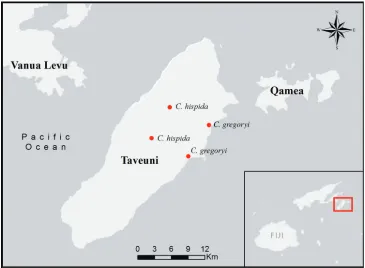
Distribution and ecology. Cyrtandra gregoryi is only known from two locations in eastern Taveuni, Fiji, where it grows in lowland forests and along stream banks from ca. 30–50 m (Fig. 3).
Phenology. Individuals of this species were in flower when collected in August and November, with fruits likely becoming mature ca. 5–6 months later.
Four new species of Cyrtandra (Gesneriaceae) from the South Pacific islands of Fiji 89
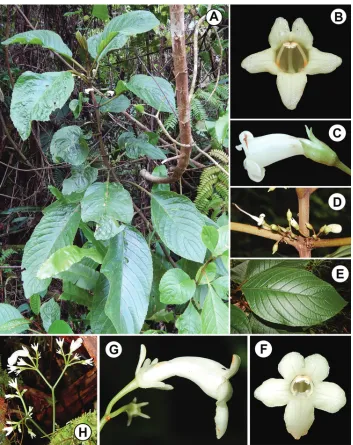
Figure 2.Cyrtandra gregoryi M.A.Johnson and closest relative (C. ciliata) based on a molecular phylog-eny by Johnson et al. (2017). A C. gregoryi shrub habit B C. gregoryi corolla, anterior view C C. gregoryi
flower, lateral view D C. gregoryi axillary cyme inflorescence E C. gregoryi adaxial leaf surface F C. ciliata
corolla, anterior viewGC. ciliata flower, lateral view H C. ciliata cauliflorous cyme inflorescence. All photos taken in the field by M. Johnson.
Figure 3. Distribution of Cyrtandra gregoryi and C. hispida on Taveuni, Fiji.
elevation. These species share a cymose inflorescence and glabrous to glabrate leaves. The key provided in the taxonomic treatment by Gillett (1967) would place C. gregoryi in species Group 5 based on the branching cyme inflorescence, non-woody inflorescence axis, deciduous calyx, styles and/or stamens being exserted from the corolla tube, and stamens 8–12 mm long.
Conservation status. Proposed IUCN Red List Category: Endangered (EN) based on an estimated area of occupancy of < 500 km2 (criterion B2), known to exist
at no more than five locations (B2a), inferred decline in area of occupancy (B2bii), decline in area, extent, and/or quality of habitat (B2biii), decline in number of mature individuals (B2bv), and population size estimated to number fewer than 250 mature individuals (D).
Four new species of Cyrtandra (Gesneriaceae) from the South Pacific islands of Fiji 91
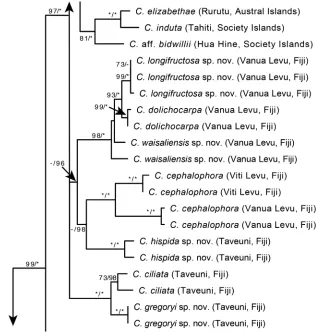
Figure 4. A portion of the Maximum Likelihood phylogram from Johnson et al. (2017) based on three nuclear (ITS, ETS, Cyrt1) and two chloroplast (psbA-trnH, rpl32-trnL) loci. Support values shown for each branch are bootstrap and posterior probabilities when ≥ 50% and ≥ 0.50, respectively. An asterisk indicates 100% BS or 1.0 PP; a dash indicates that the branch was not supported.
Additional specimens examined. FIJI. Taveuni: Tavoro Falls Trail in Bouma Na-tional Heritage Park, 19 November 2016, J.C. Game 16/235 with S. Fawcett (PTBG). Notes. Eight individuals of C. gregoryi were recorded during field surveys along the Lavena coastal trail, with all of these being reproductive. Additional field surveys in the area are likely to reveal more individuals. No other Cyrtandra species were observed growing sympatrically with C. gregoryi in the Lavena region, although C. tempestii Horne ex. C.B. Clarke was collected 0.64 km to the SE. An additional collection was made of a single individual of C. gregoryi near the Tavoro Falls in Bouma National Heritage Park, an area that also hosts C. ciliata.
Cyrtandra hispida M.A.Johnson, sp. nov. urn:lsid:ipni.org:names:77174061-1 Figs 5, 6
Diagnosis. Cyrtandra hispida is morphologically similar to C. waisaliensis sp. nov., but differs in its axillary cyme inflorescence of 2–4 flowers (vs. cauliflorous cyme inflores-cence of 2–8 flowers), green bracts and bracteoles 5–9 mm long (vs. white bracts and bracteoles 3–10 mm long), calyx pale green and 29–31 mm long (vs. calyx white and 23–37 mm long), corolla tube 31–34 mm long (vs. corolla tube 23–27 mm long), and staminodes 2 (vs. staminodes 3).
Type. FIJI. Taveuni: Des Voeux Peak, 16°50.48'S, 179°57.97'W, 1109 m elev., 13 July 2014, M.A. Johnson 91 with G.J. Hora (holotype: RSA; isotype: SUVA).
Four new species of Cyrtandra (Gesneriaceae) from the South Pacific islands of Fiji 93
Figure 5. Cyrtandra hispida M.A.Johnson. A Habit B Inflorescence C Corolla, anterior view D Co-rolla, longitudinal section E Calyx, longitudinal section and young fruit. Drawn from Johnson 91 (RSA, SUVA), Johnson 212 (SUVA), Johnson 215 (RSA), and field images.
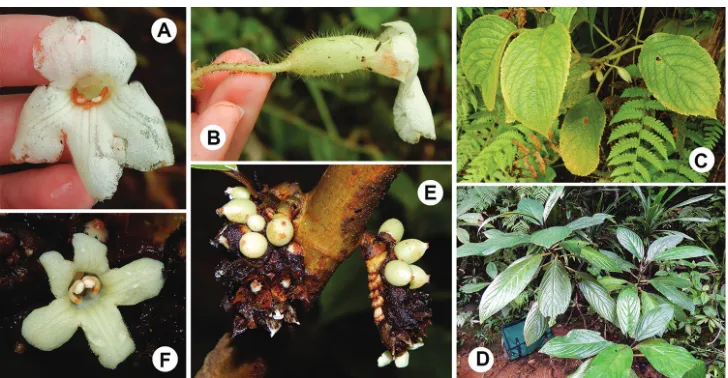
Figure 6.Cyrtandra hispida M.A.Johnson and closest relative (C. cephalophora) based on molecular phy-logeny by Johnson et al. (2017). A C. hispida corolla, anterior view B C. hispida flower, lateral view C
C. hispida shrub habit and axillary cyme inflorescence D C. cephalophora shrub habit E C. cephalophora
capitate-cylindrical cauliflorous inflorescence and young fruits F C. cephalophora corolla, anterior view. All photos taken in the field by M. Johnson, with photos of C. hispida taken from the type collection.
Phenology. Individuals of this species were in flower when collected in July, with fruits likely becoming mature ca. 5–6 months later (December–January).
Etymology. This species is named for the stiff trichomes that cover the stems, leaves, and inflorescences.
Phylogenetic placement. A recent phylogenetic study by Johnson et al. (2017) placed Cyrtandra hispida in a weakly supported clade with four other species (C. cepha-lophora Gillespie, C. waisaliensis sp. nov., C. dolichocarpa A. Gray, C. longifructosa sp. nov.) that are recorded from the Fijian Islands of Viti Levu (C. cephalophora) and/or Vanua Levu (C. cephalophora, C. waisaliensis, C. dolichocarpa, C. longifructosa) (Fig. 4). Within this clade, C. hispida is most similar morphologically to C. waisaliensis (sp. nov., described below). Both species have large bilabiate corollas, persistent cylindrical calyces, ovate to obovate leaves, and a dense indument of long stiff trichomes covering the stems, leaves, and inflorescences. Additional sampling of species and of nuclear genic regions may be required to confidently place C. hispida with its closest relatives. The key provided in the taxonomic treatment by Gillett (1967) would place C. hispida in species Group 2 based on the branching cyme inflorescence and the persistent calyx.
Conservation status. Proposed IUCN Red List Category: Endangered (EN) based on an estimated area of occupancy of < 500 km2 (criterion B2), known to exist at no
Four new species of Cyrtandra (Gesneriaceae) from the South Pacific islands of Fiji 95
dam (M. Johnson, pers. obs.). Additional threats include mining for gold and copper, invasion by plant species such as Clidemia hirta (L.) D. Don (Koster’s curse; M. John-son, pers. obs), and damage from tropical cyclones. Further surveys are needed in the upland forests of Taveuni (which remain relatively unexplored, exceptions being the area surrounding Lake Tagimoucia and the road to Des Voeux Peak) to determine the extent of occurrence and population demographics of C. hispida.
Additional specimens examined. FIJI. Taveuni: mountains above Somosomo, 16°47.67'S, 179°56.10'W, 693 m elev., 24 August 2015, M.A. Johnson 212 (SUVA), M.A. Johnson 215 (RSA).
Notes. Cyrtandra hispida was observed to grow sympatrically with three species on Des Voeux Peak (C. leucantha A.C. Sm., C. ciliata, and Cyrtandra sp.) and three species in the mountains above Somosomo (C. leucantha, C. ciliata, C. taviunensis Gillespie). Several individuals were observed that appeared to be of hybrid origin in these popula-tions, with the widespread and common C. ciliata inferred as one of the parents based on similar floral morphology. While the observation of ongoing hybridization in these populations suggests the possibility of C. hispida being of hybrid origin, none of the sympatric species have morphological characters similar to C. hispida. Furthermore, C. hispida is placed in a clade of species that are endemic to the neighboring islands of Vanua Levu and Viti Levu, and does not appear to be closely related to species endemic to Taveuni.
Cyrtandra longifructosa M.A.Johnson, sp. nov. urn:lsid:ipni.org:names:77174062-1
Figs 7, 8
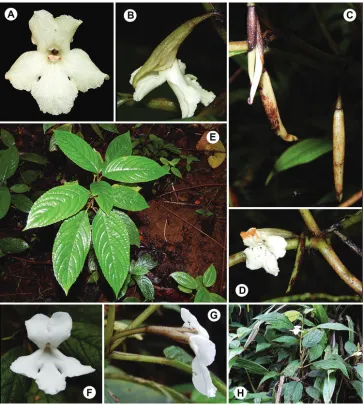
Diagnosis. This species is closely related to C. dolichocarpa (Fig. 8), but differs in its glabrous elliptic-ovate leaves (vs. moderately pubescent lanceolate-ovate leaves), blades up to 22 × 9 cm (vs. blades up to 17 × 7 cm), petioles 3–9 cm long (vs. petioles 1–4 cm long), deciduous lanceolate bracts (vs. persistent ovate bracts), peduncles 2–4 mm long (vs. 5–10 mm long), pedicels 11–18 mm long (vs. 21–27 mm long), deciduous beaked calyx (vs. persistent cylindrical calyx), and corolla tube 23–29 mm long (vs. corolla tube 36–55 mm long).
Type. FIJI. Vanua Levu: ca. 0.8 km NE of Waisali Village along the Waisali Creek, 16°38.51'S, 179°14.54'E, 110 m elev., 09 July 2014, M.A. Johnson 65 with G.J. Hora (holotype: SUVA; isotype: RSA).
Figure 7.Cyrtandra longifructosa M.A.Johnson. A Habit B Corolla, staminate phase, anterior view C Mature elongate cylindrical fruit D Inflorescence and young fruit E Corolla, ovulate phase, anterior view. Drawn from Johnson 65 (SUVA, RSA), Johnson 59 (RSA), and field images.
Four new species of Cyrtandra (Gesneriaceae) from the South Pacific islands of Fiji 97
Figure 8.Cyrtandra longifructosa M.A.Johnson and closest relative (C. dolichocarpa) based on molecular phylogeny by Johnson et al. (2017). A C. longifructosa corolla, anterior view B C. longifructosa flower, lat-eral view C C. longifructosa elongate cylindrical fruits D C. longifructosa axillary inflorescence and young fruits E C. longifructosa shrub habit F C. dolichocarpa corolla, anterior view G C. dolichocarpa flower, lateral view H C. dolichocarpa shrub habit. All photos taken in the field by M. Johnson, with photos of C. longifructosa taken from the type collection.
nectary disc cupulate, annular, deciduous from mature fruit; gynoecium (ovary, style, and stigma) ca. 24 mm long, ovary glabrous, style pubescent with capitate glandular tri-chomes along distal ⅓ of its length, stigma bilobed; berries cylindrical, elongate, mature fruit to 40 mm long and 5 mm wide, glabrous, turning white at maturity.
Distribution and ecology. Cyrtandra longifructosa is known only from one popu-lation in the Waisali region of central Vanua Levu, Fiji, where it occurs in the wet forest understory along a small creek at ca. 110 m elevation (Fig. 9).
Phenology. Individuals of this species had flowers, immature fruits, and mature fruits when collected in July.
Etymology. Named for the elongate cylindrical fruits, one of the diagnostic char-acteristics of this species.
Phylogenetic placement. The phylogenetic study by Johnson et al. (2017) placed Cyrtandra longifructosa as sister to C. dolichocarpa (endemic to Vanua Levu and Rabi, Fiji) with strong support (Fig. 4). These species both have large bilabiate corollas and elongate cylindrical berries. The key provided in the taxonomic treatment by Gillett (1967) would place C. longifructosa in species Group 3 based on the branching cyme inflorescence, non-woody inflorescence axis, deciduous calyx, inserted anthers and styles, and calyx lobes about the same length as the calyx tube.
Conservation status. Proposed IUCN Red List Category: Critically Endangered (CR): based on an estimated area of occupancy of < 10 km2 (criterion B2), known to
Four new species of Cyrtandra (Gesneriaceae) from the South Pacific islands of Fiji 99
exist only at a single location (B2a), projected decline in extent of occurrence (B2bi), area of occupancy (B2bii), and area, extent, and/or quality of habitat (B2biii). This species is only known from one locality in the central mountains of Vanua Levu, war-ranting additional surveys in areas of Vanua Levu with intact rainforest (e.g., Waisali, the Natewa Peninsula) to determine the full extent of occurrence and population de-mographics of C. longifructosa. Regions with suitable rainforest habitat on Vanua Levu are threatened by logging, mining for bauxite and gold, invasive plant species such as Clidemia hirta (Koster’s curse; M. Johnson, pers. obs.), and tropical cyclones.
Additional specimens examined. FIJI. Vanua Levu: NE of Waisali Village along Waisali Creek, 16°38.51'S, 179°14.54'E, 110 m elev., 09 July 2014, M.A. Johnson 59 with G.J. Hora (RSA).
Notes. The population ofC. longifructosa was observed to contain ca. 20 individu-als, many of which were reproductive. No other Cyrtandra species were observed grow-ing in the immediate vicinity, although the closely related species C. dolichocarpa, C. waisaliensis, and C. cephalophora were all collected 2.25 km W of the C. longifructosa population described here.
Cyrtandra waisaliensis M.A.Johnson, sp. nov. urn:lsid:ipni.org:names:77174063-1
Figs 10, 11
Diagnosis. The new species is closely related to C. dolichocarpa and C. longifructosa (Fig. 8), but differs in its dense bristly pubescence on the young stems, leaves, petioles, and inflorescences (vs. moderate appressed pubescence on C. dolichocarpa; vs. glabrous on C. longifructosa), cauliflorous inflorescences (vs. axillary inflorescences in both C. dolichocarpa and C. longifructosa), persistent foliaceous ovate white bracts to 10 mm long (vs. non-foliaceous green bracts to 5 mm long in C. dolichocarpa; vs. deciduous non-foliaceous lanceolate green bracts to 8 mm long in C. longifructosa), and multiple persistent foliaceous white bracteoles (vs. single deciduous non-foliaceous green brac-teoles in C. dolichocarpa; vs. bracbrac-teoles absent in C. longifructosa).
Type. FIJI. Vanua Levu: Waisali Forest Reserve along the lower portion of the Sa-vuqoro Creek, 16°38.39'S, 179°13.25'E, 338 m elev., 07 July 2014, M.A. Johnson 50 with G.J. Hora (holotype: SUVA; isotype: RSA).
Figure 10.Cyrtandra waisaliensis M.A.Johnson. A Habit B Cauliflorous inflorescence CCorolla, an-terior view D Corolla, longitudinal section E Gynoecium F Calyx, longitudinal section and young fruit. Drawn from Johnson 48 (RSA), Johnson 50 (SUVA, RSA), and field images.
Four new species of Cyrtandra (Gesneriaceae) from the South Pacific islands of Fiji 101
Figure 11.Cyrtandra waisaliensis M.A.Johnson. A Corolla, anterior view B Flower, lateral view C Cau-liflorous cyme inflorescence D Shrub habit ERainforest understoryhabitat. All photos from the type collection, taken in the field by M. Johnson.
apically connate, staminodes 3; nectary disc prominent, annular, 2 mm high; gynoecium (ovary, style, and stigma) 16–26 mm long, ovary glabrous, style pubescent with capi-tate glandular trichomes along distal ⅓ of length, stigma bilobed; berries ellipsoid, green when immature, enclosed by the persistent calyx, mature fruit not seen.
Distribution and ecology. Cyrtandra waisaliensis is known only from one popula-tion in the Waisali Forest Reserve on Vanua Levu, Fiji at 300–360 m elevapopula-tion, occur-ring in the dense forest understory alongside a creek (Fig. 9).
Phenology. Flowers and immature fruits were observed in July, with fruits likely becoming mature ca. 5–6 months later (December–January).
Etymology. The new species is named after the area of Vanua Levu where it was collected, Waisali Forest Reserve.
caly-ces, and a dense indument of stiff uniseriate trichomes. Cyrtandra hispida is currently placed in a polytomy with C. cephalophora and the clade comprising C. waisaliensis, C. longifructosa, and C. dolichocarpa. The key provided in the taxonomic treatment by Gillett (1967) would place C. waisaliensis in species Group 2, based on the branching cyme inflorescence and the persistent calyx.
Conservation status. Proposed IUCN Red List Category: Critically Endangered (CR) based on an estimated area of occupancy of < 10 km2 (criterion B2), known to
exist at only a single location (B2a), projected decline in extent of occurrence (B2bi), area of occupancy (B2bii), and area, extent, and/or quality of habitat (B2biii). This species is only known from one locality in the central mountains of Vanua Levu, war-ranting additional surveys in areas of Vanua Levu with intact rainforest (e.g., Waisali, the Natewa Peninsula) to determine the full extent of occurrence and population de-mographics of C. waisaliensis. Regions with suitable rainforest habitat on Vanua Levu are threatened by logging, mining for bauxite and gold, invasive plant species such as Clidemia hirta (Koster’s curse; M. Johnson, pers. obs.), and tropical cyclones.
Additional specimens examined. FIJI. Vanua Levu: Waisali Forest Reserve along the lower portion of the Savuqoro Creek, 16°38.34'S, 179°13.18'E, 355 m elev., 07 July 2014, M.A. Johnson 48 with G.J. Hora (RSA).
Notes. The observed population of C. waisaliensis was comprised of ca. 20 indi-viduals, many of which were reproductive. A single individual appeared to be of hybrid origin, with the putative parents being C. waisaliensis and C. cephalophora based on morphological characters intermediate between these two species.
Conclusions
The recognition of C. gregoryi, C. hispida, C. longifructosa, and C. waisaliensis brings the new total of Fijian Cyrtandra species to 41. The four new species of Cyrtandra described here demonstrate that the islands of Fiji remain poorly explored botani-cally, at least in some regions. Of the 28 Fijian Cyrtandra species collected during field expeditions in 2014 and 2015, four of these were new to science. An additional four Cyrtandra species could not be keyed out to any of the existing species due to a lack of reproductive material. However, with further field study it is possible that these, along with other future collections, may be identified as new species.
Acknowledgements
Four new species of Cyrtandra (Gesneriaceae) from the South Pacific islands of Fiji 103
being an excellent field assistant and for providing endless encouragement and moral support. This work would not have been possible without the kind peoples of Fiji, who offered their assistance, expertise and hospitality. The following herbaria graciously al-lowed the use of their collections for study: BISH, GH, K, NY, RSA, SUVA, UC, US, and WU. John Game provided collection information and photographs of Cyrtandra gregoryi for study. Funding for this project was provided by the following: Rancho Santa Ana Botanic Garden; Garden Club of America Award in Tropical Botany; American Philosophical Society Lewis and Clark Fund for Exploration and Field Research; The Gesneriad Society Nelly D. Sleeth Scholarship Endowment Fund; The Gesneriad Soci-ety Elvin McDonald Fund; SociSoci-ety of Systematic Biologists Graduate Student Research Award; Sigma Xi Grants-in-Aid of Research; American Society of Plant Taxonomists Graduate Student Research Grant; and Claremont Graduate University. Lastly, I am grateful to my sister, Liv Johnson, for the beautiful line drawings, and to Lucinda Mc-Dade, John R. Clark, J. Travis Columbus, J. Mark Porter, David Lorence, and one anonymous reviewer for comments that greatly improved this manuscript.
References
Atkins HJ, Bramley GLC, Clark JR (2013) The taxonomy of Cyrtandra (Gesneriaceae): current knowledge, future directions. Selbyana 31(2): 157–165.
Clark JR, Ree RH, Alfaro ME, King MG, Wagner WL, Roalson EH (2008) A comparative study in ancestral range reconstruction methods: retracing the uncertain histories of insular lineages. Systematic Biology 57(5): 693–707. https://doi.org/10.1080/10635150802426473
Clark JR, Wagner WL, Roalson EH (2009) Patterns of diversification and ancestral range reconstruction in the southeast Asian-Pacific angiosperm lineage Cyrtandra (Gesneriace-ae). Molecular Phylogenetics and Evolution 53: 982–994. https://doi.org/10.1016/j. ympev.2009.09.002
Emanuel K (2005) Increasing destructiveness of tropical cyclones over the past 30 years. Nature 436: 686–688. https://doi.org/10.1038/nature03906
Gillett GW (1967) The genus Cyrtandra in Fiji. Contributions from the United States National Herbarium 37: 107–159.
Gillett GW (1973) The genus Cyrtandra (Gesneriaceae) in the South Pacific. University of Cali-fornia Publications in Botany (vol. 66). University of CaliCali-fornia Press, Berkeley.
Goulding W, Moss PT, McAlpine CA (2016) Cascading effects of cyclones on the biodiver-sity of Southwest Pacific islands. Biological Conservation 193: 143–152. https://doi. org/10.1016/j.biocon.2015.11.022
IUCN Standards and Petitions Subcommittee (2016) Guidelines for using the IUCN Red List categories and criteria. Version 11. http://www.iucnredlist.org/documents/RedListGuide-lines.pdf [accessed 9 September 2016]
Johnson MA, Clark JR, Wagner WL, McDade LA (2017) A molecular phylogeny of the Pacific clade of Cyrtandra reveals a Fijian origin, recent diversification, and the impor-tance of founder events. Molecular Phylogenetics and Evolution 116: 30–48. https://doi. org/10.1016/j.ympev.2017.07.004
Knutson TR, McBride JL, Chan J, Emanuel K, Holland G, Landsea C, Held I, Kossin JP, Srivastava AK, Sugi M (2010) Tropical cyclones and climate change. Nature Geoscience 3: 157–163. https://doi.org/10.1038/ngeo779
Lin H-L (2012) Colonial uneven development, Fijian Vanua, and modern ecotourism in Taveuni, Fiji. Pacific Asia Inquiry 3: 41–57.
Smith AC (1991) Flora Vitiensis Nova: A New Flora of Fiji (vol. 5). National Tropical Botanical Garden, Kauai, Hawaii.
Smith JF, Burke CC, Wagner WL (1996) Interspecific hybridization in natural populations of Cyrtandra (Gesneriaceae) on the Hawaiian Islands: evidence from RAPD markers. Plant Systematics and Evolution 200: 61–77. https://doi.org/10.1007/BF00984748