ARTIGO ORIGINAL
AMP
STUDENT
ARTIGO
ACEITE P
ARA
PUBLICAÇÃO DISPONÍVEL
EM WWW
.ACT
AMEDICAPORTUGUESA.COM
Correlation of Estimated Creatinine Clearance and
Glomerular Filtration Rate in Very Elderly Patients and
Antibiotic Prescribing Errors: Cohort Study
Correlação entre a Clearance da Creatinina Estimada e a
Taxa de Filtração Glomerular Estimada nos Doentes Muito
Idosos e Erros de Prescrição dos Antibióticos: Um Estudo
de Coorte
Manuel Alberto SILVA1, Gustavo DIAS2, Teresa CARDOSO1,3
Acta Med Port 2020 xxx;33(AOP):xxx-xxx ▪ https://doi.org/10.20344/amp.12408
ABSTRACT
Introduction: Determination of renal function is particularly important when prescribing antibiotics to elderly patients. This study aims to
determine the correlation between estimated creatinine clearance and the estimated glomerular filtration rate, for a hospitalized popula
-tion of very elderly patients, and to audit antibiotic prescribing errors.
Material and Methods: Retrospective cohort study of all patients ≥ 80 years hospitalized with antibiotic. Creatinine clearance was calculated using Cockcroft-Gault equation and estimated glomerular filtration rate by Modification of Diet in Renal Disease Study and Chronic Kidney Disease Epidemiology Collaboration equations. Dosing errors were determined through adjustment of daily define dose to renal function.
Results: The study included 589 patients. The correlation of Cockcroft-Gault with Modification of Diet in Renal Disease and Chronic
Kidney Disease Epidemiology Collaboration was r = 0.98 and 0.96 for the minimum serum creatinine, and 0.97 and 0.93 for the maxi
-mum serum creatinine. Based on Cockcroft-Gault, there were errors in the daily defined dose in 45% in the mini-mum serum creatinine, and 52% in the maximum serum creatinine day. There was a discrepancy in the recording of errors of 14% to 16% when Cockcroft-Gault was compared with Modification of Diet in Renal Disease and Chronic Kidney Disease Epidemiology Collaboration.
Discussion: There was a good correlation of Cockcroft-Gault with the estimated glomerular filtration rate by Modification of Diet in Re -nal Disease or Chronic Kidney Disease Epidemiology Collaboration. Regardless of the equation used to estimate re-nal function there was a high rate of antibiotic dosing errors documented in this population.
Conclusion: This study supports the maintenance of the Cockcroft-Gault equation for drug dosing in the very elderly population. Fur
-ther studies are needed to investigate underlying causes of prescribing errors.
Keywords: Aged, 80 and over; Aging; Anti-Bacterial Agents; Creatinine; Glomerular Filtration Rate; Medication Errors
RESUMO
Introdução: A determinação da função renal é particularmente importante na prescrição de antibióticos em doentes idosos. O objetivo deste estudo é correlacionar a clearance de creatinina com a taxa de filtração glomerular estimada, numa população hospitalizada de doentes muito idosos, e auditar os erros de prescrição antibiótica.
Material e Métodos: Coorte retrospetivo de todos os doentes ≥ 80 anos hospitalizados com antibioterapia prescrita. A clearance de creatinina foi calculada através da equação Cockcroft-Gault, e a filtração glomerular estimada através das equações Modification of Diet in Renal Disease e Chronic Kidney Disease Epidemiology Collaboration. Os erros de prescrição foram determinados pelo ajuste da dose diária definida à função renal.
Resultados: Foram incluídos 589 doentes. A correlação da Cockcroft-Gault com Modification of Diet in Renal Disease e Chronic Kidney Disease Epidemiology Collaboration foi r = 0,98 e 0,96 para a creatinina sérica mínima, e 0,97 e 0,93 para a creatinina sérica máxima. Com base na Cockcroft-Gault, a taxa de erro na dose diária definida foi 45% no dia da creatinina sérica mínima e 52% no dia da creatinina sérica máxima. Quando a Cockcroft-Gault foi comparada com a Modification of Diet in Renal Disease e a Chronic Kidney Disease Epidemiology Collaboration houve uma discrepância no registo de erros de 14% a 16%, respetivamente.
Discussão: Verificou-se uma boa correlação entre a Cockcroft-Gault e as equações que calculam a filtração glomerular: Modification
of Diet in Renal Disease ou Chronic Kidney Disease Epidemiology Collaboration. Independentemente da equação utilizada para esti
-mar a função renal, foi documentada uma taxa elevada de erros na dose de antibióticos prescrita nesta população.
Conclusão: Este estudo reforça a manutenção do uso da equação de Cockcroft-Gault para calcular a dose adequada de antibióticos na população muito idosa. Mais estudos são necessários para investigar as causas subjacentes aos erros de prescrição.
Palavras-chave: Antibacterianos; Creatinina; Envelhecimento; Erros de Medicação; Idoso de 80 Anos ou mais; Taxa de Filtração Glomerular
INTRODUCTION
Most drugs and their metabolites are excreted by the kidney through glomerular filtration. The overall size, mass and 1. Instituto de Ciências Biomédicas Abel Salazar. Universidade do Porto. Porto. Portugal.
2. Pharmaceutical Services. Hospital de Santo António. Centro Hospitalar Universitário do Porto. Porto. Portugal. 3. Polyvalent Intensive Care Unit. Hospital de Santo António. Centro Hospitalar Universitário do Porto. Porto. Portugal. Autor correspondente: Manuel Alberto Silva. [email protected]
ARTIGO ORIGINAL
AMP
STUDENT
ARTIGO
ACEITE P
ARA
PUBLICAÇÃO DISPONÍVEL
EM WWW
.ACT
AMEDICAPORTUGUESA.COM
effective area of filtration decrease with increasing age.1,2
Therefore, there is an increased risk of drug and active metabolite accumulation in older patients, which accounts for the greater incidence of adverse drug reactions in this age group.1
Adverse drug events are between the fourth and sixth leading cause of death in the United States3 and are responsible for one in six hospital admissions of older adults.4
Antibiotics are the second most common cause of adverse drug events in the ambulatory setting among seniors.5 Most guidelines recommend drug dosing adjustments in older adults with or without renal disease. The focus should be placed on reaching the optimal balance between improved outcomes while minimizing potential for drug toxicity. There-fore, the evaluation of renal function is of the essence. In order to determine renal function, several equations have been studied and validated using serum creatinine level as a marker for renal clearance. The Cockcroft-Gault (CG) equation, despite inaccurate in the elderly, remains the most widely used equation for determining the creatinine clearance. For more accurate assessment of estimated glomerular filtration rate (GFR), two other equations have been developed using larger populations: the Modification of Diet in Renal Disease (MDRD) Study equation and the Chronic Kidney Disease Epidemiol-ogy Collaboration (CKD-EPI) equation.1,6
In comparisons between the CG, MDRD and CKD-EPI in the elderly, MDRD and CKD-EPI have been shown to more accurately assess estimated GFR than CG6; however, the MDRD Study equation has not been validated in elderly persons (> 70 years of age).7
The aim of this study is to determine the correlation between estimated creatinine clearance by CG equation with es-timated GFR by MDRD and CKD-EPI equations, for a hospitalized population of very elderly patients (aged 80 years and older), and to audit antibiotic prescription, namely adjustment to renal function.
MATERIAL AND METHODS
Retrospective cohort study of all patients aged 80 years and older, admitted to Hospital de Santo António, Centro Hospitalar Universitário do Porto (HSA-CHUP), to whom antibiotic therapy was prescribed with intention to treat (antibiotic prophylaxis was not included). It was conducted over a three- month period, between 1st January 2017 and 31th March 2017. Ethical approval was obtained from the Ethical Committee for Health of HSA-CHUP, on March 2019 – N/REF.ª 2018.224(194-DEFI/193-CES).
Clinical characterization and approach
In the study period, prescribed antibiotic regimens, the loading doses, the daily defined doses (DDD) – in the day of maximum and minimum serum creatinine – and the total period of antibiotic therapy were obtained from the clinical re-cords. In every patient, only the first cycle of antibiotic treatment in each hospitalization was considered. If modifications were made to the prescribed antibiotics, the reasons stated in the clinical records were also obtained. Patients with end-stage renal disease undergoing hemodialysis, peritoneal dialysis, or kidney transplantation, those prescribed with topical antibiotics or antibiotics with a prophylactic intent or those in whom the treatment lasted less than 48 hours were excluded. Patients’ age, gender, race, body weight and height were obtained from the clinical records. Patients’ comorbidities were determined and used to obtain the Charlson Comorbidity Index (CCI) score.8 The degree of functional impairment was determined according to the Karnofsky Performance Status Scale (KPS), using the information provided by clinical re-cords.9 This variable was then categorized in two groups: a group of patients with preserved autonomy in activities of daily living (score ≥ 70%) and a group of patients with some degree of dependence (score < 70%). The prescribing software used for inpatients was also used to assess if the patients’ weight and creatinine were registered for automatic calculation of creatinine clearance.
Renal function calculation equations
For each patient, renal function was estimated using three creatinine-based equations: the CG equation,10 which was further adjusted based on body weight and body mass index (BMI), since this equation appears to become less accurate in weight extremes (underweight and particularly overweight and obesity)11; the 4-variable MDRD Study equation12; and the CKD-EPI equation.13 The MDRD Study and CKD-EPI equations calculate the estimated GFR normalized to a standard body surface area (BSA) of 1.73 m2 and generally are reported in mL/min/1.73 m2. These BSA-adjusted values were con-verted through the Dubois formula,14 so that all were expressed in units of mL/min, the units of GFR that are expressed in the majority of drug dosing labels.
Antibiotic prescribing errors
ARTIGO ORIGINAL
AMP
STUDENT
ARTIGO
ACEITE P
ARA
PUBLICAÇÃO DISPONÍVEL
EM WWW
.ACT
AMEDICAPORTUGUESA.COM
a dosing error, that error prevailed upon the correct dosing; if both presented different types of dosing errors (e.g.: under and excess dosing), under dosing was prioritized. As three different equations for estimating renal function were used, the impact that using different formulas to estimate renal function had on the number of dosing errors was also compared. The association of dosing errors with patient age, gender, race, comorbidities, functional status, body weight (real, ideal, adjusted), height, BMI, weight and/or creatinine registry in the prescribing software were also examined. All dosing errors were based on the same day creatinine.
Statistical analysis
Categorical variables were described as proportions and compared using chi-square or Fisher’s exact test. Continuous variables were described by mean and standard deviation. Comparisons of continuous variables were performed using student t-test, after confirming its normal distribution through histogram.
Correlation was studied with Pearson correlation coefficient.
The association between the dependent variable (antibiotic prescribing error) and the other variables was studied through univariate logistic regression. Those with a clear association in the univariate analysis (p-value < 0.1) were se-lected for the multivariable analysis. The results of the multivariable models are expressed as odds ratio (OR) with 95% confidence interval (CI95%) and p-values. The calibration was tested using the Hosmer-Lemeshow goodness-of-fit test. The significance level was defined as p < 0.05.
The statistical analysis was performed in IBM SPSS (Statistical Package for the Social Sciences)®25 (SPSS Inc., Chi-cago IL).
RESULTS
Clinical characterization and correlation between estimated CG and estimated GFR
During the study period, 929 patients aged 80 years or older undergoing antibiotic therapy were admitted to HSA-CHUP. Of these, a total of 340 patients (36.6%) were excluded from this study (Fig. 1): 12 (1.3%) had end-stage renal disease undergoing hemodialysis, peritoneal dialysis or kidney transplantation; 7 (0.8%) were on topical antibiotics; 89 (9.6%) had antibiotic prophylaxis; 104 (11.2%) had antibiotic therapy for less than 48 hours; 21 (2.3%) did not have serum creatinine values available in the clinical records during the antibiotic therapy period; and 107 (11.5%) did not have weight and/or height data available in the clinical records.
The clinical characteristics of the 589 patients included in the study population are listed in Table 1. The mean age of the cohort was 87 ± 4 years. The male gender accounted for 42% of patients. Only one patient of this population was black. Regarding the KPS, 37% of patients were independent in activities of daily living (Karnofsky score above 70%).
Considering the baseline serum creatinine, mean creatinine clearance estimated with CG equation was 42 ± 17 mL/min and mean estimated GFR with MDRD Study and CKD-EPI equations were 63 ± 27 and 57 ± 20 mL/min, respectively (p < 0.001). The correlation of CG equation with MRDR (r = 0.95, p < 0.001) is shown in Fig. 2A and with CKD-EPI (r = 0.96, p < 0.001) in Fig. 2B.
Considering the minimum serum creatinine, mean creatinine clearance from CG equation was 36 ± 19 mL/min and mean estimated GFR from MDRD Study and CKD-EPI equations were 54 ± 31 and 49 ± 24 mL/min, respectively (p = 0.002). The correlation of CG equation with MRDR obtained an r = 0.98 (p < 0.001) and with CKD-EPI an r = 0.96 (p < 0.001).
Considering the maximum baseline serum creatinine, mean creatinine clearance from CG equation was 46 ± 22 mL/ min and mean estimated GFR from MDRD Study and CKD-EPI equations were 70 ± 38 and 59 ± 24 mL/min, respectively (p < 0.001). The correlation of CG equation with MRDR obtained an r = 0.97 (p < 0.001) and with CKD-EPI an r = 0.93 (p < 0.001).
Antibiotic prescribing errors
Dosing errors in the loading dose were observed in 264 patients (44.8%): 226 (38.4%) in excess and 38 (6.5%) in under dosing.
Considering the CG equation, there were errors in DDD in 52.0% of the patients in the minimum creatinine day and 47.7% of the patients in the maximum creatinine day. Errors in the DDD according to the different renal function calculation equations are presented in Table 2. Error rates varied from 46.7% to 52.0%, in the day of minimum creatinine, and 40.1% to 53.7%, in the day of maximum creatinine.
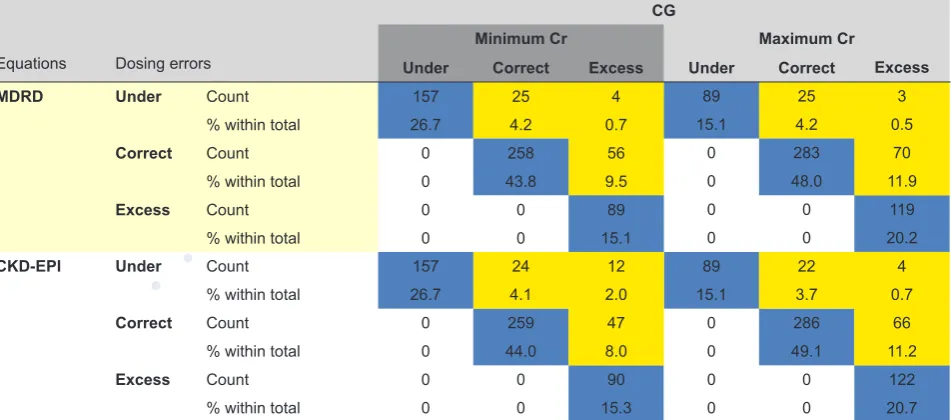
Table 3 compares dosing errors obtained according to the MDRD and CKD-EPI equations compared to the CG equa-tion. Using MDRD to calculate GFR, there were 85 patients (14.4%) in whom dosing errors were classified differently from the CG equation for creatinine clearance for minimum creatinine and 98 (16.6%) for maximum creatinine. Using the CKD-EPI equation, there were 83 patients (14.1%) classified differently when compared to the classification based on the CG equation for the minimum serum creatinine and 92 (15.6%) for the maximum serum creatinine.
ARTIGO ORIGINAL
AMP
STUDENT
ARTIGO
ACEITE P
ARA
PUBLICAÇÃO DISPONÍVEL
EM WWW
.ACT
AMEDICAPORTUGUESA.COM
retained, with an adjusted OR (CI95%), without available data on weight = 1.571 (1.123 - 2.197), for the minimum creatinine day, and ideal body weight = 0.982 (0.966 - 0.998) per kg for the maximum creatinine day. The Hosmer and Lemeshow test did not show evidence of lack of fit.
Prescribed antibiotics were modified in 154 cases (26.1%) and only in five patients it was due to side effects. Of these five patients, and according to the CG equation, four presented excess dosing either in the minimum creatinine day, maxi-mum creatinine day or in the loading dose, and only one did not present any dosing errors at all.
DISCUSSION
In this population of very old patients there was an excellent correlation of CG with MDRD and CKD-EPI for different levels of renal impairment. Regardless of the equation used to estimate renal function there was a high rate of antibiotic dosing errors documented in this population.
In the elderly, MDRD and CKD-EPI have been shown to more accurately estimate GFR when compared with CG.6 However, pharmacokinetic studies over the last few years have used the CG equation to determine the level of renal func-tion for dosage adjustment in drug labels. As a result, it has become a common practice for drug dosing. Furthermore, most of the published information on dosage adjustments in renal impairment is based on creatinine clearance estimated from the CG equation.
Based on the CG equation, there were errors in DDD in approximately half of the study population; this value is within the range described by Long et al, a review that included 4 studies conducted in inpatient settings that describes renal dos-ing guideline noncompliance rates between 19% and 67%.16 Although these studies considered drugs other than antibiot-ics, most of the medications prescribed at unadjusted doses were antibiotics. A recent retrospective observational study performed in two geriatric hospitals found that 20% of inpatients were prescribed a drug with incorrect adjustment for renal function based on the CG equation.17
Dosing errors reported in this study were due to both under and excess dosing. In the loading dose, excess dosing was more frequent; in the DDD, under dosing was slightly more frequent in the minimum creatinine day, whereas over-dosing was more frequent in the maximum creatinine day. Any form of dosing error can be harmful. Over-dosing a drug may lead to administration of inappropriately large doses and possible toxicity. Among the five patients in whom the initial antibiotic was changed due to side effects, there was over-dosing of the prescribed antibiotic in four. Conversely, under dosing may result in compromised therapeutic efficacy, resistance development and poor prognosis.
When comparing CG with MDRD and CKD-EPI for the calculation of antibiotic dosing, there was a discrepancy in 14% to 16% of patients. In all these patients, if the antibiotic dosing was based on MDRD or CKD-EPI, a higher dose of antibiotic would have been recommended, because the MDRD and CKD-EPI equations overestimate creatinine clearance.17-22 How-ever, according to the study by Delanaye et al, the assertion that CG must be favored because it gives systematically lower results, and thus prevents over-dosing is an oversimplification. The authors found that CKD-EPI did not always overesti-mate creatinine clearance since this was not true in obese geriatric patients.23 Also, new creatinine-based GFR estimating equations have been reported. A recent study, in a group of patients 65 years and older, compared four equations – includ-ing the CKD-EPI equation – with the reference inulin-measurinclud-ing method. The authors found that none of the equations had a better diagnostic performance and that each equation had limitations regarding accuracy.24 Thus, for patients with extreme characteristics, like those with morbid obesity, one may opt for a specific equation for an optimum result, while for common patients, the CG equation is more practical because it is already established in clinical practice with good results and there is no compelling evidence supporting change (either clinical benefits or pharmacokinetic evidence). In light of these findings, the use of the MDRD or CKD-EPI equations interchangeably with the CG equation in drug dosing cannot be advocated.17-22
This study also focused on risk factors for antibiotic prescribing errors for which no systematic risk factors were found. This study has some limitations. In order to audit antibiotic prescribing and its adequacy to renal function, dosages that did not follow the recommended guidelines were determined. However, it would have been important to assess the consequences of dosing errors in clinical practice. Concerning excess dosing, antibiotic modifications motivated by side effects were determined. However, the presence of side effects should have been assessed in every patient and not only in situations of antibiotic switch. Therefore, it is possible that adverse drug events related to prescribing errors were missed. Moreover, side effects should have been further characterized. In the case of under dosing, indices of therapeutic failure should have been searched.
Another important limitation was that neither the glomerular filtration rate nor the antibiotic serum concentration were measured, which would have been the gold standard, but being a retrospective study, this was not possible to obtain and, at the moment, only the serum levels of aminoglycosides and vancomycin can be assessed in our hospital.
As GFR was not directly measured, it was not possible to assess which equation was more accurate in estimating renal function in this group of very elderly patients. Thus, the present analysis was based solely on the comparison of estimated values.
ARTIGO ORIGINAL
AMP
STUDENT
ARTIGO
ACEITE P
ARA
PUBLICAÇÃO DISPONÍVEL
EM WWW
.ACT
AMEDICAPORTUGUESA.COM
and/or elimination, meaning that antibiotic dosing is challenging in this population and should be individualized. Since as-sessment of serum antibiotic levels for most antibiotics are not available, clinicians have to resort to other methods. The recommendation in acute kidney injury (AKI) is to use the trend in serum creatinine over several measurements – that is difficult to operate in a common ward and more feasible in high dependency or intensive care units, where the standard is the measure of creatinine clearance using its serum and urinary concentration, which is not possible for all hospitalized patients under antibiotic therapy and AKI. Therefore, dosage adjustments should be cautious and adjusted to the clinical scenario.
This study has a number of strengths. It included only very elderly patients, a particularly vulnerable segment of the population, in which adverse drug events are extremely common. Official dosing guidelines for renal impairment often disregard elderly patients as, in general, their inclusion in clinical studies is limited. Furthermore, this study only included antibiotics, a class of drugs widely used in clinical practice, associated with a high rate of adverse drug events. Finally, in order to ensure data was consistent, a large group of patients was studied.
CONCLUSION
In this population of very old patients there was an excellent correlation of CG with MDRD and CKD-EPI for different levels of renal impairment. The GFR calculated by MDRD and CKD-EPI equations overestimates creatinine clearance calculated by CG equation, and they estimate different things. Therefore, the use of the MDRD or CKD-EPI equations interchangeably with the CG equation in drug dosing cannot be advocated. Using the CG equation for drug dosing may be a safer and easier practice, especially in the very elderly. Also, given the high rate of antibiotic dosing errors documented, further studies should be conducted to investigate underlying causes of prescribing errors.
PROTECTION OF HUMAN AND ANIMAL SUBJECTS
The authors declare that the research procedures were performed according to the regulations of the institution’s ethics committee and the Code of Ethics of the World Medical Association (Declaration of Helsinki).
PROTECTION OF HUMAN AND ANIMAL SUBJECTS CONFIDENTIALITY OF DATA
The authors declare that they have followed the protocols of their work center regarding the publication of data from patients.
CONFLICT OF INTEREST
No conflict of interest has been declared by any author.
FUNDING
No financial support was received by any author.
REFERENCES
1. Olyaei AJ, Bennett WM. Chapter 9: Drug dosing and renal toxicity in the elderly patient. Geriatric Nephrology Curriculum, American Society of Nephrology 2009. [accessed 2018 Sep 13]. Available from: https://www.asn-online.org/education/distancelearning/curricula/geriatrics/Chapter9.pdf.
2. Glassock RJ, Rule AD. Aging and the kidneys: anatomy, physiology and consequences for defining chronic kidney disease. Nephron. 2016;134:25-9. 3. Lazarou J, Pomeranz BH, Corey PN. Incidence of adverse drug reactions in hospitalized patients: a meta-analysis of prospective studies. JAMA.
1998;279:1200-5.
4. Pretorius RW, Gataric G, Swedlund SK, Miller JR. Reducing the risk of adverse drug events in older adults. Am Fam Physician. 2013;87:331-6. 5. Gurwitz JH, Field TS, Harrold LR, Rothschild J, Debellis K, Seger A, et al. Incidence and preventability of adverse drug events among older persons in
the ambulatory setting. JAMA. 2003;289:1107-16.
6. Lassiter J, Bennett WM, Olyaei AJ. Drug dosing in elderly patients with chronic kidney disease. Clin Geriatr Med. 2013;29:657-705.
7. Levey AS, Bosch JP, Lewis JB, Greene T, Rogers N, Roth D. A more accurate method to estimate glomerular filtration rate from serum creatinine: a new prediction equation. Modification of Diet in Renal Disease Study Group. Ann Intern Med. 1999;130:461-70.
8. Charlson ME, Pompei P, Ales KL, MacKenzie CR. A new method of classifying prognostic comorbidity in longitudinal studies: development and validation. J Chronic Dis. 1987;40:373-83.
9. Karnofsky D, Burchenal J. The Clinical evaluation of chemotherapeutic agents in cancer. In MacLeod CM, editor. Evaluation of chemotherapeutic agents. New York City: Columbia Univ Press; 1949.
10. Cockcroft DW, Gault MH. Prediction of creatinine clearance from serum creatinine. Nephron. 1976;16:31-41.
11. Winter MA, Guhr KN, Berg GM. Impact of various body weights and serum creatinine concentrations on the bias and accuracy of the Cockcroft-Gault equation. Pharmacotherapy. 2012;32:604-12.
12. Levey AS, Coresh J, Greene T, Stevens L, Zhang Y, Hendriksen S, et al. Using standardized serum creatinine values in the modification of diet in renal disease study equation for estimating glomerular filtration rate. Ann Int Med. 2006;145:247-54.
13. Levey AS, Stevens LA, Schmid CH, Zhang YL 3rd, Castro A, Feldman H, et al. A new equation to estimate glomerular filtration rate. Ann Int Med. 2009;150:604-12.
14. Dubois D, Dubois E. A formula to estimate the approximate surface area if height and weight be known. Arch Intern Med. 1916;17:863-71.
15. Gilbert DN, Chambers HF, Eliopoulos GM, Saag MS, Pavia AT. The Sanford Guide to Antimicrobial Therapy. 48th ed. Sperryville: Antimicrobial Therapy,
Inc.; 2018.
16. Long CL, Raebel MA, Price DW, Magid DJ. Compliance with dosing guidelines in patients with chronic kidney disease. Ann Pharmacother. 2004;38:853-8.
ARTIGO ORIGINAL
AMP
STUDENT
ARTIGO
ACEITE P
ARA
PUBLICAÇÃO DISPONÍVEL
EM WWW
.ACT
AMEDICAPORTUGUESA.COM
Cockcroft-Gault equation for estimating renal function and drug dosage adjustment in elderly patients. Fundam Clin Pharmacol. 2017;31:110-9. 18. Wargo KA, Eiland EH 3rd, Hamm W, English TM, Phillippe HM. Comparison of the modification of diet in renal disease and Cockcroft-Gault equations for
antimicrobial dosage adjustments. Ann Pharmacother. 2006;40:1248-53.
19. Gill J, Malyuk R, Djurdjev O, Levin A. Use of GFR equations to adjust drug doses in an elderly multi-ethnic group--a cautionary tale. Nephrol Dial Transplant. 2007;22:2894-9.
20. Golik MV, Lawrence KR. Comparison of dosing recommendations for antimicrobial drugs based on two methods for assessing kidney function: cockcroft-gault and modification of diet in renal disease. Pharmacotherapy. 2008;28:1125-32.
21. Hermsen ED, Maiefski M, Florescu MC, Qiu F, Rupp ME. Comparison of the modification of diet in renal disease and Cockcroft-Gault equations for dosing antimicrobials. Pharmacotherapy. 2009;29:649-55.
22. Dowling TC, Wang ES, Ferrucci L, Sorkin JD. Glomerular filtration rate equations overestimate creatinine clearance in older individuals enrolled in the Baltimore Longitudinal Study on Aging: impact on renal drug dosing. Pharmacotherapy. 2013;33:912-21.
23. Delanaye P, Guerber F, Scheen A, Ellam T, Bouquegneau A, Guergour D, et al. Discrepancies between the Cockcroft-Gault and chronic kidney disease epidemiology (CKD-EPI) equations: implications for refining drug dosage adjustment strategies. Clin pharmacokinet. 2017;56:193-205.
24. da Silva Selistre L, Rech DL, de Souza V, Iwaz J, Lemoine S, Dubourg L. Diagnostic performance of creatinine-based equations for estimating glomerular filtration rate in adults 65 years and older. JAMA Intern Med. 2019;179:796-804.
Figure 1 – Flow diagram of included patients
ESRD: end-stage renal disease
Initial population: 929 patients
Included: 589 patients Excluded:
• ESRD undergoing hemodialysis, peritoneal dialysis or kidney transplantation – 12 (1.3%)
• Topical antibiotic – 7 (0.8%)
• Prophylactic antibiotic – 89 (11.2%)
• Antibiotic therapy ≤ 48h – 104 (11.2%)
• Missing creatinine – 21 (2.3%)
• Missing weight and/ or height – 107 (11.5%)
Figure 2 – (A) Correlation between baseline estimated CG and estimated GFR by MDRD equation (mL/min); (B) Correlation between baseline estimated CG and estimated GFR by CKD-EPI equation (mL/min).
CG: Cockcroft-Gault equation; MDRD: Modification of Diet in Renal Disease Study equation; CKD-EPI: Chronic Kidney Disease Epidemiology Collaboration equation
0 0
0 50 100 150 200 0 20 40 60 80 100 120
20 20
40 40
60 60
80 80
100 100
120 120
MDRD CKD-EPI
CG CG
ARTIGO ORIGINAL
AMP
STUDENT
ARTIGO
ACEITE P
ARA
PUBLICAÇÃO DISPONÍVEL
EM WWW
.ACT
AMEDICAPORTUGUESA.COM
Table 1 – Clinical characteristics Characteristic
Age (years), mean ± SD 87 ± 4
Male gender, n (%) 246 (42)
KPS scale ≥ 70, n (%) 216 (37)
CCI score, mean ± SD 7 ± 2
Weight (kg), mean ± SD 65 ± 14
Ideal body weight (kg), mean ± SD 56 ± 10
Adjusted body weight (kg), mean ± SD 60 ± 10
Height (cm), mean ± SD 161 ± 9
BMI (kg/m2), mean ± SD 30 ± 5
CG (mL/min), mean ± SD 42 ± 17
MDRD (mL/min), mean ± SD 63 ± 27
CKD-EPI (mL/min), mean ± SD 57 ± 20
Antibiotic therapy period (days), median (IQR) 8 (6 – 10)
SD: standard deviation; KPS: Karnofsky Performance Status scale; CCI: Charlson Co
-morbidity index; BMI: body mass index; CG: Cockcroft-Gault equation; MDRD: Modifica
-tion of Diet in Renal Disease Study equa-tion; CKD-EPI: Chronic Kidney Disease Epidemi
-ology Collaboration equation; IQR: interquartile range
Table 2 – Dosing errors in the daily defined dose of antibiotic therapy according to the different renal function calculation equations in the day of minimum and maximum serum creatinine
Errors in daily defined dose, n (%) CG MDRD CKD-EPI Minimum Cr
Under 157 (26.7) 186 (31.6) 193 (32.8)
Excess 149 (25.3) 89 (15.1) 90 (15.3)
Total 306 (52.0) 275 (46.7) 283 (48.0)
Maximum Cr
Under 89 (15.1) 117 (19.9) 192 (32.6)
Excess 192 (32.6) 119 (20.2) 124 (21.1)
Total 281 (47.7) 236 (40.1) 316 (53.7)
Note: ‘Under’ refers to dosing errors in which lower daily doses than recommended were given; ‘excess’ refers to dosing errors in which the maximum daily dose was exceeded. Cr: creatinine; CG: Cockcroft-Gault equation; MDRD: Modification of Diet in Renal Disease Study equation; CKD-EPI: Chronic Kidney Disease Epidemiology Collaboration equation
Table 3 – Comparison of dosing errors using MDRD and CKD-EPI formulas compared with the CG equation
Equations Dosing errors
CG
Minimum Cr Maximum Cr
Under Correct Excess Under Correct Excess
MDRD Under Count 157 25 4 89 25 3
% within total 26.7 4.2 0.7 15.1 4.2 0.5
Correct Count 0 258 56 0 283 70
% within total 0 43.8 9.5 0 48.0 11.9
Excess Count 0 0 89 0 0 119
% within total 0 0 15.1 0 0 20.2
CKD-EPI Under Count 157 24 12 89 22 4
% within total 26.7 4.1 2.0 15.1 3.7 0.7
Correct Count 0 259 47 0 286 66
% within total 0 44.0 8.0 0 49.1 11.2
Excess Count 0 0 90 0 0 122
% within total 0 0 15.3 0 0 20.7
Note: ‘Under’ refers to dosing errors in which lower DDD than recommended were given; ‘correct’ refers to the lack of dosing errors; and ‘excess’ refers to dosing errors in which the maximum doses were exceeded. The blue-colored cells refer to dosing errors classified in the same way by both equations; and the yellow-colored cells refer to dosing errors classified differently by both equations.
ARTIGO ORIGINAL
AMP
STUDENT
ARTIGO
ACEITE P
ARA
PUBLICAÇÃO DISPONÍVEL
EM WWW
.ACT
AMEDICAPORTUGUESA.COM
Table 4 – Factors associated with error in daily defined dose
DDD error in the minimum creatinine day
(n = 306) DDD error in the maximum creatinine day (n = 281)
Risk factor Crude OR p value Crude OR p value
Age (years), mean ± SD 87 ± 4 1.020 per year 0.300 87 ± 5 1.017 per year 0.359
Male gender, n (%) 123 (40) 0.874 0.422 107 (38) 0.748 0.083
KPS scale ≥ 70, n (%) 111 (36) 0.965 0.835 93 (33) 0.744 0.086
CCI, mean ± SD 7 ± 2 1.044 per point 0.311 7 ± 2 0.992 per point 0.843
Real body weight (kg), mean ± SD 65 ± 15 1.003 per kg 0.643 65 ± 15 1.001 per kg 0.849
Ideal body weight (kg), mean ± SD 56 ± 10 0.995 per kg 0.546 55 ± 10 0.982 per kg 0.032
Adjusted body weight (kg), mean ± SD 60 ± 10 0.999 per kg 0.917 59 ± 10 0.989 per kg 0.217
Height (cm), mean ± SD 161 ± 9 0.995 per cm 0.612 161 ± 9 0.981 per cm 0.035
BMI (kg/m2), mean ± SD 25 ± 6 1.014 per kg/m2 0.393 25 ± 5 1.021 per kg/m2 0.193
Baseline serum creatinine (mg/dL), mean ± SD 1.1 ± 0.4 1.401 per mg/dL 0.077 1.1 ± 0.4 1.012 per mg/dL 0.948
Electronic weight registry absent, n (%) 173 (57) 0.637 0.008 176 (63) 1.085 0.632