© The Author(s) 2018. Published by Oxford University Press on behalf of The Gerontological Society of America. All rights reserved. For permissions, please e-mail: [email protected].
S74
Review Article
Progressive Support for Activities of Daily Living for
Persons Living With Dementia
Lindsay P. Prizer, PhD*
,1,2and Sheryl Zimmerman, PhD
31
Division of General Medicine & Geriatrics, Emory University School of Medicine, Atlanta, Georgia.
2Atlanta VA Medical
Center, Veterans Affairs Administration, Decatur, Georgia.
3Cecil G. Sheps Center for Health Services Research and the
School of Social Work, The University of North Carolina at Chapel Hill.
*Address correspondence to: Lindsay P. Prizer, PhD, Division of General Medicine & Geriatrics, Emory University School of Medicine, 1841 Clifton Road 5th Floor, Atlanta, GA 30329. E-mail: [email protected]
Received: March 13, 2017; Editorial Decision Date: April 28, 2017
Decision Editor: Beth A. Kallmyer, MSW
Abstract
Background and Objectives: Dementia is accompanied by increasing need for support in activities of daily living (ADLs). This brief report/literature review summarizes the practices to care for early stage, middle stage, and late stage ADL needs (dressing, toileting, and eating/nutrition), and examines commonalities across ADL needs and the extent to which practices are reflected in guidelines and/or evidence.
Research Design and Methods: A review of the grey and peer-reviewed literature, using some but not all procedures of a systematic review. Key terms were identified for ADLs overall and for each of the 3 ADLs, and a search was conducted using these words in combination with (a) dementia, Alzheimer’s disease, and similar terms, and (b) practices, interventions, guide-lines, recommendations, and similar terms. Searches were conducted using databases of peer-reviewed literature as well as the Grey Literature Reports and Google search engine. Sources were included if they provided evidence or recommendations on interventions to address ADL functioning for dressing, toileting, and feeding for persons living with dementia.
Results: As cognitive and functional impairment increases, the number of care practices and themes that embody care prac-tices increases. The majority of pracprac-tices are evidence-based, and most evidence is incorporated into guidelines.
Discussion and Implications: Virtually all practices reflect person-centered care principles. Five recommendations summa-rize the evidence and recommendations related to providing support to persons living with dementia in relation to dressing, toileting, and eating/nutrition.
Keywords: Dressing, Eating, Person-centered care, Toileting
Dementia is a progressive disease, accompanied by progres-sive need for support in the conduct of activities of daily living (ADLs); from first to last, the need for supportive care gener-ally follows the order of bathing, dressing, grooming, toileting, walking, and eating (Cohen-Mansfield, Werner, & Reisberg, 1995). This order is consistent with that of the Functional Assessment Staging Test (FAST) for dementia, which (for example) identifies challenges with dressing beginning in mod-erate dementia, and with toileting occurring in modmod-erately severe dementia (Reisberg, 1988); need for support in eating
typifies severe dementia. Making the need for support even more evident, loss of independence in ADLs is associated with poorer quality of life (Chan, Slaughter, Jones, & Wagg, 2015); therefore, it is especially important to understand guidelines for care and evidence-based strategies to promote ADL func-tion—which must reflect practices related to not only the ADL itself, but also to the level of diminished cognitive capacity of the person living with dementia.
This report summarizes the grey and peer-reviewed lit-erature regarding guidelines and evidence-based dementia
cite as: Gerontologist, 2018, Vol. 58, No. S1, S74–S87 doi:10.1093/geront/gnx103
care practices for one early stage, one middle stage, and one late stage ADL loss: dressing, toileting, and eating/nutrition. The discussion highlights the nature of person-centered care that cuts across all three ADLs regardless the level of cogni-tion, and provides summative recommendations emanating from the data. Consequently, this paper is of special interest to care providers, policy makers, and researchers who strive to improve the well-being of people living with dementia.
Research Design and Methods
To conduct the grey and peer-reviewed literature search, key terms were identified for ADLs overall (e.g., ADLs, function) and for each of the three ADLs (e.g., dressing, clothing; toileting, continence; eating, drinking), and a search was conducted using these words in combination with (a) dementia, Alzheimer’s disease, and similar terms, and (b) practices, interventions, guidelines, recommenda-tions, and similar terms. Searches were conducted using databases of peer-reviewed literature (Cochrane Library, Psycinfo, Pubmed, and Google Scholar) as well as the Grey Literature Reports (New York Academy of Medicine) to identify books, reports, newspaper articles, and other non-peer reviewed materials. Additional searches used the Google search engine to identify guidelines and qual-ity improvement initiatives of relevant organizations. Publications were also identified through reference lists of studies already included in the review. Sources were included if they provided evidence or recommendations on interventions to address ADL functioning for dressing, toileting, and feeding for individuals living with demen-tia. Sources were excluded if they did not address care for individuals living with dementia or if they could not be accessed through the university library database.
For each of the three ADLs, the literature was summa-rized to describe the practice and identify whether it derived from a guideline and/or evidence. Additionally, evidence was graded based on the Johns Hopkins Nursing Evidence-Based Practice Model (http://www.hopkinsmedicine.org/ evidence-based-practice/_docs/Appendix%20C%20image. jpg), a widely used classification system:
• Level I: experimental studies, randomized controlled tri-als (RCTs), systematic reviews of RCTs;
• Level II: quasi-experimental studies, systematic reviews of a quasi-experimental studies with or without RCTs; • Level III: nonexperimental studies, systematic reviews
nonexperimental studies with or without quasi-experi-mental studies and/or RCTs.
Then, within each ADL, the material was organized into themes, which are summarized in the text that follows. Tables provide the specific practices, and the Supplementary Appendix provides the data from the research citations, pre-sented in alphabetical order by author within type of ADL. Of note, many of the methods detailed above follow standards for a systematic review, but the grading we used to critique the articles did not meet the standards of a sys-tematic review, in that (for example) bias and precision were not rated, nor was a meta-analysis conducted. Therefore, the methods are best considered a literature review, and not a systematic review.
Results
A total of 59 relevant sources were identified, some of which referred to more than one care practice. The material included a combination of evidence-based guidelines (i.e., guidelines that were largely evidence based; n = 7 sources; Alzheimer’s
Australia WA, 2009; Alzheimer’s Association, 2009a, 2009b;
Dementia, The NICE-SCIE Guideline on Supporting People with Dementia and Their Carers in Health and Social Care,
2007; “Detection, Diagnosis and Management of Dementia,
n.d.”; Encouraging eating: Advice for at-home
demen-tia caregivers, 2006; “Preventing and managing resistance
when attending to activities of daily living, n.d.;”
guide-lines lacking an identified evidence-base (n = 6; ALZLIVE;
Anderson, 2017; “Dementia; The dining experience,” 2016;
“Helping persons with dementia with eating, n.d.;” Kyle,
2012; “Toileting (for dementia),” 2012); and peer-reviewed research evidence (n = 46). Of the evidence that existed (46 sources, which included systematic and literature reviews) the majority was Level II evidence (n = 21), followed by Level III evidence (n = 15), and then Level I evidence (n = 10). Table 1 lists the themes that summarize the guidelines and evidence for each ADL, and indicates the one common theme related to all areas: person-centered assessment and care.
Table 1. Themes Summarizing Guidelines and Evidence to Provide Support for Dressing, Toileting, and Eating/Nutrition for Persons With Dementia
Dressing Toileting Eating/nutrition
Dignity/respect/choice Dignity/respect Dignity/respect/choice
Dressing process Toileting process Dining process
Dressing environment Toileting environment Dining environment
Health/biological considerations Health/biological considerations Adaptations/functioning Food/beverage/appetite
Note: Common Theme: Person-centered assessment and care.
Dressing
Three themes, based on 20 practices, summarize the guide-lines and evidence related to dressing: dignity/respect/choice (e.g., respect individual style and culture), dressing process (e.g., simplify clothing routines), and dressing environment (e.g., dress in a comfortable and safe area). Nineteen of the practices are included in guidelines (ten with and nine with-out an evidence base), and one practice is based on evi-dence that has not yet been incorporated into guidelines. None of the evidence is Level I; instead, it is primarily Level III (nine practices), and to a lesser extent Level II (four prac-tices, two of which also have Level III evidence). Simple verbal instructions for dressing (e.g., Lancioni et al., 2009) and sequential arrangement of clothing (e.g., Namazi &
Johnson, 1992), both with Level II evidence, relate to
improved ability to dress and decreased need for assistance. An example recommendation that does not have a clear evidence base is to gather information regarding personal style preferences (Alzheimer’s Association, 2009b). Table 2 lists the themes and practices, indicates whether they are a guideline and/or have an evidence base, the level of evi-dence (if relevant), and the related sources/citations. The Supplementary Appendix provides information about the evidence itself.
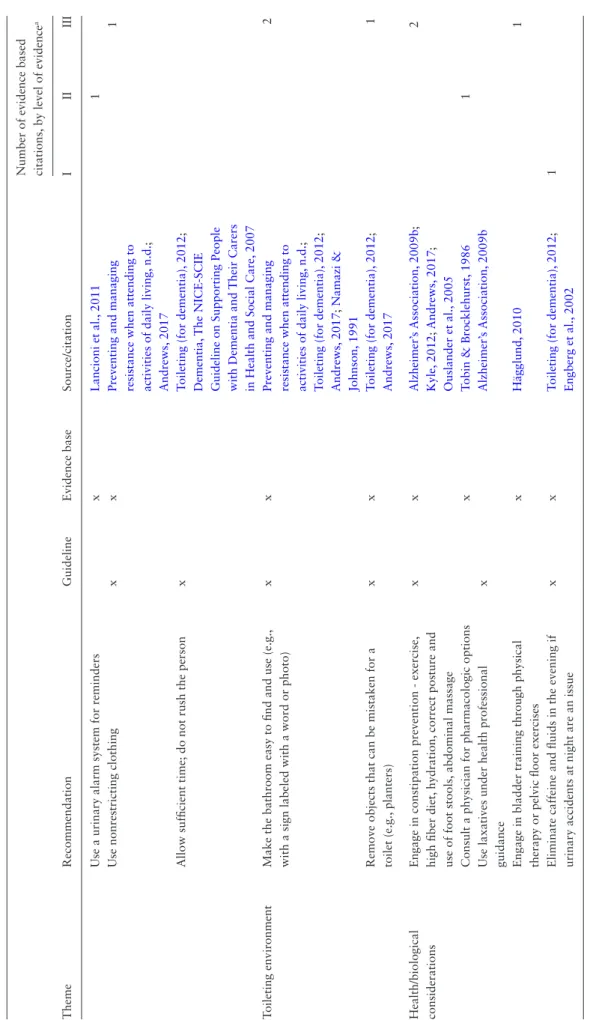
Toileting
Four themes, based on 21 practices, summarize the guide-lines and evidence related to toileting: dignity/respect (e.g., promote privacy), toileting process (e.g., maintain a pattern of bathroom visits), toileting environment (e.g., make the bathroom easy to find and use), and health/biological
con-siderations (e.g., engage in constipation prevention). Sixteen
of the 21 practices are included in guidelines (nine with and seven without an evidence base); five of the practices are based on evidence that has not been incorporated into identified guidelines. Five practices are supported by Level I evidence: positive reinforcement and reassurance (which are part of multi-component interventions), verbal remind-ers to use the bathroom (e.g., Schnelle et al., 1983), graded assistance (Doody et al., 2001), patterns of bathroom visits (e.g., Ouslander et al., 2005) and avoiding caffeine and flu-ids in the evening (Engberg, Sereika, McDowell, Weber, &
Brodak, 2002); all practices relate to a decrease in
incon-tinence episodes. There also is strong evidence (Level II) for use of a urinary alarm (Lancioni et al., 2011), and con-sulting a physician for pharmacologic treatments (Tobin &
Brocklehurst, 1986). Table 3 includes guidelines and
evi-dence related to toileting, and the Supplementary Appendix provides information about the evidence.
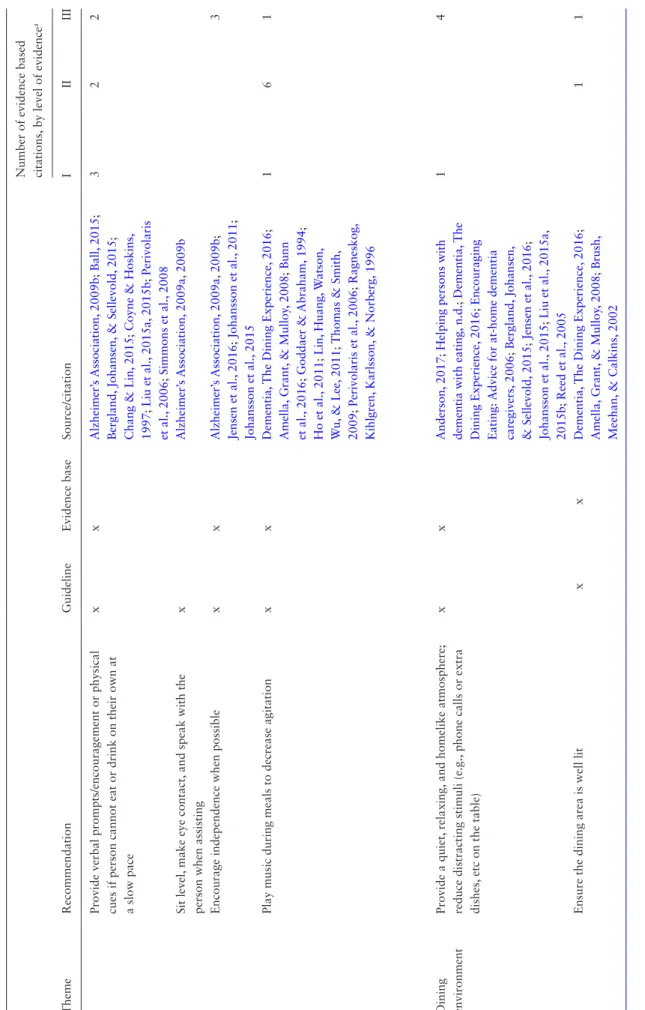
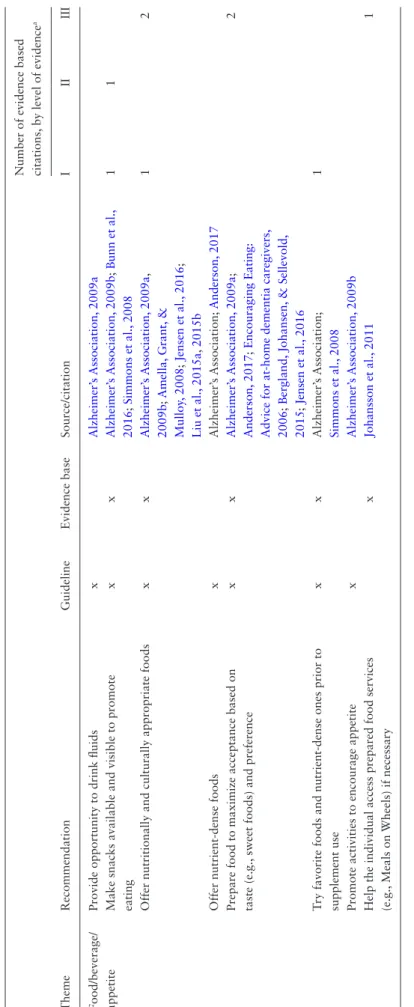
Eating
Six themes, based on 33 practices, summarize the guidelines and evidence related to dressing: dignity/respect/choice
(e.g., engage the individual in the mealtime experience),
dining process (e.g., provide verbal prompts or physical
cues), dining environment (e.g., provide a quiet, relaxing, and homelike atmosphere), health/biological considerations (e.g., maintain dental checkups and oral health),
adapta-tions/functioning (e.g., use adaptive devices/utensils), and
food/beverage/appetite (e.g., make snacks available and
visible). Twenty-eight of the 33 practices are included in guidelines (20 with and eight without an evidence base); five of the practices are based on evidence that has not been incorporated into identified guidelines. Twelve practices are supported by Level 1 (or less rigorous) evidence, 5 by Level II (or less rigorous) evidence, and eight by only Level III evidence. For example, there is strong evidence that ver-bal prompts and encouragement increase eating and weight (a practice that is part of multi-component interventions; e.g., Simmons et al., 2008) and that playing music during meals decreases agitation and increases consumption (e.g.,
Thomas & Smith, 2009). See Table 4 for the guidelines and
the Supplementary Appendix for evidence related to eating.
Discussion and Implications
The practices identified in this review highlight that cogni-tive issues in Alzheimer’s disease and other dementias are increasingly relevant to ADL support as the disease pro-gresses. For example, decline in the ability to independently dress can be improved by sequentially organizing the closet
(Namazi & Johnson, 1992), a cue that requires more
cog-nitive capacity than most practices recommended for toi-leting and eating. That said, given individual differences in the timing of cognitive and ADL loss, cognitive capacity is still indicated for some toileting practices—albeit fewer— such as to engage in physical therapy for incontinence
(Hägglund, 2010).
Common themes across all practices included dignity/
respect/choice, the care process, and the care environment.
With the progressive loss of cognitive and ADL function, the number of themes and care practices increases: 20 prac-tices (three themes) for dressing; 21 pracprac-tices (four themes) for toileting; and 33 practices (six themes) for nutrition. These results highlight the trend that as cognitive function-ing becomes more impaired, the amount and complexity of care needs increase.
Of the 74 practices, the majority (50) were evidence-based (68%), with most evidence being level III (the least rigorous) followed by level II; all but 11 evidence-based practices were incorporated into guidelines. Relatedly, the 63 practices that were included in guidelines were primar-ily evidence-based (62%). Conversely, 38% of the practices included in guidelines lacked supporting evidence. These unsupported guidelines largely offered pragmatic advice (such as attending to nonverbal cues to use the bathroom), or related to basic human values, such as dignity. One could argue, then, that the practicality and principles of these guidelines offsets the need for “evidence” of their value.
Table 2.
Dressing Guidelines and Evidence
Number of evidence based citations, by level of evidence
a
Theme
Recommendation
Guideline
Evidence base
Source/citation
I
II
III
Dignity/respect/ choice Respect individual style and cultural preferences
x
x
Alzheimer’
s Association,
2009b
;
T
ips for helping
a person with dementia to dress,
n.d.
;
Mahoney
,
Coon,
& Lozano,
2016
1
Gather information on personal style preferences from the person with dementia and his/her family
x
Alzheimer’
s Association,
2009b
Lay out two outfits to encourage freedom of choice
x
Alzheimer’
s Australia W
A,
2009
Ensure dirty clothes are promptly removed
x
Alzheimer’
s Australia W
A,
2009
Use a
“dignity”
or
“modesty cape”
to ensure
the person is covered while dressing
x
Alzheimer’
s Australia W
A,
2009
Use clothing as a conversation starter to engage the person
x
Alzheimer’
s Association,
2009b
Engage the person by name and explain all actions before progressing
x
Alzheimer’
s Australia W
A,
2009
Provide encouragement and positive reinforcement for as much independence as possible
x
x
T
ips for helping a person with dementia to dress,
n.d.
;
Alzheimer’
s Australia W
A,
2009
;
Cohen-Mansfield et al.,
2006
;
Rogers et al.,
1999
1
1
Do not debate or argue
x
x
T
ips for helping a person with dementia to dress,
n.d.
;
Mahoney
, LaRose,
& Mahoney
, 2015
;
Mahoney
, Coon,
&
Lozano,
2016
2
Dressing process
Simplify routines
x
x
Alzheimer’
s Association,
2009b
;
T
ips for helping a person
with dementia to dress,
n.d.
;
Alzheimer’
s Australia W
A,
2009
;
Mahoney
, LaRose,
& Mahoney
, 2015
1
Organize dressing process (or closet) sequentially
x
x
Alzheimer’
s Association,
2009b
;
T
ips for helping a person
with dementia to dress,
n.d.
;
Alzheimer’
s Australia W
A,
2009
;
Namazi & Johnson,
1992
1
Table 2.
Continued
Number of evidence based citations, by level of evidence
a
Theme
Recommendation
Guideline
Evidence base
Source/citation
I
II
III
Give short verbal instructions (following graded levels of assistance) on dressing
x
x
Alzheimer’
s Association,
2009b
;
T
ips for helping a person
with dementia to dress,
n.d.
;
Alzheimer’
s Australia W
A,
2009
;
Engelman,
Mathews,
&
Altus,
2002
;
Lancioni et al.,
2009
;
Namazi & Johnson,
1992
;
Rogers et al.,
1999
4
Use gentle physical prompting (following graded levels of assistance) as needed
x
x
Alzheimer’
s Australia W
A,
2009
;
Cohen-Mansfield et al.,
2006
;
Namazi & Johnson,
1992
1
1
Label drawers with the type of clothing they contain
x
Alzheimer’
s Australia W
A,
2009
Plan for sufficient time to dress
x
x
Alzheimer’
s Association,
2009b
;
T
ips for helping a person
with dementia to dress,
n.d.
;
Alzheimer’
s Australia W
A,
2009
;
Dementia,
The NICE-SCIE Guideline on Supporting People
with Dementia and
Their Carers in Health and Social Care,
2007
;
Cohen-Mansfield et al.,
2006
1
Play familiar music to encourage movement
x
Alzheimer’
s Australia W
A,
2009
Choose comfortable,
simple (e.g.,
zippers and
velcro instead of buttons and ties) dressing options and weigh the pros and cons of each
x
x
Alzheimer’
s Association,
2009b
;
T
ips for helping a person
with dementia to dress,
n.d.
;
Cohen-Mansfield et al.,
2006
;
Mahoney
, LaRose,
& Mahoney
, 2015
2
Use comfortable,
nonslip shoes
x
Alzheimer’
s Association,
2009b
Dressing environment Dress in a comfortable and safe area (e.g., bathrooms may increase falls risk)
x
x
Alzheimer’
s Australia W
A,
2009
;
Cohen-Mansfield et al.,
2006
1
Consider caregiver safety (e.g.,
use an adjustable
bed to reduce bending)
x
Cohen-Mansfield et al.,
2006
1
Note
:
aLevel I: experimental studies,
randomized controlled trials (R
CT),
systematic reviews of R
CT
s; Level II: quasi-experimental studies,
systematic reviews of the same in combination with R
CT
s; Level III: nonexperimental
studies,
systematic reviews of the same in combination with more rigorous designs,
and qualitative studies.
Table 3.
Toileting Guidelines and Evidence
Number of evidence based citations,
by level of evidence
a
Theme
Recommendation
Guideline
Evidence base
Source/citation
I
II
III
Dignity/respect
Assess for signs of leakage or incontinence
x
Alzheimer’
s Association,
2009b
Use adult diapers or pads to prevent accidents
x
Ouslander
, Zarit,
Orr
, & Muira,
1990
1
Do not chide or argue
x
Andrews,
2017
1
Promote privacy
x
Preventing and managing resistance when attending to activities of daily living,
n.d.
Provide positive reinforcement and reassurance to maintain personal dignity
x
x
Alzheimer’
s Association,
2009b
;
Detection,
Diagnosis and
Management of Dementia,
n.d.
;
Engberg et al.,
2002
;
Lancioni
et al.,
2011
;
Schnelle et al.,
1983
2
1
Toileting process
Talk to family to assess urinary and bowel patterns
x
Alzheimer’
s Association,
2009b
Be aware of and plan to avoid circumstances surrounding accidents
x
Alzheimer’
s Association,
2009b
Pay attention to nonverbal cues of needing to use the bathroom
x
Preventing and managing resistance when attending to activities of daily living,
n.d.
;
Toileting (for dementia),
2012
Encourage independence by using graded assistance as needed
x
x
Detection,
Diagnosis and
Management of Dementia,
n.d.
;
Toileting (for dementia),
2012
;
Doody et al.,
2001
1
Provide verbal reminders to use the bathroom
x
x
Detection,
Diagnosis and
Management of Dementia,
n.d.
;
Andrews,
2017
;
Doody et al.,
2001
;
Engberg et al.,
2002
;
Hägglund,
2010
;
Ouslander et al.,
2005
;
Schnelle et al.,
1983
4
2
Help maintain pattern of bathroom visits (e.g., on a timed schedule)
x
x
Alzheimer’
s Association,
2009b
;
Detection,
Diagnosis and
Management of Dementia,
n.d.
;
Toileting (for dementia),
2012
;
Andrews,
2017
;
de Codt et al.,
2015
;
Doody et al.,
2001
;
Hägglund,
2010
;
Ouslander et al.,
1990
1
1
3
Number of evidence based citations,
by level of evidence
a
Theme
Recommendation
Guideline
Evidence base
Source/citation
I
II
III
Use a urinary alarm system for reminders
x
Lancioni et al.,
2011
1
Use nonrestricting clothing
x
x
Preventing and managing resistance when attending to activities of daily living,
n.d.
;
Andrews,
2017
1
Allow sufficient time; do not rush the person
x
Toileting (for dementia),
2012
;
Dementia,
The
NICE-SCIE
Guideline on Supporting People with Dementia and
Their Carers
in Health and Social Care,
2007
Toileting environment
Make the bathroom easy to find and use (e.g., with a sign labeled with a word or photo)
x
x
Preventing and managing resistance when attending to activities of daily living,
n.d.
;
Toileting (for dementia),
2012
;
Andrews,
2017
;
Namazi &
Johnson,
1991
2
Remove objects that can be mistaken for a toilet (e.g.,
planters)
x
x
Toileting (for dementia),
2012
;
Andrews,
2017
1
Health/biological considerations Engage in constipation prevention - exercise, high fiber diet,
hydration,
correct posture and
use of foot stools,
abdominal massage
x
x
Alzheimer’
s Association,
2009b
;
Kyle,
2012
;
Andrews,
2017
;
Ouslander et al.,
2005
2
Consult a physician for pharmacologic options
x
Tobin & Brocklehurst,
1986
1
Use laxatives under health professional guidance
x
Alzheimer’
s Association,
2009b
Engage in bladder training through physical therapy or pelvic floor exercises
x
Hägglund,
2010
1
Eliminate caffeine and fluids in the evening if urinary accidents at night are an issue
x
x
Toileting (for dementia),
2012
;
Engberg et al.,
2002
1
Note
:
aLevel I: experimental studies,
randomized controlled trials (R
CT),
systematic reviews of R
CT
s; Level II: quasi-experimental studies,
systematic reviews of the same in combination with R
CT
s; Level III: nonexperimental
studies,
systematic reviews of the same in combination with more rigorous designs,
and qualitative studies.
Table 3.
Continued
Table 4.
Eating/Nutrition Guidelines and Evidence
Number of evidence based citations,
by level of evidence
a
Theme
Recommendation
Guideline
Evidence base
Source/citation
I
II
III
Dignity/respect/ choice Allow individual to choose meal time or adjust it based on agitation or disorientation
x
Alzheimer’
s Association,
2009a
;
Dementia,
The Dining Experience,
2016
Offer food choices
x
Perivolaris,
LeClerc,
W
ilkinson,
&
Buchanan,
2006
;
Simmons et al.,
2008
1
1
Engage individual in the mealtime experience/ preparation to stimulate appetite
x
x
Alzheimer’
s Association,
2009b
;
Dementia,
The Dining Experience,
2016
;
Ball,
2015
;
Johansson et al.,
2015
2
A
void confrontation
x
Ball,
2015
1
Dining process
Maintain familiar dining routines
x
x
Alzheimer’
s Association,
2009b
;
Encouraging Eating:
Advice for at-home
dementia caregivers,
2006
;
Ball,
2015
;
Johansson et al.,
2011
;
Johansson et al.,
2015
3
Facilitate social eating with others
x
x
Dementia,
The Dining Experience,
2016
;
Encouraging Eating:
Advice for at-home
dementia caregivers,
2006
;
Amella,
Grant,
& Mulloy
, 2008
;
Ball,
2015
;
Jensen,
Rekve,
Ulstein,
Skovdahl,
2016
;
Johansson
et al.,
2015
;
Perivolaris et al.,
2006
;
Reed,
Zimmerman,
Sloane,
W
illiams,
& Boustani,
2005
1
1
4
To avoid overeating,
limit access between meals,
maintain a schedule,
and monitor intake
x
Alzheimer’
s Association,
2009b
Provide ample time to eat
x
x
Dementia,
The Dining Experience,
2016
;
Encouraging Eating:
Advice for at-home
dementia caregivers,
2006
;
Bunn et al.,
2016
;
Jensen et al.,
2016
1
1
Model the sequence of eating in the meal
x
x
Helping persons with dementia with eating, n.d.
;
Jensen et al.,
2016
1
Serve family style meals
x
Altus,
Engelman,
& Mathews,
2002
;
Amella,
Grant,
& Mulloy
, 2008
;
Bunn et al.,
2016
;
Charras & Frémontier
, 2010
3
1
Number of evidence based citations,
by level of evidence
a
Theme
Recommendation
Guideline
Evidence base
Source/citation
I
II
III
Provide verbal prompts/encouragement or physical cues if person cannot eat or drink on their own at a slow pace
x
x
Alzheimer’
s Association,
2009b
;
Ball,
2015
;
Bergland,
Johansen,
& Sellevold,
2015
;
Chang & Lin,
2015
;
Coyne & Hoskins,
1997
;
Liu et al.,
2015a
,
2015b
;
Perivolaris
et al.,
2006
;
Simmons et al.,
2008
3
2
2
Sit level,
make eye contact,
and speak with the
person when assisting
x
Alzheimer’
s Association,
2009a
,
2009b
Encourage independence when possible
x
x
Alzheimer’
s Association,
2009a
,
2009b
;
Jensen et al.,
2016
;
Johansson et al.,
2011
;
Johansson et al.,
2015
3
Play music during meals to decrease agitation
x
x
Dementia,
The Dining Experience,
2016
;
Amella,
Grant,
& Mulloy
, 2008
;
Bunn
et al.,
2016
;
Goddaer &
Abraham,
1994
;
Ho et al.,
2011
;
Lin,
Huang,
W
atson,
W
u,
& Lee,
2011
;
Thomas & Smith,
2009
;
Perivolaris et al.,
2006
;
Ragneskog,
Kihlgren,
Karlsson,
& Norberg,
1996
1
6
1
Dining environment
Provide a quiet,
relaxing,
and homelike atmosphere;
reduce distracting stimuli (e.g.,
phone calls or extra
dishes,
etc on the table)
x
x
Anderson,
2017
;
Helping persons with
dementia with eating,
n.d.
;
Dementia,
The
Dining Experience,
2016
;
Encouraging
Eating:
Advice for at-home dementia
caregivers,
2006
;
Bergland,
Johansen,
& Sellevold,
2015
;
Jensen et al.,
2016
;
Johansson et al.,
2015
;
Liu et al.,
2015a
,
2015b
;
Reed et al.,
2005
1
4
Ensure the dining area is well lit
x
x
Dementia,
The Dining Experience,
2016
;
Amella,
Grant,
& Mulloy
, 2008
;
Brush,
Meehan,
& Calkins,
2002
1
1
Table 4.
Continued
Table 4.
Continued
Number of evidence based citations,
by level of evidence
a
Theme
Recommendation
Guideline
Evidence base
Source/citation
I
II
III
Use colored plates to provide contrast and make the food easier to see
x
x
Alzheimer’
s Association,
2009b
;
Dementia,
The Dining Experience,
2016
;
Amella,
Grant,
& Mulloy
, 2008
;
Ball,
2015
;
Bergland,
Johansen,
& Sellevold,
2015
;
Brush,
Meehan,
& Calkins,
2002
;
Dunne
et al.,
2004
2
3
Health/biological considerations
Maintain dental checkups and oral health
x
Encouraging Eating:
Advice for at-home
dementia caregivers,
2006
Consult with a physician on supplements such as vitamins and herbs
x
x
Alzheimer’
s Association,
2009b
;
Lauque
et al.,
2004
1
Adaptations/ functioning Provide functionally-appropriate foods and beverages (e.g.,
match texture to
swallowing capability)
x
x
Alzheimer’
s Association,
2009b
;
Ball,
2015
;
Bergland,
Johansen,
& Sellevold,
2015
;
Jensen et al.,
2016
3
Adapt foods (e.g.,
finger foods) and provide
assistance when utensils can no longer be used
x
x
Alzheimer’
s Association,
2009b
;
Encouraging Eating:
Advice for at-home
dementia caregivers,
2006
;
Ball,
2015
;
Liu
et al.,
2015a
,
2015b
1
1
Ensure seating addresses balance issues
x
Alzheimer’
s Association,
2009b
Help the individual sit comfortably with good posture
x
x
Alzheimer’
s Association,
2009b
;
Amella,
Grant,
& Mulloy
, 2008
;
Simmons et al.,
2008
1
1
Use adaptive devices/utensils as needed
x
x
Alzheimer’
s Association,
2009b
;
Dementia,
The Dining Experience,
2016
;
Encouraging Eating:
Advice for at-home
dementia caregivers,
2006
;
Amella,
Grant,
& Mulloy
, 2008
;
Ball,
2015
;
Johansson
et al.,
2015
;
Perivolaris et al.,
2006
1
3
Engage the person in feeding skills training (e.g., spaced retrieval,
Montessori techniques) or the
caregiver in feeding care programs
x
Lui,
W
.,
2015,
Bunn et al.,
2016
1
1
Number of evidence based citations,
by level of evidence
a
Theme
Recommendation
Guideline
Evidence base
Source/citation
I
II
III
Food/beverage/ appetite
Provide opportunity to drink fluids
x
Alzheimer’
s Association,
2009a
Make snacks available and visible to promote eating
x
x
Alzheimer’
s Association,
2009b
;
Bunn et al.,
2016
;
Simmons et al.,
2008
1
1
Offer nutritionally and culturally appropriate foods
x
x
Alzheimer’
s Association,
2009a
,
2009b
;
Amella,
Grant,
&
Mulloy
, 2008
;
Jensen et al.,
2016
;
Liu et al.,
2015a
,
2015b
1
2
Offer nutrient-dense foods
x
Alzheimer’
s Association;
Anderson,
2017
Prepare food to maximize acceptance based on taste (e.g.,
sweet foods) and preference
x
x
Alzheimer’
s Association,
2009a
;
Anderson,
2017
;
Encouraging Eating:
Advice for at-home dementia caregivers, 2006
;
Bergland,
Johansen,
& Sellevold,
2015
;
Jensen et al.,
2016
2
T
ry favorite foods and nutrient-dense ones prior to supplement use
x
x
Alzheimer’
s Association;
Simmons et al.,
2008
1
Promote activities to encourage appetite
x
Alzheimer’
s Association,
2009b
Help the individual access prepared food services (e.g.,
Meals on
Wheels) if necessary
x
Johansson et al.,
2011
1
Note
:
aLevel I: experimental studies,
randomized controlled trials (R
CT),
systematic reviews of R
CT
s; Level II: quasi-experimental studies,
systematic reviews of the same in combination with R
CT
s; Level III: nonexperimental
studies,
systematic reviews of the same in combination with more rigorous designs,
and qualitative studies.
Table 4.
Continued
The 11 evidence-based practices that are not explicitly incorporated into guidelines are of three types: those that convey basic principles of dementia care (i.e., do not chide or argue [regarding toileting]; avoid confrontation [regarding eating]); those that are already generally accepted practice (i.e., use adult diapers or pads; offer food choices); and those that may merit inclusion in guidelines so as to promote use (e.g., consider caregiver safety [when dressing]; use a urinary alarm system for reminders; engage in feeding skills training). Throughout all practices runs a central theme: person-centered care. Not only is dignity/respect/choice common for all ADLs, but practices embodied in other themes also recognize the individual—such as what constitutes “suffi-cient time to dress” (ALZLIVE; Alzheimer’s Association,
2009b), or an individual’s own “nonverbal cues”
convey-ing need to use the bathroom (Toiletconvey-ing (for dementia), 2012), or what constitutes a “familiar” mealtime routine
(Johansson, Sidenvall, & Christensson, 2015). In fact, no
one-size-fits-all approach was recommended in any guide-line or evidence, and the importance of tailoring support to the individual’s preferences and needs was stressed by virtually all sources. These recommendations reflect the importance of a person-centered approach to promote function throughout the life of person living with dementia
(Fazio, Pace, Flinner, & Kallmer, 2018).
Results from this review suggest the following five prac-tice recommendations, with related brief explanations.
1. Support for ADL function must recognize the activity, the individual’s functional ability to perform the activ-ity, and the extent of cognitive impairment.
Dementia is a progressive disease, accompanied by pro-gressive loss in the ability to independently conduct ADLs. Needs for supportive care increase over time—such as beginning with support needed for dressing, and later toi-leting, and later eating—and must address both cognitive and functional decline as well as remaining abilities. 2. Follow person-centered care practices when providing
support for all ADL needs.
Not only are dignity, respect, and choice a common theme across all ADL care, but the manner in which support is provided for functionally-specific ADLs must attend to the individualized abilities, likes and dislikes of the person living with dementia.
3. When providing support for dressing, attend to dignity, respect and choice; the dressing process; and the dress-ing environment.
In general, people living with dementia are more able to dress themselves independently if, for example, they are provided selective choice and simple verbal instruc-tions, and if they dress in comfortable, safe areas. 4. When providing support for toileting, attend to dignity
and respect; the toileting process; the toileting environ-ment; and health and biological considerations.
In general, people living with dementia are more able to be continent if, for example, they are monitored for signs of leakage or incontinence, have regularly scheduled bath-room visits and access to a bathbath-room that is clearly evi-dent as such, and avoid caffeine and fluids in the evening.
5. When providing support for eating, attend to dignity, respect and choice; the dining process; the dining envi-ronment; health and biological considerations; adapta-tions and functioning; and food, beverage and appetite.
In general, people living with dementia are more likely to eat if, for example, they are offered choice, dine with others and in a quiet, relaxing, and homelike atmosphere, main-tain oral health, are provided adaptive food and utensils, and offered nutritionally and culturally appropriate foods.
Supplementary Material
Supplementary data are available at The Gerontologist online.
Funding
This work was supported by a grant from the National Institute on Aging (grant R01 AG0284690). L. P. Prizer’s effort was addition-ally supported by the Veterans Affairs Administration. This paper was published as part of a supplement sponsored and funded by the Alzheimer’s Association.
Conflict of Interest
None reported.
References
Alzheimer’s Association. (2009a). Dementia Care Practice Recommendations for Assisted Living Residences and Nursing Homes: Phases 1 and 2. Retrieved from http://www.alz.org/ national/documents/brochure_DCPRphases1n2.pdf
Alzheimer’s Association. (2009b). Dementia Care Practice Recommendations for Professionals Working in a Home Setting: Phase 4. Retrieved from http://www.alz.org/national/documents/ Phase_4_Home_Care_Recs.pdf
Alzheimer’s Australia WA. (2009). Effective dressing in demen-tia care. Perth, Australia: DBMAS WA. Retrieved from http:// dbmas.org.au/uploads/resources/DBMASWA_Guidelines_for_
Effective_Dressing_2012.pdf.
Alzlive, T. Tips for Helping a Person with Dementia to Dress. Retrieved from http://alzlive.com/elder-care/routines/tips-for- helping-a-person-with-dementia-to-dress/
Amella, E. J., Grant, A. P., & Mulloy, C. (2008). Eating behavior in persons with moderate to late-stage dementia: Assessment and interventions. The Journal of the American Psychiatric Nurses Association, 13, 360–367.
Anderson, A. (2017). A caregiver’s guide: Maximizing mealtime for people with dementia. Retrieved from https://http://www.crisis-prevention.com/Blog/July-2016/food-and-dementia
Andrews, J. (2017). Managing faecal incontinence in people with dementia. British Journal of Community Nursing, 22, 89–90. doi:10.12968/bjcn.2017.22.2.89
Altus, D. E., Engelman, K. K., & Mathews, R. M. (2002). Using family-style meals to increase participation and communication in per-sons with dementia. Journal of Gerontological Nursing, 28, 47–53. Baldelli, M. V., Boiardi, R., Ferrari, P., Bianchi, S., & Bianchi, M.
H. (2007). Dementia and occupational therapy. Archives of Gerontology and Geriatrics, 44(Suppl. 1), 45–48. doi:10.1016/j. archger.2007.01.006
Ball, L., Jansen, S., Desbrow, B., Morgan, K., Moyle, W., & Hughes, R. (2015). Experiences and nutrition support strategies in demen-tia care: Lessons from family carers. Nutrition & Dietetics, 72, 22–29.
Benigas, J. E., & Bourgeois, M. (2016). Using spaced retrieval with external aids to improve use of compensatory strate-gies during eating for persons with dementia. American Journal of Speech-Language Pathology, 25, 321–334. doi:10.1044/2015_AJSLP-14-0176
Bergland, Å., Johansen, H., & Sellevold, G. S. (2015). A qualita-tive study of professional caregivers’ perceptions of processes contributing to mealtime agitation in persons with dementia in nursing home wards and strategies to attain calmness. Nursing Open, 2, 119–129. doi:10.1002/nop2.24
Brush, J. A., Meehan, R. A., & Calkins, M. P. (2002). Using the enironment to improve intake for people with dementia.
Alzheimer’s Care Quarterly, 3, 330–338.
Bunn, D. K., Abdelhamid, A., Copley, M., Cowap, V., Dickinson, A., Howe, A., & Hooper, L. (2016). Effectiveness of interven-tions to indirectly support food and drink intake in people with dementia: Eating and Drinking Well IN dementiA (EDWINA) systematic review. BMC Geriatrics, 16, 89. doi:10.1186/ s12877-016-0256-8
Chan, C. S., Slaughter, S. E., Jones, C. A., & Wagg, A. S. (2015). Greater independence in activities of daily living is associated with higher health-related quality of life scores in nursing home residents with dementia. Healthcare (Basel, Switzerland), 3, 503–518. doi:10.3390/healthcare3030503
Chang, C. C., & Lin, L. C. (2005). Effects of a feeding skills training programme on nursing assistants and demen-tia patients. Journal of Clinical Nursing, 14, 1185–1192. doi:10.1111/j.1365-2702.2005.01240.x
Charras, K., & Frémontier, M. (2010). Sharing meals with institu-tionalized people with dementia: A natural experiment. Journal of Gerontological Social Work, 53, 436–448. doi:10.1080/0163 4372.2010.489936
Cohen-Mansfield, J., Werner, P., & Reisberg, B. (1995). Temporal order of cognitive and functional loss in a nursing home popula-tion. Journal of the American Geriatrics Society, 43, 974–978. Cohen-Mansfield, J., Creedon, M. A., Malone, T., Parpura-Gill, A.,
Dakheel-Ali, M., & Heasly, C. (2006). Dressing of cognitively impaired nursing home residents: Description and analysis. The Gerontologist, 46, 89–96.
Cole, D. (2012). Optimising nutrition for older people with demen-tia. Nursing Standard (Royal College of Nursing (Great Britain): 1987), 26, 41–48. doi:10.7748/ns2012.01.26.20.41.c8883 Coyne, M. L., & Hoskins, L. (1997). Improving eating behaviors in
dementia using behavioral strategies. Clinical Nursing Research,
6, 275–290. doi:10.1177/105477389700600307
de Codt, A., Grotz, C., Degaute, M. F., Tecco, J. M., & Adam, S. (2015). Management of demented patients with urinary incon-tinence: A case study. The Clinical Neuropsychologist, 29, 707– 722. doi:10.1080/13854046.2015.1062561
Dementia; The dining experience. (2016). Dublin, IE: Irish Nutrition + Dietetic Institute. Retrieved from https://http://www.indi. ie/fact-sheets/fact-sheets-on-nutrition-for-older-people/997-dementia-the-dining-experience.html
Dementia, The NICE-SCIE Guideline on Supporting People with Dementia and Their Carers in Health and Social Care. (2007). Leicester, UK: The British Psychological Society and Gaskell. Detection, Diagnosis and Management of Dementia. Retrieved
from http://tools.aan.com/professionals/practice/pdfs/demen-tia_guideline.pdf
Doody, R. S., Stevens, J. C., Beck, C., Dubinsky, R. M., Kaye, J. A., Gwyther, L., & Cummings, J. L. (2001). Practice parameter: Management of dementia (an evidence-based review). Report of the Quality Standards Subcommittee of the American Academy of Neurology. Neurology, 56, 1154–1166.
Drennan, V. M., Greenwood, N., Cole, L., Fader, M., Grant, R., Rait, G., & Iliffe, S. (2012). Conservative interventions for incontinence in people with dementia or cognitive impairment, living at home: A systematic review. BMC Geriatrics, 12, 77. doi:10.1186/1471-2318-12-77
Dunne, T. E., Neargarder, S. A., Cipolloni, P. B., & Cronin-Golomb, A. (2004). Visual contrast enhances food and liquid intake in advanced Alzheimer’s disease. Clinical nutrition (Edinburgh, Scotland), 23, 533–538. doi:10.1016/j.clnu.2003.09.015 Encouraging eating: Advice for at-home dementia caregivers. (2006).
Bethesda, MD: National Institute on Aging. Retrieved from https://http://www.nia.nih.gov/alzheimers/features/encouraging-
eating-advice-home-dementia-caregivers.
Engberg, S., Sereika, S. M., McDowell, B. J., Weber, E., & Brodak, I. (2002). Effectiveness of prompted voiding in treating urinary incontinence in cognitively impaired homebound older adults.
Journal of Wound, Ostomy, and Continence Nursing: Official Publication of The Wound, Ostomy and Continence Nurses Society, 29, 252–265.
Engelman, K. K., Mathews, R. M., & Altus, D. E. (2002). Restoring dressing independence in persons with Alzheimer’s disease: A pilot study. American Journal of Alzheimer’s Disease and Other Dementias, 17, 37–43. doi:10.1177/153331750201700102 Fazio, S., Pace, D., Flinner, J., & Kallmer, B. (2018). The
fundamen-tals of person-centered care for individuals with dementia. The Gerontologist, 58, S10–S19. doi:10.1093/geront/gnx122. Goddaer, J., & Abraham, I. L. (1994). Effects of relaxing music on
agi-tation during meals among nursing home residents with severe cog-nitive impairment. Archives of Psychiatric Nursing, 8, 150–158. Hägglund, D. (2010). A systematic literature review of
incon-tinence care for persons with dementia: The research evidence. Journal of Clinical Nursing, 19, 303–312. doi:10.1111/j.1365-2702.2009.02958.x
Helping persons with dementia with eating. Retrieved from https://http://www.dementiacarecentral.com/caregiverinfo/ handsoncare/eating/
Ho, S. Y., Lai, H. L., Jeng, S. Y., Tang, C. W., Sung, H. C., & Chen, P. W. (2011). The effects of researcher-composed music at mealtime on agitation in nursing home residents with dementia. Archives of Psychiatric Nursing, 25, e49–e55. doi:10.1016/j.apnu.2011.08.006
Jensen, L. H., Rekve, K. H., Ulstein, I. D., & Skovdahl, K. (2016). Promoting independence at mealtimes for older persons with severe dementia. International Practice Development, 6, 1–13. Johansson, L., Christensson, L., & Sidenvall, B. (2011).
Managing mealtime tasks: Told by persons with demen-tia. Journal of Clinical Nursing, 20, 2552–2562. doi:10.1111/j.1365-2702.2011.03811.x
Johansson, L., Sidenvall, B., & Christensson, L. (2015). Staff views on how to improve mealtimes for elderly people with dementia living at home. Dementia, 0, 1–18.
Johns Hopkins Nursing Evidence-Based Practice Model. Johns Hopkins Medicine, Center for Evidence-Based Practice. Retrieved from
http://www.hopkinsmedicine.org/evidence-based-practice/_docs/Appendix%20C%20image.jpg.
Kyle, G. (2012). Continence management in patients with dementia. Retrieved from http://www.independentnurse.co.uk/clinical-article/ continence-management-in-patients-with-dementia/63597/ Lancioni, G. E., Pinto, K., La Martire, M. L., Tota, A., Rigante, V.,
Tatulli, E., Oliva, D. (2009). Helping persons with mild or mod-erate Alzheimer’s disease recapture basic daily activities through the use of an instruction strategy. Disability and Rehabilitation,
31, 211–219. doi:10.1080/09638280801906438
Lancioni, G. E., Singh, N. N., O’Reilly, M. F., Sigafoos, J., Bosco, A., Zonno, N., & Badagliacca, F. (2011). Persons with mild or mod-erate Alzheimer’s disease learn to use urine alarms and prompts to avoid large urinary accidents. Research in Developmental Disabilities, 32, 1998–2004. doi:10.1016/j.ridd.2011.04.011 Lauque, S., Arnaud-Battandier, F., Gillette, S., Plaze, J. M., Andrieu,
S., Cantet, C., & Vellas, B. (2004). Improvement of weight and fat-free mass with oral nutritional supplementation in patients with Alzheimer’s disease at risk of malnutrition: A prospective randomized study. Journal of the American Geriatrics Society,
52, 1702–1707. doi:10.1111/j.1532-5415.2004.52464.x Lin, L. C., Huang, Y. J., Watson, R., Wu, S. C., & Lee, Y. C.
(2011). Using a Montessori method to increase eating abil-ity for institutionalised residents with dementia: A crosso-ver design. Journal of Clinical Nursing, 20, 3092–3101. doi:10.1111/j.1365-2702.2011.03858.x
Liu, W., Galik, E., Boltz, M., Nahm, E. S., & Resnick, B. (2015a). Optimizing eating performance for older adults with demen-tia living in long-term care: A systematic review. Worldviews on Evidence-Based Nursing, 12, 228–235. doi:10.1111/ wvn.12100
Liu, W., Galik, E., Nahm, E. S., Boltz, M., & Resnick, B. (2015b). Optimizing eating performance for long-term care residents with dementia: Testing the impact of function-focused care for cognitively impaired. Journal of the American Medical Directors Association, 16, 1062–1068. doi:10.1016/j.jamda.2015.06.023 Mahoney, D. F., LaRose, S., & Mahoney, E. L. (2015). Family
car-egivers’ perspectives on dementia-related dressing difficulties at home: The preservation of self model. Dementia (London, England), 14, 494–512. doi:10.1177/1471301213501821 Mahoney, D. F., Coon, D. W., & Lozano, C. (2016). Latino/Hispanic
Alzheimer’s caregivers experiencing dementia-related dressing issues: Corroboration of the Preservation of Self model and reac-tions to a “smart dresser” computer-based dressing aid, Digit Health, 2, 1–22.
Namazi, K. H., & Johnson, B. D. (1991). Physical environmental cues to reduce the problems of incontinence in Alzheimer’s
disease units. American Journal of Alzheimer’s Disease and Other Dementias, 6, 22–28.
Namazi, K. H., & Johnson, B. D. (1992). Dressing independently: A closet modification model for Alzheimer’s disease patients.
American Journal of Alzheimer’s Disease and Other Dementias,
7, 22–28.
Ouslander, J. G., Zarit, S. H., Orr, N. K., & Muira, S. A. (1990). Incontinence among elderly community-dwelling dementia patients. Characteristics, management, and impact on caregiv-ers. Journal of the American Geriatrics Society, 38, 440–445. Ouslander, J. G., Griffiths, P. C., McConnell, E., Riolo, L., Kutner,
M., & Schnelle, J. (2005). Functional incidental training: A ran-domized, controlled, crossover trial in Veterans Affairs nursing homes. Journal of the American Geriatrics Society, 53, 1091– 1100. doi:10.1111/j.1532-5415.2005.53359.x
Perivolaris, A., LeClerc, C. M., Wilkinson, K., & Buchanan, S. (2006). An enhanced dining program for persons with dementia.
Alzheimer’s Care Quarterly, 7, 258–267.
Preventing and managing resistance when attending to activities of daily living. Bendigo, Australia: Bendigo Health. Retrieved from http://www.dementiamanagementstrategy.com/Pages/ABC_of_ behaviour_management/Management_strategies/Resistance_to_ activities_of_daily_living__ADLs_.aspx
Ragneskog, H., Kihlgren, M., Karlsson, I., & Norberg, A. (1996). Dinner music for demented patients: Analysis of video-recorded observations. Clinical Nursing Research, 5, 262–277; discussion 278. doi:10.1177/105477389600500302
Reed, P. S., Zimmerman, S., Sloane, P. D., Williams, C. S., & Boustani, M. (2005). Characteristics associated with low food and fluid intake in long-term care residents with dementia. The Gerontologist, 45 Spec No 1, 74–80.
Reisberg, B. (1988). Functional assessment staging (FAST).
Psychopharmacology Bulletin, 24, 653–659.
Rogers, J. C., Holm, M. B., Burgio, L. D., Granieri, E., Hsu, C., Hardin, J. M., & McDowell, B. J. (1999). Improving morning care routines of nursing home residents with dementia. Journal of the American Geriatrics Society, 47, 1049–1057.
Schnelle, J. F., Traughber, B., Morgan, D. B., Embry, J. E., Binion, A. F., & Coleman, A. (1983). Management of geriatric inconti-nence in nursing homes. Journal of Applied Behavior Analysis,
16, 235–241. doi:10.1901/jaba.1983.16-235
Simmons, S. F., Keeler, E., Zhuo, X., Hickey, K. A., Sato, H. W., & Schnelle, J. F. (2008). Prevention of unintentional weight loss in nursing home residents: A controlled trial of feeding assistance.
Journal of the American Geriatrics Society, 56, 1466–1473. doi:10.1111/j.1532-5415.2008.01801.x
Thomas, D. W., & Smith, M. (2009). The effect of music on caloric consumption among nursing home residents with dementia of the Alzheimer’s type. Activities, Adaptation & Aging, 33, 1–16. Tobin, G. W., & Brocklehurst, J. C. (1986). The management of
uri-nary incontinence in local authority residential homes for the elderly. Age and Ageing, 15, 292–298.
Toileting (for dementia). (2012). Retrieved from https://http://www. caregiver.org/toileting-dementia
Young, K. W., Greenwood, C. E., van Reekum, R., & Binns, M. A. (2004). Providing nutrition supplements to institutionalized sen-iors with probable Alzheimer’s disease is least beneficial to those with low body weight status. Journal of the American Geriatrics Society, 52, 1305–1312. doi:10.1111/j.1532-5415.2004.52360.x