c
Sharif University of Technology, December 2010
A Fuzzy Rule-Based Expert
System for Diagnosing Asthma
M.H. Fazel Zarandi
1;, M. Zolnoori
2;3, M. Moin
4and H. Heidarnejad
5Abstract. Asthma is a chronic lung disorder of which the number of suerers estimated to be between 1.4-27.1% of the population in dierent areas of the world. Results of various studies show that asthma is usually under-diagnosed, especially in developing countries, because of limited access to medical specialist and laboratory data. The purpose of this paper is to design a fuzzy rule-based expert system to alleviate this hazard by diagnosing asthma at initial stages. A knowledge representation of this system is provided from a high level, based on patient perception, and organized into two dierent structures called Type A and Type B. Type A is composed of six modules, including symptoms, allergic rhinitis, genetic factors, symptom hyper-responsiveness, medical factors and environmental factors. Type B is composed of 8 modules including symptoms, allergic rhinitis, genetic factors, response to short-term drug use, bronchodilator tests, challenge tests, PEF tests and exhaled nitric oxide. The nal result of every system is de-fuzzied in order to provide the assessment of the possibility of asthma for the patient. Verication and validations criteria are considered throughout a life-cycle; the system was developed by the participation of general physicians, experienced asthma physicians and asthmatic patients.
Keywords: Fuzzy sets; Medical expert system; Asthma; Diagnosis.
INTRODUCTION
Asthma is a chronic disease with three signs: chronic inammation, hyper-responsiveness and reversible air-ow obstruction [1-5]. In spite of improvements in understanding the pathologies of this disease, and the growth level of hygiene in the world, there is remark-ably a considerable dierence between the prevalence of physician diagnosed asthma and the prevalence of asthma related symptoms showing that asthma has usually been under-diagnosed [6-11]. The major causes of this under-diagnosing could be classied into two categories:
1. Department of Industrial Engineering, Amirkabir University of Technology, Tehran, P.O. Box 15875-4413, Iran. 2. Department of Information Technology Management, Tarbiat
Modares University, Tehran, Iran.
3. Mathematic and Informatics Group (ACECR), Academic Center for Education, Culture and Research (ACECR), Tehran, P.O. Box 1411713116, Iran.
4. Immunology, Asthma and Allergy Research Institute, Tehran University of Medical Sciences, Tehran, P.O. Box 13145-955, Iran.
5. Masih Daneshvari Hospital, Shahid Beheshti University of Medical Sciences, Tehran, P.O. Box 19835-389, Iran. *. Corresponding author. E-mail: [email protected]
Received 28 October 2009; received in revised form 7 September 2010; accepted 6 November 2010
1. Disregard of respiratory symptoms, especially at the rst stages of this disease by patients; a survey shows that 10% of asthmatic children are not aware of their disease [12],
2. Insucient experience of general physicians, the inability to perform spirometry in young children, the lack of spirometry tests at most of the pri-mary care settings [13-15], the complexity of the diagnosis [16,17] and the frequent remission and exacerbation of symptoms. In developing countries, other conditions, such as an inadequate number of asthma physicians, elevates the problem of diag-nosing asthma. The consequences of this under-diagnosing, such as the increasing severity of the asthma, create considerable restrictions on the physical, emotional, and environmental aspects of the patient's lives and could nally increase the morbidity and mortality rate of asthma [18-21]. In diagnosing asthma, physicians make decisions about the type of disease based on the symptoms and by studying the history of the patients. The uncertainty about the possibility of this disease may be represented by linguistic variables.
The purpose of this paper is to deal with asthma under-diagnosing by designing a Fuzzy Expert System
(FES). The designed FES gives patients with respi-ratory symptoms the ability to check their disease for asthma, based on the status of their respiratory symptoms and historical data. In addition, it helps physicians to expedite asthma diagnosing at initial stages.
This paper is organized as follows: A brief outline of the fuzzy expert system is presented, the material and method of the fuzzy model for diagnosing asthma will be discussed, system validation and verication considers the evaluation of the system performance, and nally the discussion and conclusion are pre-sented.
FUZZY TECHNOLOGY
The knowledge required for building expert systems; knowledge represented in a knowledge-base and infor-mation that is available in working memory are not always denite and explicit [22]. The principle task of a knowledge engineer in the developing of expert systems is representing uncertainty in a knowledge-base and designing an inference engine providing conclusions from uncertain conditions. Uncertainty may arise from several sources in an expert system during the process of knowledge acquisition, knowledge representation and incomplete information.
The uncertainty in the knowledge-base is usually represented as linguistic variables or vague numeric values in the rule's antecedents, consequences, or both [23,24]. For example, consider the following rule: If forced expiration followed in one second (FEV1) is greater than 15%,
then the possibility of asthma is high.
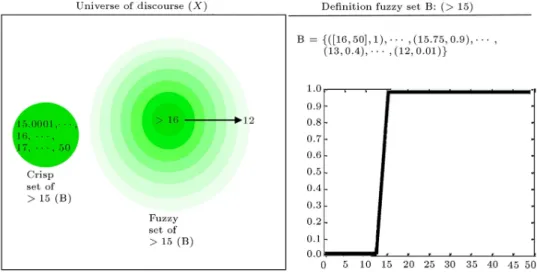
In this rule, values greater than 15% (called B) in Figure 1 seem to be crisp (without vagueness), as
compared to high (with vagueness). High is a linguistic variable, and dierent physicians do not have the same opinion about its value. It may be expanded in the domain of [.5 .9]. Although a physician may accept all numbers in the domain as high, every number has a dierent partial degree. This set, with the characteristic of partial degree membership for every member, is called fuzzy. The schematic view of a fuzzy set of high is shown in Figure 2. X is a universe of discourse that contains fuzzy sets: very high, medium, low and very low. In this gure, the membership degree of elements in a fuzzy set of high is reduced with the increasing transparency of colors.
The premise of the above rule, the value of greater than 15%, brings about the question as to whether a patient with FEV1 14.75 belongs to a fuzzy set high or not. It seems that B in the antecedent has an internal uncertainty, so it could be presented as a fuzzy set. Figure 1 shows the schematic view of the fuzzy set of B. In this gure, the membership degree of elements in set B (value of > 15%) reduced with the increasing transparency of colors.
The combination of the fuzzy technique with an expert system provides a suitable intelligent system for eliciting the asthma expert's knowledge and their mental algorithm, in order to generate cost-eective intelligence systems with the ability of diagnosing [25-31].
MARTIAL AND METHOD
In diagnosing asthma, the knowledge-base contains declarative and procedural knowledge collected by methods of interviewing, task performance and pro-tocols (the reasoning mechanism) from active human expertise (physicians and patients). In addition, latent expertise (text books and papers) is used for complet-ing the knowledge-base.
Figure 2. Schematic view of fuzzy set of high.
Graphical Representations
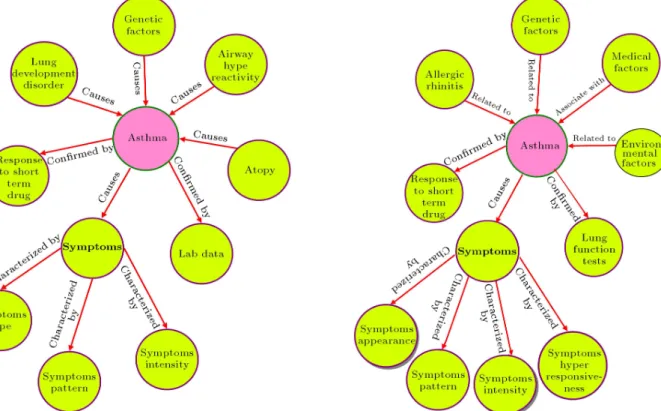
The graphical representation of the knowledge ac-quisition process is represented as semantic networks (Figures 3 and 4) which are made of nodes providing the conditions of asthma (cause nodes) and nodes representing the eects of asthma (eect nodes).
The semantic network of Model 1 in Figure 3 is represented as low level, i.e. the physician's perception of asthma, and contains seven major nodes. These nodes are divided into two parts. The cause nodes include atopy, airway hyper-reactivity, genetic factors
Figure 3. Semantic network of asthma (Model 1).
and lung development disorders. The eect nodes include the response to short-term drugs, lab data and symptoms. Every major node includes other nodes that are connected to them by specic labels. For example, a symptom node is characterized by symptom type, pattern and intensity.
The semantic network of Model 2 represented in Figure 4 is a modication of the semantic network of Model 1, which represents cause and eect nodes from the high level (patient's perception). Major cause nodes include allergic rhinitis, genetic factors environmental factors, and medical factors. Major
eect nodes include lung functions, the eects of short term drugs and symptoms characterized by symptom appearance, symptom hyper-responsiveness, symptom intensity and symptom pattern.
The approach of a representation of disease knowl-edge (asthma), based on the situation surrounding a patient, provides understandable knowledge for pa-tients and makes an intelligent system more applicable to them.
Representation of Production Rule
In this section, the knowledge of semantic network Model 2 is represented as production rules.
Medical diagnosing is performed based on three classes of data: symptom class history class and lab data class. Every node of Model 2 belongs to one of these classes. For representing knowledge as production rules, every major node is considered as a module that contains related variables (sub-nodes). The priority of considering these modules by a system inference engine is matched with the sequence of considering the medical class by physicians. Variables of the module sub-module may be represented as a statement of positive and negative relationships with the degree of uncertainty as linguistic variables, such as never, sometimes, and always.
The usual form of the casual relationship of these modules is represented as follows:
- Form 1: Condition A causes asthma with a degree of uncertainty,
- Form 2: Asthma causes consequence B with a degree of uncertainty, which is modied, as consequence B is an indicator of asthma with a degree of uncer-tainty.
The reason for this modication is the assimilation of knowledge in the knowledge-base.
A casual statement could be extended by adding deeper knowledge and presenting it in the form of pro-duction rules. The conditions of these propro-duction rules are variables in dened modules, and their consequence is the degree of asthma possibility. This possibility is calculated using local experience knowledge and global knowledge. Local knowledge involves inductive, deductive and constraint satisfaction knowledge that physicians use in their diagnosis. Global knowledge includes consideration of the Yourden Index (evalu-ated the diagnostic ecacy of a test by the use of specicity and sensitivity) and the Positive Predictive Value (PPV) for certain symptom(s)/condition(s) [32] obtained from various studies in dierent countries.
The domain of the degree of asthma possibility in all modules expect the lung function test to be considered between 0-10, which is subdivided into
Table 1. Categories of possibility of asthma and related fuzzy intervals.
Categories Fuzzy Interval EL (Extremely Low) 0-1 VVL (Very Very Low) 0-2 Vl (Very Low) 1-3 L (Low) 2-4 ML (Medium-Low) 3-5 M (Medium) 4-6 MH (Medium-High) 5-7 H (High) 6-8 VH (Very High) 7-9 VVH (Very Very High) 8-10
ten fuzzy interval categories represented as linguistic variables (Table 1).
Triangular and trapezoidal membership functions are used for representing fuzzy sets because of compu-tational eciency (Figure 5).
Representing Knowledge of Every Module Knowledge of every module is represented as produc-tion rules that are explained briey here.
Symptoms module belonging to symptoms class. Production rules in this module were generated using a combination of symptom appearance, pat-tern and intensity, as antecedents, and the degree of possibility of asthma as a consequence. The combination of antecedents is considered based on the stages of this disease (mild, moderate and severe) [33].
Figure 5. Membership functions related to fuzzy categories of possibility of asthma.
An example of rules at the moderate stage is as follows:
Rule of stage 2:
If the patient has dry coughing without a cold and the patient has dyspnoea each time
and coughing is more severe in the early morning (after midnight)
then the degree of asthma is high
Allergic rhinitis module belonging to symptoms class.
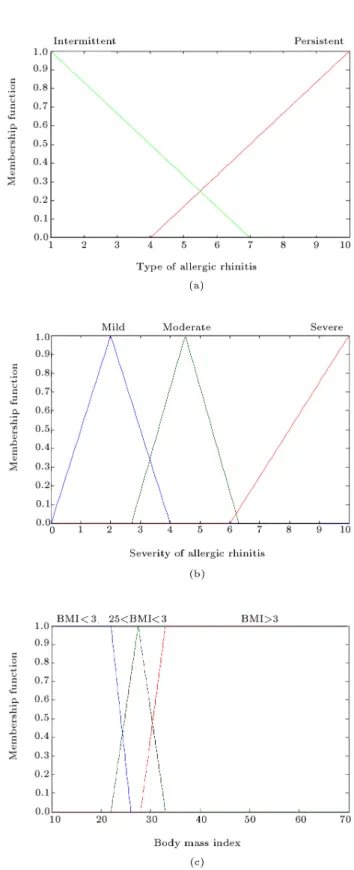
Antecedents of rules related to allergic rhini-tis [34,35] are composed of the type and severity of rhinitis, body mass index and the result of diagnosing the allergy (yes vs. no). Values of the type and severity of allergy rhinitis usually are represented with linguistic variables. As a result, these variables cannot be precisely measured and inherently contain uncertainty. Values of body mass index [36] are stated in three categories, as BMI 25, 25 < BMI < 30, BMI 30, which contain uncertainty, especially for values on the border line, such as 25 or 30. Table 2 represents these variables, linguistic values and related fuzzy intervals. The input variable of the diagnosed allergy is considered a crisp value.
Figure 6 depicts the degrees of membership function of the type and severity of rhinitis and BMI, respectively.
An example of rules of allergic rhinitis is as follows:
If the patient has allergic rhinitis
and the allergy rhinitis is moderate to severe and the diagnosing of the allergy is yes and the type of rhinitis is persistent
and the body of mass index is > 25 and < 30 then the degree of possibility of asthma is very high
Table 2. Linguistic values and fuzzy intervals related to variables of allergic rhinitis.
Variables Linguistic Values
Fuzzy Interval Types Intermittent
Persistent
1-7 4-10 Mild 0-4 Severity Moderate 3-7 Severe 6-10 BMI 25 10-26 Body mass index 25 < BMI < 30 22-33 BMI 30 28-70
Figure 6. (a) Membership functions of type of allergic rhinitis. (b) Membership functions of severity of asthma. (c) Membership functions of body mass index.
Genetic factor module belonging to history class. The production rules of this module are represented as a single input-single output. All variables in this module are considered as crisp variables.
If mother or father has asthma/allergy/hay fever then the degree of possibility of asthma is medium Symptoms hyper-responsiveness module belonging to
history class and lab data class.
The antecedents of production rules in this module are type of allergens, irritants and the data of atopy tests. Asthmatic patients react to aller-gens/irritants with dierent intensity, based on the stages of asthma, so the positive/negative response to allergens or irritants could conrm/reject the existence of asthma. All variables in this module are considered crisp variables.
An example of rules of genetic factor module is as follows:
If the patient has severe respiratory symptoms (cough/ dyspnoea/ wheezing/ tightness of chest) during exposure or after 6-12 minutes or 1-2 hours of exposure to dust especially in bed
and/or pollen from trees and/or grass
and/or a cooling system (water cooler) or heating (gas heater, wood stove)
then the degree of possibility of asthma is high Medical factor module belonging to history class.
Production rules of this module are composed of variables that consider the medical history of asth-matic patient [37]. All variables of this module are considered as crisp variables, except BMI, which is presented as a fuzzy variable with membership functions represented in Figure 6c.
An example of rules of this module is as follows: If the patient has BMI >= 30
and the patient has emotional coughing/ dysp-noea/ wheezing
and the existence of eczema is positive
and/or the existence of food allergy is positive (early beginning of food during infancy)
then the degree of possibility of asthma is medium/high
Environmental factors module belonging to history class.
This module is divided into two main sub-modules, based on the patient environment, as a sub-module of factors, specically of cities [38], and a sub-module of common factors in cities and villages. - Module of factors specically of a city: In this
module, places that are sources of mites, fungi/ mild allergens, and the existence of pets and cockroaches are dened as crisp because of their clear denition.
- Module of common factors: variables of air pollu-tion, childhood exposure to chemical substances,
and the existence of current chemical substances are dened as crisp variables. However, every place could be interpreted as having partial de-grees of pollution or chemicals. Other variables, such as the mother smoking during pregnancy, the existence of passive smoking and exposure to passive smoking during infancy are considered crisp variables, because the responses (yes, no) do not contain any uncertainty.
An example of rules of this sub-module is as follows:
If the patient has been exposed to passive smoking during infancy
and/or there has been exposure to chemical substances during infancy
and/or3 the mother smoked during pregnancy and air pollution is high
and/or passive smoking is high
and/or the existence of chemical substances is high
then the degree of asthma is high Response to short term drug module.
This module includes only the variable of the degree of improvement of symptoms by taking asthma inhalation drugs such as salbotamol.
Lung function module belonging to lab data class. This module contains four sub-modules including bronchodilator tests, challenge tests, exhaled nitric oxide tests and peak expiratory tests. Lung function tests [39] are applied in diagnosing when physicians cannot conrm or reject asthma when using symp-toms and history data.
This module is applied to the process of di-agnosing in this system, if the data for the lung function test be available. Using the results of the laboratory data, the system presents the nal result of diagnosing (a patient with respiratory symptoms has asthma or not), otherwise, conrmation of the obtained results of the system need conrmation by the physician.
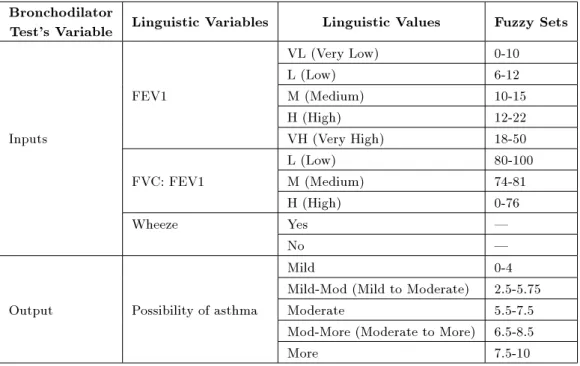
Rules of this module are presented in the form of single input-single output. Antecedents contain indicators of lung function tests. Antecedents of the sub-module of the bronchodilator test include Forced Expiratory Volume in one second (FEV1), and the ratio of FEV1: FVC and wheezing. The consequence of these rules is the degree of possibility of asthma. Table 3 represents these linguistic variables and values, and associated fuzzy intervals related to variables of the bronchodilator test.
An example of the rule of the module of the bronchodilator test is as follows:
If the increase in FEV1 after using a bronchodila-tor is 10% and 15%
Table 3. Input and output of bronchodilator test. Bronchodilator
Test's Variable Linguistic Variables Linguistic Values Fuzzy Sets VL (Very Low) 0-10 L (Low) 6-12 FEV1 M (Medium) 10-15
H (High) 12-22 Inputs VH (Very High) 18-50 L (Low) 80-100 FVC: FEV1 M (Medium) 74-81
H (High) 0-76
Wheeze Yes |
No |
Mild 0-4
Mild-Mod (Mild to Moderate) 2.5-5.75 Output Possibility of asthma Moderate 5.5-7.5
Mod-More (Moderate to More) 6.5-8.5 More 7.5-10
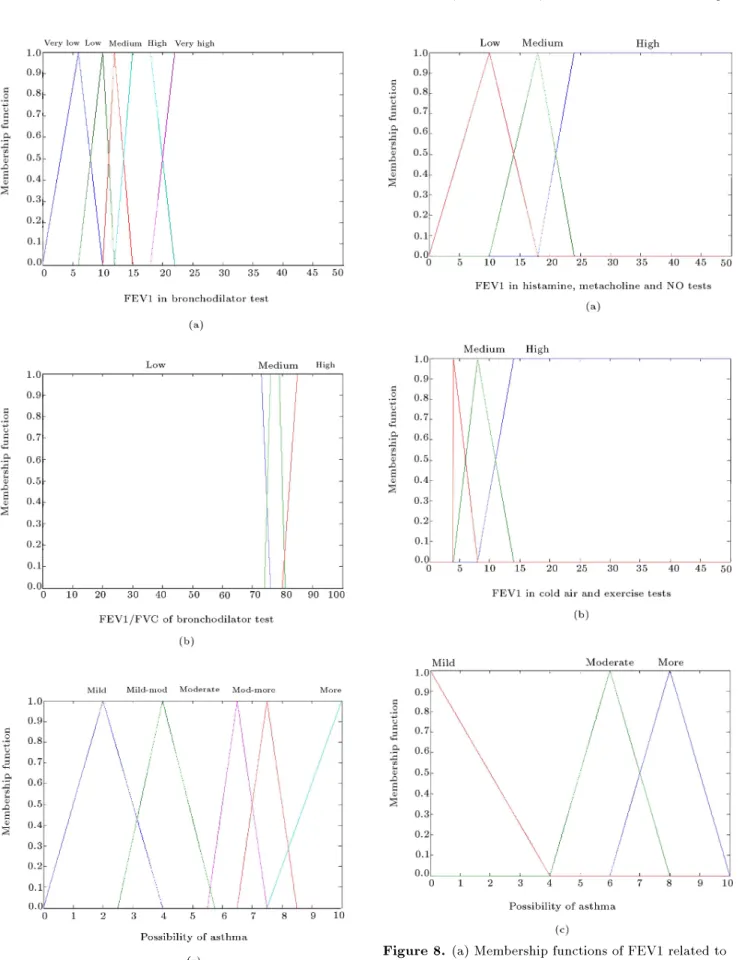
then the degree of possibility of asthma is medium Figure 7 depicts the membership functions of lin-guistic values related to FEV1, FEV1: FVC and the degree of possibility of asthma, respectively. The values of the variable of wheezing are considered as crisp values.
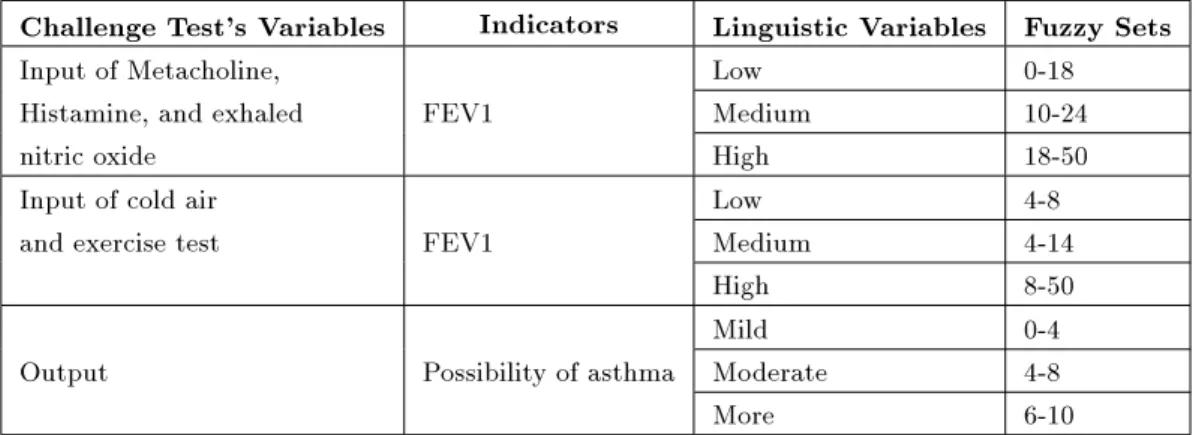
Variables of metacholine, histamine, cold air, and exercise tests are categorized in the sub-module of the challenge tests. The variable of FEV1 makes antecedents of the rules of this module, and the degree of possibility of asthma is represented as a consequence of these rules. The module of exhaled nitric oxide contains the variables of the exhaled nitric test as the antecedent and the possibility of asthma as a consequence of its related rule. Variables of the module of the challenge test and exhaled nitric oxide with their linguistic values and fuzzy intervals are represented in Table 4.
An example of the rule of challenge tests (metacholine test):
If the decrease in FEV1 after using 2.4 mg.ml 1
of methacholine is > 20
then the degree of possibility of asthma is high Figure 8a depicts the membership functions of FEV1 in Histamine, Metacholine and no tests. Figure 8b shows the membership functions of FEV1 in cold air and exercise tests, and Figure 8c represents the possibility of asthma.
The sub-module of the PEF test contains the antecedent of Peak Expiratory Follow (PEF) as the antecedent, and the possibility of asthma as a consequence. Table 5 represents these variables
with linguistic values and fuzzy intervals. Figures 9a and 9b represent the membership function, PEF and the degree of possibility of asthma in this module, respectively.
An example of rules of this module is as follows: If improvement is in PEF 20 and 30 after inhalation of a bronchodilator
then the degree of possibility of asthma is high Method of Control
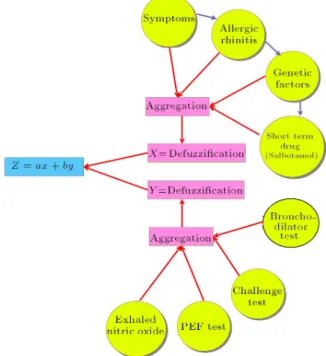
The dened modules of the asthma knowledge-base are organized into two dierent types: Type A and Type B. Type A (Figure 10a) is designed without a module of the lung function test and a response to short term drugs, in order to be applicable to patients with respiratory symptoms, or general physicians in primary care settings. The nal result of this system is obtained by considering the Mamdani fuzzy infer-ence mechanism. Aggregation of the fuzzy outputs of this system module is performed using s-norm max. The method of centroid is used for output de-fuzzication.
Type B (Figure 10b) focuses on the lung function module in calculating the output of the system, because of the importance of lung function tests in diagnosing asthma. The result of Type B is calculated based on equation Z = 0:2x + 0:8y. In this equation, variable x is the de-fuzzication of fuzzy sets obtained by aggregating outputs of modules of symptoms, including allergic rhinitis, genetic factors and symptom
hyper-Figure 7. (a) Membership functions of FEV1. (b) Membership functions of FEV1/FVC. (c) Membership functions of degree of possibility of asthma in
bronchodilator tests.
Figure 8. (a) Membership functions of FEV1 related to challenge tests of histamine, metacholine and NO measurement. (b) Membership functions of FEV1 related to challenge tests of cold air and exercise test. (c)
Membership functions of degree of possibility of asthma in challenge tests and NO module.
Table 4. Input and output variables related to challenge tests and exhaled nitric oxide (ENO). Challenge Test's Variables Indicators Linguistic Variables Fuzzy Sets Input of Metacholine, Low 0-18 Histamine, and exhaled FEV1 Medium 10-24
nitric oxide High 18-50
Input of cold air Low 4-8 and exercise test FEV1 Medium 4-14
High 8-50 Mild 0-4 Output Possibility of asthma Moderate 4-8 More 6-10
Table 5. Input and output related to PEF test. Peak Expiratory
Follow Variable Indicators Linguistic Variables Fuzzy set High 25-60 Input PEF Medium 15-33 Low 10-25 Very low 5-15 Very Mild 0-4.5 Output Possibility of asthma Mild 3-6
Moderate 5-7 More 6-10
responsiveness. Variable y is the de-fuzzication of fuzzy sets, which are the nal result of the lung function module. Coecients x and y are determined based on unanimity among experienced asthma physicians. In this structure, we withdraw modules of symptom hyper-responsiveness, medical factors and environmen-tal factors, in order to increase the speed of inference of the system and decrease the number of questions asked of patients or physicians.
Meta Rules of System
The meta rules of this system are classied into three categories: directive, heuristic and strategic.
- Directive meta rules or demon rules are responsible for assigning suitable questions to patients or physi-cians and gathering information.
- Heuristic meta rules are responsible for managing constraints on modules. The structure of this rule is as follows:
If < module n > and < heuristic >; then < action >
- Strategic meta rules are responsible for the accurate
application of modules and actions dened in the system.
The stopping rule of the two structures (Type A and Type B) of the system is dened as follows:
If the degree of possibility of asthma in the system (Type A or Type B) is higher than 75
then stop the process of reasoning of the system The value of (0.75) is dened as the cut-o of the system. It is obtained based on the opinion of asthma physicians. If the structure (Type A) is considered for diagnosis, and the patient has asthma (the output of the system is more than (0.75)), the patient is referred to an asthma physician. Otherwise, the structure (Type B) is used for diagnosis; in this structure, the value of more than (0.75) equals patient having asthma.
VALIDATION AND VERIFICATION
This system is tested based on methods of system veri-cation and validation. The veriveri-cation and validation of this system are performed during the ve steps of its life-cycle, including problem denition, knowledge
Figure 9. (a) Membership functions of Peak Expiratory Flow (PEF). (b) Membership function of degree of possibility of asthma in peak expiratory follow.
acquisition, design and testing, by participants of three groups of system user: general physicians experienced asthma physicians and asthmatic patients.
The performance of this system is calculated by considering all modules of the knowledge-base, including symptoms, allergic rhinitis, genetic factors, symptoms hyper-responsiveness, medical factors, envi-ronmental factors, short term drug use and laboratory data.
In order to evaluate the nal results obtained by these modules, 53 asthmatic patients and 53 non asthmatic patients with respiratory symptoms were considered and referred to Imam Khomeini Hospital and Masih Daneshvari in Tehran, Iran. The output of this system (the degree of possibility of asthma) has been compared with the diagnosis of physicians. Analyzing the results, based on criteria of specicity and sensitivity in the cut-o value 0:7, presented a sensitivity of 0.94% and specicity of 100%. Table 6 represents some result systems for 6 asthmatic and 4 non-asthmatic patients. In these tables, the primary diagnosis of physicians, the degree of possibility of asthma of the respiratory symptoms module, the nal
Figure 10a. Organization of modules without considering lab data.
Figure 10b. Organization of modules by focus on lab data.
diagnosis of the system and the nal diagnosis of physicians are represented.
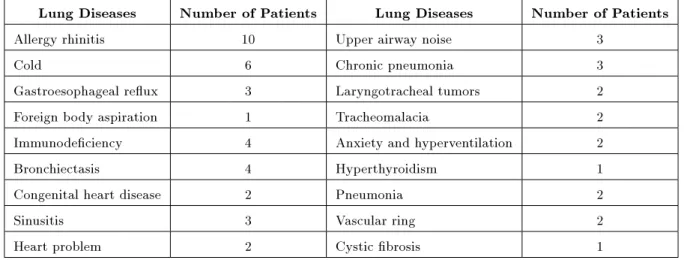
In order to increase the accuracy of this evalua-tion, especially for calculating specicity, the testing of non-asthmatic patients with lung diseases having a high dierential diagnosis of asthma is performed. Table 7 summarizes the types of lung disease of non-asthmatic patients who participated in this study.
pro-Table 6. Results of diagnosing system for asthmatic and nonasthmatic patients. Number of
Patients
Primary Diagnosis of Physicians
Diagnosis of System-Based on Respiratory Symptoms
Final Diagnosis of the System
Final Diagnosis of Physician Patient 1 Allergy 9 9 Asthma
Patient 2 cold 7 7.83 Asthma Patient 3 Allergy 6 7.36 Asthma Patient 4 Allergy 7 7.8 Asthma Patient 5 sinusitis 7.25 8 Asthma Patient 6 Pneumonia unspecied 7 9 Asthma
Patient 7 Pneumonia unspecied 3 3.6 Pneumonia unspecied Patient 8 Allergy 4 5.3 Allergy rhinitis Patient 9 GER No asthma No asthma Heart problem Patient 10 Cold No asthma No asthma Cold
Table 7. Lung disease of non-asthmatic patients participating in the sampling for calculating specicity. Lung Diseases Number of Patients Lung Diseases Number of Patients Allergy rhinitis 10 Upper airway noise 3
Cold 6 Chronic pneumonia 3 Gastroesophageal reux 3 Laryngotracheal tumors 2 Foreign body aspiration 1 Tracheomalacia 2 Immunodeciency 4 Anxiety and hyperventilation 2 Bronchiectasis 4 Hyperthyroidism 1 Congenital heart disease 2 Pneumonia 2 Sinusitis 3 Vascular ring 2 Heart problem 2 Cystic brosis 1
posed to patients to be checked by it. The criteria of ease of use, clarity of questions, clarity of explanation and clarity of results are considered by physicians and patients, and have been improved to make it more ecient in diagnosing asthma.
DISCUSSION AND CONCLUSION
Regarding the high prevalence of asthma and its con-sequence of mortality and morbidity, some intelligence systems have been developed to manage asthma dis-ease. These systems, based on purposes of application to hospitals or primary care settings (oine or online access) can be classied into three categories including: 1. Diagnosing or contributing to diagnosing.
2. Control management and training (such as
present-ing a web-based asthma tool for enhancpresent-ing informa-tion and awareness of asthmatic patients [40]). 3. Prediction (such as predicting the number of
pedi-atric asthma admissions, using neural networks, in a Barbados hospital [41]).
Considering the literature of the rst category (diag-nosing or contributing to diag(diag-nosing) shows that pub-lished articles have attempted to diagnose or contribute to diagnosing based on dierent approaches. Building knowledge models include the following:
Neural networks, case-based reasoning and discrim-inative analysis for diagnosing asthma (presenting the result of a prediction rate (92%) for a neural network, a prediction rate (96%) for a discrimina-tive analysis to evaluate asthmatic patients, and a prediction rate (80%) to evaluate non-asthmatic patients) [42].
The use of neural networks for recognizing the de-gree of airway hyper-responsiveness (presenting that a deterministic relationship exists between sound spectra and lung function parameter FEV1) [43]. A fuzzy rule-based system for analyzing the
ob-tained results of spirometry tests (showing the result of system evaluation by physicians presents accept-able results) [44].
An expert system for the interpretation of serial peak expiratory patterns follows measurements in occupational asthma ( reinforcing a sensitivity of 75% and a specicity of 94%) [45].
A computer-aided intelligent diagnostic system for bronchial asthma (presenting a result of 90.03% accuracy) [46].
Diagnosing asthma: computer-assisted symptom-based diagnosis (reinforcing a sensitivity of 56.2%, and a specicity of 93.5%.) [47].
Systems developed for diagnosing lung diseases, such as a fuzzy expert system (reinforcing acceptable results in regard to physician evaluation) [48], which are some of the intelligence systems that belong to the rst category.
The approach considered for generating the fuzzy expert system explained in this paper represents the knowledge of diagnosing asthma by including symp-tom data history data and lab data in the modular structure of the knowledge-base. The fuzzy inference engine designed for this system involves the modules of symptoms; allergic rhinitis, genetic factors, symptom hyper-responsiveness, medical factors, environmental factors, short term drug use and laboratory data, during the process of diagnosing, respectively. The knowledge in these modules is presented as production rules. Meta rules are considered in the knowledge-base, which presents relevant questions for patients in the user interface. To handle the uncertainty of laboratory data in the module of the lung function test and some vague variables in other modules such as allergic rhinitis, fuzzy techniques have been considered for inference of uncertain rules.
The eciency of this system was analyzed using 53 asthmatic and 53 non-asthmatic patients for a cut-o value 0.7, reinforcing the specicity 100% and sensitivity 94%. Representing uncertain data and providing eective rules contribute to achieving this acceptable result.
Future work can focus on providing more data for evaluating the performance of this system. In addition, evaluating the results of the system without focusing on laboratory data can evaluate its eciency for application to primary care settings.
Diagnosing asthma in children in age ranges 6 years is the main problem in the area of lung disease
that can be considered as the subject of intelligence systems.
REFERENCES
1. Louis, R. et al. \The Relationship between airways inammation and asthma severity", American Journal of Respiratory and Critical Care Medicine, 161, pp. 9-15 (2000).
2. Ritz, B. \Emotional activity of the airway in asthma: consistency across emotional induction techniques and emotional qualities", Biological Psychology, 84(1), pp. 74-81 (2010).
3. Lawrence, S. \Asthma, oxidant stress, and diet", Nutrition, 15(12), pp. 899-907 (1999).
4. Welte, T. \Asthma and COPD", Experimental and Toxicologic Pathology, 57(2), pp. 35-40 (2006). 5. Moin, M. \Principle of asthma", in Asthma; Basic
Clinical Science, M. Moine et al., Eds., 1th Edn., University Publication Center, Tehran, Iran, pp. 57-130 (2003).
6. Masjedi, M.R. et al. \Prevalence and severity of asthma symptoms in children of Tehran international study of asthma and allergies in childhood (ISAAC)", Iranian Journal of Allergy, Asthma and Immunology, 3(1), pp. 25-30 (2004).
7. Tootoonchi, P. \Prevalence of asthma, related symp-toms and risk factors in children younger than 5 years", Acta. Medica. Iranica, 42(6), pp. 450-454 (2004). 8. Mir Saeid Ghazi, B. et al. \The prevalence of asthma
among students (7-18 years old) in Tehran during 2002-2003", Iranian Journal of Allergy, Asthma and Immunology, 3(2), pp. 89-92 (2004).
9. Golshan, M. et al. \Prevalence of asthma and related symptoms in junior high school children in Isfahan, Iran", Monaldi. Arch. Chest Dis., 57(1), pp. 19-24 (2002).
10. Boskabady, M.H. and Simaei, N.R. \Prevalence of asthma symptoms among high school students in the city of Mashhad, North-East of Iran", Irn. J. Med. Sci., 24(1&2), pp. 48-52 (1999).
11. Lai, C. et al. \Global variation in the prevalence and severity of asthma symptoms: Phase three of the international study of asthma and allergies in childhood (ISAAC)", Thorax, 64, pp. 476-483 (2009). 12. Frank, T.L. et al. \Assessment of a simple scoring system applied to a screening questionnaire for asthma in children aged 5 15 years", Eur. Respir. J., 14, pp. 1190 -1197 (1999).
13. Hall, C.B. et al. \Diagnosing pediatric asthma: Val-idating the easy breathing survey", J. Pediatr., 139, pp. 267-272 (2001).
14. Global Initiative for Asthma. Global Strategy for Man-agement and Prevention, National Heart, Lung, and Blood Institute; National Institutes of Health. 2006 NIH publication, Internet Draft, available at: http: // www.ginasthma.com. (2007).
15. Nelson, B.W. et al. \The continuing problem of asthma in very young children: A community-based participa-tory research project", J. Sch. Health, 79(5), pp. 209-215 (2009).
16. Assembly on Asthma of the Spanish Society of Pul-monologyand Thoracic Surgery. Guidelines for the Diagnosis and Management of Dicult-to-Control Asthma, Arch Brononeumol, 41(9), pp. 513-523 (2005) 17. Gordon, B.R. et al. \Asthma history and presenta-tion", Otolayngol. Clin. North Am., 41(2), pp. 375-385 (2008).
18. Bellamya, D. \Poor perceptions and expectations of asthma control: Results of the international control of asthma symptoms (ICAS) survey of patients and gen-eral practitioners", Primary Care Respiratory Journal, 14, pp. 252-258 (2005).
19. Shaya, F.T. et al. \Burden of COPD, asthma, and concomitant COPD and asthma among adults: Racial disparities in a medicaid population", Chest, 136, pp. 405-411 (2009).
20. Blanchette, C.M. \Economic burden in direct cost of concomitant chronic obstructive pulmonary disease and asthma in a medicine advantage population", J. Manage. Care Pham., 14(2), pp. 176-185 (2008). 21. McElligott, S. and Daniel, P. \The opportunity costs
of screening children for asthma", Journal of Allergy and Clinical Immunology, 125(3), pp. 651-652 (2010). 22. Innocent, P.R. and John, R.I. \Computer aided fuzzy medicine diagnosis", Information Science, 162, pp. 81-104 (2004).
23. Eshghi, K. and Nematian, J. \Special classes of fuzzy integer programming models with all-di erent constraints", Journal of Scientia Iranica, Transaction E: Industrial Engineering, 16(1), pp. 1-10 (2009). 24. Fazel Zarandi, M.H. et al. \A fuzzy intelligent
infor-mation agent architecture for supply chains", Journal of Scientia Iranica, 15(5), pp. 623-636 (2008). 25. Yen, C.Y. \Rule selection in fuzzy expert system",
Expert System with Applications, 16, pp. 79-84 (1999). 26. Zadeh, A.L. \Fuzzy logic = computing with words", IEEE Transaction with Fuzzy Systems, 4(2), pp. 103-109 (1996).
27. Emami, R.M. et al. \A unied parameterized formula-tion of reasoning in fuzzy modeling and control", Fuzzy Sets and Systems, 108, pp. 59-81 (1999).
28. Klir, J.G. and Yuan, B., Fuzzy Sets and Fuzzy Logic: Theory and Applications, pp. 51-96, Prentice Hall, India (2002).
29. Mamdani, E.H. and Assilian, S. \An experiment in linguistic synthesis with a fuzzy logic controller", International Journal of Man-Machine Studies, 7, pp. 1-13 (1975).
30. Nyirenda, C.N. and Dawoud, D.S. \Self-organization in a particle swarm optimized fuzzy logic congestion detection mechanism for IP networks", Journal of Scientia Iranica, 15(6), pp. 589- 604 (2009).
31. Shavandi, H. and Mahlooji, H. \Fuzzy hierarchical queuing models for the location set covering problem in congested systems", Journal of Scientia Iranica, 15(3), pp. 378-388 (2008).
32. Sistek, D. \Clinical diagnosis or current asthma: Pre-dictive value of respiratory symptoms in the SAPAL-DIA study", Eur. Respir. J., 17, pp. 214-219 (2000). 33. Rhee, H. et al. \Adolescents' perception of asthma
symptoms and health care utilization", Journal of Pediatric Health Care, In Press (2010).
34. Makris, M. et al. \Temporal relationship of allergic rhinitis with asthma and other co-morbidities in a Mediterranean country: A retrospective study in a tertiary reference allergy clinic", Allergologia et Im-munopathologia, In Press (2010).
35. Vercelli, D. \Genetics and biology of asthma 2010: La' ci darem la mano...", Journal of Allergy and Clinical Immunology, 125(2), pp. 347-348 (2010).
36. Kopel, S.J. \Asthma symptom perception and obesity in children", Biological Psychology, 84(1), pp. 135-141 (2010).
37. Sly, P.D. et al. \Do early-life viral infections cause asthma?", Journal of Allergy and Clinical Immunology, 125(6), pp. 1202-1205 (2010).
38. Gern, J.E. \The urban environment and childhood asthma study", Journal of Allergy and Clinical Im-munology, 125(3), pp. 545-549 (2010).
39. Lewis, J. et al. \Spirometry guidelines inuence lung function results in a longitudinal study of young adults", Respiratory Medicine, 104(6), pp. 858-864 (2010).
40. Glykas, M. and Chytas, P. \Technological innovations in asthma patient monitoring and care. Expert Sys-tems with Applications", Expert System with applica-tion, 27(1), pp. 121-123 (2004).
41. Blades, E. et al. \Predicting pediatric asthma admis-sions for barbados", Allergy Clin Immunol, 113(2), pp. S341- S404 (2003).
42. Chae, Y.M. and Ho, S.H. \Comparison of alternative knowledge model for diagnosis of asthma", Expert System with Application, 11(4), pp. 423-429 (1996). 43. Oud, M. \Lung function interpolation by means
of neural-network-supported analysis of respiration sounds", Medical Engineer and Physics, 25, pp. 309-316 ( 2003).
44. Uncu, U. et al. \A fuzzy rule-base model for classica-tion of spirometric FVC graphs in chronic obstructive pulmonary diseases", Annual Reports of the Research Reactor Institute, Kyoto University, 4, pp. 3866-3869 (2000).
45. Burge, P.S. et al. \Development of an expert system for the interpretation of serial peak expiratory ow mea-surements in the diagnosis of occupational asthma", Occupational and Environmental Medicine, 56, pp. 758-764 (1999).
46. Chakraborty, C. et al. \CAIDSA: computer-aided intelligent diagnosing system for bronchial asthma", Expert System with Applications, 36, pp. 4958-4966 (2009).
47. Whui Choi, B. et al. \Easy diagnosing of asthma: computer-assisted symptom-based diagnosis", Journal of Korean Medical Science, 22(5), pp. 832-838 (2007). 48. Phuong, N.H. and Kreinovich, V. \Fuzzy logic and its applications in medicine", International Journal of Medical Informatics, 62, pp. 165 -173 (2001).
BIOGRAPHIES
Mohammad Hossein Fazel Zarandi, Ph.D., is Professor in the Department of Industrial Engineering at Amirkabir University, Tehran, Iran. His research interests include: The Intersection of the General Fields of Knowledge/Intelligent Information Systems, Articial Intelligence and Fuzzy Techniques, Decision Support Systems (DSS/ES), Management Information Systems, Intelligent Agent Based Systems, and Finan-cial Decision Support Systems.
Maryam Zolnoori, M.S., is currently Junior Re-searcher in the Mathematic and Informatics Group (ACECR) at the Academic Center for Education, Culture and Research (ACECR). Her main areas of
research consist of Intelligence System in Medicine. She has published some papers in the area of fuzzy expert systems at conferences and in journals. Her other experience includes some projects in the elds of CMS, CRM and Tourism Management Systems. She is now Project Manager in the design of a web-base system for diagnosing asthma in the Asthma and Allergy Research Center in Tehran, Iran.
Mostafa Moin, M.D., is a Professor of Pediatrics. Moeen was the Minister of Culture and Higher Edu-cation from 1989 to 1993 and from 1997 to 2000. He later became the Minister of Science, Research and Technology (the same post, with a changed name) from 2000 to 2003. Currently, he is Director of the Immunology, Asthma and Allergy Research Institute, aliated to Tehran University of Medical Sciences (TUMS). During his scientic career, he has been one of the leading Iranian researchers in the eld of pediatric asthma, immunology and allergies.
Hassan Heidarnezhad, M.D., is Professor of Pul-monary Medicine at Shahid Beheshti University, Tehran. His areas of interest lie in Asthma Prevalence, Necrotizing Pneumonia, CPAP Therapy, Immunod-eciency Diseases, Immunology, Allergies and other Respiratory Diseases.