Sharif University of Technology
Scientia IranicaTransactions A: Civil Engineering www.scientiairanica.com
A hybrid optimization algorithm for the optimal design
of laterally-supported castellated beams
A. Kaveh
and F. Shokohi
Centre of Excellence for Fundamental Studies in Structural Engineering, Iran University of Science and Technology, Narmak, Tehran, P.O. Box 16846-13114, Iran.
Received 10 January 2015; received in revised form 19 May 2015; accepted 22 June 2015
KEYWORDS Colliding Bodies Optimization (CBO); Particle Swarm Optimization (PSO); A hybrid CBO-PSO algorithm;
Optimum design of castellated beams; Hexagonal opening beam;
Cellular opening beam.
Abstract. In this paper, a hybrid method is developed for optimum design of castellated beams by combining two meta-heuristic algorithms, namely the Colliding Bodies Optimization (CBO) and Particle Swarm Optimization (PSO). In this hybrid algorithm (CBO-PSO), positive features of PSO are added to the CBO. Two common types of laterally supported castellated beams are considered to be the design problems: beams with hexagonal openings and beams with circular openings. These beams have found widespread usage in buildings because of great savings in materials and construction costs. Here, the minimum cost is taken as the design objective function and the new hybrid method is utilized for obtaining the solution of some benchmark problems. Comparison of the results of the CBO-PSO with those of some other meta-heuristics demonstrates the capability of the presented optimization algorithm. For most of the examples, the results obtained by CBO-PSO have less cost than those of the other considered methods. It is also concluded that the beams with hexagonal openings require smaller amount of steel, hence being superior to the beams with cellular openings.
© 2016 Sharif University of Technology. All rights reserved.
1. Introduction
Nowadays, due to huge extension in size and dimension of the structures, there has been a great increase in weight and cost of construction materials used for structures. Therefore, it is not surprising that a lot of attention is being paid by engineers to optimal design of the structures which lead to a signicant decrease in their cost.
Since the 1940s, the production of structural beams with higher strength and lower cost has been an asset to engineers in their eorts to design more ecient steel structures. Due to the limitations on maximum allowable deections, the use of sections with heavy weight and high capacity in the design
*. Corresponding author. Tel.: +98 21 77240104; Fax: +98 21 77240398
E-mail address: [email protected] (A. Kaveh)
problem cannot always be benecial. As a result, several new methods have been created for increasing the stiness of steel beams without increase in weight of the required steel. Hence, castellated and cellular beams have been utilized extensively in recent years [1]. In design of steel structures, beams with web-opening are widely used to pass the underoor services ducts such as water pipes and air ducts. Castellated beam is created from a standard wide-ange beam by cutting it longitudinally in a zigzag or semi-circular pattern, separating and osetting the two halves, and welding them back together. The resulting holes in the webs permit mechanical ducts, plumbing, and electrical lines to pass through the beam rather than beneath the beam. Web-openings have been used for many years in structural steel beams in a great variety of applications because of the necessity and economic advantage. The important advantage of the steel beam castellation process is that the designer can increase the depth of
a beam to raise its strength without adding steel. The resulting castellated beam is approximately 50% deeper and much stronger than the original unaltered beam [2-5].
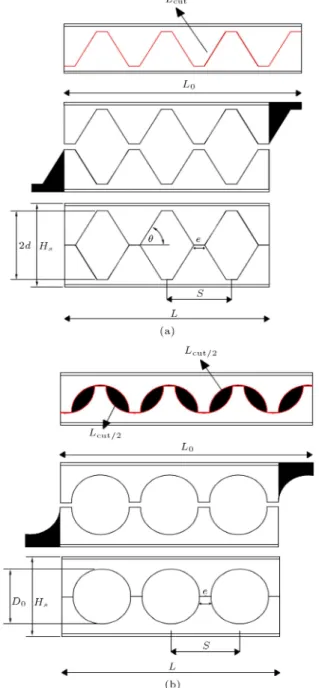
In recent years, a great deal of progress has been made in the design of steel beams with web-openings and cellular beam is one of them. Cellular beam is the modern form of the traditional castellated beam, but with a far wider range of applications for oor beams, in particular. Cellular beams are steel sections with circular openings that are made by cutting a rolled beam web in a half-circular pattern along its centerline and re-welding the two halves of hot rolled steel sections as shown in Figure 1. This opening increases the overall
Figure 1. (a) A castellated beam with hexagonal opening. (b) A castellated beam with circular opening.
beam depth, moment of inertia, and section modulus without increasing the overall weight of the beam [6].
The Colliding Bodies Optimization method (CBO) is one of the recently developed meta-heuristic algorithms that utilizes simple formulation and it re-quires no parameter tuning. This algorithm is based on one-dimensional collisions between two bodies, where each agent solution is modeled as a body [7,8].
Particle Swarm Optimization (PSO) is based on the behavior of a colony or swarm of insects (such as ants, termites, bees, and wasps), a ock of birds, or a school of sh. This algorithm was originally proposed by Kennedy and Eberhart in 1995. A basic variant of the PSO algorithm works by having a population (swarm) of candidate solutions (particles). These particles move around in the search-space using a few simple formulas. Each particle iteratively moves across the search-space and is attracted to the position of the best tness (evaluation of the objective function) historically achieved by the particle itself (local best) and by the best among the neighbors of the particle (global best) [9,10].
The main objective of this paper is to present a hybrid CBO-based algorithm (combined with the PSO) to nd an optimum design of castellated beams. For this purpose, the positive properties of the PSO will be added to the CBO.
According to the above-mentioned content, the present study is organized as follows: In Section 2, the design of castellated beam is introduced. Statement of the optimization design problem is formulated in Section 3, based on The Steel Construction Institute Publication Number 100 and Euro code 3. In Section 4, the CBO algorithm and the PSO approach are briey introduced. Also, the new hybrid method is presented in this section. In Section 5, the cost of castellated beam as the design objective function is minimized, and nally, Section 6 concludes the paper.
2. Design of castellated beams
Beams must be suciently strong to carry the applied bending moments and shear forces. The performance of any beam is dependent upon the physical dimensions as well as the cross-section geometry and shape. Due to the presence of holes in the web, the structural behavior of castellated steel beam is dierent from that of the solid web beams. At present, there is not a prescribed design method due to the complexity of the behavior of castellated beams and their associated modes of failure [2]. The strength of a beam with various web openings is determined by considering the interaction of the exure and shear at the openings. There are many failure modes to be considered in the design of a beam with web opening consisting of lateral-torsional buckling, Vierendeel mechanism,
exural mechanism, rupture of welded joints, and web post buckling. Lateral-torsional buckling may occur in an unrestrained beam. A beam is considered to be unrestrained when its compression ange is free to displace laterally and rotate. In this paper, it is assumed that the compression ange of the castellated beam is restrained by the oor system. Therefore, the overall buckling strength of the castellated beam is omitted from the design considerations. These modes are closely associated with beam geometry, shape parameters, type of loading, and provision of lateral supports. In the design of castellated beams, these criteria should be considered [11-17].
2.1. Overall beam exural capacity
This mode of failure can occur when a section is subjected to pure bending. In the span subjected to pure bending moment, the tee-sections above and below the holes yield in a manner similar to that of a plain webbed beam. Therefore, under applied load combinations, the castellated beam should have sucient exural capacity to be able to resist the external loading [12,13]:
MU MP = ALTPYHU; (1)
where ALT is the area of lower tee, PY is the design
strength of steel, and HU is the distance between
centers of gravities of upper and lower tees. 2.2. Beam shear capacity
In the design of castellated beams, it is necessary to control two modes of shear failure. The rst one is the vertical shear capacity and the upper and lower tees should undergo it. The sum of the shear capacities of the upper and lower tees is checked using the following equations [2,13]:
PV Y = 0:6PY(0:9AW UL) for circular opening,
PV Y=
p 3
3 PY(AW UL) for hexagonal openning, (2) where AW UL is the total area of the webs of tees.
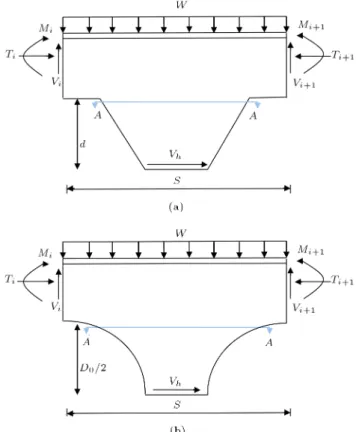
The second one is the horizontal shear capacity. It is developed in the web post due to the change in axial forces in the tee-section as shown in Figure 2. Web post with too short mid-depth welded joints may fail prematurely when horizontal shear exceeds the yield strength. The horizontal shear capacity is checked using the following equations [2,13]:
PV H = 0:6PY(0:9AW P) for circular opening
PV H =
p 3
3 PY(AW P) for hexagonal openning; (3) where AW P is the minimum area of web post.
Figure 2. Horizontal shear in the web post of castellated beams: (a) Hexagonal opening; and (b) circular opening.
2.3. Flexural and buckling strength of web post As mentioned above, it is assumed that the compres-sion ange of the castellated beam is restrained by the oor system. Thus, the overall buckling of the castel-lated beam is omitted from the design considerations. The web post buckling capacity in castellated beam is given by [2,13]:
MMAX
ME =
C1: C2:2 C3; (4)
where = S
2d for hexagonal openings, and = DS0
for circular openings, also MMAX is the maximum
allowable web post moment and ME is the web post
capacity at critical section A-A shown in Figure 2. C1,
C2, and C3 are constants obtained by the following
expressions:
C1= 5:097 + 0:1464() 0:00174()2; (5)
C2= 1:441 + 0:0625() 0:000683()2; (6)
C3= 3:645 + 0:0853() 0:00108()2; (7)
where = 2d
tw for hexagonal openings, and =
D0
tw for
circular openings, S is the spacing between the centers of holes, d is the cutting depth of hexagonal opening, D0 is the holes diameter, and tw is the web thickness.
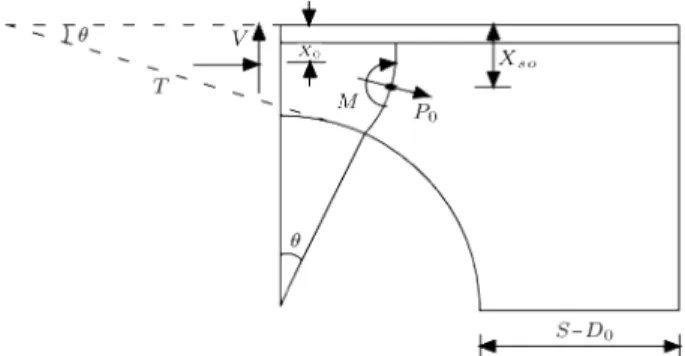
Figure 3. Olander's curved beam approach.
2.4. Vierendeel bending of upper and lower tees
Vierendeel mechanism is the most common failure for perforated steel beams that results in the formation of four plastic hinges above and below the web opening. It is always critical in steel beams with web openings, where global shear force is transferred across the opening length, and the Vierendeel moment is resisted by the local moment resistances of the tee-sections above and below the web openings.
The overall Vierendeel bending resistance de-pends on the local bending resistance of the web-ange sections. This mode of failure is associated with high shear forces acting on the beam. The Vierendeel bending stresses in the circular opening is obtained by using the Olander's approach in Figure 3. The interaction between Vierendeel bending moment and axial force for the critical section in the tee should be checked as follows [13]:
P0
PU +
M
MP 1:0; (8)
where P0and M are the force and the bending moment
on the section, respectively; PU is equal to the area of
critical section PY; MP is calculated as the plastic
modulus of critical section in plastic section or elastic section modulus of critical section for other sections.
The plastic moment capacity of the tee-sections in castellated beams with hexagonal opening are calcu-lated independently. The total of the plastic moments is equal to the sum of the Vierendeel resistances of the above and below tee-sections [2]. The interaction between Vierendeel moment and shear forces should be checked by the following expression:
VOMAX:e 4MT P 0; (9)
where VOMAX and MT P are the maximum shear force
and the moment capacity of tee-section, respectively. 2.5. Deection of castellated beam
Serviceability checks are of high importance in design, especially for beams with web opening where the de-ection due to shear forces is signicant. The dede-ection
of a castellated beam under applied load combinations should not exceed span/360. In castellated beams with circular opening, the deection at each point is calculated by the following expression:
YT OT = YMT+ YW P + YAT + YST+ YSW P; (10)
where YMT, YW P, YAT, YST, and YSW P are deection
due to bending moment in tee, deection due to bending moment in web post of beam, deection due to axial force in tee, deection due to shear in tee, and deection due to shear in web post, respectively. These equations are provided in [13].
For a castellated beam with hexagonal opening and length L subjected to transverse loading, the total deection is composed by two terms: the rst term corresponds to pure moment action, fb, and the second
one corresponds to shear action, fs. Thus, the total
deection can be calculated by the following expression: f = fb+ fs= c1L3+ c2L; (11)
c1 and c2 are determined by means of a curve tting
technique [15].
3. Formulation of the optimization problem The main initiative for producing and using castellated beam is to suppress the cost of material by apply-ing more ecient cross sectional shapes made from standard proles in combination with aesthetic and architectural design considerations.
In a castellated beam, there are many factors that require special considerations when estimating the cost of beam, such as man-hours of fabrication, weight, price of web cutting, and welding process. At this study, it is assumed that the costs associated with man-hours of fabrication for hexagonal and circular opening are iden-tical. Thus, the objective function includes three parts: the beam weight, price of the cutting, and price of the welding. The objective function can be expressed as:
Fcost= Ainitial(L0):P1+ Lcut:P2+ Lweld:P3; (12)
where P1, P2, and P3 are the price of the weight
of the beam per unit weight, length of cutting and welding for per unit length, respectively, L0 is the
initial length of the beam before castellation process, is the density of steel, Ainitial is the area of the
selected universal beam section, Lcut and Lweld are
the cutting length and welding length, respectively. The length of cutting is dierent for hexagonal and circular web-openings. The dimension of the cutting length is described by the following equations:
For circular opening:
For hexagonal opening: Lcut= 2NH
e +sin()d
+ 2e +sin()d ; (14) where NH is the total number of holes, e is the length of horizontal cutting of web, D0is the diameter of holes,
d is the cutting depth, and is the cutting angle. Also, the welding length for both circular and hexagonal openings is determined by Eq. (15):
Lweld= e(NH + 1): (15)
As an example, in Figure 1(a), the number of holes is equal to 3. Therefore, the total length of cutting can be expressed by the following equation:
Lcut= 8e + 7
d sin()
: (16)
Similarly, for cellular beams, the same equations can be obtained. Lcutis shown for both circular and hexagonal
openings in Figure 1.
3.1. Design of castellated beam with circular opening
Design process of a cellular beam consists of three phases: selection of a rolled beam, selection of a diameter, and spacing between the centers of holes or total number of holes in the beam as shown in Fig-ure 1, [13,14]. Hence, the sequence number of the rolled beam section in the standard steel sections tables, the circular holes diameter, and the total number of holes are taken as design variables in the optimum design problem. The optimum design problem formulated by considering the constraints explained in the previous sections can be expressed as follows.
Find an integer design vector fXg = fx1; x2; x3gT
where x1 is the sequence number of the rolled steel
prole in the standard sections list, x2 is the sequence
number for the hole diameter which contains various diameter values, and x3 is the total number of holes
for the cellular beam [13]. Hence, the design problem can be expressed as:
Minimize Eq. (12): Subjected to:
g1= 1:08 D0 S 0; (17)
g2= S 1:60 D0 0; (18)
g3= 1:25 D0 Hs 0; (19)
g4= Hs 1:75 D0 0; (20)
g5= MU MP 0; (21)
g6= VMAXSUP PV 0; (22)
g7= VOMAX PV Y 0; (23)
g8= VHMAX PV H 0; (24)
g9= VA-AMAX MWMAX 0; (25)
g10= VTEE 0:50 PV Y 0; (26)
g11=PP0 U +
M
MP 1:0 0; (27)
g12= YMAX L=360 0; (28)
where tW is the web thickness; Hs and L are the
overall depth and the span of the cellular beam; S is the distance between centers of holes; MU is the
maximum moment under the applied loading; MP
is the plastic moment capacity of the cellular beam; VMAXSUP is the maximum shear at support; VOMAX
is the maximum shear at the opening; VHMAX is the
maximum horizontal shear; MA-AMAXis the maximum
moment at A-A section shown in Figure 2. MWMAX
is the maximum allowable web post moment; VTEE
represents the vertical shear on the tee at = 0 of web opening; P0 and M are the internal forces on the
web section as shown in Figure 3; and YMAX denotes
the maximum deection of the cellular beam [13,17]. 3.2. Design of castellated beam with hexagonal
opening
In design of castellated beams with hexagonal open-ings, the design vector includes four design variables: selection of a rolled beam, selection of a cutting depth, spacing between the centers of holes or total number of holes in the beam, and cutting the angle as shown in Figure 2. Hence, the optimum design problem can be expressed as follows.
Find an integer design vector fXg = fx1; x2; x3;
x4gT, where x1 is the sequence number of the rolled
steel prole in the standard sections list, x2 is the
sequence number for the cutting depth which contains various values, x3 is the total number of holes for the
castellated beam, and x4 is the cutting angle. So, the
design problem turns out to be as follows: Minimize Eq. (12).
Subjected to:
g1= d 38: (Hs 2tf) 0; (29)
g2= (Hs 2tf) 10 (dT tf) 0; (30)
g3=23:d: cot e 0; (31)
g4= e 2d: cot 0; (32)
g6= 45 0; (34)
g7= 64 0; (35)
g8= MU MP 0; (36)
g9= VMAXSUP PV 0; (37)
g10= VOMAX PV Y 0; (38)
g11= VHMAX PV H 0; (39)
g12= MA-AMAX MWMAX 0; (40)
g13= VTEE 0:50 PV Y 0; (41)
g14= VOMAX:e 4MT P 0; (42)
g15= YMAX L=360 0; (43)
where tf is the ange thickness, dT is the depth of
the tee-section, MP is the plastic moment capacity
of the castellated beam, MA-AMAX is the maximum
moment at A-A section, shown in Figure 2, MWMAX
is the maximum allowable web post moment, VTEE
represents the vertical shear on the tee, MT P is the
moment capacity of tee-section, and YMAX denotes
the maximum deection of the castellated beam with hexagonal opening [2].
4. A hybrid colliding bodies optimization and particle swarm optimization
In this section, the hybrid CBO and PSO methods is presented. In order to create the hybrid approach, the CBO is used as the main algorithm and the positive features of the PSO are added to it. The hybrid algorithm utilizes the location of the global and local best points to improve the searching process. A summary of these methods is described in the following subsections.
4.1. Particle swarm optimization algorithm Particle swarm optimization, rst developed by Kennedy and Eberhart [9], is a population-based meta-heuristic method. The development of this algorithm follows from observations of social behaviors of animals, such as bird ocking and sh schooling. The theory of PSO describes a solution process in which each particle ies through the multidimensional search space while the velocity and position of the particle are constantly updated according to the best previous performance of the particle or of the particle's neighbors, as well as the best performance of the particles in the entire population [18].
The velocity vector is used to update the current position of each particle in the swarm. Likewise, the
velocity vector is updated utilizing a memory in which the best position of each particle and the best position among all particles are stored.
The position of the ith particle at iteration k + 1 is calculated using the following equation:
xi
k+1= xik+ vk+1i ; (44)
where, xi
k+1 is the new position, xik is the position
at the kth iteration, and vi
k+1 is the updated velocity
vector of the ith particle. The velocity vector of each particle is determined by:
vi
k+1= !:vik+ c1:r1: Pki Xki
+ c2:r2: Pkg Xki
; (45) where, vi
k is the velocity vector at iteration k; r1 and
r2 are two random numbers between 0 and 1; Pki
represents the best ever position of particle i, local best; Pkg is the best position among all particles in the swarm up to iteration k; c1and c2are two acceleration
constants; and ! is the inertia weight.
4.2. Colliding bodies optimization algorithm The Colliding bodies optimization algorithm is one of the recently developed meta-heuristic search algo-rithms [7]. It is a population-based search approach, where each agent is considered as a Colliding Body (CB) with mass m. The idea of the CBO algorithm is based on observation of a collision between two objects in one dimension, in which one object collides with another object and they move toward minimum energy level [8].
In the CBO algorithm, each solution candidate, Xi, is considered to be a Colliding Body (CB). The
massed objects are composed of two main equal groups, i.e. stationary and moving objects, where the moving objects move to follow stationary objects and a collision occurs between pairs of objects. This is done for two purposes: (i) to improve the positions of moving objects; (ii) to push stationary objects towards better positions. After the collision, the new positions of the colliding bodies are updated based on their new velocities.
The pseudo-code for the CBO algorithm can be summarized as follows:
Step 1. Initialization. The initial positions of CBs are determined randomly in the search space:
x0
i = xmin+ rand: (xmax xmin) i = 1; 2; :::; n;
(46) where x0
i determines the initial value vector of the
ith CB; xmin and xmax are the minimum and the
maximum allowable value vectors of variables, respec-tively; rand is a random number in the interval [0,1], and n is the number of CBs.
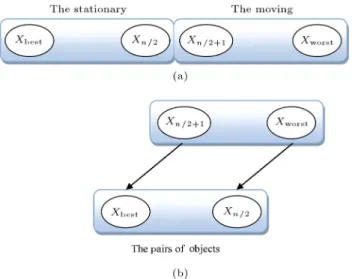
Figure 4. (a) The sorted CBs in an increasing order. (b) The pairs of objects for the collision.
Step 2. Determination of the body mass for each CB. The magnitude of the body mass for each CB is dened as:
mk= 1 fit(k)
Pn
i=1fit(i)1
; k = 1; 2; :::; n; (47)
where fit(i) represents the objective function value of the agent i, and n is the population size. Obviously, a CB with good values exerts a larger mass than the bad ones. Also, for maximizing the objective function, the term 1
fit(i) is replaced by fit(i).
Step 3. Arrangement of the CBs. The arrangement of the CBs objective function values is performed in ascending order (Figure 4(a)). The sorted CBs are equally divided into two groups:
The lower half of CBs (stationary CBs): These CBs are good agents which are stationary and the velocity of these bodies before collision is zero. Thus:
vi= 0 i = 1; 2; :::;n2: (48)
The upper half of CBs (moving CBs): These CBs move toward the lower half. Then, according to Figure 4(b), the better and worse CBs, i.e. agents with upper tness value in each group, will collide with each other. The change of the body position represents the velocity of these bodies before collision as:
vi= xi xi n
2 i =
n
2 + 1; :::; n; (49) where vi and xi are the velocity and position
vectors of the ith CB in this group, respectively; and xi n
2 is the ith CB pair position of xi in the
previous group.
Step 4. Calculation of the new position of the CBs. After the collision, the velocity of bodies in each group is evaluated using collision laws and the velocities before collision. The velocity of each moving CB after the collision is:
v0 i=
(mi "mi n 2)vi
mi+ mi n 2
i = n2 + 1; :::; n; (50)
where viand vi0are the velocity of the ith moving CB
before and after the collision, respectively; mi is the
mass of the ith CB; and mi n
2 is mass of the ith CB
pair. Also, the velocity of each stationary CB after the collision is:
v0 i=
mi+n
2 + "mi+n2
vi+n
2
mi+ mi+n 2
; i = 1; :::;n2; (51) where vi+n
2 and vi are the velocity of the ith moving
CB pair before and the ith stationary CB after the collision, respectively; miis mass of the ith CB; mi+n 2
is mass of the ith moving CB pair. As mentioned previously, " is the Coecient Of Restitution (COR) and for most of the real objects, its value is between 0 and 1. It is dened as the ratio of the separation velocity of two agents after collision to the approach velocity of two agents before collision. In the CBO algorithm, this index is used to control the explo-ration and exploitation rates. For this goal, the COR decreases linearly from unit to zero. Thus, " is dened as:
" = 1 iteriter
max; (52)
where iter is the actual iteration number, and itermax
is the maximum number of iterations, with COR being equal to unit and zero representing the global and local search, respectively.
New positions of CBs are obtained using the generated velocities after the collision in position of stationary CBs.
The new position of each moving CB is: xnew
i = xi n
2 + rand vi0 i =
n
2 + 1; :::n; (53) where xnew
i and v0i are the new position and the
velocity after the collision of the ith moving CB, respectively; xi n
2 is the old position of the ith
stationary CB pair. Also, the new positions of stationary CBs are obtained by:
xnew
i = xi+ rand v0i i = 1; :::;n2; (54)
where xnew
i , xi, and vi0 are the new position, old
position, and velocity after the collision of the ith stationary CB, respectively. rand is a random vector uniformly distributed in the range (-1,1) and the sign \" denotes an element-by-element multiplication.
Step 5. Termination criterion control. Steps 2-4 are repeated until a termination criterion as the maximum number of iterations is satised.
4.3. Hybrid CBO and PSO
Both of the previously introduced methods (CBO and PSO) are population-based algorithms and nd optimum solutions by changing the position of the agents. However, the movement strategies are dierent for the CBO and PSO. The PSO algorithm utilizes the local best and the global best to determine the direction of the movement, while the CBO approach uses the collision laws and the velocities before collision to determine the new positions. Using the local best and the global best are the main reasons for the success of PSO.
However, in spite of having the above-mentioned advantages, the standard PSO is infamous for prema-ture convergence. This algorithm has some problems in controlling the balance between the exploration and exploitation due to ignoring the eect of other agents. Similar to the PSO method, the CBO algorithm uses the previous velocities, when the upper half of CBs (moving CBS) moves toward the stationary CBs. As it is mentioned in the previous section, after the collision, the velocity of all CBs is evaluated using the velocity of moving CBs before the collision and the mass of the paired CBs. This will lead to loss of the best position of particles which is found in the previous iteration. Therefore, in the present hybrid algorithm, the advantages of the PSO consist of the local best and the global best is added to the CBO algorithm. For this purpose, the best position of the stationary particles is saved in a memory called Stationary Bodies Memory (SBM). Also, another memory is considered to save the better position of each particle that has been found so far. This memory, so-called Particles Memory (PM), is treated as the local best in the PSO, and it is updated by the following expression:
P Mi k+1=
8 < :
P Mi
k! F (Xk+1i ) F (Xki)
Xi
k+1! F (Xk+1i ) F (Xki);
(55)
in which the rst term identies that when the new position is not better than the previous one, updating will not be performed, while when the new position is better than the so far stored good position, the new solution vector is replaced. With the above denitions, and considering the above-mentioned new memories, the velocity of CBs after collision is modied by the following equations:
For moving particles:
v0
i= mi "mi
n 2
vi
mi+ mi n 2
+ r1:c1: (P Mi xi)
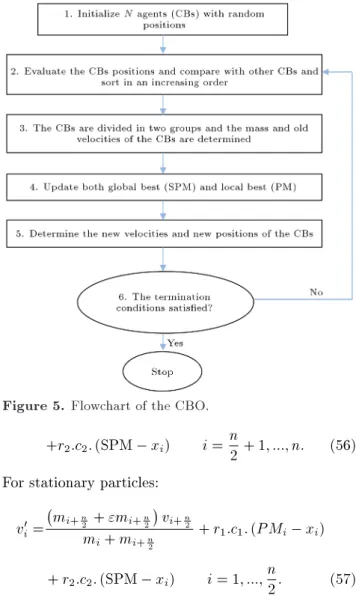
Figure 5. Flowchart of the CBO.
+r2:c2: (SPM xi) i = n2 + 1; :::; n: (56)
For stationary particles:
v0 i=
mi+n
2 + "mi+n2
vi+n
2
mi+ mi+n 2
+ r1:c1: (P Mi xi)
+ r2:c2: (SPM xi) i = 1; :::;n2: (57)
Figure 5 shows the schematic procedure of the CBO-PSO algorithm.
5. Design examples
In this section, in order to compare fabrication costs of the castellated beams with circular and hexagonal holes, three benchmark examples from the literature are selected. Also, these beams are used in this section to show the eciency of the new optimization algorithm. Among the steel section list of British Standards, 64 Universal Beam (UB) sections starting from 254 102 28 UB to 914 419 388 UB are chosen to constitute the discrete set for steel sections from which the design algorithm selects the sectional designations for the castellated beams. In the design pool of holes diameters, 421 values are arranged which vary between 180 and 600 mm with increment of 1 mm. Also, for cutting depth of hexagonal opening, 351 values are considered which vary between 50 and 400 mm with increment of 1 mm and cutting angle changes from 45 to 64. Another discrete set is arranged for the
Figure 6. Simply supported beam with 4 m span.
number of holes. Likewise, in all the design problems, the modulus of elasticity is equal to 205 kN/mm2 and
Grade 50 is selected for the steel of the beam which has the design strength of 355 MPa [13,14]. The coecients P1, P2, and P3in the objective function are considered
0.85, 0.30, and 1.00, respectively.
5.1. Castellated beam with 4 m span
A simply supported beam with 4 m span, shown in Figure 6, is selected as the rst design example. The beam is subjected to 5 kN/m dead load including its own weight. A concentrated live load of 50 kN also acts at mid-span of the beam and the allowable displacement of the beam is limited to 12 mm. The number of CBs is taken as 50 and the maximum number of iterations is considered 200.
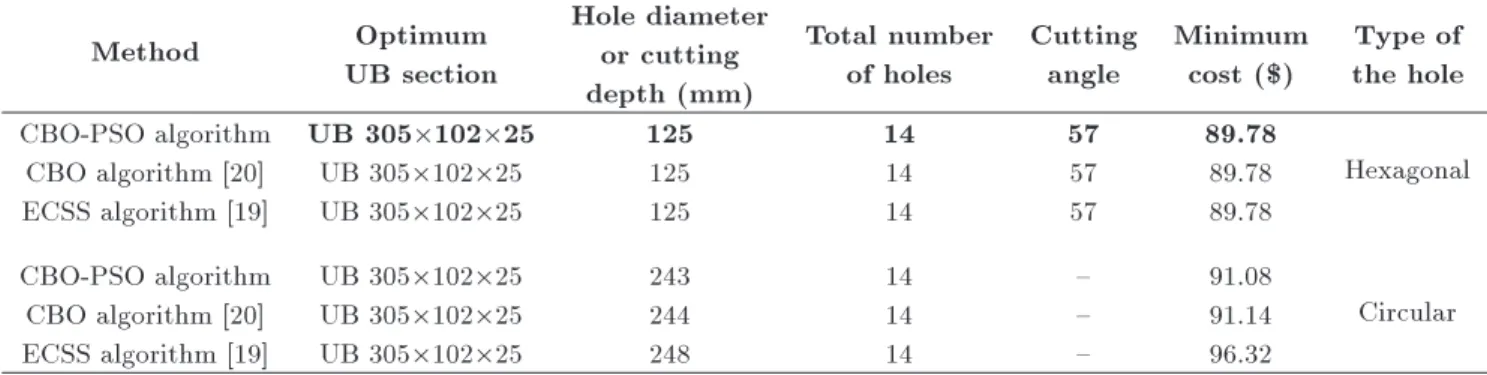
Castellated beams with hexagonal and circular openings are separately designed by using the new algorithm. The optimum results obtained by CBO-PSO are given in Table 1. It is apparent from the same table that the optimum cost for castellated beam with hexagonal hole is equal to 89.78$, which is obtained by three methods, but the CBO-PSO algorithm gives better results than those of other approaches for cellu-lar beams [19-20]. Also, these results indicate that the castellated beam with hexagonal opening has low cost as compared to the cellular beam. In this problem, the length of the span is short; hence, shear capacity is very important in optimum design of this beam and it is the most eective factor in the design of this example.
Figure 7 shows the convergence of CBO-PSO algorithm for design of castellated beams with dierent openings.
5.2. Castellated beam with 8 m span
In the second problem, the CBO-PSO algorithm is used to design a simply supported castellated beam
Figure 7. Variation of minimum cost versus the number of iterations for 4 m span castellated beam: (a)
Castellated beam with hexagonal opening; and (b) castellated beam with circular opening.
with 8 m span. The beam carries a uniform dead load 0.40 kN/m, which includes its own weight. In addition, it is subjected to two concentrated loads; dead load of 70 kN and live load of 70 kN, as shown in Figure 8. The allowable displacement of the beam is limited to 23 mm. The number of CBs is taken as 50. The maximum number of iterations is considered 200.
This beam is also designed by three optimization methods and the optimum results are given in Ta-ble 2. In design of the beam with hexagonal hole, the corresponding costs obtained by the ECSS and
Table 1. Optimum designs of the castellated beams with 4 m span.
Method Optimum
UB section
Hole diameter or cutting depth (mm)
Total number of holes
Cutting angle
Minimum cost ($)
Type of the hole
CBO-PSO algorithm UB 30510225 125 14 57 89.78
Hexagonal
CBO algorithm [20] UB 30510225 125 14 57 89.78
ECSS algorithm [19] UB 30510225 125 14 57 89.78
CBO-PSO algorithm UB 30510225 243 14 { 91.08
Circular
CBO algorithm [20] UB 30510225 244 14 { 91.14
Table 2. Optimum designs of the castellated beams with 8 m span.
Method Optimum
UB section
Hole diameter or cutting depth (mm)
Total number of holes
Cutting angle
Minimum cost ($)
Type of the hole
CBO-PSO algorithm UB 610229101 244 14 55 718.33
Hexagonal
CBO algorithm [20] UB 610229101 243 14 59 718.93
ECSS algorithm [19] UB 610229101 246 14 59 719.47
CBO-PSO algorithm UB 610229101 487 14 { 721.55
Circular
CBO algorithm [20] UB 610229101 487 14 { 721.55
ECSS algorithm [19] UB 610229101 487 14 { 721.55
Table 3. Optimum designs of the castellated beams with 9 m span.
Method Optimum
UB section
Hole diameter or cutting depth (mm)
Total number of holes
Cutting angle
Minimum cost ($)
Type of the hole
CBO-PSO algorithm UB 684254125 230 16 56 990.33
Hexagonal
CBO algorithm [20] UB 684254125 233 15 64 993.79
ECSS algorithm [19] UB 684254125 277 13 56 995.97
CBO-PSO algorithm UB 684254125 538 14 { 998.58
Circular
CBO algorithm[20] UB 684254125 538 14 { 997.57
ECSS algorithm [19] UB 684254125 539 14 { 998.94
Figure 8. A simply supported beam with 8 m span.
CBO are equal to 719.47$ and 718.93$, respectively, while this value is equal to 718.33$ for the CBO-PSO algorithm. As a result, the performance of the CBO-PSO method is better than other ways in this design example. According to the obtained results, the designed beam with hexagonal opening in comparison with the cellular beam has low cost, and it is a more appropriate option in this case. Also, the maximum value of the strength ratio is equal to 0.99 for both hexagonal and circular beams, and it is shown that these constraints are dominant in the design.
Figure 9 shows the convergence history for opti-mum design of hexagonal beam, which is obtained by three methods. As can be observed, the convergence rate of the CBO-PSO is nearly the same as that of the CBO and higher than ECSS.
5.3. Castellated beam with 9 m span
The beam with 9 m span is considered to be the last example of this study in order to compare the minimum cost of the castellated beams. The beam
Figure 9. Convergence history of the hexagonal beam with 8 m span.
Figure 10. Simply supported beam with 9 m span.
caries a uniform load of 40 kN/m including its own weight and two concentrated loads of 50 kN, as shown in Figure 10. The allowable displacement of the beam is limited to 25 mm. Similar to the two previous examples, the number of CBs is taken as 50 and the maximum number of iterations is considered 200.
Table 3 compares the results obtained by the CBO-PSO with those of the other algorithms. In the optimum design of castellated beam with hexagonal
Figure 11. Optimum proles of the castellated beams with cellular and hexagonal openings.
hole, CBO-PSO algorithm selects 684 254 125 UB prole, 16 holes, and 230 mm for the cutting depth and 56 degree for the cutting angle. The minimum cost of design is equal to 990.33$. Also, in the optimum design of cellular beam, the CBO-PSO algorithm selects 684 254 125 UB prole, 14 holes, and 538 mm for the holes diameter. It is observed from Table 3 that the optimal design has the minimum cost of 990.33$ for the beam with hexagonal holes, which is obtained by the CBO-PSO algorithm; however, the CBO method gives better results for cellular beam. In cellular beam, the maximum value of deection of the beam is smaller than that of its upper bound. This shows that the strength criteria are dominant in the design of this beam and they are related to the Vierendeel mechanism. Similar to the cellular beam, in castellated beam with hexagonal opening, the strength constraints are dominant in the design process. The maximum ratio of these criteria is equal to 0.99 for the Vierendeel mechanism.
The optimum shapes of the hexagonal and cir-cular openings are illustrated separately as shown in Figure 11.
6. Concluding remarks
In this paper, a new hybrid algorithm, called CBO-PSO, has been proposed for optimum design of castel-lated beams. This algorithm consists of hybridization of the CBO and PSO methods and it synthesizes their merits. For this purpose, the positive features of the PSO algorithm are added to the CBO. Three castellated beams are selected from literature to design by the presented algorithm. Beams with hexagonal and circular openings are considered as web-openings of castellated beams. Also, the cost of the beam is considered as the objective function. Comparing the results obtained by CBO-PSO with those of other optimization methods demonstrates that the proposed approach is superior to the other methods in the ability to nd the optimum solution. It is observed that the optimization results obtained by the CBO-PSO algorithm for more design examples have low cost
in comparison to the results of the CBO and ECSS algorithms. Also, from the results obtained in this paper, it can be concluded that the use of the beam with hexagonal opening can lead to the use of less steel material and it is better than cellular beam from the point of view of the cost.
Acknowledgment
The rst author is grateful to Iran National Science Foundation for the support.
References
1. Konstantinos, T. and D. Mello, C. \Optimisation of novel elliptically-based web opening shapes of perfo-rated steel beams", Journal of Constructional Steel Research, 76, pp. 1605-1620 (2012).
2. Soltani, M.R., Bouchair, A. and Mimoune, M. \Non-linear FE analysis of the ultimate behavior of steel castellated beams", Journal of Constructional Steel Research, 70, pp. 101-114 (2012).
3. Zaarour, W. and Redwood, R.G. \Web buckling in thin webbed castellated beams", Journal of Structural Engineering (ASCE), 122(8), pp. 860-866 (1996). 4. Redwood, R. and Demirdjian, S. \Castellated beam
web buckling in shear", Journal of Structural Engi-neering (ASCE), 124(10), pp. 1202-1207 (1998). 5. Sweedan, M.I. \Elastic lateral stability of I-shaped
cellular steel beams", Journal of Constructional Steel Research, 67(2), pp. 151-163 (2011).
6. Konstantinos, T. and D. Mello, C. \Web buckling study of the behavior and strength of perforated steel beam with dierent novel web opening shapes", Journal of Constructional Steel Research, 67, pp. 1605-1620 (2011).
7. Kaveh, A. and Mahdavai, V.R. \Colliding bodies opti-mization: A novel meta-heuristic method", Computers and Structures, 139, pp. 18-27 (2014).
8. Kaveh, A. and Mahdavi, V.R. \Colliding bodies optimization method for optimum design of truss structures with continuous variables", Advances in Engineering Software, 70, pp. 1-12 (2014).
9. Eberhart, R.C. and Kennedy J. \A new optimizer using particle swarm theory", In: Proceedings of the Sixth International Symposium on Micro Machine and Human Science, Nagoya, Japan (1995).
10. Kaveh, A. and Talatahari, S. \Hybrid charged system search and particle swarm optimization for engineering design problems", Engineering Computations, 28(4), pp. 423-440 (2011).
11. EN 1993-1-1 \Eurocode 3: Design of steel structures part 1-1: general rules and rules for building", CEN (2005).
Cellular Beams, The Steel Construction Institute Publication (1990).
13. Erdal, F., Dogan, E. and Saka, M.P. \Optimum design of cellular beams using harmony search and particle swarm optimization", Journal of Constructional Steel Research, 67(2), pp. 237-247 (2011).
14. Saka, M.P. \Optimum design of steel skeleton struc-tures", Studies in Computational Intelligence, 191, pp. 87-112 (2009).
15. Raftoyiannis, I. and Ioannidis, G. \Deection of castel-lated I-beams under transverse loading", Journal of Steel Structures, 6(1), pp. 31-36 (2006).
16. British Standards, BS 5950, Structural Use of Steel Works in Building. Part 1. Code of practice for Design in Simple and Continuous Construction, Hot Rolled Sections, London (UK): British Standard Institute (2000).
17. LRFD-AISC, Manual of Steel Construction-Load and Resistance Factor Design, SA (1986).
18. Kao, Y.T. and Zahara, E. \A hybrid genetic algo-rithm and particle swarm optimization for multimodal functions", Applied Soft Computing, 8(2), pp. 849-857 (2008).
19. Kaveh, A. and Shokohi, F. \Cost optimization of castellated beams using charged system search algo-rithm", Iranian Journal of Science and Technology, Transaction on Civil Engineering, 38(C1+), pp. 235-249 (2014).
20. Kaveh, A. and Shokohi, F. \Optimum design of laterally-supported castellated beams using CBO al-gorithm", Steel and Composite Structures, 18(2), pp. 305-324 (2015).
Biographies
Ali Kaveh was born in 1948 in Tabriz, Iran. After graduation from the Department of Civil Engineering at the University of Tabriz in 1969, he continued his studies on Structures at Imperial College of Science and Technology at London University, and received his MS, DIC, and PhD degrees in 1970 and 1974, respectively. He then joined the Iran University of Science and Technology in Tehran where he is presently Professor of Structural Engineering. Professor Kaveh is the author of 461 papers published in international journals and 145 papers presented at international conferences. He has authored 23 books in Farsi and 7 books in English published by Wiley, the American Mechanical Society, Research Studies Press and Springer.
Farnoud Shokohi was born in 1988 in Naghadeh, Iran. He obtained his BS Degree in Civil Engineering from Tabriz University, Iran, in 2010, and his MS Degree in Structural Engineering from Iran University of Science and Technology in 2012. At present, he is working on the analysis, design, and optimization of structures.