Optimal firm behavior with consumer social image
concerns and asymmetric information
Alexander Sebald
∗and Nick Vikander
†August 31, 2018
Abstract
This paper explores how consumers’ belief-dependent social image concerns can
affect firm strategic choices in a product market setting. We consider a theoretical
framework with incomplete information where a profit-maximizing monopolist sets a
price for its product, taking into account that consumers care about the belief that
others hold about the product’s popularity. Throughout our analysis, we highlight
the close connection between our dynamic psychological game and the literature on
network effects. We show in particular that belief-dependent social image concerns
generate equilibrium price distortions that do not arise in a network effect setting, and
we explore the implications for consumer demand and firm profits.
Keywords: social image, optimal firm behavior, consumer search
JEL-Classifications: D91, D21, L11, D83
1
Introduction
In recent years, more and more game theorists have started to incorporate insights from
psy-chology into models of strategic behavior. One of those insights is that people are emotional.
It is for example acknowledged that people often behave reciprocally towards others [see e.g.
Rabin (1993) and Dufwenberg and Kirchsteiger (2004)], feel anger [see e.g. Battigalli et al.
(2017)] or are guilt averse which impacts their behavior in strategic interactions [Battigalli
and Dufwenberg (2007)].
One prominent way to model these emotions is psychological game theory [see
Geanakop-los et al. (1989) and Battigalli and Dufwenberg (2009)]. This approach assumes that people’s
utilities directly depend on their (higher-order) beliefs. Theories of belief-dependent
reci-procity, for example, assume that people use their beliefs about the beliefs of others to get a
sense of their intentions [see Rabin (1993), Dufwenberg and Kirchsteiger (2004) and Sebald
(2010)]. Theories of belief-dependent guilt aversion, on the other hand, assume that people
form beliefs about other people’s expectations (i.e. beliefs) and are averse to letting these
others down [see Battigalli and Dufwenberg (2007)].
In contrast to much earlier work on psychological games, which looks at how emotions
like reciprocity and guilt aversion affect cooperation, gift exchange, contributions to public
goods, etc, we consider how consumers’ belief-dependent preferences affect firm strategic
choices (i.e. pricing) in a product market setting. The strategic environment we analyze is
a dynamic psychological game with asymmetric information [see Battigalli and Dufwenberg
(2009, section 6.2)]. More specifically, we theoretically explore a setting with incomplete
in-formation in which a profit-maximizing monopolist sets a price for its product. Subsequently
consumers motivated by belief-dependent image concerns choose whether or not to buy the
product. Consumers are assumed to care about what other consumers believe regarding the
product’s popularity. Note that these consumers are different from consumers that directly
care about product popularity / experience a network effect. In a way one can think of these
consumers as being motivated by concern for social esteem, which depends on the beliefs of
their peers about product popularity rather than the product popularity as such.
Consumers in our model are either shoppers or non-shoppers. Both are aware of the
prod-uct’s existence and hold beliefs about the beliefs of others regarding the prodprod-uct’s popularity.
the price set by the firm. Shoppers automatically learn the price, whereas non-shoppers only
learn the price if they pay a strictly positive search cost.1
In this strategic setting, we investigate the firm’s optimal behavior when consumers care
about whether other consumers believe that the product is popular. We consider the case
of conformists and snobs whose willingness to pay is respectively increasing/decreasing in
their 2nd-order beliefs about product popularity. To be precise, we theoretically explore
the potential consequences of this natural belief-dependent way of specifying people’s social
image concerns. In doing so, we of course also address whether the exact way in which we
specify image concerns affects the predicted results.
Our analysis relates to a literature looking at how consumer concerns about product
popularity can affect firm strategic choices [e.g. Becker (1991), Amaldoss and Jain (2005)
and Buehler and Halbheer (2012)]. The key difference with our paper is that consumers’
behavior in this literature is modeled as only depending on people’s 1st-order beliefs about
demand. In fact, work in this literature is often non-commital about whether willingness to
pay depends on 1st- or 2nd-order beliefs, because the distinction does not matter in their
settings; consumers have symmetric information about their environment and the firm’s
strategic choices, and so hold the same beliefs of every order. Thus, ‘social effects’ in this
literature are entirely equivalent to network effects that depend directly on quantity sold.2 In contrast, the distinction between 1st- and 2nd-order beliefs, and that between network
effects and social image concerns, is crucial in our setting, because some consumers are more
informed than others.
Our paper also relates to work on social image (or social status) and conspicuous
con-sumption that assumes consumers differ in their type, type is unobservable, and consumers
care directly about what others believe about their type, conditional on their purchase [see,
e.g., Ireland (1994), Bagwell and Bernheim (1996), Corneo and Jeanne (1997); more recently
1We think of non-shoppers as consumers who shop infrequently, so for whom searching for information
regarding the product and going to the store is costly.
2With this interpretation, the network effect experienced by conformists is positive, and that experienced
Yoganarasimhan (2012), Rayo (2013), Friedrichsen (2018)]. A similarity with our paper is
that a consumer’s payoff from buying in this literature depends directly on other consumers’
beliefs. However, this literature has only considered settings where all consumers are fully
informed about their environment and the firm’s strategic choices, and therefore hold the
same beliefs (of every order) about who will buy particular products. As a result, the novel
price distortions we identify in our analysis do not occur, because a consumer’s willingness
to pay depends only on her 1st-order beliefs about the distribution of types who buy.
The previous overview over the existing related literature highlights the close connection
between our dynamic psychological game and the literature on network effects. Throughout
our analysis, we will therefore compare our results when consumers are motivated by social
image concerns with results that would arise in the absence of image concerns but if the
product exhibited network effects. Specifically, Section 2 presents the model, and Section 3
contains the analysis and results. Section 4 then concludes.
2
Model
In what follows, we characterize the model which forms the basis for our analysis presented
in Section 3. We first describe the firm’s characteristics and then turn to the consumers who
are assumed to be partially motivated by belief-dependent social image concerns.
Consider a monopolist that faces a measure one of consumers who would each like to buy
up to one good. The firm sets a pricepin order to maximize its profits. Marginal production costs are constant and normalized to zero.
Consumers in our setting differ in two dimensions. First, they are either shoppers or
non-shoppers. Second, they differ in terms of their intrinsic valuation of the product. Specifically,
a fractionαP p0,1qof consumers are shoppers, who initially observe the firm’s choice of price
and simply decide whether or not to buy the product. A fraction p1´αq of consumers are
non-shoppers, who only observe the price, and can only buy the product, if they decide to
payoff of consumer i from buying the product. For both shoppers and non-shoppers, θ is distributed according to continuous density function f on rθ, θs, with θ ą0.3 LetF denote
the corresponding distribution function.
The timing of the game is as follows. At t “0, the firm sets price p, which is observed
by shoppers. Att“1, non-shoppers decide whether to search, where each non-shopper who searches then observesp. Att“2, shoppers and non-shoppers who searched choose whether
to buy a unit of the product. Lastly, at t “ 3, each consumer i is paired up with another consumerj in the market, wherej’s beliefs about product popularity affects the social image of i. Payoffs are then realized and the game ends.
LetQj
edenote the 1st-order belief of consumerj about demand for the product, given the information at her disposal at t “ 3. If consumer i buys the product, and is then matched with j, her payoff is equal to
θi
loomoon
Intrinsic Payoff
` λQje
loomoon
Social Image Payoff
´ p
loomoon
Price
, (1)
whereλ is a parameter whose magnitude measures the strength of social image concerns. If λ ą 0, then we will say that consumers in this market are conformists. In this case
consumer i’s social image payoff from buying is larger if consumer j believes demand was high. If instead λ ă 0, we will say that consumers in this market are snobs. In this case
consumer i’s social payoff from buying is larger if consumer j believes demand was low. Consumers who do not buy take an outside option of zero.4 We will assume that λ
ă fp1θq
3We use this set-up with a general density function to develop our first set of results in Section 3.1, and
then continue with a more specific function in Section 3.2.
4Consumers do not know who they will be matched with, so they condition their purchase decision on
their belief about the average belief in the population regarding the popularity of the product. The
belief-dependent social image payoff is realized only after random matching with another consumer, who serves as
a social contact. This formulation means that each consumer never observes aggregate product sales, but
only whether their social contact purchased the product. For a broadly similar approach, where consumers
match with one another and then experience a social payoff that depends on their earlier purchase decisions,
holds for all θ P rθ, θs, which will ensure that demand is downward sloping. For most of the analysis, we will be interested in interior solutions where at least some shoppers do not buy.
To summarize, the firm’s strategy is a choice of pP R`. The strategy of a shopper is a
choice whether or not to buy, for each possible value of p. The strategy of a non-shopper is a choice whether to search, and, conditional on searching, a choice whether to buy for each
value ofp.
We solve for a Perfect Bayesian Equilibrium, where (i) the firm sets the price p at t “
0 which maximizes profits, given consumer equilibrium strategies; (ii) shoppers and
non-shoppers who search maximize their expected payoff by buying/not buying the product
at t “ 2, given the price p they observe, and their beliefs about the expectation of their
partner about demand att“3; (iv) the search decisions of non-shoppers at t“1 maximize their expected payoff, given their beliefs about the price, about their purchase decision
conditional on searching, and about the expectation of their partner at t“3; (v) all beliefs and expectations are consistent with consumers’ equilibrium strategies; (vi) for consumers
who observep, their beliefs and expectations are consistent with the price they observe; (vii) for consumers who do not observe p, their beliefs and expectations are consistent with the firm’s equilibrium strategy.
3
Analysis
In the first part of the analysis we develop ‘the general case’. That is, we allow the consumers’
intrinsic valuation θ to be drawn from a general continuous density function f as specified in Section 2. In the second part of this analysis, we develop further results by assuming
that the intrinsic valuation of consumers is drawn from a uniform distribution: ‘the uniform
3.1
The general case
To illustrate the mechanism at work in our setting, we start by examining how a marginal
price change affects demand under social image concerns, compared to an analogous setting
without image concerns but where the product exhibits network effects. The key point will
be that the price change has a different impact on consumers’ 1st-order and 2nd-order beliefs.
In this section, we let Qe denote the 1st-order beliefs about demand Q, held at the start of t “ 2, by shoppers and non-shoppers who chose to search. These are the consumers who have observed the price and must then decide whether to buy. Let EpQeq denote the corresponding 2nd-order beliefs; what these consumers believe is the average 1st-order belief
held by other consumers in the market. From (1), and the fact that each consumer i is equally likely to be matched with each other consumer j att “3, the expected social image payoff from buying isλEpQeq. That is, since the realized payoff of consumericonditional on buying will depend on the 1st-order beliefs of consumerj, what consumeri expects to earn on average from buying can be expressed in term of her own 2nd-order beliefs. This implies
that demand Q will depend on EpQeq, because these 2nd-order beliefs affect willingness to pay.
Now consider a setting with network effects rather than social image concerns. In this
setting, the payoff of consumer iwho buys the product is
θi
loomoon
Intrinsic Payoff
` λQ
loomoon
Network Payoff
´ p
loomoon
Price
. (2)
To facilitate the comparison with social image concerns, we again use the parameter λ, but the magnitude of this parameter now captures the strength of the network effect. We
continue to assume λă fp1θq for allθ P rθ, θs. The only difference between (1) and (2) is that
the former depends on the beliefs of the consumer with whom a buyer is matched, whereas
the latter depends directly on demand.
It follows from (2) that the expected network payoff from buying, for a consumer who
To say more, let qp ” BBQp, and qQe ” BBQeQ, andqEpQeq ” BQ
BEpQeq. Then we can write
dQ
dp “qp`qQe dQe
dp , (3)
under network effects and
dQ
dp “qp`qEpQeq
dEpQeq
dp , (4)
under social image concerns.
Expressions (3) and (4) show that a marginal price change has a direct impact on demand,
along with an indirect impact which operates through a change in beliefs. Consumers who
observe the price change adjust their 1st- and 2nd-order beliefs about demand; the change
in 1st-order beliefs is what affects their willingness to pay under network effects, whereas
the change in 2nd-order beliefs is what affects their willingness to pay under social image
concerns. The direct effect is negative, qp ă0, as is the sum of both effects in our setting, because demand is downward sloping, dQdp ă 0.5 That being said, the direct and indirect effects go in the same direction (and thus reinforce one another) if consumers are conformists,
and go in opposite directions (and thus mitigate one another) if consumers are snobs: qQe ą0
qEpQeqą0 if λą0; andqQe ă0 and qEpQeq ă0 if λă0.
We will consider expressions (3) and (4) evaluated at p “ pe, to capture a situation where the firm marginally changes its price away from the level that consumers expected.
The only difference between social image concerns and network effects is then whether we
are interested in the 1st- or 2nd-order beliefs of consumers who have observed the price.
To see how a price change affects these beliefs, notice that consumers who observe the
price are fully informed. Since they also understand the structure of the model, and take into
account players’ equilibrium strategies, this allows them to correctly predict both demand
and other consumers’ beliefs about demand. As such, they themselves will hold correct
beliefs of every order. Consumers who do not observe the price (i.e. non-shoppers who do
not search) instead think that the firm charged the price that was expected, and so their
beliefs of every order are equal to demand evaluated at the expected price, pe. This implies
5The fact that demand in our setting is downward sloping also implies dQe
dp ă0 and dEpQeq
that consumers who observe the price hold 1st-order beliefs
Qe “Q, and 2nd-order beliefs
EpQeq “ rα` p1´αqγsQ` p1´αqp1´γqQppeq,
where γ denotes the fraction of non-shoppers who search, and where the notation Qppeq emphasizes that these particular beliefs depend only on the expected price.6 Differentiating
Qe and EpQeq with respect top yields
dQe
dp “ dQ
dp, (5)
and
dEpQeq
dp “ rα` p1´αqγs dQ
dp, (6)
respectively.
It follows that wheneverγ ă1, 2nd-order beliefs are less sensitive to a price change then 1st-order beliefs: dQedp ă dEdppQeq ă 0. The reason is that non-shoppers who do not search
will not realize the price has changed, and that demand differs from what they expected.
Moreover, consumers who observe the price realize that this is the case. Combining (5) and
(6) with (3) and (4) gives
dQ
dp “qp`qQe dQ
dp (7)
under network effects and
dQ
dp “qp `qEpQeqrα` p1´αqγs dQ
dp, (8)
under social image concerns. The right-hand sides of (7) and (8) suggest that demand is less
price sensitive (i.e. dQdp ă0 is closer to zero) under social image concerns than under network
6The fractionγwill depend on the expected pricep
e, and on the equilibrium strategies of non-shoppers,
but not on the actual price p, which non-shoppers do not observe before searching. Since consumers
un-derstand the structure of the model and others players’ equilibrium strategies, they can correct predict the
effects if consumers are conformists, and the opposite is true if consumers are snobs.7 The underlying reason is the same in both cases: a price change generates a smaller indirect effect
on demand under social image concerns than under network effects, because its impact on
2nd-order beliefs is smaller than its impact on 1st-order beliefs.
This difference in price sensitivity has implications for equilibrium pricing. Given profits
π “pQ, the first-order condition for profit-maximization is
pdQ
dp `Q“0. (9)
Under network effects, and given (7), this first-order condition reduces to
p qp
1´qQe
`Q“0. (10)
Consumers who observe the price are fully informed, and thus hold correct 1st-order
beliefs, Qe“Q, so (10) implies
p qp
1´qQ
`Q“0, (11)
which is the equilibrium condition for pricing under network effects when evaluated atpe “p. By the same reasoning, but using (8) instead of (7), the equilibrium condition for pricing
under social image concerns is
p qp
1´qQrα` p1´αqγs
`Q“0, (12) evaluated at pe“p.
We are now in a position to state the following result.
Proposition 1. Suppose that fpθq “fpθq “0, fpθq ą0 for all θ P pθ, θq, and that there is a unique p“p˚n.e.ăθ satisfying the equilibrium condition for pricing under network effects,
(11) . Then the pricep˚
s.i. in any equilibrium under social image concerns satisfiesp˚s.i. ąp˚n.e.
if consumers are conformists (λą0) and p˚s.i. ăp˚n.e. if consumers are snobs (λ ă0).
7As argued in the proof of Proposition 1,q
pis the same under social image concerns and network effects,
Proof: see appendix
Intuitively, under social image concerns, the firm can fool non-shoppers who do not
search about demand for its product by deviating in its choice of price. If it deviates to a
higher price, then consumers who observe the deviation will realize that some non-shoppers
do not. Since they realize that these non-shoppers will not adjust their 1st-order beliefs
about demand, their own 2nd-order beliefs will not change by very much. With conformists,
this means that the social payoff from buying can remain high following an unexpected price
increase, even though the product becomes less popular. As a result, demand is less sensitive
to a price increase, and it is the firm’s temptation to set a higher price than expected that
pushes up the equilibrium price. Similarly, it is the firm’s temptation to set a lower price
than expected that pushes down the equilibrium with snobs. These effects are not present
under network effects, because the willingness to pay of consumers who observe the price
then only depends on their 1st-order beliefs.
These effects, seen in isolation, will not help the firm leverage consumer social-image
concerns in equilibrium. To the contrary, the fact that prices are pushed up if consumers are
conformists will yield lower demand, and the fact that prices are pushed down if consumers
are snobs will yield higher demand. The result, in both cases, will be lower equilibrium
willingness to pay.
3.2
The uniform case
We now place more structure on the model by assuming that intrinsic willingness to payθ is uniformly distributed on r0,1s. This assumption will not change the fundamental forces at
work, but will increase tractability and allow us to derive explicit expressions for demand.8 As such, it will help us to say more about how belief-dependent social image concerns affect
8Strictly speaking, Proposition 1 does not have implications for the results that follow, sincef
pθq “fpθq
does not hold for the uniform distribution. The assumptionfpθq “fpθqwas made for technical reasons in
Proposition 1, to ensure continuity of the relevant equilibrium conditions when consumers with θ “ θ for
the equilibrium market outcome, including issues of comparative statics and firm profits.
We will continue to assume that λ is ‘not too large’ in magnitude, when λ ą 0, to
rule out corner solutions where all shoppers buy. Specifically, holding fixed α P p0,1q, we allow for any λ ă minp21α,1q in the rest of the analysis.9 At some points we will consider
comparative statics with respect to α, and let α be arbitrarily close to 1. There we can think ofλă 12 for these comparative statics, to guarantee interior solutions for all αP p0,1q.
The assumption λăminp21α,1qalso ensures that strategic complementarities are not strong enough to generate multiple equilibria, given that θ is uniformly distributed on r0,1s.
We first describe the incentives of shoppers to buy the product, the incentives of
non-shoppers to search, and the incentives of non-non-shoppers to buy, conditional on searching.
Following this, we derive comparable results for a setting where social image concerns are
absent but where the product exhibits network effects. We then briefly compare the two
before moving on to equilibrium pricing.
Social image concerns: A consumer’s payoff from buying is increasing in her type, by
(1), so consumer behavior must follow a threshold structure. In particular, there exists a
critical value θ˚
n P r0,1s such that a non-shopper of type θ will search if and only if θ ěθ˚n. Given this critical value, a fraction 1´θ˚
n of non-shoppers search, since type is uniformly distributed on r0,1s.
Given this, a shopper of type θ who observes pricep will buy if and only if
θ´p`λ
”
αEspQseq ` p1´αqp1´θ
˚
nqE s
pQne|seq ` p1´αqθ
˚
nE s
pQne|noq
ı
ě0, (13)
where EspQseq denotes her belief about what others shoppers will believe about demand at
t “3, EspQne|seq denotes her belief about what non-shoppers who search will believe about demand at t “ 3, and EspQne|noq denotes her belief about what non-shoppers who do not search will believe about demand at t “3. A key feature of (13) is that willingness to pay
depends on 2nd-order beliefs about demand, as it did in Section 3.1. The superscripts in
9Formally, when stating our results, we also assumeλ
‰0, so that social image concerns are not completely
(13) explicitly reflect the fact that different consumers (shoppers, non-shoppers who search,
and non-shoppers who do not search) may in principle hold different 1st-order beliefs, and
also hold different beliefs about the 1st-order beliefs of others.
To simplify (13), notice that all shoppers are fully informed, as they observe the price.
Non-shoppers who search will become fully informed by t “ 2, as they observe the price after searching. Shoppers and non-shoppers who search will therefore hold the same 1st-order
beliefs about demand att“3, and these beliefs will be confirmed, as long as consumers follow their equilibrium strategies: Qs
e “ Q n|se
e “ Q. Moreover, all consumers realize this is the case, so shoppers will correctly anticipate these 1st-order beliefs, EspQseq “ EspQne|seq “ Q. All consumers will also correctly anticipate the 1st-order beliefs of non-shoppers who do not
search, EpQne|seq “Qne|se. Given (13), a shopper of typeθ will therefore buy if
θ´p`λ
”´
α` p1´αqp1´θn˚q
¯
Q` p1´αqθn˚Q n e
ı
ě0. (14)
A non-shopper of type θ who searches will also buy if (14) holds, since she has the same information as shoppers after searching, and her search costs are sunk.
A non-shopper’s decision whether to search at t “ 1 depends on her expectation about the price, pe. Given type θ, she will search if and only if
θ´pe`λ
”
αEnpQseq ` p1´αqp1´θ˚
nqE n
pQn|se
e q ` p1´αqθn˚E n
pQn|no e q
ı
´cě0, (15) where EnpQs
eq denotes her belief about what shoppers will believe about demand at t “3,
EnpQne|seqdenotes her belief about what non-shoppers who search will believe about demand att “3, and EnpQn|no
e q denotes her belief about what non-shoppers who do not search will believe about demand at t“3.
Att“1, non-shoppers believe that the firm has set the price as expected, p“pe, by the very definition of pe. Thus, non-shoppers believe at t “1 that all consumers will hold the same beliefs about demand att “3, regardless of whether they will have observed the price. Each non-shopper’s 2nd-order beliefs at t “ 1 therefore coincide with her 1st-order beliefs:
EnpQs
eq “EnpQ n|se
search if
θ´pe`λQne ´cě0. (16)
Network effects: Now suppose that social image concerns are absent, but that the product
exhibits network effects, so the payoff from buying, for a consumer of typeθi, is given by (2). We again use the parameter λ, whose magnitude now captures the strength of the network effect. We again allow λ to take on both positive and negative values, with λăminp21α,1q.
From (2), a shopper of type θ who observes price pwill buy if and only if
θ´p`λQse ě0, (17) where Qse denotes the 1st-order beliefs of shoppers about demand. Since shoppers are fully informed, they can correctly predict demand as long as consumers follow their equilibrium
strategies, so (17) amounts to
θ´p`λQě0. (18)
Non-shoppers who observe pricepafter searching will also buy if and only if (18) holds, since these consumers then have the same information as shoppers, and search costs are sunk.
A non-shopper of type θ who expects price pe at t“1 will search if and only if
θ´pe`λQne ´cě0, (19) where Qn
e denotes the 1st-order beliefs of non-shoppers about demand.
To compare consumer behavior with social image to that with network effects, first notice
that (16) is identical to (19). That is, the incentive of non-shoppers to search is the same
in these two settings. What effectively matters for searching, in the end, is a non-shopper’s
1st-order beliefs about demand, at the moment when she must choose whether to search.
Second, notice that (14) differs from (18). The incentive of consumers to buy, conditional
on observing the price, is not necessarily the same with social image concerns as it is with
network effects. The two only coincide if all non-shoppers choose to search. This suggests
very much depend on the search behavior of non-shoppers. We explore this in the following
two subsections: in the first where we assume that search costs are large, and in the second
we assume that search costs are small.
3.3
Large Search Costs
In this subsection, we assume that search costs c are sufficiently large that both (16) and (19) are violated in equilibrium, for all types θ P r0,1s. This implies that all non-shoppers
choose not to search, so that all buyers will be shoppers. Given this, what is demand under
belief-dependent social image concerns and network effects?
Social image concerns: In a setting with social image concerns, where non-shoppers do
not search, a shopper of type θ will buy if and only if (14) holds when evaluated at θ˚
n “1. This condition is equivalent toθ ěp´λrαQ`p1´αqQnes. Since type is uniformly distributed onr0,1s, and there are a totalα of shoppers, demand Qsatisfies
Q“αp1´p`λrαQ` p1´αqQnesq.
This is equivalent to
Q“α
ˆ
1´p`λp1´αqQne 1´λα2
˙
, (20)
which describes how demand depends on the (1st-order) beliefs of non-shoppers.
Non-shoppers know that demand satisfies (20), and believe the firm has set the price as expected,
by the definition of pe. Taking expectations of both sides of (20) yields
Qne “α
ˆ
1´pe`λp1´αqQne 1´λα2
˙
.
Non-shoppers therefore believe that demand is equal to
Qne “α
ˆ
1´pe 1´λα
˙
.
Substituting into (20) yields
Qs.i. “α
˜
1´p`λp1´αqα`11´´λαpe˘
1´λα2
¸
. (21)
Network effects: In a setting with network effects, a shopper of type θ will buy if and only if (18) holds, or equivalently θ ěp´λQ. Since type is uniformly distributed on r0,1s,
and there are a total α of shoppers, this means that demand Q satisfies
Q“αp1´p`λQq,
which implies
Qn.e. “α
ˆ
1´p
1´αλ
˙
, (22)
where the subscript n.e. stands fornetwork effects.
Comparing (21) with (22) shows the two expressions for demand are equal if and only if
the firm sets the price that consumers expect,p“pe. Thus, if we fix pricep, and consider an equilibrium at that price, then demand under social image concerns will be equal to demand
under network effects (on the equilibrium path), and is given by (22). We can write this
demand as
Qppe “pq “ α
ˆ
1´p
1´αλ
˙
. (23)
However, demand under social image concerns will differ from demand under network effects
off the equilibrium path.
This allows us to formulate the following result regarding equilibrium pricing in the case
of high search costs.
Proposition 2. Suppose that c ě c˚ ” max 1 2
` 1
1´αλ
˘
,2 1
´αλ´α2λ
(
. Then the equilibrium
price under network effects is p˚
n.e. “ 1{2, and the equilibrium price under social image
concerns is
p˚s.i. “ 1´α
2λ 2´αλ´α2λ,
where p˚
s.i. ą p˚n.e. if consumers are conformists pλ ą 0q and p˚s.i. ă p˚n.e. if consumers are
snobs pλ ă 0q. The difference between p˚
s.i. and p˚n.e. is increasing in the magnitude of λ,
B|p˚
s.i.´p˚n.e.|
B|λ| ą 0, and is non-monotonic in the proportion of shoppers, with limαÑ0`|p ˚
s.i. ´
p˚
n.e.| “limαÑ1´|p˚s.i.´p˚n.e.| “0.
When search costs are high, belief-dependent social image concerns generally lead to
a different equilibrium price than the firm would set in a situation with network effects.
Specifically, if consumers are conformists, the equilibrium price will be higher under social
image concerns than under network effects. The reverse is true if consumers are snobs. This
is all in line with the conclusions of Proposition 1.
Proposition 2 also tells us more, in terms of comparative statics, in particular that the
size of this effect is increasing in the magnitude ofλ. This is because the social image payoff of buyers is proportional to this parameter. When λ is large in magnitude, the firm is more tempted to fool non-shoppers about demand, since fooling them then has a large impact on
the social image of buyers. The size of the effect is non-monotonic in the fraction of shoppers
because there are two opposing effects. On the one hand, when there are only few shoppers,
this means that there are many consumers in the market who can be fooled. However, when
there are few shoppers, a deviation in price will only have a small impact on demand, so
non-shoppers are not fooled by very much.
Holdingλfixed, Proposition 2 applies to situations where search costs exceed a threshold value. An equivalent formulation is that, holding search costs fixed, Proposition 2 applies
to situation where λ is below a threshold value. Specifically, Proposition 2 applies when
λ ď minpλn.e., λs.i.q, with λn.e. ” 22cαc´1 and λs.i. ” αp21c`´α1qc. For these values of λ, no non-shopper has an incentive to search, either under network effects or social image concerns. In
particular, for fixed cą 12, Proposition 2 always applies when consumers are snobs (λ ă0)
and sometimes applies when consumers are conformists ( λ ą 0 but sufficiently small in magnitude). In contrast, for fixed c ă 12, Proposition 2 never applies when consumers are
conformists, and only sometimes applies when consumers are snobs (λ ă0 and sufficiently large in magnitude).10
Proposition 2 compared equilibrium prices under network effects and social image
con-10In this sense, holding c fixed, Proposition 2 describes features of the equilibrium prices for values ofλ
and αfor which c ąc˚ holds, so that the Proposition applies. Note that Proposition 2 will apply for all
cerns. An additional result highlights the comparison of the equilibrium profit levels and
consumer payoffs.
Proposition 3. Suppose that c ě c˚ ” max 1 2
` 1
1´αλ
˘
,2´αλ1´α2λ
(
. Then profits under
network effects are strictly higher than under social image concerns, π˚
n.e. ą π˚s.i.. Each
consumer’s payoff is higher under network effects than under social image concerns if λą0, and the opposite is true if λă0.
Proof: see appendix
If the firm could commit to a particular price, to maximize its profits given demand
(23), then it would choose to set p “ 12. This is precisely equal to the equilibrium price under network effects. The equilibrium price under social image concerns always differs from
p“ 12 implying lower equilibrium profits. In a nutshell, social image concerns generate price distortions which negatively impact the firm’s profits, all because the firm cannot commit not
to fool non-shoppers. The result on consumers’ payoffs follows from the fact that consumers
always benefit from having a lower price, even taking into the resulting impact on social
image.
3.4
Small Search Costs
In the previous subsection, we assumed search costs were sufficiently high such that only
shoppers were willing to buy the product. In contrast, we now assume that search costs c
are sufficiently low so that both (16) and (19) hold in equilibrium, for at least some type
θ P r0,1s. This implies that at least some non-shoppers choose to search. Just as in the earlier analysis, we proceed to derive the demand function under social image concerns and
under network effects.
Social image concerns: Under social image concerns, a shopper of type θ will buy if and only if (14) holds, which is equivalent toθ ěp´λ
”´
α` p1´αqp1´θ˚
nq
¯
Q` p1´αqθ˚
nQne
ı
Thus, demand from shoppers is
Qs“α
´
1´p`λ
”´
α` p1´αqp1´θn˚q
¯
Q` p1´αqθn˚Qne
ı¯
. (24) A non-shopper of type θ will search if and only if (16) holds, which is equivalent to θěpe´
λQn
e`c. This means that the number of non-shoppers who search isp1´αqp1´pe`λQne´cq. Since condition (18) is weaker than (19) for all p sufficiently close to the expected price pe, bycą0, this means there exists a neighborhood ofpesuch that all non-shoppers who search will buy at any pricepin that neighborhood. For any such price, demand from non-shoppers is
Qn “ p1´αqp1´pe`λQne ´cq. (25) We now derive an expression for Qne and Qse, the (1st-order) beliefs of non-shoppers and shoppers, which we will then substitute into (24) and (25) to obtain explicit expressions
for demand. At t “ 1, non-shoppers believe the firm has set the price as expected, by the definition of pe. They also know by (24) and (25) that demand Q“Qs`Qn is equal to
Q“α
´
1´p`λ
”´
α` p1´αqp1´θ˚
nq
¯
Q` p1´αqθ˚
nQne
ı¯
`p1´αqr1´pe`λQne´cs. (26) Taking the expectation of both sides of (26) gives
Qne “α
´
1´pe`λ
”´
α` p1´αqp1´θ˚nq
¯
Qne ` p1´αqθn˚Q n e
ı¯
` p1´αqr1´pe`λQne ´cs, which implies that beliefs of non-shoppers are
Qne “ 1´pe´ p1´αqc
1´λ . (27)
Substituting (27) into (25) and simplifying gives demand from non-shoppers
Qn“ p1´αq
ˆ
1´pe´ p1´λαqc 1´λ
˙
. (28)
For pricespin a neighborhood ofpe, all non-shoppers who search will buy: p1´αqp1´θn˚q “
Qn. The fraction of non-shoppers who search is therefore 1´θ˚
n “
„
1´pe´ p1´λαqc 1´λ
To obtain demand from shoppers, write Q“Qs`Qn in (24)
Qs“α
´
1´p`λ
”´
α` p1´αqp1´θ˚nq
¯
pQs`Qnq ` p1´αqθn˚Q n e
ı¯
, (30) which implies
Qs“α
¨
˝
1´p`λ
”
pα` p1´αqp1´θ˚
nqqQn` p1´αqθn˚Qne
ı
1´αλrα` p1´αqp1´θ˚
nqs
˛
‚, (31)
with Qne given by (27), Qn by (28), andp1´θn˚q by (29).
To summarize, we have derived demand under belief-dependent social image concerns
from non-shoppers and shoppers, given by (28) and (31) respectively, for price pin a neigh-borhood of the expected pricepe. Notice that demand from non-shoppers is perfectly inelastic for prices in this neighborhood.
Network effects: Under network effects, a shopper of type θ will buy if and only if (18) holds, which is equivalent to θěp´λQse. Thus, demand from shoppers is
Qs “αp1´p`λQseq. (32) A non-shopper of type θ will search if and only if (19) holds, which is equivalent to θ ě
pe´λQne`c. The number of non-shoppers who search is thereforep1´αqp1´pe`λQne´cq. Since condition (18) is weaker than (19) for all p sufficiently close to the expected price pe, bycą0, this means there exists a neighborhood ofpesuch that all non-shoppers who search will buy at any pricepin that neighborhood. For any such price, demand from non-shoppers therefore satisfies
Qn “ p1´αqp1´pe`λQne ´cq, (33) just as under social image concerns (see (25)).
We now derive expression for Qn
Q“Qs`Qn is equal to
Q“αp1´p`λQseq ` p1´αqp1´pe`λQne ´cq. (34) Taking the expectation of both sides of (34) gives
Qne “αp1´pe`λQneq ` p1´αqp1´pe`λQne ´cq, or equivalently
Qne “ 1´pe´ p1´αqc
1´λ .
Substituting these beliefs into (33) and simplifying gives demand from non-shoppers
Qn“ p1´αq
ˆ
1´pe´ p1´λαqc 1´λ
˙
. (35)
This means that total demand, Q“Qs`Qn, is equal to
Q“Qs` p1´αq
ˆ
1´pe´ p1´λαqc 1´λ
˙
. (36)
Shoppers realize that demand satisfies (36), so their beliefs are just Qs
e “ Q. Substituting these beliefs into (32) and solving forQs gives the demand from shoppers
Qs“
α
1´αλ
„
p1´pq ` p1´αqλ
1´λ r1´pe´ p1´λαqcs
. (37)
To summarize, we have derived demand from shoppers and from non-shoppers, under
net-work effects, for price p in a neighborhood of the expected price pe. Demand from non-shoppers is given by (35), which is identical to that under social image concerns. Demand
from shoppers is given by (37), which is not. However, demand from shoppers will coincide
in the two settings if the firm setspe“p. On the equilibrium path (so evaluating atpe “p), with network effects and with social image concerns, demand from non-shoppers is
Qnppe “pq “ p1´αq
ˆ
1´p´ p1´λαqc
1´λ
˙
, (38)
and demand from shoppers is
Qsppe “pq “ α
ˆ
1´p´ p1´αqλc
1´λ
˙
Total demand, Qn`Qs, on the equilibrium path, is
Qppe “pq “
1´p´ p1´αqc
1´λ . (40)
We are now in a position to state our result about equilibrium pricing for situations in
which search costs are sufficiently low.
Proposition 4. Suppose that c ă c˚˚ ” min 12`1´1αλ˘,2´αλ1´α2λ
(
. Then the equilibrium
price under network effects is
p˚
n.e. “
r1´cp1´αqsp1´αλq p1´λqα` p1´αλq .
There is a unique equilibrium price p˚
s.i. under social image concerns, where p˚s.i. ą p˚n.e. if
λ ą 0 and p˚
s.i. ă p˚n.e. if λ ă 0. The difference between p˚s.i. and p˚n.e. is non-monotonic
in the proportion of shoppers, with limαÑ0`|p˚s.i.´p˚n.e.| “ limαÑ1´|p˚s.i. ´p˚n.e.| “ 0. When
αď 12, this difference is non-monotonic in λ over the domain λP p0,1q, with limλÑ0`|p˚s.i.´
p˚
n.e.| “ limλÑ1´|ps.i.˚ ´p˚n.e.| “ 0. When α ą 1
2, this difference is non-monotonic in λ over
the domain λ P p0,21αq if search costs are sufficiently small, with limλÑ0`|p˚s.i. ´p˚n.e.| “
lim
pλ,cqÑp21α´,0q|p ˚
s.i.´p˚n.e.| “0.
Proof: see appendix
Equilibrium prices with network effects and social image concerns differ from their
cor-responding counterparts in Proposition 2, but the same logic as before applies: depending
on whether we look at conformists or snobs, equilibrium prices with social image concerns
are higher than with network effects (conformists, λ ą 0) or the other way around (snobs,
λ ă 0), again in line with Proposition 1. The reason is again that social image concerns
make the firm tempted to fool non-shoppers who do not search about product popularity,
either by deviating to a marginally higher price if consumers are conformists, or by deviating
to a marginally lower price if consumers are snobs.
Unlike with large search costs, Proposition 4 shows that the difference between the two
conformists. A large λą 0 means that the firm has a larger incentive to fool non-shoppers who do not search, by deviating from the expected price. But largeλalso has a countervailing effect for two reasons. First, large λ means that more non-shoppers will search and observe the price, so there are fewer of them to fool. When there are relatively many shoppers, and
when search costs are small, this leads to interior solutions for λclose to 21α where almost all non-shoppers search. Second, when there are relatively few shoppers, we can have interior
solutions for λ close to 1 where many non-shoppers may not search; however, in this limit, strategic complementarities are so strong that they push the equilibrium price to the same
value, namely p “ 1´ p1´αqc, under both network effects and social image concerns (see expression (30)).
Holding search costs fixed, Proposition 4 applies to situations whereλexceeds a threshold value, specifically when λ ąmaxpλn.e., λs.i.q, with λn.e. ” 22cαc´1 and λs.i. ” αp21c`´α1qc. For these values of λ, some non-shoppers have an incentive to search, both under network effects and social image concerns. In particular, for fixed c ă 12, Proposition 4 always applies when
consumers are conformists (λą0), and sometimes applies when consumers are snobs (λ ă0 but sufficiently small in magnitude). In contrast, for fixedcą 12, Proposition 4 never applies
when consumers are snobs, and only sometimes applies when consumers are conformists (for
λą0 and sufficiently large in magnitude).11
Again, an additional result can be obtained for the equilibrium profits and consumer
payoffs.
Proposition 5. Suppose that c ă c˚˚ ” min 1 2
` 1
1´αλ
˘
,2´αλ1´α2λ
(
. Then for any given
λ ą 0, profits under network effects are strictly higher than under social image concerns.
However, if că 12, then there exists λă0 such that profits under social image concerns are strictly higher than under network effects whenever λ P pλ,0q. Each consumer’s payoff is
higher under network effects than under social image concerns if λą0, and the opposite is
11In this sense, holding c fixed, Proposition 4 describes features of the equilibrium prices for values ofλ
andαfor whichcăc˚˚holds, so that the Proposition applies. Note that Proposition 4 will always apply if
true if λă0.
Proof: see appendix
Unlike with large search costs, Proposition 5 shows that profits under social image
con-cerns can exceed profits under network effects if search costs are small. The reason is that
commitment issues due to consumer search push the price up, compared to the level that
would be optimal (conditional on serving a strictly positive measure of non-shoppers) if the
firm could commit, which is p˚
“ 1´p12´αqc. This effect is typical in a setting with consumer search; non-shoppers pay the search cost before observing the price, which leaves the firm
tempted to charge a higher price than expected. The presence of social image concerns
pushes up the price further still, relative to the price under network effects, if consumers are
conformists, but pushes down the price if consumers are snobs.
The two opposing effects when consumers are snobs opens up the possibility that profits
under social image concerns can exceed profits under network effects. That is precisely what
occurs when λ ă0 is small in magnitude, as both prices then exceed p˚ “ 1´p1´αqc
2 , but the price under social image concerns is closer to the optimum.12 In terms of consumer payoffs, we again have the result that a price increase makes consumers suffer. Thus, we have a range
of parameter values, λ ă 0 but small in magnitude, for which all players have a (weakly) higher payoff under social image concerns than under network effects.
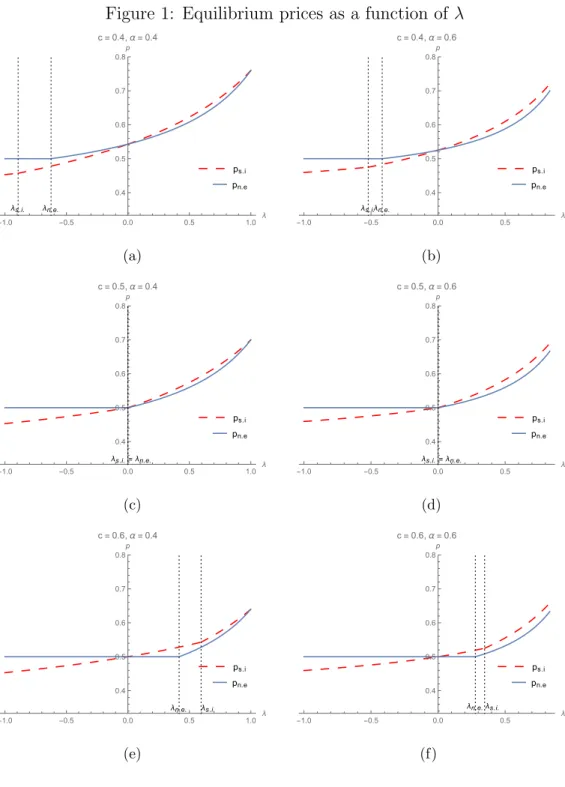
Figure 1 plots equilibrium prices p˚
s.i. and p˚n.e. as a function of λ, for different values of the search costcand the fraction of informed consumersα. The solid blue curve depicts the equilibrium price under network effects whereas the dashed red line depicts the equilibrium
price under social image concerns. The vertical dotted lines in each panel (which in panels
c and d both coincide with the y-axis) show values λn.e. ” 22cαc´1 and λs.i. ” αp21c`´α1qc. Recall that Proposition 2 applies in the region λ ă minpλn.e., λs.i.q, and Proposition 4 applies in the region λąmaxpλn.e., λs.i.q.13
12Notice that as λ
ă0 increases in magnitude, Proposition 2 will eventually apply, so that profits under
network effects will exceed those under social image concerns.
13Recall that we assume throughout thatλ
Figure 1: Equilibrium prices as a function of λ
ps.i pn.e
-1.0 -0.5 0.0 0.5 1.0 λ
0.4 0.5 0.6 0.7 0.8 p c=0.4,α=0.4
λs.i. λn.e.
(a)
ps.i pn.e
-1.0 -0.5 0.0 0.5 λ
0.4 0.5 0.6 0.7 0.8 p c=0.4,α=0.6
λs.i.λn.e.
(b)
ps.i pn.e
-1.0 -0.5 0.0 0.5 1.0 λ
0.4 0.5 0.6 0.7 0.8p
c=0.5,α=0.4
λs.i.=λn.e.
(c)
ps.i pn.e
-1.0 -0.5 0.0 0.5 λ
0.4 0.5 0.6 0.7 0.8p
c=0.5,α=0.6
λs.i.=λn.e.
(d)
ps.i pn.e
-1.0 -0.5 0.0 0.5 1.0 λ
0.4 0.5 0.6 0.7 0.8 p c=0.6,α=0.4
λs.i.
λn.e.
(e)
ps.i pn.e
-1.0 -0.5 0.0 0.5 λ
0.4 0.5 0.6 0.7 0.8 p c=0.6,α=0.6
λs.i.
λn.e.
Figure 1 reflects a number of features of the equilibrium prices as stated in Propositions
2 and 4. Namely, that the equilibrium price under social image concerns exceeds that under
network effects whenλ ą0 but not when λă0; that the difference between these two prices in monotonic in the magnitude of λ in situations where Proposition 2 applies; and that the difference between these two prices is non-monotonic in the magnitude of λ in situations where λą0,αă1{2, and Proposition 4 applies.
Figure 1 also shows features of the equilibrium prices which were not described in our
analytical results. First, it shows that prices are everywhere increasing monotonically in λ, including under social image concerns when λ ą λs.i..14 Second, in all panels, p˚s.i. ą p˚n.e. holds whenever λ ą0, and p˚s.i. ăp˚n.e. holds whenever λ ă0, even for values of λ for which neither Proposition 2 nor Proposition 4 applies, i.e. forminpλn.e, λs.i.q ă λămaxpλn.e, λs.i.q. Third, panels (b), (d), and (f) show that p˚
s.i.´p˚n.e. can be non-monotonic in λ whenαą
1 2 for relatively large values of c, not just for the small search costs mentioned in Proposition 4. Fourth, panel (a) implies that profits under social image concerns exceed profits under
network effects for all value of λă0 such that Proposition 4 applies.15
4
Discussion and Conclusion
In this paper, we explored how the belief-dependent social image concerns of consumers
can affect firm behavior. Our theoretical analysis focused on the implications of specifying
social image concerns in a natural way that involves consumers’ 2nd order beliefs, in a
tractable setting with conformists and snobs. By comparing to a situation with network
14The fact that the difference in pricesp˚
s.i.´p˚n.e. is eventually decreasing inλ, which reflects the
non-monotonicity described in Proposition 4, is simply because the price under network effects then increases
more quickly than the price under social image concerns.
15This follows from the fact that the optimal price under commitment in panel (a), conditional on serving
a strictly positive measure of non-shoppers, isp“ 1´p12´αqc “0.38, and both curves lie above this value for
all λ ąmaxpλn.e., λs.i.q. Calculations show in fact that profits under social image concerns exceed those
under network effects for allλP p´0.84,0q, and thus also for much of the region where neither Proposition
effects, we demonstrated that belief-dependent social image concerns generate novel effects
on equilibrium prices and profits, highlighting the subtle role and importance of consumers’
2nd-order beliefs. The main mechanism involved how social image concerns, combined with
consumer asymmetric information about firm strategic decisions, could push these decisions
in particular directions in equilibrium, compared to a situation where only 1st-order beliefs
mattered.
Going beyond the specific results derived in our setting, our mechanism has broader
implications for work on other kinds of social image concerns, that looks at how organizations
may try to leverage these concerns through their own strategic decisions. This includes the
literature on prosocial behavior, where agents may signal their unobservable type by taking
a prosocial action, and where a decision-maker may adjust monetary incentives so as to
strengthen their signaling motivation (see, e.g., Glazer and Konrad (1996); B´enabou and
Tirole (2006); B´enabou and Tirole (2011)). It also includes the literature on conspicuous
or image-based consumption, where agents may signal their type by buying a product with
particular characteristics, and where firms may exploit this through choices such as raising
their price, restricting advertising, or adjusting their product line (see, e.g., Bagwell and
Bernheim (1996); Yoganarasimhan (2012); Rayo (2013); Friedrichsen (2018)).
Our mechanism suggests that the extent to which organizations can exploit agents’
im-age concerns in equilibrium, through their own strategic decisions, may not be particularly
large, if these decisions are not widely observed. In such situations, organizations may have
an incentive to act in an unexpected way (say increase the monetary incentive to take a
particular prosocial action, or adjust its product line by adding or removing a variety) that
reduces signaling value, knowing this change will do little to affect the 2nd-order beliefs of
those who do observe it. This effect will limit the ability to leverage image concerns in
equilibrium, as in our setting where price distortions reduced consumers’ equilibrium social
image payoff from buying.
We focus on a simple setting with consumer search, where non-shoppers only observe
fruitful direction for future research might be to allow the firm to advertise, in a setting
where consumers only observe the price if they receive an ad. By targeting advertising to
specific segments of the market, a firm might create informational asymmetries that affect
both consumers’ beliefs and their willingness to pay. At the same time, a commitment to
advertise widely in equilibrium might help the firm commit to a more profitable price. For a
first step in this direction, see Sebald and Vikander (2018). Another possibility would be to
consider a market consisting of both conformists and snobs, where the relative size of each
group would likely influence the extent to which our mechanism would push prices up or
down.
Lastly, on a side note, our work also contributes to the literature on consumer search.16 Typically, in this literature, some consumers end up better informed than others, simply
because they find it optimal to search.17 Our approach of considering both non-shoppers, who face search costs, and shoppers, who do not, is also common (see, e.g., Stahl (1989),
Stahl (1996), Janssen and Moraga-Gonz´alez (2004), Janssen and Parakhonyak (2017)), as is
our focus on equilibrium pricing. Our paper is the first to introduce social image concerns
into a framework with consumer search, and to explore how their interaction affects market
outcomes.
16We do not attempt to review this vast literature here. For seminal contributions, see, e.g. Diamond
(1971), Burdett and Judd (1983), Stahl (1989).
17The idea that some consumers are better informed about prices than others is also a common feature of
work on informative advertising. In this literature, the reason is that some consumers receive ads whereas
1
Appendix
Proof of Proposition 1. When pe “ p, all consumers are effectively fully informed, and so all have correct beliefs of every order, equal to Q“ Qe “EpQeq. The network payoff from buying (under network effects) and the social image payoff from buying (under social image
concerns) are therefore both equal toλQ. Thus, for givenpe “p, consumers have the same incentive to buy under network effects and social concerns, and so demand Q listed in (11) coincides with that listed in (12). As a result, the partial derivatives qp and qQ in (11) and (12) must also coincide.
We will show that left-hand side of (11), evaluated atpe“p, is continuous inp. To start, recall thatθ is distributed according to continuous density functionf on supportrθ, θs, with
θ ą0, where F is the corresponding distribution function. A shopper will buy if and only if
θ`λQ´pě0, whereas a non-shopper will search and buy if and only ifθ`λQ´p´cě0. Define critical valuesθs “p´λQand θn“p´λQ`c“θs`c, where BBθsp “1 and BBθsQ “ ´λ. Suppose that căθ´θ.18 The relationship between Q,p, and θs is as follows:
Q“
$
’ ’ ’ ’ ’ ’ ’ ’ ’ ’ ’ ’ &
’ ’ ’ ’ ’ ’ ’ ’ ’ ’ ’ ’ %
1, if θs`cďθ (Case 1)
α` p1´αqr1´Fpθs`cqs, if θsďθăθs`căθ (Case 2)
αr1´Fpθsqs ` p1´αqr1´Fpθs`cqs if θ ďθsăθs`cďθ (Case 3)
αr1´Fpθsqs if θ ăθsăθ ďθs`c (Case 4)
0 if θ ďθs (Case 5)
(41)
For Case 1, all consumers buy. Given demandQfrom (41), this case applies for any price
p ď θ`λ´c, where θs “ θ´c if p “ θ `λ´c. Q is then independent of p, and partial derivativesqp and qQ are both equal to zero.
For Case 2, all shoppers and some non-shoppers buy. Given demand Q from (41), θs
18We will carry out the proof forc
ăθ´θ. If c ąθ´θ, Case 3 under (41) cannot occur, and instead
is implicitly defined by θs `λ
`
α ` p1 ´αqr1 ´Fpθs `cqs
˘
“ p. The left-hand side is continuous and increasing in θs, with derivative 1´λp1´αqfpθs`cq ą0, sinceλfpθq ă1. Thus, there is a unique θs (demand Q) associated with each price p, and it is continuous and increasing (decreasing) in p. The partial derivatives qp “ ´p1´αqfpθs `cq ă 0 and
qQ “ λp1´αqfpθs`cq are continuous in p, by the continuity of fpθq and θs, with qQ ă 1 by λfpθq ă 1. At the boundary with Case 1, p “ θ `λ´c and θs “ θ ´c, both partial derivatives equal zero, by fpθs`c“θq “0. Case 2 will apply up until the price such that
θs “θ, so for θ`λ´căpďθ`λ
`
α` p1´αqr1´Fpθ`cqs˘.
For Case 3, some shoppers and some non-shoppers buy. Given demand Q from (41), θs is implicitly defined by θs`λ
`
αr1´Fpθsqs ` p1´αqr1´Fpθs`cqs
˘
“ p. The left-hand
side is continuous and increasing in θ, with derivative 1´λ“αfpθsq ` p1´αqfpθs`cq
‰
ą0, since λfpθq ă1. Thus, there is a unique θs (demand Q) associated with each price p, and it is continuous and increasing (decreasing) in p. The partial derivatives qp “ ´αfpθsq ´ p1´
αqfpθs`cq ă0 andqQ “λαfpθsq `λp1´αqfpθs`cqare continuous in p, by the continuity of fpθq and θs, with qQ ă 1 by λfpθq ă 1. Both partial derivatives are also continuous at the boundary with Case 2, since fpθs “ θq “ 0. Case 3 will apply up until the price such that θs`c“θ, so until p“θ`λαp1´Fpθsqq.
For Case 4, some shoppers and no non-shoppers buy. Given demand Q from (41), θs is implicitly defined by θs`λαr1´Fpθsqs “p. The left-hand side is continuous and increasing in θ, with derivative 1´λαfpθsq ą 0 by λfpθq ă 1. Thus, there is a unique θs (demand Q) associated with each price p, and it is continuous and increasing (decreasing) in p. The partial derivativesqp “ ´αfpθsq ă0 andqQ “λαfpθsqare continuous inp, by the continuity of fpθq and θs, with qQ ă 1 by λfpθq ă 1. Both partial derivatives are also continuous at the boundary with Case 3, since fpθs`c “θq “ 0, and both partial derivatives equal zero at the boundary with Case 5, θs “θ, by fpθs “θq “ 0. Case 4 will apply up until the price such that θs“θ, that is up until p“θ.
For Case 5, no consumers buy. Given demand Q“0, this case applies forpěθ, so that
Taking all this together, we can conclude that demand Q evaluated pe “ p is uniquely defined for allpě0, for each case; it is everywhere continuous and decreasing inp; and that
partial derivatives qp and qQ are everywhere continuous in p, with qQ ă 1. Thus, the left-hand side of (11) is continuous inp. This left-hand side is strictly positive when evaluated at
p“0, sinceQą0 then holds, byθą0. It is also strictly positive for allpďθ`λ´c, i.e. for allp such that Case 1 applies, byQ“1 andqp “0. By assumption, there is a unique price
p˚
n.e ăθ such that (11) holds when evaluated at pe “p“p˚n.e. It follows that the left-hand side of (11) is strictly positive for all p P r0, p˚n.eq, strictly negative for all p P pp˚n.e, θq, and equals zero for a single price p˚
n.e such that either Case 2, 3, or 4 applies.
Now consider (12) evaluated at pe “ p, which is the equilibrium condition for pricing under social image concerns. For Cases 2, 3, and 4, we showed above that qp ă 0 and
qQ “ ´λqp. Moreover, a non-shopper will search if and only if θ ě θn “ θs `c, so the fraction of non-shoppers who search is γ “ 1´Frθs`cs P r0,1q for Case 2 and 3, and is
γ “ 0 for Case 4. Thus, for Cases 2, 3, and 4, the left-hand side of (12) is strictly greater
than the left-hand side of (11) if λ ą 0, and is strictly less than the left-hand side of (11) if λ ă 0. For Case 1, (12) and (11) coincide, by γ “ 1, so the left-hand side of (12) is
also strictly positive for this case, i.e. p ďθ`λ´c. Thus, the left-hand side of (12) must be strictly positive at all prices p˚
s.i P r0, p˚n.eq if λ ą 0, and strictly negative at all prices
p˚
s.i P pp˚n.e, θq if λ ă 0. Since (12) is a necessary condition for equilibrium pricing under social image concern, this gives us our result.
Proof of Proposition 2. Consider network effects, and a candidate equilibrium where all
non-shoppers choose not to search. Demand is then given by (22). Profits, π “ pQ, are therefore
π “pα
ˆ
1´p
1´αλ
˙
.
satisfies the first-order condition, dπdp “0. Thus,
α
ˆ
1´2p
1´αλ
˙
“0,
which implies
p˚
n.e.“ 1
2 (42)
Substituting p˚
n.e. into (22) gives equilibrium demand of
Q˚
n.e. “
α
4p1´αλq
We now verify that all non-shoppers will take their outside option, rather than search and
buy, given p˚
n.e. and Q˚n.e.. A non-shopper of type θ who searches and buys will earn
θ`λα
ˆ
1´p˚n.e. 1´αλ
˙
´p˚n.e.´c,
which is increasing inθ. Thus, this payoff is strictly negative for all θ P r0,1s if
p1´p˚
n.e.q `λα
ˆ
1´p˚
n.e. 1´αλ
˙
´că0,
or equivalently
1´p˚
n.e.
1´αλ ´că0,
which holds by p˚
n.e. “
1
2 and cą 1 2
` 1
1´αλ
˘
.
Consider social image concerns, and a candidate equilibrium where all non-shoppers
choose not to search. Demand is then given by (21). Profits, π “pQ, are therefore
π “pα
«
1´p`λp1´αqα`11´´λαpe˘
1´λα2
ff
.
These profits are strictly concave in p, so the equilibrium price is the value of pthat satisfies the first-order condition evaluated at pe “p, i.e. dπdp|pe“p “0. This condition is
α
«
1´2p`λp1´αqα`11´´λαpe˘
1´λα2
ff
“0.
Evaluating at pe“p and solving for pyields
p˚
s.i. “
1´α2λ
which is the unique equilibrium price.
We now verify that all non-shoppers will take their outside option, rather than search
and buy, given p˚
s.i. , and given Q˚s.i., which is equal to (23) evaluated at p “ p˚s.i.. Recall that on the equilibrium path, demand under social image concerns is equal to demand under
network effects, for any givenpe“p. Thus following the same steps as above under network effects, all non-shoppers will have an incentive to take their outside option if
1´p˚
s.i.
1´αλ ´că0
which holds by (43) and cą 2´αλ1´α2λ.
From (42) and (43), write
p˚
s.i.´p˚n.e.“
1´α2λ
2´α2λ´αλ ´ 1 2, or equivalently
p˚
s.i.´p
˚
n.e.“
λαp1´αq
2p2´α2λ´αλq, (44)
which shows that limαÑ0`|p˚s.i.´p˚n.e.| “limαÑ1´|p˚s.i.´p˚n.e.| “0. Moreover, sinceαP p0,1q,
it follows thatp˚
s.i. ąp˚n.e.ifλ ą0 andp˚s.i. ăp˚n.e. ifλă0. This also implies that|p˚s.i.´p˚n.e.| is non-monotonic in α, since |p˚
s.i.´p˚n.e.| ‰0, for any αP p0,1q. Differentiating (44) gives
B Bλpp
˚
s.i.´p˚n.e.q “
αp1´αq2p2´α2λ´αλq `λαp1´αq2pα2`αq r2p2´α2λ´αλqs2 , or equivalently
B Bλpp
˚
s.i.´p˚n.e.q “
αp1´αq p2´2α2λ´αλq2, which is strictly positive by αP p0,1q. Combined with the fact thatp˚
s.i. ąp˚n.e. ifλ ą0 and
p˚
s.i. ăp˚n.e. if λă0, it immediately follows that
B|p˚s.i.´p˚
n.e.|
B|λ| ą0.
Proof of Proposition 3. When pe “ p, demand under both network effects and social image concerns is given by (23). This implies profits of
π“ α
These profits are strictly concave in p, and attain their maximum at p “ 12. Thus, the fact that p˚
n.e.“
1
2, and that p
˚
s.i. ‰
1
2 for all λ‰0, implies π
˚
n.e.ąπs.i.˚ .
Let θ˚ denote the type of shopper who is indifferent between buying and taking her
outside option, given price pe “ p. Demand at this price is therefore αp1´θ˚q. We also know that this demand is given by (23). Thus
αp1´θ˚q “ α
ˆ
1´p
1´αλ
˙
,
or equivalently
θ˚
ppq “ p´αλ
1´αλ, (45)
where the notation makes explicit that θ˚
ppq is a function of p.
By the definition of θ˚ppq, we have the following: all consumers of type θ ă θ˚ppq take
their outside option and earn a payoff of zero. A consumer of type θ “θ˚ppq is indifferent
about buying and taking her outside option, and so also earns a payoff of zero. A consumer
of type θ ą θ˚ppq buys and earns a payoff of θ´θ˚ppq ą 0, which is the amount by which
her intrinsic payoff from buying exceeds that of type θ˚.
We know from Proposition 2 that p˚
n.e ă p˚s.i if λ ą 0, and that p˚n.e ą p˚s.i if λ ă 0. It therefore follows from (45) that θ˚pp˚
n.eq ă θ˚pp˚s.iqif λ ą0, and θ˚pp˚n.eq ąθ˚pp˚s.iq if λă0. Thus, when λą0, each consumer θ ąθ˚pp˚n.eq earns a strictly higher payoff under network effects than under social image concerns, and each consumer θ ď θ˚pp˚
n.eq earns zero under both network effects and social image concerns. When λ ă 0, each consumer θ ą θ˚pp˚s.iq earns a strictly higher payoff under social image concerns than under network effects, and
each consumer θďθ˚pp˚s.iqearns zero under both social image concerns and network effects.
Proof of Proposition 4. We divide the proof into a number of parts. In part (i), we derive
a condition which implicitly defines the equilibrium price under network effects, and then
solve explicitly for this price. In part (ii), we derive a condition which implicitly defines the
equilibrium price under social image concerns. In part (iii), we compare conditions from