Faculteit Letteren en Wijsbegeerte Departement Taalkunde
Modeling Creativity
CASE STUDIES IN PYTHON
Computermodellen van Creativiteit: Gevalstudies in de Python-programmeertaal Proefschrift voorgelegd tot het behalen van
de graad van doctor in de Kunsten aan de Universiteit Antwerpen
te verdedigen door
Tom De Smedt PROMOTOR
Prof. dr. Walter Daelemans CLiPS Computational Linguistics Group
Universiteit Antwerpen
CO-PROMOTOR
Lucas Nijs
EMRG Experimental Media Research Group St. Lucas University College of Art & Design, Antwerpen
Cover artwork: SELF-REPLICATION (Tom De Smedt & Ludivine Lechat) The fonts in the book are Computer Modern, Helvetica Neue, Arial and Courier New. The text was written in Google Docs. The layout was processed in LibreOffice. The illustrations were done in NodeBox. Computer Modern, LibreOffice and NodeBox are free and open source. Print: Silhouet, Maldegem
© 2013 Tom De Smedt
2013 Uitgeverij UPA University Press Antwerp
UPA is an imprint of ASP nv (Academic and Scientific Publishers nv) Ravensteengalerij 28
B-1000 Brussels Tel. +32 (0)2 289 26 50 Fax +32 (0)2 289 26 59 E-mail: [email protected] www.upa-editions.be ISBN 978 90 5718 260 0 NUR 984 / 616 / 656
Legal deposit D/2013/11.161/016
Modeling Creativity
CASE STUDIES IN PYTHON
Tom De Smedt“Enough!” he said, hoarse with indignation. “How dare you waste a great talent on such drivel? Either give it decent poems to write or I call the whole thing off!”
“What, those aren't decent poems?” protested Klapaucius. “Certainly not! I didn't build a machine to solve ridiculous crossword puzzles! That's hack work, not Great Art! Just give it a topic, any topic, as difficult as you like . . .”
Klapaucius thought, and thought some more. Finally he nodded and said:
“Very well. Let's have a poem, lyrical, pastoral, and expressed in the language of pure mathematics. Tensor algebra mainly, with a little topology and higher calculus, if need be. But with feeling, you understand, and in the cybernetic spirit.”
“Love and tensor algebra? Have you taken leave of your senses?” Trurl began, but stopped, for his electronic bard was already declaiming:
Come, let us hasten to a higher plane, Where dyads tread the fairy field of Venn, Their indices bedecked from one to n, Commingled in an endless Markov chain! Come, every frustum longs to be a cone, And every vector dreams of matrices. Hark to the gentle gradient of the breeze: It whispers of a more ergodic zone. [...]
Contents
Preface 7
PART 1 NATURE
1 Blind creativity 13
1.1 Evolution by natural selection 15
1.2 EVOLUTION: genetic algorithm + competition 16
1.3 Evolutionarily stable strategy (ESS) and cooperation 19
1.4 Complex systems and emergent behavior 20
1.5 Artificial life 26
1.6 Discussion 27
2 Generative art 29
2.1 Brief history 31
2.2 Overview of software for generative art 36
2.3 NodeBox 39
2.4 NodeBox case studies 41
2.5 Discussion 59
PART 2 THE MIND
3 Brain-computer interfaces 63
3.1 EEG wireless headset 63
3.2 EEG affective visualization 64
3.3 Discussion 67
4 Human creativity 69
4.1 Creativity 72
4.2 Inspiration 74
4.3 Intuition and insight 77
4.4 A concept search space 78
4.5 Imagination and metaphor 80
4.6 Creative thinking test 81
4.7 Discussion 83
5 Computational creativity 84
5.1 FLOWEREWOLF: alliterative adjectives 85
5.2 PERCEPTION: semantic network of common sense 86
PART 3 LANGUAGE
6 Computational linguistics 101
6.1 Natural language processing 104
6.2 MBSP for Python 105
6.3 Machine learning 109
6.4 Pattern for Python 117
6.5 A Mad-Tea Party (creative thinking test revisited) 128
6.6 Discussion 132
7 Sentiment Analysis 133
7.1 A subjectivity lexicon for Dutch adjectives 133
7.2 Sentiment analysis for political discourse 138
7.3 Discussion 145
Conclusions 146
Appendix 150
Bibliography 156
Preface
The topic of this work is to model creativity using computational approaches. Our aim is to construct computer models that exhibit creativity in an artistic context, that is, that are capable of generating or evaluating an artwork (visual or linguistic), an interesting new idea, a subjective opinion. The research was conducted in 2008–2012 at the Computational Linguistics Research Group (CLiPS, University of Antwerp) under the supervision of Prof. Walter Daelemans. Prior research was also conducted at the Experimental Media Research Group (EMRG, St. Lucas University College of Art & Design Antwerp) under the supervision of Lucas Nijs. Early research focuses on generative art. Related work is discussed in chapters 1, 2 and 3. More recent research focuses on computational creativity and computational linguistics. Related work is discussed in chapters 4, 5, 6 and 7.
Generative art, computational creativity and computational linguistics have a common ground in creativity. Specifically, they relate in some way to the question if and how machines can be creative and intelligent. In chapter 2, we provide a case study of a computer program that is the author of its own artworks. It will turn out that this program is not very creative because its actions are mostly random, whereas artistic creativity is the result of non-random thought processes and social consensus. After a summary of the theoretical basis of creativity in chapter 4, we direct our attention to a case study involving a program that generates creative ideas. It will turn out that the results are interesting, but also that it is difficult to evaluate whether or not they are novel and useful. In chapter 6, we discuss the PATTERN software package developed
in the course of our research, which relies on more formal methods. Chapter 7 uses the software from chapter 6 to evaluate subjective opinion in text.
Intuitively, a model for (artistic) artificial creativity appears to involve the steps illustrated in figure 1. A “good idea”, that is, a novel and appropriate solution to a given problem, is selected or combined from a pool of many possible ideas (chapters 4 and 5). A work (of art) that captures this idea is then created (chapters 2 and 3). The work is then evaluated by the author or a community of knowledgeable peers (chapters 6 and 7). Following a negative evaluation, the idea is subsequently adapted (chapter 1). We will test this conjecture in a number of case studies and ground it in the literature.
A brief overview of the different chapters:
1. Blind creativity
In this chapter we outline the mechanisms of creativity in nature, which is essentially “blind”. We discuss a computer model for evolution by natural selection, and a computer model for complexity in agent-based systems. We show how creativity does not arise ex nihilo, out of nothing, but rather as the result of a multitude of underlying, interacting processes. This is a key argument that allows us to further deconstruct the concept of creativity in following chapters.
2. Generative art
In this chapter we give an overview of the history of generative art, a rule-based form of art influenced by complexity and self-organization in nature (chapter 1). We demonstrate our Python software packages for producing generative art, NODEBOX and NODEBOX FOR OPENGL, and provide a commentary on six case studies in NODEBOX. We argue how this
kind of software offers creative leverage, since users are free to combine any kind of functionality they want in programming code. Finally, we discuss if and how art created by a machine can really be creative. This raises questions that are further addressed in chapter 4 and chapter 5.
3. Brain-computer interfaces
In this chapter we discuss VALENCE, a generative art installation created with NODEBOX FOR OPENGL. It responds to brain activity using a wireless EEG headset. The aim of such
direct brain-computer interfaces (BCI) is to augment the way in which humans communicate with machines. In our approach, we focus on alpha waves (relaxation) and the valence hypothesis (arousal). This kind of dynamic artwork would not be possible to realize using traditional software.
4. Human creativity
In this chapter we provide a brief overview of the psychological study of human creativity, from the network of neurons in the brain that generates the conscious mind – and which produces the electrical activity recorded by VALENCE – to creative ideas, intuition and
different styles of thought. In particular, we discuss a computational approach to creativity: Boden’s concept search space. It is the theoretical foundation of our PERCEPTION case
study in chapter 5.
5. Computational creativity
In this chapter we will discuss PERCEPTION, a model for computational creativity. Instead
of the visual output in chapters 2 and 3, PERCEPTION models creative thought by means of
analogy. We use our PATTERN software package (chapter 6) to implement a concept search
6. Computational linguistics
In this chapter we present MBSP FOR PYTHON, a memory-based shallow parser, and PATTERN, a Python web mining package. We briefly examine the statistical techniques that
underpin the software, the vector space model. The aim of PATTERN is to provide a wide
range of functionality that can be creatively combined to solve tasks in data mining and natural language processing. We provide short examples to demonstrate how this works, and an extensive case study in chapter 7.
7. Sentiment analysis
In this chapter we discuss a sentiment lexicon for Dutch, and a derivate for English, that can be used to predict subjective opinion in text. It is built with and part of PATTERN. We
examine the methods used, the results, and an interesting case study on political discourse in newspapers. We conclude with a discussion of how this approach can be used to evaluate art appreciation.
Our work is presented in a popular scientific tone, using a hands-on approach with case studies and examples in Python programming code. It is intended for an artistic audience, but researchers in the field of artificial intelligence may benefit as well from the comprehensive summary of the evolutionary principles in biology, the psychological study of creativity, and the statistical principles in natural language processing and machine learning. We hope that our work offers an engaging discourse on computational creativity.
Acknowledgements
The research was funded by the Industrial Research Fund (IOF) of the University of Antwerp. Artwork for CITY IN A BOTTLE was funded by the Flemish Audiovisual Fund (VAF). Artwork for NANOPHYSICAL and VALENCE was funded by Imec (Interuniversity Microelectronics Centre).
Many thanks and honors go to my advisors: Prof. dr. Walter Daelemans at the Computational Linguistics Research Group (CLiPS) and Lucas Nijs at the Experimental Media Research Group (EMRG), without whose insight, patience and impatience this work would not exist. Many thanks go to my colleagues at CLiPS and EMRG for assistance and feedback. Many thanks to the members of the review committee: Prof. dr. Steven Gillis, dr. Tony Veale, dr. Jon McCormack and dr. Guy De Pauw. Many thanks also to Imke Debecker and Jo De Wachter at Imec. A special thanks goes to my family for support; to Tom Van Iersel, Ludivine Lechat, Giorgio Olivero and dr. Thomas Crombez for support, feedback and collaboration; and worldwide to the NodeBox, GitHub and MLOSS open source communities.
Part
I
NATURE
•
The necessary nasty screeching of flirtatious fitness
quarrelsome and contentious. An entity exposition,
Restlessness
1 Blind creativity
One of the most compelling examples of creativity is no doubt life itself. These days, it is harder to spot nature and its diversity at work. Humans have been prolific in urbanizing the planet. But many of us will have pleasant childhood memories of going out to explore, to observe a bustling ant colony, to inspect the shapes and colors of flower petals, to wonder at the intricacy of a spider web. How can such purposeful intricacy exist, when nature is inherently without purpose?
Spider webs
Webs are what make spiders spiders. But the spider's ancestors didn't venture onto land to begin making webs there and then, 400 million years ago. The skill was refined bit by bit. The oldest known proto-spider (Attercopus fimbriunguis) probably lined its burrow with silk to keep water out, not to catch prey. There were no flying insects around to catch in any case. Later, single silk threads would be used around the shelter, as trip-lines for a passerby snack. Gradually, over the course of 200 million years, traps became more elaborate, from small ground webs and bush webs to the orbicular webs we know today (Craig, 1997 and Vollrath & Selden, 2007).
Building a web is an efficient hunting strategy. Instead of rummaging about (which is hard work) the spider can wait for prey to wander in. The spider releases a sticky thread and waits for the wind to blow it away, hook it onto something. It cautiously traverses the thread and reinforces it with a second line. Then it extends the line with a downward Y-shape, forming the first three radials of the web (cf. wheel spokes). It constructs an encompassing frame to attach more radials to. Then, the spider will add a spiraling line from the inside out, using its own body to measure spacing between the lines. Most spiders have three types of spinnerets to produce silk. The first spiral is constructed with non-sticky silk. It allows the spider to easily move about during construction. It will progressively replace the non-sticky parts with smaller, sticky spirals, from the outside in. Building the web requires energy of course. After an unproductive day, the spider may eat part of its web to recycle the proteins it needs to make silk, and start over (Craig, 1987).
Flower petals
Flowers primarily use pollination1 to reproduce. They depend on other organisms (pollinators) to transport pollen grains from the flower stamens to receptive flower carpels, where fertile seeds are produced. As such, the flower’s colorful petals and fragrance are not intended to gratify humans. They serve as cues to attract pollinators. Insects such as honeybees and butterflies are lured in with the promise of reward (nectar!) and in turn spread the pollen that stick to their legs when they move on to other flowers. Wind-pollinated plants on the other hand have scentless, inconspicuous flowers in shades of brown and green.
1 Over 80% of crops cultivated for human consumption in Europe (35% worldwide) depend on insect pollinators, bees
Once pollinated, some flowers change color, urging visitors to more rewarding neighbors. This “trick” benefits the flower. Fewer pollinator visits are wasted on siblings that can no longer receive or donate pollen (Delph & Lively, 1989). Some flowers will also wither their petals to decrease attraction once pollinated, since the pollinators will prefer flowers with more petals (van Doorn, 1997). But changing color is the more efficient strategy. This way, visitors can still recognize the plant from a distance and make their choice at closer range (Weiss, 1995). This scenario is not unlike checking the expiry dates in the supermarket.
Ant colonies
Observing ants at work is fun. Leave a sugar cube in the vicinity of the nest and before long there will be a chain of worker ants going back and forth, hauling bits of sugar to the nest. Ants are social insects. They rely on pheromone scent for communication. When food is located, an ant will mark the trail with secreted pheromones as it heads back to the colony. Other ants can use their antennae to assess the direction and intensity of the scent. They will go over to the food source, grab a morsel, and reinforce the trail with more pheromones on the way back. Shorter paths will be traversed faster, reinforced more often, and hence attract even more ants until an optimal route is established. Once the food source is exhausted, no new scent markers are left, so the depleted path dissipates. The ants will abandon the path and begin to look for other nearby food sources.
Social behavior is key to the ant’s success. The survival of the colony does not rely on a single individual, but on many ants cooperating. A single worker ant can specialize in the task at hand, for example moving stuff. As long as there are plenty of other workers in the chain, the ant does not need to know about the next step. It can simply go on moving stuff. Other ants in the chain will take care of the next step. If necessary, individual worker ants can switch to group behavior (e.g., a food object or an intruder is too big to handle) by means of recruitment and alarm scent signals (Hölldobler & Wilson, 1990).
SUPERORGANISM
1.1 Evolution by natural selection
Spider webs, flower petals and ant trails are just a few of the creative strategies found throughout nature. There are many more examples. How can such creative strategies exist, and why? How did spiders invent the orbicular web? Why do ants cooperate? This is explained by Darwin’s theory of evolution (1859). A scientific theory is a well-researched framework of corroborating evidence grounded in empirical phenomena, by means of observation. This differs from the popular sense of the word “theory”. The theory of evolution is a solid framework that explains how all life evolved from a universal common ancestor nearly four billion years ago. We provide a brief overview of the mechanisms, relevant to the topic of creativity. For more information, we recommend The Selfish Gene (Dawkins, 1976).
COMPETITION
The driving force behind evolution is competition: competition among plants for nutrients and light, among spiders that catch bees and bees that prefer not to be caught, among ant colonies occupying the same territory, among humans for mates and social status.
VARIATION + SELECTION
Evolution itself is the process by which organisms develop and diversify across successive generations. This happens by means of heredity. Traits are passed on from ancestors to their offspring (Fisher, 1930). Today, we know that such traits (e.g., ant foraging behavior) are controlled by genes, sequences of DNA. When two organisms of a species reproduce, each parent contributes half of the offspring’s gene pool. Mutation, errors that occur during DNA replication, may cause changes in an individual’s gene pool. Genetic recombination and mutation produces variation in the population; new, slightly different traits. Some traits will be beneficial to the organism’s survival given its surrounding environment. The fittest individuals with the best traits can reproduce more rapidly, or simply live long enough to reproduce. Gradually, favorable traits will spread throughout the population. This is called natural selection. As such, evolution is a blind process: it is a complex, non-random process, but it has no predefined goal or design.
1.2
EVOLUTION: genetic algorithm + competition
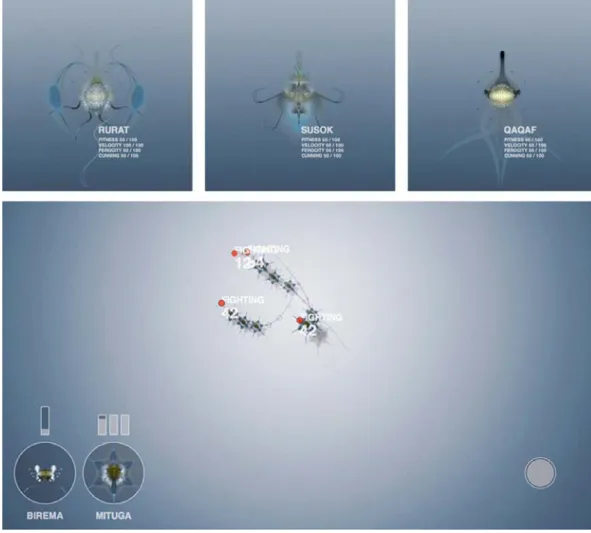
EVOLUTION (see also De Smedt, Lechat & Daelemans, 2011) is a computer model for evolution by
natural selection. The project is an extension of Ludivine Lechat’s thesis project GRAPHIC CELLULAR DOMESTICATION (GCD). Like many of Lechat’s artworks2, GCD consists of visual
elements that can be combined into different shapes (typically lifeforms) using a set of rules. This kind of rule-based art is also called generative art, discussed in chapter 2. Lechat’s work was done by hand. In EVOLUTION we expound on this by using an automated, computational approach.
The game starts out with a set of insect creatures randomly designed from a pool of components: heads, legs, wings, tails, and so on. Different components have a behavioral impact. For example, bigger eyes and antennae allow a creature to employ better hunting strategies (ambush, intercept). Larger wings allow a creature to fly faster. A longer tail allows more efficient steering.
Figure 2. EVOLUTION. Three evolved creatures and an ongoing fight between two species.
FITNESS ! CONVERGENCE
We then used a genetic algorithm to evolve better creatures. A genetic algorithm (Holland, 1992) is a search technique used in artificial intelligence (AI) computer programs, based on natural selection. A straightforward Python implementation is included in the appendix. Central to the technique is the fitness function. The fitness function calculates a score (e.g., 0.0–1.0) for each candidate in a population. Given a population of candidates, the algorithm will then select, pair and recombine the fittest candidates to create a new population. With each consecutive generation the population’s average fitness increases, slowly converging to an optimal solution. A known weakness of the technique is that the optimal solution can be either global or local. Local optima occur when the algorithm converges too fast. This happens when weaker candidates are discarded too early, since they can introduce useful variation if retained and combined with fitter candidates. A well-known solution is to use an amount of random mutation to maintain diversity and avoid local optima.
The GA’s fitness function in EVOLUTION is the game itself: an interactive hunting ground where
creatures are pitted against each other. Creatures that survive the competition are allowed to reproduce. Two creatures from the pool of survivors are randomly recombined into a new creature. For example, the “Rurat” and “Qaqaf” creatures shown in figure 2 might produce an offspring called “Quraf”, that sports the large flippers of the first parent and the elegant tentacles of the second parent.
In 2009, we expanded EVOLUTION into a procedural computer game called CITY IN A BOTTLE
(Marinus, Lechat, Vets, De Bleser & De Smedt, 2009) that features more complex scenarios, such as interaction between plants and insects. Figures 3.1 and 3.2 show development screenshots. Computer models that evolve virtual creatures are part of a field called artificial life. Other examples include Dawkins’ BIOMORPH and Sims’ EVOLVED VIRTUAL CREATURES. These focus on
generating fitter creatures as a task in itself, whereas EVOLUTION focuses on competition between
creatures. We will discuss artificial life in more detail shortly. First, we will look at evolutionary strategies such as competition and cooperation, and how a multitude of such strategies can give rise to complex systems in which creative behavior seemingly arises ex nihilo, out of nothing.
Figure 3.1. Screenshot of the procedural game world in CITY IN A BOTTLE.
1.3 Evolutionarily stable strategy (ESS) and cooperation
Evolution by natural selection is often understood as “the survival of the fittest”. In this sense it seems to imply that only strong, selfish organisms survive. The idea that selfish behavior is the natural state is a deceptive simplification that can be exploited to promote for example greed and ethnic violence (Marsella, 2005). On the contrary, it is often rewarding to play a cooperative evolutionary strategy. Each strategy has its own costs and benefits. This concept was first formalized by Maynard Smith & Price (1973) using a branch of mathematics called game theory. A strategy is a pre-programmed (genetic) behavioral policy. For example, “attack opponent” or “attack opponent if provoked”. An evolutionarily stable strategy (ESS) is a strategy adopted by most members of the population. Once an ESS is established it is very hard to replace it with another strategy. In other words, the best strategy for an individual depends on what the majority of the population is doing (Dawkins, 1976), as illustrated by the following example:
NICE ! NASTY
Imagine a population of ants where all ants are fighting each other. There is no benefit in sharing food, since none of the other ants will share. This kind of reciprocal “nasty” strategy is costly. Whenever an ant is hungry it may end up in a vicious fight over a food source. In fact, it is the worst possible strategy, since no party will yield; all ants need to eat. To clarify this we can construct a payoff matrix (table 1). Say that if an ant wins a conflict, it eats the food and scores +10. If it loses it dies and scores -100. All ants are equally nasty, so we can expect each ant to win half of the conflicts and lose half. On average, each ant scores -45. Now, suppose there is a goofy ant that doesn’t fight, but instead attempts to share. If it doesn’t work out it runs away. If it can share, it eats half of the food and scores +5. It it runs away, it gets +0 for wasting time. On average it scores +2.5, which is better than -45. Opportunity arises for ants that cooperate or flee instead of starting a fight. As more of them appear in the population their individual scores will rise to +5. Both NICE and NASTY strategies can be evolutionarily stable. In a population where all ants are cooperating, a single NASTY always gets the food (since all others run away). Its individual score is +10, so it prospers. In the end there will be a stable ratio between a part of the population with a NICE ESS and a part with a NASTY ESS.
PAYOFF MATRIX NASTY NICE
NASTY (V-C)/2, (V-C)/2 V, 0
NICE 0, V V/2, V/2
Table 1. Payoff matrix for NASTY and NICE strategies, also known as Hawk-Dove.
Let the value of a food resource V = +10 and the cost of an escalated fight C = -100.
RECIPROCAL ALTRUISM
In social science, Axelrod (1984) shows that nice strategies work better in iterated games. In an iterated game there will be many successive encounters with the other player (Axelrod calls this “the shadow of the future”). In this case, playing NASTY is undesirable since it provokes the other player to retaliate and play NASTY too on the next encounter. The Cold War (1945–1991) is an exemplar of an endless cycle of nasty retaliation. Axelrod organized a computer tournament called Prisoner’s Dilemma to which he invited game theory experts to submit programs. Each program consisted of a game strategy, for example “always play nasty” or “play nice with an occasional nasty sneak attack”. The most successful program, Anatol Rapoport's TIT FOR TAT,
was also the simplest, with four lines of programming code. TIT FOR TAT opens by playing NICE. In the next round it reciprocates the opponent’s last move. Thereafter, it will always cooperate unless provoked. When provoked it retaliates in kind, but it is forgiving. In a game with enough
TIT FOR TAT players, all-round cooperation emerges as the stable strategy.
Constructing a payoff matrix with the costs and benefits of each strategy explains how complex behavior such as cooperation can arise out of an interaction between underlying strategies. Creativity in nature is the result of evolution in a complex environment of interacting strategies.
1.4 Complex systems and emergent behavior
The Company, with godlike modesty, shuns all publicity. Its agents, of course, are secret; the orders it constantly (perhaps continually) imparts are no different from those spread wholesale by impostors. Besides–who will boast of being a mere impostor? The drunken man who blurts out an absurd command, the sleeping man who suddenly awakes and turns and chokes to death the woman sleeping at his side–are they not, perhaps, implementing one of the Company's secret decisions? That silent functioning, like God's, inspires all manner of conjectures. One scurrilously suggests that the Company ceased to exist hundreds of years ago, and that the sacred disorder of our lives is purely hereditary, traditional; another believes that the Company is eternal, and teaches that it shall endure until the last night, when the last god shall annihilate the earth. Yet another declares that the Company is omnipotent, but affects only small things: the cry of a bird, the shades of rust and dust, the half dreams that come at dawn. Another, whispered by masked heresiarchs, says that the Company has never existed, and never will. Another, no less despicable, argues that it makes no difference whether one affirms or denies the reality of the shadowy corporation, because Babylon is nothing but an infinite game of chance.
– Jorge Luis Borges, Fictions, The Lottery in Babylon (1962)
EMERGENCE
Complex systems are said to operate “at the edge of chaos” but, not unlike “the survival of the fittest”, this is rather vague and lends itself to embezzlement outside of its original context of cellular automata (Mitchell, Crutchfield & Hraber, 1994). We prefer to focus on the definition of emergence. According to Goldstein (1999), emergence is the arising of novel and coherent structures, patterns and properties during the process of self-organization in complex systems. In other words, emergent phenomena are unpredictable from the parts of the system. They manifest once the parts interact as a whole.
To illustrate this, we present an agent-based model that simulates cooperative foraging behavior. Agent-based modeling is an AI technique that describes a single autonomous agent (e.g., an ant) and its rules. Multiple agents can be put together to give insight in how they interact or how they evolve. A well-known example is BOIDS, a model for distributed flocking and swarming
(Reynolds, 1987). Distributed flocking means that there is no leader in the flock. The fluid movement of the flock emerges from the interaction between the individual agents. Each boid (slang for “bird”) observes its nearest neighbors to determine its own velocity and steering, using three rules:
SEPARATION Steer to avoid crowding neighbors. ALIGNMENT Steer towards the center of neighbors. COHESION Steer in the average direction of neighbors.
By comparison, each ant in our foraging simulation has the following rules (figure 4):
ROAM Roam freely. Return home if nothing happens.
TRACK Follow nearby trails to the food source, until the trail evaporates. HARVEST Collect nearby food. Mark the food source with pheromones. HOARD Return home with food. Mark the trail with pheromones.
Figure 4. Distributed ant foraging behavior rules.
There are two different ways to consider the system. From a holistic stance, we can consider the whole. The whole exhibits emergent behavior (cooperation). It is more than the sum of its parts. From a reductionist stance, we can consider the individual parts. The four rules that define each part or agent are easily understood. It is not hard to predict what is going to happen, even without actually visualizing the simulation. The parts sum up to the whole. Note the random() in the program below, which yields a random number between 0.0 and 1.0. It controls the ant's aimless ROAM behavior. It is used as an approximation of a subsystem, since "aimless roaming" is really the result of a complex of factors such as the terrain, the weather, scent, whether or not an ant’s left-sided legs are slightly longer than its right-sided legs and so on. Because we do not know all the factors involved we take them as a given random(). In chapter 2, we will also rely on randomness to generate visual artworks, but we will abandon it in chapter 5, where our aim is to generate creative ideas in a deterministic, non-random way (i.e., from the parts).
Food sources are defined by a location in 2D space and an amount of available food. Larger food sources have a larger radius.
class Food:
def __init__(self, x, y, amount=10): self.x = x
self.y = y
self.amount = amount
Pheromones are defined by a location in 2D space and a strength. Stronger pheromones have a larger radius. As time progresses, the strength of the scent evaporates.
class Pheromone:
def __init__(self, x, y, strength=1.0): self.x = x
self.y = y
self.strength = strength
def evaporate(self, m=0.99):
self.strength *= self.strength > 0.01 and m or 0
Ants are defined by a location in 2D space, a direction (v) and a trail of Pheromone objects. An ant may or may not be carrying a unit of food.
class Ant:
def __init__(self, colony, x, y): self.colony = colony
self.x = x self.y = y self.v = [0, 0] self.food = False self.trail = []
self.roaming = random() * 100
We define a few helper functions: steer() directs an ant towards a pheromone, a food source, an ant or a colony; pheromones() yields all pheromones for a given colony.
def distance(v1, v2):
return ((v1.x - v2.x) ** 2 + (v1.y - v2.y) ** 2) ** 0.5
def steer(ant, target):
d = distance(ant, target) + 0.0001 ant.v[0] = (target.x - ant.x) / d ant.v[1] = (target.y - ant.y) / d ant.roaming = 0
def pheromones(colony): for ant in colony.ants:
for pheromone in ant.trail: yield pheromone
We can then define the rules: roam() randomly swerves the direction of an ant (or steers it to the colony if it is roaming too long), track() steers an ant to nearby pheromones, harvest() makes an ant pick up nearby food and start a trail of pheromones, hoard() steers an ant to the colony if it is carrying food, randomly leaving pheromones along the way.
from random import random
def roam(ant, m=0.3):
ant.v[0] += m * (random() * 2 - 1) ant.v[1] += m * (random() * 2 - 1) ant.roaming += 1
if ant.roaming > ant.colony.radius: steer(ant, ant.colony)
if distance(ant, ant.colony) < 10: ant.roaming = 0
def track(ant):
for pheromone in pheromones(ant.colony):
if distance(ant, pheromone) < pheromone.strength * 30: if random() < pheromone.strength:
steer(ant, pheromone) return
def harvest(ant):
for food in ant.colony.foodsources:
if distance(ant, food) < max(1, food.amount / 2): food.amount -= 1
if food.amount <= 0:
ant.colony.foodsources.remove(food) ant.trail = []
ant.trail.append(Pheromone(food.x, food.y)) ant.trail.append(Pheromone(ant.x, ant.y)) ant.food = True
def hoard(ant, m=0.5): steer(ant, ant.colony) if random() < m:
ant.trail.append(Pheromone(ant.x, ant.y)) if distance(ant, ant.colony) < 5:
The forage() function simply bundles the rules and applies them:
def forage(ant, speed=1): if ant.food is False:
roam(ant); track(ant); harvest(ant) else:
hoard(ant)
ant.v[0] = max(-speed, min(ant.v[0], speed))
ant.v[1] = max(-speed, min(ant.v[1], speed)) ant.x += ant.v[0]
ant.y += ant.v[1]
A colony is defined as a collection of ants and available food sources in the vicinity of the colony’s location in 2D space. When Colony.update() is called, pheromone strength evaporates while all
ants continue foraging.
class Colony:
def __init__(self, x, y, radius=200, size=30): self.x = x
self.y = y
self.radius = radius self.foodsources = [] self.food = 0
self.ants = [Ant(self, x, y) for i in range(size)]
def update(self, speed=1): for ant in self.ants:
for pheromone in ant.trail: pheromone.evaporate() if pheromone.strength == 0: ant.trail.remove(pheromone) forage(ant, speed)
The system can be visualized in NODEBOX FOR OPENGL (see chapter 2, installation instructions in
the appendix). The code below opens a 400 × 400 window displaying a colony of 30 ants and 10 random food sources. Each animation frame, a dot is drawn at the new position of each ant.
from nodebox.graphics import *
colony = Colony(200, 200, size=30)
colony.foodsources = [Food(random() * 400, random() * 400) for i in range(10)]
def draw(canvas): canvas.clear()
for food in colony.foodsources: r = food.amount
ellipse(food.x-r, food.y-r, r*2, r*2) for ant in colony.ants:
ellipse(ant.x-1, ant.y-1, 2, 2) colony.update()
A JavaScript implementation of the algorithm is provided as an example in PATTERN’s online
canvas.js editor3 (discussed in chapter 6).
Figure 5. ANTAGONISM. Multiple colonies compete for food. Colonies 1, 2, 3 are marked in transparent grey. Ants carrying food are marked in green. Rivaling ants are marked in pink. Smaller dots are “injured” ants.
We can then define a 2D space with multiple ant colonies, where each colony's food hoard is also a food source for other colonies. A screenshot of the setup, called ANTAGONISM, is shown in figure
5. As food grows scarce, behavior than can be described as “plundering” and “warfare” arises. For example, colony 1 is located in a rich pocket of the virtual world, but while its ants are out collecting food it is consistently plundered by colony 2, which benefits from its central location. Colony 3 is located right on top of a food source, but it has few resources otherwise. Hence, it is involved in reciprocal parasitism with the nearby colony 2. The behavior seems to arise ex nihilo if the system is observed as a whole. But as we have seen, it is really the result of (complex) underlying strategies, in this case triggered by the setup of the artificial ecosystem (McCormack, 2007). This principle is fundamental to our stance on creativity in general. Creativity does not magically come out of nowhere. In nature, it is the result of evolution and competition and it is inherently blind. In humans, it is a conscious effort with the aim to solve a particular problem, rooted in the (complex) unconscious processes of the mind.
1.5 Artificial life
The origin of artificial life systems such as EVOLUTION and ANTAGONISM can be traced back to
von Neumann’s hypothetical self-replicating machine in the 1940’s, some years before Watson and Crick’s discovery of DNA in 1953. In the 1960’s, the first minicomputers appeared. Despite being called “mini” they were as big as a house. Because they remained unused at night (which was a waste of precious CPU cycles) scientists would use them for their own nightly entertainment. One of these pastimes was to implement Conway’s GAME OF LIFE, a simplified version of the von
Neumann replicator. GAME OF LIFE (Gardner, 1970) is a cellular automaton where each cell in an
infinite grid is either DEAD or ALIVE. A set of rules defines how neighboring cells replicate or die out. For example: “each empty cell adjacent to exactly three neighbors becomes ALIVE”. Different configurations of starting cells give rise to repeating patterns such as “guns” or “gliders” fired by guns. Combinations of patterns can be used for example to simulate a computer (i.e., it is Turing complete, Rennard, 2002) or a self-replicating machine (see Wade, 2010).
Another example of artificial life is Karl Sims’ EVOLVED VIRTUAL CREATURES (Sims, 1994). In a
virtual 3D world, creatures are evolved using a genetic algorithm. Each creature is composed of simple, connected blocks and selected for a specific task or behavior: swimming, hopping, following or competing with other creatures for the possession of a block. Another classic example is the VEHICLES thought experiment by Braitenberg (1984). In a Braitenberg vehicle, each of the
wheels is connected to a light or heat sensor. Different connections make the vehicle behave differently and seemingly exhibit an emotional response (e.g., afraid of light). With the availability of inexpensive robotics kits such as Arduino4 (2005) and Lego Mindstorms NXT5 (2006), building Braitenberg vehicles has since become quite popular.
Figure 6. BLOTTER. Vehicles exhibited at the Museum of Modern Art, Antwerp, Belgium, 2005. Photography © BLOTTER, Frederik De Bleser. Used with permission.
In 2005 we exhibited three vehicles at the Museum of Modern Art in Antwerp, Belgium. The project, called BLOTTER or “robot-plotter” (Menschaert, De Bleser & De Smedt, 2005), consisted
of three vehicles that respond to sound by steering away from silent areas. This occasionally means running around in a circle chasing the noise produced by the vehicle’s own wheel motors. Each of the vehicles had a waterproof marker attached to it, leaving an emergent pattern on the floor (figure 6). Our most intent audience was the museum’s cleaning crew who thought it was the all-time most irritating art.
Interestingly, when a vehicle approached the feet of bystanders, some of them would stop to reprimand the robot or kneel down to pet it, not unlike they would a cat or a dog. Humans seem quick to attribute volition to machines or other organisms. Imagine you come home from work and the cat is waiting at the door to give you a warm greeting. But “warm greeting” is not in the cat’s repertoire. It is exhibiting a trained behavior to promote feeding. You can reprimand the cat, in which case it will try again in a few minutes, or you can pet it and feed it, in which case you reinforce the behavior. When we say “the robot wants to inspect the noise” or “the cat wants to be fed” we are using “want” in a metaphorical sense. The robot does not have a feedback-processing loop to know what it wants. Whether the cat does is speculative, but we will attempt to answer it in chapter 4.
1.6 Discussion
In this chapter we have discussed how creative behavior can emerge as a result of evolution by natural selection. For example, in our EVOLUTION case study, virtual creatures adapt their
behavior and gradually become more competitive, as weaker creatures are removed from both the tournament and the gene pool. This kind of creativity is essentially blind: there is no “want” in the repertoire. Proponents such as Dennett (2004) and Simonton (1999) argue that Darwinian creativity also applies to human creativity. The idea dates back to Campbell’s BVSR model of “blind variation and selective retention” (Campbell, 1960). According to Simonton, since the incubation period between an individual’s first attempt to solve a problem and the final solution is marked by all sorts of random input (everyday events, memories, associative thought), it can be considered a blind variation-selection process of the mind. Sternberg (1999) has criticized the universality of Darwinian creativity (i.e., in humans) as “pushing a good idea too far”. He argues that Darwinian creativity is not-forward looking and not intentional, whereas creative humans are definitely intentional in their ways of selecting problems and solutions to solve them. This is discussed further in chapter 4.
We have discussed how creative behavior can emerge from complex systems that consist of a multitude of interacting strategies or rules. For example, in our ANTAGONISM case study, creative
When multiple groups of agents (ant colonies) interact, even more complex behavior that can be described as plundering and warfare arises. A real-life example is the Cold War: an endless cycle of NASTY retaliation that sparked the “Space Race”, thereby pioneering spaceflight, satellite technology and the internet. This shows how competition can be a creative catalyst.
EVOLUTION and ANTAGONISM were created in NODEBOX, a software application for generative art.
Generative art is a form of art influenced by complexity and artificial life. This is discussed in more detail in chapter 2.
2 Generative art
What is generative art?
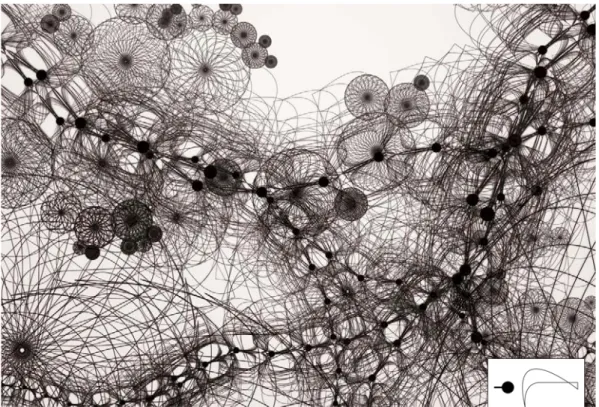
Generative art is a form of art inspired by nature and complexity (emergence in particular), and making use of techniques borrowed from AI and artificial life such as evolutionary algorithms and agent-based modeling. We have discussed evolution, complexity and artificial life in chapter 1. In a generative artwork, individual features such as lines, shapes or colors interact autonomously using a system of rules, typically a computer program. An example called SELF-REPLICATION (De
Smedt & Lechat, 2010) is shown in figure 7. It is also the cover image. The overlay figure shows the individual shapes; the building blocks that make up the composition. These are replicated over and over using a set of rules described in programming code. For example: “shape X rotates to create a circle”, “shape Y advances to create a chain”, “chains curl near circles” and “circles spawn adjacent circles”. The last rule is an application of the Apollonius problem in geometry (see Coxeter, 1968).
Rule-based systems in generative art often involve an amount of randomness to promote unexpected variation. For example, in SELF-REPLICATION not all chains will curl near a circle.
Some will ignore the rule and do nothing. Others might branch into new chains instead of curling. This way, each time the program is executed it produces a new artwork with different chains and circles. This unexpectedness, either as a result of randomness or of complexity, is referred to as self-organization or emergence (McCormack & Dorin, 2001).
PROCEDURAL
Generative art is related to the broader field of computer art. However, not all computer art is generative art (Boden, 2009). For example, in video games, web design or in Photoshop compositions the computer is used as a tool rather than as a generator. But there is at least one technique used in video games that qualifies as generative art: procedural modeling (Ebert, Musgrave, Peachey, Perlin & Worley, 2003). Procedural modeling involves rendering natural material such as marble, stone and wood with a mathematical algorithm instead of using photographs.
Generative art generally lacks a commercial or political motive. Many generative artists explore rule-based systems out of curiosity and for aesthetic or scientific pleasure, rather than as a means to express an opinion. In recent years, generative approaches are also being applied to more practical applications in the form of data visualization (Fry, 2008). For example, one approach to visualize a network of links between various web pages is to use the following rules: “web pages are represented as knots, links as lines” and “all knots repulse each other” but “lines act as springs that attract two knots”. This is a specific kind of particle system (see further). Such kind of data-driven generative art is often characterized by a volatile, dynamic nature: the work in its current form may only exist at this particular time. The form changes as new data becomes available or as multiple authors contribute new rules (e.g., crowdsourcing).
Generative art represents a method to create art (i.e., rule-based) rather than a consistent artistic style (Galanter, 2003). Style and medium can vary greatly. Some generative artists use computer graphics while others build music composition systems, swarm robots, installations with growing plants, and so on. This diversity does not mean that generative art has a lack of interest in form as such. On the contrary, Galanter (2012) remarks:
Generative art, and especially generative art that harnesses what we are learning from complexity science, is a unique opportunity to rehabilitate formalism in art. It presents form as anything but arbitrary. It presents beauty as the result of an understandable universe neutral to human social construction in a fair and unbiased way.
2.1 Brief history
The term “generative art” has gained popularity over the last decade, with principal instigators such as the Processing6 open source community and Marius Watz’ Generator.x7 forum. To date, the most widely quoted definition of generative art is again offered by Galanter (2003):
Generative art refers to any art practice where the artist uses a system, such as a set of natural language rules, a computer program, a machine, or other procedural invention, which is set into motion with some degree of autonomy contributing to or resulting in a completed work of art.
In later work Galanter has further emphasized the aspect of autonomy. To qualify as generative art, he notes, a rule-based system must be well-defined and self-contained enough to operate autonomously (Galanter, 2008). This excludes a handmade drawing. But it includes ancient tiling patterns, where individual tiles are placed according to a symmetry-based algorithm, and for example Sol LeWitt’s combinatorial sculptures and wall drawings. In fact, LeWitt’s conceptual approach to art, where “the idea becomes a machine that makes the art” (LeWitt, 1967), was already well-established in the field of computer art some years before (Nake, 2010). Another example at the foundation of generative art is the graphic work of Escher (1960), exploring concepts such as self-reference (Prententoonstelling, 1956), recursion (Circle Limit III, 1959) and infinity (Waterfall, 1961). Since Escher’s work is mostly hand drawn it is not generative in the true sense, but his notebooks contain resourceful rule systems which he used for tessellation or tiling. For example, the fish in Circle Limit III are based on the Poincaré disk model for hyperbolic geometry, introduced to Escher by Coxeter (1979).
Figure 8. “Circle Limit” III and “Circle Limit III original sketch”. All M.C. Escher works © 2012 The M.C. Escher Company (NL).
All rights reserved. Used by permission. www.mcescher.com
Watz (2005) agrees with Galanter that generative art can be found throughout history, but he attributes the term specifically to computer-based work created since the 1960’s. This includes the Artificial Life systems discussed in chapter 1, for example Conway’s GAME OF LIFE and BOIDS.
Other milestones include the work on fractal geometry by Mandelbrot (1982), L-systems (Prusinkiewicz & Lindenmayer, 1990) and particle systems (Reeves, 1983).
FRACTALS
A fractal is a mathematical description of a self-similar (i.e., recursive) shape, consisting of smaller versions of itself. Examples include snowflakes, fern leaves and coastlines. In the 1970’s Mandelbrot convincingly used computer graphics to illustrate and popularize the development of fractals. Today, fractals play an important role in procedural modeling of surface and terrain (Perlin, 1985). A variation of the fractal, the attractor, is also popular in generative art.
L-SYSTEMS
An L-system is a recursive rewriting system that can be used to model growth in plants. For example, algae growth can be described as (A !AB), (B ! A) where A is rewritten to AB, then ABA, ABAAB, ABAABABA, and so on. Note that the length of the consecutive strings also satisfies the Fibonacci sequence (1, 2, 3, 5, 8, ...). L-systems were developed by Lindenmayer concurrent with Mandelbrot’s computer-generated fractals. Today, they are widely used in computer games to render procedural plants8, trees, or even entire cities (Parish & Müller, 2001).
PARTICLE SYSTEMS
A particle system is a technique where a multitude of particles interact using attractive and repulsive forces and collision. Particle systems are used in video games and film to model fuzzy phenomena such as fire, fluids, smoke, fog, dust and explosions. The term was coined in the 1980’s by Bill Reeves while working at Lucasfilm on the special effects for the movie Star Trek II: The Wrath of Khan.
The 1970’s and the 1980’s started the home computer revolution. Video game consoles such as the Atari (1977) and the Commodore 64 (1982) appeared, along with personal computers such as the IBM PC (1981) and Apple’s Macintosh (1984). In 1971, Lucasfilm was founded. For a time (1979–1986) it incorporated Pixar, well known for its computer animation films such as Toy Story and WALL-E. From the point of view of generative art, Pixar is important for its contribution to the RenderMan 3D graphics software (1989), which advanced the use of procedural techniques. RenderMan programs are written in the C programming language, developed by Dennis Ritchie at Bell Labs in 1972. Even though nowadays C is considered a “low-level” language it remains in wide use (Linux, Windows and Mac OS are based on C) and it has a close relationship with computer graphics because it is fast. Later, C++ (1983), Python (1991) and Java (1995) were developed to augment C with additional flexibility, for example object-oriented programming, garbage collection and simpler syntax, typically at the cost of reduced speed. Such “friendly” programming languages have helped to attract a more artistic-minded audience. In 1982, John Warnock founded Adobe Systems and created PostScript, a programming language for 2D page layout. Later on, Adobe produced computer graphics applications such as Photoshop and Illustrator, which continue to be popular with artists and designers.
By the 1990’s the internet and consequently the World Wide Web were in full swing, with substantial impact on the way humans would process information. Evident examples include Google’s search engine, Twitter’s microblogging service, Facebook’s social network, YouTube videos, Amazon.com and the iTunes Store. The control exerted by major corporations over available information (internet corporatization) has been subject to criticism (Rethemeyer, 2007, and Zimmer, 2008). By contrast, open source communities such as the Wikipedia online dictionary generally lack control structure or commercial interest. They play a significant role in the context of generative art.
OPEN SOURCE
Open source communities encourage collaborative development of free software. This means that anyone is allowed to edit the software. Bits and pieces are done by various people. To prevent abuse, software is typically released under a GNU General Public License (GPL). This strategy forces any derivatives of the software to become open source GPL as well. In other words, it is a viral license (Lerner & Tirole, 2002). In terms of artistic software, users are then encouraged to share artworks created with the software and to contribute bug reports. The developers benefit with a virtual showcase of art created using their tools. The artists benefit with free software. This process intensifies as the software grows: developers may move on to become artists, artists may become contributing developers. This reward in the form of increased personal proficiency is also called human capital (Hars & Ou, 2002).
A good example is the Processing community website, which combines the documentation of its open source software with a discussion forum and an online gallery. This collaborative approach has led to the renown of several generative artists, including Ben Fry, Casey Reas, Daniel Shiffman, Ira Greenberg, Jared Tarbell, Jer Thorp, Josh Nimoy, Karsten Schmidt, Marius Watz and Tom Carden.
Other well-known generative artists, not necessarily from the Processing community, include: Aaron Koblin (BICYCLE BUILT FOR TWO THOUSAND), Adrian Bowyer (REPRAP self-replicating 3D
printer), ART+COM (KINETIC SCULPTURE), Bogdan Soban, Brendan Dawes, Celestino Soddu,
David Rokeby, Frieder Nake, Golan Levin, Iannis Xenakis (generative avant-garde music), Jonah Brucker-Cohen, Jon McCormack (MORPHOGENESIS), Joshua Davis (pioneer of generative art in
Flash), Ken Rinaldo, LAb[au], Mark Napier, Paul Bourke (geometry & fractals), Philip Worthington (SHADOW MONSTERS), Robert Hodgin (FLOCKING), Sergi Jordà (REACTABLE music
Figure 9.1 shows TISSUE by Reas (2002), which
models a synthetic neural system. Participants can then interact with the installation:
Figure 9.2 shows GENOME VALENCE by Fry
(2002), a data visualization for DNA sequences retrieved from the BLAST search algorithm:
Figure 9.1. TISSUE (2002).
© Casey Reas. Used with permission. Figure 9.2. © Ben Fry. Used with permission. GENOME VALENCE (2002).
Figure 9.3 shows SUPER HAPPY PARTICLES by
Shiffman (2004), a live video installation where each pixel is a particle in a particle system:
Figure 9.4 shows METROPOP DENIM by Carden
(2005), which combines attractors and particles with fashion photography:
Figure 9.3. SUPER HAPPY PARTICLES (2004).
Figure 9.5 displays an effect by Nimoy (2010) for the movie Tron Legacy, based on techniques such as particle systems and Perlin noise:
Figure 9.6 displays 138 YEARS OF POPULAR SCIENCE by Thorp (2011), a data visualization
of the Popular Science magazine archive:
Figure 9.5. Tron Legacy special effect (2010). © Josh Nimoy et al. Used with permission. Disney Enterprises, Inc. All rights reserved.
Figure 9.6. 138 YEARS OF POPULAR SCIENCE (2011). © Jer Thorp & Mark Hansen. Used with permission.
Figure 9.7 is MORPHOGENESIS by McCormack
(2011), an example of evolutionary art based on a genetic algorithm:
2.2 Overview of software for generative art
Table 2 provides a 1990–2010 overview of programming languages and software applications that have been used to produce generative art. There may be others not to our knowledge. Over 70% of the projects listed is open source. Based on the steady introduction of new toolkits and derivatives we can say that rethinking artistic software, or at least adopting new toys, is a factor that contributes to the definition of generative art.
Of note is the work by Maeda (2001). While at MIT he created Design By Numbers (DBN), a
software application that generates visual output based on simple programming commands such as pen and line. Students of Maeda later expanded his work into Processing (Reas & Fry, 2007), arguably the most well-known software application for generative art. In 2005 Reas and Fry received the prestigious Golden Nica award for their work. Processing is based on the Java 2D graphics library and influenced by technologies such as PostScript and OpenGL. This work has in turn led to the development of Wiring, a Processing spin-off for electronics, and Arduino, a microcontroller chip designed “to make things talk” in interdisciplinary projects (Igoe, 2007). It is interesting to note how derivatives of DBN are reminiscent of Maeda’s initial goal – achieving
simplicity in the digital age (Maeda, 2006). Processing describes itself as a “sketchbook” for programming, using combinations of simple commands such as line() and rotate(). Wiring is “thoughtfully created with designers and artists in mind”9 (i.e., a non-technical audience) and openFrameworks is intended for “folks using computers for creative, artistic expression”10. DrawBot and its derivative NodeBox adopt the Python programming language, which arguably has simpler syntax than Java (no curly braces or semicolons).
The authors of DrawBot, Just van Rossum and Erik van Blokland, define the simplicity of a computational approach to art and design in terms of volume, complexity and variation:
VOLUME In large-volume assignments (e.g., a 1,000-page book), targeting the task as a whole is easier; we adopt a systematic approach instead of handling each feature (page) individually. COMPLEXITY It is easier to adapt a layout system that controls color and composition across pages
than to adjust each page by hand (e.g., “Can you make all titles bigger?”).
VARIATION A layout system can be adapted up to the final moment, which leads to a form of digital sketching where many alternatives can be tried out in a non-destructive way.
The authors of NodeBox offer an additional metaphor. Traditionally, user interfaces in computer graphics applications have been based on real-world analogies, e.g., a pen for drawing, a stamp for copying and scissors for slicing. This model has creative limitations. First, the features can only be used as the software developers implemented them, creative recombination of tools is impossible when not foreseen.
9 http://wiring.org.co/
Second, there is not much room for abstraction: users will tend to think along the lines of what is possible with the built-in features (buttons, sliders, menus) and not about what they want (Cleveland, 2004). These limitations are mitigated when users can freely combine any kind of functionality in the form of programming code. For beginners, it is often helpful to explain this paradigm in terms of a cooking recipe:
RECIPE We can think of programming code as a recipe, a set of instructions that describes how to prepare or make something.
INGREDIENTS Any kind of functionality can freely be combined in programming code. Compared to a prepackaged dinner (i.e, buttons and sliders) you have to do a bit of work but you can do it any way you want, mixing any ingredients you like.
COOKBOOK Programming code is written down. It captures the creation process, as opposed to mouse gestures, and as such can be reused, adapted, shared and studied.
# YEAR TOOLKIT LANGUAGE OPEN DESCRIPTION
1 1988 DIRECTOR Lingo NO Application for 2D multimedia CD-ROM’s.
2 1989 RENDERMAN C NO Application for 3D distributed rendering.
3 1992 OPENGL - YES API for 3D computer graphics (cross-platform).
4 1995 DIRECTX - NO API for 3D computer graphics (Windows, XBox)
5 1996 FLASH JavaScript NO Application for 2D animation in web pages.
6 1996 SUPERCOLLIDER sclang YES Programming language for audio synthesis.
7 1996 PURE DATA dataflow YES Visual programming for computer music.
8 1998 VVVV dataflow NO Visual programming for computer graphics.
9 1998 JAVA 2D Java NO 2D graphics library for Java.
10 1999 OPENSCENEGRAPH C++ YES 3D graphics library for C++ and OpenGL.
11 1999 DBN DBN YES 2D graphics application for teaching and sketching.
12 2000 PIL Python YES 2D graphics library for Python.
13 2001 PROCESSING Java YES 3D graphics application for teaching and sketching.
14 2001 SCRIPTOGRAPHER JavaScript YES JavaScript plugin for Adobe Illustrator.
15 2002 QUARTZ Cocoa NO 2D graphics library for Mac OS X.
16 2002 AGG C++ YES 2D rendering engine with anti-aliasing.
# YEAR TOOLKIT LANGUAGE OPEN DESCRIPTION
18 2003 NODEBOX Python YES 2D graphics application for teaching and sketching.
19 2003 WIRING Java YES Application for electronics prototyping.
20 2004 QUARTZ COMPOSER dataflow NO Visual programming language for Mac OS X.
21 2004 CONTEXT FREE CFDG YES 2D graphics application based on formal grammar.
22 2005 ARDUINO Java YES Microcontroller chip programmed in Wiring.
23 2006 OPENFRAMEWORKS C++ YES 3D graphics library for C++.
24 2006 <CANVAS> JavaScript NO Scriptable graphics in a HTML <canvas> element.
25 2007 SHOEBOT Python YES 2D graphics application for teaching and sketching.
26 2007 SILVERLIGHT .NET NO Application for 2D web animation (cfr. Flash).
27 2007 PYGLET Python YES 3D graphics library for Python.
28 2008 SHOES Ruby YES 2D graphics application for teaching and sketching.
29 2008 RUBY-PROCESSING Ruby YES Ruby-based Processing.
30 2008 FIELD hybrid YES Application for digital art.
31 2008 RAPHAEL.JS JavaScript YES 2D graphics library for JavaScript (SVG).
32 2008 PROCESSING.JS JavaScript YES Web-based Processing using <canvas>.
33 2009 WEBGL JavaScript NO Web-based OpenGL using <canvas>.
34 2009 NODEBOX 2 dataflow YES NodeBox using a visual node-based interface.
35 2010 THREE.JS JavaScript YES 3D graphics library for JavaScript.
36 2011 PAPER.JS JavaScript YES Web-based Scriptographer using <canvas>.
37 2011 NOGL Python YES NodeBox for OpenGL using Pyglet.
38 2012 D3.JS JavaScript YES Data visualization library for JavaScript (SVG).
39 2012 CANVAS.JS JavaScript YES Web-based NodeBox using <canvas>.
Table 2. Overview of programming languages and software applications for generative art.
2.3 NodeBox
Figure 10. Screenshot of the NodeBox application.
NODEBOX (De Bleser, De Smedt & Nijs, 2003) is a free computer graphics application for Mac OS
X that generates static, animated or interactive 2D visuals based on Python programming code. The visuals can be exported as PDF (vectors), PNG (pixels) or MOV (movie). The application implements a state machine with a scene graph built on Mac OS X’s Quartz rendering engine. A state machine means that it has a current transformation state and a current color state, which are applied to all successive objects drawn to the canvas. A scene graph means that the objects are stored in a data structure so that they can be manipulated before or after they are drawn, as opposed to a direct drawing approach. Figure 10 shows a screenshot of the application.
Using Python code, users are free to combine any kind of functionality to produce visual output. Below is a simple example. It draws a random number of 10–100 squares on a 500 × 500 canvas, in random shades of transparent red, with random size, position and rotation.
size(500, 500)
for i in range(10, 100): x = random(WIDTH) y = random(HEIGHT) w = 50 + random(200) rotate(random(360))
NODEBOX has commands for shapes (e.g., rect), Bézier paths, images, text, transformation (e.g., rotate) and color (e.g., fill). The website11 offers a reference of the command set, tutorials for beginners and advanced users, a collection of plug-in modules, a gallery and a discussion forum.
MODULAR
Over the course of two research projects (DESIGN AUTOMATION, GRAVITAL), we have expanded the
application with a range of intermixable plug-in modules, for example for image compositing, color theory, layout systems, databases, web mining and natural language processing. A number of modules are inspired by nature and designed to produce generative art. For example, the supershape module implements the superformula (Gielis, 2003) and can be used to render many complex shapes found in nature. The lsystem module implements Lindenmayer’s L-systems. The noise module implements Perlin’s pseudo-random generator. Two modules provide examples of agent-based systems. The ants module can be used to model self-organizing ant colonies. The boids module implements Reynold’s distributed model for flocking and swarming. The graph module combines graph theory with a force-based physics algorithm for network visualization. Recent effort has produced two spin-off versions. NODEBOX 2 (De Bleser & Gabriëls, 2009) is a
cross-platform implementation that focuses on node-based interfaces to alleviate the learning curve of programming code. NODEBOX FOR OPENGL (De Smedt, 2011) is a cross-platform
implementation for simple games such as EVOLUTION and VALENCE, discussed in chapter 3.
NodeBox 2 + 3
NODEBOX 2 (and more recently NODEBOX 3) is based on the Java 2D graphics library and uses a
node-based user interface (Lee & Parks, 1995) where each operation is represented as a block or node that “does something”. Each node functions as a generator that creates elements (e.g., rectangle node) or as a filter that modifies incoming elements (e.g., rotate node). A node has no fixed purpose. Or rather, it has many purposes that depend on the other nodes attached to it. In the user interface, nodes can be connected to form a graph. Creativity is encouraged by allowing users to combine and adapt nodes in various ways. The application includes the Bézier interpolation algorithms (De Smedt, F., personal communication, 2007) from the original version.
NodeBox for OpenGL
NODEBOX FOR OPENGL (NOGL) is based on Pyglet (Holkner, 2008) and uses an updated version of
the command set. For example, its random() function has an extra bias parameter that defines preference towards higher or lower numbers. Functionality from the plug-in modules has been bundled into the core of NOGL. This includes motion tweening, animation layers,
hardware-accelerated pixel effects (using dynamic GLSL shaders), procedural images, geometry, Bézier path interpolation, tessellation, particle systems, graphs, flocking, supershapes, noise, GUI controls and audio. NOGL uses a direct drawing approach for performance.
2.4 NodeBox case studies
Following is a more detailed study of six generative artworks produced in NODEBOX, addressing
topics such as the drawing syntax, recursion, and authorship in generative art.
Nebula: random strands of curves
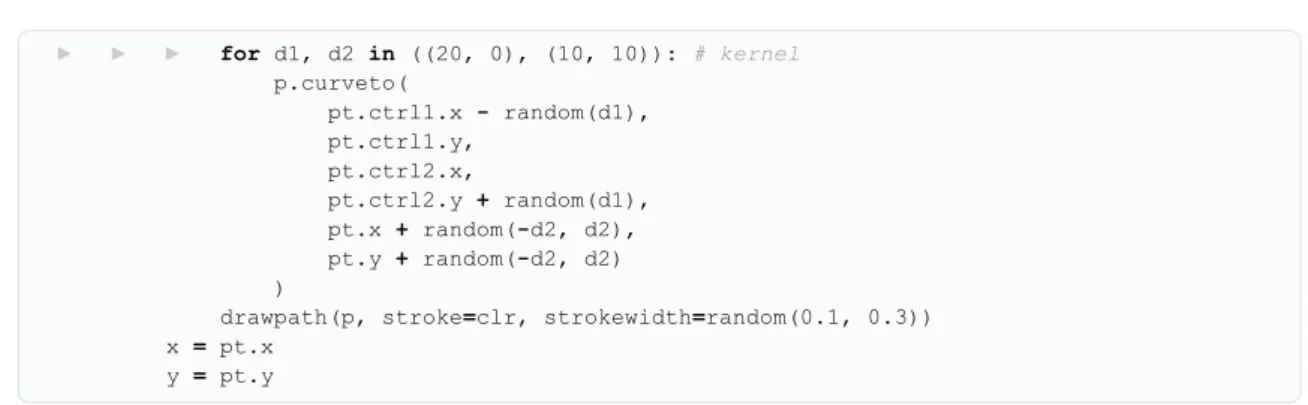
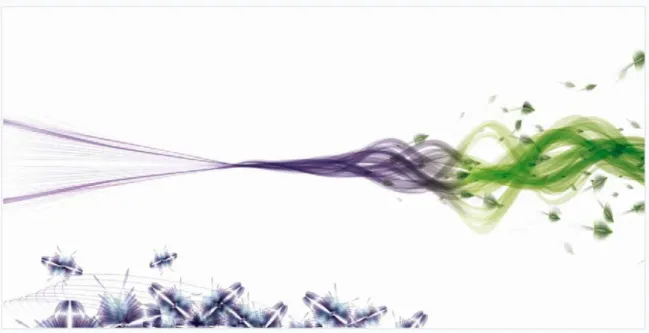
Figure 11 shows a number of variations of NEBULA (De Smedt, 2010), a NODEBOX script that
generates strands of curves with subtle changes in color, shape and rotation. The source code is given below.