doi: 10.1093/ageing/afs027 All rights reserved. For Permissions, please email: [email protected] Published electronically 16 March 2012
Effects of a stepped-care intervention
programme among older subjects who
screened positive for depressive symptoms in
general practice: the PROMODE randomised
controlled trial
G
ERDAM.
VAN DERW
EELE1, M
ARGOTW. M.
DEW
AAL1, W
ILBERTB.
VAN DENH
OUT2, A
NTONJ. M.
DEC
RAEN3, P
HILIPS
PINHOVEN4, T
HEOS
TIJNEN5, W
ILLEMJ. J. A
SSENDELFT1, R
OOSC.
VAN DERM
AST4,
J
ACOBIJNG
USSEKLOO11
Department of Public Health and Primary Care, Leiden University Medical Center, Leiden, The Netherlands 2
Department of Medical Decision Making, Leiden University Medical Center, Leiden, The Netherlands 3
Department of Gerontology and Geriatrics, Leiden University Medical Center, Leiden, The Netherlands 4
Department of Psychiatry, Leiden University Medical Center, Leiden, The Netherlands 5
Department of Medical Statistics and Bioinformatics, Leiden University Medical Center, Leiden, The Netherlands
Address correspondence to: Margot W. M. de Waal. Email: [email protected]
Abstract
Objectives: to determine (cost)-effectiveness of a stepped-care intervention programme among subjects ≥75 years who
screened positive for depressive symptoms in general practice.
Design:the pragmatic cluster-randomised controlled trial with 12-month follow-up.
Setting:sixty-seven Dutch general practices.
Subjects: two hundred and thirty-nine subjects ≥75 years screened positive for untreated depressive symptoms (15-item
Geriatric Depression Scale≥5).
Methods: usual care (34 practices, 118 subjects) was compared with the stepped-care intervention (33 practices, 121
sub-jects) consisting of three steps: individual counselling; Coping with Depression course; and—if indicated—referral back to general practitioner to discuss further treatment. Measurements included severity of depressive symptoms [Montgomery-Åsberg Depression Rating Scale (MADRS)], quality of life, mortality and costs.
Results: at baseline subjects mostly were mildly/moderately depressed. At 6 months MADRS scores had improved more
in the usual care than the intervention group (−2.9 versus−1.1 points,P= 0.032), but not at 12 months (−3.1 versus−4.6,
P= 0.084). No significant differences were found within two separate age groups (75–79 years and ≥80 years). In interven-tion practices, 83% accepted referral to the stepped-care programme, and 19% accepted course participainterven-tion. The control group appeared to have received more psychological care.
Conclusions: among older subjects who screened positive for depressive symptoms, an offered stepped-care intervention
programme was not (cost)-effective compared with usual care, possibly due to a low uptake of the course offer. Trial registration:www.controlled-trials.com/ISRCTN 71142851v.
Keywords:cost-utility, screening, depressive symptoms, stepped-care intervention, oldest old, primary healthcare, elderly
at Walaeus Library LUMC on August 27, 2012
http://ageing.oxfordjournals.org/
Introduction
Depressive symptoms at old age have a negative impact on well-being [1,2], quality of life [3], daily functioning and mortality [4], and increase the risk of developing major depression [5]. At old age depressive symptoms are reported to be under-recognised and undertreated [6], although psychological interventions have shown positive effects on clinical outcomes [7,8].
Therefore, screening older subjects for depressive symp-toms, followed by effective treatment of screen-positive subjects, is advocated [6]. Two large randomised controlled trials (RCTs) in the USA evaluated the (cost)-effectiveness of care management programmes for depressed subjects ≥60 years, who were ( partly) detected by screening, and showed reduced suicidal ideation [9], reduced depressive symptoms [10] and cost-effectiveness [11]. However, it is unknown whether screening for depressive symptoms fol-lowed by an intervention offer is beneficial and cost-effective for the oldest old. Therefore, the PROMODE study (Proactive Management of Depression in the Elderly) was initiated. PROMODE consisted of a screening study [12] and a subsequent pragmatic RCT offering either a stepped-care intervention or usual care.
The aim of the present study was to investigate the effects and costs of the stepped-care intervention offered to subjects ≥75 years who were screened positive for un-treated depressive symptoms, compared with usual care. Subjects aged 75–79 years and≥80 years were also exam-ined separately, to reveal possible age-dependent differences in the effect of this programme.
Methods
Study procedures and population
From April 2007 until July 2008, in 67 general practices in the Leiden region (the Netherlands) all 11,635 registered subjects aged ≥75 years were invited for screening at home for depressive symptoms. Exclusion criteria were current treatment for depression, clinical diagnosis of dementia or a Mini-Mental State Examination (MMSE) score <19 points, loss of partner or child in the preceding 3 months, life expectancy ≤3 months and not speaking Dutch. Screening procedures have been described previously [12].
Screening yielded 264 screen-positive subjects according to a ≥5 points score on an interviewer-administered 15-item version of the Geriatric Depression Scale (GDS-15) [13]. Of those, 239 subjects gave written informed consent to participate in the randomised trial.
The Medical Ethical Committee of the Leiden University Medical Center approved the study.
Intervention and usual care
General practitioners (GPs) in intervention practices were instructed to inform positive subjects about screen-ing result and to motivate them for referral to the
community mental health centre. The subsequent stepped-care intervention consisted of: step 1—individual counsel-ling concerning treatment needs and motivation of the sub-jects during one or two home visits by a community psychiatric nurse; step 2—coping with Depression course by trained mental health professionals; if indicated (irre-spective of course participation), step 3—referral back to GP to discuss further treatment.
The‘Coping with Depression’course, based on cognitive behavioural therapy, is effective in treating older subjects with depressive symptoms [14]. It consists of 10 weekly group meetings, with 2 course instructors and about 6–10 participants. If subjects were willing to accept the course offer, but had problems with attending group sessions, the course was offered on an individual basis at their home.
To ensure usual care, GPs in control practices were not informed about screen-positive subjects in their practice before the end of the study. Only in case of severe depressive symptoms [Montgomery-Åsberg Depression Rating Scale (MADRS)] score >30 points, see section ‘Measurements’) and/or suicidal ideation was the GP contacted by the researcher. Patients in the control practices were not indi-vidually informed about being screen-positive and treatment allocation.
Randomisation and blinding
A cluster randomised design, with the general practice as unit of randomisation, was chosen to prevent contamination [15]. After completion of screening and baseline assess-ment, block randomisation was performed using opaque envelopes. Research nurses were not informed about prac-tice allocation.
Measurements
The GDS-15 was used as a screening tool for depression. To measure cognitive functioning the MMSE was used [16]. Subjects with an MMSE score <19 points were excluded because of reduced reliability and validity to fill out the other questionnaires.
The primary outcome measure was change in severity of depressive symptoms between study groups after 6 months as assessed with the MADRS [17]. The MADRS scale con-sists of 10 items representing the depression core symp-toms. For each item, scores range from 0 to 6 points, with higher scores indicating more serious depression. Training of nurses occurred on a regular basis, with special attention paid to administering and scoring the MADRS in a uniform way. Therefore, the MADRS part of the interviews was videotaped; all MADRS scales were scored by both the interviewer and another research nurse and consensus scores were used in the analyses.
Secondary outcome measures were change in the MADRS score between study groups after 12 months; per-centage responders to treatment (intervention or usual care) defined as ≥50% decrease in the MADRS score
at Walaeus Library LUMC on August 27, 2012
http://ageing.oxfordjournals.org/
compared with baseline at 6 and 12 months; quality of life, mortality and costs. For further measurements see Supplementary data, available in Age and Ageing online, Appendices 1 and 3.
Follow-up
At 6 and 12 months after baseline measurements, subjects were visited at home to assess the GDS-15, MADRS, SF-36, chronic pain and MMSE (only at 12 months).
Sample size calculation
It was assumed that each cluster would provide 3 screen-positive subjects, on an average 1.5 subjects per age group. We planned to include 33 clusters per study arm to detect a clinically relevant difference in the MADRS score of at least 6 points in each age group (assumptions: SD = 10 points; power 80%; α= 0.05; intracluster correlation coeffi -cient (ICC) = 0.2). The (unknown) ICC was chosen conser-vatively to ascertain sufficient power [18].
Statistical analysis
Analyses were performed for all subjects and for both age groups separately. MADRS score changes after 6 and 12 months were analysed according to an intention-to-treat basis.
First, we analysed outcomes on the subject level. Sensitivity analyses were performed by substituting missing MADRS score data at 6 and 12 months following three methods: (i) last-observation-carried-forward (LOCF), (ii) highest MADRS scores in our study (30 points at 6 months and 29 points at 12 months) and (iii) lowest MADRS score in our study (0 points at 6 and 12 months).
Second, MADRS data were analysed using linear mixed models (LMM) to account for clustering at the practice level, with adjustment for MADRS scores at baseline, age and gender. Finally, measurements at 12 months were also included in the model to analyse the long-term effect.
To check whether subgroups benefited from the inter-vention on the longer term, stratified analyses were per-formed using LMM with the outcome. MADRS score changes at 12 months dependent on the presence of DSM-IV depressive disorder, perceived loneliness, chronic diseases, treatment per protocol and baseline MADRS score >10 points.
Hazard ratios (HRs) for death were estimated using a Cox proportional hazards model. Statistical analyses were carried out using SPSS 16.0 for Windows.
Results
Study population
After baseline measurements, 33 practices with 121 subjects were randomly allocated to the intervention arm and 34
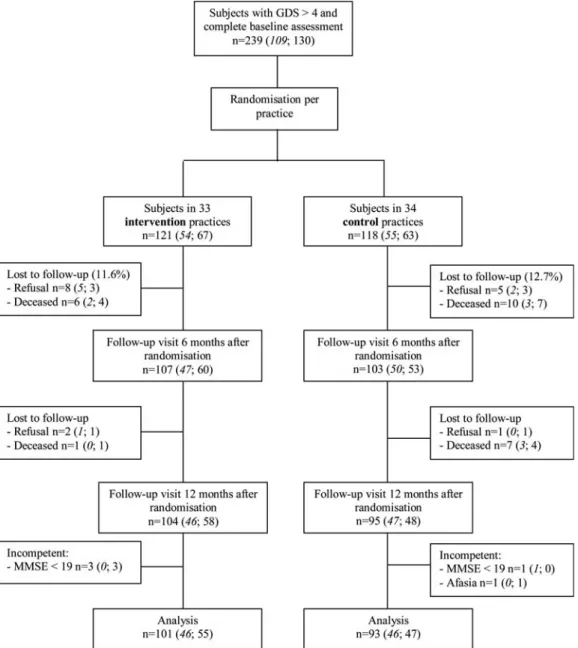
practices with 118 subjects to the control arm (Figure 1). The researcher contacted the GP for three subjects in control practices and for two subjects in intervention prac-tices because of an MADRS score >30 points and/or sui-cidal ideation. In the intervention group 7 subjects died, 10 subjects refused follow-up visits at 6 and/or 12 months and 3 subjects were unable to reliably answer the questions at 12 months. In the control group, 17 subjects died (includ-ing one subject who committed suicide, with an MADRS score <30 points and no suicidal ideation at baseline), 6 sub-jects refused follow-up visits at 6 and/or 12 months and 2 subjects had become incompetent at 12 months. As a result, 210 subjects could be analysed at 6 months (107 interven-tion and 103 control subjects), and 194 subjects at 12 months (101 intervention and 93 control subjects).
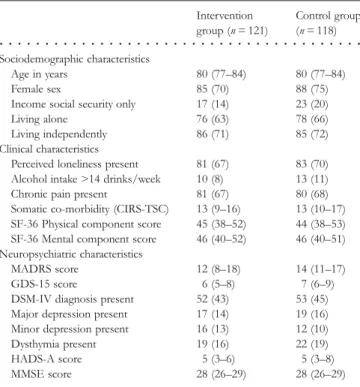
Table1presents the demographic and clinical character-istics at baseline. Baseline charactercharacter-istics between groups were similar. Median MADRS scores indicated that subjects mostly were mildly/moderately depressed.
Intervention uptake
In the intervention practices, 101 of all 121 screen-positive subjects (83%) accepted referral to the community mental health centre to start with the stepped-care intervention. Course participation was accepted by 23 (19%) subjects. Most of them (70%) finished the course. Additionally, two subjects followed the course on an individual basis and 21 participated in a group course. Five other subjects (4%) started another type of treatment.
Severity of depressive symptoms during follow-up
In the intervention group, median GDS scores remained stable at 6 points during follow-up; in the control group, scores decreased from 7 to 5. During follow-up, there was an overall decrease in MADRS scores, meaning an im-provement in severity of depressive symptoms. After 6 months, this decrease was significantly stronger in the control group than in the intervention group, but not after 12 months (Table 2). Sensitivity analyses, after substitution of missing data by LOCF or by the highest or lowest MADRS scores in our study population, did not substan-tially change these results (data not shown).
Taking clustering of subjects into account, and control-ling for the baseline MADRS score, age and gender, the de-crease in the MADRS score after 6 months was 1.4 points less in the intervention group than in the control group (P= 0.056, ICC = 0). Including measurements at 12 months, MADRS scores in the intervention group tended to be higher at all measurement moments (P= 0.088, ICC = 0.045). In none of the analysed subgroups was a positive intervention effect observed (data not shown).
at Walaeus Library LUMC on August 27, 2012
http://ageing.oxfordjournals.org/
Mortality
A total of 24 subjects died during follow-up, 7 (5.8%) in the intervention group and 17 (14.4%) in the control group (HR: 2.7; 95% CI: 1.1–6.5, adjusted for age and gender). After further adjustment for the baseline MADRS score and co-morbidity (CIRS-total score), the HR was 2.3 (95% CI: 0.94–5.6).
Age-stratified results
Between subjects aged 75–79 years and ≥80 years no dif-ferences were found in course participation and finishing the course. In both age groups, the intervention showed no positive effects on any of the MADRS outcomes or mortality (Supplementary data are available in Age and Ageingonline, Appendix 2).
Economic evaluation
Costs of the stepped-care intervention were estimated at €333 per referral to the stepped-care programme (n= 101). No significant differences were found in other costs or quality of life (Supplementary data are available in Age and Ageing online, Appendix 3).
Discussion
The present study shows no beneficial effect regarding se-verity of depressive symptoms of a stepped-care interven-tion programme among subjects aged ≥75 years who screened positive for untreated depressive symptoms, which mostly were mild to moderate, in general practice. Without beneficial effect, also the cost-effectiveness of the pro-gramme is unfavourable.
Figure 1. Flow chart of the PROMODE intervention study giving numbers of study subjects per age group between brackets
(75–79 years in italics; 80 years and over not italicised).
at Walaeus Library LUMC on August 27, 2012
http://ageing.oxfordjournals.org/
These negative findings are in contrast with the mainly positive reviews reporting that screening or case finding with subsequent enhanced care is effective in decreasing symptoms of depression [19–21], albeit sometimes
marginally [22]. However, compared with the present study, most studies included in these reviews targeted their inter-vention at populations with more (serious) depressive symptoms and/or were performed in younger populations (mostly over 55 or over 60 years). Furthermore, studied interventions are heterogeneous and ‘usual care’ may have relevant cross-cultural differences. In the Dutch healthcare system, GPs are the primary caregivers for all community-living subjects and often have a longstanding and close rela-tionship with their registered (older) patients. This enables a continuity of care that probably resembles the idea of a ‘personal care manager’, a seemingly important factor in successful interventions such as IMPACT [9]. Our aim was to enhance primary care in the intervention arm. However, we suspect the marginal role of the GP gave a breach in continuity of care that was not beneficial. In a recent Dutch trial stepped-care significantly reduced the risk of develop-ing a major depressive or anxiety disorder. Although com-parable with our study regarding healthcare setting and the age group, they included persons with persistent depressive symptoms and added problem-solving treatment to their intervention [8]. Our negative results are in line with a recent meta-analysis that concluded that psychological treat-ment for depressive symptoms is effective in primary care, but only when patients were referred by their GP for treat-ment and not when they were detected by screening [23].
Our study has some major strengths. Firstly, we did not only focus on older persons with major depression and/or dysthymia, but we focused on subjects who screened posi-tive for clinically relevant depressive symptoms, which represents the full spectrum of depression seen in general practice. This is especially important at old age, given the relatively high prevalence of subthreshold and minor de-pression, thereby enhancing the generalisability of our results in general practice. For the same reason, we chose a pragmatic study design, not strongly regulating the process of the intervention carried out by mental healthcare [24]. Secondly, our study was powered to investigate effects in two separate age groups, 75–79 years and ≥80 years. Mortality risk was higher in the control group than in the intervention group (if the age groups are combined) but not in the age-stratified groups, suggesting that our study may have been underpowered to draw definite conclusions per age group for mortality.
A possible limitation of the present study is that we chose a change in the MADRS score as our primary outcome measure. Although the MADRS is frequently used and validated to measure (changes in) severity of de-pressive symptoms among older subjects with moderate to severe depression, it may not be the optimal instrument to measure change in relatively mild depressive symptoms, and is not validated as such. Furthermore, our study could not be blinded and control subjects could have been triggered to seek help. This attention bias [25] may have played a role in our study, since the control group appeared to have received more psychological care than the intervention group. Also, the research nurses could not be completely
. . . .
Table 2.MADRS outcomes at 6 months and 12 months in the intervention and control group
Intervention (n= 121)
Control (n= 118)
P-value
MADRS scores at 6 months
Subjects,n 107 103
MADRS score, median (IQR) 12 (7–16) 11 (6–15) 0.22 MADRS responders,n(%) 17 (16) 23 (22) 0.24 MADRS change compared with
baseline, mean (SEM)
−1.1 (0.61) −2.9 (0.58) 0.032
MADRS scores at 12 months
Subjects,n 101 93
MADRS score, median (IQR) 10 (6–14) 10 (5–13) 0.45 MADRS responders,n(%) 21 (21) 31 (33) 0.049 MADRS change compared with
baseline, mean (SEM)
−3.1 (0.61) −4.6 (0.64) 0.084
MADRS, Montgomery-Åsberg Depression Rating Scale; IQR, inter-quartile range; SEM, standard error of the mean; Responder, subject with MADRS score decrease≥50% compared with baseline.
Continuous data are compared with the Mann–WhitneyUtest, categorical data with the Chi-square test, and changes of means with independent samples t-test.
. . . .
Table 1.Baseline characteristics of the study subjects
Intervention group (n= 121)
Control group (n= 118)
Sociodemographic characteristics
Age in years 80 (77–84) 80 (77–84) Female sex 85 (70) 88 (75) Income social security only 17 (14) 23 (20) Living alone 76 (63) 78 (66) Living independently 86 (71) 85 (72) Clinical characteristics
Perceived loneliness present 81 (67) 83 (70) Alcohol intake >14 drinks/week 10 (8) 13 (11) Chronic pain present 81 (67) 80 (68) Somatic co-morbidity (CIRS-TSC) 13 (9–16) 13 (10–17) SF-36 Physical component score 45 (38–52) 44 (38–53) SF-36 Mental component score 46 (40–52) 46 (40–51) Neuropsychiatric characteristics
MADRS score 12 (8–18) 14 (11–17) GDS-15 score 6 (5–8) 7 (6–9) DSM-IV diagnosis present 52 (43) 53 (45) Major depression present 17 (14) 19 (16) Minor depression present 16 (13) 12 (10) Dysthymia present 19 (16) 22 (19) HADS-A score 5 (3–6) 5 (3–8) MMSE score 28 (26–29) 28 (26–29)
Data are presented as numbers and percentages or medians and inter-quartile ranges.
CIRS-TSC, cumulative illness rating scale total score; MADRS, Montgomery-Åsberg Depression Rating Scale; GDS-15, Geriatric Depression Scale 15-items version; DSM-IV, Diagnostic and Statistical Manual of Mental Disorders (4th edition); HADS-A, Hospital Anxiety Depression Scale, anxiety-subscale; MMSE, Mini-Mental State Examination; SF-36, Short-Form
36 items. at Walaeus Library LUMC on August 27, 2012
http://ageing.oxfordjournals.org/
blinded for treatment allocation during follow-up visits, al-though they were not informed about this by the research team. To avoid a biased assessment and scoring of the MADRS, permanent training for the research nurses was provided and all videotaped MADRS interviews were inde-pendently scored. Finally, we were only partially informed about the third step of the intervention, in spite of our attempts to get complete and reliable information.
Our study shows a low uptake (19%) of the course offer among screen-positive older subjects, which probably is not surprising since these subjects did not (have the in-tention to) ask for help. In a qualitative exploration, we found that important reasons for declining the course offer were: not feeling depressed, or having negative thoughts about the course effect, about group participation or about being too old to change and learn new things [26]. Being screen-positive requires further exploration of subjective complaints and needs, as well as the motivation to accept help. Moreover, particularly in old age, it seems important that exploration of needs should not only focus on the de-pressive symptoms but also on other domains, such as functional limitations and chronic pain. Such an exploration will probably require a longitudinal approach with several stages and a broad scope with respect to possible interven-tion opinterven-tions. Furthermore, in the present study the GPs (who are a respected and trusted advisor for most elderly subjects) were allocated only a limited role, because we assumed that they could not invest the extra time required for the follow-up of screen-positive subjects. It is an im-portant question whether an intervention programme would have been more successful if the GP had been more involved in exploring their patients’needs after screening.
In conclusion, among older subjects who screened posi-tive for depressive symptoms in general practice the offer of a stepped-care intervention did not result in better clinic-al outcomes compared with usuclinic-al care. Possibly, this was partly due to the low uptake of the main part of the inter-vention. Therefore, this combined screening/stepped-care intervention programme for depressive symptoms does not seem to be a useful strategy to deal with untreated depres-sive symptoms at old age. It seems worthwhile to explore whether a more individualised approach for screen-positive subjects would yield more effective results.
Key points
•The stepped-care intervention programme for screen-positive depressed subjects aged 75 years and over did not result in better clinical outcomes compared with usual care.
•Among screen-positive subjects the uptake of the main part of the intervention was only 19%.
•Economic evaluation of the stepped-care intervention programme also showed no favourable results.
Acknowledgments
We thank all subjects, GPs and research nurses (Astrid Cock, Els de Haas and Inge Mooyekind) who contributed to this research project.
Conflicts of interests
None declared.
Funding
This work was supported by a grant from the Netherlands Organisation for Health Research and Development (grant number 945-07-502); and a grant from Rivierduinen, Center for mental health care. The funders played no role in the design, execution, analysis and interpretation of data or writing of the study.
Supplementary data
Supplementary data mentioned in the text is available to subscribers in Age and Ageingonline.
References
1. Beekman AT, Penninx BW, Deeg DJ, de Beurs E, Geerling SWvan Tilburg W. The impact of depression on the well-being, disability and use of services in older adults: a longitudinal per-spective. Acta Psychiatr Scand 2002; 105: 20–7.
2. Lyness JM, Kim J, Tang Wet al. The clinical significance of subsyndromal depression in older primary care patients. Am J Geriatr Psychiatry 2007; 15: 214–23.
3. Unutzer J, Patrick DL, Diehr P, Simon G, Grembowski D, Katon W. Quality adjusted life years in older adults with de-pressive symptoms and chronic medical disorders. Int Psychogeriatr 2000; 12: 15–33.
4. Penninx BW, Geerlings SW, Deeg DJ, van Eijk JT, van Tilburg WBeekman AT. Minor and major depression and the risk of death in older persons. Arch Gen Psychiatry 1999; 56: 889–95. 5. Cuijpers P, Smit F. Subthreshold depression as a risk indicator
for major depressive disorder: a systematic review of prospect-ive studies. Acta Psychiatr Scand 2004; 109: 325–31.
6. Pignone MP, Gaynes BN, Rushton JL et al. Screening for de-pression in adults: a summary of the evidence for the U.S. Preventive Services Task Force. Ann Intern Med 2002; 136: 765–76.
7. Cuijpers P, Smit F, van Straten A. Psychological treatments of subthreshold depression: a meta-analytic review. Acta Psychiatr Scand 2007; 115: 434–41.
8. van’t Veer-Tazelaar PJ, van Marwijk HW, van Oppen Pet al. Stepped-care prevention of anxiety and depression in late life: a randomized controlled trial. Arch Gen Psychiatry 2009; 66: 297–304.
9. Bruce ML, Ten Have TR, Reynolds CF IIIet al. Reducing sui-cidal ideation and depressive symptoms in depressed older primary care patients: a randomized controlled trial. JAMA 2004; 291: 1081–91.
at Walaeus Library LUMC on August 27, 2012
http://ageing.oxfordjournals.org/
10. Unutzer J, Katon W, Callahan CM et al. Collaborative care management of late-life depression in the primary care setting: a randomized controlled trial. JAMA 2002; 288: 2836–45.
11. Katon WJ, Schoenbaum M, Fan MYet al. Cost-effectiveness of improving primary care treatment of late-life depression. Arch Gen Psychiatry 2005; 62: 1313–20.
12. van der Weele GM, de Waal MW, van den Hout WB et al. Yield and costs of direct and stepped screening for depressive symptoms in subjects aged 75 years and over in general prac-tice. Int J Geriatr Psychiatry 2011; 26: 229–38.
13. de Craen AJ, Heeren TJ, Gussekloo J. Accuracy of the 15-item geriatric depression scale (GDS-15) in a community sample of the oldest old. Int J Geriatr Psychiatry 2003; 18: 63–6.
14. Haringsma R, Engels GI, Cuijpers P, Spinhoven P. Effectiveness of the Coping With Depression (CWD) course for older adults provided by the community-based mental health care system in the Netherlands: a randomized con-trolledfield trial. Int Psychogeriatr 2006; 18: 307–25. 15. Smelt AF, van der Weele GM, Blom JW, Gussekloo J,
Assendelft WJ. How usual is usual care in pragmatic interven-tion studies in primary care? An overview of recent trials. Br J Gen Pract 2010; 60: e305–18.
16. Folstein MF, Folstein SE, McHugh PR.‘Mini-mental state’. A practical method for grading the cognitive state of patients for the clinician. J Psychiatr Res 1975; 12: 189–98.
17. Montgomery SA, Asberg M. A new depression scale designed to be sensitive to change. Br J Psychiatry 1979; 134: 382–9.
18. Killip S, Mahfoud Z, Pearce K. What is an intracluster correl-ation coefficient? Crucial concepts for primary care research-ers. Ann Fam Med 2004; 2: 204–8.
19. Cuijpers P. Psychological outreach programmes for the depressed elderly: a meta-analysis of effects and dropout. Int J Geriatr Psychiatry 1998; 13: 41–8.
20. Van Citters AD, Bartels SJ. A systematic review of the effect-iveness of community-based mental health outreach services for older adults. Psychiatr Serv 2004; 55: 1237–49.
21. Skultety KM, Zeiss A. The treatment of depression in older adults in the primary care setting: an evidence-based review. Health Psychol 2006; 25: 665–74.
22. Freudenstein U, Jagger C, Arthur A, Donner-Banzhoff N. Treatments for late life depression in primary care: a system-atic review. Fam Pract 2001; 18: 321–7.
23. Cuijpers P, van Straten A, van Schaik A, Andersson G. Psychological treatment of depression in primary care: a meta-analysis. Br J Gen Pract 2009; 59: e51–60.
24. Thorpe KE, Zwarenstein M, Oxman ADet al. A pragmatic-explanatory continuum indicator summary (PRECIS): a tool to help trial designers. CMAJ 2009; 180: E47–57.
25. Sackett DL. Bias in analytic research. J Chronic Dis 1979; 32: 51–63.
26. van der Weele GM, de Jong R, de Waal MWet al. Response to an unsolicited intervention offer to persons aged ≥75 years after screening positive for depressive symptoms: a qualitative study. Int Psychogeriatr 2012; 24: 207–7.
Received 10 May 2011; accepted in revised form
14 December 2011
Age and Ageing2012;41:488–495 doi: 10.1093/ageing/afs028
© The Author 2012. Published by Oxford University Press on behalf of the British Geriatrics Society. All rights reserved. For Permissions, please email: [email protected] Published electronically 19 March 2012
Tuberculosis in ageing: high rates, complex
diagnosis and poor clinical outcomes
L
UISP
ABLOC
RUZ-H
ERVERT1, L
OURDESG
ARCÍA-G
ARCÍA1, L
ETICIAF
ERREYRA-R
EYES1, M
IRIAMB
OBADILLA-
DEL-V
ALLE2, B
ULMAROC
ANO-A
RELLANO1, S
ERGIOC
ANIZALES-Q
UINTERO1, E
LIZABETHF
ERREIRA-G
UERRERO1,
R
ENATAB
ÁEZ-S
ALDAÑA1, N
ORMAT
ÉLLEZ-V
ÁZQUEZ1, A
RIADNAN
AVA-M
ERCADO1, L
UISJ
UÁREZ-S
ANDINO1,
G
UADALUPED
ELGADO-S
ÁNCHEZ1, C
ÉSARA
LEJANDROF
UENTES-L
EYRA1, R
OGELIOM
ONTERO-C
AMPOS1,
R
OSAA
RELIM
ARTÍNEZ-G
AMBOA2, P
ETERM. S
MALL3, J
OSÉS
IFUENTES-O
SORNIO2, A
LFREDOP
ONCE-
DE-L
EÓN21
Instituto Nacional de Salud Pública (INSP), Av. Universidad # 655, Col. Sta. María Ahuacatitlán, C.P. 62100, Cuernavaca Morelos, México
2
Instituto Nacional de Ciencias Médicas y Nutrición Salvador Zubirán (INCMNSZ), México DF, México 3
Bill and Melinda Gates Foundation, Seattle, WA, USA
Address correspondence to: L. García-García. Tel: (+52) 7773293071; Fax: (+52) 777 3175485. Email: [email protected]
at Walaeus Library LUMC on August 27, 2012
http://ageing.oxfordjournals.org/