COMPLEMENTARY THOUGHTS IN THE WRITINGS AND SPATIAL DESIGNS OF ARNOLD SCHOENBERG AND ADOLF LOOS
Megan K. Eagen
A thesis submitted to the faculty of the University of North Carolina at Chapel Hill in partial fulfillment of the requirements for the degree of Master of the Arts in the Department of Music.
Chapel Hill 2010
ABSTRACT
MEGAN K. EAGEN: Complementary Thoughts in the Writings and Spatial Designs of Arnold Schoenberg and Adolf Loos
(Under the direction of Severine Neff)
ACKNOWLEDGEMENTS
TABLE OF CONTENTS
LIST OF FIGURES ...v
Introduction...1
PART I: WRITINGS Artistry verses Craftsmanship...4
“Ornament is Crime”: the Aesthetics of Adolf Loos...7
Balance, Self-Expression, and the Divine: Schoenberg’s Musical Idea...12
“Every man his own Interior Designer” ...15
Schoenberg on Craftsmanship ...17
The Drawing Board and the Kiln...21
Schoenberg on Architecture...25
Loos on Music ...26
“The Artistic Trailblazer...28
“From the Works of Masters”: Schoenberg and Loos on Time ...31
Frozen Music, Liquid Architecture: Schoenberg and Loos on Space ...33
PART II: CASE STUDY Schoenberg’s Variationen für Orchester...37
Conclusions...56
APPENDICES ...57
LIST OF FIGURES
Figure I-II (Digital models of Villa Müller) ...11
Figure III (Drawing illustrating conventional use of space)...33
Figures VI-V (Photographs of interior spaces in Villa Müller)...35
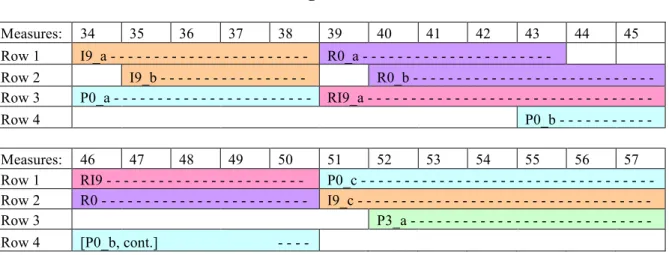
Figure VI (List of movements in op. 31) ... 39-40 Figure VIIa-b (Template for op. 31)...41
Figure VIII (Chart for op. 31)...41
Figure IXa-d (Chart for op. 31 with templates superimposed)... 41-42 Figure X (P0 row for op. 31) ...43
Figure XI (Tone-row analysis) ...45
Figure XII (List of instruments in op. 31) ...46
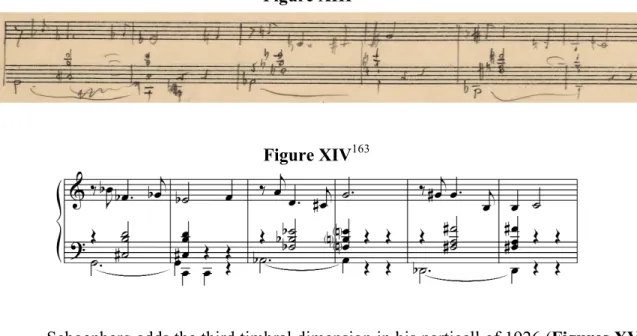
Figure XIII (Preliminary sketch of op. 31, “Thema”) ...47
Figure XIV (Transcription of Figure XIII) ...47
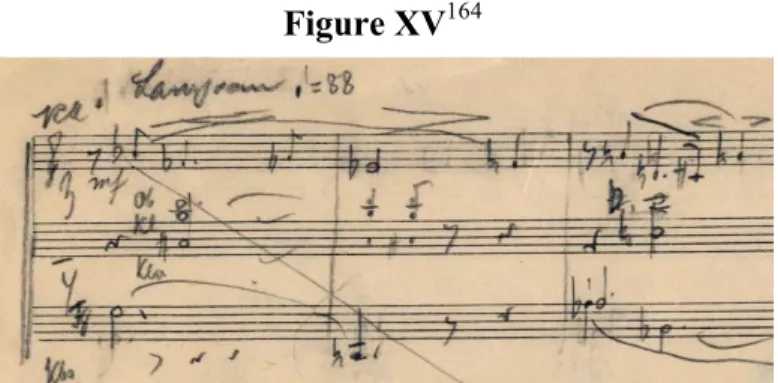
Figure XV (Particell sketch of op. 31, “Thema”) ...48
Figure XVI (Transcription of Figure XV) ...48
Figure XVII (First draft sketch of op. 31, “Thema”)...49
Figure XVIII (Transcription of Figure XVII)...49
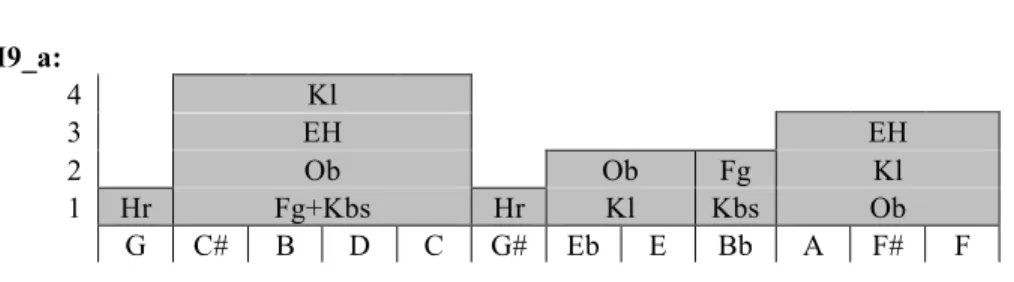
Figure XIX (2D representation of texture and timbre in row I9_a)...50
Figure XX (2D representation of texture and timbre in row R0_a)...51
Figure XXI (2D representation of texture and timbre in row P0_b) ...51
Figure XXIII (2D representation of texture and timbre in row P0_c) ...53
Figure XXIV (2D representation of texture and timbre in row I9_b) ...53
Figure XXV (2D representation of texture and timbre in row R0_b) ...53
Introduction
The arts are not isolated from one another but engage in dialogue. Much of the new music … is a reply to modern painting and sculpture.
… However, each art can do what another cannot.
John Cage, 19641
The viable relationship between the pantonal works of Arnold Schoenberg and the modern architecture and polemical thought of Adolf Loos has been established by a host of scholars—Benedetto Gravagnuolo, Richard Neutra, Yehuda Safran, Sherwin Simmons, and, most recently, Holly Watkins.2 Here I will augment their research, first by detailing the connections present in Schoenberg and Loos’s critical and pedagogical writings, and second by suggesting some ways in which Loos’s novel “Raumplan” concept resonates with the unique textural and timbral organization of Schoenberg’s Variationen für Orchester, op. 31. By extension, I will show that Schoenberg’s twelve-tone technique is as much a means of liberating orchestrational techniques as it is an expansion of the Western tonal system.
1 Two of Cage's most influential teachers were Arnold Schoenberg (in composition) and Pauline Schindler
(in high school English). Schindler was married the Viennese-born architect, Rudolph Schindler who had been close to Adolf Loos and his most famous student, Richard Neutra. Both Neutra and Cage resided in Schindler’s Kings Road House, whose open floor plan is conceptually similar to Loos’s Michaelerplatz and Villa Müller. I would like to thank Severine Neff for pointing out this connection. See Glancey 2006, 144 and Perloff/Junkerman 1994, 6, 80-88, 94, and 97.
2 See Gravagnuolo’s Adolf Loos: Theory and Works, Neutra’s “Adolf Loos: Pioneer of Modern
For both Schoenberg and Loos, art “facilitated a retreat inwards.”3 On the one hand, it led Loos to the creation of highly privatized spaces, protected by a blank external façade. On the other hand, it led Schoenberg, to the development of a new methodology, wherein true art expressed “that which lies deep within the artist’s subconscious.”4 In Watkins’s words, Schoenberg’s turn to atonality was “motivated by a desire to compose solely according to his inner compulsion.”5 While the artist may isolate himself quite completely, a tension emerges from the fact that both Schoenberg and Loos figure themselves as craftsmen in their writings. The craftsman, who engages in a plethora of relationships (with the material, the cultural, the setting, his own clientele, etc.), can never fully withdraw from society.
I am intrigued by the fact that, in most essays relating the artistic output of Schoenberg and Loos, the focus tends to be almost exclusively on their musical and architectural works, respectively. Very little is said about the critical and pedagogical writings of both men. Nevertheless, through these writings the authors articulate many common aesthetic values. They also share a pallet of verbal imagery. Furthermore, both hold that an artist's inner drive demands a singular knowledge of material and craft.
Both Schoenberg and Loos hold that, if an idea or thought is to be expressed through a particular medium, it must follow the rules of that medium as well as the more general principles of thought itself.6 Taking this as my cue, I argue that Schoenberg and
3 Watkins 2008, 206
4 Schoenberg quoted in Watkins 2008, 135
5 Watkins 2008, 135
6 By extension, this requires that the artist be divinely acquainted with his materials. This is a paraphrase of
Loos’s complementary aesthetics may be traced from writings to their artistic works. Therefore, this essay is divided into two parts. In the first part, I will summarize the major aesthetic principles of both men and provide examples of how these aesthetics emerge as a common set of literary metaphors in their writings. In the second part, I will use the opening “Thema” movement from Schoenberg’s Variationen für Orchester to demonstrate how Schoenberg and Loos’s mutual desire for freedom in design takes shape in a musical work of art. Through my assessment of I shall bring to light Schoenberg and Loos’s profound congruity of thought.
PART I: WRITINGS
Artistry Versus Craftsmanship—
E.T.A. Hoffmann rekindled the great debate between artistry and craftsmanship at the turn of the nineteenth century when he condemned the latter, preferring an elite or “absolute” form of artistry that he perceived only in the works of a select few. Hoffmann was not the only authority to bring this debate to the forefront of aesthetic discourse. A.B. Marx, a favorite writer of Schoenberg’s,7 saw the artistic process as being spiritually
directed—though he saw art is neither wholly spiritual nor wholly corporeal. Because if its singular nature, Marx believed that the true artist requires a “particular character”—a likeness in essence to art itself8—which implies that he, too, must exist somewhere between the realms of the mortal and the sublime. Eduard Hanslick suggested that art is driven by “supreme laws” knowable to artists.9 On the other hand, craftsmen, who knew
no "supreme laws" but only copied earthly designs, were inferior beings.
The aesthetic divide between craftsmanship and artistry continued throughout the nineteenth century, and well into the twentieth. Though various statements from Schoenberg’s earliest theoretical and pedagogical writings suggest he shared Hanslick’s
7 Norton Dudeque explores Marx’s influence on Schoenberg in depth in his Music Theory and Analysis in
the Writings of Arnold Schoenberg. See Dudeque 2006, 7, 14-15, 18, 137, and 160-161.
8 Marx 1920, xi
opinion,10 I posit that his views changed as a result of his strengthening relationship with the designer-critic, Adolf Loos. A life-long advocate of craftsmanship, Loos rebukes the educated (Secessionist) applied artist in many of his early reviews, saying that he has no business directing the craftsman in his work.11
Before proceeding, I should like to note that Loos saw the Vienna Secession as his chief adversary. Founded in 1897, this organization provided the new artistic movement with “a significant public forum.”12 The Secession constituted a group of artists who had broken with the established artists’ guild, on the grounds that the guild was too historically oriented and, thus, stiflingly conservative.13 The organization sponsored frequent exhibits during the late 1890s and early 1900s. Many Secession members, in turn, became instructors at the School of Applied Arts—another hapless victim of Loos’s pen.
Founding members included Gustav Klimt, Koloman Moser, Joseph Hoffmann, and Joseph Maria Olbrich. The two architects, Hoffmann and Olbrich, along with Otto Wagner, were all proponents of a particular type of linear ornamentation, which Loos found to be especially agitating. In general, novel ornamentation techniques were an
10 In Harmonielehre, for example, Schoenberg parallels the relationship between craftsmanship and artistry
and the relationship between water and wine. See Schoenberg 1983, 410.
11 For example, Loos describes the Vienna Secession as a “reign of terror.” [Loos 1998, 52]. I will address
Loos’s views in greater detail in “The Drawing Board and the Kiln.”
12 Simmons 2001, 247
13 Loos, Schoenberg, and Klaus, on the other hand, ostensibly apply elements of past practice in their
axial feature of Secessionist architecture. Secessionist exhibits showcasing this technique inspired Loos to write some of his most viciously combative reviews.14
Richard Neutra, who was both a pupil and friend of Loos, referenced a conversation he and Loos shared, wherein Loos stated his belief that artists of the Applied School suffered a form of pathology.15 As a result, they “rejected even [their] own products within three years.”16 Neutra says that, as an instructor, Loos stressed the importance of a structure’s “lastingness”—its connectivity with history. He saw ornamentation as a passing fashion, and critiqued it on these grounds, among others: “Modern ornament has no past and no future. It is joyfully welcomed by uncultivated people, to whom the true greatness of our time is a closed book—and after a short period it is rejected.”17
Based partially on personal experience—Loos’s father was a stonemason and Loos himself worked as a craftsman while traveling in the United States—and partially on polemics garnered from influential figures such as Ludwig Wittgenstein, Peter Altenberg, and Karl Kraus, Loos came to see the “simple master craftsman” as a (recently victimized) ideal. Loos praised the master craftsman for his unique familiarity with his materials—an affinity that the applied Secession artist, sequestered away with his drafting tools, could never hope to match. Materials are of the utmost importance to
14 For further information on the history of the Vienna Secession, see Bubnová 1998.
15 Holly Watkins further explores the psychological impact of rapid urbanization on urban subjects, and
addresses this “pathology” in her recent article, “Schoenberg’s Interior Designs.”
16 Neutra 1966, 89
Loos, as well as Schoenberg. Though they can never be wholly understood18 those with divine knowledge of their properties and propensities has the capacity to express through them an absolute truth.
As an aside—albeit an important one—I should like to point out that Schoenberg and Loos traveled in similar intellectual circles and socialized at least as early as 1908. Both men cited Karl Kraus as both a friend and influential figure, and both were well acquainted with Ludwig Wittgenstein and Peter Altenberg. Within the larger scope of the Viennese cultural bourgeoisie, these five artists (among others) forwarded a more rational or “purist” approach to art and design. Each reacted, through his own medium, against the so-called “degenerative” aspects of fin-de-siècle Viennese culture.19
“Ornament is Crime”: The Aesthetics of Adolf Loos20—
For Loos, beauty is synonymous with individuality. In his discussion of the Otto Wagner room—part of a Vienna design exhibition in 1898—Loos observed, “[It] is
18 “May the secrets of the material always remain mysteries to us.” Loos 1998, 150.
19 Loos uses the term, “degenerate” in describing the contemporary custom of ornamenting or “tattooing”
fabric. See Loos 1998, 187. For further information on the Viennese intellectual scene of the early twentieth century, see Schorske 1961.
20 There is a body of literature that deals artistic works distinguishing poignantly between private and
beautiful, not because of but in spite of the fact it was designed by an architect.”21 This is so, Loos adds, because the architect (Wagner) has acted as his own interior designer. Loos sought to supplant the artist-as-designer, not because he was against modern art— quite the opposite, in fact—but because he found functionality and individual taste to be the true determinants of perfection. In his own words, “The beauty of a practical object can be determined only in relation to its functions.”22 Because individuals use space differently, the furnishings and design of a room achieve their highest degree of functionality only through individual selection. As a result, such everyday objects— exempli gratia chairs, desks, and wallpaper patterns—convey a great deal about the unique habits and characteristics of inhabitants.23
The individuality of the twentieth-century artist is, according to Loos, based on general needs of the mind and thought process. In one of his earliest essays, “The Christmas Exhibition in the Austrian Museum,” Loos outlines three “requirements of the modern mind.”24 These requirements are as follows:
1. Practicality 2. Absolute truth 3. Individuality
Loos supplements this list by describing the conditions that he believes determine the “whole effort” of an artist.25 Herein, Loos argues that the artist-designer must first
21 Loos 1998, 63
22 Ibid.
23 Ibid.
24 Ibid., 23
show that his work is not meant for eternity. Rather, it is built for the duration of its usefulness. Loos’s meaning here is somewhat ambiguous. Based on his three requirements, however, I suggest Loos intended his interiors to last only so long as they remained individualized. After all, any interior designed according to specific personal tastes should, by default, be both beautiful and functional to that person(s). Conversely, a design that is no longer useful is also no longer beautiful. The design reveals both its beauty and its functionality through its individuality.
Second, the artist must use his materials in such a way that is artistically satisfying without imitating the appearance of more expensive material. Materials are the most crucial element in architectural design, according to Loos.26 In his 1908 essay, “Pottery,” Loos expresses the hope that “the secrets of [the] material always remain mysteries.”27 In response to a conversation with a group of applied arts students, who bragged that they could reproduce in glaze the blood red hue of a rose, Loos argued that their time would be better spent searching for “that can be expressed only in clay.”28 Loos also submits that the whole artist is able to design from an individual perspective, but in such a way that is attractive to many.
Finally, Loos posits that the whole artist is able to indicate, through his exterior structures, what lies within. In other words, Loos believes that continuity should exist between outer form and inner content.29 This idea of the fusion of outer and inner form is
26 To this, Loos suggests that some materials require the attentions of a particular artist—one who is able to
create an “appropriate style” for it. This suggestion merits further consideration! See Loos 1998, 66, 73.
27 Loos 1998, 150
28 Ibid., 149
epitomized in his singular notion of the “Raumplan.” Loos described how he conceived of the Raumplan for Villa Müller as follows:
My architecture is not conceived in plans, but in spaces. I do not design floor plans, facades, sections. I design spaces. For me, there is no ground floor, first floor et cetera. […] For me, there are only contiguous, continual spaces, rooms, anterooms, terraces, et cetera. Stories merge and spaces relate to each other. Every space requires a different height: the dining room is surely higher than the pantry, thus the ceilings are set at different levels. To join these spaces in such a way that the rise and fall are not only unobservable but also practical. […] It is just this spatial interaction and spatial austerity that thus far I have best been able to realize in Dr Müller's house.30
As stated, the Raumplan for Villa Müller is a continuous space made up of unequally sized cubes resting upon one another (see Figures I and II). The subsections of the Raumplan are vertically offset by short stairways, also of differing heights. Because the Raumplan is designed from the inside out—in other words, Loos sized each section according to its unique function within the whole—it can also be “traced in the outer walls.”31 Thus, the odd positioning of the windows and necessary blank spaces of
the walls evince that the house’s outer form is directly derived from its inner content. This content—the cubical sections of the Raumplan—is, in turn, shaped and organized according to greatest functionality, based on specific individual needs. To quote Severine Neff, “A quiet structure protecting the intimacy of life within.”32
30 Shorthand record of a conversation in Plzeň (Pilsen), 1930 (Szadkowska 2010)
31 Szadkowska 2010
Figures I and II33
Loos expresses his fiercest polemics—namely, his critique of ornamentation— with in his seminal work, “Ornament and Crime.” As the critic Hal Foster astutely notes, this essay may just as well have been titled “Ornament is Crime.”34 Herein, Loos critiques the Art Nouveau on the grounds that ornamentation is simultaneously erotic and excremental. In his own words, “A person of our times who gives way to the urge to daub the walls with erotic symbols is a criminal or a degenerate.”35 Loos describes his contemporaries (again, the applied artists from the Viennese School of Applied Art) as “those who prostitute art.”36 He equates the evolution of culture with the “[total] removal of ornamentation from objects of everyday use.”37 In this way, the essentials of nature come through.
33 Digital models of Villa Müller, produced in Szadkowska 2010
34 Foster 2005, 56
35 Loos 1998, 167
36 Ibid., 150
“Pure beauty” exists for Loos when an object has been so practically made that it cannot, in any way, be rendered more practical.38 Loos applies this sentiment almost verbatim when he states, “Nothing in nature is superfluous, and it is the degree of functional value, when combined with the harmony of the other parts, that we call pure beauty.”39 Loos views nature as an ideal—a paragon of design.40 He believes that changes occur in nature only when they improve a species’ capacity to function. Accordingly, nothing in nature is embellished without practical necessity. Thus, Loos would likely argue that an evolving culture strives asymptotically towards nature’s principles of change and embellishment.
Balance, Self-Expression, and the Divine: Schoenberg’s Musical Idea
Loos’s principles of modern thinking—practicality, absolute truth, and individuality—are closely paralleled by Schoenberg’s concept of the “musical Idea.” Though Schoenberg never explicitly defines this “idea” with respect to a work of art,41 he characterizes it as the “totality of a piece” and explains,
Every tone that is added to a beginning tone makes the meaning of that tone doubtful. If, for instance, G follows after C, the ear may not be sure whether this expresses C major or G major, or even F major or E minor; and the addition of other tones may or may not clarify this problem. In this manner, there is produced a state of unrest, of imbalance, which grows throughout most of the piece, and is enforced by similar functions of
38 Loos 1998, 69
39 Italics mine. Ibid., 63
40 It is unclear whether Loos is speaking of nature as an ideal physical environment, untouched by human
hands, the universe, or the divine.
rhythm. The method by which balance is restored seems to me the real idea of the composition.42
Charlotte Cross describes the idea as “multi-dimensional,” and has identified three “levels” in Schoenberg’s essays. According to Cross, the first of these levels “pertains to purely musical processes” (i.e. composition) whose primary objective is the “restoration of balance, coherence, and totality within a composition.”43 This is the most concrete level and complements Loos’s “practicality” maxim. The second level pertains to the idea as an expression of the self. Cross defines the idea on this level as “a medium by which the composer, inspired with [a] new perception of his own human nature and of the nature of the cosmos . . . communicate[s] his intuition to humanity . . . [in the] language of perception: music.”44 This more abstract level corresponds to Loos’s “individuality” criterion. Wlodarski describes the third and final level as the “presence of the divine.”45 On this level, it is the task of the composer (or any creative genius) to “translate into musical terms” the incommunicable nature of the cosmos “so that ordinary men may also perceive [them].”46 This incommunicable nature closely parallels Loos’s concept of “absolute truth,” which is his second paradigm of modern thinking.
42 Schoenberg quoted in Cross 1980, 13. As a continuation of this thought, Cross notes that Schoenberg
views themes, melodies and motives not as ideas in and of themselves, but as “details” into which the whole breaks down during its presentation. (See page 25).
43 Cross summarized in Wlodarski 2007, 604
44 Cross 1980, 31
45 Wlodarski 2007, 606
On a similar bent, Schoenberg writes, “There is no aim to the twelve-tone piece other than comprehensibility.”47 To add to this, he asserts that the connective processes that occur naturally in the medium of music “aid the listener in comprehending and identifying the musical idea.”48 As one possessing the capacity to fathom the unfathomable (Schoenberg surely considered himself thus), the composer may have perceived it his divine charge to act as an intermediary. Schoenberg expounds further on the relationships between the divine, the artist, and mankind in his essay “Composition with Twelve Tones.” Herein, he defines the creator as one who “has a vision of something which has not existed before this vision. A creator has the power to bring his vision to life; the power to realize it.”49
Cross would likely categorize this vision as the third level of the idea. The first level of the idea materializes as the vision is “translated” into a musical work of art. The second level connects the two. It is linked to the first level, as the composer inevitably applies some of his own individuality and intuition in his compositional approach. Similarly, it is linked to the third, as inspiration derives from a higher form of the self— the soul, perhaps, or God. All three levels of the idea are wholly interdependent. For ease of later reference, I offer Amy Lynn Wlodarski’s synopsis:
47 Schoenberg, Composition with Twelve Tones, 215
48 Wlodarski 2007, 608
49 Schoenberg 1975, 214-215. Both Cross and Covach discuss the relationship between Schoenberg’s
[The musical idea is…]
1. A musical execution of [the composer’s] aesthetic philosophy 2. A personal expression of his own perception
3. The divine essence that provides the material for inspiration50
From these augmentative definitions and descriptions, one may infer that the musical work of art coalesces as a representation of the musical idea. This is so because the idea itself exists beyond the realms of time and space. In order for the idea to be presented completely, the composer would have to possess perfect knowledge of his materials. Thus, Schoenberg defines composing as “thinking in tones and rhythms.”51
“Every man his own Interior Designer”—
Nowhere is Schoenberg’s fascination with handicraft and construction more concretely expressed than through his many bricolages, construction games, and tone row mechanisms. These mechanisms form the keystone between the artistic processes of Schoenberg and Loos. Though designed to facilitate the organization and presentation of sonic materials, their physical appearance, as well as the ways in which they are manipulated, suggests that Schoenberg conceptualized tone rows both sonically and spatially. Furthermore, they serve to produce a fundamental progenitor—a function— that precedes the construction of sections and, ultimately, an entire work. I have included several examples of these mechanisms in Appendix IV, though I will be focusing
50 Wlodarski 2007, 605
51 Schoenberg (Gedanke Manuscript, 6) quoted in Woldarski 2007, 591. This turn of phrase has striking
particularly on Sketches Nos. 1646A_v and 1592r (Figures VII (a and b)and VIII under
“Case Study: Schoenberg’s Variationen für Orchester”).
Schoenberg was fascinated by interior design and architecture. He dabbled in architecture by drafting furniture and constructing miniature models to illustrate his ideas. Among others, Schoenberg produced a miniature model of a cloakroom cupboard for a tennis club house, a sketch for a new kind of buffet table, a full-size model of a chair that could also be used as a library ladder, several sketches for a new type of train or bus ticket, a full-sized model for a new type of adjustable fold-up music stand, a full-sized model for a vexier case, designs and specifications for a music typewriter, and even a personalized model for a new set of dentures, which he apparently showed to his dentist. In addition to drafting and making models, Schoenberg makes frequent suggests for how a mechanism or process may be improved. In one such letter, for example, Schoenberg observes how difficult it is to transplant trees from a tree farm to a city once they are fully-grown. If one were to surround young saplings with posts, driven to the depth of an average mature root system, the posts could later serve to loosen the earth around the roots. Also, these posts, having been driven in before the tree was fully grown, would be less likely to damage the roots than posts driven in at the time of uprooting. This is because the longest roots will have grown around the posts, and are, therefore, not at risk for being gouged.52
In another letter, Schoenberg posits a new method for road construction. In still another, he bemoans the fact that small engines driven by water pipes are woefully inefficient. Schoenberg even designed specific traffic light patterns for emergencies such as fires, car accidents, and crimes. In his description, Schoenberg allows for a multitude
of possible circumstances. Under the category of “fires,” for example, the signal change pattern is simultaneously dependent on the number of people involved, the number injured, and the number killed. He applies similar criteria in determining the signal change pattern for incidents falling under the “traffic accident” and “crime” categories.
While certain inventions may only definitively reveal social concerns, all of these activities bear witness to the fact that Schoenberg was highly invested in functionality. He frequently manufactured hand-made solutions to increase his own efficiency. In essence, Schoenberg was Loos’s ideal individual-as-designer.53
Schoenberg on Craftsmanship—
In a letter of 1925, Schoenberg wrote, “My originality stems from my immediate imitation of everything that I had seen and perceived to be good, even if I had not seen others doing the same.”54 Schoenberg provides one suggestion of that which he “perceived to be good” in the dedication of a copy of his Harmonielehre (first published 1911; revised 1922). Herein, he writes, "I have perhaps learned more from you [Karl Kraus] than one is permitted to learn if one wishes to remain independent.”55 Though the expression is one of affection, the statement suggests that Schoenberg had reservations about imitating manmade work. However, he had no qualms against imitating nature—
53 The complete citation reads, “Neither the archaeologist, nor the interior designer, nor the architect, nor
the painter, nor the sculptor should furnish our apartments. Who should do it then? The answer is quite simply: Every man his own interior designer.” Loos 1998, 57.
54 “Meine Originalität kommt daher, dass ich alles Gute, das ich gesehen und erkannt hatte, sofort
nachgeahmt habe. Und das selbst dann, wenn ich es noch nicht bei andern gesehen hatte.” Schoenberg quoted in Meyer 2004, 4.
whose every element Loos held to be quintessential56—and perceived it to be the key source of his inspiration.57
Schoenberg and Loos both shared in the view of nature as the master craftsman. In the art of craftsmanship, experience with the materials is of utmost importance. At one point in Harmonielehre, Schoenberg even asserts that the act of experiencing creation is, perhaps, even more valuable to the creator than is the end product. Experience with materials leads to discovery. Schoenberg opines that even when discoveries and inventions have already been made, an apprentice must still re-discover or re-invent in order to grow as an artist. Conversely, the apprentice who has merely been handed a manual, and told to rely on the knowledge acquired by his teacher learns nothing. His task is limited to the act of making selections from a finite list of possibilities. Thus, he will never realize true inspiration, which derives only from individual experience and experimentation.58
Schoenberg holds craft in high regard. This is particularly well illustrated through his pedagogical texts and lectures. He often uses the metaphor of the “master carpenter,” for example, as a model of the composition teacher. The master carpenter is also a signifier for Schoenberg’s educational aesthetics. In Harmonielehre, for example, Schoenberg expresses the hope that he might be as successful as the joiner
56 Loos writes, “Nothing in nature is superfluous, and it is the degree of functional value, when combined
with the harmony of the other parts, that we call pure beauty.” Loos 1998, 63.
57 Among others, Schoenberg, Henry Cowell, and Marion Bauer all discuss the relationship between nature,
the natural overtone series, and the expansion of tonality. Bauer even suggests that the development of Western music could be read as a progression from the first partial to the uppermost audible partials. While this scarcely begins to answer the question of what nature in music really means—or even what it meant just to Schoenberg and Loos—I suggest Bauer’s “Breaking Down Established Rules” (Twentieth Century Music) as a good introductory source.
(cabinetmaker) in teaching craft to his pupils.59 In a talk as part of the Proceedings of the National Music Teachers Association, Schoenberg again stresses the importance of learning handicraft, stating that, according to his own experience, “The understanding of such skills opens the mind of a student to the understanding of craftsmanship in art.”60 He goes on to state that there are many degrees of craftsmanship and artistry. In other words, the art and craft lie on a common continuum.61
Both Schoenberg and Loos distinguish between craft and art on the grounds that in artistry, freedom and expression are the highest purposes, whereas in pure craftsmanship, usefulness takes precedence.62 Furthermore, like Loos, Schoenberg holds to the belief that beauty arises from economy and efficiency.63 A departure from one frame of reference in favor of another may necessitate a different kind of efficiency, however.64 This is, once again, demonstrated by Schoenberg’s constant reconsideration of various technologies, structures, and mechanisms. One may conclude that, for Schoenberg, a change in technology or point of reference, which results in the possibility of a new or different kind of practical solution, also recasts beauty in a new or different light. For example, roads built before the dawn of the mechanical age could be produced and maintained most efficiently when they followed natural contours of the land. Thus, a
59 Schoenberg 1983, 6
60 Schoenberg 1939, 251
61 Ibid.
62 Schoenberg quoted in Meyer 2004, 10
63 In his 1926 article on Loos, for example, Schoenberg writes: “[Loos] creates beauty, architecture, by
exclusively answering the needs of functionalism, homeliness and comfortableness.” Here, Schoenberg equates beauty with architecture, on the grounds that the architect’s design is informed by the principle of functionalism. This article has been reproduced in its entirety in Appendix I.
medieval road that successfully weaves in and out of valleys without rising or falling excessively is beautiful. Similarly, roads built in the late nineteenth century, with aid of explosives, drilling mechanisms, and trackers, can lead almost directly from one point to another. Thus, a “modern” road, which ducks under a mountain or sails high above a river by way of a suspension bridge is also beautiful.65
As a supplement to his polemics with regards to art and handicraft, Schoenberg draws on a plethora of craft-oriented imagery in his theoretical writings. Among other instances, he describes adding to a cadence as attaching porcelain to a vase,66 musical connections as gluing or nailing in carpentry,67 presentation of a musical idea as the action of pliers,68 forming a series of motives as making links in a chain,69 orchestrators as skillful workmen,70 and a good musician as a successful tailor.71 Schoenberg also describes harmony as the blueprint of a piece,72 and his own twelve-tone method as a compositional tool.73 These metaphors act as useful tools for comprehending Schoenberg’s music and aesthetic values. Like a cadence, porcelain strengthens and secures. It is the final element to go into a mixture, but distinctly defines a substance once it is included. Like nails and glue, connecting ideas in music often go unnoticed to
65 Meyer 2004, 12
66 Schoenberg 1983, 125-26. The list of Schoenberg's metaphors used in this thesis derive from Neff 1999.
67 Schoenberg 1995, 250-51
68 Schoenberg 1975, 123
69 Schoenberg 1967, 26
70 Schoenberg 1975, 240
71 Ibid., 382
72 Schoenberg 1995, 308-9
the untrained observer, though they serve a crucial function in binding other objects. Like a musical idea, pliers are used to tighten and draw things closer together. By likening these musical elements to items found in a workshop in the context of a pedagogical text, Schoenberg casts himself directly into the role of the master craftsman. Clothed in the mantel of a carpenter, Schoenberg implies an aesthetic based on utility, functionality, and direct contact with materials.
The Drawing Board and the Kiln—
Loos uses metaphors of a drawing board and a kiln to illuminate what he saw as the most crucial difference between artistry and craftsmanship. He sees the former as “impelled by precision,” whereas the latter is impelled by imprecision, passion, chance, dreams, and mystery.”74
In his essay, “Architecture,” of 1910, Adolf Loos engages in a veritable diatribe against art as the expression of the artist without practicality and function. In particular, Loos saw the “revolutionary” orientation of the Viennese School of Applied Art to be an unjustifiable end in and of itself. In response to a series of blueprints that he perceived to be wholly impractical, Loos argues,
The house should be pleasing to all, unlike a work of art, which does not require anyone to like it. The work of art is the private affair of the artist. The house is not. The work of art is sent out into the world, without anyone needing it. The house fulfills certain requirements. The work of art is not answerable to anyone, the house to everyone. A work of art seeks to draw people out of their comfort. The house should serve comfort. The work of art is revolutionary, the house conservative. The work of art shows humanity new paths and thinks of the future. The house thinks of the present. Man loves everything that serves his comfort. He
hates all that seeks to draw him from his customary and secure state, and all that constricts him. And thus I love the house and hate art.75
Loos saw practicality as a principle rule. He presents it as the first of his three requirements for modern thinking, and returns to it repeatedly in later essays. In order for spaces to be perfectly functional, therefore, they must be designed with the inhabitants’ particular needs and habits in mind. Spaces adorned with furnishings and wallpapers that imitated the chambers of the aristocracy not only encouraged farcical beliefs regarding social status, but also usurped the possibility for inhabitants to express themselves honestly76—to achieve the absolute truth that constitutes Loos’s second requirement in his essay, “The Christmas Exhibit,” mentioned above.
As previously mentioned, Loos blamed the artists of the School of Applied Art for forcing craftsmen into dogmatic roles as mere imitators and embellishers. He had studied architecture briefly but dropped out of school in order to travel and gain experience as a craftsman. Thus, like Schoenberg, he was primarily an autodidact. Also, most interestingly, both men turned to relatively distant historical practices as a means of self-education. Schoenberg subjected himself to intensive studies in counterpoint.77 In addition, most of his theoretical writings are tonally oriented.78 He also continued to apply traditional forms, such as the passacaglia and developing variation, when
75 Loos 2002, 108
76 Writing on a similar topic, Loos described imitation as “that monster threatening to sap the very
foundations of our handicrafts.” Loos 1998, 19.
77 It should be noted, however, that Schoenberg taught counterpoint within the domain of tonality. He
found the Aeolian mode, which lacks a raised seventh, to be “purely synthetic, a product of art.” [Schoenberg 1983, 96]. Significantly, Schoenberg’s description of art as something fabricated and less natural echoes Loos’s belief that art relates only indirectly with nature and functionality.
composing serial works. Going back even further, Loos, modeled elements of his designs on work produced by the ancient Greeks.79
Just as objects may speak to the nature of their owners, so too can they bear witness to the needs of their society and the role of the craftsman. In writing about Greek sculpture, Loos observes how those dwelling on the banks of fast-moving rivers built vases with funnel-shaped mouths, thereby hastening the flow of running water into their bellies. Further inland, archeologists discovered vases with narrow tops and wide bases. The people of these regions had to transport water from local springs, and therefore carried the vases on their heads. The lower center of gravity of these vases enhanced their practicality.80
It is unlikely that these vases were produced by artists; more likely artisans. Since the time of the ancient Greeks, their highly functional designs have been adapted and/or embellished time and time again. Loos allows for adaptations that improve the vases’ functionality, but opines that all other embellishments are superfluous. As stated above, practicality is one of Loos’s two main conditions for beauty—the second being individuality. If a vase is altered in such a way that improves neither its functionality nor its aesthetic value to the owner, it loses some of its universal value as well. Loos distinguishes between craftsmen and artists on the grounds that craftsmen work under the direction of individual clients, and hold to a primary principle of practicality, whereas
79 Loos championed the study of classical architecture in several of his essays, including “Glass and China”
and, most significantly, “Ornament and Education.” Loos also used classical columns in his Karma Villa, a classical cornices in his Duschnitz and Mandl towers, and a frieze modeled on a frieze from the Parthenon in his Rufer house. Risselada 2008, 36.
artists seek to please only themselves and find false beauty in “improving” the old via imitation and embellishment—a task which Loos figures as a “Sisyphean labor.”81
Loos defends the uneducated artisan not only because he has been wrongly victimized but also (and more importantly) in recognition of his intimate knowledge of materials. When the “appropriate craftsman” creates a water glass, he “thinks like a glass blower.” When he makes a brass bedstead he “thinks and feels like a brass worker.”82 Since materials are, once again, the most crucial element for Loos, he seeks to elevate the status of the craftsman above the status of the applied artist. In his own words, “The cabinetmaker does not need a mentor, and it is high time this most unjust supervision order were canceled.”83
Loos recognizes a deep divide between the camps of artistry and craftsmanship. He uses metaphors of a drawing board and a kiln to symbolize this divide. In his view, the drawing board (i.e. “artistry”) is impelled by precision, where as the kiln (i.e. “craftsmanship”) is impelled by imprecision, passion, chance, dreams, and mystery.84 The appropriate craftsman thinks in the colors, shapes, and textures of his materials. Thus, the materials direct the will of the craftsman, but the artist imposes his own will onto the materials.85
81 Loos 1998, 48
82 Ibid., 62
83 Ibid., 53
84 Ibid., 150
85 By extension, it is the entire “nexus of interactions” (Cohen’s phrase) between the craftsman and the
Schoenberg on Architecture—
Schoenberg often uses architectural imagery in his theoretical texts on music. By itself, this fact affirms the close connection between Schoenberg and Loos. Schoenberg describes himself as an architect at one point in Style and Idea, and later transfers the designation to the composer in both The Musical Idea and the Logic, Technique, and Art of its Presentation and Coherence, Counterpoint, Instrumentation, Instruction in Form.86 In Harmonielehre Schoenberg bestows the title upon the composition student.87
Schoenberg shares Loos’s disdain for ornamentation, even citing the designer-critic in referring to ornamentation as “tattooing.” Schoenberg also describes the addition of ornaments to a progression as adding cheap stucco to a smooth surface.88 Schoenberg holds that tones have an innate relief. Thus, he is able to equate structural tones in polyphony to structural components of a house.89 Schoenberg views music as space in Style and Idea. Following a common trope, he describes music as “frozen architecture.”90
Of equal importance is Schoenberg’s description of harmony as the blueprint of a musical work, so described in The Musical Idea.91 To this he adds that harmonic
86 See Schoenberg 1975, 94, and Schoenberg 1994, 58
87 Schoenberg 1983, 203
88 Ibid., 202
89 Schoenberg 1975, 262
90 Ibid., 313
exercises may be conceived as architectural sketches for a ground plan.92 This is particularly important to my study, as it implies that Schoenberg viewed harmony as occupying only one plane in a musical “structure.” His thought could readily be expanded to include rhythm, melody, timbre, texture, dynamics, and so forth as other levels or dimensions in the sonic space of a composition. How this space is defined musically merits further critique.
As a final point of interest—and to unite this section with a crucial point from “The Musical Idea”—Schoenberg states that a structure can only become meaningful “by the logic of its ‘coherence’.”93 Rendering the divine element of the idea accessible is, once again, the duty of the composer-as-visionary. I suggest that Schoenberg uses the image of a structure because it is easier to imagine seeing connective features while passing through rooms, hallways, and stairwells than it is to imagine hearing musical connections while listening to a composition. More importantly, it shows that Schoenberg was willing to conceive of a musical work of art as a physical structure. I will return to this point in the penultimate section, “Frozen Music, Liquid Architecture: Schoenberg, Loos, and Space.”
Loos on Music—
By the mid-1920s Loos’s hearing was severely impaired. Thus, one may be inclined to disregard the possibility that music had any influence on him. Nevertheless, Loos applies musical imagery extensively, not only in his early essays, but also in works
92 Schoenberg 1983, 203. On a related note, I find Schoenberg’s use of the terms “coherence” and “unity”
to be synonymous. Though I have not discussed Schoenberg’s application of the former, an example of this may be found in Schoenberg 1957, 247-248.
as late as 1913.94 Interestingly, it is in the context of handicraft wherein Loos draws most readily on musical insights and imagery. In “Glass and China,” for example, Loos provides an anecdote of a Spanish students’ chorus (estudiantes). In honor of a high-ranking official, the estudiantes sang a simple song, whose sentiment was roughly equivalent to the English, “For he’s a jolly good fellow.” The song had two verses whose respective functions, according to Loos, could be translated as the “moldings” (abaci, tori, trochili, et cetera) of Renaissance architecture. The various moldings—exempli gratia abacus, torus, scotia, or ogee—serve to shape the work, just as the first verse of the estudiantes ditty established the framework for all of the post ceding verses. The moldings embellish the otherwise vacant face of the moldings, just as the second verse of the song embellished the first, adding greater depth of meaning through the introduction of new words and a contrasting tune.95
In both cases, Loos praises classical simplicity, asserting that functionality often arises from that which is suitable for all occasions.96 Because the text of the estudiantes song was relatively non-specific (“For he’s a jolly good fellow” could be used for a birthday celebration, a political or military victory, a successful business maneuver, et cetera), and the melody easily manipulated, this song had, apparently, been around for some time. Similarly, the relatively non-specific moldings and ornamentations of Renaissance Austria continue to function adequately with minimal maintenance, and without drawing attention to themselves. This highlights another element of Loos’s
94 See, for example, “The Interiors of the Rotunda,” “Chairs,” “Glass and China,” and “Beethoven’s Ears”
in Loos 1998, 59, 63, 70, and 178.
95 Loos 1998, 63
aesthetic—Loos considered it vulgar to deliberately attract attention to oneself or one’s work.97
Among others, Loos also uses the terms virtuoso, harmony, sound, and noise, along with the names of a several musical instruments (especially the violin and piano) for varying effects. Perhaps most directly related to music is Loos’s essay, “Beethoven’s Sick Ears.” Herein, Loos describes how Beethoven’s music was, in his own time, negatively received. Near the end of his life the Viennese were “scandalized with horror” at what he wrote, and “asserted that he must have had sick ears.”98 At the conclusion of his anecdote, Loos writes “Now everyone has Beethoven’s sick ears.”99 Like Beethoven, Loos also suffered from physical deafness. Benedetto Gravagnuolo suggests that Loos became metaphorically “deaf to the fashions and pressures of his age.”100 Accordingly, his condition—both literal and otherwise—allowed his mind to develop “its own ideas in intellectual solitude.”101
“The Artistic Trailblazer”—
Whereas Schoenberg’s theoretical texts are flush with romantic imagery, Loos’s style is highly direct—quite literally, without ornament. Where Schoenberg might describe the fundamental tone as an embryo, struggling between life and death,102 Loos’s
97 Loos 1998, 40
98 Godsill 1985, 92
99 Loos quoted in Godsill 1985, 92
100 Godsill 1985, 92
101 Ibid.
favorite illustration is the craftsman-as-cabinetmaker. The designer-critic uses imagery and metaphor very sparsely. When metaphors do appear, that which is being imagined is often so closely related to that which is being discussed that it is difficult to even justify calling describing them metaphors at all. Thus, it is difficult to make a comparison between Loos’s application of imagery and Schoenberg’s.103
That having been said, Loos and Schoenberg do share a very common vocabulary. “Carpentry” is a common image, both in Harmonielehre and in “Ornament and Crime.” Both authors also make reference to tools, such as nails, hammers, and cement.104 Both make use of “embryo,” though in significantly different ways. For Loos, the image of the human embryo suggests degeneracy or amorality. According to Loos, humans develop morality with age. Therefore childish or “embryonic” art is erotic and tasteless.105 Schoenberg’s uses the term as a metaphor for his materials, in their most fundamental state—the single tone that provides the impetus for an entire work.106
Both Schoenberg and Loos apply a variety of terminology borrowed from the sciences. Loos, for instance, describes the nineteenth century as the “refractory age” in “The Jubilee Exhibition in Vienna.”107 Schoenberg opines that works of art mirror modes of thought and perception.108 Both use the terms weight, gravity, force, energy, heat, pressure, eccentricity, stasis, and motion. This is important because each of these
103 In the case of the former, see page 7; in the case of the latter, see page 173
104 See, for example, Schoenberg 1995, 250-51 and Loos 1998, 152
105 Loos 1998, 167
106 Schoenberg 1983, 28-29
107 Loos 1998, 25
forces and physical properties must be considerations in craftsmanship and architecture. A craftsman who has no knowledge of stress, elasticity, tensile strength, compression, or shearing cannot hope to design something functional and long lasting. These properties take on a more figurative import in Schoenberg’s writings. For example, in Style and Idea, the composer describes tonality as gravity.109 A student composing without knowledge of the natural propensities of tonal harmony cannot hope to produce a functioning progression. Similarly, in the same text, Schoenberg describes harmony as centrifugal.110 In essence, harmony naturally expands. As previously stated, Schoenberg and Loos were fascinated with determining innate tendencies of their materials. Schoenberg may have interpreted this tendency as a form of sanctification for his experiments with pantonality.
Interestingly, both Schoenberg and Loos also use some Biblical language. In “Pottery,” for example, Loos states that he will not submit works for an upcoming exhibition until those who “prostitute art” have been “driven out of the temple.”111 Loos also believes that God, in His wisdom, deliberately left some ideas unexplored in order to “allow mankind to participate in the glorious joy of creation.”112 Loos also refers to inspiration as a form of revelation, which comes from working directly with materials. Schoenberg states that an aphorism for artwork is revelation in The Musical Idea and the
109 Schoenberg 1975, 87, 245, 258, 262, and 348. Again, the list of Schoenberg's metaphors derive from
Neff 1999.
110 Schoenberg 1975, 380
111 Loos 1998, 150
Logic, Technique, and Art of its Presentation.113 And, like Loos, Schoenberg describes composition as a religious gift from the Divine.114
Some descriptions appear almost verbatim on Loos and Schoenberg’s theoretical writings. In an early essay, Loos uses the phrase, “the thorny path of the artistic trailblazer.”115 Schoenberg writes that the “path to atonality [is] set with thorns.”116 And finally, both Schoenberg and Loos describe ornamentation as “tattooing.”117
“From the Works of Masters”: Schoenberg and Loos on Time—
Though only four years Schoenberg’s senior, Adolf Loos’s approach to design— particularly as expressed through his numerous journal articles published during the late 1890s—had a significant impact on the composer. Though these articles do not constitute an exact methodology, Loos’s artistic values and sensibilities form a strong undercurrent unifying all of his writings. In particular, Loos viewed his works as evolving directly from past practices—specifically, those of Greek classicism.118 In other words, he did not see himself as a revolutionary, but rather as an informed historian, taking from the past that which he found to be most practical and stripping it of all
113 Schoenberg 1995, 114-115
114 See Schoenberg 1975, 67, 86
115 Loos 1998, 25
116 Schoenberg 1975, 49
117 Schoenberg 1983, 340 and Loos, 1998, 187. As an added point of interest, Schoenberg and Loos also
share more than a passing interest in clothing. For Loos, of course, this is quite pronounced. In the words of the designer-critic states, “Among the best people, to attract attention to oneself [as a result of one’s attire] is considered vulgar.”117 Loos adds that an article of dress is modern if, “when wearing it on a
particular occasion in the best society at the center of one’s culture, one attracts as little attention to oneself as possible.” On a similar bent, Schoenberg describes dissonance as a “holiday outfit.” See Loos 1998, 40, and Schoenberg 1983, 50.
unnecessary ornamentation. In Loos’s own words, “The evolution of culture is synonymous with the removal of ornament from utilitarian articles.”119
As a reminder, the very first item in Loos’s list of conditions that determine “the whole effort of the artist” is “each building [must] show it was not built for eternity (Italics mine).”120 Perhaps the reason for its impermanence has to do with Loos’s abiding fascination with nature, whose evolutionary tendencies are geared towards increased practicality.121 On a comparably ambiguous vain, Schoenberg praises the art of Dehmel, saying,
It taught us…the ability to listen to what goes on inside us, and to be a man of our own time for all that. Or rather, just because of that, since in reality time was within us rather than outside us. But it also taught us the opposite: how to be a man of all time, simply by being a man (Italics Schoenberg’s).122
A shared respect for the techniques of past authorities complements Schoenberg and Loos’s mutually uncertain views regarding the future significance of their work. For example, Loos, writes that “every time architecture strays from its model at the hands of the mediocre and the decorators, the great architect reappears to bring it back to antiquity.”123 Schoenberg’s view comes across with equal resonance where he states that
119 Loos 1998, 167
120 Ibid., 26
121 Again, when Loos speaks of “nature” and “impermanence,” his meaning is somewhat open to debate.
Based on how he uses these terms in his essays, however, I suggest that he means “nature” in an ideal but earthly sense, wherein all elements function purely to facilitate the longevity of a plant or organism, and evolution progresses asymptotically towards flawless efficiency. Thus, when he speaks of a work of art’s “impermanence,” I believe he means that only the material is impermanent. The Idea—in Loos’s case, pure practicality, individuality, and truth—carries on into the future.
122 Schoenberg quoted in Safran 1985, 63
he will be taking almost all of his examples “from the works of masters” in the Foreword to Coherence, Counterpoint, Instrumentation, Instruction in Form.124
Frozen Music, Liquid Architecture: Schoenberg and Loos on Space—
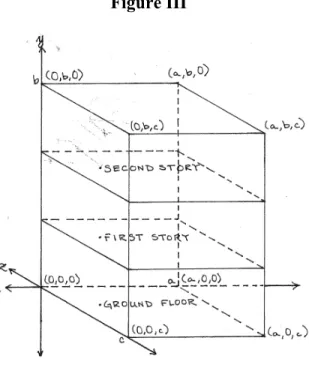
One aspect of the Schoenberg-Loos equation that has not been fully explored is their correlative departure from traditional usage of space—physical space, in the case of Loos, and sonic-temporal space in the case of Schoenberg. Traditionally designed buildings generally occupy the three spatial dimensions at regular intervals. All three levels of a simple, three-story apartment, for example, might share a common length (a), width (c), and height (b). Figure III (below) illustrates this use of space.
Figure III
Loos’s late designs—in particular, the Café Museum, American Bar, and Villa Müller—exhibit an entirely different treatment of physical space, as generated by their
unique Raumplans. “Rooms” within these buildings are not distinguishable by standard-sized walls, ceilings, or floor. Instead, they are offset from one another via short stairways, narrow halls, variegated textiles, and wall paneling. Loos also uses volume and proportionality to indicate whether a room (or section) is public or private.125 As one moves through Villa Müller’s interior, therefore, one gains a sense of the hierarchy of the rooms with respect to the structure as a whole, while also experiencing the relative publicity/privacy of the various sections. Thus, just as composition facilitates a procession through sound, which (for Schoenberg) is representative of an idea, architecture facilitates a procession through space, which (for Loos) is representative of its inhabitants.
The following images (Figures IV-V) demonstrate the interior effect of Loosian design. Shown below are two areas—one transitional and one stationary—in Villa Müller. In the former, a plethora of materials—in this case, plaster, wood, and glass panels—serve to produce tension. The presence of an open hallway and adjoining stairwell also confirm that this space is designed for motion rather than repose. In the latter, the harmonious blend of light colored wood, carpeting, and patterned upholstery create an atmosphere of ease and relaxation. In addition, this space is somewhat confined. Even though the inhabitant, on entering this space, can still see transition spaces and other rooms beyond, the materials and proportionality of this room encourage thoughts of private repose.
125 Volume and proportionality are interdependent. Consider, for example, one’s experience in a parking
Figures IV126 and V127
Schoenberg’s 1926 review of Loos’s Michaelerplatz opens the possibility of comparing the composer’s voice-leading and orchestrational techniques (as metaphorical dimensions in sound) of this period to Loos’s designs.128 Schoenberg writes,
The most astonishing thing about [Loos] is his absolute manner of thinking and his ability to operate freely within a space. While the majority of architects take refuge in a specific plane—the vertical façade, the horizontal ground plan—his incredible talent for spatial conception enables him to design with such freedom within the space involved that one is scarcely capable of following. The positioning of the rooms is such that the most surprising results are achieved for every vertical or horizontal cross section of any house that has merely been rebuilt by him. In addition, he creates beauty, architecture, by exclusively answering the needs of functionalism, homeliness, and comfortableness. He never loses contact with necessities, never works from the outside in; rather, his vision shows him an organism in which the exterior creates itself as a result of
126 Source: http://farm3.static.flickr.com /2470/4015949058_3931a31300_o.jpg
127 Source: http://www.lablog.org.uk/wp-content/margine-interno.jpg
128 Though Schoenberg wrote this review for the purpose of increasing public awareness of Loos, it was
the interior; the most accomplished harmony: a beautiful soul must surely produce a beautiful body.129
For Schoenberg, Loos’s architecture represented a liberation of space, in must the same way as his atonal and early serial works represented a liberation of sound. Both men considered functionality a critical criterion. Once again, Loos states this directly when he outlines his three axioms of modern thought. I have also shown how this principle may also be derived from Schoenberg’s writings on the musical idea. In the case of Loos, functionality is dependent on the needs of individual inhabitants. In the case of Schoenberg, it is dependent on the unique aesthetic philosophy of the composer. But more concretely, functionality is dependent upon materials. In order to service the individual on all levels—spiritual, mental, and physical—Schoenberg and Loos both hold that designer/composer’s thought must follow the materials.130
Among the most fundamental materials available to Schoenberg are rhythm, pitch, timbre, and texture. Imagine a musical work of art as a structure, whose sonic and temporal dimensions emerge from organized combinations of these four elements. Time, as the first dimension, could be represented through rhythm. Pitch, timbre, and texture form the three spatial dimensions. In the final section of this essay, I will demonstrate how Schoenberg, perhaps, taking a cue from Loos, “operates freely” in the virtual space of a musical work.
129 Dated 17 January 1926. This article has been reproduced in its entirety in Appendix I.
PART II: CASE STUDY
Schoenberg’s Variationen für Orchester—
Schoenberg’s innovative voice-leading and orchestration techniques may be viewed as evidence of a reevaluation of sonic-temporal space. Within tonal orchestral music, one expects to hear four-part harmonies based on triads (with the exception of dominant and diminished seventh chords, and augmented sixths), instruments employed in groups according to like timbres, solo lines carried out by a single voice, or passed between a limited number of voices, and large blocks of sound with continuous textures. Thus, the “blueprint” of a late Baroque or early Classical work might not look terribly dissimilar from Figure XXI turned on its side.131
Like Loos’s Villa Müller, wherein one finds that there is no absolute ground level, but rather many inter-dimensional planes, Schoenberg’s early serial works illustrate the composer’s exploration of new sonic dimensions. Within serial music, a single chord may comprise as few as two or as many as twelve chromatic pitches. Watkins explores the pitch dimension in her recent article, “Schoenberg’s Interior Designs.”132 In this section, I will augment her research by exploring the timbral and textural dimensions of
131 See, for example, the opening measures of “Et in Spiritum sanctum” from Bach’s B minor Mass, BWV
232. Here, a duet between the first and second oboe d’amore is contrasted by a contrapuntal line performed by the basso continuo. Once initiated, each of these three lines are continuous until the cadence in measure thirteen. Thus, a graphic representation of both timbre and texture would take the form of a horizontal line at three units high and thirteen units long. This form, as will be shown, is very different from the graphic representations of timbre and texture in Schoenberg’s op. 31.
Schoenberg’s serial music, using the “Thema” of Variationen für Orchester as a case study.
Only a few years after the completion of his first atonal works, Schoenberg introduced the concept of Klangfarbenmelodie. Alfred Cramer notes that this concept is based on the premise that timbres possess melodic value “comparable to that of pitch.”133 This concept is a critical antecedent to my argument, as it justifies the notion that timbre is, for Schoenberg, of equal importance. It can, therefore, be viewed as one of the three spatial dimensions of sound.
Before moving into a discussion of the work itself, I should like to note, briefly, the significant form op. 31 articulates: the developing variation. As with Loos, Schoenberg’s writings convey an abiding interest in past practice in and development of Western music composition.134 This fascination comes across with equal weight in compositions based on classical forms. Beyond the point that harmony is centrifugal,135 and therefore develops naturally, Schoenberg makes an interesting claim linking variation with ornamentation and development:
One can distinguish two methods of varying a motive.
With the first, usually the changes virtually seem to have nothing more than an ornamental purpose; they appear in order to create variety and often disappear without a trace. (Seldom without the second method!!)
The second can be termed developing variation. The changes proceed more or less directly toward the goal of allowing new ideas to arise.136
133 Cramer 2002, 1
134 See again “Schoenberg, Loos, and History”
135Schoenberg 1969, 175 and Schoenberg 1975, 380
136 Italics Schoenberg’s. Schoenberg 1994, 39. In a footnote to this passage, Neff writes: “For comments