Comparison of two Different Breeding Systems of Laying
Hens in Relation to Egg Shell Quality
Mária Angelovičová, Viera Ševčíková, Marek Angelovič, Ondřej Bučko
Slovak University of Agriculture, 949 01 Nitra, Tr. A. Hlinku 2, Slovakia
Abstract
The aim of work was to follow up and statistically evaluate the selected quality indicators of egg shell according to two different breeding systems and different age of laying hens. An object of investigation were shell weight, share of the shell, strength and thickness of the shell for table eggs. There were used the laying hens of final hybrid ISA Brown reared in enriched cage system, and free range system. In both breeding systems were ensured the conditions with application of the welfare principles. There was used to feed a complete feed mixture HYD 10 in the both breeding systems. The feeders were supplemented with feed by hand, daily and the same day was supplemented water to drinking troughs. Egg collection was hand in both breeding systems. This paper is a contribution to the solution of optimal breeding laying hens and production of high quality and safe production of table eggs. From the evaluation of the results was formulated conclusion, which shows that statistically significant (p ≤ 0.05) higher egg shell thickness was observed in the breeding free range system compared to the thickness of the egg shell in the breeding cage system, and in age 40 weeks of laying hens in both breeding systems compared to the thickness of the egg shell in age 30 weeks of laying hens. No statistically significant difference (p ≥ 0.05) was observed in egg shell weight between breeding cage system and free range system. Statistically significant (p ≤ 0.05) higher egg shell weight was observed in the age 40 weeks of laying hens in both breeding systems compared to age 30 weeks of laying hens. There no statistically significant difference (p ≥ 0.05) was observed in the share of egg shell and egg shell strength between breeding cage system and free range system, nor between age 30 and 40 weeks of laying hens.
Keywords: egg shell quality, table egg, laying hen, breeding system, age, comparison.
1. Introduction
Direct comparison of different breeding systems
of laying hens (cages, halls with deep litter,
free-range) on the egg shell quality is difficult to
perform because there is the lack of experimental
data and knowledge. Much knowledge to
formulation of conclusions was taken on the basis
of experience which is not scientifically
substantiated. Prevailing problems remain in
monitoring of the breeding system of laying hens
in the free range system [1]. Strength egg shell,
dynamic stiffness, deformation and thickness
parameters are for the assessment of its quality
* Corresponding author: Mária Angelovičová, Tel.: +421376415805,
Email:[email protected]
[2]. If is the reduced quality of the egg shell, there
is reduced the quality of eggs, and following the
economic losses. The research results of breeding
system effect on quality egg shell are
contradictory and do not provide a clear indication
where the breeding system ensures the production
of egg shell quality [3].
The aim of this paper is to contribute to the
solution of safe production of table eggs, and with
research quality shells depending on the various
systems of rearing and age of laying hens.
2. Materials and methods
Object of investigation were the table eggs, their
damage and dirty, and egg weight in laying hens of
final hybrid ISA Brown reared in enriched cage
system in an experimental device of Slovak
University of Agriculture, Faculty of Biotechnology
and Food Sciences, Department of Food Hygiene
and Safety, no. SK P 1001, and in the free range
system in smally-breeder. We progressed according
to the methodology of
Angelovičová et al. (2014)
[4]. Egg shell weight was determined on the
instrument type KERN 440-35N, with an accuracy
of 0.01 g and a maximum weight of
400 g. The share
of egg shell was calculated on the basis of egg shell
weight and egg weight. Egg shell strength was
measured on a test apparatus Instron 1112 with
luteum of diameter 4.48 mm for exerting pressure on
the shel
l by the method Angelovičová et al. (1994)
[5] and Rataj (1994) [6]. The egg shell
thickness was
measured on the test device micrometer Somet type
60/0, 01 mm with a range of 0-10 mm. Sample
preparation: the egg shell was dried at 55 °C, were
then cut 3 pcs of samples in the equator, 1 pc of
sample at an blunt and 1 pc of sample at the sharp
end. Data from measurements of the samples were
evaluated on the basis of the basic statistical
characteristics (arithmetic mean, standard deviation,
coefficient of variation). For statistical comparison
of the differences between groups was used
Scheffe’s test ANOVA in SAS software system,
version 8.2 at significance level P
0.05.3. Results and discussion
Egg shell weight
The values of the average egg shell weight were
different in the breeding cage system and in the
free range system. The average egg shell weight
was in the breeding cage system 6.42 g and in the
free range system 6.49
g but no difference
statistically significant (p ≥ 0.05).
Figure 1. Average egg shell weight in the breeding cage system and breeding free range system (g) 6.42 =
cage system, 6.49 =free range system.
Table 1. Statistical characteristics and statistical significance of difference in weight of egg shell between breeding cage system and breeding free range
system
Breeding system n SD CV P0.05
Cage 120 0.36 5.61
Free range 120 0.40 6.16 p ≥ 0.05 SD = standard deviation, CV = coefficient of variation, ≥ 0.05 = no statistically significant difference.
Average egg shell weight in the breeding cage
system and breeding free range system in age
30 and 40 weeks of laying hens
Statistical evaluation of the egg shell weight
between breeding cage system and breeding free
range system in the age 30 weeks showed no
difference statistically significant (p ≥ 0.05) but
difference statistically significant (p ≥ 0.05) was
observed in the age 40 weeks.
Table 2. Average egg shell weight in the breeding cage system and breeding free range system in age 30 and 40 weeks of laying hens
Breeding system
Cage Free range
Age of hens, weeks n SD CV SD CV
30 60 6.31 0.29 4.60 6.26 0.35 5.59 40 60 6.53 0.40 6.13 6.66 0.42 6.31
= mean,SD = standard deviation, CV = coefficient of variation.
Table 3. Statistical significance of difference in weight of egg shell between breeding cage system and free range system depending on age 30 and 40 weeks of laying hens
Breeding system, age of hens
Free range, week 30
Cage, week 40
Free range, week 40 Cage, week 30 p ≥ 0.05 p ≤ 0.05 p ≤ 0.05
Free range, week 30 p ≤ 0.05 p ≤ 0.05
Cage, week 40 p ≤ 0.05
Statistically significant differences (p ≤ 0.05) were
observed in the weight of egg shell between
different ages of laying hens and different
breeding systems. There difference significant was
observed in weight egg shell between age 30
weeks of laying hens in breeding cage system and
age 40 weeks of laying hens in free range system,
and between age 30 weeks of laying hens in free
range system and age 40 weeks of laying hens in
the breeding cage system. The increase in shell
weight as hens' age was not sufficient to
compensate for the increment of egg weight, so
that the ratio of shell weight to egg weight
decreased. Increasing egg shell with advancing
age of laying hens reported by [7] on the basis
significantly increase of egg shell area
.
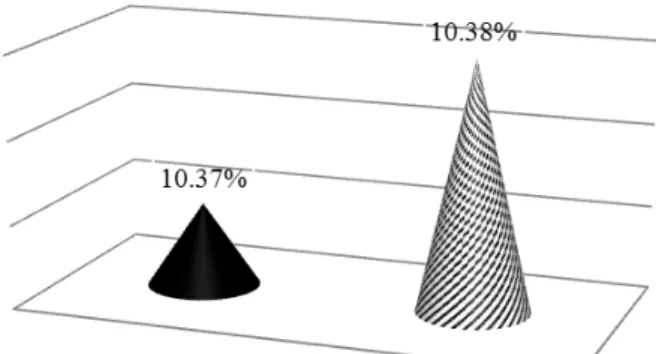
Share of the egg shell of the egg weight
The difference in share of egg shell between
breeding cage system and free range system
during our experiment was negligible and
statistically non-significant
(p ≥ 0.05). Another
conclusion reported by [8] in their study,
according to which the highest share of egg shell
was for eggs of produced in the breeding system
of conventional cages compared to eggs produced
in all other production systems (free range, hall
with deep litter and organic breeding).
Figure 2. Average share of egg shell in the breeding cage system and breeding free range system (%) 10.37
= cage system, 10.38 = free range system.
Table 4. Statistical characteristic and statistical significance of difference in share of egg shell between breeding cage system and breeding free range system
Breeding system n SD CV P0.05
Cage 120 0.5 5.59
Free range 120 0.64 6.17 p ≥ 0.05 SD = standard deviation, CV = coefficient of variation, p ≥ 0.05 = no statistically significant difference.
Average share of egg shell
in the breeding cage
system and breeding free range system in age
30 and 40 weeks of laying
hens
No difference
statistically significant (p ≥ 0.05)
was confirmed also in the share of the egg shell
between different ages of laying hens and between
different breeding systems.
Table 5. Average share of egg shell in the breeding cage system and breeding free range system in age 30 and 40 weeks of laying hens
Breeding system
Cage Free range
Age of hens, weeks n SD CV SD CV
30 60 10.36 0.65 6.27 10.23 0.73 7.14 40 60 10.39 0.49 4.72 10.42 0.53 5.09
= mean,SD = standard deviation, CV = coefficient of variation
Table 6. Statistical significance of difference in the share of egg shell between breeding cage system and free range system depending on age 30 and 40 weeks of laying hens
Breeding system, age of hens
FFree range, week 30
Cage, week 40
Free range, week 40 Cage, week 30 p ≥ 0.05 p ≥ 0.05 p ≥ 0.05 Free range, week 30 p ≥ 0.05 p ≥ 0.05
Cage week 40 p ≥ 0.05
p ≥ 0.05 = no statistically significant difference
Egg shell strength
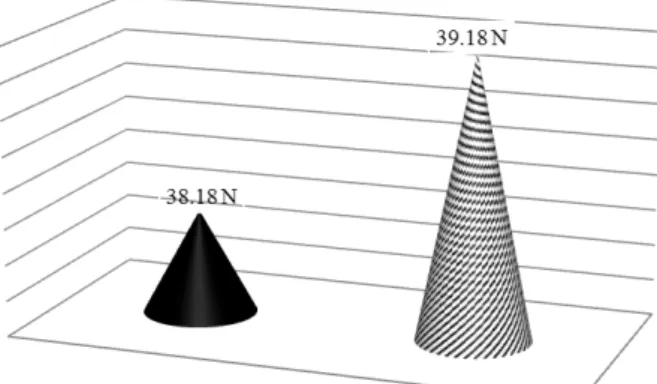
No statistically significant difference (p ≥ 0.05) was
observed in strength of egg shell during our
strength egg shell between the eggs produced in
breeding system of conventional and enriched cages.
Figure 3. Average egg shell strength in the breeding cage system and breeding free range system (N) 38.18
= cage system, 39.18 =free range system.
Table 7. Statistical characteristic and statistical significance of difference in strength of egg shell between breeding cage system and breeding free range
system
Breeding system n SD CV P0.05
Cage 120 5.88 15.40
Free range 120 5.62 14.34 p ≥ .05
SD = standard deviation, CV = coefficient of variation, p ≥ 0.05 = no statistically significant difference.
Table 8. Average egg shell strength in the breeding cage system and breeding free range system in age 30 and 40 weeks of laying hens
Breeding system
Cage Free range
Age of hens, weeks n SD CV SD CV
30 60 37.09 6.38 17.20 38.08 6.06 15.91 40 60 39.27 5.36 13.65 40.28 5.19 12.88
= mean, SD = standard deviation, CV = coefficient of variation.
Table 9. Statistical significance of difference in the egg shell strength between breeding cage system and free range
system depending on age 30 and 40 weeks of laying hens
Breeding system, age of hens
FFree range, week 30
Cage, week 40
Free range, week 40 Cage, week 30 p ≥ 0.05 p ≥ 0.05 p ≥ 0.05 Free range, week 30 p ≥ 0.05 p ≥ 0.05
Cage week 40 p ≥ 0.05
p ≥ 0.05 = no statistically significant difference.
Average
egg shell strength
in the breeding cage
system and breeding free range system in age
30 and 40 weeks of laying hens
No statistically significant difference (p ≥ 0.05)
was observed in egg shell strength also between
different ages of laying hens and the different
breeding systems. Some authors justified the
relation between egg shell quality indicators, such
as between the thickness and strength. Egg shell
strength is directly related to egg shell thickness
[10] and the palisade layer of egg shell comprises
approximately two-thirds of the egg shell [11].
Therefore, it is likely that alterations in the
thickness of the palisade layer, independent of
structural reorganization of the palisade columns,
could affect shell strength. Egg shell strength
ultimately affects the soundness of the shell, with
weaker shelled eggs more prone to cracks and
breakages and subsequently microbial
contamination [12]. Shell strength can be affected
by a wide range of factors.
Egg shell thickness
Figure 4. Average egg shell thickness in the breeding cage system and breeding free range system (mm)
0.486= cage system, 0.468 = free range system.
Table 10. Statistical characteristic and statistical significance of difference in thickness of egg shell between breeding cage system and breeding free range
system
Breeding system n SD CV P0.05
Cage 120 0.028 5.76
Free range 120 0.016 3.42 p ≤ 0.05
SD = standard deviation, CV = coefficient of variation, p ≤ 0.05 = statistically significant difference.
Table 11. Average egg shell thickness in the breeding cage system and breeding free range system in age 30 and 40 weeks of laying hens
Breeding system
Cage Free range
Age of hens, weeks n SD CV SD CV
30 60 0.481 0.009 1.87 0.463 0.047 10.15 40 60 0.492 0.014 2.84 0.473 0.031 6.55
= mean, SD = standard deviation, CV = coefficient of variation.
Table 12. Statistical significance of difference in the egg shell thickness between breeding cage system and free
range system depending on age 30 and 40 weeks of laying hens
Breeding system, age of hens
FFree range, week 30
Cage, week 40
Free range, week 40
Cage, week 30 p ≥ 0.05 p ≤ 0.05 p ≤ 0.05
Free range, week 30 p ≤ 0.05 p ≤ 0.05
Cage week 40 p ≤ 0.05
p ≤ 0.05 = statistically significant difference, p ≥ 0.05 = no statistically significant difference.
Average
egg shell
thickness in the breeding
cage system and breeding free range system in
age 30 and 40 weeks of laying hens
No difference statistically significant (p ≥ 0.05)
was observed in the thickness of the egg shell in
age 30 weeks of laying hens between breeding
cage system and free range system but statistically
significant difference (p ≤ 0.05) was confirmed in
the age 40 weeks of laying hens between breeding
system.
Statistically significant differences (p ≤
0.05) were observed in the thickness of the egg
shell between different ages of laying hens and
different breeding systems. There difference
significant was observed in the thickness of the
egg shell between age 30 weeks of laying hens in
breeding cage system and age 40 weeks of laying
hens in free range system, and between age 30
weeks of laying hens in free range system and age
40 weeks of laying hens in the breeding cage
system. A similar conclusion stated by [13] in his
study, where it is stated that there were significant
differences in egg shell thickness with the
differences of age of laying hens. Older birds tend
to lay bigger eggs and have a higher egg output,
which impacts on shell strength [14].
Very young
birds with immature shell glands may produce
shell-less eggs or eggs with very thin shells
[15]. Interesting results were obtained these
authors. In their study is reported the average
egg shell thickness 0.401 mm. The shell was
significantly (p < 0.01) thicker in the age 28
weeks of group compared to others. As age
advanced the shell thickness gradually
reduced with a significant lower shell
thickness in the age 40 weeks. The higher egg
shell thickness helps in preventing the damage
during handling and also improves the
keeping quality of the eggs.
4. Conclusions
The work is a contribution to the solution of
optimal breeding system for laying hens and
production of high quality and safe table eggs.
Based on the results of investigation and statistical
evaluation of selected quality the indicators egg
shell in age 30 and 40 weeks of laying hens
depending on the breeding system in enriched
cages and free range system can be stated as
follows:
a) Trend (p
≥
0.05) of increase of egg shell weight
was observed in the breeding free range system
compared to the egg shell in the breeding cage
system. Statistically significant (p
≤
0.05) higher
egg shell weight were observed in the age 40
weeks of laying hens in both breeding systems
compared to the egg shell weight in the age 30
weeks of laying hens in both breeding systems.
Statistically significant difference (p
≤
0.05) in
weight of egg shell was observed between
breeding systems in favour of free range system.
b) No statistically significant different (p
≥
0.05)
in share of egg shell and in the egg shell strength
were observed between breeding systems or
between ages of laying hens.
c) Statistically significant difference (p
≤
0.05) in
the egg shell thickness was observed between
breeding cage system and breeding free range
system. Trend (p
≥
0.05) of increase of egg shell
thickness was observed in the breeding cage
system in age 30 weeks of laying hens.
Statistically significant (p
≤
0.05) higher egg shell
thickness was observed in both breeding systems
in the age 40 weeks of laying hens compared to
egg shell thickness in the age 30 weeks of laying
hens. Statistically significant difference (p
≤
0.05)
in egg shell thickness was observed between
breeding systems in favour of breeding cage
system.
References
1. Fraser, A. C., Bain, M. M., A comparison of eggshell structure from birds housed in conventional battery cages and in a modified free range system. Proceedings of the 3th European Poultry Conference, Glasgow, U. K., 1994, pp. 151-152
2. USDA, 2005. Voluntary Grading of Shell Eggs, 7 CFR Part 56. Home page address: http://www.access.gpo.gov/nara/cfr/waisidx_08/7cfr56 _08.html. Accessed January 2, 2008.
3. Abrahamsson, P., Tauson, R., and Elwinger, K., Effects on production, health and egg quality of varying proportions of wheat and barley in diets for two hybrids of laying hens kept in different housing systems, ActaAgriculturae Scandinavica, Section A – Animal Science, 1996, 46, 73-182
4. Angelovičová, M., Ševčíková, V., Bučko, A., Comparison of two different breeding systems laying hens in relation to egg damage and dirty, I, Animal Science and Biotechnologies, 2014, 47, 1, in press 5. Angelovičová, M., Mihálik, V., and Rataj, V., Stability of egg shell depends on nutrition of laying type of hens, International Agrophysics, 1994, 8, 607-610
6. Rataj, V., Determination of strength of agricultural materials by loading, Zemědělská technika, 1994, 40, 87-93
7. Rayan, G.N., Galal, A., Fathi, M. M. and El-Attar, A. H., Impact of Layer Breeder Flock Age and Strain on Mechanical and Ultrastructural Properties of Eggshell in Chicken, International Journal of Poultry Science, 2010, 9, 2, 139-147, 2010. Home page address: http://www.pjbs.org/ijps/fin1639.pdf
8. Hidalgo, A., Rossi, M., Clerici, F., Ratti, S., A market study on the quality characteristics of eggs from different housing systems, Food Chemistry, 2008, 106, 1031-1038.
9. Guesdon V., Faure J. M., Laying performance and egg quality in hens kept in standard or furnished cages, Animal Research, 2004, 53, 45-57
10. Khatkar, M. S., Sandhu, J. S., Brah, G. S. and Chaudhary, M. L., Estimation of egg shell breaking strength from egg characteristics in layer chickens, Journal of Poultry Science, 1997, 32, 111-113
11. Parsons, A. H., Structure of the eggshell, Poultry Science, 1982, 61, 2013-2021
12. Yoruk, M. A., Gul, M., Hayirli, A., and M. Karaoglu, Laying performance and egg quality of hens supplemented with sodium bicarbonate during the late laying period, International Journal of Poultry Science, 2004, 3, 272-278
13. Zaman, M. A., Sørensen, P., and Howlider, M. A. R., Egg production performances of a breed and three crossbreeds under semi-scavenging system of management, Livestock Research for Rural Development, 2004, 16, 8. Home page address: http://www.lrrd.org/lrrd16/8/zama16060.htm
14. Butcher, G. D., Miles, R. D., Factors causing poor pigmentation of brown shelled eggs, University of Florida, 2003. Home page address: