AN ALAYSIS OF MACHINE LEARNING PREDICTION ALGORITHM
TO DETERMINE BEST PERFORMING ROUTES IN COGNITIVE
RADIO NETWORKS
Abhishek Kumar Gupta
1, Dr.K. P. Yadav
2Department of Computer Science and Engineering
1,2
OPJS University, Churu (Rajasthan) – India
Abstract
The Cognitive Radio Network is an innovative software-defined radio technique viewed as one of the promising technologies to enhance the use of the clogged RF spectrum. Receiving CR is inspired by the fact that an expansive bit of the radio spectrum is underutilized often. In CR networks, secondary system/users can share spectrum bands with the authorized primary system/users, either on a sans interference premise or on an interference-tolerant premise. The primary objective of a Cognitive Network is to build network efficiency and performance. The important part of a cognitive network is that it improves data communication for the entire network between the sender and the recipient to meet the expected end-to-ultimate objectives of users of the network. While spectrum sensing techniques and spectrum sharing solutions are two important perspectives that have gotten the consideration of the CRN community, steering in CRNs remains an important yet unexplored angle. A few steering measurements were proposed; These measurements will be utilized to gather data concerning the quality of the courses and the data will be utilized to model the prediction algorithm.
1. INTRODUCTION
Cognitive Radio innovation is since the authorized users (additionally named primary users, PUs) are not continually utilizing their spectrum bands; CR brings new radio sorts cognitiveradios that ought to the right off the bat, recognize the current spectrum openings, and also, use them in an adaptable way, as per an access medium plan. CRs have likewise been proposed for a wide range of applications including Internet of Things, 5G wireless networks and smart matrix communications. CR guarantees to dramatically enhance spectrum access, limit, and connection performance while likewise fusing the necessities and the setting of the client. CRs
are progressively being seen as a fundamental part of cutting-edge wireless networks. Regular network advances bundles utilizing steering algorithms and identifies disappointments after parcels are lost.
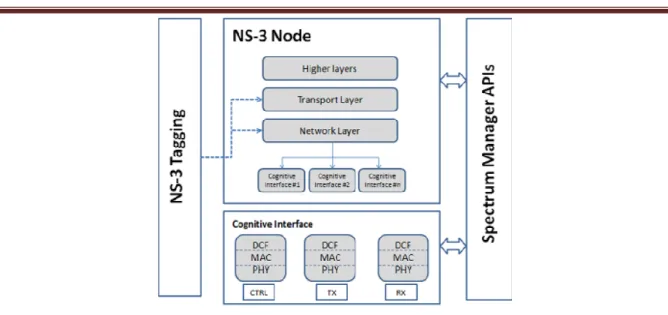
Figure 1: Layered Architecture of an NS-3 CR node The TX Distributed Coordination Function
(DCF) will also be modified to store queued packets into different MAC queues based on the channel that they should be transmitted on. This will help the TX interface select which packets to transmit when it switches spectrum. At the physical layer (PHY), a new sensing state will be added. The functionality of the sensing state is similar to that of the handoff state where the PHY layer instructs the DCF to halt dequeueing from the respective MAC queue, while the sensing or hand-off operation is ongoing.
The sensing and hand-off times can be defined using the ns-3 attribute system. The sensing state in the PHY layer uses the Spectrum Manager APIs which queries the PU Database to determine PU activity. Note that the PHY layer can switch between any numbers of defined channels. These channels can have a different frequency, propagation path loss and delay models, as defined by the default ns-3 simulation environment.
2. BAYESIAN LEARNING: MASSIVE MIMO AND COGNITIVE RADIO
The rationality of Bayesian learning is to process the a posteriori likelihood appropriation of the objective factors adapted on its information signals and on the majority of the preparation cases. Some straightforward instances of generative models that might be educated with the guide of Bayesian techniques incorporate however are not restricted to, the Gaussians mixture model (GM), expectation maximization (EM), and hidden Markov models (HMM). GM is where every datum point belongs to one of a few bunches or groups, and the data focuses inside each bunch are Gaussian dispersed.
through a Markov process as opposed to being free of the one another. The Bayesian learning model might be promptly conjured for spectral characteristic learning and estimation in cutting edge networks.
To address the pilot sullying problem experienced in monstrous MIMO systems, the channel parameters of the ideal connections in an objective cell and in addition those of the interfering connections of the contiguous cells, where channel estimation was done with the guide of meager Bayesian learning techniques. Based on the perception of got signals, the channel part was first modeled by a GM, to be specific by a weighted whole of Gaussian appropriations having diverse fluctuations, and after that evaluated with the guide of the EM algorithm. Another three firmly related applications might be found in cognitive radio networks. A cooperative wideband spectrum sensing plan based on the EM algorithm was proposed for the identification of a primary client (PU) supported by a multi-antenna helped cognitive radio network.
This iterative technique previously made the log-probability function of both the obscure spectrum inhabitance and of the channel data and of the clamor in the "E" step. At that point, it amplified the log-probability function for inducing the obscure data amid the "M" step, which was done by mutually distinguishing both the PU signal and in addition evaluating the channel's obscure frequency reaction and the clamor change of multiple subbands. Gee on a two-state hidden Markov process, where the PUs are available or missing and a two-state perception space, demonstrating whether the PUs are available or missing.
3. UNSUPERVISED LEARNING IN
WIRELESS COMMUNICATIONS
K-MEANS CLUSTERING:
HETEROGENEOUS NETWORKS
K-means clustering goes for partitioning n perceptions into k groups, where every perception belongs to the nearest bunch. It characterizes the centroid of a bunch as the focal point of gravity, that is, the mean estimation of the points inside the group. The clustering algorithm continues in an iterative way, where an item is appointed to the explicit bunch whose centroid is nearest to the article based on the Euclidean separation 'similitude metric,' and after that, the in-group contrasts are limited by iteratively refreshing the bunch centroid until 'union' is accomplished. Unequivocally, the union is esteemed to be accomplished when the task winds up stable, that is, bunches framed in the current round are equivalent to those shaped in the past round.
Applications: Clustering is a typical problem in 5G networks, particularly in heterogeneous situations related with different cell sizes and also WiFi and D2D networks. For instance, the little cells must be cautiously grouped to stay away from interference utilizing coordinated multi-point transmission (CoMP), while the mobile users are bunched to comply with an optimal offloading arrangement, the devices are bunched in D2D networks to accomplish high vitality efficiency, and the WiFi users are grouped to keep up an optimal access point association, etc.
algorithm, the MAPs are isolated into k groups related with the nearest GAPs.
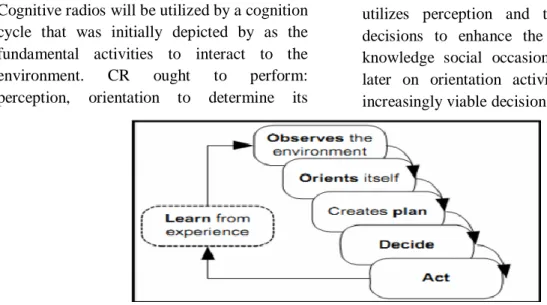
Cognitive radios will be utilized by a cognition cycle that was initially depicted by as the fundamental activities to interact to the environment. CR ought to perform: perception, orientation to determine its
significance, makes an elective arrangement, settle on the decision and after that execute the actions. At last, is the learning activity that utilizes perception and the result of the decisions to enhance the radio task? This knowledge social occasion will be misused later on orientation activities to create an increasingly viable decision.
Figure 2: Mitola’sSimplified Cognition Cycle The sensing, learning and thinking conduct of
the two CRs and SON is accomplished by broadly utilizing artificial intelligence (AI) and machine-learning techniques. The CRs are an advanced type of SDRs, realized by the epitome of the cognitive engine (CE) that abuses the AI techniques for the cognitive conduct to decide optimally. The CR network
(CRN) pursues the cognitive cycle, for unparalleled resource management and better network performance. Cognitive cycle, starts with the sensing of dynamic radio environment parameters, along these lines watching and learning recursively the detected qualities for reconfiguration of the basic parameters to accomplish the ideal targets.
Figure 3: Learning Process in Cognitive Radios 4. ARTIFICIAL INTELLIGENCE BASED
COGNITIVE ROUTING FOR
COGNITIVE RADIO NETWORKS
realized through fuse of substantial computational or artificial intelligence (AI)— particularly, machine learning, knowledge thinking and normal dialect processing into SDR equipment. In an advanced setting, this is accomplished by consolidation of a cognitive engine (CE) using different AI-based techniques through which the CR adapts to the network conditions to fulfill some idea of optimality. CRs have additionally been proposed for a wide range of applications including canny transport systems, open wellbeing systems, femtocells, cooperative networks, dynamic spectrum access, and smart matrix communications.
With a large portion of the radio spectrum as of now being authorized in this mold, advancement in wireless innovation is compelled. The problem is aggravated by the perception, imitated in various estimation based examinations world over, that the authorized spectrum is terribly underutilized. The DSA worldview proposes to permit secondary users (SUs) additionally called cognitive users, access to the authorized spectrum subject to the condition that SUs don't interfere with the activities of the primary network of occupants. While CRs have been defined in an unexpected way, the accompanying tasks are viewed as essential to them:
i) Observation or awareness, ii) Reconfiguration, and iii) Cognition.
In this research, we will be possessed for the most part with cognition as we look to build cognitive, AI-based, steering conventions. Cognition subsumes both thinking and learning with the thinking is the process of finding the fitting action for particular circumstances to meet some system target, and learning being the process of aggregating
knowledge based on the aftereffects of past actions. As a rule, cognition for a CR involves understanding and thinking about the radio environment so educated decisions might be taken to upgrade the performance of the radio and the general network. Both learning and thinking are basic components of cognition, and a ton of research consideration has appropriately centered on joining cognition in CRs.
5. MACHINE LEARNING ALGORITHMS FOR COGNITIVE RADIO WIRELESS NETWORKS
In many countries around the globe, the electromagnetic spectrum assigned to wireless networks and services is managed by governmental regulatory bodies. For example, there is the European Telecommunications Standards Institute in Europe (ETSI) and the Federal Communications Commission’s (FCC) in United States. These governing bodies are saddled with the responsibility of allocating spectral frequency blocks to specific groups or companies. More often than not, the allocation process involves
(i) Partitioning of the spectrum into distinct bands, with each band spanning across a range of frequencies;
(ii) Assigning specific communication services to specific bands, and (iii) Deciding the licensee for each
band who usually is given the exclusive right over the use of the allocated frequency band.
the common frequency spectrum is being dispensed. This worry is further being elevated by the regularly expanding demand for higher data rates as wireless communication innovation propels from voice just communications to data concentrated multimedia and interactive services currently being universally conveyed.
For instance, examines led in the United States have uncovered that in many areas, just 15% of spectrum is utilized. All the more specifically, a field spectrum estimation taken in New York City demonstrated that the maximum total spectrum inhabitance for bands from 30MHz to 3GHz is just 13.1 %. The comparative outcome was additionally acquired in the most swarmed region of downtown Washington, D.C., where inhabitance of fewer than 35 % is recorded for the radio spectrum underneath 3 GHz.
Also, spectrum utilization likewise shifts significantly at a different time, frequency and geographic areas. Cognitive radio (CR) is a developing innovation that can effectively manage the developing demand and shortage of the wireless spectrum. It is a worldview of wireless communication in which a wise wireless system uses data about the radio environment to adapt its working characteristics to guarantee solid communication and effective spectrum usage. Recently, a few IEEE 802 measures for wireless systems have considered cognitive radio systems, for example, IEEE 802.22 standard and IEEE 802.18 standard.
6. CONCLUSION
Machine learning approaches are additionally consolidated to decide the accessible range. In light of the highlights of the signal got, diverse machine learning techniques are as connected, for example, minimum square rationale
relapse; bolster vector machine, and complex inclining. The element separated can likewise be anticipated to a higher component space so classification execution can be additionally made strides. In light of the guidelines characterized, each haze node can reason and pick the best range contender to transmit the signal without meddling with the authorized genuine essential clients. The signal could be prepared by the nearby nodes promptly, while the neighborhood node can likewise send the signal outline to the cloud with the goal that the choice principles at the edge nodes depend on can be refreshed progressively.
REFERENCES
[1].Y. Cui, X. jun Jing, S. Sun, X. Wang, D. Cheng, and H. Huang, ―Deep learning based primary user classification in cognitive radios,‖ in Proc. Int. Symp. Commun. and Inform. Tech., Nara, Japan, Oct. 2015, pp. 165–168.
[2].M. Ghozzi, F. Marx, M. Dohler, and J. Palicot, ―Cyclostatilonarilty-based test for detection of vacant frequency bands,‖ in Proc. Int. Conf. Cognitive Radio Oriented Wireless Networks and Commun., Mykonos Island, Greece, Jun. 2006, pp. 1–5.
[3].Z. Quan, W. Zhang, S. J. Shellhammer, and A. H. Sayed, ―Optimal spectral feature detection for spectrum sensing at very low SNR,‖ IEEE Trans. Commun., vol. 51, pp. 201–212, Jan. 2011.
[4].Y. Zeng and Y.-C. Liang, ―Spectrum-sensing algorithms for cognitive radio based on statistical covariances,‖ IEEE Trans. Veh. Tech., vol. 58, no. 4, pp. 1804–1815, May 2009.
cooperative spectrum sensing for cognitive radio,‖ IEEE J. Sel. Topics Signal Process., vol. 5, no. 1, pp. 49– 55, Feb. 2011.
[6].M. Ghozzi, M. Dohler, F. Marx, and J. Palicot, ―Cognitive radio: methods for the detection of free bands,‖ ComptesRendus Physique, vol. 7, no. 7, pp. 74–81, 2006.
[7].R. Tandra and A. Sahai, ―SNR walls for signal detection,‖ IEEE J. Sel. Topics Signal Process. vol. 2, no. 1, pp. 4–17, Feb. 2008.