Volume XIII (2015), Page 123 - 138
SUSTAINABLE GOVERNANCE IN RELATION TO THE FINANCIAL ASPECT IN MANAGING COASTAL AREAS: MALAYSIAN
EXPERIENCE
M. Zainora Asmawi1, Lukman Hakim Mahamod2, Mohd Zin Mohamed3 &
Tuminah Paiman4
1,2,3&4
Kulliyyah of Architecture & Environmental Design INTERNATIONAL ISLAMIC UNIVERSITY MALAYSIA
Abstract
Managing natural resources sustainably is essential in this contemporary era of land use planning system. This includes managing and planning the invaluable of coastal areas. In this regards, coastal management programmes have been regarded as a key approach in delivering the coastal strategies and objectives towards achieving a sustainable coastal development worldwide. This is supported by the good governance to ensure that the implementation of coastal development is successful. As such, this paper suggests that the aspect of good governance as one essential element of coastal management that can and should make a substantial contribution to planning and managing coastal land uses in Malaysia. It has many positive implications to the environmental, social and economic sectors. The experience of Lembaga Urus Air Selangor (LUAS) in managing the coastal areas via the implementation of good governance indicates the requirement of good governance in ensuring a successful coastal management. In addition, financial element has become a significant attribute in implementing coastal management initiatives. This study offers input in planning literatures by addressing the integration of coastal management, good local governance, land use planning and financial elements which are very relevant with today‘s current global changes on environment as a whole.
Keyword: Governance, coastal management; financial; town planning; land use; sustainable.
ERRATUM
INTRODUCTION
Coastal management (CM) programmes have been acknowledged as an essential approach in delivering the coastal strategies and objectives towards achieving a sustainable coastal development. Globally, it is increasingly seen as an effective management tool working across sectoral, disciplinary and institutional boundaries to manage coastal resources (Asmawi, 2010). It has many positive implications to the environmental, social and economic sectors. Its universal framework is applicable to any desired country to fulfil the nation aspiration to moving ahead in physical and socio-economic development and growth. In this regards, the financial factor has become a significant attribute in implementing CM initiatives. Many literatures demonstrate the influence and importance of financial in the practice of CM (refer Milne and Christie, 2005; Salamanca, 2003; Pomeroy, Oracion, Pollnac and Caballes, 2005; and Chua, 2001). Of the particular concern nowadays, the implementation of governance for sustainable coastal development is considered as a key driven factor in managing coastal areas as a whole. As such, this paper discusses the relationship established between CM and financial aspects from the perspective of good governance which is considered as the field that has the ‘power’ to control and regulate land use changes within the land-side areas. The aim of this paper is to illustrate a review that could move the management of coastal areas towards a sustainable outcome by looking at what driven by the question: what institutional arrangement and governance mechanisms could facilitate the delivery of a sustainable coastal development? Evidence is presented through reviewing the status quo of coastal management in relation to financial aspect and governance aspect based on the collection of series of secondary data pertaining to the subject matter. The approach used in this study refers to the pertinent lessons learnt from the discussion on case studies in relation to the aspect of good governance and financial aspect.
REVIEWING THE COASTAL MANAGEMENT IN MALAYSIA
Coastal Resources and their Management
dimensional ways. According to Klee (1999), the constant change in the coastal zone is due to three natural factors: terrestrial factors; marine factors; and biological factors.
Coastal Management in Malaysia
Malaysia is considered to be a maritime country as it is virtually surrounded by sea with abundant environmental resources for economic development. Together, Peninsular Malaysia, Sabah and Sarawak on the island of Borneo have a coastline of total length 4,810km. There is no state within the country that does not have a coastal area. The coasts of Malaysia experience enormous and numerous environmental and ecological problems due to massive development. The main problems are: beach erosion; resource depletion; environmental degradation; and destruction of natural habitat (Abdul Salam, 1998; Basiron, 1998; Cicin-Sain & Knecht, 1998); multiple use conflicts and multiple stakeholders with differing interests (Basiron, 2000); population expansion and rapid urbanisation (Chong A., 2001); massive tourism and recreational development (Che Omar, 1992); and agricultural development, transportation and navigation (Mokhtar & Aziz, 2003). Abdullah (1999) includes other problems such as uncontrolled sand mining activities and over-exploitation of fishery resources. Recognising the importance of CM, the government has taken preliminary initiatives by providing many development guidelines about how to protect coastal areas although a sectoral approach is currently applied. The evolution of CM initiatives in Malaysia is generally driven by a problem-based and reactive approach to resource degradation and international commitments (Basiron, 2000; Mokhtar & Aziz, 2003; Siry, 2006).
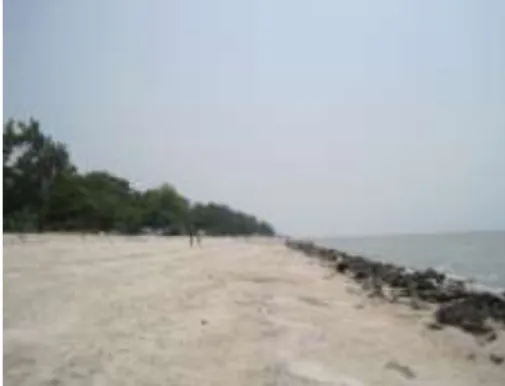
Figure 1: Pantai Remis in Kuala Selangor district is facing erosion problem that requires coastal deference work to curb it.
2006). Malaysian CM is complicated by the involvement of a variety of agencies that operate by sectors (Saharuddin, 2001). Abdul Salam (1998) states that the involvement of many sectors creates conflict of interest, overlapping and duplication. The main government departments which have a sectoral interest in coastal issues are the Department of Irrigation and Drainage (DID), the Department of Environment (DOE), the Town and Country Planning Department (TCPD) and the Department of Fisheries (DOF).
In Malaysian experience, the first pilot CM project was undertaken at State level in South Johore (Chua & Scura, 1992; Ministry of Science, Technology and the Environment, 1992). Three pilot projects were undertaken in Sabah, Sarawak and Penang (1996), with assistance from the Danish Co-operation for Environment and Development (DANCED) and the Economic Planning Unit (EPU) (Cho, 2002; Pedersen et al., 2005; Siry, 2006). The overall objective of the pilot projects was to understand the processes and mechanisms that were needed in the formulation and implementation of CM policy at State level. The national objective was to develop the process for formulating a national policy for CM that will provide clear principles and guidelines (Ibrahim, 1999) and to strengthen interstate and Federal-State co-operation in relation to CM (Pedersen et al., 2005). Port Klang CM programme was undertaken in 2001 which operated at a local level. It was launched as a smart partnership under the ‘Partnership in Environmental Management in South East Asia’ (PEMSEA) initiative with the International Maritime Organisation (IMO) (Mohd Sharif, 2003). Sabak Bernam and Kuala Selangor CM plans were recently (2011) launched under the same arrangement of partnership, undertaken by Lembaga Urus Air Selangor (LUAS). However, the success of these CM plans still has to be evaluated.
Institutional Arrangements for Coastal Management in Peninsular Malaysia Malaysia currently practises a three-tier system of government: Federal; State; and Local Authorities. This system has major influence on the development and management of land, water and natural resources. It is important to understand the constitutional arrangements about the executive, administrative and legislative boundaries between the Federal and State Governments. The distribution of legislative competence can be found under Part VI of the Federal Constitution 1957 (Government of Malaysia, 1999). Article 73 of Part VI and the Ninth Schedule divide the subject matter of the Federal and State legislative power into three parts in which the coastal matters are listed in 1.
Table 1: The division of power between levels of Malaysian Government on coastal matters
List Subjects that have a coastal significance List I: The Federal List
(those matters enumerated on which Parliament may enact laws)
shipping and navigation on the high seas and in tidal and inland waters;
ports and harbours;
lighthouses and other provisions for the safety of navigation; maritime and estuarine fishing and fisheries (excluding turtles);
light dues; wreck and salvage;
federal works on water supplies, rivers and canals (except those wholly within one State);
scientific and technical research; tourism; and
industry. List II: The State List
(those matters enumerated on which State legislatures may enact laws
all land matters; agriculture and forestry; Local Government;
state work and water (water supplies, rivers and canals); and
turtles and riverine fishing. List III: The Concurrent
List (the common subject-matter on which both the Parliament and the state legislatures have competence
protection of wild animals and wild birds; national parks;
animal husbandry; town and country planning; public health;
drainage and irrigation;
rehabilitation of mining land; and housing.
Source: Government of Malaysia (1999); Usuluddin (1999)
particular functions and resources to oversee. Where coastal resources are concerned, it can be briefly said that water and land matters fall within the jurisdiction of the State Government and entails development planning and zoning, as well as other activities. In relation to biological resources, work is shared between the Federal and State Governments. In this case, the LPAs, together with relevant government agencies, act as a channel of communication for both the Federal and State Governments (Mokhtar & Aziz, 2003). Abdul Salam (1998) says that each State Government has constitutional rights and authority over land, minerals and the marine environment up to three nautical miles from the coastline. The Federal Government has jurisdiction beyond three nautical miles offshore (Abdullah, 1999; Syed Abdullah, 1992).
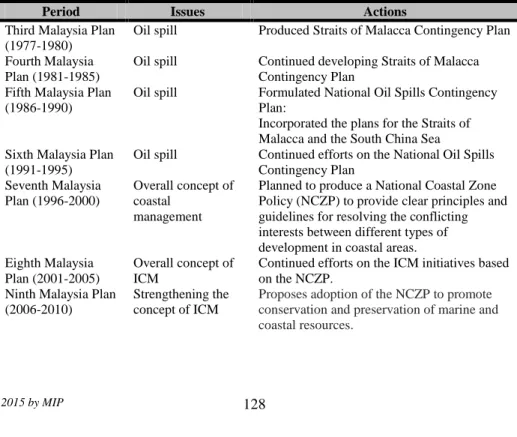
Malaysia has continuing 5-year national development plans, called Malaysia Plans. They set out the macroeconomic growth targets to achieve Outline Perspective Plans (OPPs) which provide the broad thrusts and strategies in the development agenda for Malaysia in the long-term (30 years) (Economic Planning Unit, 2004). Currently, the Tenth Malaysia Plan (2011-2015) is being implemented. However, coastal issues were not included in Malaysia Plans until the Third Malaysia Plan (1977-1980) (Table 2). This introduced policy on oil spills. Later, the Seventh Malaysia Plan (1996-2000) stated that a National Coastal Zone Policy (NCZP) would be produced for the country. The study for the NCZP was commenced during the Eighth Malaysia Plan (2001-2005).
Table 2: The coverage of coastal issues in Malaysia Plans
Period Issues Actions
Third Malaysia Plan (1977-1980)
Oil spill Produced Straits of Malacca Contingency Plan
Fourth Malaysia Plan (1981-1985)
Oil spill Continued developing Straits of Malacca Contingency Plan
Fifth Malaysia Plan (1986-1990)
Oil spill Formulated National Oil Spills Contingency Plan:
Incorporated the plans for the Straits of Malacca and the South China Sea Sixth Malaysia Plan
(1991-1995)
Oil spill Continued efforts on the National Oil Spills Contingency Plan
Seventh Malaysia Plan (1996-2000)
Overall concept of coastal
management
Planned to produce a National Coastal Zone Policy (NCZP) to provide clear principles and guidelines for resolving the conflicting interests between different types of development in coastal areas. Eighth Malaysia
Plan (2001-2005)
Overall concept of ICM
Continued efforts on the ICM initiatives based on the NCZP.
Ninth Malaysia Plan (2006-2010)
Strengthening the concept of ICM
Tenth Malaysia Plan (2011-2015)
Implementing some initiatives on coastal management
Preparation of National Physical Plan-Coastal Areas by the Federal Town and Country Planning Department and other initiatives.
Source: Economic Planning Unit, 1977; 1981; 1986; 1991; 1996; 2001;2006; 2010.
FINANCIAL
ASPECT
IN
COASTAL
MANAGEMENT
PROGRAMMES
Integrating the financial aspect in CM approach is important especially in understanding the cost of undertaking one and ascertaining whether the outcomes are worth the money spent (Salamanca, 2003). In addition, Pollnac and Pomeroy (2005) state that financial investment is the backbone of successful CM. Without the essential financial support, CM will not be initiated and implemented. In Malaysia, research on the incorporation of costing impact factor in CM initiatives is currently unavailable. Though several programmes on CM have started and are on-going stages, no studies have tried to account the total level of investment. Case studies from other countries in the regional setting, e.g. the Philippines, also indicate that there is lacking of research on the relationship between financial and CM. Literature shows that the success of most CM programmes depends, largely, on the ability of municipalities to secure adequate financial for CM initiatives (Milne & Christie, 2005). The financial element can be especially important in future planning of coastal areas, particularly if the sources of fund are limited. Knowing the costing aspect in coastal management approach is important especially in understanding the cost of undertaking one and ascertaining whether the outcomes are worth the money spent (Salamanca, 2003). In addition, Pollnac and Pomeroy (2005) state that financial investment is the backbone of coastal management. Without the essential financial support, coastal management will not be initiated and implemented.
Local Planning Authority (LPA) is responsible for the implementation of CM programmes in which they need to decide on the measures to be implemented in the maintenance and up-keep of the shoreline. These decisions have to be appropriate for the sustainability of the habitats. Persson (2010) states that coastal habitats are valuable for the biodiversity of their fauna and flora while the dunes and wetlands provide flood control, drinking water, and waste assimilation, and beaches are valuable assets for tourism and recreation. He addresses that tools for taking account of costs and benefits are necessary for the establishment of priorities in CM:
i. between different areas in need of help because of the shoreline being threatened; and
For instance, there are three levels of response in efforts to combat coastal erosion and its negative impacts on society can be distinguished in the appraisal of projects in this area. Figure 1 shows the associated aspects, i.e. planning or policy, engineering or implementation, and financial aspect used in order to handle the coastal issue. The appraisal for measures includes identifying problems, risk assessment of the alternative solutions, implementing the chosen programme and evaluating the impact to the environment and society. It is crucial to assess the effect as sustainability is the main goal of any CM programme. “Qualifying the effects” means assigning a qualitative value to each of the identified effects. The values can be monetary or non-monetary where monetary values can be represented by investment costs, production losses, and costs of restoring damage. Non-monetary values include classification and ordinal or interval scales that describe the effects of different alternatives. Nonetheless, the problem with monetary qualification lies in the actual appropriateness of making trade-offs between different costs and benefits and the transfer of wealth that can occur. In Malaysia scenario, studies on the inter-relationship between CM, TP and financial aspect are very limited either in academic literatures or practice. It is hoped that this paper could contribute to increasing the value of life by addressing the important linkage of various disciplines.
Figure 3: Level of Response Involved in Combating Coastal Erosion
PLANNING OR POLICY
• Policy options eg. 'hold the line', 'move seaward', managed realignment' and 'no active intervention'.
• Involves an understanding of natural coastal processes and awareness of the strategic sediment reservoirs that exist (EUrosion, 2004).
ENGINEERING OR IMPLEMENTATION • Hard and soft mitigation measures.
• Hard techniques, eg. breakwaters, gabions, geo-textiles, groin fields, revetments, sea walls.
• Soft techniques, eg. beach nourishment, reprofiling, dune and marsh regeneration, vegetaion planning, beach and cliff drainage.
FINANCIAL ASPECT
• Measures and incentives for controlling excess coastal urbanisation and tourism (development and land use taxes), promoting restoration and cultivation, arranging for the resettlement of the at-risk coastal population (financial compensation).
THE RELEVANCE OF TOWN PLANNING TO COASTAL
MANAGEMENT
It is observed that CM has some objectives that can only be achieved by curtailing development. Only TP has the power that lies in a statutory regime. Therefore, CM must be able to communicate, co-ordinate, co-operate and collaborate in partnership efforts within the scope of TP. At a local level, the TP system can make a contribution to CM by using its development plan and development control systems as shown in Figure 2. Coastal policies could be incorporated into development plans and development control decisions made based on development plans.
Figure 4: A Generic Relationship between Town Planning and Coastal Management
LUAS
EXPERIENCE
IN
GOVERNING
PORT
KLANG
INTEGRATED COASTAL MANAGEMENT (ICM) PROGRAMME
The ICM initiative in Port Klang was set up as part of various efforts, involving several coastal nations in south-east Asian region. The International Maritime Organisation (IMO) established a Regional Programme office in Manila, Philippines, under the ‘Partnership in Environmental Management for the Seas of East Asia’ (PEMSEA) programme. Port Klang was chosen as ‘pioneer area and National Demonstration site’ under the PEMSEA programme. The programme was known as Port Klang Coastal Strategy.
The project area covers 7,960 kilometres squareand comprises the Klang District, the Hulu Langat District and all the islands that fall under the jurisdiction of these districts (Figure 3). There are two local authorities involved: Klang Municipal Council; and Kuala Langat District Council. This project area is sufficiently close to Kuala Lumpur to experience its direct influence and impacts on the eastern part of the area.
DEVELOPMENT PLAN: development
policies & strategies
DEVELOPMENT CONTROL: controls and regulates coastal
land uses
Figure 5: Location of Port Klang ICM programme
Source: Based on Port Klang ICM Project, 2004a
The coastal of Port Klang are important for many reasons: as a source of livelihood; for its natural beauty; for its ecological functions; for its historical and cultural heritage; and for its economic activities. This area has experienced both the positive and negative impacts of development within its catchment, including generating employment in tourism and beach erosion. Thus, there is a need to harmonise economic development and environmental conservation.
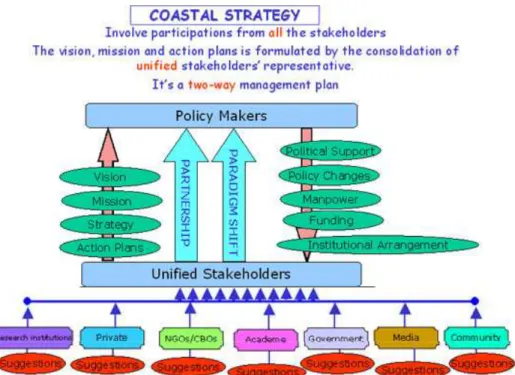
Figure 6, which is taken directly from Port Klang ICM Project (2004b) demonstrates the process by which the strategy was prepared. It indicates the two-way communication between policy makers and stakeholders with support from other relevant parties such as research institutions and academics. The policy making components in the Port Klang ICM programme consist of various elements including political support, policy changes, manpower, funding and institutional arrangements.
Figure 6: Relationship between policy makers and stakeholders in Port Klang ICM programme
Source: Port Klang ICM Project, 2004b
The programme demonstrates that funding is one of key elements in implementing coastal strategies in the study area. However, the current practice indicates that there is lacking of coordination among the stakeholders in which it is done in a disintegrated manner. As a result, the element of funding does not involve properly in the programme which it leads to several issues, as follows:
ii. record on itemised budgeting and spending expenditure is hardly available to see the priority sector of coastal management; and
iii. the importance of funding element in supporting the success of coastal management programme is not recognised in the study area.
Some lessons could be learnt from the case of LUAS. Firstly, the experience of LUAS in governing the implementation of its coastal management offers opportunities for improvement in order to establish a good governance of funding element in supporting coastal management initiatives. Secondly, from the planning perspective, financial aspect is regarded as an important factor that can boost the implementation activities involved in planning coastal land use to ensure that a sustainable coastal development can be attained in the longer term. Thirdly, the support from good governance will ensure the sustainability of managing coastal areas.
CONCLUDING REMARKS
REFERENCES
Abdullah, K. (1999). Malaysian coastal environment: planning, development and management of the environment in preparation for the next millennium. Proceeding of the international symposium and exposition on coastal environment and management: challenges in the new millennium. 13-15 October, 1999. Kuala Lumpur, Malaysia.
Abdul Salam, M.N. (1998). An Overview of Integrated Coastal and Estuarine Area Management, Kuala Lumpur: World Wildlife Fund-Malaysia. Asmawi, M. (2010). Integrated Coastal Management and Town Planning in
Peninsular Malaysia: Concept and Practice, Mauritius: VDM Publishing.
Basiron, M.N. (1998). The implementation of chapter 17 of Agenda 21 in Malaysia: challenges and opportunities. Ocean and Coastal Management, 41, 1-17.
Basiron, M.N. (2000). The development of a coastal zone management policy for Malaysia. Tropical Coast, 7(2), 44-51.
Che Omar, C. M. (1992). Planning of coastal areas and nature conservation: a search for new approach. Proceeding of the conference on planning towards a caring society. Malaysia: EAROPH.517-528.
Cho, F. (2002). Integrated coastal zone management: issues and concerns. Proceeding of the conference on sustainability science and management: issues of the coastal zone Malaysia. Kuala Lumpur.
Chong, A. (2001). Integrated coastal zone management project: visions, strategies and planning. Proceeding of the conference on effective and efficient strategic project management: strategies, planning, tools and techniques, implementation and control. Kuala Lumpur: Asia Diligence Sdn. Bhd.
Chua, T.-E. and Scura, L.F. (1992). Integrative framework and methods for coastal area management. Manila: ICLARM.
Chua, T.-E. (2001). Developing sustainable financing mechanisms for coastal and marine environmental management. GEF/UNDP/IMO Regional Programme on Partnership in Environmental Management for the Seas of East Asia. Quezon City, Philippines.
Cicin-Sain, B. and Knecht, R.W. (1998). Integrated coastal and ocean management: concepts and practices. USA: Island Press.
Economic Planning Unit. (2004). Development planning in Malaysia. Kuala Lumpur: National Printing Department.
Government of Malaysia. (1999). Federal Constitution. Kuala Lumpur: National Printing Department.
management: challenges in the new millennium. 13-15 October, 1999. Kuala Lumpur, Malaysia.
Klee, G.A. (1999). The Coastal Environment: Toward Integrated Coastal and Marine Sanctuary Management, New Jersey: Prentice Hall.
Milne, N. and Christie, P. (2005). Financing integrated coastal management: experiences in Mabini and Tingloy, Batangas, Philippines [Electronic version], Ocean and Coastal Management, 48, 427-449.
Mokhtar, M. & A.Ghani Aziz, S.A. (2003). Integrated coastal zone management using the ecosystems approach: some perspectives in Malaysia [Electronic version]. Ocean and Coastal Management, 46, 407-419. Moss, T., 2004. The governance of land use in river basins: prospects for
overcoming problems of institutional interplay with the EU Water Framework Directive. Land Use Policy, 21, 85–94.
Persson, M. (2010) Impact assessment and project appraisal in cases of coastal erosion. International Journal of Disaster. Resilience in the Built Environment, 1(3), 297-309.
Port Klang ICM Project. (2004a). Port Klang ICM. Retrieved July 28, 2011, from http://luas.gov.my/icm/portklang_coastalink/icm_story.htm
Port Klang ICM Project. (2004b). Stakeholders policy makers relations.
Retrieved July 27, 2011, from
http://luas.gov.my/icm/knowledge_center/organizational_linkage.htm Pedersen, J.D., Beck, S., Johansen, H.B. & Jensen, H.B. (2005). Capacity
development in integrated coastal zone management: some lessons learned from Malaysia [Electronic version]. Coastal Management, 33, 353-372.
Pollnac, R. & Pomeroy, R. (2005). Factors influencing the sustainability of integrated coastal management projects in the Philippines and Indonesia, Ocean and Coastal Management, 48(3-6), 233-251.
Pomeroy, R.S., E. G. Oracion, R. B. Pollnac & D. A. Caballes. (2005). Factors influencing the sustainability of integrated coastal management projects in the Philippines. Ocean and Coastal Management, 48(3-6), 360-377. Salamanca, A. M. (2003). The cost of action: CRM investment in the Philippines.
[Electronic version]. NAGA, WorldFish Center Quarterly, 26, 25-29. Saharuddin, A. H. (2001). National ocean policy - new opportunities for
Malaysian ocean development [Electronic version]. Marine Policy, 25, 427–435.
Siry, H.Y. (2006). Decentralized coastal zone management in Malaysia and Indonesia: a comparative perspective. [Electronic version]. Coastal Management, 34(3), 267–285.
Syed Abdullah, S.M. (1992). Development plan for coastal zone management in Malaysia: issues and recommendations. In Tjia H.D. and Syed Abdullah, S.M. (Eds.), The coastal zone of Peninsular Malaysia (pp. 63-71). Kuala Lumpur: Universiti Kebangsaan Malaysia.