P Eva Julianti, Dlis Firmansyah, Asmawi Moch. The Effect of Physical Activities on Physical Education Learning Outcomes. Journal of Education, Health and Sport. 2019;9(11):100-109. eISSN 2391-8306. DOI http://dx.doi.org/10.12775/JEHS.2019.09.11.007
https://apcz.umk.pl/czasopisma/index.php/JEHS/article/view/JEHS.2019.09.11.007 https://zenodo.org/record/3540932
The journal has had 5 points in Ministry of Science and Higher Education parametric evaluation. § 8. 2) and § 12. 1. 2) 22.02.2019. © The Authors 2019;
This article is published with open access at Licensee Open Journal Systems of Kazimierz Wielki University in Bydgoszcz, Poland
Open Access. This article is distributed under the terms of the Creative Commons Attribution Noncommercial License which permits any noncommercial use, distribution, and reproduction in any medium, provided the original author (s) and source are credited. This is an open access article licensed under the terms of the Creative Commons Attribution Non commercial license Share alike.
(http://creativecommons.org/licenses/by-nc-sa/4.0/) which permits unrestricted, non commercial use, distribution and reproduction in any medium, provided the work is properly cited. The authors declare that there is no conflict of interests regarding the publication of this paper.
Received: 25.10.2019. Revised: 04.11.2019. Accepted: 13.11.2019.
The Effect of Physical Activities on Physical Education Learning Outcomes
Eva Julianti P, Firmansyah Dlis, Moch Asmawi
Sport Science Study Program, State University of Jakarta, Indonesia Email: [email protected]
ABSTRACT
This study aimed to find the effect of physical activity on academic performance of physical education. The research method used in this research is quantitative approach, survey method with test and measurement technique.The population of the research was students at a public secondary school in East Jakarta, and 216 students of 6 classes grade eight participating in this research. There is a positive influence of physical activityon student learning outcome of physical education. Physical activity has a direct positive effect on learning outcomes of physical education. This means that increasing physical activity will lead to an increase in physical education learning outcomes. Implication of the present study isthat efforts can be made to improve learning outcomes physical education through structured physical activity, by providing physical activities, games and sports chosen to achieve educational goals.
Keywords: academic achievement; motor ability; METs; MVPA
INTRODUCTION
impressions as well as various expressions that are creative, skillfully innovative, have physical fitness, healthy living habits and have knowledge and understanding of human motion.
Some problems that become phenomena to look for the effect of physical activity on learning outcomes, among others, there are differences in Minimum Learning Completion (MLC) in assessment, there are students who have not yet reached the minimum learning outcome in physical education subjects. Also identified are the problems faced by teachers in conducting performance-based assessments as well as the differences in teachers in determining the components of physical education learning outcomes assessment. The next problem is the percentage of students who have less physical activity than those who have enough physical activity, so the WHO does not meet the minimum physical activity criteria recommended by WHO. As well as the lack of physical activity of students, where students are lazy to move and follow or do mobile assignments and are fully involved in activities in the field during physical education lessons. In accordance with the things stated above, this study aims to find and measure the effect of physical activity on physical education learning outcomes. Physical education is an integral part of the curriculum in secondary school which emphasizes efforts to stimulate, increase growth and physical, mental, emotional, and social development of students. According to Nichols (2001), physical education is the only part of the curriculum that gives attention to motor skills and skills, studies human motion and gives space and facilitates movement to develop. Even physical education in secondary school is an important moment in the development of children's attitudes to active participation in sports / other motion activities throughout their lives.
Furthermore, Baumgartner (2006) explained that physical education is a process of a person as an individual and a member of the community carried out consciously and systematically through various activities in order to acquire physical abilities and skills, growth, intelligence, and character formation. Physical education as a part that contributes to education in general. Through the provision of hands-on experiences in order to help the growth and development of children that are total or comprehensive. Pettifor in Kohl and Cook (2013) said that physical education gives students the opportunity to practice an active and healthy lifestyle by providing a range of neat and systematic learning experiences. That is, physical education provides space to shape students as a whole child and is directed at the development of cognitive, affective and psychomotor aspects. In the other side the physical education program in secondary school must be followed by all students, starting from grade seven to grade nine, given with three hours of study time per week consisting of mandatory activities and optional activities.
(written tests); attitudes and behavior of students in Activity Settings (teacher observations with rubrics); as well as student knowledge about Personal and Social Skills in Activity Settings (written test). Determination of learning outcomes, educators or schools must also determine the criteria for deciding whether a student has achieved Minimal Learning Completion or not. , and sustainable, in order to reveal various aspects needed in making decisions.
The regulation of the Indonesian Minister of Education and Culture concerning Education Assessment Standards states that assessment of learning outcomes by educators serves to monitor learning progress, monitor learning outcomes, and detect the need for continuous improvement in student learning outcomes. Implementation of implementation the 2013 curriculum uses authentic assessment (authentic assessment). Authentic assessment is an assessment carried out comprehensively to assess starting from the input (input), process, and output (output) of learning or a significant measurement of student learning outcomes for the realm of attitudes, skills, and knowledge. According to the Educational Assessment Standards mentioned above, the teacher evaluates skills competency through performance appraisal, which is an assessment that requires students to demonstrate a certain competency using practice tests, projects, and portfolio assessment. However, not all physical education teachers do performance evaluations.
Based on previous research found the phenomenon that physical education teachers knew about performance-based assessment, but not all understood performance-based assessment. Another finding is that physical education teachers do not carry out assessments at the beginning of learning and do a little assessment during learning, but many do in the middle and the end of the semester. The implementation of assessment uses standardized tests, uses observations and uses tests and observations. There are even teachers who do not do an assessment because they think students have not received the material to be assessed. In the other side, the results of the interview, physical education teachers in a state junior high school in East Jakarta have used authentic assessment and to assess skills using performance-based assessment. Physical education learning outcomes in the daily assessment in the first mid-semester, student learning outcomes indicate there are 57.41% who have not reached the Minimal Learning Completion (MLC). While 42.59% of students have reached MLC. The difference in learning outcomes becomes interesting for researchers to see the factors that influence the differences. Furthermore, in conducting an assessment, several factors are considered to be determinants of student learning outcomes and to be able to achieve MLC in physical education, including the level of student physical activity (Bellarin, 2016; Centers for Disease Control and Prevention, 2010; Kyan, Takakura, & Miyagi , 2018; Resaland et al., 2016).
fourth analysis it was known that more students felt there was a relationship between physical activity and academic achievement.
Based on Nicole J. Smith et al. (2015) shows physical activity is significantly different between modified schools and traditional schools. Students who attend traditional schools engage in higher physical activity in sports lessons. Physical activity is positively related to fitness and the teacher's invitation to students to actively move. In line with Smith et al. (2015), Burhein, (2017) states children develop, grow and learn through physical activity, so that moving plays a very important role in the total child development process. Moving is a tool/media for children to explore, make friends and face the surrounding environment. By moving, a child processes to develop their potential. In this case the main function of parents and teachers is to help children develop this potential. The development of children in relation to this is all functional changes in each individual, which is a product of heredity (genes), growth, maturity, experience and adaptation. Human development itself is classified based on age stages, where each stage shows changes in behavior and growth. At each stage of its development, children in general are at the stage of education according to their classification of development. Several of theories tend to link the entire achievement of learning outcomes with motor development, rather than seeing motion activities as a tool for learning. According to Otero and Perez (2015) which reinforces Cratty's (1973) opinion that existing theories state that, if certain motion activities are used appropriately, it can prepare children to gain intelligence in spelling, reading and activity similar in the early days of school. This can be true, if the activity of motion is related to the process of gaining intelligence.
extracurricular and other tutoring, to sleep or play gadgets, watching TV and do other light activities.
The results of the questionnaire show students have inactive behavior when at home. Likewise, from the results of observations when at school, showing less active behavior, where students during recess only sit and chat in and outside the classroom. The experiences of motion obtained by children contribute to the development of cognitive and perceptual domains. It is assumed that, if physical activity plays an important role in the cognitive and perceptual development of children, and both contribute to academic success, then there is an influence of physical activity with academic success in this case physical education learning outcomes. Physical education using physical activity as a medium of the learning process, does not mean ignoring the development of cognitive and affective parts, but through the accompanying impact of physical activity can directly contribute to the achievement of goals in the cognitive and affective domains. Physical education is the process of education about and through physical activities, games, and sports chosen to achieve educational goals. One factor that affects physical activity is mental health. (Centers for Disease Control and Prevention, 2010) Where physical activity can relieve symptoms of depression and improve one's mood. So, if students have good activities, it will have an impact on improving learning outcomes while at school, especially on physical education subjects. Thus, it is suspected that there is a direct influence between physical activity and physical education learning outcomes.
METHOD
Physical education learning outcomes are scores of changes experienced by students through a physical activity to achieve the learning objectives to be achieved because of the planned learning process. Physical education learning outcomes are grades on student learning outcomes reports in odd semester.
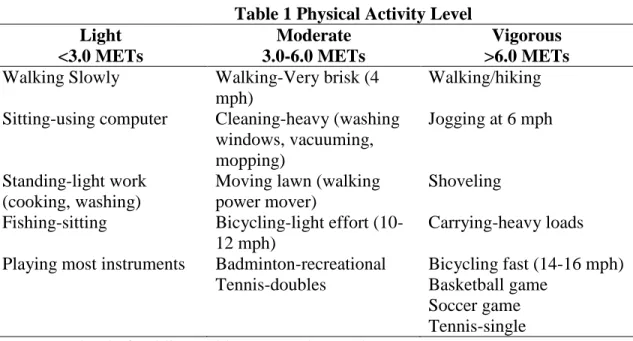
Table 1 Physical Activity Level Light
<3.0 METs
Moderate 3.0-6.0 METs
Vigorous >6.0 METs
Walking Slowly Walking-Very brisk (4
mph)
Walking/hiking
Sitting-using computer Cleaning-heavy (washing
windows, vacuuming, mopping)
Jogging at 6 mph
Standing-light work (cooking, washing)
Moving lawn (walking power mover)
Shoveling
Fishing-sitting Bicycling-light effort
(10-12 mph)
Carrying-heavy loads
Playing most instruments Badminton-recreational Bicycling fast (14-16 mph)
Tennis-doubles Basketball game
Soccer game Tennis-single Source: School of Public Health – Harvard T.H.Chan
RESULTS
Descriptions of each variable are performed using descriptive statistics which include measures of concentration and data distribution. The size of the concentration of data includes the mean, mode and median values. The size of the data spread includes the range and standard deviations of the data and the variance of the data. The description of the data includes data on physical education learning outcomes (Y) which are referred to as endogenous variables, physical activity variables (X) as exogenous variables. The data is then processed statistically into a frequency distribution list, the number of classes is calculated according to the Sturges rule, obtained nine classes with a maximum score of 96 and a minimum score of 70, so that the range of scores is 26.
The results of the calculation of the data are obtained an average of 81.32; standard deviation of 4.89; variance of 23.9410; a median of 81.5; and mode of 82. Grouping data on physical education learning outcomes can be seen in the frequency distribution table as follows.
Table 2 Frequency Distribution of Physical Education Learning Outcomes
N
o Interval
Class Limit Frequency
Below Upper Absolut
e Relative
Cumulativ e
1 70 - 72 69,5 72,5 8 3,70% 3,70%
2 73 - 75 72,5 75,5 18 8,33% 12,04%
3 76 - 78 75,5 78,5 33 15,28% 27,31%
4 79 - 81 78,5 81,5 49 22,69% 50,00%
5 82 - 84 81,5 84,5 57 26,39% 76,39%
6 85 - 87 84,5 87,5 32 14,81% 91,20%
7 88 - 90 87,5 90,5 9 4,17% 95,37%
8 91 - 93 90,5 93,5 7 3,24% 98,61%
Physical activity has an empirical score range of 51 to 85, so that the range of scores is 34. The results of data calculations obtained an average of 67.81; standard deviation of 7.46; variance of 55.5871; a median of 67.0; and mode of 65. Grouping physical activity data can be seen in the frequency distribution table as follows. Gallat normality test results of the estimated Y over X obtained the value of Lcount = 0.0408 this value is smaller than the value of Ltable (n = 216; α =
0.05) of 0.060. Considering that Lcount is smaller than Ltable, the distribution of physical education
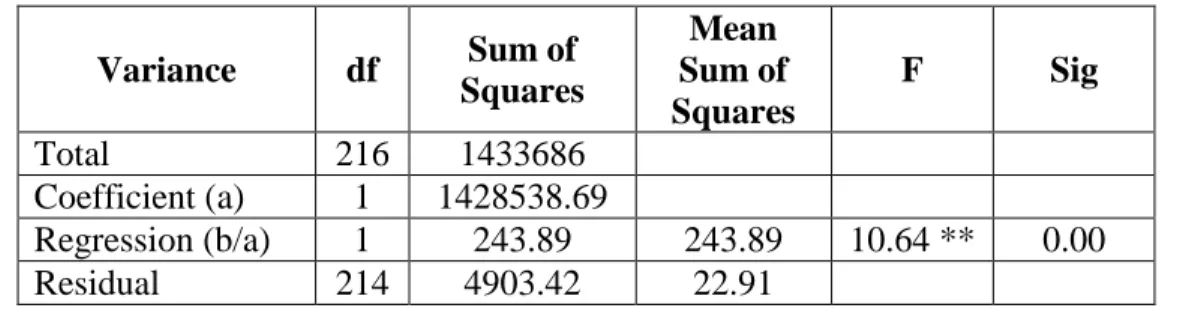
learning outcomes for physical activity comes from normally distributed populations. While the significance test and regression linearity of physical education learning outcomes on physical activities obtained a regression constant a = 71.63 and a regression coefficient b = 0.14. Thus the relationship of the simple regression equation model is Ŷ = 71.63 + 0.14X1. Before the regression equation model is further analyzed and used in drawing conclusions, first the significance and linearity of the regression equation is tested. The results of the calculations of significance and linearity are arranged in the following ANAVA table.
Table 3. ANAVA Test of Significance & Linearity of Regression Equations Ŷ = 71.63 +0.14X1
Variance df Sum of
Squares
Mean Sum of Squares
F Sig
Total 216 1433686
Coefficient (a) 1 1428538.69
Regression (b/a) 1 243.89 243.89 10.64 ** 0.00
Residual 214 4903.42 22.91
Information :
**: Regression is very significant (Fcount> Ftable)
ns: Regression is linear (Fcount <Ftable)
df: Degrees of freedom
Regression equation Ŷ = 71.63 + 0.14X1, for the significance test obtained Fcount 10.64 greater
than Ftable (0.05; 1: 214) 3.89 at α = 0.05. Because Fcount> Ftable, the regression equation is
declared significant. For the linearity test, the Fcount of 1.20 is smaller than the Ftable (0.05; 33:
181) of 1.50 at α = 0.05. Because Fcount <Ftable, the estimated point distribution forming a linear
line is acceptable.
The results of testing the hypothesis of the influence of physical activity on physical education learning outcomes obtained by the path coefficient value of physical activity on physical education learning outcomes of 0.152 with a tcount of 2.22. Because the t-value is greater than the
table value at df = 212 for α = 0.05 of 1.97, H0 is rejected and H1 is accepted, which means there
is a positive direct effect of physical activity variables on the variable of physical education learning outcomes.
DISCUSSION
programs every day for nine months. The program lasts several hours, involving about 40 minutes of moderate to very active physical activity (MVPA). Children do more moderate to very active physical activity as long as the physical activity program performs better than their peers in the most demanding tasks that require executive functions (EF) from the brain. Its function is to: hypothesized brain processes that control other brain processes. Included in the work of EF is inhibition, memory, attention, flexibility, planning, and problem solving. The results of hypothesis analysis produce findings that physical activity has a direct positive effect on learning outcomes physical education. Based on these findings it can be concluded that the physical education learning outcomes are directly affected positively by physical activity. Increased physical activity will result in increased learning outcomes physical education. The results of this study are in line with the thoutht that physical education is the educational process about and through physical activities, games, and sports chosen to achieve educational goals. Likewise the recommendations from the Centers for Disease Control and Prevention (2010) where physical activity can relieve depression symptoms and improve one's mood. So, if students have good physical activity, it will have an impact on improving learning outcomes while at school, especially on physical education subjects.
The study present has differences and similarities with previous studies, Castelli and Donelly, using physical activity interventions for 9 months to 3 years, measuring the effect of interventions during that time period (longitudinally). While in the present study, physical activity measurements with 7 days PA recall. Longitudinal studies measuring the effect of physical activity in Indonesia so far have not been found by researchers. Thus, opening up space for further research. This can strengthen to reveal whether physical activity has a direct or indirect effect on physical education learning outcomes. Likewise, it is considered to obtain a valid level of physical activity using an accelerometer, as was done through research by the Avon Longitudinal Study of Parents and Children (ALSPAC) which suggests a long-term positive impact of MVPA on academic achievement in adolescence. Physical activity following various studies (Heidi Syväoja et al., 2012) does not directly influence learning outcomes, but through several factors that mediate, such as: brain development and brain function. Examines physical activity from the perspectives of school physical education classes, other physical activity during the school day, leisure-time physical activity, overall physical activity and physical fitness. This study in line with other research on the effects of physical activity on academic achievement, cognitive functions, schooling and mechanisms that may possibly mediate the effects of physical activity on learning. And then also in line with analyses what the research results mean in terms of best practices to increase children’s physical activity during the school day increasing physical activity at school. Learning is considered from the perspectives of school grades, cognitive functions (attention, perception, memory and problem-solving), behavior and schooling.
CONCLUSION
physical education learning outcomes, limitations in the accuracy of students recalling their physical activities in the last 7 days, teacher assessment components in physical education learning outcomes, and research weaknesses. Therefore further research is needed to obtain the similarity of results that there is the influence of physical activity on physical education outcomes. While for Physical Education Teachers, it is expected to be more concerned in the learning process by developing various activities related to basic movement skills and optimizing all the potentials and experiences of physical education teachers in providing teaching material.
REFERENCES
Bartholomew, J. B., & Jowers, E. M. (2011). Physically active academic lessons in elementary children. Preventive Medicine, 52(Suppl), S51–S54.
https://doi.org/10.1016/j.ypmed.2011.01.017
Baumgartner, T., Jackson, A. (Tony), Mahar, M., & Rowe, D. (2006). Measurement for
Evaluation in Physical Education and Exercise Science (8th ed.). McGraw-Hill
Humanities/Social Sciences/Languages.
Bellarin, M. M. (2016). The Effect of Physical Activity and Exercise on the Academic Achievement of Elementary School Students (Vol. 9). https://doi.org/10.5151/cidi2017-060 Bevans, K. B., Fitzpatrick, L. A., Sanchez, B. M., Riley, A. W., & Forrest, C. (2010). Physical Education Resources, Class Management, and Student Physical Activity Levels: A Structure-Process-Outcome Approach to Evaluating Physical Education Effectiveness. Journal of School
Health, 80(12), 573–580. https://doi.org/10.1111/j.1746-1561.2010.00544.x
Centers for Disease Control and Prevention. (2010). The association between school based
physical activity, including physical education, and academic performance (Vol. 2010). Atlanta.
Chen, W., Mason, S., Hypnar, A., & Bennett, A. (2016). Assessing motor skill competency in elementary school students: A three-year study. Journal of Sports Science and Medicine, 15(1), 102–110.
Committee on Physical Activity and Physical Education in the School Environment. (2013). Educating the Student Body. In C. H. Kohl HW III (Ed.), Educating the student body: taking
physical activity and physical education to school. https://doi.org/10.17226/18314
Cothran, D. J. P. H. K. (2015). Classroom Management in Physical Education. Journal of
Physical Education, Recreation & Dance, 57(6), 29–32.
https://doi.org/10.1080/07303084.1986.10606159
Cratty, B. J. (1973). Intelligence in Action: Physical Activities for Enhancing Intellectual
Abilities. Englewood Cliffs, N.J.: Prentice-Hall.
Donnelly, J. E., Ed, D., Co-chair, F., Hillman, C. H., Co-chair, P. D., Ph, D., … Ph, D. (2017). Physical activity, fitness, cognitive function, and academic achievement in children: A
systematic review. Medicine and Science in Sports and Exercise, 48(6), 1197–1222. https://doi.org/10.1249/MSS.0000000000000901.Physical
Donnelly, J. E., & Lambourne, K. (2011). Classroom-based physical activity, cognition, and academic achievement. Preventive Medicine, 52(SUPPL.), S36–S42.
https://doi.org/10.1016/j.ypmed.2011.01.021
Ellemberg, D., & St-Louis-Deschênes, M. (2010). The effect of acute physical exercise on cognitive function during development. Psychology of Sport and Exercise, 11, 122–126. https://doi.org/10.1016/j.psychsport.2009.09.006
29. Retrieved from
https://search.ebscohost.com/login.aspx?direct=true&db=eue&AN=97479191&site=ehost-live Heidi Syväoja, Kantomaa, M., Laine, K., Jaakkola, T., Pyhält , K., & Tammelin, T. (2012).
Physical Activity and Learning. Helsinki.
J Hylok, M. (2011). Exploring Student Perceptions to Explain the Relationship Between Physical
Activity and Academic Achievement in Adolescents: A Mixed Methods Study.
Kyan, A., Takakura, M., & Miyagi, M. (2018). Does physical fitness affect academic
achievement among Japanese adolescents? A hybrid approach for decomposing within-person and between-persons effects. International Journal of Environmental Research and Public
Health, 15(9). https://doi.org/10.3390/ijerph15091901
Kohl, H.W., & Cook, H.D. (2013).Educating the student body: Taking physical activity and physical education to school. Washington, D.C.: The National Academic Press
Magistro, D., Bardaglio, G., & Rabaglietti, E. (2015). Gross motor skills and academic achievement in typically developing children: The mediating effect of ADHD related Behaviours. Cognition, Brain, Behavior, 19(2), 149–163.
Mahar, M. T., Murphy, S. K., Rowe, D. A., Golden, J., Shields, A. T., & Raedeke, T. D. (2006). Effects of a classroom-based program on physical activity and on-task behavior. Medicine and
Science in Sports and Exercise, 38(12), 2086–2094.
https://doi.org/10.1249/01.mss.0000235359.16685.a3
Mercier, K., & Doolittle, S. (2013). Assessing Student Achievement in Physical Education for Teacher Evaluation. Journal of Physical Education, Recreation & Dance, 84(3), 38–42. https://doi.org/10.1080/07303084.2013.767721
Nichols, B. (2001). Moving and Learning: The Elementary School Physical Education
Experience (3rd ed.). NY: McGraw-Hill College.
Otero, I. R., & Perez, L. M. R. (2015). Adolescence, motor coordination problems and competence. Educación XX1, 18.2, 189–213. https://doi.org/10.5944/educXX1.14015 Pesce, C., Crova, C., Cereatti, L., Casella, R., & Bellucci, M. (2009). Physical activity and mental performance in preadolescents: Effects of acute exercise on free-recall memory. Mental
Health and Physical Activity, 2, 16–22. https://doi.org/10.1016/j.mhpa.2009.02.001
Resaland, G. K., Aadland, E., Moe, V. F., Aadland, K. N., Skrede, T., Stavnsbo, M., …
Anderssen, S. A. (2016). Effects of physical activity on schoolchildren’s academic performance: The Active Smarter Kids (ASK) cluster-randomized controlled trial. Preventive Medicine, 91, 322–328. https://doi.org/10.1016/j.ypmed.2016.09.005
Singh, K. K. (2013). The Impact of Physical Education/Activity and Motor Development on Academic Achievement. SSRN Electronic Journal. https://doi.org/10.2139/ssrn.2231958 Smith, N. J., Monnat, S. M., & Lounsbery, M. A. F. (2015). Physical Activity in Physical Education: Are Longer Lessons Better? Journal of School Health, 85(3), 141–148. https://doi.org/10.1111/josh.12233
Tomporowski, P. (2003). Effects of acute bouts of exercise on cognition. Acta Psychologica,
112, 297–324. https://doi.org/10.1016/S0001-6918(02)00134-8
van der Fels, I. M. J., te Wierike, S. C. M., Hartman, E., Elferink-Gemser, M. T., Smith, J., & Visscher, C. (2015). The relationship between motor skills and cognitive skills in 4-16 year old typically developing children: A systematic review. Journal of Science and Medicine in Sport,