www.ijemst.com
Envisioning the Changes in Teaching
Framed by the National Science
Education Standards-Teaching
Standards
Todd Campbell1, Emma Smith2
1
University of Connecticut
2Utah State University
To cite this article:
Campbell, T. & Smith, E. (2013). Envisioning the changes in teaching framed by the
National Science Education Standards-Teaching Standards.
International Journal of
Education in Mathematics, Science and Technology, 1
(3), 162-183.
This article may be used for research, teaching, and private study purposes.
Any substantial or systematic reproduction, redistribution, reselling, loan, sub-licensing,
systematic supply, or distribution in any form to anyone is expressly forbidden.
Authors alone are responsible for the contents of their articles. The journal owns the
copyright of the articles.
Volume 1, Number 3, July 2013, 162-183
ISSN: 2147-611X
Envisioning the Changes in Teaching Framed by the National Science
Education Standards-Teaching Standards
Todd Campell1, Emma Smith2
1University of Connecticut 2 Utah State University
Abstract
The National Science Education Standards (NRC, 1996) have been one of the leading reformed documents in the U.S. since its release. It has served as a foundation for all state standards and has supported the development of the newest standards documents recently released in the U.S. (i.e., Achieve Inc., 2013; NRC 2012). One of the most important contributions this document has made is in the area of teaching, as it puts forth explicit standards for teaching science grounded framed by constructivism. These standards are quite different than what has traditionally been found in U.S. schools. This article examine each of the teaching standards outlined in the NSES, 1) to better explain the bases and importance of the teaching standard and specific less/more emphasis indicators found in the Changing Emphasis table in the teaching standards, before 2) current science education research that is forming the foundations of each of the standards moving forward is shared. Finally, examination of each teaching standard in the article concludes with exemplar vignettes to provide a vision for the enactment of each standard in the context of teachers’ and students’ everyday classroom and school experiences.
Key words: Science Standards, Science Teaching, Student Learning
Introduction
The National Science Education Standards (NSES) (National Research Council [NRC], 1996) has been one of the leading reform documents in the United States since its release. In addition, it has also served as a foundational referent used in shaping influential state level standards documents and moving forward a vision for a new science standards framework in the U.S. when the National Academies of Science released a preliminary public draft of A Framework for Science Education during the summer of 2010. The National Academies of Science document was finalized in 2012 (NRC, 2012), and served as the framework for writing the newest standards document in the U.S. released during the spring of 2013 (Achieve Inc., 2013).
So, while it is important to recognize that a new standards document have recently been released in the U.S., much of what will be included in the new framework has either 1) emerged from research in science education that was initiated by the NSES or 2) remains consistently aligned with the NSES. We have learned much from the NSES in U.S. schools, but nothing we have learned seems greater than what we have learned about teaching. This can be seen as the NSES acknowledges the importance of classroom instruction as a change agent and highlights instructional strategies as central determinants of reform. This stance is consistent with what others have found. As an example Darling-Hammond (2010) declares that Teachers are the fulcrum determining whether any school initiative tips toward success or failure. Every aspect of school reform depends on highly skilled teachers for its success . . .
One of the few areas of consensus among education policymakers, practitioners, and the general public today is that improving teacher quality is one of the most direct and promising strategies for improving public education outcomes (n.p). Researchers also agree with this stance concerning the importance of quality teaching, as for example (National Research Council [NRC], 2008; Paley, Weiss, Shimkus, & Smith, 2004). Specific studies
1
Corresponding Author:
which speak to the central importance of the teacher in science classrooms can be found in Piburn et al. (2000) and Adamsen et al. (2003). These last two examples are poignant as they reveal an instrument, the Reform Teaching Observation Protocol (RTOP) that was created in alignment with the NSES. The Piburn et al. (2000) and Adamsen et al. (2003) studies provide evidence of student achievement gains with respect to holistic views of science learning (i.e. science reasoning, attitudes about science, nature of science, and science conceptual understanding) as they reveal how alignment of instructional strategies outlined in the NSES leads to increased student learning when compared with more traditional instructional practices.
So what are traditional instructional strategies and how are the instructional strategies outlined in the NSES teaching standards different? To answer these questions, it might first be advantageous to consider the theoretical framework of the NSES. One of the main driving forces of current reform in science education and foundations of the NSES is constructivism. Broadly defined, constructivism is a theory focused on the nature of learning where knowledge is fashioned by the learner (Hruby, 2002).
There are certainly differences in how many interpret constructivism, whether it is focused on individual knowledge construction aligned with the work of Piaget (1983) or whether it is focused on the role of society, language, and culture aligned with the work of Vygotsky (1978) there are certain commonalities that cut across most all hues of constructivism. More generally speaking, constructivism leads to instructional strategies whereby student learning is facilitated through teachers’ engaging learners actively in creating, interpreting, and reorganizing or synthesizing knowledge (Gordan, 2008). In summary, constructivism frames student learning as an active process of students working overtime to develop meanings that align with their current understandings, environment, and social settings.
In the National Science Education Standards, teaching consistent with the constructivism will
• Focus and support inquiries while interacting with students. • Orchestrate discourse among students about scientific ideas.
• Challenge students to accept and share responsibility for their own learning.
• Recognize and respond to student diversity and encourage all students to participate fully in science learning.
• Encourage and model the skills of scientific inquiry as well as the curiosity, openness to new ideas and data, and skepticism that characterize science (NRC, 1996, p. 32).
This framework is quite different than what has traditionally been found in U.S. schools. Brooks and Brooks (1999) offer a few characteristics of traditional classrooms not framed by constructivism:
• Students are viewed as “blank slates” onto which information is etched by the teacher. • Teachers generally behave in a didactic manner, disseminating information to students. • Teachers seek the correct answer to validate student learning.
• Assessment of student learning is viewed as separate from teaching and occurs almost entirely through testing. (p. 17)
• Brooks and Brooks (1999) further articulate the stark contrast expected in classrooms framed by constructivism:
• Pursuit of student questions is highly valued.
• Curricular activities rely heavily on primary sources of data and manipulative materials.
• Teachers seek the students’ point of view in order to understand students’ present conceptions for use in subsequent lessons.
• Assessment of student learning is interwoven with teaching and occurs through teacher observations of students’ work and through student exhibitions and portfolios (p. 17).
Table 1. Teaching Standards Changing Emphasis.
Less Emphasis On More Emphasis On
Treating all students alike and responding to the group as a whole
Understanding and responding to individual student’s interests, strengths, experiences, and needs
Rigidly following curriculum Selecting and adapting curriculum
Focusing on student acquisition of information
Focusing on student understanding and use of scientific knowledge, ideas, and inquiry processes
Presenting scientific knowledge through lecture, text, and demonstration
Guiding students in active and extended scientific inquiries
Asking for recitation of acquired knowledge
Providing opportunities for scientific discussion and debate among students
Testing students for factual information at the end of the unit or chapter
Continuously assessing student understanding (and involving students in the process)
Maintaining responsibility and authority
Sharing responsibility for learning with students
Supporting competition Supporting a classroom community with cooperation, shared
responsibility, and respect
Working alone Working with other teachers to enhance the science program
Through the remainder of this article, each of the teaching standards outlined in the NSES will be more closely and carefully discussed chronologically to 1) examine each of the teaching standards outlined in the NSES, 2) to better explain the bases and importance of the teaching standard and specific less/more emphasis indicators found in the Changing Emphasis table in the teaching standards, before 3) current science education research that is forming the foundations of each of the standards moving forward is shared. Examination of each teaching standard will conclude with an exemplar vignette to provide a vision for the enactment of each standard in the context of teachers’ and students’ everyday classroom and school experiences.
Teachers of science plan an inquiry-based science program for their students
Table 2. Teaching Standard A.
Teachers of science plan on inquiry-based science program for their students. In doing this, teachers:
Develop a framework of yearlong and short-term goals for students.
Select science content and adapt and design curricula to meet the interests, knowledge, understanding, abilities, and experiences of students.
Select teaching and assessment strategies that support the development of student understanding and nurture a community of science and learners.
Work together as colleagues within and across disciplines and grade levels.
As was discussed in the introduction, one of the main driving forces of current reform in science education and foundations of the NSES is constructivism. As we consider what student learning framed by constructivism in the context of what characterizes science teaching, the focus shifts “to involve students in doing rather than being told or only reading about science . . . [where] teaching models were based on theories of learning that emphasized the central role of students' own ideas and concrete experiences in creating new and deepened understandings of scientific concepts” (NRC, 2000, p. 16-17). A bold statement which reflects the vision for what constructivism looks like as a foundation for science teaching is “[i]nquiry into authentic questions generated from student experiences is the central strategy for teaching science (NRC, 1996, p. 31).”
Campbell, Oh, Shin, & Zhang (2010) examined the alignment between engaging students in the five principles of scientific inquiry outlined in the NRC (2005) (i.e. 1) Framing research questions, 2) Designing investigations, 3) Conducting investigations, 4) Collecting data, and 5) Drawing conclusions) and constructivism.
As students are engaged in the principles of scientific inquiry, they can be found relying on their prior knowledge base to frame research questions, designing investigations in ways aligned with what they have seen in other examples but have perhaps modified to meet the immediate needs of a particular inquiry, conducting investigations, and collecting data where they gain firsthand experiences to draw on in creating new understandings. Finally, students are asked to draw conclusions by reconciling what they learned from their investigations with what they knew previously (Campbell, Oh, Shin, & Zhang, 2010, p. 158).
The National Research Council (2007, 2008) outlined four strands of science learning (science conceptual, science process, nature of science, and communication in science). NRC (2008) explains how science learning is deepened as all of the four strands of science learning are targeted cohesively:
Another important aspect of the strands is that they are intertwined, much like the strands of a rope. Research suggests that each strand supports the others, so that progress along one strand promotes progress in the others. For example, there is evidence that students can make substantial gains in their conceptual knowledge of science when given opportunities to “do” science, and scientific reasoning tends to be strongest in domains in which a person is more knowledgeable. Students are more likely to make progress in science when classrooms provide opportunities to advance across all four strands (NRC, 2008, p. 18).
While teaching science as inquiry is aligned with constructivism, it is also a mechanism for extending science learning beyond conceptual understandings to other realms of science learning equally as important (i.e. science process, nature of science, and communication in science), especially as we consider science education for an informed citizenry. And, it is this holistic consideration of science learning that was articulated in the preliminary public draft of A Framework for Science Education during the summer of 2010 and that is also expected in the finalized framework draft scheduled for release in early 2011.
Before additional discussion about teaching standard A is examined in more detail, it is prudent here to define scientific inquiry.
[A] multifaceted activity that involves making observations; posing questions; examining books and other sources of information to see what is already known; planning investigations; reviewing what is already known in light of experimental evidence; using tools to gather, analyze, and interpret data; proposing answers, explanations, and predictions; and communicating the results (NRC 1996, p. 23).
Through engaging in inquiry as teachers plan an inquiry-based science program for their students, students are able to, among other things, experience “[t]he processes embraced by science that allow us to extract explanation from evidence are paramount to a citizen’s understanding of science (Johnston, 2008, p. 12)”.
We next turn our attention to how the Less/More indicators found in the Changing Emphasis table in the teaching standards (NRC, 1996, p. 52) help differentiate between traditional and constructivist aligned instruction specifically focused on an inquiry based science program.
Specific Less/More Indicators relevant to Standard A
In actualizing Teaching Standard A, planning an inquiry-based science program for students, teachers are expected to move away from
• Treating all students alike and responding to the group as a whole • Rigidly following curriculum . . .
• Presenting scientific knowledge through lecture, text, and demonstration • Testing students for factual information at the end of the unit or chapter, • Maintaining responsibility and authority
• Supporting competition
• Working alone (NRC, 1996, p.52)
• Instead, Teaching Standard A envisions teachers
• Selecting and adapting curriculum . . .
• Guiding students in active and extended scientific inquiry . . . • Continuously assessing student understanding,
• Sharing responsibility for learning with students . . .
• Working with other teachers to enhance the science program (NRC, 1996, p.52).
Current science education research efforts that are forming the foundations of planning an inquiry-based science program for students
Given the importance of the teaching standards in shaping the future of science instruction experienced in classrooms and the amount of time which has elapsed since the release of the NSES, we now stand better positioned to view the standards document in hindsight, to see what research it has spawned and to consider how this research can provide a footing for actualizing the teaching standards. Table 3 highlights research, while not exhaustive, reveals what we are learning from science education researchers about Teaching Standard A.
Table 3.Current Research Supporting Teaching Standards A. Teachers of science plan an inquiry-based science program for their students
Constructs of Teaching Standard A Examples of Research Supportive of Teaching Standard A
constructs
• Develop a framework of yearlong
and short-term goals for students.
• Learning Progressions research that looks at
discipline specific conceptual development for ‘learning pathways’ (e.g. Catley, Lehrer, & Reiser, 2005; Smith, C. L., Wiser, M., Anderson, C. W., & Krajcik, J., 2006)
• Instructional Assessment research that investigates the impact of teaching (e.g. Reformed Teaching Observation Protocol development and subsequent research completed by Adamsen et al., 2003 & Piburn et al., 2000.
• Science-Technology-Society (STS) and
Socio-scientific Issues (SSI) instructional strategies research for nurturing communities of science learners (e.g. Akcay & Yager, 2010; Campbell, 2011; Zeidler et al., 2005)
• Select science content and adapt and design curricula to meet the
interests, knowledge, understanding, abilities, and experiences of
students.
• Select teaching and assessment strategies that support the development of student understanding and nurture a community of science learners.
• Work together as colleagues within and across disciplines and grade levels.
• Professional Development research that partners
teachers with teachers and teachers with scientists and science educators (e.g. Campbell & Lott, 2010; Lotter, Harwood, & Bonner, 2006)
to Teaching Standard B, let us first examine a vignette which illuminates much of the visions outlined in Teaching Standard A.
A vignette to exemplify a teacher planning an inquiry-based science program for students.
In a 10th-grade Biology classroom, at the beginning of the lesson, Mr. Johnson is introducing the topic of study for the next unit: living organisms’ interactions with other organisms and the environment. He begins this unit by taking his students on a visit to a sagebrush environment adjacent to their school. While at the site, the students are instructed to begin to consider the many organisms that are found in the environment. When the students return to the classroom, Mr. Johnson asks the students to develop a concept map detailing what they know about the sagebrush environment. They are instructed to include as many organisms as they can in their concept map and to begin to think about how these organisms might be connected to both other organisms and other materials found in the environment. As they create these maps, Mr. Johnson asks the student to highlight those areas of their concept maps that where they are unsure about or have questions about. On the next day, students are asked to share their concept maps with the class and any gaps or uncertainties they have about their maps. After the presentations, students are instructed to identify classmates whose questions or uncertainties mirror their own. Over the next several days of class students work in their groups to develop research questions and procedures that which can help answer the questions that they have . . . [as an example] One group is interested in understanding how soil contributes to the uniqueness of this environment. Remembering their experience from another class where they interacted with a group of students from another school in a state in a different region of the country . . . they recognize that this state’s environment is likely different than their own and invite these students to join them in a comparative study of their environmental soils. They plan to collect data and use Google Earth to create landmarks to document factors characteristic of their environment that might be responsible for the differences identified. Another group is interested in how the sunlight in their region contributes to the environment and begins to use probeware to monitor the sunlight from their site so that they can compare it to data found online from a distinctly different environment. As the unit progresses, students articulate objectives for their study― all of which fall within what Mr. Johnson intended (i.e. living organisms’ interactions with other organisms and the environment). At the conclusion of this unit of study, each group of students presents shares the results of their studies, which includes revisiting and presenting their revised concept maps to detail how their work has informed the previous gaps in understanding that were identified earlier. A rubric is used to assess the extent to which what students learned was intended in the unit. The rubric was developed earlier in the process with the help of students who identified what they saw as important indicators of their learning. This rubric was but one measure to help Mr. Johnson and the students better understand what they were learning. Additionally, the students shared their work through a blog and with community members in a sagebrush environment symposium held afterschool where each group shared what they had learned before discussing their findings with community members. Through this process, not only did students gain additional understandings and an appreciation about the environment, they also shared this with the community at large (Wang, Hsu, & Campbell, 2010, p. 109-110).
Teachers of science guide and facilitate learning
Table 4. Teaching Standard B.
Teachers of science guide and facilitate learning. In doing this, teachers:
• focus and support inquiries while interacting with students. • orchestrate discourse among students about scientific ideas.
• challenge students to accept and share responsibility for their own learning.
• recognize and respond to student diversity and encourage all students to participate fully in science learning.
• encourage and model the skills of scientific inquiry, as well as the curiosity, openness to new ideas and data, and skepticism that characterize science.
Teaching Standard B says much about the importance of science teachers as they are expected to rely heavily on what Aristotle described as a ‘phronesis’ of teaching science (Melville, Campbell, Fazio, & Bartley, 2012). Where ‘phronesis’ is defined by Squires (1999) as the ‘practical wisdom’ that guides the development and deployment of teachers’ disciplinary conceptual knowledge concurrently and cohesively with their ‘craft’ or ‘art’ of teaching. Others have framed phronesis as pedagogical content knowledge (PCK) or as the intersection of teachers’ pedagogical and content knowledge expertise as a guide for facilitating student learning. The NSES discusses the phronesis or PCK in science instruction in more practical terms as Teachers of science constantly make decisions, such as when to change the direction of a discussion, how to engage a particular student, when to let a student pursue a particular interest, and how to use an opportunity to model scientific skills and attitudes. Teachers must struggle with the tension between guiding students toward a set of predetermined goals and allowing students to set and meet their own goals. Teachers face a similar tension between taking the time to allow students to pursue an interest in greater depth and the need to move on to new areas to be studied (NRC, 1996, p. 33).
So, it is as science teachers are navigating the tensions of instruction (e.g. digging deeper with subsequent student questions or moving forward to new and exciting areas of study) that students are, in the best cases, developing habits of mind supportive of the four strands of science learning or in the worst cases going through the motions. Looking closer at the Less/More indicators found in the Changing Emphasis table in the teaching standards (NRC, 1996, p. 52) will help better illuminate directions for teachers guiding and facilitating learning framed by their expertise as teachers of science.
Specific Less/More Indicators relevant to Standard B
In actualizing Teaching Standard B, teachers of science guiding and facilitating learning, teachers are expected to move away from:
• presenting scientific knowledge through lecture, text, and demonstration, • asking for recitation of acquired knowledge . . .
• maintaining responsibility and authority, • supporting competition . . .
• focusing on student acquisition of information (NRC, 1996, p.52) • Instead, Teaching Standard B envisions teachers:
• guiding students in active and extended scientific inquiry,
• providing opportunities for scientific discussion and debate among students . . . • sharing responsibility for learning with students,
• supporting a classroom community with cooperation, shared responsibility, and respect . . .
• focusing on student understanding and use of scientific knowledge, ideas, and inquiry processes (NRC, 1996, p.52).
Current science education research efforts that are forming the foundations of guiding and facilitating learning
Because of the importance of teachers guiding and facilitating learning, it is no surprise much research exists investigating mechanisms through which teachers can focus and support inquiries (e.g. research focused on Model-Based Inquiry [MBI]) or orchestrate discourse among students about science ideas (e.g. research focused on scientific argumentation). Additionally, quality foundational research can readily be found to recognize and respond to student diversity and encourage all students to participate fully in science (e.g. research focused on critically evaluating additions needed to the NSES to attain this call).
Table 5. Current Research supporting Teaching Standards B. Teachers of science guide and facilitate learning
Constructs of Teaching Standard B
Examples of Research Supportive of Teaching Standard B constructs
• Focus and support inquiries while
interacting with students.
• Model-Based Inquiry that is closely connected to Model-Based Reasoning that uses models as learning anchors supportive of student learning (e.g. Campbell, Zhang, Nielson, 2010; Passmore, Stewart, & Cartier, 2009; Windschitl, Thompson, & Braaten, 2008)
• Orchestrate discourse among students
about scientific ideas.
• Scientific argumentation research that focuses on developing students capacity to understand and develop scientific arguments (e.g. Driver, Newton, & Osborne, 2000)
• Challenge students to accept and share responsibility for their own learning.
• Science-Technology-Society (STS) and
Socio-scientific Issues (SSI) instructional strategies research (e.g. Akcay & Yager, 2010; Campbell, 2011; Zeidler et al., 2005)
• Recognize and respond to student diversity
and encourage all students to participate fully in science learning.
• Research focused on critically evaluating
additions needed to the NSES to attain this call (e.g. Ferguson, 2008) and Inquiry Instructional Strategies as a mechanism for reducing gaps in student achievement among diverse groups of students (e.g. Wilson, Taylor, Kowalski & Carlson , 2010).
• Encourage and model the skills of
scientific inquiry, as well as the curiosity, openness to new ideas and data, and skepticism that characterize science.
• Research investigating teachers self efficacy in teaching science as inquiry (e.g. Smolleck & Yoder, 2008), the extent to which inquiry is enacted in classrooms (Campbell, Abd-Hamid, & Chapman, 2010), and research investigating how instructional strategies are enhanced to promote student understanding of the nature of science (e.g. Ackerson, Abd-El-Khalick, & Lederman, 2000).
A reflection to exemplify a teacher guiding and facilitating learning
In years past, I was ready each fall to explain the whole wonderful story of the butterfly’s life cycle to the children. With many teacher led, hands-on experiences, I taught them new vocabulary, the structure of the butterfly and larva, the names and descriptions of several butterflies, their habitats,. . .They were actively involved . . . but that experience was in no way as incredible as the natural inquiry experience I lead them through this fall . . . Instead of sharing my expertise with the children, I stayed in the background and listened to their conversations and took notes. I heard some information, some misinformation, and at last...some questions . . . Of course those questions that were so important and relevant to them were addressed and through much discussion, they found ways they could work together to find the answers to them. They were in charge of their learning, not me . . . Instead of much narrative and many directives from their teacher, their science experiences became their own and a true adventure . . . all questions were asked by the children themselves....not questions or points set up by their teacher. My Kindergartners are having the chance to do real science and loving it. They are also learning how to question, how to persevere, how to work together to find answers, how to problem solve, how to reason, how to organize information . . .
Teachers of science engage in ongoing assessment of their teaching and of student learning
The NSES emphasize the term assessment refers to both formal and informal methods and the goal of assessment is communication. Communication needs to encompass feedback to and from students, teachers, administrators, and parents alike. As written, in Table 6, Standard C advocates “teachers of science engage in ongoing assessment of their teaching and of student learning”.
It could be argued the ultimate reflection of effective teaching is student learning. It is often difficult to assess the individual gains of students; a machine gun approach is often taken when a bow and arrow approach would be more apropos. In lieu of the luxury of extended one-on-one time with students to monitor and assess their learning, science teachers turn to innovative means to collect data from their students in a variety of ways.
Table 6. Teaching Standard C.
Teachers of science engage in ongoing assessment of their teaching and of student learning. In doing this, teachers:
• use multiple methods and systematically gather data about student understanding and ability.
• analyze assessment data to guide teaching.
• guide students in self-assessment.
• use student data, observations of teaching, and interactions with colleagues to reflect on and improve teaching practice.
• use student data, observations of teaching, and interactions with colleagues to report student achievement and opportunities to learn to students, teachers, parents, policy makers, and the general public.
Specific Less/More Indicators relevant to Standard C
In actualizing Teaching Standard C, engaging in ongoing assessment of their teaching and of student learning, teachers are expected to move away from:
• focusing on student acquisition of information • asking for recitation of acquired knowledge
• presenting scientific knowledge through lecture, text, and demonstration • Testing students for factual information at the end of the unit or chapter • Maintaining responsibility and authority
• Supporting competition
• Working alone (NRC, 1996, p.52)
• Instead, Teaching Standard C envisions teachers:
• focusing on student understanding and use of scientific knowledge, ideas, and inquiry processes • providing opportunities for scientific discussion and debate among students
• continuously assessing student understanding • sharing responsibility for learning with students
• supporting a classroom community with cooperation, shared responsibility, and respect • working with other teachers to enhance the science program (nrc, 1996, p.52).
Current science education research efforts that are forming the foundations of engaging in ongoing assessment of teaching and of student learning
Table 7. Research supporting Teaching Standards C.
Teachers of science engage in ongoing assessment of their teaching and of student learning. Use multiple methods and systematically gather data about student understanding and ability
Constructs of Teaching Standard C Examples of Research Supportive of Teaching
Standard C constructs
Analyze assessment data to guide teaching
Formative Assessment (e.g. Aylward, 2010; Buck & Trauth-Nare, 2009; Gioka, 2009)
Alternative Assessment (e.g. Lawrenz, Huffman, & Welch, 2001;
Understanding by Design (e.g. Wiggins & McTighe, 2006)
Performance Assessment (e.g. Morrison,
McDuffie, & Akerson, 2005)
Guide students in self-assessment
Self Assessment (e.g. Milne, 2009)
Personal Response Systems a.k.a. “clickers” (e.g. Moss & Crowley, 2011; Beuckman, Rebello, & Zollman, 2007)
Pair Shair (e.g. ibe, 2009)
Use student data, observations of teaching, and interactions with colleagues to reflect on and improve teaching practice.
Concept Maps and Modeling (Neilson, Campbell, & Allred, 2010)
Whiteboarding (e.g. Jang, 2010; Blanton, 2008)
Peer coaching (e.g. Jang, 2010)
Use student data, observations of teaching, and interactions with colleagues to report student achievement and opportunities to learn to students, teachers, parents, policy makers, and the general public.
Student Questioning & Feedback to inform (e.g. Aguiar, Mortimer, & Scott, 2010; Williams & Kane, 2009)
Student Notebooks (e.g. Ruiz-Primo, Li, Ayala, & Shavelson, 2004)
Although the four major constructs are listed independently, several of the research examples integrate the constructs in assessing student learning in their research, as well as evidenced in the efforts of a secondary science teacher actively involved in meeting Teaching Standard C described in the following vignette.
used to come to a conclusion in the context of science processes and how well were they able to communicate their scientific findings.
Teachers of science design and manage learning environments that provide students with the time, space, and resources needed for learning science
Sometimes the biggest hurdle to overcome in designing and managing learning environments needed for learning science is the teacher’s own inhibitions about embarking on extended investigations incorporating scientific inquiry. One inhibition cited frequently by science teachers is “it is too difficult or time consuming, we have to give up on content” (French, 2005, p. 60). A seasoned chemistry teacher expressed to a group of colleagues during a professional development project how he initially had some angst implementing an inquiry investigation because he didn’t know with certainty what the student outcomes would be. Great comfort had been taken over the years in the ‘predictiveness’ of canned or cookbook labs. Despite his inhibitions, he adhered to the guidelines of Teaching Standard D and discovered the students actually took the goal he had planned deeper than the basic concept he had planned for.
Table 8. Teaching Standard D.
Teachers of science design and manage learning environments that provide students with time, space, and resources needed for learning science
In doing this, teachers:
• structure the time available so that students are able to engage in extended investigations.
• create a setting for student work that is flexible and supportive of science inquiry.
• ensure a safe working environment.
• make the available science tools, materials, media, and technological resources accessible to students.
• identify and use resources outside the school.
• engage students in designing the learning environment.
Specific Less/More Indicators relevant to Standard D
In actualizing Teaching Standard D, designing and managing learning environments that provide students with the time, space, and resources needed for learning science, teachers are expected to move away from:
• rigidly following curriculum
• presenting scientific knowledge through lecture, text, and demonstration • maintaining responsibility and authority
• supporting competition
• working alone (NRC, 1996, p.52)
• Instead, Teaching Standard C envisions teachers • Selecting and adapting curriculum
• Guiding students in active and extended scientific inquiry • Sharing responsibility for learning with students
• Supporting a classroom community with cooperation, shared responsibility, and respect
• Working with other teachers to enhance the science program (NRC, 1996, p.52).
Current science education research efforts that are forming the foundations of designing and managing learning environments that provide students with the time, space, and resources needed for learning science
contains just a few of the available techniques gleaned from rigorous studies supportive of Teaching Standard D constructs.
Table 9. Research supporting Teaching Standards D.
Teachers of science design and manage learning environments that provide students with the time, space, and resources needed for learning science.
Constructs of Teaching Standard D Examples of Research Supportive of Teaching
Standard D constructs
Structure the time available so that students are able to engage in extended investigations.
Scaffolding (e.g. Flick, 1998; Puntambekar, & Kolodner, 2005)
Team Teaching (e.g. Roth, Tobin, Carambo, & Dalland, 2005)
Interdisciplinary Units (e.g. Stinson, Harkness, Meyer, & Stallworth, 2009; Bybee, & Van Scotter, 2007)
Create a setting for student work that is flexible and supportive of science inquiry.
Management Protocol (e.g. Sampson, 2004)
Classroom Rules (e.g. Frazier & Sterling, 2005)
Ensure a safe working environment.
Manuals for Safer Classrooms
Investigating Safely (e.g. Texley, Kwan, & Summers, 2004)
Inquiring Safely (e.g. Kwan & Texley, 2003)
Exploring Safely (e.g. Kwan & Texley, 2002)
Make the available science tools, materials, media, and technological resources accessible to students.
Video Analysis (e.g. Brown & Cox, 2009; )
Web Tools & Simulations (e.g. Campbell, Wang, Hsu, Duffy, & Wolf, 2010)
Identify and use resources outside the school.
Instructional Technologists (e.g. Campbell, 2008)
University Scientists (e.g. Ruebush, Grossman, Miller, North, Schielack, & Simanek, 2009; Caton, Brewer, & Brown, 2008)
Engage students in designing the learning
environment.
Participatory Design (e.g. Könings, van Zundert, Brand-Gruwel, & van Merriënboer, 2007)
Ensuring students understand the parameters required for a learning environment conducive to learning science begins with well-designed classroom policies and safety codes of conduct. Organization is also essential and can serve as the primary component unifying the constructs of Teaching Standard D. Time, resources, and the classroom are all avenues where science teaching and learning can benefit from a focus on organization.
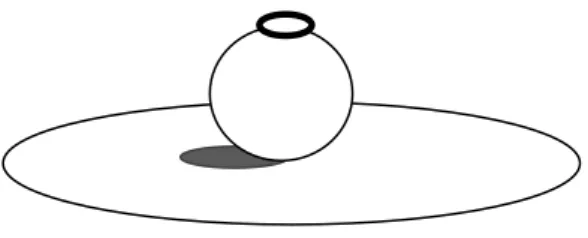
Toss” and students find a small coin resting on top of a tennis ball sitting inside a loop of string (see Figure 1). Students are instructed to hit the tennis ball as hard as they can to knock the coin out of the circle formed by the loop touching only the tennis ball.
Figure 1. Illustration of exploratory Coin Toss task.
Exploratories provide an efficient method for students to experience an assortment of investigations with a common concept. Observing students as they move through the exploratory, Mr. Williams assesses students’ level of prior knowledge as recommended by Teaching Standard C―using multiple methods and systematically gathering data about student understanding and ability.
The flexible and supportive setting for such science inquiry was created at the very beginning of the school year. Mr. Williams begins the school year engaging students in establishing safety is of the upmost importance and value in the classroom. Rather than just declaring the do’s and don’ts of safety, Mr. Williams invests the time to share with students the rationale for each of the items on the Student Safety Code of Conduct (SSCC) and provides an example of the benefit and possible outcome of not adhering to each SSCC item. Students become more invested in safety as this extended dialogue affords them the immediate relevance to their classroom behavior and learning. The SSCC becomes the backbone not only for safety but for organization and classroom management in general as well.
Teachers of science develop communities of science learners that reflect the intellectual rigor of scientific inquiry and the attitudes and social values conducive to science learning
Table 10.Teaching Standard E.
Teachers of science of develop communities of science learners that reflect the intellectual rigor of scientific inquiry and the attitudes and social values conducive to social learning.
In doing this, teachers:
• Display and demand respect for the diverse ideas, skills, and experiences of all students.
• Enable students to have a significant voice in decisions about the content and context of their work and require students to take responsibility for the learning of all members of the community.
• Nurture collaboration among students.
• Structure and facilitate ongoing formal and informal discussion based on a shared understanding of rules of scientific discourse.
• Model and emphasize the skills, attitudes, and values of scientific inquiry.
Teaching Standard E is primarily focused on the importance of teachers cultivating a community of learners. This standard emphasizes how important communication within the classroom is in learning science. Hruby (2002) captures much of the essence of the importance of communication and communities of learners as he describes how social constructivism operates in supporting and mediating learning because “human beings are inherently social and that therefore learning is a social process of developing understanding such that they reflect the knowledge and forms of knowing that are held privileged within one’s community” (p. 585). This explanation deserves closer attention, especially as it pertains to science classrooms and teaching standards.
community’, it is important that a community be formed inside the classroom, but this community must also connect to and see itself as part of the scientific community so that developing understandings are constantly being vetted not only by the norms of science discourse happening inside the classroom, but also by the norms of understandings ‘held privileged’ in the greater scientific community. Therefore it is essential that science teachers ensure that a bridge is made between what students are coming to understand as they structure knowledge in classrooms to frameworks for the same knowledge as the scientific community structures it.
Consideration of the Less/More indicators found in the Changing Emphasis table in the teaching standards (NRC, 1996, p. 52) provides changes that are needed for establishing a community of learners in the science classroom.
Specific Less/More Indicators relevant to Standard E
In Teaching Standard E, teachers of science developing communities of science learners that reflect the intellectual rigor of scientific inquiry and the attitudes and social values conducive to science learning, teachers are expected to move away from:
• treating all students alike and responding to the group as a whole. . . • maintaining responsibility and authority,
• supporting competition . . .
• focusing on student acquisition of information (NRC, 1996, p.52) • Instead, Teaching Standard E envisions teachers
• understanding and responding to individual student's interests, strengths, experiences, and needs . . . • sharing responsibility for learning with students,
• supporting a classroom community with cooperation, shared responsibility, and respect . . .
• focusing on student understanding and use of scientific knowledge, ideas, and inquiry processes (NRC,
1996, p.52).
Current science education research efforts that are forming the foundations of teachers of science developing communities of science learners that reflect the intellectual rigor of scientific inquiry and the attitudes and social values conducive to science learning
Due to the central importance of building communities of learners in science classrooms where constructivism and more specifically social constructivism is considered as a framework, it is essential that models of how this can be accomplished are explored. One model for establishing this is whole-class inquiry as described by Smithhenry and Gallagher-Bolos (2009). Through whole-class inquiry, a self-sufficient community of learners is formed where the whole class inquires through a range of challenges together. One important feature inherent in whole-class inquiry is the range of framing structured by teachers. Exley & Luke (2010) better explain ‘framing’
Strong framing occurs when the teacher has more control over the selection, sequencing, pacing, criteria and social relations of classrooms. Here a teacher is asserting authoritative control of social relations, modes and forms of representation; pedagogic practice is “visible”; the rules for acquiring knowledge are explicit. Weaker framing is generally affiliated with more student-centred pedagogy, where students may assert what appears to be more overtly agentive speaking positions, epistemic authority and interactional strategies (p. 6).
Exley & Luke (2010) assert it is a mix of strong and weak framing which enables students to develop the “skills and dispositions for life-long learning” (NRC, 1996, p. 46) and this is consistent with what Smithhenry and Gallagher-Bolos (2009) structure through strong framing of whole-class inquiry early in the academic year followed by weaker framing later in the year leading to a self-sustaining community of learners.
Another important consideration outlined in Teaching Standard E is the formal and informal discussions within communities of learners mediated through shared rules of scientific discourse. Much of the research into scientific argumentation based on the work of Toulman (1958) provide insight into a model for developing understandings and rules for scientific discourse (Driver, Newton, & Osborne, 2000) and the impact of argumentation strategies on student learning in science.
Table 11.Current Research supporting Teaching Standards E.
Teachers of science develop communities of science learners that reflect the intellectual rigor of scientific inquiry and the attitudes and social values conducive to science learning.
Constructs of Teaching Standard E Examples of Research Supportive of Teaching Standard
E constructs
Display and demand respect for the diverse ideas, skills, and experiences of all students.
Inquiry as an instructional strategy capable of eliciting diverse student ideas and experiences (Lee, Buxton, Lewis, & LeRoy, 2006)
Enable students to have a significant voice in decisions about the content and context of their work and require students to take responsibility for the learning of all members of the community.
Framing research investigating effective teaching strategies (Exley & Luke, 2010) and Teacher questioning research in classrooms facilitated with high levels of constructivist teaching practices (Erdogan & Campbell, 2008)
Nurture collaboration among students.
Whole-class inquiry research focused on cultivating a self-sufficient community of learners (Smithhenry & Gallagher-Bolos, 2009)
Structure and facilitate ongoing formal and informal discussion based on a shared understanding of rules of scientific discourse.
Scientific argumentation research focusing on developing students capacity to understand and develop scientific arguments (e.g. Driver, Newton, & Osborne, 2000)
Model and emphasize the skills, attitudes, and values of scientific inquiry.
Research into effective mechanisms for teaching science as inquiry (Sadeh & Zion, 2009) and developing students understandings of the nature of science (Abd-El-Khalick, Bell, & Lederman, 1998; Ackerson, Abd-El-Khalick, & Lederman, 2000)
Through the vision originally articulated in Teaching Standard E and subsequent ongoing research, it is believed that communities of learners can develop. And, it is believed these communities will more accurately depict scholarly scientific communities where scientific knowledge is fashioned and empower students with meaningful skills and dispositions for lifelong societal participation.
A vignette to exemplify teachers of science developing communities of science learners that reflect the intellectual rigor of scientific inquiry and the attitudes and social values conducive to science learning
practitioners to help parents identify children that who may be at heightened risk of manifesting symptoms of autism. The students realized the survey was controversial as one nurse who commented on the survey thought it would lead to increased numbers of parents avoiding vaccinations for their children―, an action that she felt could have a greater negative impact on the population as a whole when compared to the minimal risk and evidence she felt supported the link between vaccinations and autism.
Both products were created by the students and initially edited by the research scientist and the present author science teacher educator. After initial editing, groups of students created pilot studies to gauge the usefulness of these products by the feedback collected from the audiences selected for the pilot testing. The brochure was shared with parents and community members, while the survey was shared with medical professionals involved in administering vaccinations. The project ended with students articulating, based on the results of their pilot studies, what they would do next with the project given additional time (Campbell, 2011, p. 9-10).
Teachers of science actively participate in the ongoing planning and development of the school science program.
Table 12. Teaching Standard F.
Teachers of science actively participate in the ongoing planning and development of the school science program.
Plan and develop the school science program.
Participate in decisions concerning the allocation of time and other resources to the science program.
Participate fully in planning and implementing professional growth and development strategies for themselves and their colleagues.
The NSES describe a vision for teachers of science to collaborate not only with other science teachers in their department or building but to extend collaborative efforts to include teachers from other disciplines and strive to build learning communities similar to those described in Teaching Standard E. In order to fully participate in the ongoing planning and development the school science program, it is imperative teachers be provided with opportunities to be leaders within both their schools and districts. Also in conjunction with school district cooperation, science teachers have a responsibility “for designing and implementing the ongoing professional development opportunities they need to enhance their skills in teaching science, as well as their abilities to improve the science programs in their schools” (NRC, 1996, p. 52).
Specific Less/More Indicators relevant to Standard F
In Teaching Standard F, teachers of science actively participating in the ongoing planning and development of the school science program are expected to move away from:
• rigidly following curriculum
• maintaining responsibility and authority, • supporting competition . . .
• working alone (nrc, 1996, p.52)
• instead, teaching standard f envisions teachers • selecting and adapting curriculum
• sharing responsibility for learning with students,
• supporting a classroom community with cooperation, shared responsibility, and respect . . .
• working with other teachers to enhance the science program (NRC, 1996, p.52).
Table 13.Current Research supporting Teaching Standard F.
Teachers of science actively participate in the ongoing planning and development of the school science program.
Constructs of Teaching Standard F Examples of Research Supportive of Teaching Standard F
constructs
Plan and develop the school science program.
STEM co-teaching experiences (Gilmore, Hurst, & Maher, 2009)
Coordination in co-teaching (Roth, Tobin, Carambo, & Dalland, 2005)
Participate in decisions concerning the allocation of time and other resources to the science program.
Leadership for Learning (Glickman, 2002)
Participate fully in planning and implementing professional growth and development strategies for themselves and their colleagues.
Mentoring (Stanulis & Floden, 2009)
Collaboration & Training / Professional Development (Bursal & Paznokas, 2006; Austin et al., 2009; Desimone, L. M. (2009)
Somewhat analogous to the way science teaching has changed in response to science education reform efforts, inservice professional development has undertaken various forms over the past few decades. Wei, Darling-Hammond, Andre, Richardson, and Orphanos, (2009) outlined characteristics of professional development in countries with high student achievement on the Trends in International Mathematics and Science Study (TIMSS). These countries’ professional development practices were steeped with much more content over a longer period of time than the United States’ Eisenhower grants which consisted of an average of 25 hours contact time in a span of less than a week. Collaborative, embedded, and sustained “professional learning” (Wei, Darling-Hammond, Andre, Richardson, & Orphanos, 2009) are now central to post Eisenhower grant era professional development in the U.S.
A vignette which demonstrates teachers of science actively participating in the ongoing planning and development of the school science program within the scope of professional learning follows. The vignette also incorporates the construct of using student data and interactions with colleagues to reflect on and improve teaching practice as well as the construct of identifying and using resources outside the school from Teaching Standard D.
Ms Bell is invited by a science teacher educator professor of a local university to participate in a professional development/learning experience where she will be partnered with disciplinary specific science teachers from several school districts and university scientists. The collaboration will focus on continually improving science teaching and learning through working in professional learning communities to develop curriculum aligned to national, state, and local science standards.
The collaborative project begins one week during the summer at the university with examination of current research literature pertinent to science teaching and learning and how this applies to the development of teaching modules which will be developed over the course of the week. This is followed by the formation of the learning communities which consist of disciplinary specific science teachers and a university scientist of the same discipline. The remainder of the week is spent largely in the continued development of a module targeting a state science standard identified by the learning community. Near the end of the week the various learning communities select a portion of their module to peer teach and receive feedback using the Reform Teaching Observation Protocol (RTOP) as a guide.
All the learning communities from the disciplinary specific groups reconvene at the university in the winter. The purpose of this two day follow up workshop is to begin development of a second module which targets a different state science standard to be implemented during the spring term and to share student work from the first module. The second module will continue to be developed over the span of the next month or two via web conferences the learning communities have been conducting since the beginning of the school year.
At the end of the first year of the three year collaboration project, Ms Bell expresses her enthusiasm for the chance to collaborate not only with other teachers in her discipline but the advantage of having formed a working relationship with an expert in the field in the capacity of the university scientist. Furthermore, Ms Bell conveyed a desire to expand her repertoire of inquiry-based modules due to the success she experienced with the module implementation as measured by her perception of student interest and engagement with the collaboratively developed curriculum.
Conclusion
In addition to benchmarks and standards, the National Science Education Standards provide guidelines for teaching which focus on inquiry learning. These teaching standards are housed in a framework of shifting emphases. The specific less/more indicators are an effective means of providing succinct descriptions of what is considered quality science instruction. This article has examined the six science teacher standards contained in the NSES within the context of current science education research offering insight to the movement from less to more. Vignettes have also been provided to articulate how the explicit teaching standard constructs can be envisioned. Even though vignettes were presented in association with a listed standard, it should be emphasized each vignette characterizes multiple standard constructs just as science is learned not as isolated concepts but in multifaceted units encompassing both the nature of science and science processes.
The ever-changing dynamics of education compel us to constantly reevaluate our pedagogical practices. Science education reform is certainly a vibrant process with a long history. The science courses students experienced when the United States was predominantly a rural nation in the 1800s “were descriptive and included little or no laboratory work” and “didactic instruction was the teaching standard” (Chiappetta, 2008, p. 22). Many decades later, Joseph Schwab, an education professor at the University of Chicago, insisted science educators work together in a “radical overhaul” (Schwab, 1960, p. 176). As stated earlier in this article, the National Science Education Standard has been one of the leading reform documents in the United States since its release. Most certainly new science education reform documents will continue to build upon the NSES 1996 standards and reflect expectations for continued improvement in science teaching and learning.
References
Abd-El-Khalick, F., Bell, R.L., & Lederman, N.G. (1998). The nature of science and instructional practice: Making the unnatural natural. Science Education, 82, 417–436.
Achieve Inc. (2013). Next generation science standards. www.nextgenscience.org/next-generation-science-standards.
Ackerson, V. L., Abd-El-Khalick, F., & Lederman, N. G. (2000). Influence of a reflective explicit activity-based approach on elementary teachers’ conceptions of nature of science. Journal of Research in Science Teaching, 37(4), 295–317.
Adamson, A.E., Banks, D., Burtch, M., Cox III, F., Judson, E., Turley, J.B., Benford, R. & Lawson, A.E. (2003). Reformed Undergraduate Instruction and Its Subsequent Impact on Secondary School Teaching Practice and Student Achievement. Journal of Research in Science Teaching, 40(10), 939-958.
Aguiar, O., Mortimer, E., & Scott, P. (2010). Learning from and Responding to Students' Questions: The Authoritative and Dialogic Tension. Journal of Research in Science Teaching, 47(2), 174-93.
Akcay, H. & Yager, R. E. (2010). The Impact of a Science/Technology/Society Teaching Approach on Student Learning in Five Domains. Journal of Science Education and Technology, 19(6), 602-611.
American Association for the Advancement of Science (AAAS). (1990). Science for all Americans. New York:
Oxford University Press.
American Association for the Advancement of Science (1993). Benchmarks for science literacy. Author, Washington.
Amann, G. (2005). Exploring Physics in the Classroom. AAPT Press: College Park, MD.
Aylward, G. (2010). Visual formative assessments: The use of images to quickly assess and record student learning. Science Scope, 33(6), 41-5.
Blanton, P. (2008). Using interactive whiteboard to enhance student learning. Physics Teacher, 46(3), 188-189. Beuckman, J., Rebello, N., & Zollman, D. (2007). Impact of a classroom interaction system on student learning.
AIP Conference Proceedings, 883(1), 129-132.
Brooks, J. G., & Brooks, M. G. (1999). In search of understanding: The case for the constructivist classroom. Alexandria, VA: Association for Supervision and Curriculum Development.
Brown, D., & Cox, A. (2009). Innovative Uses of Video Analysis. Physics Teacher, 47(3), 145-150.
Buck, G., & Trauth-Nare, A. (2009). Preparing teachers to make the formative assessment process integral to science teaching and learning. Journal of Science Teacher Education, 20(5), 475-94.
Bursal, M., & Paznokas, L. (2006). Mathematics anxiety and preservice elementary teachers' confidence to teach mathematics and science. School Science and Mathematics, 106(4), 173-80.
Bybee, R., & Van Scotter, P. (2007). Reinventing the Science Curricul-um.Educational Leadership, 64(4), 43-7. Campbell, T. (2012). Building Community in Triads Involved in Science Teacher Education: An Innovative
Professional Develop-ment Model. Brock Education Journal, 21(2), 53-69.
Campbell, T. (2011). Using Metaphors to investigate the Personal Frameworks of Pre-Service Science Teachers as they Experience a Science in Society Course. Research in Science & Technological Education, 29(1), 71–90. Campbell, T. (2008). The capacity of instructional technologists to provide systemic support for science education reform. Teacher Development, 12(1), 67-83.
Campbell, T., Abd-Hamid, N, & Chapman, H. (2010). Development of Instruments to Assess Teacher and Student Perceptions of Inquiry Experiences in Science Classrooms. Journal of Science Teacher Education, 21(1), 13-30.
Campbell, T., Oh, P. S., Shin, M. & Zhang, D. (2010). Classroom Instructions Observed from the Perspectives
of Current Reform in Science Education: Comparisons between Korean and U.S. classrooms. Eurasian
Journal of Science Mathematics and Technology Education, 6(3), 151-162.
Campbell, T. & Lott, K. (2010). Triad dynamics: Investigating the importance of social forces, positions, and storylines. Teaching Education. 21(4), 349–366.
Campbell, T., Wang, S., Hsu, H., Duffy, A., & Wolf, P. (2010). Learning with Web Tools, Simulations, and Other Technologies in Science Classrooms. Journal of Science Education and Technology, 19(5), 505-11.
Campbell, T., Zhang, D., & Neilson, D. (2010). Model Based Inquiry in the High School Physics Classroom:
An Exploratory Study of Implementation and Outcomes. Journal of Science Education and Technology.
First published online 23 August 2010. DOI 10.1007/s10956-010-9251-6.
Catley, Lehrer, & Reiser (2005). Tracing a Prospective Learning Progression for Developing Understanding of Evolution. Paper Commissioned by the National Academies Committee on Test Design for K-12 Science Achievement. http://www7.nationalacademies.org/bota/Evolution.pdf
Caton, E., Brewer, C., & Brown, F. (2000). Building teacher-scientist partnerships: Teaching about energy through inquiry. School Science and Mathematics, 100(1), 7-15.
Chiappetta, E.L. (2008). Historical development of teaching science as inquiry. In Luft, J., Bell, R. L., & Gess-Newsome, J. (Eds.) Science as inquiry in the secondary setting (pp. 21-30). Arlington, VA: National Science Teachers Association Press.
Darling-Hammond, L. (2010). Evaluating Teacher Effectiveness: How Teacher Performance Assessments Can Measure and Improve Teaching. http://www.americanprogress.org/issues/2010/10/ teacher_effectiveness .html
Desimone, L. M. (2009). Improving impact studies of teachers’ professional development: Toward better conceptualizations and measures. Educational Researcher, 38(3), 181-199.
Driver, R., Newton, P., & Osborne, J. (2000). Establishing the norms of scientific argumentation in classrooms.
Science Education, 84(3), 287–312.
Erdogan, I. & Campbell, T. (2008). Teacher questioning and interaction patterns in classrooms facilitated with differing levels of constructivist teaching practices. International Journal of Science Education. 30(14),
1891-1914.
Exley, B. E. & Luke, A. (2009). Uncritical framing : lesson and knowledge structure in school science. In: Cole, David & Pullen, Darren L. (Eds.) Multiliteracies in Motion : Current Theory & Practice. Routledge, London, pp. 17-41.
Ferguson, R. (2008). If Multicultural Science Education Standards’ Existed, What Would They Look Like?
Journal of Science Teacher Education, 19, 547–564.