International Journal of Applied Linguistics & English Literature ISSN 2200-3592 (Print), ISSN 2200-3452 (Online) Vol. 5 No. 7; December 2016 [Special Issue on Language and Literature]
Australian International Academic Centre, Australia
The Evolution and Popularity of Science Play with Specific
Reference to Marlowe’s Dr. Faustus, Brecht’s Galileo and
Frayn’s Copenhagen
Khalid Ahmad Yas (Corresponding Author)
Faculty of Modern Languages and Communication, University Putra Malaysia, Serdang, Selangor, Malaysia
E-mail: [email protected]
Arbaayah Ali Termizi
Faculty of Modern Languages and Communication, University Putra Malaysia, Serdang, Selangor, Malaysia
E-mail: [email protected]
Rosli Talif
Faculty of Modern Languages and Communication, University Putra Malaysia, Serdang, Selangor, Malaysia
E-mail: [email protected]
Hardev Kaur
Faculty of Modern Languages and Communication, University Putra Malaysia, Serdang, Selangor, Malaysia
E-mail: [email protected]
Received: 16-08-2016 Accepted: 12-10-2016 Advance Access Published: November 2016
Published: 10-12-2016 doi:10.7575/aiac.ijalel.v.5n.7p.56 URL: http://dx.doi.org/10.7575/aiac.ijalel.v.5n.7p.56
Abstract
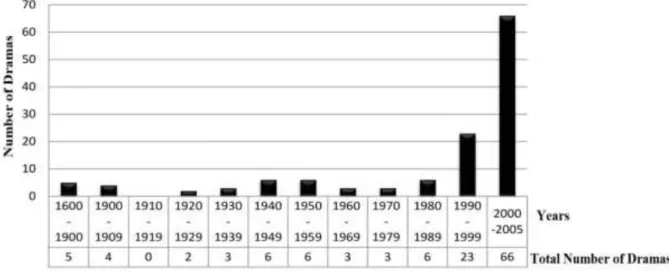
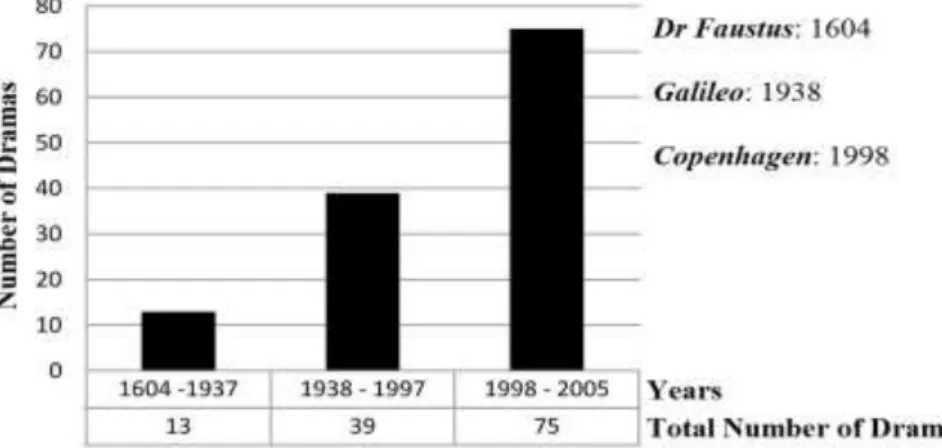
This paper traces theatrically and statistically the evolution and popularity of science play from 1604, the publication of
Marlowe’s DrFaustus, to 2005 revealing reasons behind this popularity in particular within the last few decades. It also
presents a brief classification of playwrights employed science in their works, and does analysis for major works that contributed much not only in the development and popularity of science drama, but also in the drastic change they have brought to this genre. Actually, from Marlowe to now, scientists and science have held a fascination for writers and audience on equal terms. In our genetic, atomic and tech-savvy climate, drama contains science of any kind will head
directly to spotlight. The pivotal year of 1998, when Copenhagen was first premiered, has led to unprecedented wave of
science plays. Science has become the vogue and science play has gone beyond using science as a sort of ornament to
integrate it into the fabric of drama. Everything from Newton's Principia to Greene's books on String Theory has passed
across the stage. Consequently, this wave of science plays has not only softened the earth for a permanent shift in our perception of science as a fundamental part of our culture and a legitimate and compelling subject for theatre, but also has brought the vision of ‘‘a third culture’’ into reality.
Keywords: science play, evolution, Dr. Faustus, Galileo, Copenhagen, quantum physics
1. Introduction
Since Marlowe’s Dr Faustus (1604), Jonson’s The Alchemist (1610) and Shadwell’s The Virtuoso (1676), science has
been featured as a subject matter for theatre. These plays are important as they laid the foundation for the collaboration
between science and theatre and featured scientist in the cast. To Philip Ball (2006), their importance, in particular Dr
Faustus and The Alchemist, lies ‘‘in terms of the archetypes they helped establish for the dramatic scientist: as arrogant
Promethean man and as wily charlatan’’ (p.431).
During the 18th and 19th centuries, science and scientists appeared intermittently in science drama. It was the 20th century and more precisely the year of 1945 when science began to receive serious attention from stage all over the
world due to the devastating discovery of nuclear power and the consequences of WWII. Brecht’s versions of Life of
Galileo (1938/1947) were a turning point in the evolution of science play as the light had been shifted for the first time
from the scientist to the potential danger of science itself. To Barr (2006), the dates 1938 and 1947 were quite crucial. She described Brecht’s play as ‘‘a watershed in the development of science plays’’ (p. 24).
Later, theatre was swept by many plays tackled the theme of the potential danger of modern science where the physicist,
in particular, came to the fore. Thornton Wilder’s The Skin of Our Teeth (1942), Ewan MacColl’s Uranium 235 (1947),
H.F. Davis E=mc2 (1948), Charles Morgan’s The Burning Glass (1953), William Golding’s The Brass Butterfly (1958),
Robert Bolt's The Tiger and the Horse (1960), Friedrich Durrenmatt’s The Physicists (1964), Howard Brenton’s The
Genius (1983) and Tom Stoppard's Hapgood (1988) all came as a response to modern science, the advent of the nuclear
era, Cold War and arms race. Glaser (2003) states that ‘‘the common denominator of [these plays] is the importance of responsible conduct on the part of the scientific community’’ (pp. 190-191).
The unparalleled revolutionary advancements in, physics, mathematics, and computer science at the turn of 20th century,
the demise of ‘‘Judeo‐Christian myth as a totalizing source of meaning’’ (Varela, 2004, p. 220) and the decline of ‘‘the discourse engendered by the nuclear age’’ (Niekerk, 2002, p. 2) in movies and literature stimulated finding another perspective for tackling science and scientific discoveries. They paved the way for a radical change in science play where science was incorporated and integrated into the texture of drama.
Stoppard's Arcadia (1993), Frayn's Copenhagen (1998) Wertenbaker's After Darwin (1998), Edison’s Wit (1998), McBurny’s Mnemonic (1999) and last but not least Auburn’s Proof (2001) garnered great attention and were highly celebrated. Catherine Hughes (2007) comments on such success:
What makes current science theater different from past efforts like Bertolt Brecht’s Life of Galileo
(1943) or Friedrich Durenmatt’s The Physicists (1962) is the attempt—in many cases successful—to
tackle head-on, with consummate theatrical technique, truly difficult scientific content. Productions today deal with topics that have high policy value, from DNA sequencing and cloning to genetically modified food and global warming. (p. 14)
No branch of science is spared by theatre from evolution and neurology to quantum physics and science of chaos, and no concept is left out from quantum entanglement to sensitivity of initial conditions and unpredictability of evolution. Theatre starts to borrow concepts, images and metaphors directly from neurology, math and physics and merge them into scenography and dramaturgy. Complicated scientific ideas are turned into metaphors that assist much in explaining ideas of high importance in our daily life and sometimes destabilize the ones we cherish a lot about truth and reality.
2. Method
The goal of this paper is twofold: to trace the evolution and popularity of science plays theatrically and statistically from 1604 to 2005, and to examine major works that contributed much in both the evolution and popularity of this genre. As it is difficult to cover the whole history of science play from Marlowe through Goethe, Ibsen, Shaw and Brecht to Lanford, Wertenbaker, Frayn and Stoppard, this paper is going to be selective. The paper will classify briefly playwrights dealt with science and then probe major factors led to the popularity and the recent growing interest in science drama in general. The major part will be dedicated for the analysis of the most significant representatives
mentioning reasons of choice within. First, it will tackle Christopher Marlowe’s Dr. Faustus (1604) as a prototype laid
the foundations for science plays then the two versions of Life of Galileo (1939/1947) by Bertolt Brecht as a defining
moment turning the spotlight from the scientist to the potential danger and apocalyptic consequences of modern science
on humanity to conclude with Michael Frayn’s Copenhagen (1998) as play integrated successfully hard science into the
fabric of drama and inaugurated a new stage in the development of science play.
3. Playwrights
First and foremost, playwrights deal with science fall into three main categories. They are either writers who are interested in utilizing science in their works, e.g. Tom Stoppard, Michael Frayn, Bertolt Brecht, Timberlake Wertenbaker, and Caryl Churchill, or scientists captivated by the potentiality of stage to convey scientific ideas such as Carl Djerassi, Allan Lightman, Sidney Perkowitz, and Elizabeth Burns. Structurally speaking, the latter is not that skilled as the playwrights’ main intention is to promote science employing theatre as a vehicle to serve their end. Arguably, the greatness of content is undeniable, but technically and aesthetically their plays are not that consistent. The third group is playwrights who prefer collaborating with scientists, for instance; Peter Brook and Marie-Helene Estienne, Luca Ronconi and John Barrow and Alain Prochiantz and Jean-Francois Peyret. The third group, outspokenly, are the most ‘‘interesting and innovative one’’ (Barr, 2006, p.4).
4. Popularity
Actually, reasons for popularity of science play within the last few decades are so many, but can be attributed to certain factors. The increasing secularization in contemporary life has contributed much in making people turn to science for answers. Science nowadays as Shaffer (1998) revealed ‘‘has taken the place of both theology and philosophy’’ in answering man’s pressing questions about origin, purpose and end of life (p. 2). It is also due to the spirit of the age on the one hand as one cannot imagine life without technology, and to some science writing books that make science accessible to non-specialists on the other. Smith and Higgins in their seminal article "Postmodernism and Popularization" (2003) stated openly that some scientific theories, chaos and complexity for instance, ‘‘have proven to be highly marketable” (p. 93). The great admiration for geniuses has also played an important role. People are quite eager to know; how geniuses think, how they do it, what the secret is and finally how they manage to cope between work and domestic demands (Barr, 2008).
Equally important, people and critics are fed up with plays that tackle family issues as they lack political or intellectual content. Contrariwise, the implications of scientific ideas discussed by science plays can cover these aspects very well. As to the very core of drama is the tragic conflict, science can provide theatre with endless material: ethical dilemmas, debatable questions and above all the character of the scientist himself can make him a perfect tragic hero. Writers, actually, find in science a mine of ideas (Brook, 1998). Besides some science plays cast light on very important events that shape our present life, they dig deep into the reasons and consequences of these ideas that might be of assistance to warn humanity of going back to chaos (Barr, 2003).
Lastly, magazines, newspapers, internet and movies partook much in promoting science. However, they failed to outshine theatre as they tend to be more informative. They tell people about science, but they cannot construe it in a vivid, interactive and accessible way as theatre does (Barr, 2003). Nonetheless, some movies like; A Beautiful Mind
(2001) directed by Ron Howard, Proof (2005) directed by John Madden and Creation (2009) directed by Jon Amiel succeeded to some extent in telling the story of science and the scientist in magnificent coherent way.
Figure 1. Evolution of Science Play from 1604 to 2005 (Lustig and Barr, 2011)
5. Evolution: Analysis of Main Stages
5.1 Dr. Faustus (written 1588? / published1604)
It narrates the story of a scientist who exchanges his soul for absolute power and carnal pleasure. The importance of Marlowe’s play lies in establishing the basis for the collaboration between science and theatre where the scientist not the science is the pivot. The desire to obtain more knowledge, to touch the impermissible and to challenge the established religious doctrines finds its way to contemporary theatre, e.g. Life of Galileo (1938), Inherit the Wind (1955)
and After Darwin (1998). Biblical Adam’s curiosity and Icarus-like picture of going beyond limits are also reflected in
contemporary theatre and has become more ethically involved as the case with The Genius (1983) and An Experiment
with an Air-Pump (1998). Cartwright in his seminal article ‘‘Science and Literature: Towards a Conceptual
Framework’’ (2007) casts light on Faustus as a symbolic figure ‘‘of the new humanist learning that is impatient with the
stale intellectual fodder of the Middle Ages’’ (p. 130).
Structurally, the play is episodic tracing the rise and the decline of Faustus’ pride. In other words, the play is a journey from pride to despair and loss. Science in the hands of overreachers sooner or later will bring nothing but destruction. The great doctor, the proud philosopher, the brilliant professor, the eloquent speaker, the most accomplished arguer, the matchless inventor has been changed into a juggler and conjuror of shadows. Dreams of raising people from the dead, drying the ocean, dropping the moon from its sphere, benefiting humanity and Germany, solving the mysteries of universe are ended up with conjuring false pictures of the dead, teasing poor people for handful of dollars and bringing fruit out of season to a pregnant lady suffering from morning sickness!
The fifth act sets the end to the journey of the proud humanist. The Icarus of Renaissance age, the Prometheus of enlightenment and the Elizabethan Everyman has to face his destiny alone. The hell he calls a fable, the damnation he denies, and the eschatology he mocks at come into reality. The magic circle he draws in Act I to protect him from the devils becomes a trap. Faustus begins to feel the flames of hell approaching. He practices his last conjuration by summoning the spirit of Helen, a symbol of destructive beauty. His union with her reveals that repentance is beyond his reach as the figure before him is not Helen, but a devil in her guise, a succubus. His final soliloquy is the most moving part in the play. His money, honor, fame, and his daring knowledge will not accompany him to grave. He has to travel alone. In a sort of epiphany, Faustus sees the blood of Christ twinkling in the firmament, but there is no drop for him or even a half drop. The proud humanist asks time to stop, but the hour of his doom strikes harshly. He wishes that all hills and mountains to fall on him, the earth to gape and swallow him, but nothing can shelter him from “the heavy wrath of God” (Marlowe, 1982, 5.2. 164). He curses the hour of his birth and the parents beget him.
a vow to burn his books, but it was too late. Unfortunately, regret always comes at the end. Faustus has become a metaphor and later an adjective ‘Faustian’ for those who aspire to go beyond human limitations. Faustus’ tragedy is the tragedy of the Renaissance man who rejects religion and tradition and embraces nothing but shadows. Science in the hands of the Faustian ‘‘becomes irresponsible and diabolical instead of liberating; Mephistophelean instead of Promethean” (Cartwright, 2007, p. 131).
5.2 Life of Galileo (1938/1947)
This section casts light on why Life of Galileo by Bertolt Brecht remains an epicenter and prototype in the evolution of
science plays. In fact, there are two versions of it. Each one reflects author’s views about science, society and policy. The 1938-version titled The Earth Moves tackles science versus religion concept. It centers on the scientist’s confrontation with the Inquisition and his choice to defend heliocentricity and condemned as a heretic or not. The 1947-version or American 1947-version titled only Galileo reflects his view of the immediate danger of weapons of mass destruction. It came as a response to Nagasaki and Hiroshima tragedy in 1945 (Esslin, 1959, pp. 54-88).
The 1938-version shifts the metaphor of depicting stage as the world to universe. While in Shakespeare’s As You Like it,
the speaker compares the world to a stage where each person has a certain role to perform (Shakespeare, 1975, 2.7.140), Brecht’s play uses the stage as a universe to construe how Copernicus’ theory of heliocentricity works. This idea of
stage as cosmos can also be traced in The Skin of Our Teeth (1942) by Wilder and Uranium 235 (1947) by MacColl. It
is highly relevant to mention here that reading Life of Galileo through the specs of Thomas S. Kuhn’s seminal book The
Structure of Scientific Revolutions (1970) can shed more light on the importance of this work; two paradigms cannot coexist in the same time. One has to win the battle and replaces the other. This theme is also clear in postmodern
theatre. Stoppard’s Arcadia (1993) reveals this conflict in systems where the Newtonian is replaced by the chaotic one.
The dialogue between Galileo and the monk is quite open. The monk encouraged Galileo to focus on the applied aspect of science, something useful and can improve the life of people like irrigation. Galileo answered bitterly; how a scientist can develop a machine makes use of river water if he is not allowed to think and discuss the bigger machine, ‘‘of the heavenly bodies’’ (Galileo, 1966, p. 85).
In 1947-version, one can notice easily the drastic change in depicting the scientist as a hero who seeks to break bonds with the established religious institution into a villain who is only after satisfying his basic needs and bragging his new discoveries before public and pretending they are his own. While Galileo’s 1938-version possesses similarity with Faustus as an overreacher dealing with the concept of religion versus science, the 1947-version presents Galileo as Faustian villain performing cheap tricks. This transformation, in author’s view of tackling the same story, is due to the effect of WWII and bombing Hiroshima and Nagasaki with nuclear weapon. This incident overnight forces him to change his view and reconsider the life of the father of modern science from different perspective (Bentley, 1966). It is a departure from the concept of science versus religion to the danger of too much knowledge and responsibility towards humanity in general. The impact of science is no longer personal as it was with Faustus who hurt nobody but himself. M. A. Orthofer (2002) wrote:
The detonation of atomic bombs over Hiroshima and Nagasaki in August 1945, the subsequent revelations about the development of this weapon of mass destruction, and the ensuing Cold War arms race shifted the scientist – and specifically the physicist – to the fore of public consciousness. Until then the work of scientists was often seen as abstract, having little to do with everyday life. The discoveries of Copernicus, Newton, Darwin, and others had profound but not always immediate implications. The atomic and then hydrogen bombs were very different products of science, posing a discernible, proximal threat of large scale annihilation from which no one could shield themselves. (p.176)
Conversely, the influence of Brecht’s style is well-shown in plays written after WWII; Uranium 235 (1947) by Ewan
MacColl and E=mc2 (1948) by H.F. Davis. MacColl taught audience in amusing way about physics then dramatically
shocked them with a question of choice; to consider the value of nuclear power. The playwright left the fate of the planet in the audience’s hands, entreating them to choose the right path in exploiting atomic energy.
Wilder’s The Skin of Our Teeth, performed during the darkest times of WWII, is a survey of mankind history where each act centers on a historic disaster; the ice age, Noah’s flood and modern age. Characters are allegorical with Antrobus’ family as a pivot emphasizing that humanity survives through all global catastrophes not by science but by instinct; the skin of their teeth. Man escapes extinction many times and he will continue to do so (Haynes, 1994).
Brechtian effect on Wilder can be traced through the technique of alienation where Sabrina, one of the characters, directly talks to audience reminding them that she is an actress performing a role on stage. As a cornerstone in epic theater, alienation helps keep an emotional distance between audience and actors. Apart from addressing audience directly other Brechtian devices are used, e.g. telling audience what is happing at backstage, asking them to go out smoking while actors rehearsing the scene, continuous interruptions and the use of projections for visual effects. The hopelessness of ‘‘underreaching or taking back knowledge once it is attained’’ is another proof that reveals Galileo ‘‘as a watershed science play’’ (Barr, 2006, p. 32). This tendency appeared directly after WWII. It opposes the Faustian tradition of ‘overreaching’. It is well-presented in The Physicists (1962) by Friedrich Durrenmatt. The play is a kind of apocalyptic warning against putting science in wrong hands where the hero discovered a theory of everything. Fearing his discovery might fall in wrong hands; he pretends insanity and shuts himself up in asylum. Outwitted by a doctor at
He did his best not let his discovery fall in the wrong hands. Both Leo Lehrer of The Genius and Mobius of The
Physicists felt quilt-ridden of endangering humanity. Mobius admits bitterly and openly ‘‘what was once thought can
never be unthought’’ (qtd. in Barr, 2006, p. 33).
Scientist in these plays is a person whose work or the knowledge he has poses an immediate threat to humanity and puts a great burden upon his shoulders. Durrenmatt (1982) comments that ‘‘the content of physics is the concern of physicists, its effect the concern of all men’’ (p. 156).
5.3 Copenhagen (1998)
While Dr. Faustus presents the character of scientist and Life of Galileo exhibits the potential danger of science,
Copenhagen is chosen for it demonstrates hard science in a highly sophisticated and accessible way. Physicist John Marburger (2002) states openly that lots of stories can be said about science, but he doubts if there is any can ‘‘rise to the standard set by Frayn’s Copenhagen’’ (p. 9). The play does not have a linear action or traditional acts division;
however, it has woven successfully powerful scientific metaphors into the content. It is the choice of characters, Bohr and Heisenberg, the fathers of quantum physics, and the smooth transition into the discussion of a complicated subject
matter what makes Copenhagen a canonical science play. According to Jenn Stephenson (2006) Copenhagen has taken
the relation between science and theatre a huge step forward.
With three characters and three chairs, Copenhagen has discussed one of the most complicated sciences, quantum physics, and tackled a highly important event not only in science, but also in the history of humanity, the development of atomic bomb. The starkness of stage, actually, forces spectators to focus on conversation and not distracted by theatricality. It makes audience more involve in the dialogue as if they were participating in a real experiment on stage where the fourth wall is literally demolished. Actors’ moving around an atom-like stage brings to the mind the motion of electrons around the nucleus.
The play narrates the story of Werner Heisenberg, Niels Bohr and his wife as they met in the eerie world of spirits to recall what happened in 1941. The play reenacts the visit done by Heisenberg to Bohr’s house in occupied Denmark. The three characters spent the remainder of the two acts trying to answer question posed by Margret, Bohr’s wife, about the real purpose of Heisenberg’s mysterious visit to Copenhagen.
The two brilliant physicists, whose collaboration helped in the development of quantum theory and eventually opened the way to break the atom, found themselves in opposite camps. Heisenberg is the head of Nazi-German nuclear program and the half-Jewish Bohr is a citizen of German-occupied Denmark. Although the main purpose of the play is to discuss the motives of Heisenberg’s mysterious visit, it is well-laden with much scientific discussion about uncertainty principle, complementarity principle, nuclear fission, quantum entanglement and chain reaction (Frazzetto, 2002).
The level of sophisticated scientific language about, how to get pure uranium-235 and chain reaction that makes explosion possible, helps to make characters more plausible. The title itself serves dual-meaning; as a location and also as a reference to the famous ‘Copenhagen interpretation’ of the dual nature of light whether it travels as a wave or as a particle developed by Heisenberg and Bohr during 1920s.
The play succeeds remarkably in merging ideas of quantum science into the drama where ‘‘science is not only a new language, [but also] a stimulus for formal experimentation in drama and performance’’ (Campos, 2013, p. 303). Quantum indeterminacy and the relation between the observed and the observer are used metaphorically not only to explain physics but also to shed light on the uncertainty of human motivations. At Bohr’s house, Heisenberg reiterates ‘‘I crunch over the familiar gravel to the Bohrs' front door. . . . I crunch over the familiar gravel, and tug at the familiar bell-pull. . . . And once again I crunch over the familiar gravel’’ (Frayn, 2010, p. 15, 55, 88.).
Victoria Stewart states that ‘‘Frayn's use of Heisenberg's principle of uncertainty ultimately reveals that this plurality of possibilities has to replace any search for a definitive answer’’ (302). He cleverly interlinks the roles of the observer and the observed to comment that it is impossible to figure out what happened during the visit. Characters cannot even settle on the exact location of the meeting than what happened between them in Copenhagen in 1941. It indirectly questions the dependability and trustworthiness of memory and the concept of absolute truth.
6. Conclusion
The three stations science drama went through are quite apparent now. Marlowe’s Dr. Faustus laid the foundations and
the influence of the Faustian tradition of a scientist, be it Promethean or Mephistophelean, echoed in theater for a long time. Brecht’s Life of Galileo has participated highly in the development of science play on different levels. The attention is transferred from depicting stage as big as the world to as big as the universe. The focus is no longer on the character of a scientist himself rather than on potential danger of science owing to the effect of WWWII and the advent of nuclear era. The play is a sort of a warning against the apocalyptic consequences of modern science put into the wrong hands. The idea of ‘‘overreaching’’ is replaced by the idea of ‘‘underreaching’’; it is impossible to take knowledge back the moment it is gained. Brecht’s impact, actually, extended even to his style that was adopted by many playwrights, i.e. the technique of alienation—of keeping emotional distance between actors and audience. As a
quantum leap forward in the story of the development of science play, Copenhagen’s influence lies in presenting real
science, and in integrating it into the texture of drama. Copenhagen is not only employing an event from science history
as previous plays do, but also probing science related deeply as an extending metaphor. It follows its own techniques. There is no linear action or traditional act division. The play is performed with almost zero props and few characters forcing audience to focus on dialogue and involve more in action. All in all, with Copenhagen, the fourth wall is no longer existed. Its invigorating combination of quantum physics with moral dilemmas defies the old axiom that science and art cannot co-exist. In closing, it is quite clear and easy to understand now why New York Times critic Ben Brantley was amazed about how ‘‘three dead, long-winded people talking about atomic physics would be such electrifying companions” (New York Times Theater Reviews, 2001, p. 296).
References
Ball, P. (2006). Theatre of science. Nat Phys Nature Physics,2(7), 431.
Bentley, E. (1966). ‘‘The Science Fiction of Bertolt Brecht.’’ In E. Bentley (Ed); C. Laughton (Trans), Life of Galileo
(pp.9-42). New York: Grove Press.
Brecht, B. (1966). Life of Galileo. E. Bentley, Ed; C. Laughton, Trans. New York: Grove Press.
Brook, P. (1998). Thread of Time: A Memoir. London: Methuen.
Cartwright, J. (2007). Science and literature: Towards a conceptual framework. Science & Education,16(2), 115-139.
Campos, L. (2013). Science in contemporary British theatre: A conceptual approach. InterdisciplinaryScienceReviews,
38(4), 295–305.
Dürrenmatt, F. (1982 ). Plays and Essays: Friedrich Dürrenmatt. V. Sander (Ed.). A&C Black.
Esslin, M. (1959). Brecht: A Choice of Evils. London: Eyre and Spottiswoode.
Frazzetto, G. (2002). Science on the stage. European Molecular Biology Organization, 3(9), 818-820.
Frayn, M. (2010). Frayn Plays: 4: Copenhagen, Democracy and Afterlife. A&C Black.
Glaser, B. (2003).‘‘Female Scientists / Women and Science New Characters and Themes in British Drama.’’ In Sandra
Carroll, Birgit Pretzsch and Peter Wagner (Eds), Framing Women: Changing Frames of Representation from the
Enlightenment to Postmodernism (pp.189-206). Niemeyer.
Haynes, R. D. (1994). From Faust to Strangelove: Representations of the Scientist in Western Literature. Johns Hopkins University Press.
Hughes, C. (March/April 2007). Staging science: The case for theater in museums. ASTCDimensions, 14.
Kuhn, T. S. (1970). The Structure of Scientific Revolutions. University of Chicago press.
Lustig, H., & Shepherd-Barr, K. (2011, Jan. 17) . "Science in Theatre/Theatre on Science – By Harry Lustig." Creative
Research Center Directors Blog RSS. Creative Research Center: Director's Blog. Retrieved from
https://blogs.montclair.edu/crdirector/2011/01/17/science-in-theatretheatre-on-science/
Marburger, J. (2002, March 2). On The Copenhagen Interpretation of Quantum Mechanics. In The Copenhagen
Interpretation: Science and History on Stage. Symposium conducted at National Museum of Natural History of the Smithsonian Institution.
Marlowe, C. (1982). The Complete Works. J.B. Stane (Ed.). G.B.: Hazell Waston & Viney Ltd.
New York Times Theater Reviews. (2001). The New York Times Theatre Reviews 1999-2000. Taylor & Francis.
Niekerk, D. V. (2002). Theatre and science, with Specific reference to Shelagh Stephenson's An Experiment with an Air
Pump (1999). (MA Thesis, Rhodes University) Retrieved from
http://contentpro.seals.ac.za/iii/cpro/DigitalItemViewPage.external?sp=1004270
Orthofer, M. A. (2002). The scientist on the stage: A survey. Interdisciplinary Science Reviews, 27(3), 173-183.
Polvinen, M. (2008). Reading the texture of reality: Chaos theory, literature and the humanist perspective. (Doctoral
Dissertation, University of Helsinki). Retrieved from
Shaffer, E. S. (1998). ‘‘Introduction: The Third Culture — Negotiating the “two cultures”. In E. S. Shaffer (Ed.), The Third Culture: Literature and Science (pp. 1–12). Berlin:de Gruyter & Co.
Shakespeare, W. (1975). As You Like It. A. Latham (Ed.). London: Methuen & Co Ltd.
Shepherd-Barr, K. (2006). Science on Stage: From Doctor Faustus to Copenhagen. Princeton University Press.
---. (2008). Darwin on stage: Evolutionary theory in the theatre. Interdisciplinary Science Reviews,33(2), 107-115.
---. (2003). From Copenhagen to infinity and beyond: Science meets literature on stage. Interdisciplinary Science
Reviews,28(3), 193-199.
Smith, W., & Higgins, M. (2003). "Postmodernism and Popularization: The cultural life of Chaos Theory." Culture and
Organization,9(2): 93-104. Web. 25 Apr. 2016.
Stephenson, J. (2006).Metatheatre and authentication through metonymic compression in John Mighton's "Possible Worlds". Theatre Journal, 58(1), 73-93.
Stewart, V. (1999). A theatre of uncertainties: Science and history in Michael Frayn's‘Copenhagen’. New Theatre Quarterly, 15(4), 301-307.
Varela, J. A. (2004). Vortex to virus, myth to meme: The literary evolution of nihilism and chaos in modernism and
postmodernism. (Doctoral Dissertation, Florida State University). Retrieved from