AUSTRALIAN JOURNAL OF BASIC AND
Open Access Journal
Published BY AENSI Publication
© 2016 AENSI Publisher All rights reserved
This work is licensed under the Creative Commons Attribution International License (CC BY).
http://creativecommons.org/licenses/by/4.0/
To Cite This Article: Kanagaraj Narayanasamy and Padmapriya Arumugam Encryption using a Randomly Generated Bitmap Image
i-TEE – An Image Encryption Algorithm based on Multilevel Encryption
using a Randomly Generated Bitmap Image
1Kanagaraj Narayanasamy and 2Padmapriya Arumugam
1Research Scholar, Department of Computer Science and Engineering, Alagappa University, Karaikudi, Tamilnadu, India. 2Associate Professor, Department of Computer Science and Engineering, Alagappa University, Karaikudi, Tamilnadu, India.
Address For Correspondence:
Kanagaraj Narayanasamy, Research Scholar, Department of Computer Science and Engineering, Alagappa University, Karaikudi Tamilnadu, India.
Tel: +91-999 49 49 350; E-mail: [email protected]
A R T I C L E I N F O Article history:
Received 04 December 2015 Accepted 22 January 2016 Available online 14 February 2016
Keywords:
Randomly generated Bitmap image; transposition; encryption; index mapping; cryptography
For the past few decades, the security and integrity of data are the main concern in data communication. During transmission over the internet, the data may become vulnerable to attacks. Cryptography
is one of the ways to secure the image.
the process of converting the original image to disguised format and vice A key is used in both encryption and decryption processes.
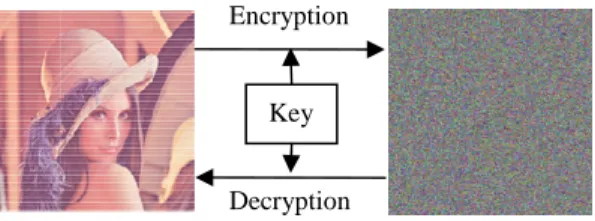
Fig. 1: represents the conversion of original image to encrypted image using key and vice versa
By the way of using the key, the encryption technique differs. If a same key is used for encryption and decryption; then it is said to be symmetric encryption technique. If different keys are used for encryption and decryption processes; it is said to be an Asymmetric encryption technique. The proposed algorithm comes under the symmetric encryption technique. The processing ti
AUSTRALIAN JOURNAL OF BASIC AND
APPLIED SCIENCES
ISSN:1991-8178 EISSN: 2309-8414 Journal home page: www.ajbasweb.com
AENSI Publisher All rights reserved
This work is licensed under the Creative Commons Attribution International License (CC BY).
http://creativecommons.org/licenses/by/4.0/
Kanagaraj Narayanasamy and Padmapriya Arumugam, i-TEE – An Image Encryption Algorithm based on Multilevel Encryption using a Randomly Generated Bitmap Image. Aust. J. Basic & Appl. Sci., 10(2): 150-155, 2016
An Image Encryption Algorithm based on Multilevel Encryption
using a Randomly Generated Bitmap Image
Padmapriya Arumugam
of Computer Science and Engineering, Alagappa University, Karaikudi, Tamilnadu, India. Associate Professor, Department of Computer Science and Engineering, Alagappa University, Karaikudi, Tamilnadu, India.
Narayanasamy, Research Scholar, Department of Computer Science and Engineering, Alagappa University, Karaikudi mail: [email protected]
A B S T R A C T
Due to intensive growth in communications; Images are transferred through the internet in an ease of way. Since the images may be misused, the images need to be encrypted before transmitting. Image encryption algorithms need to be easily acceptable, effect and more secured by avoiding statistical attacks and other kind of attacks from outside. This paper proposes a new multilevel encryption algorithm called
Transposition and Encryption processes to secure the image.
using Java and tested with different set of images. The security of the image is assessed through the histogram results of the encrypted images. So this
suited for encrypting the images in an efficient way.
INTRODUCTION
For the past few decades, the security and integrity of data are the main concern in data communication. During transmission over the internet, the data may become vulnerable to attacks. Cryptography
is one of the ways to secure the image. It has two processes, namely encryption and decryption. Encryption is the process of converting the original image to disguised format and vice-versa is said to be decryption process. A key is used in both encryption and decryption processes.
represents the conversion of original image to encrypted image using key and vice versa
By the way of using the key, the encryption technique differs. If a same key is used for encryption and is said to be symmetric encryption technique. If different keys are used for encryption and decryption processes; it is said to be an Asymmetric encryption technique. The proposed algorithm comes under the symmetric encryption technique. The processing time and computational requirement for encryption
Encryption
Decryption Key
Image Encryption Algorithm based on Multilevel
An Image Encryption Algorithm based on Multilevel Encryption
of Computer Science and Engineering, Alagappa University, Karaikudi, Tamilnadu, India. Associate Professor, Department of Computer Science and Engineering, Alagappa University, Karaikudi, Tamilnadu, India.
Narayanasamy, Research Scholar, Department of Computer Science and Engineering, Alagappa University, Karaikudi – 630 003,
Due to intensive growth in communications; Images are transferred through the internet in an ease of way. Since the images may be misused, the images need to be encrypted before transmitting. Image encryption algorithms need to be easily acceptable, effective and more secured by avoiding statistical attacks and other kind of attacks from outside. This paper proposes a new multilevel encryption algorithm called i-TEE that uses Transposition and Encryption processes to secure the image. i-TEE was implemented using Java and tested with different set of images. The security of the image is assessed through the histogram results of the encrypted images. So this i-TEE algorithm is well
For the past few decades, the security and integrity of data are the main concern in data communication. During transmission over the internet, the data may become vulnerable to attacks. Cryptography (Stalling, 2013) It has two processes, namely encryption and decryption. Encryption is versa is said to be decryption process.
represents the conversion of original image to encrypted image using key and vice versa
technique are the challenges in securing an image. Cryptanalysts (Bruce, 1996) are the people who will try to get the decrypted message without the original key. In images, an adversary can intercept the encrypted image and alter the image. There may be some possibilities of modification on encrypted images by Gaussian noise, Salt and Pepper attack, and Pixel value alteration (Gonzales and Woods, 2003; Gonzales and Woods, 1992; Santhosh et al, 2010). The algorithm must produce the decrypted image with no or less changes.
Different techniques are used for securing the images; some of them are selective bit plane encryption (Podesser et al, 2002), fuzzy PN codes based on color image encryption (Shreyamsha and Patil, 2010), standard DES (Dang et al, 2000), modified AES (Zeghid et al, 2007) and polarization encryption (Tan et al, 2001). They provide better secured image and varying degrees of success of resistance from attacks. Due to the tremendous usage of the internet; an algorithm becomes old within a short span of time. So, there comes a need for cryptographers to (re)design an algorithm. In this regard, we propose a new algorithm which encompasses the transposition and encryption processes that produce more secured image. This paper is divided into four phases; the first phase deals about preface to the proposed methodology. The second phase reveals the work flow of the proposed methodology. The next phase is dealt with the results and discussion where the results of the proposed algorithm are pointed out and a short discussion is done and the final phase is the conclusion and future work.
Proposed Methodology:
In this research paper, the image is encrypted in a three step processes. In the first phase, the image is going under the process of transposition in a spiral manner. The pixel is extracted in spiral manner and positioned from top left corner (top to bottom) of the image. This kind of repositioning process shuffles the entire image drastically.
In the second phase, a randomly generated bitmap image is used as a key to encrypt the image. Randomness provides unpredictable values, that is, doesn’t follow any mathematical procedures to acquire the next value. So the randomly generated image acts as a better key for encryption purpose. By index mapping method, the original image is encrypted using the randomly generated bitmap image. Here, the index represents the position of the desired value in the image; and the mapping represents interrelating two image’s index values. The following formula represents this process. Enc_Image1= (Transpose_image +
Rand_gen_image ) )mod 255 (1)
In the last phase, a value called ‘Chosen Value’ (CV) is taken from the randomly generated bitmap image’s red values. The CV must fall under the 30 percent of the original image’s size. If the CV is between the ranges 0% to 9%, 10% to 19%, and 20% to 29%, then R, G, and B values will be chosen respectively. The CV is also used as a position notifier. Based on the CV value; the Red or Green or Blue value is taken as a key for the next stage of the encryption process. For instance, if the chosen value is 9, then ‘R’ value is taken from the randomly generated image at the position (9, 9). This process makes the encrypted image further more complex for cryptanalysts. The following formula represents this process. Enc_Image2 = (Enc_Image1 + val(R/G /
B(X,X))) mod 255 (2)
Where, ‘X’ represents the position and ‘val’ represents the respective value from the position/index. The next part of the paper will clearly reveal the process of the proposed methodology.
Work Flow:
The image (Gonzales and Woods, 2003) is a collection of pixels. A pixel holds alpha-RGB values which in turn represent the intensity at a particular position of the image. The image can be represented in matrix form as shown below (Fig. 2).
Fig. 2: represents the matrix for a image with x,y as image size.
In the first phase, the original image pixels are undergoing the process of transposition in a spiral way. The initial position of the transposition may differ according to the CV. The output image from the transposition process completely differs according to the initial position of the transposition process. For instance, a 4x4
image is taken into account and the below matrices show the pixels before and after the transposition process. This kind of transposition makes the cryptanalysis to be tougher.
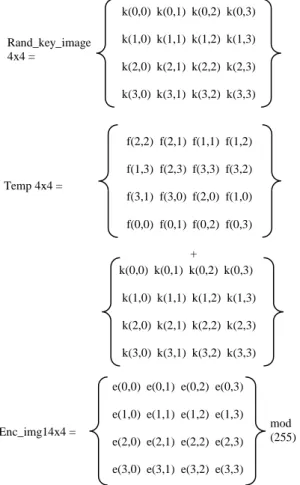
In the next phase, according to the size of the original image, a bitmap image is generated with random values. This randomly generated bitmap image is used as key to encrypt the transposition-image. The Index mapping method is used, that is, the index of transposition image (Trans_img) and randomly generated image (Rand_key_image) are mapped; and encrypted as per the above equation (1). This process is explained in the following figure (Fig. 4). The R, G, B values of the transposition image are added to the R, G, B values of the randomly generated image; then the modulo operation operates on those values.
Fig. 3: represents the matrix (index) of image before and after transposition process.
The RED value is extracted from the alpha-RGB value of the randomly generated image. Those values are stored in a single dimensional array. A value is chosen from that array and that value must be less than 30% of the original image size.
Fig. 4: represents the collection of Matrices which represents the second stage of encryption process. e(0,0) e(0,1) e(0,2) e(0,3)
e(1,0) e(1,1) e(1,2) e(1,3) e(2,0) e(2,1) e(2,2) e(2,3) e(3,0) e(3,1) e(3,2) e(3,3) Rand_key_image
4x4 =
Temp 4x4 =
f(2,2) f(2,1) f(1,1) f(1,2) f(1,3) f(2,3) f(3,3) f(3,2) f(3,1) f(3,0) f(2,0) f(1,0) f(0,0) f(0,1) f(0,2) f(0,3)
mod (255) k(0,0) k(0,1) k(0,2) k(0,3) k(1,0) k(1,1) k(1,2) k(1,3) k(2,0) k(2,1) k(2,2) k(2,3) k(3,0) k(3,1) k(3,2) k(3,3)
+
k(0,0) k(0,1) k(0,2) k(0,3) k(1,0) k(1,1) k(1,2) k(1,3) k(2,0) k(2,1) k(2,2) k(2,3) k(3,0) k(3,1) k(3,2) k(3,3)
Enc_img14x4 =
f(0,0) f(0,1) f(0,2) f(0,3) f(1,0) f(1,1) f(1,2) f(1,3) f(2,0) f(2,1) f(2,2) f(2,3) f(3,0) f(3,1) f(3,2) f(3,3)
f(2,2) f(2,1) f(1,1) f(1,2) f(1,3) f(2,3) f(3,3) f(3,2) f(3,1) f(3,0) f(2,0) f(1,0) f(0,0) f(0,1) f(0,2) f(0,3) Image 4x4 =
For instance, if the chosen value is 2, then the “Red” value is chosen at the position (2, 2). That “Red” value is used to encrypt the resultant image from the second process. Figure 5 represents this process. The randomly generated bitmap image is the key to be sent. The key can be sent as an image or as a matrix key file to the receiver.
Fig. 5: represents the third stage of encryption process
In short, the transposition is done in the first phase and then encrypted using a randomly generated bitmap image and again encrypted with a key from the randomly generated image itself. This method of three steps encryption process gives a better encrypted image.
RESULTS AND DISCUSSION
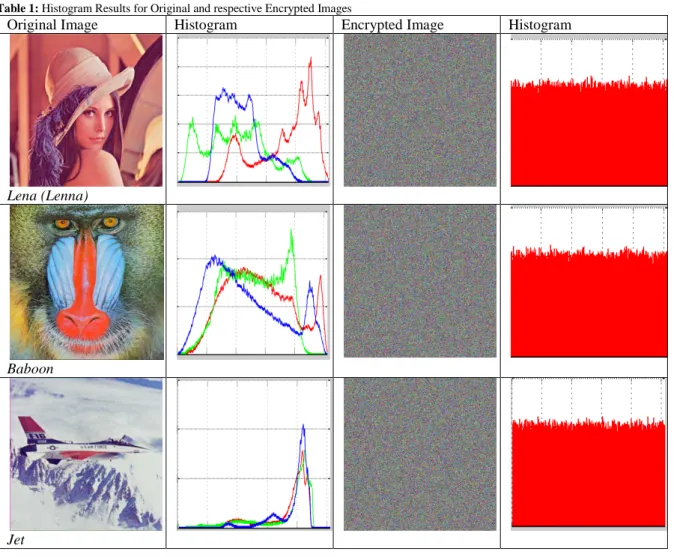
A histogram for the image used to know the distribution of the pixels at each color intensity level (in graph). The histograms (individual components - RGB) are plotted for different images in the table (1). If histograms of the original and encrypted have little or no statistical similarity then it is possible to conclude that the cryptanalysts cannot break easily using statistical analysis. Here, the histograms of original images clearly show the variations in the image components whereas the histograms plotted for the respective encrypted images show no variations at all. These histograms reveal that the original images are completely encrypted and won’t provide any information through any statistical attacks.
For assessment purposes the mean values are also provided in table (2). The table (2) reveals that the mean value of Red, Green and Blue components is shattered in an almost equal manner. The histogram drawn for the encrypted images belongs to the Red component since the mean value of Red, Green and Blue doesn’t show any differences.
Peak Signal-to-Noise Ratio (PSNR) (Web links; National Instruments, 2013) is an image quality metric; which is used to compare the quality between the original and decrypted image. In this research work, PSNR is calculated for original and encrypted image to assess the strength of the encryption process. If two images are identical; the result would show infinity; otherwise, PSNR will be less according to the encryption process on the original image. In table (2), the results show that the values are lesser than 20; these values show that the image is encrypted in a better way and assure that the images won’t disclose any information to the intruders while transferring.
Execution speed is another important factor in the design of image encryption algorithm. It decides the applicability of the algorithm in the real world. The average encryption and decryption time is determined using various images with 512x512 pixels are 512ms and 490ms respectively on personal computer equipped with an Intel processor (Core i3) with clock speed of 1.7GHz, 2GB of RAM and 520GB of Hard disk capacity.
Conclusion:
A new multilevel encryption algorithm i-TEE has been presented in this paper. The algorithm utilizes the transposition procedure, encryption based on the randomly generated bitmap image and encryption based on the key from the partial portion of the randomly generated image. This three set of processes makes the original image to be encrypted in a great form. Statistical analysis has been done using histograms for the encrypted images and it clearly shows that there is no possible ways to cryptanalysis by using the statistical attack. In addition, the huge number of possible keys to predict the randomly generated image makes a brute-force attack as impossible to carry out on the i-TEE algorithm.
e(0,0) e(0,1) e(0,2) e(0,3) e(1,0) e(1,1) e(1,2) e(1,3) e(2,0) e(2,1) e(2,2) e(2,3) e(3,0) e(3,1) e(3,2) e(3,3)
+ val(2,2) mod (255) Enc_img
Table 1: Histogram Results for Original and respective Encrypted Images
Original Image Histogram Encrypted Image Histogram
Lena (Lenna)
Baboon
Jet
Table 2: Mean values for original and respective encrypted images with PSNR values
Image Name Original image’s Mean Values Encrypted image’s Mean Values PSNR (RGB)
Lena
Red : 180.22 Red : 126.96
19.88
Green : 99.05 Green : 126.96
Blue :105.41 Blue : 126.88
Baboon
Red : 137.39 Red : 126.91
20.24
Green : 128.86 Green : 126.91
Blue : 113.12 Blue : 127.12
Jet
Red : 177.58 Red : 126.91
18.28
Green : 177.85 Green : 126.86
Blue : 190.21 Blue : 126.90
REFERENCES
Bruce Schneier,1996. Applied Cryptography, 2nd edition. Wiley. ISBN 0-471-11709-9.
Dang, Philip P., and Paul M. Chau, 2000. Image encryption for secure internet multimedia applications, Consumer Electronics, IEEE Transactions, 46(3): 395-403.
Gonzales R. and R. Woods,1992. Digital Image Processing. Addison Wesley. pp: 187-213.
National Instruments, 2013. Peak Signal-to-Noise Ratio as an Image Quality Metric (White paper). ChinaAvailable online at http://www.ni.com/white-paper
Podesser, Martina, Hans-Peter Schmidt, and Andreas Uhl, 2002. Selective bitplane encryption for secure transmission of image data in mobile environments, Proceedings of the 5th IEEE Nordic Signal Processing Symposium (NORSIG’02).
Rafael C.Gonzalez, and Richard E. Woods,December 2003. Digital Image Processsing (2nd ed.), Pearson Education, 15-20, 222-223 & 243. ISBN 978-8178086293.
ShreyamshaKumar, B.K. and Chidamber R. Patil, 2010. JPEG image encryption using fuzzy PN sequences, Signal, image and video processing, 4(4): 419-427.
Tan, Xiaodi, et al.,2001. Secure optical memory system with polarization encryption, Applied optics, 40(14): 2310-2315.
Web links, http://in.mathworks.com/help/ images/image -quality-metrics.html &
http://in.mathworks.com/help/images/image-quality.html (Web links - Last accessed on: 9th, Dec 2015)
William Stalling, 2013. Cryptography and Network Security: Principles and Practice (Sixth ed.).Prentice Hall. ISBN 978-0133354690.