Data Paper
Wildlife inventory from camera-trapping surveys
in the Azores (Pico and Terceira islands)
Lucas Lamelas-Lopez, Xose Pardavila, Isabel R. Amorim , Paulo A. V. Borges
‡ CE3C – Centre for Ecology, Evolution and Environmental Changes / Azorean Biodiversity Group and Universidade dos Açores, Angra do Heroísmo, Azores, Portugal
§ Área de Ecoloxía, Departamento de Bioloxía Celular e Ecoloxía, Universidade de Santiago de Compostela. Spain., Santiago de Compostela, Spain
Corresponding author: Lucas Lamelas-Lopez ([email protected])
Academic editor: Cynthia Parr
Received: 31 Oct 2019 | Accepted: 03 Jan 2020 | Published: 24 Jan 2020
Citation: Lamelas-Lopez L, Pardavila X, Amorim IR, Borges PAV (2020) Wildlife inventory from camera-trapping surveys in the Azores (Pico and Terceira islands). Biodiversity Data Journal 8: e47865.
https://doi.org/10.3897/BDJ.8.e47865
Abstract
Background
The present publication provides a dataset from five camera-trapping sampling campaigns on two islands of the Azorean archipelago (Pico and Terceira islands), between 2013-2018. This dataset was obtained as a by-product of campaigns designed for different purposes. The sampling campaigns were designed to: (i) study the ecology of introduced mammals; (ii) assess the impact of introduced mammals on native birds (Azores woodpigeon
-Columba palumbus azorica and Cory's shearwater - Calonectris diomeda borealis), through nest predation; and (iii) obtain information about the impact of vertebrates on agricultural systems, particularly on Azorean traditional vineyards. A total of 258 sites and 47 nests were sampled using camera traps. These sampling campaigns provided a large data series that allowed the creation of a vertebrate wildlife inventory.
‡ § ‡ ‡
New information
We obtained a total of 102,095 camera-trap records, which allowed us to to identify 30 species of vertebrates: one amphibian, one reptile, 17 birds and ten mammal species. This represented 100% of the amphibians and terrestrial mammals, 58% of the breeding birds and 50% of the reptile species known for Pico and/or Terceira islands. Concerning the colonisation status of the species, we recorded 15 indigenous (native non-endemic or endemic) and three introduced bird species; all known terrestrial amphibians, reptiles and mammals in the Azores are introduced species. The data collected contribute to increasing knowledge on the distribution of vertebrate species on Pico and Terceira islands, where most existing records of some species were only available to Island level (e.g. mustelids and hedgehogs). None of the identified species was previously unknown to the study area.
Keywords
Camera-traps, Vertebrates, Oceanic islands, Introduced species
Introduction
Camera-trapping is commonly used to answer a variety of research questions in the fields of animal ecology, behavioural studies and conservation biology (O’Connell et al. 2011). It has also been used to assess the impacts of invasive species on native biodiversity (Hervías et al. 2012, Oppel et al. 2014) and the damage to wildlife in agriculture systems (Coates et al. 2010), as well as to address questions on spatial and temporal dynamics of animal populations (O’Connell et al. 2011). Although camera-traps are most often used to study medium- and large-sized terrestrial mammals (Tobler et al. 2008, Rovero et al. 2010), they have been successfully used to study arboreal mammals (Oliveira-Santos et al. 2008, Di Cerbo and Biancardi 2012) and small-sized species (MCCleery et al. 2014, Rendall et al. 2014, Taylor et al. 2014). Camera-traps are also useful for detecting rare or elusive species (Si et al. 2014).
Cameras are triggered by passing animals, allowing a record of animal presence and date and time of the detection (O’Connell et al. 2011). This allows the estimation of abundance and density (using capture-recapture models) for individually recognisable species (Karanth 1995, O’Connell et al. 2011). However, when it is impossible to distinguish specimens individually, camera-traps can also be used to calculate relative abundance indices of species (Rovero and Marshall 2009, O’Connell et al. 2011).
In the Azores, very few studies have been done using camera-trapping to study vertebrates (but see, for example, Hervías et al. 2012 about nest predation). Here we aim to describe the main findings of the five sampling campaigns using camera-trapping to survey vertebrates, conducted between 2013 and 2018 in the Azores, namely on the islands of Pico and Terceira.
General description
Purpose: To provide a vertebrate inventory for the Azores (Pico and Terceira islands), based on data obtained as a by-product from five field sampling campaigns using camera-trapping.
Additional information: Between 2013 and 2018, two sampling campaigns were conducted on Terceira island ("TER_13-15" survey) and on Terceira and Pico islands ("TER-PIC_18" survey) in order to study the ecology of introduced mammals. A third sampling campaign was performed between 2015 and 2017 in vineyards on Terceira island in order to evaluate grape consumption by vertebrate species ("Vineyards_15-17" survey). Additionally, between 2016 and 2018, two sampling campaigns were performed on Terceira island, in order to assess the impact of introduced mammals on native birds, on Cory's Shearwater (Calonectris diomedea borealis; "Calonectris_16" survey) and the Azores woodpigeon (Columba palumba azorica; "Columba_17-18" survey), through nest predation monitoring.
Sampling methods
Study extent: This dataset was obtained from different sampling campaigns performed between 2013 and 2018 in two islands of the central group of the Azores archipelago, Pico and Terceira Islands.
We described the study extent of the different sampling campaigns below:
• The survey "TER_13-15" was conducted between 2013 and 2015 on Terceira island, to investigate the ecology of introduced mammals. A total of 72 sites were sampled, but five sites were excluded due to camera failures. Each site was sampled during seven consecutive days.
• The survey "PIC-TER_18" was conducted in 2018 on Pico and Terceira islands, to investigate the ecology of introduced mammals. A total of 69 sites were sampled, with 33 and 34 sites, located in Pico and Terceira islands, respectively. Each site was sampled during ten consecutive days.
sites sampled during 2015, 2016 and 2017, respectively. Each site was sampled during seven consecutive days.
• The survey "Calonectris_16" was conducted in 2016 on Terceira island, to assess the impact of introduced mammals. A total of 17 nests of Calonectris diomedea borealis were sampled. Each nest was sampled during ten consecutive days. • The survey "Columba_17-18" was conducted in 2017 and 2018 on Terceira island,
to assess the impact of introduced mammals. A total of 30 nests of Columba palumbus azorica were sampled, with 9 and 21 sites sampled in 2017 and 2018, respectively. Each nest was sampled during ten consecutive days.
Sampling description: All sites were sampled using camera-traps that were fixed to a tree or wooden stick. The sampling effort was measured as camera-trap days, i.e. the number of camera traps multiplied by the number of days that they remained active (Rovero et al. 2010). The sensitivity of the infrared sensor was configured to high to increase the species detection (O’Connell et al. 2011). Cameras were configured to take events with 30 seconds of delay between them, recording the date and time of each event. Cameras remained active 24 hours per day.
For the surveys "TER_13-15" and "PIC-TER_18" sampling sites were randomly selected, separated at least by 1 km. In each sampling site, one camera trap and a bait were deployed, 150-200 cm apart. Bait, consisting of meat or fish, fruit or vegetables and molasses, was used to increase the species detection (du Preez et al. 2014).
For the surveys "Vineyards_15-17", "Calonectris_16" and "Columba_17-18", no bait was used. In the case of the "Vineyards_15-17" survey, sampling sites were selected at random, deploying one camera at each site, facing bunches of grapes. For
Figure 1.
"Calonectris_16" and "Columba_17-18" surveys, one camera was installed at 50-150 cm from the study nest (Fig. 1).
Quality control: Taxonomic nomenclature followed the GBIF species profile and, for Azorean subspecies, we used the vertebrate checklist in Borges et al. 2010.
Geographic coverage
Description: Pico and Terceira islands, the Azores, Macaronesia, Portugal
Coordinates: 38.434491 and 38.7617777778 Latitude; -28.4228543692 and -27.1971972222 Longitude.
Taxonomic coverage
Taxa included:
Rank Scientific Name Common Name
class Mammalia Mammals
class Aves Birds
class Reptilia Reptiles
class Amphibia Amphibians
Temporal coverage
Data range: 2013-9-08 - 2018-8-10.
Usage rights
Use license: Open Data Commons Attribution License
Data resources
Data package title: Wildlife inventory in the Azores using camera trapping
Resource link: http://ipt.gbif.pt/ipt/resource?r=camera_trapping_azores
Alternative identifiers: https://www.gbif.org/dataset/ 7d6b90d2-14c0-4ba6-9e45-449b56bab878
Data set name: Wildlife inventory in the Azores using camera trapping
Data format: Darwin Core Archive
Data format version: version 1
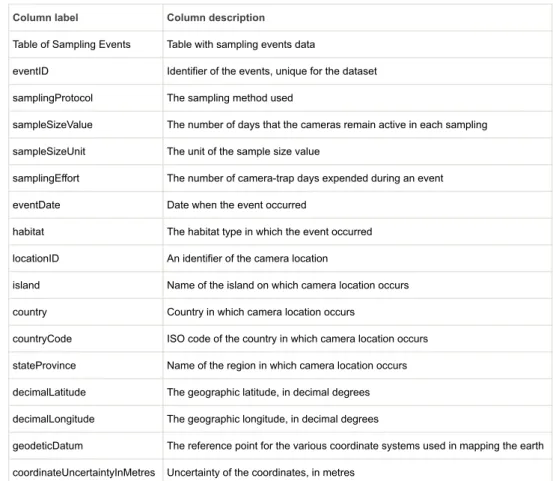
Description: The dataset was published in GBIF (see Lamelas-López et al. 2019). The following data table includes all the records for which a taxonomic identification of the species was possible. The dataset submitted to GBIF is structured as a sample event dataset, with two tables: event (as core) and occurrences. The data in this sampling event resource have been published as a Darwin Core Archive (DwCA), which is a standardised format for sharing biodiversity data as a set of one or more data tables. The core data table contains 2,308 records (eventID). One extension data table also exists with 108,186 occurrences. This large number of occurrences is a consequence of the fact that cameras were configured to take occurrences with 30 seconds of delay between them, recording the date and time of each record. Cameras remained active 24 hours per day. An extension record supplies extra information about a core record. The number of records in each extension data table is illustrated in the IPT link. This IPT archives the data and thus serves as the data repository. The data and resource metadata are available for downloading in the downloads section.
Column label Column description
Table of Sampling Events Table with sampling events data
eventID Identifier of the events, unique for the dataset samplingProtocol The sampling method used
sampleSizeValue The number of days that the cameras remain active in each sampling sampleSizeUnit The unit of the sample size value
samplingEffort The number of camera-trap days expended during an event eventDate Date when the event occurred
habitat The habitat type in which the event occurred locationID An identifier of the camera location
island Name of the island on which camera location occurs country Country in which camera location occurs
countryCode ISO code of the country in which camera location occurs stateProvince Name of the region in which camera location occurs decimalLatitude The geographic latitude, in decimal degrees decimalLongitude The geographic longitude, in decimal degrees
fieldNotes Notes about the use or non-use of bait in the sampling sites eventRemarks Additional information supporting the survey code Table of Occurrences Table with species occurrences
id Unique identifier
eventID A unique identifier of an occurrence
ocurrenceID Identifier of the event, coded as a global unique identifier basisOfRecord The nature of the data record
eventDate Date when the event occurred eventTime Time of the day when the event occurred organismQuantity A number for the quantity of organisms organismQuantityType The unit used to quantify the organisms
occurrenceStatus Information about the presence/absence of a taxon at a camera location kingdom Kingdom name in which the taxon is classified
phylum Phylum name in which the taxon is classified class Class name in which the taxon is classified order Order name in which the taxon is classified family Family name in which the taxon is classified genus Genus name in which the taxon is classified specificEpithet Species name in which the taxon is classified infraspecificEpithet Subspecies name in which the taxon is classified scientificName The full scientific name including author and year taxonRank Lowest taxonomic rank of the event
Additional information
Results and Discussion
europaeus), according to current GBIF occurrence data. Spatial (e.g. habitat type) and temporal (date and hour of the record) information of the species are also included in the dataset resources.
A total of 30 species were identified: one amphibian, one reptile, 17 birds and ten mammal species (Table 1). According to the most recent available Azorean biota checklist (Borges et al. 2010), we recorded 100% of the amphibians and terrestrial mammals, 58% of the breeding birds and 50% of the reptile species known for Pico and/or Terceira islands. Cattle (e.g. cows) and invertebrate species (e.g. flies, bees or snails) were also recorded, but were excluded from the analysis and results.
Class Species Status TER_13-15 PIC-TER_18
Vineyards_15-17 Calonectris_16 Columba_17-18
Amphibia Pelophylax perezi (López-Seoane, 1885)
int 0 2 0 0 0
Reptilia Teira dugesii (Milne-Edwards, 1829)
int 56 985 11017 14 0
Figure 2.
Example of a camera trap record. The record shows the presence of a cat (Felis catus) on 21 February 2015, at 06:44 pm.
Table 1.
Class Species Status TER_13-15 PIC-TER_18
Vineyards_15-17 Calonectris_16 Columba_17-18
Aves Coturnix coturnix conturbans Hartert, 1917
nat 0 0 1 0 0
Aves Calonectris borealis (Cory, 1891)
nat 0 3 0 2015 0
Aves Buteo buteo rothschildi (Swann, 1919)
azo 1 0 0 0 0
Aves Larus michahellis atlantis Dwight, 1922
azo 4 0 0 0 0
Aves Gallinago gallinago (Linnaeus, 1758)
nat 0 2 0 0 0
Aves Scolopax rusticola Linnaeus, 1758
nat 16 102 0 0 0
Aves Columba livia domestica Gmelin, 1789
int 1 0 23 100 0
Aves Columba palumbus azorica Hartert, 1905
azo 47 6 40 0 53752
Aves Asio otus otus (Linnaeus, 1758)
nat 7 0 0 0 0
Aves Chloris chloris aurantiiventris (Cabanis, 1851)
Class Species Status TER_13-15 PIC-TER_18
Vineyards_15-17 Calonectris_16 Columba_17-18
Aves Fringilla coelebs moreletti Pucheran, 1859
azo 60 117 88 1 8
Aves Serinus canaria (Linnaeus, 1758)
mac 2 6 259 2 0
Aves Motacilla cinerea patriciae Vaurie, 1957
azo 6 0 0 0 0
Aves Passer domesticus domesticus Linnaeus, 1758
int 2 3 1544 0 0
Aves Sturnus vulgaris granti Hartert, 1903
azo 10 0 0 1 0
Aves Sylvia atricapilla gularis Alexander, 1898
azo 4 248 65 2 2
Aves Erithacus rubecula rubecula (Linnaeus, 1758)
nat 25 92 6 6 0
Aves Turdus merula azorensis Hartert, 1905
azo 300 1403 912 23 1
Mammalia Mustela nivalis (Linnaeus, 1758)
Class Species Status TER_13-15 PIC-TER_18
Vineyards_15-17 Calonectris_16 Columba_17-18
Mammalia Mustela furo (Linnaeus, 1758)
int 4 43 0 1 0
Mammalia Felis silvestris catus Schreber, 1775
int 996 1042 41 10 30
Mammalia Canis lupus familiaris Linnaeus, 1758
int 150 64 1 0 0
Mammalia Dama dama (Linnaeus, 1758)
int 0 4 0 2 0
Mammalia Mus musculus Linnaeus, 1758
int 83 3037 63 2 0
Mammalia Rattus norvergicus (Berkenhout, 1769)
int 0 2134 0 0 0
Mammalia Rattus rattus (Linnaeus, 1758)
int 0 20239 0 0 278
Mammalia Oryctolagus cuniculus (Linnaeus, 1758)
int 369 3 4 0 0
Mammalia Erinaceus europaeus europaeus (Linnaeus, 1758)
int 40 20 2 0 0
The species with the highest number of records were the Azores Woodpigeon - Columba palumbus azorica (53,752), the black rat - Rattus rattus (40,756) and the Madeira lizard
-Teira dugesii (24,074). In the case of the Azores Woodpigeon, the high number of records was due to the fact that adults remain in the nests for long periods, causing many camera captures.
Green frog - Pelophylax perezi, the European quail - Coturnix coturnix, Azorean
snipe - Gallinago gallinago, long-eared owl - Asio otus and grey wagtail - Motacilla cinerea patriciae were the least captured species (< 10 records).
In total, we recorded 15 indigenous (native non-endemic or endemic) and three introduced bird species (Table 1). All known amphibians, reptiles and terrestrial mammals found in Azores are introduced species (Borges et al. 2010). None of the identified species was previously unknown to the study area.
Acknowledgements
We thank Lucía Lamelas, Herlander Lima, Jose Sarangollo, David Rodilla, María Olivo, Sophie Wallon, Raquel Daza, Alejandra Ros, William Sharkey, Jose Ortolá and Luis Ansias for their assistance during the fieldwork, and Jagoba Malumbres-Olarte for his useful comments in the first version of the manuscript. We are also grateful to the Agrarian Development Service of Terceira and the Natural Park of Terceira for logistical support, particularly to Fábio Raposo, Paula Cordeiro, Sónia Alves and João Amaral. LLL was supported by a grant from Fundação para a Ciência e Tecnologia - FCT (SFRH/BD/ 115022/2016). Open access was funded by FEDER (85%) and by Azorean Public funds (15%), through the Operational Program Azores 2020 under the project AZORESBIOPORTAL – PORBIOTA (ACORES-01-0145-FEDER-000072).
Author contributions
LLL and XP conceived the sampling protocols. LLL and PAV conceived the data paper. LLL performed the fieldwork. LLL analysed the data; LLL led the writing of the manuscript and XP, IRA and PAV contributed to the final manuscript.
References
• Borges PAV, Costa A, Cunha R, Gabriel R, Gonçalves V, Martins AF, Melo I, Parente M, Raposeiro P, Rodrigues P, Santos RS, Silva L, Vieira P, Vieira V (2010) A list of the terrestrial and marine biota from the Azores. Princípia, Cascais, 430 pp. URL: http:// www.azoresbioportal.angra.uac.pt/files/publicacoes_Listagem_ml.pdf
• Coates R, Delwiche M, Gorenzel WP, Salmon T (2010) Evaluation of damage by vertebrate pests in California vineyards and control of wild turkeys by bioacoustics. Utah State University 4 (1): 130‑144. https://doi.org/10.26077/KMNP-J738
• De Bondi N, White J, Stevens M, Cooke R (2010) A comparison of the effectiveness of camera trapping and live trapping for sampling terrestrial small-mammal communities. Wildlife Research 37 (6): 456‑465. https://doi.org/10.1071/wr10046
• du Preez B, Loveridge A, Macdonald D (2014) To bait or not to bait: A comparison of camera-trapping methods for estimating leopard Panthera pardus density. Biological Conservation 176: 153‑161. https://doi.org/10.1016/j.biocon.2014.05.021
• Glen A, Cockburn S, Nichols M, Ekanayake J, Warburton B (2013) Optimising camera traps for monitoring small mammals. PLOS One 8 (6): e67940. https://doi.org/10.1371/ journal.pone.0067940
• Hervías S, Henriques A, Oliveira N, Pipa T, Cowen H, Ramos JA, Nogales M, Geraldes P, Silva C, de Ybáñez RR, Oppel S (2012) Studying the effects of multiple invasive mammals on Cory’s shearwater nest survival. Biological Invasions 15 (1): 143‑155.
https://doi.org/10.1007/s10530-012-0274-1
• Karanth KU (1995) Estimating tiger Panthera tigris populations from camera-trap data using capture—recapture models. Biological Conservation 71 (3): 333‑338. https:// doi.org/10.1016/0006-3207(94)00057-w
• Lamelas-López L, Pardavila X, Amorim IR, Borges PAV (2019) Wildlife inventory in the Azores using camera trapping. v1.4. Universidade dos Açores. Dataset/Samplingevent. 1.4. GBIF. Release date: 2019-10-17. URL: https://doi.org/10.15468/tcmnya
• Lyra-Jorge MC, Ciocheti G, Pivello VR, Meirelles ST (2008) Comparing methods for sampling large- and medium-sized mammals: camera traps and track plots. European Journal of Wildlife Research 54 (4): 739‑744. https://doi.org/10.1007/
s10344-008-0205-8
• MCCleery R, Zweig C, Desa M, Hunt R, Kitchens W, Percival HF (2014) A novel method for camera-trapping small mammals. Wildlife Society Bulletin 38 (4): 887‑891. https:// doi.org/10.1002/wsb.447
• O’Connell A, Nichols J, Karanth KU (2011) Camera traps in animal ecology: Methods and analyses. Springer Science & Business Media, 271 pp. https://doi.org/
10.1007/978-4-431-99495-4
• Oliveira-Santos L, Tortato M, Graipel M (2008) Activity pattern of Atlantic Forest small arboreal mammals as revealed by camera traps. Journal of Tropical Ecology 24 (5): 563‑567. https://doi.org/10.1017/s0266467408005324
• Oppel S, Burns F, Vickery J, George K, Ellick G, Leo D, Hillman J (2014) Habitat-specific effectiveness of feral cat control for the conservation of an endemic ground-nesting bird species. Journal of Applied Ecology 51 (5): 1246‑1254. https://doi.org/ 10.1111/1365-2664.12292
• Rendall A, Sutherland D, Cooke R, White J (2014) Camera trapping: A contemporary approach to monitoring invasive rodents in high conservation priority ecosystems. PLOS One 9 (3): e86592. https://doi.org/10.1371/journal.pone.0086592
• Rovero F, Marshall A (2009) Camera trapping photographic rate as an index of density in forest ungulates. Journal of Applied Ecology 46 (5): 1011‑1017. https://doi.org/ 10.1111/j.1365-2664.2009.01705.x
• Rovero F, Tobler M, Sanderson J (2010) Camera trapping for inventorying terrestrial vertebrates. In: Eymann J, Häuser C, Monje JC, Samyn Y, VandenSpiegel D (Eds) Manual on field recording techniques and protocols for all taxa biodiversity inventories. The Belgian National Focal Point to the Global Taxonomy Initiative, 100-128 pp. • Rovero F, Owen N, Jones T, Canteri E, Iemma A, Tattoni C (2016) Camera trapping
• Silveira L, Jácomo AA, Diniz-Filho J (2003) Camera trap, line transect census and track surveys: a comparative evaluation. Biological Conservation 114 (3): 351‑355. https:// doi.org/10.1016/s0006-3207(03)00063-6
• Si X, Kays R, Ding P (2014) How long is enough to detect terrestrial animals? Estimating the minimum trapping effort on camera traps. PeerJ 2 https://doi.org/ 10.7717/peerj.374
• Taylor B, Goldingay R, Lindsay J (2014) Horizontal or vertical? Camera trap orientations and recording modes for detecting potoroos, bandicoots and pademelons. Australian Mammalogy 36 (1): 60‑66. https://doi.org/10.1071/am13012
• Tobler MW, Carrillo-Percastegui SE, Pitman RL, Mares R, Powell G (2008) An evaluation of camera traps for inventorying large‐ and medium‐sized terrestrial rainforest mammals. Animal Conservation 11 (3): 169‑178. https://doi.org/10.1111/j. 1469-1795.2008.00169.x