G-4100 v2
802.11g Wireless Hotspot Gateway
User’s Guide
Version 1.00
7/2006
Edition 1
Copyright
Copyright © 2006 by ZyXEL Communications Corporation.
The contents of this publication may not be reproduced in any part or as a whole, transcribed,
stored in a retrieval system, translated into any language, or transmitted in any form or by any
means, electronic, mechanical, magnetic, optical, chemical, photocopying, manual, or
otherwise, without the prior written permission of ZyXEL Communications Corporation.
Published by ZyXEL Communications Corporation. All rights reserved.
Disclaimer
ZyXEL does not assume any liability arising out of the application or use of any products, or
software described herein. Neither does it convey any license under its patent rights nor the
patent rights of others. ZyXEL further reserves the right to make changes in any products
described herein without notice. This publication is subject to change without notice.
Trademarks
ZyNOS (ZyXEL Network Operating System) is a registered trademark of ZyXEL
Communications, Inc. Other trademarks mentioned in this publication are used for
identification purposes only and may be properties of their respective owners.
Certifications
Federal Communications Commission (FCC) Interference Statement
This device complies with Part 15 of FCC rules. Operation is subject to the following two
conditions:
• This device may not cause harmful interference.
• This device must accept any interference received, including interference that may cause
undesired operations.
This equipment has been tested and found to comply with the limits for a Class B digital
device pursuant to Part 15 of the FCC Rules. These limits are designed to provide reasonable
protection against harmful interference in a commercial environment. This equipment
generates, uses, and can radiate radio frequency energy, and if not installed and used in
accordance with the instructions, may cause harmful interference to radio communications.
If this equipment does cause harmful interference to radio/television reception, which can be
determined by turning the equipment off and on, the user is encouraged to try to correct the
interference by one or more of the following measures:
• Reorient or relocate the receiving antenna.
• Increase the separation between the equipment and the receiver.
• Connect the equipment into an outlet on a circuit different from that to which the receiver
is connected.
• Consult the dealer or an experienced radio/TV technician for help.
FCC Radiation Exposure Statement
• The device complies with FCC RF radiation exposure limits set forth for an uncontrolled
environment, under 47 CFR 2.1093 paragraph (d)(2). End users must follow the specific
operating instructions for satisfying RF exposure compliance.
To maintain compliance
with FCC RF exposure compliance requirements, please follow operation instruction as
documented in this manual.
• This transmitter must not be co-located or operating in conjunction with any other
antenna or transmitter.
• IEEE 802.11b or 802.11g operation of this product in the U.S.A. is firmware-limited to
channels 1 through 11.
• To comply with FCC RF exposure compliance requirements, a separation distance of at
least 20 cm must be maintained between the antenna of this device and all persons.
注意 !
依據 低功率電波輻射性電機管理辦法
者均不得擅自變更頻率、加大功率或變更原設計之特性及功能。
第十四條 低功率射頻電機之使用不得影響飛航安全及干擾合法通信;經發現 有干擾現象時,應立即停用,並改善至無干擾時方得繼續使用。
前項合法通信,指依電信規定作業之無線電信。低功率射頻電機須忍 受合法通信或工業、科學及醫療用電波輻射性電機設備之干擾。
Notices
Changes or modifications not expressly approved by the party responsible for compliance
could void the user's authority to operate the equipment.
This device has been designed for the WLAN 2.4 GHz network throughout the EC region and
Switzerland, with restrictions in France.
This Class B digital apparatus complies with Canadian ICES-003.
Viewing Certifications
1
Go to
http://www.zyxel.com
.
2
Select your product from the drop-down list box on the ZyXEL home page to go to that
product's page.
Safety Warnings
For your safety, be sure to read and follow all warning notices and instructions.
• Do NOT open the device or unit. Opening or removing covers can expose you to
dangerous high voltage points or other risks. ONLY qualified service personnel can
service the device. Please contact your vendor for further information.
• Connect the power cord to the right supply voltage (110V AC in North America or 230V
AC in Europe).
• Place connecting cables carefully so that no one will step on them or stumble over them.
Do NOT allow anything to rest on the power cord and do NOT locate the product where
anyone can walk on the power cord.
• The PoE (Power over Ethernet) devices that supply or receive power and their connected
Ethernet cables must all be completely indoors.
• If you wall mount your device, make sure that no electrical, gas or water pipes will be
damaged.
• Do NOT install nor use your device during a thunderstorm. There may be a remote risk of
electric shock from lightning.
• Do NOT expose your device to dampness, dust or corrosive liquids.
• Do NOT use this product near water, for example, in a wet basement or near a swimming
pool.
• Make sure to connect the cables to the correct ports.
• Do NOT obstruct the device ventilation slots, as insufficient airflow may harm your
device.
• Do NOT store things on the device.
• Connect ONLY suitable accessories to the device.
• CAUTION: RISK OF EXPLOSION IF BATTERY (on the motherboard) IS REPLACED
BY AN INCORRECT TYPE. DISPOSE OF USED BATTERIES ACCORDING TO
THE INSTRUCTIONS. Dispose them at the applicable collection point for the recycling
of electrical and electronic equipment. For detailed information about recycling of this
product, please contact your local city office, your household waste disposal service or
the store where you purchased the product.
ZyXEL Limited Warranty
ZyXEL warrants to the original end user (purchaser) that this product is free from any defects
in materials or workmanship for a period of up to two years from the date of purchase. During
the warranty period, and upon proof of purchase, should the product have indications of failure
due to faulty workmanship and/or materials, ZyXEL will, at its discretion, repair or replace the
defective products or components without charge for either parts or labor, and to whatever
extent it shall deem necessary to restore the product or components to proper operating
condition. Any replacement will consist of a new or re-manufactured functionally equivalent
product of equal value, and will be solely at the discretion of ZyXEL. This warranty shall not
apply if the product is modified, misused, tampered with, damaged by an act of God, or
subjected to abnormal working conditions.
Note
Repair or replacement, as provided under this warranty, is the exclusive remedy of the
purchaser. This warranty is in lieu of all other warranties, express or implied, including any
implied warranty of merchantability or fitness for a particular use or purpose. ZyXEL shall in
no event be held liable for indirect or consequential damages of any kind of character to the
purchaser.
To obtain the services of this warranty, contact ZyXEL's Service Center for your Return
Material Authorization number (RMA). Products must be returned Postage Prepaid. It is
recommended that the unit be insured when shipped. Any returned products without proof of
purchase or those with an out-dated warranty will be repaired or replaced (at the discretion of
ZyXEL) and the customer will be billed for parts and labor. All repaired or replaced products
will be shipped by ZyXEL to the corresponding return address, Postage Paid. This warranty
gives you specific legal rights, and you may also have other rights that vary from country to
country.
Registration
Register your product online to receive e-mail notices of firmware upgrades and information
at www.zyxel.com for global products, or at www.us.zyxel.com for North American products.
Customer Support
Please have the following information ready when you contact customer support.
• Product model and serial number.
• Warranty Information.
• Date that you received your device.
• Brief description of the problem and the steps you took to solve it.
METHOD LOCATION
SUPPORT E-MAIL TELEPHONEA WEB SITE
REGULAR MAIL SALES E-MAIL FAX FTP SITE
CORPORATE HEADQUARTERS (WORLDWIDE)
[email protected] +886-3-578-3942 www.zyxel.com www.europe.zyxel.com
ZyXEL Communications Corp. 6 Innovation Road II
Science Park Hsinchu 300 Taiwan [email protected] +886-3-578-2439 ftp.zyxel.com
ftp.europe.zyxel.com CZECH REPUBLIC
[email protected] +420-241-091-350 www.zyxel.cz ZyXEL Communications Czech s.r.o.
Modranská 621
143 01 Praha 4 - Modrany Ceská Republika [email protected] +420-241-091-359
DENMARK
[email protected] +45-39-55-07-00 www.zyxel.dk ZyXEL Communications A/S Columbusvej
2860 Soeborg Denmark [email protected] +45-39-55-07-07
FINLAND
[email protected] +358-9-4780-8411 www.zyxel.fi ZyXEL Communications Oy Malminkaari 10
00700 Helsinki Finland [email protected] +358-9-4780 8448
FRANCE
[email protected] +33-4-72-52-97-97 www.zyxel.fr ZyXEL France 1 rue des Vergers Bat. 1 / C 69760 Limonest France
+33-4-72-52-19-20
GERMANY
[email protected] +49-2405-6909-0 www.zyxel.de ZyXEL Deutschland GmbH. Adenauerstr. 20/A2 D-52146 Wuerselen
Germany [email protected] +49-2405-6909-99
HUNGARY
[email protected] +36-1-3361649 www.zyxel.hu ZyXEL Hungary 48, Zoldlomb Str. H-1025, Budapest Hungary
[email protected] +36-1-3259100 KAZAKHSTAN
http://zyxel.kz/support +7-3272-590-698 www.zyxel.kz ZyXEL Kazakhstan 43, Dostyk ave.,Office 414 Dostyk Business Centre 050010, Almaty Republic of Kazakhstan [email protected] +7-3272-590-689
NORTH AMERICA
[email protected] 1-800-255-4101 +1-714-632-0882
www.us.zyxel.com ZyXEL Communications Inc. 1130 N. Miller St.
Anaheim CA 92806-2001 U.S.A. [email protected] +1-714-632-0858 ftp.us.zyxel.com
NORWAY
[email protected] +47-22-80-61-80 www.zyxel.no ZyXEL Communications A/S Nils Hansens vei 13 0667 Oslo
Norway [email protected] +47-22-80-61-81
POLAND
[email protected] +48 (22) 333 8250 www.pl.zyxel.com ZyXEL Communications ul. Okrzei 1A
03-715 Warszawa Poland
+48 (22) 333 8251 RUSSIA
http://zyxel.ru/support +7-095-542-89-29 www.zyxel.ru ZyXEL Russia Ostrovityanova 37a Str. Moscow, 117279 Russia
[email protected] +7-095-542-89-25 SPAIN
[email protected] +34-902-195-420 www.zyxel.es ZyXEL Communications Arte, 21 5ª planta 28033 Madrid Spain [email protected] +34-913-005-345
SWEDEN [email protected] +46-31-744-7700 www.zyxel.se ZyXEL Communications A/SSjöporten 4, 41764 Göteborg Sweden
[email protected] +46-31-744-7701 UKRAINE
[email protected] +380-44-247-69-78 www.ua.zyxel.com ZyXEL Ukraine 13, Pimonenko Str. Kiev, 04050 Ukraine [email protected] +380-44-494-49-32
UNITED KINGDOM
[email protected] +44-1344 303044 08707 555779 (UK only)
www.zyxel.co.uk ZyXEL Communications UK Ltd.,11 The Courtyard, Eastern Road, Bracknell, Berkshire, RG12 2XB, United Kingdom (UK) [email protected] +44-1344 303034 ftp.zyxel.co.uk
a. “+” is the (prefix) number you enter to make an international telephone call. METHOD
LOCATION
SUPPORT E-MAIL TELEPHONEA WEB SITE
REGULAR MAIL SALES E-MAIL FAX FTP SITE
Table of Contents
Copyright ... 3
Certifications ... 4
Safety Warnings ... 6
ZyXEL Limited Warranty... 7
Customer Support... 8
Table of Contents ... 11
List of Figures ... 19
List of Tables ... 23
Preface ... 27
Chapter 1
Getting to Know Your ZyXEL Device... 29
1.1 Introducing the ZyXEL Device ...29
1.2 Features ...29
1.3 Applications ...33
1.3.1 Internet Access for LAN Networks ...33
1.3.2 Internet Access in Public Areas ...34
Chapter 2
The Web Configurator... 35
2.1 Introducing the Web Configurator ...35
2.2 Accessing the Web Configurator ...35
2.3 Wizard Setup Screens ...36
2.4 Navigating the Web Configurator ...36
2.5 Screens Overview ...38
2.6 Quick View Screen ...39
2.7 Login Accounts ...41
2.7.1 Changing Login Account Usernames and Passwords ...42
2.8 Methods of Restoring Factory-Defaults ...44
2.8.1 Using the Reset Button to Restore Factory-Defaults ...44
2.8.2 Using the Web Configurator to Restore Factory-Defaults ...45
2.9 Restarting the ZyXEL Device ...46
Chapter 3
General System Setup ... 49
3.1 General System Setup ...49
3.2 System Name ...49
3.3 Domain Name ...49
3.4 iPnP ZyXEL Implementation ...49
3.4.1 How iPnP Works ...50
3.5 General System Settings ...51
Chapter 4
WAN, LAN and Server Setup... 57
4.1 Factory Ethernet Defaults ...57
4.2 LANs and WANs ...57
4.3 IP Address Assignment ...57
4.4 DHCP Configuration ...57
4.4.1 IP Address and Subnet Mask ...58
4.4.2 Private IP Addresses ...58
4.5 DNS Server Address ...59
4.6 PPPoE ...59
4.6.1 PPP MTU ...59
4.6.2 TCP MSS ...60
4.7 PPTP ...60
4.8 Configuring the WAN and LAN Settings ...60
4.9 Server Configuration ...63
Chapter 5
Authentication ... 67
5.1 About the Built-in Authentication ...67
5.2 Authentication Settings ...67
Chapter 6
RADIUS ... 71
6.1 About RADIUS ...71
6.2 RADIUS Settings ...71
Chapter 7
Billing ... 75
7.1 About the Built-in Billing ...75
7.1.1 Accumulation Accounting Method ...75
7.1.2 Time-to-finish Accounting Method ...75
Chapter 8
Accounting ... 79
8.1 About Subscriber Accounts ...79
8.2 Discount Price Plan ...79
8.2.1 Charge by Levels ...79
8.3 Accounting Settings ...79
8.3.1 Charge By Levels Example ...82
8.4 Creating Accounts ...83
8.4.1 Creating Accounts in the Web Configurator ...83
8.4.2 Using an Exclusive Printer to Create and Print Subscriber Statements ..85
8.5 Viewing the Account List ...85
Chapter 9
Credit Card... 89
9.1 About the Credit Card Screen ...89
9.2 Credit Card Settings ...89
Chapter 10
Keypad ... 93
10.1 About the Keypad ...93
10.2 Keypad Settings ...93
10.3 Keypad Configuration Examples ...95
10.3.1 Keypad with Pre-Paid Billing Example ...95
10.3.2 Keypad with Post-Paid Billing Example ...97
Chapter 11
Customization ... 101
11.1 About the Customization Screens ...101
11.2 About the Login Page Screen ...101
11.3 Customizing the Subscriber Login Screen ...101
11.3.1 Standard Subscriber Login Screen ...102
11.3.2 Redirect Subscriber Login Screen ...104
11.3.3 Advanced Subscriber Login Screen ...105
11.3.4 Framed Subscriber Login Screen ...108
11.4 Adding a Logo ...109
11.5 About the Information Windows ...110
11.5.1 Customizing the Information Windows ... 111
11.6 About the Account Printout ...112
11.6.1 Customizing the Account Printout ...112
11.7 Customizing the Credit Card ...118
11.7.1 Credit Card Standard Login Page ...118
11.7.2 Credit Card Service Selection Page ...119
11.7.4 Credit Card Fail Page ...125
Chapter 12
Pass Through ... 127
12.1 About the Pass Through ...127
12.2 Configuring Pass Through ...127
Chapter 13
Filtering ... 131
13.1 About Filtering ...131
13.2 Configuring Filtering ...131
Chapter 14
Share ... 135
14.1 About Share ...135
14.2 Configuring Share ...135
Chapter 15
Portal Page, Advertisement Links and Walled Garden... 139
15.1 Portal Page Advertisement Links and Walled Garden Overview ...139
15.2 Portal Page ...139
15.3 Advertisement Links ...140
15.4 Walled Garden ...141
15.4.1 Walled Garden Login Example ...142
Chapter 16
DDNS ... 143
16.1 About DDNS ...143
16.1.1 DYNDNS Wildcard ...143
16.2 Configuring DDNS ...143
Chapter 17
LAN Devices ... 147
17.1 LAN Devices and NAT Overview ...147
17.1.1 Port Mapping ...147
17.2 Configuring LAN Devices Port Mapping ...147
17.2.1 LAN Device Management Example ...149
17.2.2 Specifying an Inside Server Example ...150
Chapter 18
Syslog ... 153
18.1 Syslog Configuration ...153
Chapter 19
Session Trace ... 161
19.1 Session Trace ...161
19.2 Session Trace Configuration ...161
19.3 Session Trace Filename Convention ...162
Chapter 20
Bandwidth ... 165
20.1 Bandwidth ...165
20.2 Bandwidth Configuration ...165
Chapter 21
Secure Remote ... 167
21.1 Secure Remote Configuration ...167
Chapter 22
Account Generator... 169
22.1 Account Generator Configuration ...169
Chapter 23
Wireless LAN ... 173
23.1 Wireless LAN Overview ...173
23.1.1 IBSS ...173
23.1.2 BSS ...173
23.1.3 ESS ...174
23.2 Wireless LAN Basics ...174
23.2.1 Wireless Standards ...175
23.2.2 Wireless LAN Coverage ...175
23.2.3 Channel ...175
23.2.4 Introduction to WPA ...176
23.2.5 WEP Encryption ...176
23.2.6 RTS/CTS ...176
23.2.7 Fragmentation Threshold ...177
23.3 Wireless LAN Setup ...178
Chapter 24
Subscriber Login... 183
Chapter 25
Report Printing Using the SP-200E ... 185
25.1 Reports Overview ...185
25.2 Key Combinations ...185
25.4 Monthly Account Summary ...186
25.5 Account Report Notes ...187
25.6 System Status ...187
25.7 Network Statistics ...189
Chapter 26
System Status... 191
26.1 About System Status ...191
26.2 View System Information ...191
26.3 Account List ...194
26.4 Account Log ...195
26.5 Current Users ...196
26.6 DHCP Clients ...197
26.7 Session List ...197
26.8 LAN Devices ...199
26.8.1 Accessing a LAN Device ...199
Chapter 27
Configuration, Firmware and Accounting Log Maintenance ... 201
27.1 Filename Conventions ...201
27.2 Configuration File Maintenance ...201
27.2.1 Backup Configuration Using HTTP ...201
27.2.2 Backup Configuration Using TFTP ...203
27.2.3 Restore Configuration Using HTTP ...204
27.2.4 Restore Configuration Using TFTP ...204
27.3 Firmware Upgrade ...205
27.3.1 Manual Firmware Upgrade Using the Web Configurator ...206
27.3.2 Manual Firmware Upgrade via TFTP Server ...207
27.3.3 Manual Boot Code Upgrade Using the Web Configurator ...207
27.3.4 Scheduled Firmware Upgrade ...209
Chapter 28
SSL (Secure Socket Layer) Security ... 211
28.1 About SSL ...211
28.2 Activating SSL Security for Management Connections ...211
28.3 Viewing and Installing the SSL Security Certificate ...212
28.4 Activating SSL Security for Subscriber Logins ...217
28.5 SSL Certificate Download ...218
Chapter 29
Ping Command... 221
29.1 About Ping Command ...221
Chapter 30
Restart ... 223
30.1 Restart ...223
Chapter 31
Troubleshooting ... 225
31.1 Using LEDs to Diagnose Problems ...225
31.1.1 The Power LED ...225
31.1.2 The LAN Port LEDs ...225
31.1.3 The WAN Port LED ...226
31.2 Web Configurator ...226
31.3 Internet Access ...227
31.4 Statement Printer ...227
Appendix A
Product Specifications ... 229
Appendix B
Setting up Your Computer’s IP Address... 235
Appendix C
IP Address Assignment Conflicts ... 251
Appendix D
Indoor Installation Recommendations... 255
Appendix E
Wireless LANs ... 257
Appendix F
IP Addresses and Subnetting ... 267
List of Figures
Figure 1 Application: Internet Access for LAN Networks ... 34
Figure 2 Application: Internet Access in Public Areas ... 34
Figure 3 Entering ZyXEL Device IP Address in Internet Explorer ... 35
Figure 4 Web Configurator: Login ... 36
Figure 5 Web Configurator Navigation ... 37
Figure 6 WIZARD Submenu ... 38
Figure 7 Quick View ... 40
Figure 8 SYSTEM TOOLS > SYSTEM ACCOUNT ... 43
Figure 9 Side Panel ... 45
Figure 10 SYSTEM TOOLS > CONFIGURATION ... 46
Figure 11 Restart ... 47
Figure 12 LOGOUT ... 47
Figure 13 iPnP Example ... 50
Figure 14 ADVANCED > SYSTEM ... 52
Figure 15 ADVANCED > WAN/LAN ... 61
Figure 16 ADVANCED > SERVER ... 64
Figure 17 ADVANCED > AUTHENTICATION ... 67
Figure 18 ADVANCED > AUTHENTICATION > Code ... 69
Figure 19 ADVANCED > RADIUS ... 72
Figure 20 ADVANCED > BILLING ... 76
Figure 21 ADVANCED > ACCOUNTING ... 80
Figure 22 Charge By Levels Example ... 82
Figure 23 Account Generator Panel ... 83
Figure 24 Web-based Account Generator Printout Preview Example ... 84
Figure 25 Web-based PC-connected Printout Preview Example ... 85
Figure 26 Account List ... 86
Figure 27 ADVANCED > CREDIT CARD ... 90
Figure 28 ADVANCED > KEYPAD ... 94
Figure 29 Select Pre-Paid Billing ... 95
Figure 30 Define Pre-Paid Billing Profiles ... 96
Figure 31 Billing Profiles 1 and 2 Examples ... 97
Figure 32 Select Post-Paid Billing ... 98
Figure 33 Define Post-Paid Billing Plan ... 98
Figure 34 Post-Paid Account Printout Example ... 99
Figure 35 Post-Paid Account Bill Printout Example ... 99
Figure 36 ADVANCED > CUSTOMIZATION > Login Page ... 102
Figure 37 ADVANCED > CUSTOMIZATION > Login Page: Standard ... 103
Figure 39 ADVANCED > CUSTOMIZATION > Login Page: Redirect ... 104
Figure 40 ADVANCED > CUSTOMIZATION > Login Page: Redirect > Code ... 105
Figure 41 ADVANCED > CUSTOMIZATION > Login Page: Advanced ... 106
Figure 42 ADVANCED > CUSTOMIZATION > Login Page: Advanced> View Color Grid .. 107
Figure 43 Subscriber Login Screen Example: Advanced ... 108
Figure 44 ADVANCED > CUSTOMIZATION > Login Page: Frame ... 108
Figure 45 Subscriber Login Screen Example: Frame ... 109
Figure 46 ADVANCED > CUSTOMIZATION > Logo ... 110
Figure 47 ADVANCED > CUSTOMIZATION > Information Windows ... 111
Figure 48 ADVANCED > CUSTOMIZATION > Account Printout ... 113
Figure 49 Preview of PC-connected Printer Example ... 116
Figure 50 Preview of Account Generator Printer Example ... 117
Figure 51 Preview of Post-Paid Printout Example ... 118
Figure 52 ADVANCED > CUSTOMIZATION > Credit Card: Standard Login Page ... 119
Figure 53 Credit Card Standard Login Page Example ... 119
Figure 54 ADVANCED > CUSTOMIZATION > Credit Card: Service Selection Page ... 120
Figure 55 Credit Card Service Selection Page Preview ... 123
Figure 56 ADVANCED > CUSTOMIZATION > Credit Card: Successful Page ... 124
Figure 57 Credit Card Successful Page Preview ... 125
Figure 58 ADVANCED > CUSTOMIZATION > Credit Card: Fail Page ... 126
Figure 59 Credit Card Failed Page Preview ... 126
Figure 60 ADVANCED > PASS THROUGH ... 128
Figure 61 ADVANCED > FILTERING ... 132
Figure 62 ADVANCED > SHARE ... 136
Figure 63 ADVANCED > PORTAL PAGE ... 139
Figure 64 ADVANCED > ADVERTISEMENT ... 140
Figure 65 ADVANCED > WALLED GARDEN ... 141
Figure 66 Walled Garden Login Example ... 142
Figure 67 ADVANCED > DDNS ... 144
Figure 68 ADVANCED > LAN DEVICES ... 148
Figure 69 LAN Device Remote Management Example 1 ... 149
Figure 70 ADVANCED > LAN DEVICES: Example 1 ... 149
Figure 71 LAN Device Remote Management Example 2 ... 150
Figure 72 ADVANCED > LAN DEVICES: Example 2 ... 150
Figure 73 ADVANCED > SYSLOG ... 154
Figure 74 ADVANCED > SYSLOG > Log Settings ... 156
Figure 75 ADVANCED > SESSION TRACE ... 161
Figure 76 Session Trace Information Example ... 162
Figure 77 ADVANCED > BANDWIDTH ... 166
Figure 78 ADVANCED > SECURE REMOTE ... 167
Figure 79 ADVANCED > ACCOUNT GENERATOR ... 170
Figure 80 IBSS (Ad-hoc) Wireless LAN ... 173
Figure 82 Extended Service Set ... 174
Figure 83 RTS/CTS ... 177
Figure 84 ADVANCED > WIRELESS ... 179
Figure 85 Subscriber Login Screen ... 183
Figure 86 Subscriber Login: Time Window ... 183
Figure 87 Daily Account Example ... 186
Figure 88 Monthly Account Example ... 187
Figure 89 System Status Example ... 188
Figure 90 Network Statistics Example ... 190
Figure 91 SYSTEM STATUS > SYSTEM ... 191
Figure 92 SYSTEM STATUS > ACCOUNT LOG ... 195
Figure 93 SYSTEM STATUS > CURRENT USER ... 196
Figure 94 SYSTEM STATUS > DHCP ... 197
Figure 95 SYSTEM STATUS > Session List ... 198
Figure 96 SYSTEM STATUS > LAN DEVICES ... 199
Figure 97 SYSTEM TOOLS > CONFIGURATION: Backup Using HTTP ... 202
Figure 98 Configuration Backup: File Download ... 202
Figure 99 Configuration Backup: Save As ... 203
Figure 100 SYSTEM TOOLS > CONFIGURATION: Backup Using TFTP ... 203
Figure 101 Configuration Backup: Using TFTP Successful ... 204
Figure 102 SYSTEM TOOLS > CONFIGURATION: Restore Using HTTP ... 204
Figure 103 SYSTEM TOOLS > CONFIGURATION: Restore Using TFTP ... 205
Figure 104 SYSTEM TOOLS > FIRMWARE > Manual Firmware Upgrade: Using the Web Configurator ... 206
Figure 105 System Restart ... 206
Figure 106 SYSTEM TOOLS > FIRMWARE > Manual Firmware Upgrade: via TFTP Server 207 Figure 107 SYSTEM TOOLS > FIRMWARE > Manual Firmware Upgrade: Boot Code Upgrade Using the Web Configurator ... 208
Figure 108 System Restart ... 208
Figure 109 SYSTEM TOOLS > FIRMWARE > Scheduled Firmware Upgrade ... 209
Figure 110 Synchronization Check File Example ... 210
Figure 111 ADVANCED > SERVER: Enable SSL (HTTPS) Security ... 212
Figure 112 Installing the SSL Security Certificate: First Security Alert ... 213
Figure 113 Installing the SSL Security Certificate: Second Security Alert ... 213
Figure 114 Installing the SSL Security Certificate: View Certificate ... 214
Figure 115 Installing the SSL Security Certificate: Certificate Import Wizard ... 214
Figure 116 Certificate Import Wizard: Location ... 215
Figure 117 Certificate Import Wizard: Finish ... 215
Figure 118 Root Certificate Store ... 216
Figure 119 Certificate Import Wizard ... 216
Figure 120 Certificate Details ... 216
Figure 121 Security Alert: Trusted ... 217
Figure 123 SYSTEM TOOLS > SSL CERTIFICATE ... 218 Figure 124 SYSTEM TOOLS > PING COMMAND ... 221 Figure 125 SYSTEM TOOLS > RESTART ... 223 Figure 126 WAN Port Cable Pin Assignments ... 232 Figure 127 LAN Port Cable Pin Assignments ... 233 Figure 128 WIndows 95/98/Me: Network: Configuration ... 236 Figure 129 Windows 95/98/Me: TCP/IP Properties: IP Address ... 237 Figure 130 Windows 95/98/Me: TCP/IP Properties: DNS Configuration ... 238 Figure 131 Windows XP: Start Menu ... 239 Figure 132 Windows XP: Control Panel ... 239 Figure 133 Windows XP: Control Panel: Network Connections: Properties ... 240 Figure 134 Windows XP: Local Area Connection Properties ... 240 Figure 135 Windows XP: Internet Protocol (TCP/IP) Properties ... 241 Figure 136 Windows XP: Advanced TCP/IP Properties ... 242 Figure 137 Windows XP: Internet Protocol (TCP/IP) Properties ... 243 Figure 138 Macintosh OS 8/9: Apple Menu ... 244 Figure 139 Macintosh OS 8/9: TCP/IP ... 244 Figure 140 Macintosh OS X: Apple Menu ... 245 Figure 141 Macintosh OS X: Network ... 246 Figure 142 Red Hat 9.0: KDE: Network Configuration: Devices ... 247 Figure 143 Red Hat 9.0: KDE: Ethernet Device: General ... 247 Figure 144 Red Hat 9.0: KDE: Network Configuration: DNS ... 248 Figure 145 Red Hat 9.0: KDE: Network Configuration: Activate ... 248 Figure 146 Red Hat 9.0: Dynamic IP Address Setting in ifconfig-eth0 ... 249 Figure 147 Red Hat 9.0: Static IP Address Setting in ifconfig-eth0 ... 249 Figure 148 Red Hat 9.0: DNS Settings in resolv.conf ... 249 Figure 149 Red Hat 9.0: Restart Ethernet Card ... 250 Figure 150 Red Hat 9.0: Checking TCP/IP Properties ... 250 Figure 151 IP Address Conflicts: Case A ... 251 Figure 152 IP Address Conflicts: Case B ... 252 Figure 153 IP Address Conflicts: Case C ... 252 Figure 154 IP Address Conflicts: Case D ... 253 Figure 155 Peer-to-Peer Communication in an Ad-hoc Network ... 257 Figure 156 Basic Service Set ... 258 Figure 157 Infrastructure WLAN ... 259 Figure 158 RTS/CTS ... 260
List of Tables
Table 1 Web Configurator Screens Overview ... 39 Table 2 Quick View ... 40 Table 3 SYSTEM TOOLS > SYSTEM ACCOUNT ... 43 Table 4 SYSTEM TOOLS > CONFIGURATION ... 46 Table 5 ADVANCED > SYSTEM ... 53 Table 6 ADVANCED > LAN/WAN ... 62 Table 7 ADVANCED > SERVER ... 65 Table 8 ADVANCED > AUTHENTICATION ... 68 Table 9 ADVANCED > RADIUS ... 73 Table 10 ADVANCED > BILLING ... 77 Table 11 ADVANCED > ACCOUNTING ... 81 Table 12 Charge By Levels Example ... 82 Table 13 Account List ... 86 Table 14 ADVANCED > CREDIT CARD ... 90 Table 15 ADVANCED > KEYPAD ... 94 Table 16 ADVANCED > CUSTOMIZATION > Login Page: Standard ... 103 Table 17 ADVANCED > CUSTOMIZATION > Login Page: Redirect ... 104 Table 18 ADVANCED > CUSTOMIZATION > Login Page: Advanced ... 106 Table 19 ADVANCED > CUSTOMIZATION > Login Page: Frame ... 108 Table 20 ADVANCED > CUSTOMIZATION > Logo ... 110 Table 21 ADVANCED > CUSTOMIZATION > Information Windows ... 111 Table 22 ADVANCED > CUSTOMIZATION > Account Printout ... 114 Table 23 ADVANCED > CUSTOMIZATION > Credit Card: Standard Login Page ... 119 Table 24 ADVANCED > CUSTOMIZATION > Credit Card: Service Selection Page ... 121 Table 25 ADVANCED > CUSTOMIZATION > Credit Card: Successful Page ... 124 Table 26 ADVANCED > CUSTOMIZATION > Credit Card: Fail Page ... 126 Table 27 ADVANCED > PASS THROUGH ... 128 Table 28 ADVANCED > FILTERING ... 132 Table 29 ADVANCED > SHARE ... 136 Table 30 ADVANCED > PORTAL PAGE ... 140 Table 31 ADVANCED > ADVERTISEMENT ... 141 Table 32 ADVANCED > WALLED GARDEN ... 142 Table 33 ADVANCED > DDNS ... 145 Table 34 ADVANCED > LAN DEVICES ... 148 Table 35 ADVANCED > SYSLOG ... 154 Table 36 Log Formats ... 157 Table 37 Subscriber Trace Relationship ... 159 Table 38 Session Trace File Fields ... 163Table 39 ADVANCED > BANDWIDTH ... 166 Table 40 ADVANCED > SECURE REMOTE ... 167 Table 41 ADVANCED > ACCOUNT GENERATOR ... 170 Table 42 IEEE 802.11b Data Rates and Modulation ... 175 Table 43 IEEE 802.11g Data Rates and Modulation ... 175 Table 44 Wireless LAN Coverage ... 175 Table 45 ADVANCED > WIRELESS ... 180 Table 46 Report Printing Key Combinations ... 185 Table 47 System Status ... 188 Table 48 Network Statistics ... 190 Table 49 SYSTEM STATUS > SYSTEM ... 193 Table 50 SYSTEM STATUS > ACCOUNT LOG ... 195 Table 51 SYSTEM STATUS > CURRENT USER ... 196 Table 52 SYSTEM STATUS > DHCP ... 197 Table 53 SYSTEM STATUS > Session List ... 198 Table 54 SYSTEM STATUS > LAN DEVICES ... 199 Table 55 SYSTEM TOOLS > SSL CERTIFICATE ... 219 Table 56 SYSTEM TOOLS > PING COMMANDT ... 221 Table 57 Troubleshooting Power LED ... 225 Table 58 Troubleshooting LAN LEDs ... 225 Table 59 Troubleshooting WAN LEDs ... 226 Table 60 Troubleshooting the Web Configurator ... 226 Table 61 Troubleshooting the Internet Browser Display ... 227 Table 62 Troubleshooting Internet Access ... 227 Table 63 Troubleshooting a Statement Printer ... 227 Table 64 Firmware Specifications ... 229 Table 65 Wireless Specifications ... 230 Table 66 Hardware Specifications ... 230 Table 67 Certifications ... 231 Table 68 Network Cable Types ... 232 Table 69 WAN Port Cable Pin Assignments ... 232 Table 70 WAN Port Cable Pin Assignments ... 232 Table 71 LAN Port Cable Pin Assignments ... 233 Table 72 LAN Port Cable Pin Assignments ... 233 Table 73 IEEE 802.11g ... 261 Table 74 Comparison of EAP Authentication Types ... 265 Table 75 Wireless Security Relational Matrix ... 265 Table 76 Classes of IP Addresses ... 268 Table 77 Allowed IP Address Range By Class ... 268 Table 78 “Natural” Masks ... 269 Table 79 Alternative Subnet Mask Notation ... 269 Table 80 Two Subnets Example ... 270 Table 81 Subnet 1 ... 270
Table 82 Subnet 2 ... 271 Table 83 Subnet 1 ... 271 Table 84 Subnet 2 ... 272 Table 85 Subnet 3 ... 272 Table 86 Subnet 4 ... 272 Table 87 Eight Subnets ... 273 Table 88 Class C Subnet Planning ... 273 Table 89 Class B Subnet Planning ... 274
Preface
Congratulations on your purchase of the ZyXEL Device.
Note:
Register your product online to receive e-mail notices of firmware upgrades and
information at www.zyxel.com for global products, or at www.us.zyxel.com for
North American products.
Your ZyXEL Device is easy to install and configure.
About This User's Guide
This manual is designed to guide you through the configuration of your ZyXEL Device for its
various applications. The web configurator parts of this guide contain background information
on features configurable by web configurator. The SMT parts of this guide contain
background information solely on features not configurable by web configurator.
Note:
Use the web configurator, System Management Terminal (SMT) or command
interpreter interface to configure your ZyXEL Device. Not all features can be
configured through all interfaces.
Related Documentation
• Supporting Disk
Refer to the included CD for support documents.
• Quick Start Guide
The Quick Start Guide is designed to help you get up and running right away. It contains
a detailed easy-to-follow connection diagram, default settings, handy checklists and
information on setting up your network and configuring for Internet access.
• Web Configurator Online Help
Embedded web help for descriptions of individual screens and supplementary
information.
• ZyXEL Glossary and Web Site
Please refer to www.zyxel.com for an online glossary of networking terms and additional
support documentation.
User Guide Feedback
Help us help you. E-mail all User Guide-related comments, questions or suggestions for
improvement to [email protected] or send regular mail to The Technical Writing
Team, ZyXEL Communications Corp., 6 Innovation Road II, Science-Based Industrial Park,
Hsinchu, 300, Taiwan. Thank you!
Syntax Conventions
• “Enter” means for you to type one or more characters. “Select” or “Choose” means for
you to use one predefined choices.
• Mouse action sequences are denoted using a comma. For example, “In Windows, click
Start
,
Settings
and then
Control Panel
” means first click the
Start
button, then point
your mouse pointer to
Settings
and then click
Control Panel
.
• “e.g.,” is a shorthand for “for instance”, and “i.e.,” means “that is” or “in other words”.
Graphics Icons Key
ZyXEL Device Computer Notebook computer
Server Firewall Wireless Signal
C
H A P T E R
1
Getting to Know Your ZyXEL
Device
This chapter introduces the features and applications of the ZyXEL Device.
1.1 Introducing the ZyXEL Device
The ZyXEL Device Hot Spot Gateway combines an IEEE 802.11g wireless access point,
router, 4-port switch and service gateway in one box. If you have an “exclusive printer”, you
can connect it directly to the ZyXEL Device, allowing you to easily print subscriber
statements. The ZyXEL Device is ideal for offices, coffee shops, libraries, hotels and airport
terminals catering to subscribers that seek Internet access. You should have an Internet account
already set up and have been given usernames, passwords etc. required for Internet access.
1.2 Features
Your ZyXEL Device provides the following features to accommodate subscribers with a
variety of network configurations with little or no technical support.
iPnP
The IP Plug and Play feature allows a computer to access the Internet or the ZyXEL Device
without changing the network settings (such as IP address and subnet mask) of the computer,
even when the IP addresses of the computer and the ZyXEL Device are not in the same subnet.
WEP Data Encryption
WEP (Wired Equivalent Privacy) encrypts data frames before transmitting over the wireless
network to help keep network communications private. The ZyXEL Device uses 64-bit or
128-bit WEP encryption.
WPA Data Encryption
Wi-Fi Protected Access (WPA) encrypts data frames before transmitting over the wireless
network to help keep network communications private. WPA provides user authentication and
better data encryption than WEP.
VPN (Virtual Private Network) Pass Through
The ZyXEL Device allows subscribers to create VPN networks (which use data encryption
and the Internet to provide secure communications) that go through the ZyXEL Device.
VLAN
The ZyXEL Device uses port-based VLAN (Virtual Local Area Network) on the LAN
Ethernet ports to block direct communications between subscribers. This is called layer 2
isolation.
SSL Secure Login
With Secure Socket Layer (SSL) activated upon login, data exchanged between the ZyXEL
Device and client computers are encrypted and protected.
PPTP Support
Point-to-Point Tunneling Protocol (PPTP) is a network protocol that enables secure transfer of
data from a remote client to a private server, creating a Virtual Private Network (VPN) using a
TCP/IP-based network. PPTP supports on-demand, multi-protocol and virtual private
networking over public networks, such as the Internet. Use PPTP to connect to a broadband
modem to achieve access to high-speed data networks via a familiar "dial-up networking" user
interface.
PPPoE Support (RFC2516)
PPPoE (Point-to-Point Protocol over Ethernet) emulates a dial-up connection. It allows your
ISP to use their existing network configuration with newer broadband technologies such as
ADSL. The PPPoE driver on the ZyXEL Device is transparent to the computers on the LAN,
which see only Ethernet and are not aware of PPPoE thus saving you from having to manage
PPPoE clients on individual computers.
Network Address Translation (NAT)
NAT (Network Address Translation - NAT, RFC 1631) allows the translations of multiple IP
addresses used within one network to different IP addresses known within another network.
DHCP Support
DHCP (Dynamic Host Configuration Protocol) allows the individual computers (DHCP
clients) to obtain TCP/IP configuration at start-up from a centralized DHCP server. The
ZyXEL Device has built-in DHCP server capability. It can assign IP addresses, an IP default
gateway and DNS servers to DHCP clients. The ZyXEL Device can also act as a surrogate
DHCP server (DHCP Relay) where it relays IP address assignment from the actual real DHCP
server to the DHCP clients.
E-mail Forwarding
The ZyXEL Device is able to forward and retrieve e-mail messages when the subscriber’s
default email server is down or behind a firewall.
DNS Proxy
With DNS proxy, the ZyXEL Device provides DNS redirection when a subscriber’s
configured DNS server is behind a firewall or located in a private Intranet.
Local Subscriber Database
The ZyXEL Device allows you to maintain a subscriber database on the ZyXEL Device
without setting up an external RADIUS server. Subscriber accounting and authentication are
done using the local subscriber database.
RADIUS
The ZyXEL Device can use an external RADIUS (Remote Authentication Dial In User
Service defined in RFC2138 and 2139) server for subscriber authentication and accounting.
Accounting
The ZyXEL Device has a built-in accounting feature for keeping track of subscriber Internet
usage time.
iPass
The iPass company provides connectivity services for mobile Internet users. The ZyXEL
Device can authenticate iPass clients through an external RADIUS server that is Wi-Fi based
Wireless Internet Service Provider roaming (WISPr) compliant.
Local Content and Advertising Links
Once connected to the network, the ZyXEL Device directs the subscriber to a specified web
site and display advertisement links. This can be a source of extra online advertising revenues
and increased business exposure.
Access Control (Walled Garden)
With the walled garden feature, subscribers are able to access predetermined web sites without
logging in. The ZyXEL Device blocks full Internet access until the subscribers log in.
Subscriber Login Page Customization
You can customize the subscriber login page according to your business needs. The advanced
settings allow you to include welcome messages, company logo and basic formatting.
Web Configurator Management
The ZyXEL Device comes with an embedded web-based configurator. It offers advanced
management features and allows you to manage the ZyXEL Device remotely using Internet
Explorer.
SNMP
SNMP (Simple Network Management Protocol) is a protocol used for exchanging
management information between network devices. SNMP is a member of the TCP/IP
protocol suite. Your ZyXEL Device supports SNMP agent functionality, which allows a
manager station to manage and monitor the ZyXEL Device through the network. The ZyXEL
Device supports SNMP version 2c (SNMPv2c).
Upgrade Firmware
The firmware of the ZyXEL Device can be upgraded via the web configurator.
Syslog
The ZyXEL Device’s syslog function allows network administrators to monitor the usage
status of subscribers from a remote site. You can set up a syslog server to receive the log of
information on current logged-in subscribers that the ZyXEL Device sends periodically.
IEEE 802.11g Wireless LAN Standard
The ZyXEL Device complies with the IEEE 802.11g wireless standard, which supports data
speeds of up to 54 Mbps.
IEEE 802.11b Wireless LAN Standard
The ZyXEL Device is also fully compatible with the 802.11b standard. This means an IEEE
802.11b radio card can interface directly with the ZyXEL Device (and vice versa) at 11 Mbps
or lower depending on range.
Antennas
The ZyXEL Device is equipped with two reverse SMA connectors and two detachable
omni-directional 2dBi antennas to provide a clear radio signal between the wireless stations and the
access points.
4-Port Switch
A combination of switch and Internet gateway makes your ZyXEL Device a cost-effective and
viable network solution. You can connect up to four computers to the LAN ports on the
ZyXEL Device without the cost of a hub. To connect more than four Ethernet devices, attach a
hub or switch.
10/100M Auto-negotiating Ethernet/Fast Ethernet Interface
This auto-negotiating feature allows the ZyXEL Device to detect the speed of incoming
transmissions and adjust appropriately without manual intervention. It allows data transfer of
either 10 Mbps or 100 Mbps in either half-duplex or full-duplex mode depending on your
Ethernet network.
Reset Button
Use the reset button to restore the ZyXEL Device back to its factory defaults.
Statement Printer
A statement printer allows you to generate subscriber accounts on the ZyXEL Device and
print out the account information on-site without using a computer.
The statement printer is also known as an “account generator”, “three-button printer” or
“exclusive printer”.
Ease of Installation
Your ZyXEL Device is designed for quick, intuitive and easy installation. It can be mounted
on a desktop or a wall.
1.3 Applications
The following sections describe network application examples in which the ZyXEL Device is
used.
11.3.1 Internet Access for LAN Networks
With a broadband modem or router (A), the ZyXEL Device allows the attached computers to
enjoy high speed Internet access.
1. The total number of concurrent WLAN users allowed is 24. The total number of concurrent users (WLAN and Wired) allowed is 100
Figure 1 Application: Internet Access for LAN Networks
1.3.2 Internet Access in Public Areas
In public areas, such as a hotel, the ZyXEL Device provides high speed Internet access to
subscribers. Account billing and authentication can be done using a statement printer (B) and
the built-in billing function and local subscriber database.
The ZyXEL Device functions as an access point (AP) to bridge the wired and the wireless
network allowing wireless stations to access the Internet through the ZyXEL Device.
Figure 2 Application: Internet Access in Public AreasC
H A P T E R
2
The Web Configurator
This chapter introduces how to access the web configurator to perform general system
configuration.
2.1 Introducing the Web Configurator
The web configurator is best viewed with Internet Explorer (version 4.0 or above) or Netscape
Navigator (version 6.0 or above). Your browser must have JavaScript support enabled.
2.2 Accessing the Web Configurator
Follow the steps below to access the web configurator.
Note:
The ZyXEL Device allows only one web configurator session at a time.
1
Make sure your ZyXEL Device is properly connected (refer to instructions in the
Quick
Start Guide
on hardware installation and connections).
2
Launch your web browser and type the WAN or LAN IP address of the ZyXEL Device as
the web address (it is recommended that you connect your computer to the LAN and use
the LAN IP address for initial configuration).
192.168.1.1
is the default IP address for the
LAN port.
If you are using a different port number (between 8000 and 8099) for the web server, you
must also append the port number to the LAN IP address separated with a colon “:”, for
example,
http://192.168.1.1:8080
.
Figure 3 Entering ZyXEL Device IP Address in Internet Explorer
3
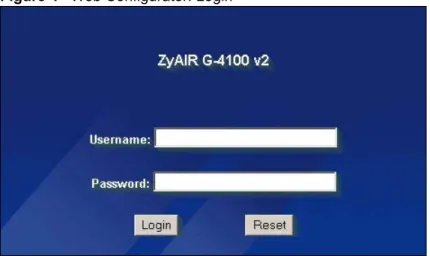
A login screen displays. Type “admin” (default) as the user name and "1234" (default) as
the password and click
Login
.
Figure 4 Web Configurator: Login
4
You should see the first screen of the Wizard Setup. Refer to the
Quick Start Guide
for
more information on configuring the Wizard Setup screens.
Note:
The ZyXEL Device automatically logs you out if there is no activity for longer
than five minutes after you log in. If this happens, simply log back in again. You
can change the time period in the
ADVANCED SERVER
screen’s
Administrator Inactivity Timer field.
2.3 Wizard Setup Screens
The Wizard Setup screens display when you first access the ZyXEL Device. Refer to the
Quick Start Guide
for information on how to configure the Wizard Setup screens.
2.4 Navigating the Web Configurator
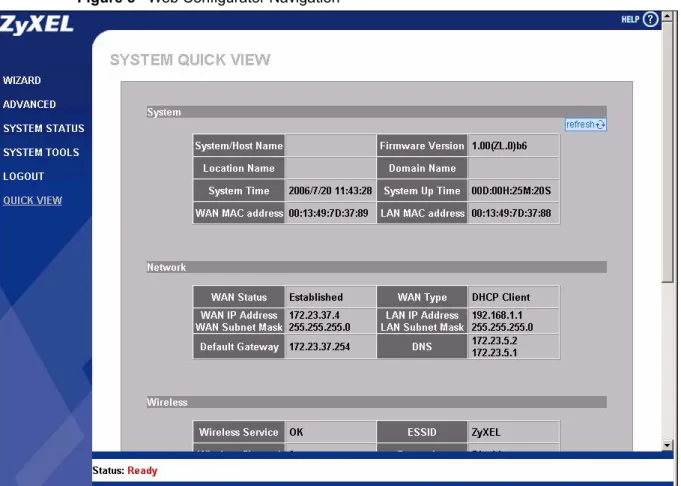
After you finish the Wizard Setup screens, you first see the
Quick View
screen after login.
Note:
Click the
Help
icon (located in the top right corner of most screens) to view
online help.
Figure 5 Web Configurator Navigation
Click a navigation panel link to open a submenu of links to individual screens. For example,
click
WIZARD
to display the following submenu.
Figure 6 WIZARD Submenu
The following table lists the various web configurator screens.
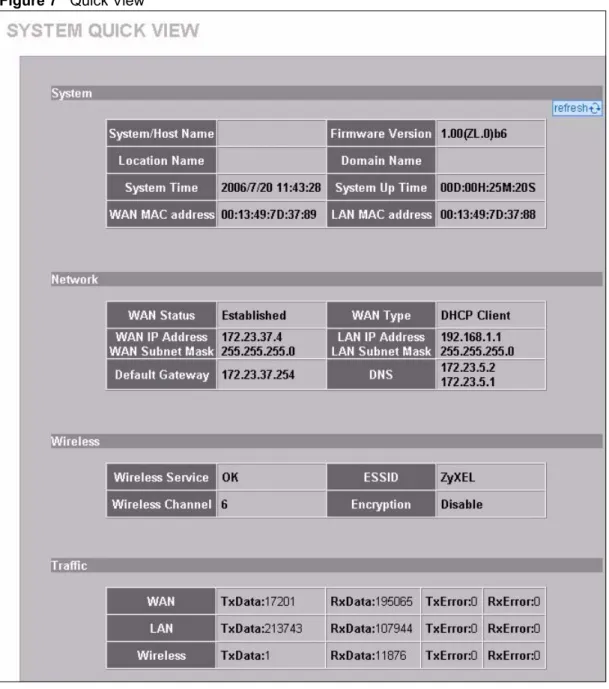
2.6 Quick View Screen
Click
QUICK VIEW
to display the following screen. This screen displays key system status
information.
Table 1 Web Configurator Screens Overview
WIZARD ADVANCED SYSTEM STATUS SYSTEM TOOLS
INTERNET WIRELESS E-MAIL AUTHENTICATION BILLING PRINTER ACCOUNTING SYSTEM SYSTEM WAN/LAN SERVER AUTHENTICATION RADIUS BILLING ACCOUNTING CREDIT CARD KEYPAD CUSTOMIZATION Login Page Logo Information Windows Account Printout Credit Card PASS THROUGH FILTERING SHARE PORTAL PAGE ADVERTISEMENT WALLED GARDEN DDNS LAN DEVICES SYSLOG Syslog Log Settings SESSION TRACE BANDWIDTH SECURE REMOTE ACCOUNT GENERATOR WIRELESS SYSTEM ACCOUNT LIST ACCOUNT LOG CURRENT USER DHCP CLIENT SESSION LIST LAN DEVICES CONFIGURATION FIRMWARE Manual Firmware Upgrade Scheduled Firmware Upgrade SYSTEM ACCOUNT SSL CERTIFICATE PING COMMAND RESTART
Figure 7 Quick View
The following table describes the labels in this screen.
Table 2 Quick ViewLABEL DESCRIPTION
System
Refresh Click Refresh to update this screen. System/Host
Name This field displays the description name of the ZyXEL Device for identification purposes. Firmware Version This field displays the version of the firmware on the ZyXEL Device.
Location Name This field displays the device’s geographical location. Domain Name This field displays the domain name of the ZyXEL Device.
2.7 Login Accounts
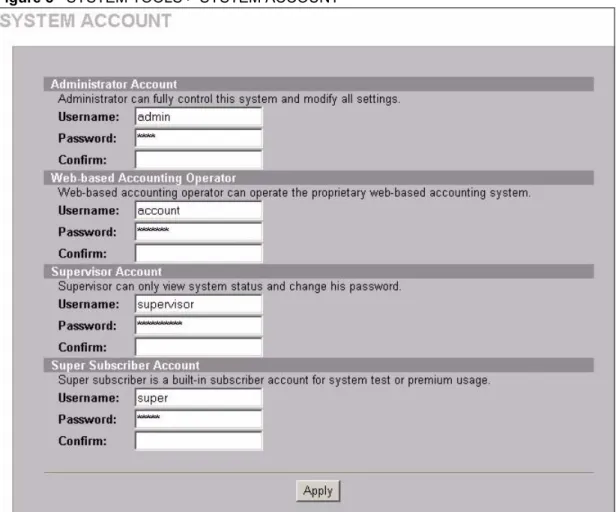
There are four system accounts that you can use to log in to the ZyXEL Device: administrator,
account manager, supervisor and super subscriber.
The administrator account allows you full access to all system configurations. The default
administrator user name is “admin” and the default password is “1234”.
System Time This field displays the ZyXEL Device’s current time.
System Up Time This field displays the how long the ZyXEL Device has been operating since it was last started.
WAN MAC
Address This field displays the MAC address of the ZyXEL Device on the WAN. LAN MAC
Address This field displays the MAC address of the ZyXEL Device on the LAN. Network
WAN Status This field displays the status of the ZyXEL Device’s connection to the Internet (Established or Not Established).
WAN Type This field displays the DHCP mode of the WAN port. It displays DHCP Client, Static IP Setting, PPPoE, or PPTP.
WAN IP Address WAN Subnet Mask
This field displays the IP address and the subnet mask of the WAN port on the ZyXEL Device.
LAN IP Address
LAN Subnet Mask This field displays the IP address and the subnet mask of the LAN port on the ZyXEL Device. Default Gateway This field displays the IP address of the default gateway of the WAN port on the
ZyXEL Device.
DNS This field displays the IP address of the DNS server that the ZyXEL Device is using. Wireless
Wireless Service This field displays the status of the ZyXEL Device’s wireless LAN. ESSID This field displays the ZyXEL Device’s Extended Service Set IDentity. Wireless Channel This field displays the channel that the ZyXEL Device is using.
Encryption This field displays the type of data encryption that the ZyXEL Device is using. WEP displays if the ZyXEL Device is using WEP data encryption. WPA displays if ZyXEL Device is using WPA data encryption. Disable displays if the ZyXEL Device is not using data encryption.
Traffic
WAN This field displays traffic statistics for the ZyXEL Device’s WAN connection. LAN This field displays traffic statistics for the ZyXEL Device’s LAN connection.
Wireless This field displays traffic statistics for the ZyXEL Device’s wireless LAN connection. Table 2 Quick View (continued)
The account manager account is used for proprietary subscriber account management only.
No system configuration is allowed. This account is useful for front desk personnel (such as in
a hotel) for setting up subscriber accounts without tampering with the system configuration.
The account manager default user name and password are “account”.
With the supervisor account, you can only view the system status and change the supervisor
account password. This account is useful for allowing a manager to view the device’s status
and lists of accounts and logged in subscribers without changing the system configuration. The
default supervisor account user name and password is “supervisor”.
Use the super subscriber account to test the Internet connection between the ZyXEL Device
and the ISP. The ZyXEL Device does not impose time limitations or charges on this account.
Thus, anyone who logs in with this account is able to gain Internet access for free. The default
super subscriber user name and password are “super”.
Note:
You can only log in using the super subscriber account in the subscriber login
screen.
2.7.1 Changing Login Account Usernames and Passwords
Note:
It is recommended you change the account passwords.
Figure 8 SYSTEM TOOLS > SYSTEM ACCOUNT
Note:
The account user names and passwords are case sensitive. Table 3 SYSTEM TOOLS > SYSTEM ACCOUNTLABEL DESCRIPTION
Administrator Account
Username Enter the user name for the administrative account. The default is admin. Password Enter a new administrative account password.
Confirm Enter the new administrator password again for confirmation. Web-based Accounting
Manager
Username Enter the user name for the account manager account. The default is account.
Password Enter a new account manager password.
Confirm Enter the new account manager password again for confirmation. Supervisor Account
Username Enter the user name for the supervisor account. The default is supervisor. Password Enter a new supervisor password.
2.8 Methods of Restoring Factory-Defaults
There are two methods you can use to erase the current configuration and restore factory
defaults.
2.8.1 Using the Reset Button to Restore Factory-Defaults
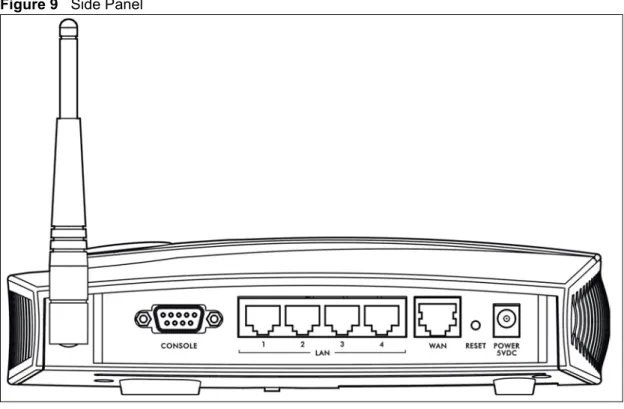
The reset button is located on the side panel. Use a pointed object to press this button in once
to reset the ZyXEL Device back to the factory defaults.
Note:
All of your custom configuration including the local subscriber database will be
erased.
Super Subscriber
Account
Note:
You can only log in using the super subscriber account
in the subscriber login screen.
Username Enter the user name for the super subscriber account. The default is super. Password Enter a new super subscriber account password.Confirm Enter the new super subscriber account password again for confirmation. Apply Click Apply to save the changes back to the ZyXEL Device.
Table 3 SYSTEM TOOLS > SYSTEM ACCOUNT (continued)
Figure 9 Side Panel
2.8.2 Using the Web Configurator to Restore Factory-Defaults
To reset the ZyXEL Device back to the factory defaults, click
SYSTEM TOOLS >
CONFIGURATION
to display the screen as shown next.
Figure 10 SYSTEM TOOLS > CONFIGURATION
The following table describes the labels in this screen.
2.9 Restarting the ZyXEL Device
You
must
restart the ZyXEL Device every time you change the system IP address or upload a
firmware or configuration file.
Click
SYSTEM TOOLS > RESTART
. Then click
Apply
.
Table 4 SYSTEM TOOLS > CONFIGURATIONLABEL DESCRIPTION
Reset the system back to factory defaults
Keep subscriber
profile Select this option to reset the system configuration back to the factory default but retain subscriber account information. All other custom configuration is erased. Apply Click Apply to reset system configuration back to the factory defaults.
Figure 11 Restart
Note:
When the ZyXEL Device restarts, all connections will be terminated. Anyone
using a system account will need to log in again. The subscribers may also
need to log in again.
2.10 Logging Out of the Web Configurator
Click
LOGOUT
to exit from the web configurator.
Figure 12 LOGOUTC
H A P T E R
3
General System Setup
This chapter describes how to configure the
SYSTEM
advanced setup screens.
3.1 General System Setup
Use this screen to configure administrative and system-related general settings for your
ZyXEL Device.
3.2 System Name
System name is for identification purposes. However, because some ISPs check this name you
should enter your computer's "Computer Name".
In Windows 95/98 click Start, Settings, Control Panel, Network. Click the Identification tab,
note the entry for the Computer Name field and enter it as the System Name.
In Windows 2000, click Start, Settings and Control Panel and then double-click System. Click
the Network Identification tab and then the Properties button. Note the entry for the Computer
name field and enter it as the System Name.
In Windows XP, click Start, My Computer, View system information and then click the
Computer Name tab. Note the entry in the Full computer name field and enter it as the ZyXEL
Device System Name.
3.3 Domain Name
The Domain Name entry is what is propagated to the DHCP clients on the LAN. If you leave
this blank, the domain name obtained by a DHCP server is used. While you must enter the host
name (System Name), the domain name can be assigned from the ZyXEL Device via DHCP.
3.4 iPnP ZyXEL Implementation
Traditionally, you must set the IP addresses and the subnet masks of a computer and the
ZyXEL Device to be in the same subnet to allow the computer to access the Internet (through
the ZyXEL Device). In cases where your computer is required to use a static IP address in
another network, you may need to manually configure the network settings of the computer
every time you want to access the Internet via the ZyXEL Device.
With the iPnP feature and NAT enabled, the ZyXEL Device allows a computer to access the
Internet without changing the network settings (such as IP address and subnet mask) of the
computer, when the IP addresses of the computer and the ZyXEL Device are not in the same
subnet.
ModifiedWhether a computer is set to use a dynamic or static (fixed) IP address, you can simply
connect the computer to the ZyXEL Device and access the Internet.
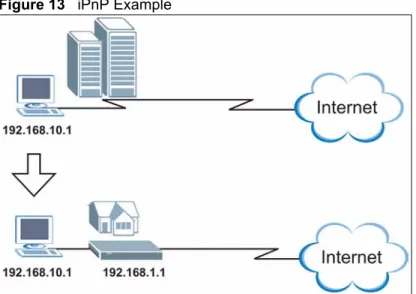
The following figure depicts a scenario where a computer is set to use a static private IP
address in the corporate environment. In a residential house where a ZyXEL Device is
installed, you can still use the computer to access the Internet without changing the network
settings, even when the IP addresses of the computer and the ZyXEL Device are not in the
same subnet.
Figure 13 iPnP Example
The iPnP feature does not apply to a computer using either a dynamic IP address or a static IP
address that is in the same subnet as the ZyXEL Device’s IP address.
AddedNote:
You
must
enable NAT to use the iPnP feature.
3.4.1 How iPnP Works
Address Resolution Protocol (ARP) is a protocol for mapping an Internet Protocol address (IP
address) to a physical machine address, also known as a Media Access Control or MAC
address, on the local area network. IP routing table is defined on IP Ethernet devices (the
ZyXEL Device) to decide which hop to use,
to help forward data along to its specified
destination.
The following lists out the steps taken, when a computer tries to access the Internet for the first
time through the ZyXEL Device.
1
When a computer (which is in a different subnet) first attempts to access the Internet, it
sends packets to its default gateway (which is not the ZyXEL Device) by looking at the
MAC address in its ARP table.
2
When the computer cannot locate the default gateway, an ARP request is broadcast on the
LAN.
3
The ZyXEL Device receives the ARP request and replies to the computer with its own
MAC address.
4
The computer updates the MAC address for the default gateway to the ARP table. Once
the ARP table is updated, the computer is able to access the Internet through the ZyXEL
Device.
5
When the ZyXEL Device receives packets from the computer, it creates an entry in the IP
routing table so it can properly forward packets intended for the computer.
After all the routing information is updated, the computer can access the ZyXEL Device and
the Internet as if it is in the same subnet as the ZyXEL Device.
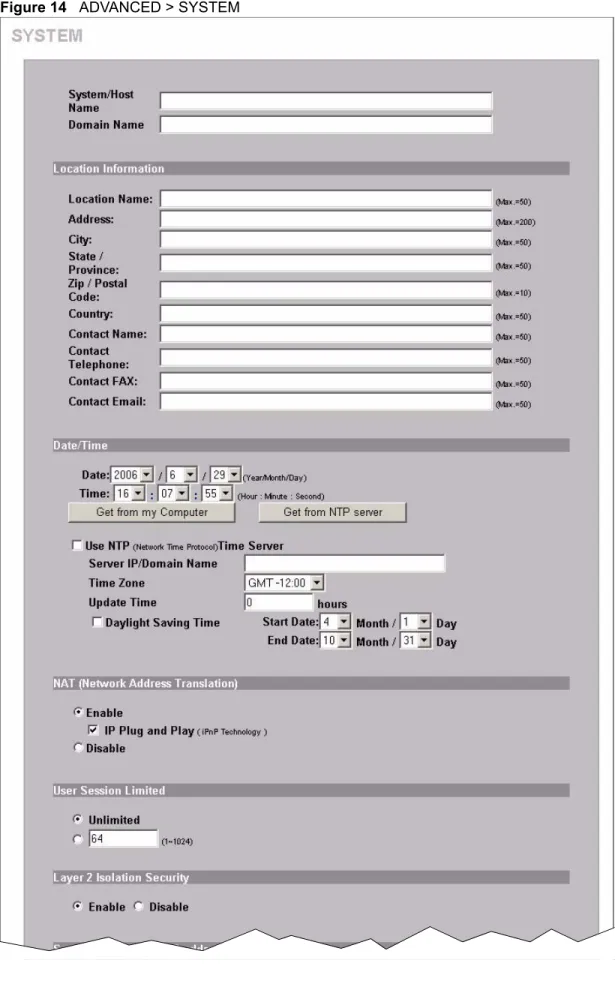
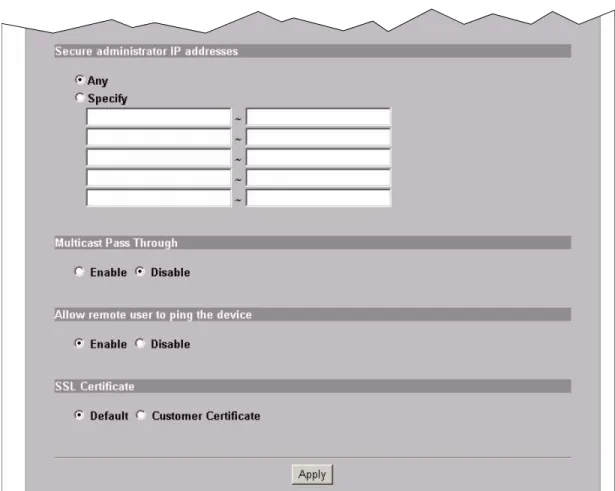
3.5 General System Settings
The following table describes the labels in this screen.
Table 5 ADVANCED > SYSTEMLABEL DESCRIPTION
System/Host Name Enter a descriptive name (up to 40 characters) for identification purposes. Domain Name Enter the domain name (if you know it) here. If you leave this field blank, the
ZyXEL Device may obtain a domain name from a DHCP server.
The domain name entered by you is given priority over the DHCP server assigned domain name.
Location Information
Location Name Enter the device’s geographical location. Address Enter the street address of the device’s location. City Enter the city of the device’s location.
State/Province Enter the state or province of the device’s location. ZIP/ Postal Code Enter the zip code or postal code for the device’s location. Country Enter the country of the device’s location.
Contact Name Enter the name of the person responsible for this device.
Contact Telephone Enter the telephone number of the person responsible for this device. Contact FAX Enter the fax number of the person responsible for this device.