VHDL Simulation of Image Compression
Using LBG
Rahul R. Ade1 Prof. Ashish B. Kharate2
Department of Electronics and Telecommunication Engineering, H.V.P.M’S College of Engineering Amravati, India
ABSTRACT: Image-related communications are forming an increasingly large part of modern communications,
bringing the need for efficient and effective compression. Image compression is important for effective storage and transmission of images. Image compression is concerned with minimizing the number of bits required to represent an image. The algorithm used for this paper is Linde, Buzo and Gray (LBG) algorithm. It is based on minimization of the squared-error distortion measure. LBG proposed the VQ schemes for gray scale image compression. The basic requirement for this paper is codebook generation. A good codebook is required because the reconstruct image highly depends on the codeword’s in this very codebook. The generated codebook store into text file for VHDL file handling or data array in VHDL code. The VHDL file handling concept used for the quantization. This process of file handling will convert in blockwise conversion in a set of pixel value. The block array splitting by using Pairwise Nearest Neighbor (PNN) principle. The performance of compression ratio will be measure in Mean square Error (MSE) and Peak Signal to Noise Ratio (PSNR). Analysis the synthesis result & timing summary for purpose of design parameter.
KEYWORDS: Image compression, LBG Algorithm, Vector Quantization, Codebook.
I. INTRODUCTION
The purpose of image compression is to reduce the amount of data required to represent a digital image. This reduction process can be understood as removing redundant data. Over the years, the need for image compression has grown steadily. An ever-expanding number of applications depend on the efficient manipulation, storage, and transmission of binary, gray-scale, or color images. Image compression is utilized for image transmission and storage.
codebook store into text file for VHDL file handling or data array in VHDL code.
The algorithm for the design of VQ is referred to as LBG algorithm; and it is based on minimization of the squared-error distortion measure. LBG proposed the VQ schemes for gray scale image compression and it has proven to be a powerful tool for both speech & digital image compression.
II. RELATED WORK
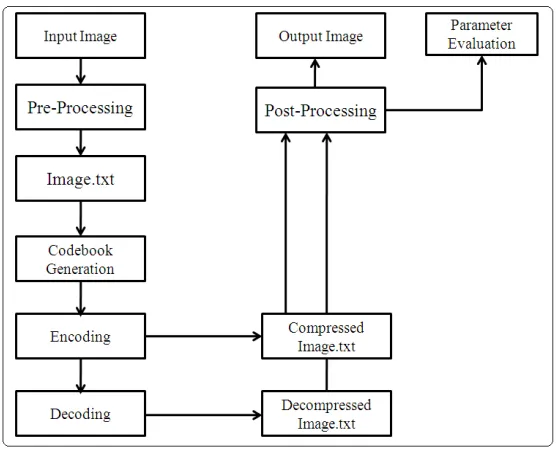
The vector quantization is done by three process i.e. codebook generation, encoding process & decoding process. The first how to be codebook generated procedure will done. Image is stored as a two dimensional array of integers. The input image is stored as set of pixel array. These image provide information pixel by pixel data. The pixel represent single bytes i.e. converts eight bit into [128 128] block in binary form. In preprocessing process write a code in matlab The input image is read single dimension vector quantization in binary form to get codebook generation.
Generated codebook used VHDL file handling concept for quantization. This process of image text file will convert in blockwise conversion.
Fig. 1Block diagram of working principal.
The image to be encoded is segmented into set of input image vectors and get compress image text file and decoding process to achieved single data. It is comes under in matrix form i.e. single dimension binary data to convert in matrix form and it is display in a form of image. The compression performance measured in a compression ratio and peak signal to noise ratio.
III.VECTOR QUANTIZATION
Vector quantization done three steps (1) codebook design (2) encoding process (3) decoding process. In LBG algorithm an initial codebook is chosen at random from the training vectors. The codebook and the index-table is nothing but the compressed form of the input image. The encoding process, any arbitrary vector corresponding to a block from the image under consideration is replaced by the index of the most appropriate representative codeword. In decoding process, the codebook which is available at the receiver end too, is employed to translate the index back to its corresponding codeword. Figure shows schematic diagram of VQ encoding and decoding process.
Fig.2 Vector quantization scheme
From Figure we find there is a search engine in the encoder for finding the best match codevector of an input vector. But the decoder does not have this procedure. This is because the only thing the decoder needs to do is reconstructing the codevector from the index. Although the encoder may take much calculation time to find the best match codevector, the time for the decoder to reconstruct the codevector will be much less. This feature of vector quantization makes vector quantization very suitable to applications that the resources available for the decoder are much less than the resources available for the encoder. Such situations happen in many multimedia applications. The information is encoded and sent to the user. The user has a decoder to decode the encoded file and retrieve the information. Normally, the end user hopes the decoding time can be as short as possible. They do not care how long it takes to encode the information.
IV.OBJECTIVE
We describe and analyze below LBG algorithm based implementation.
To develop image compression algorithm.
To design hardware descriptive code i.e. VHDL for LBG image compression,
To verify & simulate the operation of image compression and decompression using matlab and modelsim.
To analyze the parameter for design of purpose work.
V. LITERATURE SURVEY
forming vectors from a training data sequences, grouping similar vectors into clusters and assigning each cluster with a single representative vector. The nearest cluster representative referenced by a simple cluster index. The list of all cluster representative forms as codebook and each coding known as codeword [2].
Compressing image data by using Vector Quantization (VQ) will compare Training Vectors with Codebook. The result is an index of position with minimum distortion. The implementing Random Codebook will reduce the image quality[1]-[3]. One of the key roles of vector quantization is how to generate a good codebook such that distortion between the original image and reconstruct image is the minimum. Image pixels that are highly correlated and VQ performs better if it's input vector have components that are more highly correlated. Therefore vector in image domain are formed as compact little connect of adjacent pixels. Quality or efficiency can attained by size of the block[4]
The VQ based image compression technique has major three steps i.e. codebook design, encoding and decoding
process. The VQ technique depend on constructed codebook. A widely used technique for VQ codebook design is LBG algorithm. These algorithm depends on codebooks [5]. For using VQ a fast LBG codebook is generated. The LBG algorithm is an iterative procedure. Starting with initial segmentation of the training set. The completion codebook is updated centroid of these training vectors. The new generation codeword stored into average distortion in the codebook design procedure. This method will provides a good way to reduce computation cost in codebook training process [6]&[7]
The codeword choice is based on the best similarity between the image blocks represented by a coded vector and image blocks represented by codeword’s from dictionary. The codebook is transmitted together with the coded data. The advantage of vector quantization is a simple receiver structure consisting of a look-up table [8].
In the image domain strategies for forming vectors are relatively simple. Image pixels that are closer together are highly correlated & VQ performs better if its input vector have component that are more highly correlated. Therefore vector in image domain are form collection of adjacent pixels [9] An adaptive VQ technique for image compression is presented. The LBG algorithm consist three phase i.e. initial phase, adopted LBG & redundant generated codebook [10].
VI.APPLICATION
Image transmission applications include broadcast television, remote sensing via satellite, aircraft, radar and sonar, teleconferencing, computer communication, and facsimile transmission. Image storage applications include educational and business documents, medical images, etc. Because of its wide applications, image compression is of great importance in digital image processing
VII. CONCLUSION AND FUTURE WORK
Above proposed algorithm reduces the complexity of a transferred image, without sacrificing performance. Image compressions address the problem of reducing amount of data to represent digital image with no significant loss of data. The quality of image depends on whether we use Lossless or Lossy compression technique. The amount of compression is depends on the type of compression scheme. More compression is achieved in case of lossy compression than lossless compression. The LBG algorithm used for image compression. These algorithms require as codebook generation. The codebook is the collection of codeword. These algorithm in community of vector quantization for purpose of data compression. The LBG used for to remove redundancy in data reconstruction makes possible. The compress image will be stored into VHDL simulation. The performance of compression ratio will be measure in compression ratio and peak signal to noise ratio. Design a purpose work for to analyse parameter.
One area of future researchis to improve the file size reduction most significant benefit of image compression. For real time purpose using wavelet transform algorithm. The focus on LBG algorithm is easy, rapid, efficient and simple algorithm which saves computation cost and time. It also ensure for developing vector quantization technique is less storage space, less transfer time, less image viewing and loading time such that faster file transfer will possible
.
VIII. RESULT SIMULATION
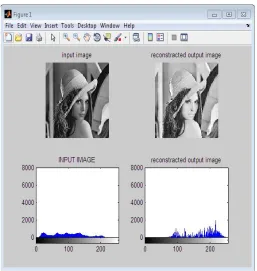
process. These image file will convert in 4 x 4 block conversion for the process of codebook generation. The generated codebook store into VHDL file. The encoding and decoding process used for compression & decompression image. In post processing by using matlab to get reconstruct image. Then analysis the parameter for design of purpose work by using Xilinx.
Fig. Original Image
Fig.3 Reconstruct Image
MSE & PSNR
MSE = 1.3671
PSNR = 46.7727
Elapsed Time = 2.226960 sec
SYNTHESIS RESULT OF ENCODER
TIMING SUMMARY OF ENCODER
Speed Grade :- 3
Minimum Period : No path found
Minimum input arrival time before clock : 9.146ns
Minimum output require time after clock : 3.597ns
Maximum combinational path delay : No path found
SYNTHESIS RESULT OF DECODER
TIMING SUMMARY OF DECODER
Speed Grade :- 3
Minimum Period : 1.941ns (Maximum Frequency : 515.159MHZ)
Minimum input arrival time before clock : 3.078ns
Maximum combinational path delay : No path found
REFERENCES
1. Chetan Duahagara, Dr. Kishor Atkoiya, “Image compression using vector quantization”,IJIEASR Vol.2, No.2, Feb 2013.
2. Peter Veprek, A. B. Bradley “An improved algorithm for vector quantization design” 1070-9908 IEEE.
3. Noppart Pantsaena, etal T. Phaprasit, “IMAGE COMPRESSION USING VECTOR QUANTIZATION” The Research Center for Communication and Information Technology (ReCCIT).
4. Y. Linde ,A. buzo, & R.M. Gray “An Algorithm for Vector Quantazation” IEEE Transactions communications vol.28, pp.84-95 Jan 2003 5. Arup Kumar Pal and Anupsar “An Efficient Codebook Initialization using LBG Algorithm” IJCSEA Vol.1 No.4 Aug 2011
6. K. Somasundaram and S. Domic “Modified Vector Quantization Method for Image Compression” World Academy of Science, Engineering And Technology,2006.
7. Sachin Dhawan “A Review of Image Compression of its Algorithm”, IJECT Vol.2, Issue1, March 2011.
8. YUNG-KUAN CHAN, CHIN-CHEN CHANG , “A VQ COMPRESSION BASED ON THE VARIOTIONS OF THE IMAGE BLOCK
GROUPS” ICIC Vol.6, No.10.Oct 2010, pp 4527-4537.
9. “Digital Image Processing” by Rafael C. Gonzalez &Richard E. Woods.
10. “Digital Image Processing” by S. Jayaraman, S. Esakkirajan, T.Veerakumar-Tata Mc Graw.
BIOGRAPHY
Ashish B. Kharate is received his Bachelor of Engineering degree in Electronics and Telecommunication Engineering
and Master of Engineering in Digital Electronics by Sant Gadge Baba Amravati University, Amravati. He is professor of the institute Department of Electronics & Telecommunication college of H.V.P.M’S C.O.ET Amravati. He is Awarded state of Maharashtra Best N.S.S. co-ordinator. He is guided M.E./M.Tech and B.E./ B.Tech projects. He has publish papers in National / International Conferences and Journals to his credit. His Research interest include image processing, image compression and data compression.
Rahul R. Ade1 is born in Umardari, Maharashtra, in India, on August 4, 1990. He received his