Proof of Reality
Yansong Gao
School of Electrical and Electronic Engineering, The University of Adelaide, SA 5005, Australia,
Abstract. Securely sharing the same secret key among multiple parties is the main concern in symmetric cryptography that is the workhorse of modern cryptography due to its simplicity and fast speed. Typically asymmetric cryptography is used to set up a shared secret between par-ties, after which the switch to symmetric cryptography can be made. In this paper, we introduce a novel key exchange protocol based on phys-ical hardware implementation to establish a shared secret between par-ties rather than relying on mathematical implementation of asymmetric cryptography. In particular, the key exchange is dependent on a new se-curity concept named as virtual proof of reality or simplyvirtual proof (VP)that enables proof of a physical statement over untrusted digital communication channels between two parties (a “prover” and a “veri-fier”) residing in two separate local systems. We firstly exploit the VP to secure key exchange and further prove it by using experimental data. The key transfered in this protocol is only seen by the prover and hidden from not only the adversary but also the verifier. While only the verifier can successfully discover it.
Keywords: key exchange, virtual proof, physical unclonable function (PUF), sensor PUF.
1
Introduction
Cryptographic applications require securely key exchange between parties before a secure communication channel is set up. The asymmetric crypto-system is usually used to secure a shared key (private key) exchange. However, in this case a strong random number generator is always needed, otherwise an attacker will be able to guess the private key. In general, the asymmetric cryptography is built on mathematical framework, while the strong random number generation is relying on hardware device that is capable of generating true random number rather than pseudo-random number built on mathematical means.
that its response (output) is a complex physical function of its challenge (input). The complex physical function exploits minute process variations during device manufacturing that is irreversible, uncontrollable and unclonable in physical way. The sensor PUF makes sensor and crypto module inseparable by merging sensing with cryptography, which ensures authenticity and veracity of measurements in a untrusted remote environment. Recently, Ruhrmair et. al. [4] generalize the application of sensor PUF and named it as VP enabling that the prover situated in untrusted environment proves a physical statement of a witness object (WO) to verifier through an untrusted communication channel. We extend these two works further to secure key exchange. In this work [4], the used PUF for VP proof is generalized as (WO) that is prepared by the verifier and handed over to the prover through an untrusted supply chain prior to the VP application.
2
Structure
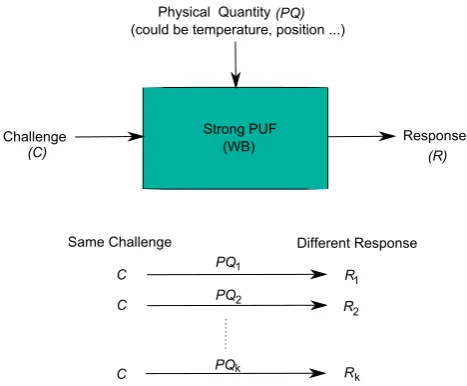
Fig. 1. Response (R) of the PUF is a function of the Challenge (C) and Physical Quantity (PQ). For the same C, different R are produced due to the difference of PQ.
To achieve securely key exchange based on VP, firstly, an WO is needed. in this paper, we deploy a strong PUF [5] as an necessary WO shown in Fig .1. This strong PUF will be transfered between the prover and verifier. Secondly, the PUF will satisfy some features:
FPUF(Cj, P Qi). Very different R is desirable for the same C under different discretizedP Qi.
2. TheRis insensitive to other variations except the specificP Q. For example, if the specific P Q is temperature, then the strong PUF should be stable against voltage variations.
3. The PUF is resistant to model building attacks, which means that knowing manyRi
j =FPUF(Cj, P Qi) for various Cj and P Qi, an adversary can not predict the unmeasuredRs
r for new Cr 6=Cj or new P Qs 6=P Qi. This is actually the key feature of a strong PUF.
3
Protocol
The protocol divides into two phases: enrollment phase and key exchange phase.
3.1 Enrollment Phase
1. The verifier prepares a strong PUFA that is depend on a specific P Q. 2. fori= 1 :k
set strong PUF underP Qi forj = 1 :m
randomly selectCi
j, applyCji to the strong PUF and measureRij; end
end
3. The challenge response pairs (CRPs) database is created and saved. Here DB=Ci
j, Rij, P Qi fori= 1, ..., kandj= 1, ..., m. 4. The PUFA is transfered to the prover.
3.2 Key Exchange Phase
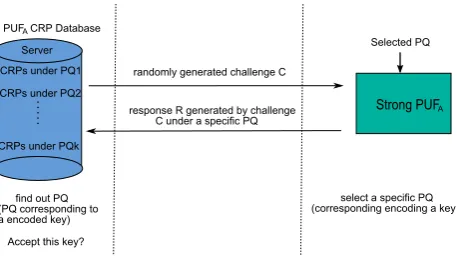
Notably that theP Qican be encoded as different digital values while the encod-ing scheme is public. So once the verifier discover theP Qi, he/she can figure out the corresponding key to it. For example, if P Q stands for temperature, then T1, T2, ..., Tk, wherek= 8, can be encoded as 000, 001, 010, 011, 100, 101, 110, 111. The key exchange protocol follows three/four steps:
1. The verifier randomly picks up a Cj and sends to the prover.
2. According to the key needs to be exchanged, the prover sets PUFAunder a specificP Qi and appliesCj to PUFAto obtain theRji. Hence,Rij contains the information ofP Qi that is actually the encrypted key. For example, if the key of 010 needs to be transfered, then the PUFA is set underP Q=T3. Hence,R3
j is acquired by the prover. 3. The verifier receives the Ri
j and compares all stored R 0i
j with Rij. If one of R0i
j matches Rij, then the key encoded by P Qi is accepted. Otherwise, if none of R0i
Only the R‘3
j will match R3j. Then the encoded key of 010 is decrypted by the verifier. Otherwise, this round key exchange is aborted if none of R‘i j matchesR3j.
4. If the transfered key is long, then the key will be divided to short length keys. Steps 1—3 will be repeated until the entire key is completely transfered.
Fig. 2.Key exchange protocol.
4
Discussion and Proofs
Why this key exchange protocol is secure? Which means the adversary cannot obtain the key neither through eavesdropping nor from prediction. And the ver-ifier can successfully discover the key encoded by the prover. The answer relies on two important pre-conditions:
1. The transfer operation of PUFA between two parties (the prover and the verifier) is secure. Even the adversary can physical access the PUFA, he/she is impossible measure all of the CRPs within a period (several days, months) due to huge population of CRPs generated from the strong PUF. The ad-versary can not predictR for a given unused C due to its third feature in Section Structure.
2. The fractional hamming distance among all Ri
j named as SC-DPQ-FHDis large enough—wherei= 1,2, ..., kand henceRi
jis measured under different P Qi to the same challengeCj—than bit error rate (BER), shown in Fig 3 due to other variations, see the second feature in Section Structure. Where BER is FHD among R corresponding to the same C and P Q but the R evaluated multiple times. In general, BER is induced by measurement noise or other minor environment variations.
Fig. 3. Fractional Hamming Distance (FHD) Distribution. Evaluation is carried out for the same PUF.
CRPs generated from PUFA. Hence, it ensures that the prover is the authentic part that the verifier wants to communicate with. The second pre-condition enables the verifier is capable of discovering theP Qion behalf of the key encoded by the prover.
To prove the pre-conditions can be met by hardware implementations and therefore show the efficiency of our proposed protocol. Experimental data in [4] is used for illustration. TheP Qs include temperature and position are used respectively showing different PQ of VP can be ultilised to satisfy our key ex-change protocol in practice. To verify that temperature can be used as a P Q, a 4 XOR-Bistable Ring PUFs [1] (4 XOR BR-PUF) is tested. To verify that position can be treated as a P Q, the optical PUF [2] is used and tested. The performance of two key metrics that should be considered for our proposed key exchange protocol are showed in Table 1. As we can see, average SC-DPQ-FHDs are always higher than the BER for different discretized P Qs. Especially when theP Qof position is used. In terms of the performance of 4 XOR BR-PUF, its performance of SC-DPQ-FHDs can be improved increase the PUF’s sensitivity to temperature, which is left as our future work.
Therefore, the verifier is able to find out the encoded key (P Qi) by the prover, even the key is hidden from both the adversary and the verifier. The adversary have no idea which key is transferred but through guessing. Simultaneously, successfully key discover by the verifier is ensured by the large FHD difference between the BER and SC-DPQ-FHD.
Table 1.average BER and SC-DPQ-FHD performance under differentP Qs
PQ BER SC-DPQ-FHD WO
5
Conclusion
In this paper, we extend the sensor PUF and VP to protect key exchange from attacking based on hardware implementation rather than number theory. The novel key exchange protocol is proposed and proved by using experimental data. This key exchange protocol can be broaden among multiple parties once more WOs are used and transfered among multiple parties, while each pair of parties is treated as the prover and verifier demonstrated in this paper.
References
1. Q. Chen, G. Csaba, P. Lugli, U. Schlichtmann, and U. Ruhrmair. The bistable ring puf: A new architecture for strong physical unclonable functions. In Hardware-Oriented Security and Trust (HOST), 2011 IEEE International Symposium on, pages 134–141. IEEE, 2011.
2. R. Pappu, B. Recht, J. Taylor, and N. Gershenfeld. Physical one-way functions.
Science, 297(5589):2026–2030, 2002.
3. K. Rosenfeld, E. Gavas, and R. Karri. Sensor physical unclonable functions. In
Hardware-Oriented Security and Trust (HOST), 2010 IEEE International Sympo-sium on, pages 112–117. IEEE, 2010.
4. U. R¨uhrmair, J. Martinez-Hurtado, X. Xu, C. Kraeh, C. Hilgers, D. Kononchuk, J. J. Finley, and W. P. Burleson. Virtual proofs of reality and their physical imple-mentation. In36th IEEE Symposium on Security and Privacy, 2015.