© 2016, IJCSMC All Rights Reserved 167
Available Online atwww.ijcsmc.com
International Journal of Computer Science and Mobile Computing
A Monthly Journal of Computer Science and Information Technology
ISSN 2320–088X
IJCSMC, Vol. 5, Issue. 2, February 2016, pg.167 – 173
Utilizing Cognitive Radio with Wireless Body Area
Network for Optimized WBAN Performance
1
Shashank,
2Malvika
1,2
Department of Electronics and Communication Engineering
1
Delhi Technological University, 2North Cap University
1
Formerly Delhi College Of Engineering, 2Formerly ITM University
1
[email protected], 2 [email protected]
Abstract— Wireless Body Area Network requires an operational frequency with many technical constraints and it is required to use an unlicensed ISM band for transmission. Also with the choice of unlicensed operational frequency, there is a trade-off of increased interference due to multiple interfering sources using the same band, thus it is very much required to associate Cognitive radio with WBAN for optimized transmission and improving the performance of WBAN. In this paper we have discussed the importance of associating Cognitive radio with WBAN and demonstration of a pseudo-code for the same. Keywords— Wireless Body Area Network, Cognitive Radio, MATLAB
I. INTRODUCTION
Wireless body area network requires to sense and transmit real time body signals at regular short time intervals .It is very important that the transmission is made free of cost. Thus selecting an unlicensed band operational frequency is a must.
But with the advantage of free operational frequency in unlicensed ISM band ,we also have a trade-off of multiple technologies using the same or similar frequency in a very close proximity which surely will affect the transmission by increasing interference and occupying the transmission channel for most of the time which affects the transmission by WBAN network.
Hence it is very important to get this problem resolved. The best way is to utilize cognitive radio with WBAN so that interference can be reduced to the best possible extent improving the transmission ability of the system.
© 2016, IJCSMC All Rights Reserved 168
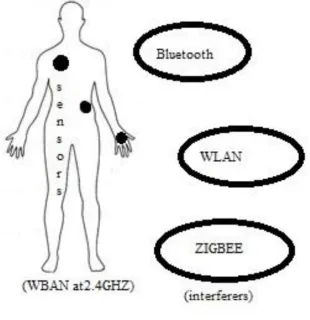
Fig. 1 WBAN Interferers.
II. BASICS OF COGNITIVE RADIO
Cognitive Radio(CR) is basically an intelligent radio tuner that senses the transmission channel at very frequent basis and as the channel is free, then it is alloted to a different source improving the efficiency of transmission.The transmission priorities can be set initially so that the transmission can be done as per the preference.
Cognitive scenario typically categorises users in two categories being Primary users(PU) and secondary users(SU). The transmission criteria being that the most prior primary user is offered the highest preference to use the channel and if the channel is free, it is alloted to the SU. But for using CR with WBAN, the WBAN events are categorised and differentiated amongst each other according to the necessity of transmission of any event and thus particular weights are assigned to each event and also to the other sources and channel is used as per the weights of different events from WBAN or other sources .
The main requirement of associating CR with WBAN is to give different weights to different events of WBAN transmission network such that the transmission can be done in an effective and optimised way and also the proper and optimised utilisation of channel can be done so that all different technologies can operate in the close proximity without affecting transmission of each other still using the same channel at different times.
III. COGNITIVE SETUP
The Cognitive radio tuner control unit setup consists of some basic functional blocks for channel sensing, decision making and data storage. The major blocks are as follows:
Fusion centre
Controlling centre
© 2016, IJCSMC All Rights Reserved 169
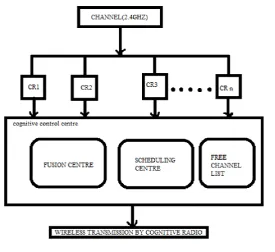
The complete setup of associating Cognitive Radio with WBAN is as shown below:
Fig. 2 Cognitive setup
The basic setup for Cognitive radio tuner system for WBAN consists of multiple cognitive radios associated with all technologies and particularly to all events. The events assumed in this particular scenario are as follows:
WBAN emergency condition.(W1)
WBAN normal condition.(W2)
Bluetooth(W3)
WLAN(W4)
ZIGBEE(W5)
W1,W2,W3,W4,W5 here are the weights of each event associated that decides the priorities of associated transmissions. We can
decide the weights as per the requirement of any particular environment and as per the urgency of any event .
Each event is associated with an independent cognitive radio or in other words we can say that each technology is assumed to have a cognitive radio tuner for each event.
We also differentiate the WBAN emergency and normal events and thus can give more preference to transmission of alarming situations.
All the cognitive radio tuners are linked to the cognitive control centre or the base centre where information from all the cognitive radios are clubbed and compared and thus a conclusion is made for transmission.The control centre consists of a fusion centre that receives information about the channel usage and requirements of different technologies.
The scheduling centre logically decides the order of transmission as per the priorities set earlier as per the environment. The free channel list consists of those events which are free and are updated at regular intervals. The free channel list update is also done by the scheduling centre.
© 2016, IJCSMC All Rights Reserved 170
IV. SENSING PARAMETERS
The performance of the cognitive radio tuner system depends upon how efficiently and correctly the information about channel is analyzed. The sensing parameters associated with the cognitive radio performance are:
Sensing efficiency:
This corresponds to the ability of any designed algorithm to find the free channel for as long duration as possible and to utilize the channel in most efficient way.
Sensing accuracy:
This refers to how correctly the channel state is predicted by the sensing algorithm used. The errors in predicting the state of channel can be due to the following reasons:
1. The channel is free but not predicted by the algorithm.
2. The channel is not free but still a false free alarm is generated by the algorithm.
V. ALGORITHM DESIGN
The algorithm for cognitive channel allotment depends on the priorities that are set up according to the surrounding environment and the requirements and urgency of different events associated. An algorithm design must hence be compatible with the
scheduling centre of cognitive control centre because it will be logically linked to scheduling centre logic control unit.
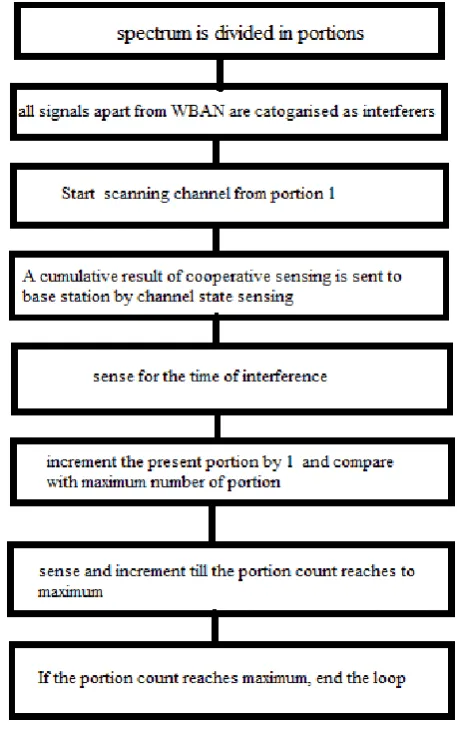
An efficient algorithm for the same is as given below:
Fig. 3 Algorithm for channel allotment
We assume that the events from WBAN are taken together and events from interferers are taken together. We assumed W1=W2=Wwban;
W3=W4=W5=Winter;
Also, Wwban>Winter
The state of the channel is the major concern here because the state of the channel decides whether the transmission channel is available or not.
© 2016, IJCSMC All Rights Reserved 171
Fig. 4 Cooperative sensing
For the channel sensing we opt for basic sequential search of the channel .Here the channel spectrum is divided in a finite number of portions and starting from the first portion, the channel signal strength is compared with the threshold. If the channel is found to be free, that particular time detail is obtained and forwarded to the base station where the free channel list is updated.
The portion count is then incremented and channel is sensed for all the portions of the spectrum. This is a type of sequential search method for sensing channel portions one by one.
The steps involved in channel sensing sequential search algorithm are as shown below:
© 2016, IJCSMC All Rights Reserved 172
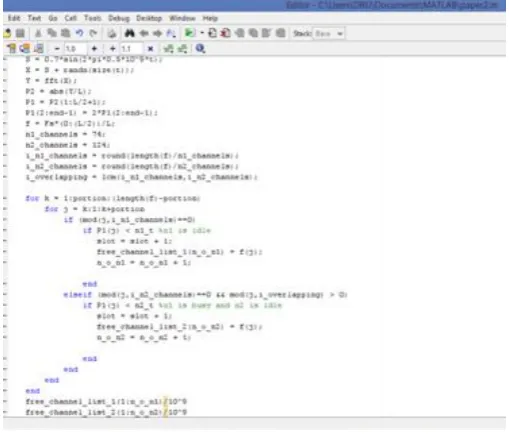
We assumed a random environment with additive white Gaussian noise and evaluated the channel state using MATLAB.
A pseudo code for the same is as shown below:
Fig. 4 pseudo-code 1
Fig.5 Pseudo-code 2
VI. RESULTS DRAWN
© 2016, IJCSMC All Rights Reserved 173
The state of channel is observed as shown below:
Fig. 6 Free channel list timings updated
VII. CONCLUSION
From the results drawn according to the code, the channel state can be obtained and hence transmission efficiency can be improved. Therefore, the utility of Cognitive Radio with WBAN is justified. There can be many other different algorithms for the same according to requirements as per necessity.
REFERENCES
[1] Praveen Kalyanasundaram, “Cooperative Spectrum Sensing Algorithms in WBAN”
[2]Tevfik Yucek,Huseyin Irslan, “A Survey of Spectrum Sensing Algorithms for Cognitive Radio Application”