AN EFFICIENT ROUTING STRUCTURE FOR MOBILE
USERS DATA COLLECTION IN WSNs
N.Anitha
1A.Muthukrishnan
21
PG Student, Anna University, Chennai. Regional Centre Madurai, Tamilnadu, (India)
2
Faculty, Anna University, Chennai. Regional Centre Madurai,Tamilnadu, (India).
ABSTRACT
We study the universal data collection for mobile users in wireless sensor networks. People with handheld devices can easily interact with the network and collect data. We propose a novel approach for mobile users to collect the network-wide data. The routing structure of data collection is additively updated with the movement of the mobile user. With this approach, we only perform a limited modification to update the routing structure while the routing performance is bounded and controlled compared to the optimal performance. The proposed protocol is easy to implement. Our analysis shows that the proposed approach is scalable in maintenance overheads, performs efficiently in the routing performance, and provides continuous data delivery during the user movement. We implement the proposed protocol in a prototype system and test its feasibility and applicability by a 49-node testbed. We further conduct extensive simulations to examine the efficiency and scalability of our protocol with varied network settings.
Keywords: Data Collection, Mobile User,Wireless Sensor Networks,
I INTRODUCTION
We investigate the following fundamental question - how fast can information be collected from a wireless sensor
network organized as tree? To address this, we explore and evaluate a number of different techniques using realistic
simulation models under the many-to-one communication model known as converge cast. We first consider time
scheduling on a single frequency channel with the aim of minimizing the number of time slots required (schedule
length) to complete a converge cast. Next, we combine scheduling with transmission power control to moderate the
effects of interference, and show that while power control helps in reducing the schedule length under a single
frequency, scheduling transmissions using multiple frequencies is more efficient.We give lower bounds on the
schedule length when interference is completely eliminated, and propose algorithms that achieve these bounds. We
interference.
Then, the data collection rate no longer remains limited by interference but by the topology of the routing tree. To
this end, we construct degree-constrained spanning trees and capacitated minimal spanning trees, and show
significant improvement in scheduling performance over different deployment densities. Lastly, we evaluate the
impact of different interference and channel models on the schedule length.
II. RELATED WORK
As a basic operation, the data collection in WSNs has been extensively studied. A surge of works study the data
gathering but with static settings. In addition, according to how does each packet transmitted, the data collection can
be further divided into two categories: with collection or without collection. In the former category, in-network
collection data results in a reduction in the amount of bits transmitted, and hence, saves energy. Typical examples
include [15], [21]. Michael et al. [15] propose the first such protocol. In [21], authors study the construction of a data
gathering tree to maximize the network lifetime. In the latter category, Rangwal et al. [14] propose to collect data
through a tree structure with fair rate control. [12] proposes to form an information potential-based routing structure.
In [11], Challen et al. present IDEA, a sensor network service enabling effective network-wide data collection
framework. Even WSNs are capable to support large volume data accessing, while recent works [16], [17], [22]
indicate that existing data collection schemes under the static setting incur a poor performance if they are used in the
network with mobile users directly. The problem will become even worse if the transmission loss and interference
are serious in the network [23]. In the network context with mobile users, most existing works explore how to plan
the moving trajectory for the mobile user or sink to achieve an efficient data collection. [18] reactive mobility to
improve the target detection performance. Mobile sensors work together with static sensors and move reactively in
[18]. Tan et al. [19] further jointly optimizes data routing paths and the datacollection tour. In [24], the authors
investigate the approach that makes use of a mobile sink for balancing the traffic load and in turn improving network
lifetime. SinkTrail is proposed in [25] as a proactive data reporting protocol, and the SHDGP problem is studied in
[26]. Moreover, on the application level, Gao et al. [27] propose to adopt HST tree to distributed manage resources
in WSNs and [28] introduces a method to collect event data using mobile sinks. On the other hand, some recent
works do not assume the fixed route of mobile users or sinks. In [20], authors propose to use data traffic to probe the
future position of the mobile user. The mobile user probing process does not introduce extra communication costs;
nevertheless, [20] is not tailored for the optimization of routing tree transitions. In [16], authors propose to use
mobility graphs to predict the future data collection position of the mobile user. Lee et al. [17] utilize linear
programming to optimize the prediction accuracy. Those works mainly focus on predicting the movement of mobile
users to improve routing efficiency. So far as we know, however, no works for directly optimizing the everywhere
III.PROPOSED WORK
Existing work had the objective of minimizing the completion time of converge casts. However, none of the
previous work discussed the effect of multi-channel scheduling together with the comparisons of different channel
assignment techniques and the impact of routing trees and none considered the problems of aggregated and raw
converge cast, which represent two extreme cases of data collection.
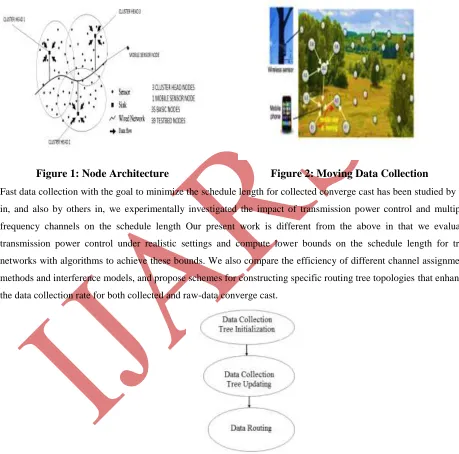
Figure 1: Node Architecture Figure 2: Moving Data Collection
Fast data collection with the goal to minimize the schedule length for collected converge cast has been studied by us
in, and also by others in, we experimentally investigated the impact of transmission power control and multiple
frequency channels on the schedule length Our present work is different from the above in that we evaluate
transmission power control under realistic settings and compute lower bounds on the schedule length for tree
networks with algorithms to achieve these bounds. We also compare the efficiency of different channel assignment
methods and interference models, and propose schemes for constructing specific routing tree topologies that enhance
the data collection rate for both collected and raw-data converge cast.
Figure 3: Flow Diagram of Data Collection
Tree Initialization
Finding number of nodes with in the coverage area.
Datas are frequently updated inmoving sensor node.
Routing
Used to route packets in the network by finding the shortest path.
Advantage
* Power consumption is low
* Network lifetime is high.
* Reduce the drop.
* Increase throughput
IV.RESULTS AND DISCUSSION
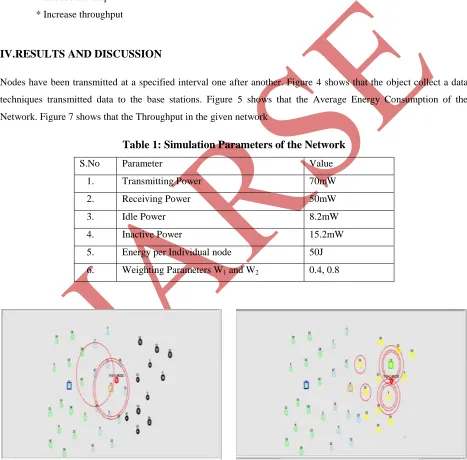
Nodes have been transmitted at a specified interval one after another. Figure 4 shows that the object collect a data
techniques transmitted data to the base stations. Figure 5 shows that the Average Energy Consumption of the
Network. Figure 7 shows that the Throughput in the given network
Table 1: Simulation Parameters of the Network
S.No Parameter Value
1. Transmitting Power 70mW
2. Receiving Power 50mW
3. Idle Power 8.2mW
4. Inactive Power 15.2mW
5. Energy per Individual node 50J
6. Weighting Parameters W1 and W2 0.4, 0.8
Figure 4: Shows That the Object Collect a Data Techniques Figure 5: shows that the Average Energy
In the figure 4 shows the sensed data from the Object tracking techniques in the network. Figure 5 shows the
average energy consumed in the data transmission network. It is inferred that the energy consumed decreases as time
progresses. The result of energy reduction increases the life time of the network. It gives the energy consumption,
when no. of sources is increased.
Figure 6: Shows That the Energy Consumption the Given Network Figure 7: Shows That the Throughput the
Given Network
Figure 6 shows the average energy consumed in the data transmission network. It is inferred that the energy
consumed decreases as time progresses. The result of energy reduction increases the life time of the network. It
gives the energy consumption, when no. of sources is increased.
Figure 7 shows the increase in throughput of the proposed technique. The numbers of packets are received when the
data is transmitted to the sink successfully. It gives the Packet Received, when no. of sources is increased.
Power Consumption
Figure 8: Shows the Power Consumption in the Given Network
V. CONCLUSION
collection tree in the system. Whenever the mobile user moves and changes the virtual sink to access the sensor
network, a new data collection tree can be efficiently formed by locally modifying the previously constructed data
collection tree. With such an approach, the routing performance is bounded and controlled compared to the optimal
performance while the overhead in updating the routing structure is significantly reduced. Such a property ensures
low data collection delay, providing real-time data getting hold of for the mobile user. In addition, our proposed
protocol is compatible to existing mobility estimate mechanisms and easy to implement. We implement the
proposed protocol in a 49- node testbed and test its feasibility and applicability in practice. We further conduct
extensive simulations, which prove the efficiency and scalability of our approach.
VI. REFERENCES
[1] T. He, J. Stankovic, T. Abdelzaher, and C. Lu, “A Spatiotemporal Communication Protocol for Wireless Sensor Networks,” IEEE Trans. Parallel and Distributed Systems, vol. 16, no. 10, pp. 995-1006, Oct. 2005.
[2] L. Wang and W. Liu, “Navigability and Reachability Index for Emergency Navigation Systems Using Wireless
Sensor Net- works,” Tsinghua Science and Technology, vol. 16, no. 6, pp. 657- 668, 2011.
[3] Y. Zhu and L. Ni, “Probabilistic Approach to Provisioning Guaranteed Qos for Distributed Event Detection,”
Proc. IEEE INFOCOM, pp. 592-600, 2008.
[4] I. Stojmenovic, “Localized Network Layer Protocols in Wireless Sensor Networks Based on Optimizing Cost
over Progress Ratio,” IEEE Network, vol. 20, no. 1, pp. 21-27, Jan./Feb. 2006.
[5] D. Guo, J. Wu, H. Chen, Y. Yuan, and X. Luo, “The Dynamic Bloom Filters,” IEEE Trans. Knowledge and Data
Eng., vol. 22, no. 1, pp. 120-133, Jan. 2010.
[6] Y. Liu, Y. Zhu, and L.M. Ni, “A Reliability-Oriented Transmission Service in Wireless Sensor Networks,”
IEEE Trans. Parallel and Distributed Systems, vol. 22, no. 12, pp. 2100-2107, Dec. 2011.
[7] S. Tang, X. Mao, and X. Li, “Efficient and Fast Distributed Top-K Query Protocol in Wireless Sensor
Networks,” Proc. IEEE 19th Int’l Conf. Network Protocols (ICNP), pp. 99-108, 2011.
[8] I. Stojmenovic and X. Lin, “Loop-Free Hybrid Single-Path/ Flooding Routing Algorithms with Guaranteed
Delivery for Wireless Networks,” IEEE Trans. Parallel and Distributed Systems, vol. 12, no. 10, pp. 1023-1032,
Oct. 2001.
[9] Y. Liu, Y. He, M. Li, J. Wang, K. Liu, L. Mo, W. Dong, Z. Yang, M. Xi, J. Zhao, and X. Li, “Does Wireless
Sensor Network Scale? A Measurement Study on Greenorbs,” Proc. IEEE INFOCOM, pp. 873-881, 2011.
[10] O. Gnawali, R. Fonseca, K. Jamieson, D. Moss, and P. Levis, “Collection Tree Protocol,” Proc. ACM Seventh
Conf. Embedded Networked Sensor Systems, pp. 1-14, 2009.
[11] G. Challen, J. Waterman, and M. Welsh, “IDEA: Integrated Distributed Energy Awareness for Sensor
Networks,” Proc. Eighth Ann. Int’l Conf. Mobile Systems, Applications and Services (Mobisys), pp. 35-48, 2010.
[12] H. Lin, M. Lu, N. Milosavljevic, J. Gao, and L.J. Guibas, “Composable Information Gradients in Wireless
Sensor Net- works,” Proc. ACM Seventh Int’l Conf. Information Processing in Sensor Networks (IPSN), pp.
[13] Y. Mao, F. Wang, L. Qiu, S. Lam, and J. Smith, “S4: Small State and Small Stretch Compact Routing Protocol
for Large Static Wireless Networks,” IEEE/ACM Trans. Networking, vol. 18, no. 3, pp. 761- 774, June 2010.
[14] S. Rangwala, R. Gummadi, R. Govindan, and K. Psounis, “Interference-Aware Fairerate Control in Wireless
Sensor Ne- towrks,” Proc. ACM SIGCOMM, pp. 63-74, 2006.
[15] S. Michael, M. Franklin, J. Hellerstein, and W. Hong, “TAG: A Tiny AGgregation Service for Ad-Hoc Sensor Networks,” Proc. Fifth Usenix Symp. Operating Systems Design and Implementation (OSDI), pp. 131-146, 2002.
[16] B. Kusy, H. Lee, M. Wicke, N. Milosavljevic, and L. Guibas, “Predictive QoS Routing to Mobile Sinks in
Wireless Sensor Networks,” Proc. ACM Int’l Conf. Information Processing in Sensor Networks (IPSN), pp.
109-120, 2009.
[17] H. Lee, M. Wicke, B. Kusy, O. Gnawali, and L. Guibas, “Data Stashing: Energy-Efficient Information Delivery
to Mobile Sinks through Trajectory Prediction,” Proc. ACM/IEEE Ninth Int’l Conf. Information Processing in
Sensor Networks (IPSN), pp. 291-302, 2010.
[18] R. Tan, G. Xing, J. Wang, and H. So, “Exploiting Reactive Mobility for Collaborative Target Detection in
Wireless Sensor Networks,” IEEE Trans. Mobile Computing, vol. 9, no. 3, pp. 317-332, Mar. 2010.
[19] G. Xing, T. Wang, Z. Xie, and W. Jia, “Rendezvous Planning in Wireless Sensor Networks with Mobile
Elements,” IEEE Trans. Mobile Computing, vol. 7, no. 12, pp. 1430-1443, Dec. 2008.
[20] J.W. Lee, B. Kusy, T. Azim, B. Shihada, and P. Levis, “Whirlpool Routing for Mobility,” Proc. ACM
Mobihoc, pp. 131-140, 2010.
[21] Y. Wu, Z. Mao, S. Fahmy, and N. Shroff, “Constructing Maximum-Lifetime Data Gathering Forests in Sensor
Networks,” IEEE/ACM Trans. Networking, vol. 18, no. 5, pp. 1571-1584, Oct. 2010.
[22] O. Durmaz, A. Ghosh, B. Krishnamachari, and K. Chintalapudi, “Fast Data Collection in Tree-Based Wireless Sensor Networks,” IEEE Trans. Mobile Computing, vol. 11, no. 1, pp. 86-99, Jan. 2012.
[23] K. Wu, H. Tan, Y. Liu, J. Zhang, Q. Zhang, and L. Ni, “Side Channel: Bits over Interference,” IEEE Trans.
Mobile Computing, vol. 11, no. 8, pp. 1317-1330, Aug. 2012.
[24] J. Luo, J. Panchard, M. Piorkowski, M. Grossglauser, and J. Hubaux, “Mobiroute: Routing Towards a Mobile Sink for Improving Lifetime in Sensor Networks,” Proc. IEEE Int’l Conf. Distributed Computing in Sensor Systems
(DCOSS), pp. 480-497, 2006.
[25] X. Liu, H. Zhao, X. Yang, X. Li, and N. Wang, “Trailing Mobile Sinks: A Proactive Data Reporting Protocols
for Wireless Sensor Networks,” Proc. IEEE Seventh Int’l Conf. Mobile Ad Hoc and Sensor Systems (MASS), pp.
214-223, 2010.
[26] K. Tian, B. Zhang, K. Huang, and J. Ma, “Data Gathernig Protocols for Wireless Ensor Networks with Mobile
Sinks,” Proc. IEEE GLOBECOM, pp. 1-6, 2010.
[27] J. Gao, L. Guibas, N. Milosavljevic, and D. Zhou, “Distributed Resource Management and Matching in Sensor
Networks,” Proc. IEEE Int’l Conf. Information Processing in Sensor Networks (IPSN), pp. 97-108, 2009.
[28] J. Luo, D. Wang, and Q. Zhang, “On the Double Mobility Problem for Water Surface Coverage with Mobile