
ISSN 2348 – 7968
373
Efficient solution to remove impulse noise with high
density in color images based on locative-adaptive
processing and butterworth frequency filter
Mehran Shirkhaneghah1, Sonia Montasheri2
1
University of Mohaghegh Ardabili Ardabil, Iran
2
Department of Computer Engineering, East Azerbaijan Science and Research Branch, Islamic Azad University Tabriz, Iran
ABSTRACT
Deleting unwanted disturbances such as types of noise and improving the quality of the image, considered as the essential challenge in the research. In this study, by using the locative-adaptive processing and Butterworth frequency filter, an innovative method for detection and removing of impulse noise was presented while maintaining important information such as edges and texture image which includes new algorithms for the detection of impulse noise, high-density and high-density proposed a new filter is to delete impulse noise. The results obtained from tests on noisy images have been evaluated with accurate quantitative and qualitative criteria, such as PSNR. Visual results of the proposed methods, represents the texture and edge detection and noisy image quality improvement compared with existing algorithms.
Keywords: Image Processing, impulse noise, noisy image quality improvement.
1. INTRODUCTION
The noise is an unwanted signal that causes interference, change or destroy the original signal and finally causing the disorder. Noise affects in the measurement of the output values of the system, so that it is different from the real amount with value recorded in output. One of the most important types of noise can be pointed to impulse noise that occurs as irregular and discontinuous. Impulse noise on digital images is in the form that the intensity difference noisy pixel by around pixels differs very much. Improvement of damaged image with impulse noise is done by various methods such as filters based on median or nonlinear filters, but these methods lead to image important information removing such as edges and texture. The methods based on soft computing such as filters based on fuzzy logic contains complexity and high computational fees. Setting the parameters in these methods are problematic and obtaining the purpose is difficult.
From the methods for impulse noise removing and image quality improvement it can be mentioned to switching filters such as GLAM [4], BDND [5], OCS [6], FSM [7], EEP [8], SAWM [9], CNDSM [10], NAFSM [11], NAGM [12]and DNLM [13].
In [14] provided the spectrum gradient combined based on a two-stage method for the impulse noise removing. In [15] provided adaptive two-stage median filter (ATSM) for noise removing. The algorithms based on median filter have simple structure and fast run time. the disadvantages of methods based on median filters that if the image contain high-density noise, these filters are not able to detect noisy pixels from non-noisy pixels, and leads to the image important information removing such as edges. [4,7,9,10,14].
In the following sections, we review the related studies in the field of noise removing and the proposed method will be presented in the third section. The simulation results are presented in the fourth Section. The fifth section contains conclusions.
2. RELATED WORK
One of the most important problems in the image processing is the damaged image improvement by impulse noise that is done by different methods including filters based on the median. In relation with salt and pepper noise filtering, median filter is used as a nonlinear filter. The median filter can delete point noises or separated liner noise, while the image edges will not change. One of the disadvantages of the median filter is when the image accepts noise of a threshold higher than 60%. In this case, filter is not able to detect noisy pixels from non-noise pixel and therefore decreases the filter performance. To overcome this problem, the median filter has been improved. Several algorithms have been proposed to median filter improvement.
ISSN 2348 – 7968
374
window values replaces the current value of the pixel, Otherwise the values 0 and 255 have been removed from the windows and remaining values Median placed in the current pixel. These operations will continue to scan the whole picture. In [17] to remove the impulse noise in images with gray levels of intensity [0255], the noisy image pixels to be processed line by line from beginning to end. A two-dimensional window5 × 5 created in the center of each pixel and to neighbors of each pixel is assigned a specific weight. Variable count 1 and count 2 to hold the number of noisy pixels in the neighborhood of the current pixel is taken up, so that if any of the neighbors {NW, N, NE, W, E, SW, S, SE} have value of 0 or 255, then added to count1. If any of the neighbors {N2, S2, E2, W2, NE2, SW2, NW2, SE2} have the value of 0 or 255 then added to count2.
T1 and T2 are constant parameters that defined by the user.
If T1>count1 and T2>count2 then, there is noise.
If T1<count1 and T2>count2 then, there is noise.
If T1>count1 and T2<count2 then, there is noise.
If T1<count1 and T2<count2 then, there is no noise.
If the current pixel was determined noisy:
1- If in the window5 × 5, the number of pixels without noise was greater than 3, then the without noise values median of window is considered for the current pixel. 2- Otherwise, the values mean of window is
considered for the current pixel.
In [18] if in the noisy image, the current pixel value was 0 or 255 then value median of window other than 0 and 255 is calculated. If there was the median, median value will replace the current pixel. Otherwise, the window size will be larger. Windows grow up continues to the maximum size sets by the user. If the window size reach to the possible maximum extent and the median value other than 0 and 255 could not be found, if the number of values 0 was more than the threshold values set by the user, 0willreplace the current pixel. If the number of values 255 was more than the threshold values set by the user, 255 will replace the current pixel.
In [1] a simple and efficient method to delete impulse noise is presented in two stages. In the first stage, after applying a median filter, deletes the noisy points with low dispersion. In the second stage of the algorithm, the noisy points with high-density that the filter in the first stage was unable to correct them, puts under the other median filter. In the second stage of the algorithm, particle collective intelligence is used to find the remaining noisy points.
The presented algorithm In [1] that was named PSOMF works as follows: firstly the output of the standard median filter 3 × 3compares between the nearly points to0 and nearly to 255 and the points
that are between the two interval, left untouched and the rest points (where the median filter 3 × 3 has failed to correct them) will be replaced using by median filter 5 × 5.
In [2], in order to deletes the impulse noise, presented a two-step method in the form of identifying and replacing the noisy points. In the first stage, the noisy point detected using by a leading neural network with Reverse publication and the second stage, with the knowledge of the noisy point, the new value is replaced by a two-dimensional cellular automata.
In order to identify the noisy point has been used a leading multi-layer artificial neural network with backward error publication method. The network consist of 3 layers is considered. Input layer is corresponding with the number of neighborhood points and the target point and output layer is corresponding with central point. But the number of appropriate nodes in the median layer according to the accuracy of results is obtained in the number of variable nodes in the network structure in a several test sample. After the neural network training, the network with acceptable accuracy will be able to detect noise.
In [3] a new neural-fuzzy filter to impulse noises deleting of image is presented. This filter is composed of two parts. In the first part using by a decision criterion, specified the noisy pixels and in the second part using by healthy pixel and with the help of neural-fuzzy network ANFIS that trained by this pixels, noisy pixels of image are reconstructed. In [3], the type of shock pulse is a general accumulative noise. Since the impulse noise has values that are difference in terms of light intensity of their surrounding pixels, the method used in [3] contains the noise with constant value.
3. PROPOSED METHOD
In the first phase of the proposed algorithm, our aim is to detect the impulse noise. Since the impulse noise for the highest and lowest intensity exist in the noisy image, we receive highest and lowest threshold as input parameters in the first step.
The lowest threshold as input parameters receives from the user =T1
The highest threshold as input parameters receives from the user =T2
ISSN 2348 – 7968
375
have noise and should be analyzed using the proposed algorithms.
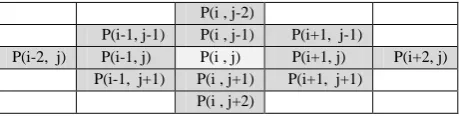
To correct the pixel values that are likely to be noisy, at the first step, a two-dimensional window
5×5 is formed centered at the current pixel by pixel values in the neighborhood of von Neumann, as showed in Figure 1.
P(i , j-2)
P(i+1, j-1) P(i , j-1)
P(i-1, j-1)
P(i+2, j) P(i+1, j)
P(i , j) P(i-1, j)
P(i-2, j)
P(i+1, j+1) P(i , j+1)
P(i-1, j+1)
P(i , j+2)
Fig.1 matrix 5×5 with pixel values in the neighborhood of Von Neumann
If all the values in the window are less than of T1
and more than of T2 Then mode of all values in the
neighborhood von Neumann window 5×5 is replaced to the current pixel. Otherwise, all of the window Values which are less than T1 and more
than T2 are overlooked and mean of the remaining
values in the window, replace the current pixel's value.
In the second phase of the proposed algorithm, the modified image in the spatial domain, investigated in the frequency domain. Processing in the frequency domain includes the modification of the Fourier transform of the image and then calculated the inverse transform to obtain the result.
In the low-pass filter of two-dimensional Butterworth, D01 is the cutoff frequency and is
received as input parameters.
Appling the Butterworth low-pass filter in the frequency domain causes eliminating impulse noise
and image softening. But, the significant
disadvantage of this filter is to remove some of the edges and texture of image. In the second phase of the proposed algorithm, we offer a method that after removing the impulse noise of the image, the edges and texture of image retained.
P3 P2 P1 P6 P5 P4 P9 P8 P7
Fig.2 windows 3×3 of image
Fig.3 edge detection Patterns the Sobel method [19]
To remove the few remaining impulse noise, improved image in spatial domain of Butterworth low-pass filter cross in the frequency domain and the result stored in the equal size array with image P whose name is Pluto detect the edges of image Q, image P of Butterworth high-pass filter crossing in the frequency domain and the result stored in the equal size array with image P whose name is HP.
cut-off frequency at a distance of D02 of the
quadrangle center of frequency is received as input parameters for Butterworth high-pass filter.
By separating the edges of impulse noise and applying values of the detected edges to image, we can enhance the quality of noisy image. To determine the validity of the edges of acts Butterworth high-pass filter, we use the sobel edge detection pattern. The actual edge of noisy image detected by applying a Butterworth high-pass filter and using the sobel detection pattern, and modified the HP values.
Finally, to improve the quality of noisy image, the actual edges of noisy image of applying Butterworth high-pass filter (HP) combined with the result of Butterworth low-pass filter (LP). Figure 4 shows the structure of the proposed algorithm and how to combine the output of the HP and LP.
1.3. THE PROPOSED ALGORITHM FOR
NOISE IMPACT IS AS FOLLOWS:
First step: receive the highest and lowestthreshold asinputparameters.
T1= Catch the lowest threshold from the user as
input parameters
T2= Catch the highest threshold from the user as
input parameters
Second step: defined the two-dimensional array P for storing the corrected values of noisy image. Third step: repeatthe below steps for the allvalues of noisyimage pixels.
Fourth step: if the current pixel value except the highest and lowest threshold, then this pixel is known asthe actual value ofimageand its valueis unchangedandstoredin P.
Fifth step: If the current pixel value is the highest and lowest threshold, then the value of this pixel, the noisy is considered.
Sixth step: repeat the below steps for the pixels with noisy values.
Seventh step: create the two-dimensional window 5×5 by centered at the noisy pixel with pixel values in the neighborhood of von Neumann.
ISSN 2348 – 7968
376
Eighth step: If all of the values in the window, less than T1 and more than T2, then:
The mode of all of the valuesin the neighborhood ofvon Neumann window 5×5 replaced the current pixel.
Otherwise:
All of thevalues less thanT1 andmore thanT2from
made up window will be ignored and average of
remaining values in the window replaced by the current pixel.
Ninth step: if the whole image scanning is not ended, then go to Fourth step.
Tenth Step: P1=P
Modified Image in the spatial domain pass of the Butterworth low-pass filter in the frequency domain and save the result in the same size array with image P1 called LP.
Step Eleventh: P2=P
Modified Image in the spatial domain pass of the Butterworth high-pass filter in the frequency domain and save the result in the same size array with image P1 called HP.
Twelfth Steps: two-dimensional array Enhance defined to final storing the noisy image modified values in the frequency domain.
Thirteenth Step: repeat the below steps for all of the noisy image pixels values.
Fourteenth Step: According to the sobel edge detection pattern, pixel P (i,j) is the edge?
Create the window w with dimensions 5×5 with centered by HP(i,j) and the corresponding values in the neighborhood of von Neumann.
W + LP(i,j) = Enhance(i,j) Otherwise: LP(i,j) = Enhance(i,j)
Fifteen Step: if all of the noisy image scanning does not ended, then go to Step Fifteenth.
Sixteenth Step: the two-dimensional array Enhance send to output as final modified image.
Seventeenth Step: end.
For impulse noise with high density (80% or 90%) suggested the window 7×7.
4. SIMULATION RESULTS
Tables 1 and 2 shows the comparison of the performance of the proposed algorithm and above mentioned methods with measure PSNR for the Lena and Baboon standard image with gray levels in size 512×512 with [0,255] intensity with impulse noise density 10% to 80%. The evaluation of Tables 1 and 2 values show the better performance and superiority of the proposed algorithm to other methods. The graph of proposed algorithm performance in comparison with the mentioned algorithms with test on the Lena and Baboon standard images with impulse noise density 10% to 80% in Figures 5 and 6 represent the superiority of the proposed algorithm to mentioned methods. The visual results of proposed algorithm with experiments on the standard images with the impulse noise density 60%, 70%, 80% and 90% are shown in the figure 7, 8, 9 and 10. According to the simulation results, it can be observed the better performance and superiority of the proposed algorithm compared to other methods.
Table 1: Compare the results of the proposed algorithm and mentioned methods with criteria PSNR, for the Lena standard images in the gray levels in size 512×512 with intensity [0,255] with impulse noise density 10% to 80%
Methods Noise ratio
10% 20% 30% 40% 50% 60% 70% 80%
Noisy 15.5 12.4 10.6 9.5 8.5 7.7 7.0 6.4
FSF [25] 33.7 28.9 23.0 18.1 14.3 11.5 9.3 7.4
SNFF [24] 30.1 28.4 24.0 21.9 20.0 18.3 16.7 15.2
NNDMF [23] 32.3 32.0 31.5 30.0 28.9 27.7 26.1 23.6
NNANFIS [22] 34.9 31.5 29.1 27.5 25.4 23.2 20.9 18.0
ANFISFWS [21] 29.2 28.2 26.8 23.8 22.0 15.4 12.9 10.8
FCA [20] 35.0 33.5 32.7 31.2 29.2 27.8 26.5 23.7
Proposed 42.0 38.3 35.8 34.1 32.3 31.3 30.3 28.1
Table 2: Compare the results of the proposed algorithm and mentioned methods with criteria PSNR, for the Baboon standard images in the gray levels in size 512×512 with intensity [0,255] with impulse noise density 10% to 80%
Methods Noise ratio
10% 20% 30% 40% 50% 60% 70% 80%
Noisy 15.6 12.6 10.8 9.5 8.6 7.8 7.1 6.5
FSF [25] 23.0 22.1 20.0 17.1 14.3 11.9 9.8 8.0
SNFF [24] 30.9 28.2 26.2 24.3 22.4 20.8 19.2 17.8
NNDMF [23] 22.7 22.6 22.5 22.3 22.0 21.6 21.2 20.5
NNANFIS [22] 31.1 28.0 26.1 24.5 23.0 21.5 19.6 17.2
ISSN 2348 – 7968
377
FCA [20] 31.2 28.5 27.2 24.6 23.3 22.3 21.5 21.0
Proposed 37.0 33.4 31.5 29.0 27.3 26.3 25.3 23.7
Fig.4 the proposed algorithm performance in comparison with mentioned algorithm with test on the Lena standard images with impulse noise density 10% to 80%
Fig.5 the proposed algorithm performance in comparison with mentioned algorithm with test on the Baboon standard images with impulse noise density 10% to 80%
0 10 20 30 40 50
10% 20% 30% 40% 50% 60% 70% 80%
P
S
N
R
i
n
d
B
Percent of impulsive noise density
Compare the results of the proposed algorithm and mentioned methods
Noisy FSF [15] SNFF [14]
NNDMF [13] NNANFIS [12] ANFISFWS [11]
0 5 10 15 20 25 30 35 40
10% 20% 30% 40% 50% 60% 70% 80%
P
S
N
R
i
n
d
B
Percent of impulsive noise density
Compare the results of the proposed algorithm and mentioned methods
Noisy FSF [15] SNFF [14]
NNDMF [13] NNANFIS [12] ANFISFWS [11]
ISSN 2348 – 7968
378
5. CONCLUSIONS AND SUGGESTED
FOR FUTURE WORK
In this paper, by using locative-adaptive processing and Butterworth frequency filter, an innovative method for impulse noise removing and detection is presented while image important information protected such as edges and texture of image that includes the following:
Introduce a new algorithm for the detection of high-density impulse noise through appropriate threshold level suggestion and image locative processing.
Suggest a new filter for the removing of high-density impulse noise through introducing the new filter by Butterworth locative and frequency processing.
The results of tests on noisy images have been evaluated with quantitative and qualitative measures most accurate such as PSNR. Visual results of the proposed methods, shows the texture and edge detection and noisy image quality improvement in comparison to the existing algorithms. The values PSNR of the modified image, on average, 1dB increased than previously reported tasks.
The following methods are recommended for future work:
Noise smart detection in impregnated images to impulse noise.
Impulse noise smart removing of impregnated images to impulse noise.
Image important information protection such as texture and edge with smart methods.
Reference
[1] Soleiman Pasban and Ahmad Habibi. Z. "an amplified two-stage median filter by particle swarm optimization to detect and delete the noise impact of digital images. " the 5th image processing conference, 2010, Iran. In Persian.
[2] Rezvanian and Faez. " A hybrid method to delete impulse noise of digital images using artificial neural network and cellular automata" the 14th Annual Conference of Computer Society, page 94, 2009, Iran. In Persian.
[3] Sharifian and Vafadoust. "neuro-fuzzy filter to delete impulsive noise with high density image" Annual
Fig.7 Compare the results of the proposed method with related methods with noise density of 90% Fig.6 Compare the results of the proposed method
ISSN 2348 – 7968
379
Conference of Computer Society, page 27 to 29, 2005,iran. In Persian.
[4] Wang, Shuenn-Shyang, and Cheng-Hao Wu. "A new impulse detection and filtering method for removal of wide range impulse noises." Pattern Recognition 42, no. 9 (2009): 2194-2202.
[5] Ng, Pei-Eng, and Kai-Kuang Ma. "A switching median filter with boundary discriminative noise detection for extremely corrupted images." Image Processing, IEEE Transactions on 15, no. 6 (2006): 1506-1516.
[6] Ze-Feng, Deng, Yin Zhou-Ping, and Xiong You-Lun. "High probability impulse noise-removing algorithm based on mathematical morphology."
Signal Processing Letters, IEEE 14, no. 1 (2007): 31-34.
[7] Srinivasan, K. S., and David Ebenezer. "A new fast and efficient decision-based algorithm for removal of high-density impulse noises." Signal Processing Letters, IEEE 14, no. 3 (2007): 189-192. [8] Chen, Pei-Yin, and Chih-Yuan Lien. "An efficient edge-preserving algorithm for removal of salt-and-pepper noise." Signal Processing Letters, IEEE 15 (2008): 833-836.
[9] Zhang, Xuming, and Youlun Xiong. "Impulse noise removal using directional difference based noise detector and adaptive weighted mean filter."
Signal Processing Letters, IEEE 16, no. 4 (2009): 295-298.
[10] Wang, Shuenn-Shyang, and Cheng-Hao Wu. "A new impulse detection and filtering method for removal of wide range impulse noises." Pattern Recognition 42, no. 9 (2009): 2194-2202.
[11] Toh, Kenny Kal Vin, and Nor Ashidi Mat Isa. "Noise adaptive fuzzy switching median filter for salt-and-pepper noise reduction." Signal Processing Letters, IEEE 17, no. 3 (2010): 281-284.
[12] Yu, Gaohang, Liqun Qi, Yimin Sun, and Yi Zhou. "Impulse noise removal by a nonmonotone adaptive gradient method." Signal Processing 90, no. 10 (2010): 2891-2897.
[13] Zhang, Xuming, Yi Zhan, Mingyue Ding, Wenguang Hou, and Zhouping Yin. "Decision-based non-local means filter for removing impulse noise from digital images." Signal Processing 93, no. 2 (2013): 517-524.
[14] Yu, Gaohang, Shanzhou Niu, and Jianhua Ma. "A hybrid spectral gradient method for removing salt-and-pepper impulse noise." In Image and Signal Processing (CISP), 2011 4th International Congress on, vol. 2, pp. 765-768. IEEE, 2011.
[15] Jeevaraj, Eliahim. "Fixed-value impulse noise suppression for images using PDE based Adaptive Two-Stage Median Filter." In 2011 International Conference on Computer, Communication and
Electrical Technology (ICCCET), pp. 290-295. 2011.
[16] Esakkirajan, S., T. Veerakumar, Adabala N. Subramanyam, and C. H. PremChand. "Removal of high density salt and pepper noise through modified decision based unsymmetric trimmed median filter." Signal Processing Letters, IEEE 18, no. 5 (2011): 287-290.
[17] Javidi, Mohammad M., Roghiyeh Hoseinpour Fard, Soheila Khatami, and Mahdi Jampour. "An effective adaptive technique for impulse noise detection and reduction in digital images." In Hybrid Intelligent Systems (HIS), 2011 11th International Conference on, pp. 217-222. IEEE, 2011.
[18] Jubair, Md Imrul, Md Mizanur Rahman, Syed Ashfaqueuddin, and Imtiaz Masud Ziko. "An enhanced decision based adaptive median filtering technique to remove Salt and Pepper noise in digital images." In Computer and Information Technology (ICCIT), 2011 14th International Conference on, pp. 428-433. IEEE, 2011.
[19] Gonzalez, Rafael C., and Richard E. Woods. "Digital image processing." Prentice Hall 10 (2002): 12-23.
[20] Sadeghi, Sana, Alireza Rezvanian, and Ebrahim Kamrani. "An efficient method for impulse noise reduction from images using fuzzy cellular automata." AEU-International Journal of Electronics and Communications 66, no. 9 (2012): 772-779. [21] Tavassoli, Sude, Alireza Rezvanian, and Mohammad Mehdi Ebadzadeh. "A new method for impulse noise reduction from digital images based on adaptive neuro-fuzzy system and fuzzy wavelet shrinkage." In Computer Engineering and Technology (ICCET), 2010 2nd International Conference on, vol. 4, pp. V4-297. IEEE, 2010. [22] Rezvanian, Alireza, Karim Faez, and Fariborz Mahmoudi. "A two-pass method to impulse noise reduction from digital images based on neural networks." In Electrical and Computer Engineering, 2008. ICECE 2008. International Conference on, pp. 400-405. IEEE, 2008.
[23] Turkmen, Ilke. "Efficient impulse noise detection method with ANFIS for accurate image restoration." AEU-International Journal of Electronics and Communications 65, no. 2 (2011): 132-139.
[24] Rosin, Paul L. "Image processing using 3-state cellular automata." Computer vision and image understanding 114, no. 7 (2010): 790-802.
![Table 1: Compare the results of the proposed algorithm and mentioned methods with criteria PSNR, for the Lena standard images in the gray levels in size 512×512 with intensity [0,255] with impulse noise density 10% to 80% Noise ratio](https://thumb-us.123doks.com/thumbv2/123dok_us/7849629.1301589/4.595.93.503.513.637/compare-results-proposed-algorithm-mentioned-criteria-standard-intensity.webp)
