ISSN 2348 – 7968
Control of vibrations in smart intelligent structures for a multivariable
case using periodic sampling method
Mr. Arunkumar G.,
1B.E., M.Tech., (Ph.D.-VTU) Dr. T.C.Manjunath,2Ph.D. (IIT Bombay), FIETE, FIE, SMIEEE
1
Research Scholar, Visvesvaraya Technological University (VTU)-Belgaum, Karnataka Email : [email protected]
2
Principal, Professor, ECE Dept., Nandi Inst. of Tech. & Mgmt. Sciences, Bangalore-45, Karnataka Email : [email protected] Phone : 9449820361
Abstract
Vibration control plays a very important role in the modern day world especially in control of earthquakes & in aerospace engineering. With reference to this, research is being carried out in this exciting field. Control of vibrations in smart intelligent structures for a multivariable case using periodic output feedback method is presented in this paper. Simulation is carried out in Matlab & the results show the effectiveness of the method presented in this paper.
Keywords: Smart structures, Periodic output sampling, Vibration control, Beams, Sensors, Actuators.
1. Introduction
Smart materials such as sensors & actuators together integrated or embedded into the structure are what is called a “Smart Structure” and are often called as the intelligent structures, which are used for control of vibrations in structures & earthquakes. Smart materials are a subset of the smart structure [1] [9]. Thus, a smart structure is a distributed parameter system that employs sensors & actuators at different finite element locations on the beam and makes use of sophisticated feedback controllers that analyze the responses obtained from the sensors and use different control logics to command the actuators to apply localized strains to the plant to respond in a desired fashion. Smart structures have also got the capability to respond to the changes in the environment on the plant, whether internal or external such as load changes or temperature changes [2]. A smart structure system comprises of 4 important sub-parts such as sensors, controller, actuators and the plant (flexible beam), whose condition is to be controlled [53]. Each component of this smart structure system has a certain functionality and the entire sub-systems are integrated to perform a self-controlled smart action, similar to a living creature who can “think”, make judgment and take actions on own at the appropriate time, thus inducing the smart & intelligentness [3].
Smart materials and smart structures, often called as the intelligent structures form a new rapidly growing interdisciplinary technology in the modern day world, especially after the world trade centre disaster [4]. This smart structure technology enhances the structural properties by integrating sensors, actuators, signal-processing, electronics and control technologies into it, thus resulting in an improved overall dynamic performance [5]. These intelligent structures form the basis for the nanotechnology concepts. Numerous applications of this technology can be found in aerospace, civil, transportation, defense, flexible manipulators, MEMS, NEMS, bio-technology, automobiles, communications, antennas and in earthquakes [55] - [60]. One exciting and interesting example of its applications is the active vibration control (AVC) in structures such as in beams, plates, structures and in shells, which is our topic of research [6].
In recent years, this active vibration control of structural characteristics using smart materials such as piezoelectrics, SMA, ER-Fluids, MR-Fluids, PVDF and optic fibers, carbon nano-tubes, pyroelectrics, graphite, etc has received considerable attention and has become an important problem in structures [7]. One of the ways to tackle this vibration problem is to make the structure smart, intelligent, adaptive and self-controlling by making use of smart intelligent materials; else they may affect its stability, longevity and its performance [54]. These smart materials can be used to generate a secondary vibrational response in a mechanical system which has the potential to reduce the overall response of the system by the destructive interference with the original response of the system, caused by the primary source of vibration [8], [10].
ISSN 2348 – 7968
2. Overview of the POF control law
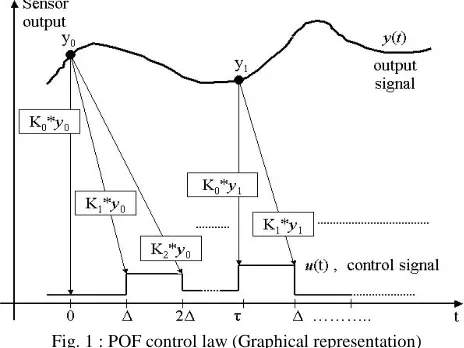
In this section, a brief review about the type of control strategy used to curb the vibrations of a smart cantilever beam along with the simulation results & justifications is presented in this context [11] [13]. The graphical illustration of the periodic output feedback control law is shown in Fig. 1 as
Fig. 1 : POF control law (Graphical representation)
Here, we are going to develop the controller strategy for the MIMO representation of the smart structure using the famous POF feedback control law [Werner and Furuta, 1995], [Werner, 1997] with 2 actuator inputs and 2 sensor outputs to the plant. The problem of pole assignment by piecewise constant output feedback was studied by Chammas and Leondes [1979], Werner [1997] for LTI systems with infrequent observations. They showed that by the use of a periodically time-varying piecewise constant output feedback gain [Levine and Athans, 1970], the poles of the discrete time control system could be assigned arbitrarily (within the natural restriction that they should be located symmetrically with respect to the real axis) using the POF technique [17]. Since the feedback gains are piecewise constants [Werner and Furuta 1995], their method could easily be implemented, guarantees the closed loop stability and indicated a new possibility. Such a control law can stabilize a larger class of systems. A brief review follows [21] – [25].
Consider a LTI CT system given by
,
,
y
Cx
Bu
Ax
x
=
+
=
which is sampled with a sampling interval of
τ
secs given by the discrete Linear Time Invariant (LTI) system (called as the tau system) as [26] – [30].,
)
(
)
(
,
)
(
)
(
)
1
(
k
x
C
k
y
k
u
k
x
k
x
=
Γ
+
Φ
=
+
τ τwhere
x
∈
ℜ
n,
u
∈
ℜ
m,
y
∈
ℜ
p and Φτ,Γτ and Care constant matrices of appropriate dimensions [16]. The following control law is applied to this system. The outputy is measured at the time instants t=kτ , k=0,1,2,... [31] – [33].
We consider constant hold functions because they are more suitable for implementation. An output-sampling interval is divided into N sub-intervals of length
N
τ
=
∆ and the hold function is assumed to be constant on these sub-intervals as shown in the figure below [15]. Thus, the control law becomes [14]
(
)
(
( )
)
l N ll
K
K
l
k
l
k
k
y
K
t
u
=
∆
+
+
≤
≤
∆
+
=
+,
1
),
(
)
(
τ
τ
τ
τ
for l = 0, 1, 2, …..(N – 1).
Note that a sequence of N gain matrices
{
K
0,
K
1,
...,
K
N−1}
, when substituted in the aboveequation, generates a time-varying piecewise constant output feedback gain K(t) for
0
≤
t
≤
τ
. Consider the following system, which is obtained by sampling the CT system with a sampling interval of ∆=τ N secs and denoted by(
Φ,Γ,C)
called as the delta system, ) ( ) ( , ) ( ) ( ) 1 ( k x C k y k u k x k x = Γ + Φ = +
ISSN 2348 – 7968
then, a state space representation for the system sampled over
τ
is), ( ) ( ), ( ) ( ) (
τ
τ
τ
τ
τ
τ
k x C k y k u k x k x N = + = + Φ Γ where[
Φ
Γ
Γ
]
=
−,...,
1 NΓ
.Applying POF,
K
y
(
k
τ
)
is substituted foru
(
k
τ
)
, the closed loop system becomes [34] – [36](
kτ
τ
)
(
C)
x(kτ
)x + = ΦN+ΓK .
The problem has now taken the form of static output feedback [Syrmos, 1997]. The above equation suggests that an output injection matrix G be found such that [37]
(
ΦN+GC)
<1ρ ,
where ρ()denotes the spectral radius. By observability, one can choose an output injection gain G to achieve any desired self-conjugate set of Eigen values for the
closed-loop matrix
(
ΦN +GC)
and fromN
≥
ν
, it follows that one can find a POF gain which realizes the output injection gain G by solving [38] – [40]G =
K Γ
for K. The controller obtained from this equation will give the desired behaviour, but might require excessive control action. To reduce this effect, we relax the condition that K exactly satisfy the linear equation and include a constraint on it. Thus, we arrive at the following in the inequality equation [41] – [42]
1
ρ <
K , Γ K−G <ρ2.
Using the Schurz complement, it is straight forward to bring these conditions in the form of linear matrix inequalities as [43] – [45]
0
21
<
−
−
I
I
TK
K
ρ
,(
)
(
)
02 2 < − − − − I G G I T K Γ K Γ
ρ
In this form, the LMI toolbox of MATLAB can be used for the synthesis of K[Yan et.al. 1998], [Yang et.al.
1993], [Geormel, 1994], [Gahnet, 1995]. The POF controller obtained by this method requires only constant gains and is hence easier to implement. Werner and Furuta [1995], Werner [1997] proposed a performance index so that ΓK=G need not be forced exactly [46] – [47]. This constraint is replaced by a penalty function, which makes it possible to enhance the closed loop performance by
allowing slight deviations from the original design and at the same time improving the behaviour. The performance index J(k)is given by
[
]
(
) (
)
, 0 0 ) ( * 1 * 0 kN kN k T kN kN l l i T l T l x x P x x u x R Q u x k J − − + =∑
∑
∞ = ∞ =where
R
∈
ℜ
m×m,
Q
,
P
∈
ℜ
n×n are positive definite and symmetric weight matrices,x
landu
ldenote the states and the inputs of the delta system respectively and*
kN
x
denotes the state that would be reached at the instantkN
, givenx
(k−1)N, ifKis solved to satisfy [48] – [50]G
=
K
Γ
exactly, i.e.,=
* kNx
(
)
N k N GC x
) 1 ( −
+
Φ .
The first term represents the ‘averaged’ state and control energy whereas the second term penalizes the deviation of
G
. A trade-off between the closed loop performance and closeness to the chosen design is expressed by the above cost function [51] – [55].3 Design of the controller for MIMO system
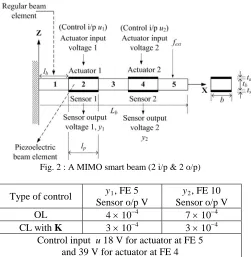
The controller algorithm is developed in Matlab. Apply an external force at the end of the beam which is divided into 4 finite elements & the sensor actuator pairs are kept at positions 2 & 4, thus giving rise to a multivariable system with 2 inputs and 2 outputs. Once the external force is applied check the open loop responses, i.e., the sensor outputs & the displacement of the beam. Consider a load matrix of unit sample in the simulations. In order to dampen out the vibrations quickly, design a POF controller and put in loop with the plant. First task is to design the selection of the sampling interval
τ
[ 56].Calculate the maximum bandwidth for all the sensor / actuator locations and then by using existing empirical rules for selecting the sampling interval based on bandwidth select approximately 10 times of the maximum 2nd vibration mode frequency of the system. The sampling interval used is
τ
=
0
.
03
seconds. Let(
Φτ,Γτ ,C)
be the discrete time model (tau system) of the system sampled at a rate of 1/
τ
seconds respectively [Umapathy et.al.ISSN 2348 – 7968
observable The ranks of the matrices is also found out [57].
The stabilizing output injection gains are obtained for the tau system such that the eigenvalues of
(
N i i)
i +G C
Φ lie
inside the unit circle and the response of the system has a good settling time. The impulse response of the system with the output injection gain Gis also observed. The CL responses with the output injection gain are also observed. Let
(
Φ
,Γ
,C
)
be the discrete time system (delta system) of the system sampled at the rate1/
∆
secs respectively. The number of sub-intervals,N
is chosen to be 10 [58].The periodic output feedback gain matrix K is obtained by solving ΓK=Gusing the LMI optimization
method which reduces the amplitude of the control signal
u
[60]. When the proposed controller is put in the loop,the closed loop impulse responses (sensor outputs y1 and
2
y ) with periodic output feedback gain Kof the system are observed [59].
4. Simulation results & justifications
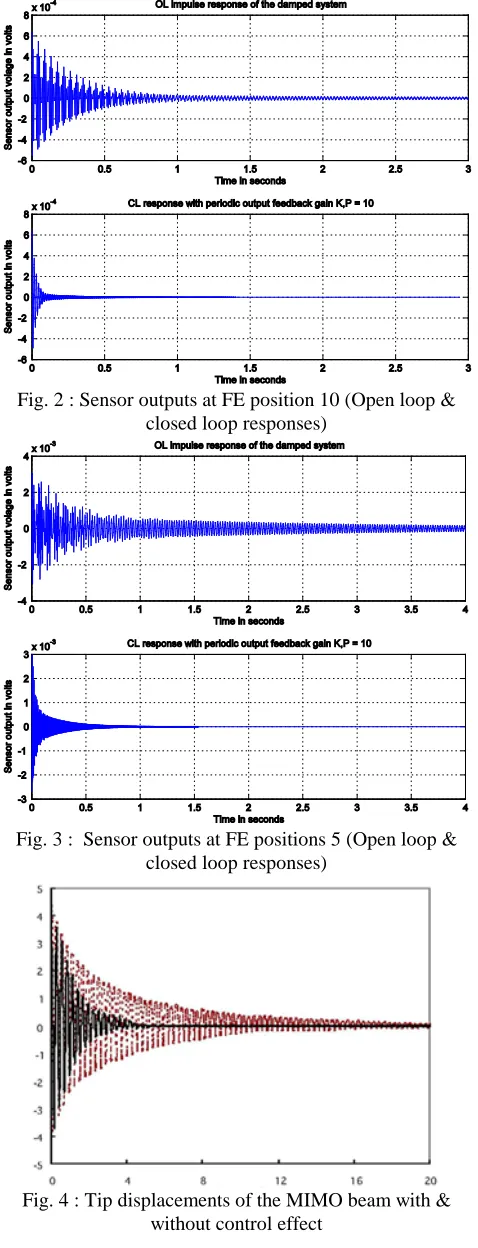
The control algorithm is developed in Matlab. The code is run & the results are observed. The variation of the control signal u1 and u2 with time for the MIMO model are also observed. The tip displacements are also observed as shown in the Figures 2 & 3 respectively. The comparisons of the quantitative results of the OL and CL responses (with output injection gain, POF gain) and with the magnitude of the control efforts, their settling times required is shown in Table 2.
Physical Parameters
Aluminum Beam
Piezoelectric sensor / actuator Length Lb = 0.3 m Lp = 0.075 m Width b = 0.025 m b = 0.025 m Thickness tb = 1.2 m tp = 1.2 m Young’s
Modulus Eb = 193 GPa Ep = 68 GPa
Table 1 : Dimensions-Properties of Al Beam & PZT Sensor & Actuator
with the dimensions of the plant as shown in Table 1 [12].
Fig. 2: A MIMO smart beam (2 i/p & 2 o/p)
Type of control y1, FE 5 Sensor o/p V
y2, FE 10 Sensor o/p V OL 4 × 10⁻⁴ 7 × 10⁻⁴ CL with K 3 × 10⁻⁴ 3 × 10⁻⁴
Control input u 18 V for actuator at FE 5 and 39 V for actuator at FE 4
Table 2 : Quantitative comparative results of POF simulations of the MIMO beam
(terms inside the brackets indicate the settling values), only the + ve magnitude values of the sensor outputs are shown here
ISSN 2348 – 7968
Fig. 2 : Sensor outputs at FE position 10 (Open loop & closed loop responses)
Fig. 3 : Sensor outputs at FE positions 5 (Open loop & closed loop responses)
Fig. 4 : Tip displacements of the MIMO beam with & without control effect
5. Conclusions
In this paper, control of vibrations in smart intelligent structures for a multivariable case using periodic output sampling method was presented. The simulation results show the effectiveness of the method developed for vibration suppression. MIMO dynamic analysis is able to identify pairs of modes that occur at nearly identical frequencies. SISO experiments are not actually reliable when it comes to accurate identification of mode pairs because they are unable to positively decipher mode pairs from signal noise in the measured Frequency Response Functions (FRF). Thus, an integrated finite element model to analyze the vibration suppression capability of a smart cantilever beams with surface mounted piezoelectric devices based on Timoshenko beam theory with multi-input-output interaction with 2 modes is presented in this paper and is sufficient to characterize the vibrations [38], Thus it is proved that SISO control is better than MIMO control as there are multiple interactions of the input and output. From the simulation results, it is observed that without control, the output settles at a faster rate than without POF control.
References
[1] Aldraihem, O.J., R.C. Wetherhold, and T. Singh, “Distributed control of laminated beams : Timoshenko vs. EBTheory,” J. Intelli. Mats. Syst. & and Struct., Vol. 8, pp. 149-57, 1997.
[2] Abramovich, H., “Deflection control of laminated composite beam with piezoceramic layers - Closed form solution,” J. Composite Struct., Vol. 43, No. 3, pp. 217-231, 1998.
[3] Saurabh Jain, Manjunath T.C. and Bandyopadhyay B., “Active vibration control of glassepoxy composite beam using output feedback,” IEEE Int. Conf. Industrial Technology, ICIT-2006, Mumbai, India, Paper No. ID-009954, pp. 2200-2206, Dec. 2006.
[4] Aldraihem, O.J., and A.A. Khdeir, “Smart beams with extension and thickness-shear piezoelectric actuators,” J. Smart Materials & Structures, Vol. 9, No. 1, pp. 1- 9, 2000. [5] Azulay, L.E., and H. Abramovich, “Piezoelectric actuation
and sensing mechanisms - Closed form solutions,” Composite StructuresJ., Vol. 64, pp. 443 - 453, 2004. [6] Abramovich, H., and A. Lishvits, “Free vibrations of
non-symmetric cross-ply laminated composite beams,” Journal of Sound and Vibration, Vol. 176, No. 5, pp. 597 - 612, 1994.
[7] Benjeddou, A., M.A. Trindade, and R. Ohayon, “New shear actuated smart structure beam finite element,” AIAA Journal, Vol. 37, pp. 378 - 383, 1998.
ISSN 2348 – 7968
Simulation, System Science and Technology, A Special issue on Modelling, Simulation and Decision Support,” Vol. 7, Nos. 4-5, pp. 51-68, Jul. 2006.
[9] Burdess J.S. and J.N. Fawcett, “Experimental evaluation of piezoelectric actuation for the control of vibration in a beam,” Journal of Syst. & Contr. Engg., Vol. 206, No. 12, pp. 99-106, 1992.
[10] Brennan, M.J., J.G. Bonito, S.J. Elliot, A. David and R.J. Pinnington, “Experimental investigation of different actuator technologies for active vibration control,” Journal of Smart Materials and Structures, Vol. 8, pp. 145-153, 1999.
[11] Manjunath T.C. and Bandyopadhyay B., “Vibration control of a smart flexible cantilever beam using periodic output feedback control technique,” Proc. Fourth Asian Control Conference ASCC-2002, Singapore, Paper No. 53-1679, pp. 1302–1307, Sep. 2002.
[12] Bona, B., M. Indri, and A. Tornamble, “Flexible piezoelectric structures-approximate motion equations and control algorithms,” IEEE Trans. on Auto. Contr., Vol. 42, No. 1, pp. 94- 101, 1997.
[13] Manjunath T.C. and Bandyopadhyay B., “Vibration suppression of Timoshenko beams with embedded piezoelectrics using POF,” International Journal of Intelligent Technology, Vol. 1, No. 1, pp. 21–30, Jan. 2006. [14] B. Bandyopadhyay, V. K. Thakar, Chakravarthini M. Saaj,
and S. Janardhanan, “Algorithm for computing sliding mode control and switching surface from output samples,” Proc. 8th IEEE Variable Structure Systems Workshop, Paper No.
04, Vilanova i la Geltru, Spain, Sep. 2004.
[15] Bartoszewicz, A, “Discrete-time quasi-sliding-mode control strategies,” IEEE Trans. Ind. Electron., Vol. 45, No. 1, pp. 633-637, 1998.
[16] Manjunath T.C. and Bandyopadhyay B., “Multivariable control of a smart structure using periodic output feedback control technique,” Proc. of the Seventh Int. Conf. on Control, Automation, Robotics and Computer Vision, ICARCV-02, Singapore, Paper No. 2002P1283, pp. 1481– 1486, Dec. 2-5, 2002.
[17] Culshaw B, “Smart structure a concept or a reality,” Journal of Syst. & Control Engg., Vol. 26, No. 206, pp. 1-8, 1992. [18] Crawley, E., and J. Luis, “Use of piezoelectric actuators as
elements of intelligent structures,” AIAA Journal, Vol.25, No. 10, pp. 1373-1385, 1987.
[19] Chandrashekhara, K., and S. Varadarajan, “Adaptive shape control of composite beams with piezoelectric actuators,” J. of Intelligent Materials Syst. & Struct., Vol. 8, pp. 112-124, 1997.
[20] Manjunath T.C. and Bandyopadhyay B., “Multivariable control of smart Timoshenko beam structures using periodic output feedback technique,” International Journal of Signal Processing, Vol. 3, No. 2, pp. 74–90, apr. 2006.
[21] Chammas, A.B., and C. T. Leondes, “Pole placement by piecewise constant output feedback,” Int. J. Contr., Vol. 29, pp. 31-38, 1979.
[22] Chammas, A.B., and C. T. Leondes, “On the design of LTI systems by periodic output feedback, Part-I, Discrete Time pole assignment,” Int.J.Ctrl., Vol. 27, pp. 885-894, 1978.
[23] Chammas, A.B. and C. T. Leondes, “On the design of LTI systems by periodic output feedback, Part-II, Output feedback controllability,” Int.J.Ctrl., Vol. 27, pp. 895-903, 1978.
[24] Doschner C. and M. Enzmann, “On model based controller design for smart structure,” Smart Mechanical Systems Adaptronics SAE International, USA, pp. 157-166, 1998. [25] Donthireddy, P., and K, “Chandrashekhara. Modeling and
shape control of composite beam with embedded piezoelectric actuators,” Composite Structures, Vol. 35, No. 2, pp. 237- 244, 1996.
[26] Davison, E.J., “A method for simplifying linear dynamical systems,” IEEE Trans. Auto. Contr., AC-11 : 93-101, 1966. [27] Fanson J. L. and T.K. Caughey, “Positive position feedback
control for structures,” AIAA Journal, Vol. 18, No. 4, pp. 717 - 723, 1990.
[28] Forouza Pourki, “Distributed controllers for flexible structures using piezo-electric actuators / sensors,” Proc. the 32nd Conference on Decision & Control, Texas, pp. 1367-1369, Dec. 1993.
[29] Gosavi, S.V., and A.V. Kelkar, “Modeling, identification, and passivity-based robust control of piezo-actuated flexible beam,” J. of Vibration & Acoustics, Vol. 129, pp. 260-271, Apr. 2004.
[30] Gandhi, M.V., and B.S. Thompson, “Smart Materials and Structures,” Chapman and Hall, 1992.
[31] Gahinet, P., C. Scherer, and Mahmoud Chilali, “Multi objective output feedback control via LMI optimization,” IEEE Trans. Auto. Contr., Vol. AC-42, No. 7, pp. 896-911, 1997.
[32] Geromel, J.C., C.C. De Souza, and R.E. Skeleton, “LMI Numerical solution for output feedback stabilization,” Proc. American Contr. Conf., pp. 40 – 44, 1994.
[33] Hubbard J.E. Jr., and T. Baily, “Distributed piezoelectric polymer active vibration control of a cantilever beam,” Journal of Guidance, Dynamics and Control, Vol. 8, No. 5, pp. 605 - 611, 1985.
[34] Hanagud, S., M.W. Obal, and A.J. Callise, “Optimal vibration control by the use of piezoelectric sensors and actuators,” J. Guidance Control & Dynamics, Vol. 15, No. 5, pp. 1199 - 1206, 1992.
[35] Hwang, W., and H.C. Park, “Finite element modeling of piezoelectric sensors and actuators,” AIAA Journal, Vol. 31, No. 5, pp. 930-937, 1993.
[36] Umapathy M., Bandyopadhyay B. and Unbehauen H., “Design of output feedback compensator for smart structure model via reduced order model,” System Science Journal, Vol. 28, No. 4, pp. 61-84, May-Jun. 2005.
[37] Umapathy M., Bandyopadhyay B. and Unbehauen H., “Design of output feedback compensator for discrete time system via reduced order model,” IETE Journal of Research, Vol. 51, no. 3, pp. 201-207, 2002.
[38] Kosmataka, J.B., and Z. Friedman, “An improved two-node Timoshenko beam finite element,” Computers and Struct., Vol. 47, No. 3, pp. 473 - 481, 1993.
ISSN 2348 – 7968
multivariable systems,” IEEE Trans. Auto. Contr., Vol. AC-15, pp. 44 – 48, 1970.
[40] Lamba, S.S. and Rao, S.V., “On the suboptimal control via the simplified model of Davison,” IEEE Trans. Auto. Contr., AC-19, pp. 448-450, 1974.
[41] Mark Balas J., “Feedback control of flexible structures,” IEEE Trans. on Auto. Contr., Vol. AC-23, No. 4, pp. 673-679, 1978.
[42] Murali, G., G.A. Pajunen, “Model reference control of vibrations in flexible smart structures,” Proc. 34th Conf. on Decision and Control, New Orleans, USA, pp. 3551-3556, Dec. 1995.
[43] M. Umapathy, “Modeling and Piecewise Constant Output Feedback Control for Smart Structures”, Ph.D. Thesis, IIT Bombay, 2001.
[44] Moita, J.S.M., I.F.P. Coreia, C.M.M. Soares, and C.A.M. Soares, “Active control of adaptive laminated structures with bonded piezoelectric sensors and actuators,” J. Comp. & Struct., Vol. 82, pp. 1349 - 1358, 2004.
[45] Manjunath T.C. and Bandyopadhyay B., “Fault tolerant control of flexible smart structures using robust decentralized periodic output sampling feedback technique,” Int. Journal of Smart Materials and Structures, Vol. 14, No. 4, pp. 624–636, Aug. 1999.
[46] Raja, S., G. Prathap, and P.K. Sinha, “Active vibration control of composite sandwich beams with piezoelectric extension-bending and shear actuators,” Jr. SMS, Vol. 11, No. 1, pp. 63-71,2002.
[47] B. Bandyopadhyay, T.C. Manjunath and M. Umapathy, “Modeling, Control and Implementation of Smart Structures : A FEM - State Space Approach”, Ser. Lecture Notes in Control and Information Sciences (LNCIS), Springer-Verlag, Berlin / Heidelberg, ISBN: 978-3-540-48393-9, ISSN: 0170-8643, Vol. 350, Total pages 292 p., 142 illus., DOI : 10.1007/978-3-540-48394-6, 79.95 Euros, 61.50 Pounds, 99 USD, Feb. 2007.
[48] Robin Scott, Michael Brown and Martin Levesley, “Robust multivariable control of a double beam cantilever smart structure,” J. of Smart Materials and Structures, Vol. 13, pp. 731-743, 2003.
[49] Manjunath T.C. and Bandyopadhyay B., “Vibration control of a smart flexible cantilever beam using periodic output feedback,” Asian Journal of Control, Vol. 6, No. 1, pp. 74– 87, Mar. 2004.
[50] Seung-Bok Choi, Chae-Cheon Cheong, and Chul-Hea Lee, “Position tracking control of a smart flexible structure featuring a piezofilm actuator,” Journal of GCD, Vol.19, 6, pp 1364-69, 1996.
[51] Sun, C.T., and X.D. Zhang, “Use of Thickness-Shear Mode in Adaptive Sandwich Structures,” Smart Materials and Structures, Vol. 4, No. 3, pp. 202 - 206, 1995.
[52] Schiehlen W. and H. Schonerstedt, “Controller design for the active vibration damping of beam structure,” Smart Mech. Systems Adaptronics-SAE International, USA, pp. 137-146, 1998.
[53] Syrmos, V.L., P. Abdallah, P. Dorato, and K. Grigoriadis, “Static Output Feedback : A Survey,” Automatica, Vol. 33, No. 2, pp. 125-137, 1997.
[54] Shiang Lee, W., “System identification and control of smart structures using neural networks,” Automatica, Vol. 38, No. 4-8, pp. 269-276, 1996.
[55] Thomas, J., and B. A. H. Abbas, “Finite Element Methods for dynamic analysis of Timoshenko beam,” J. of Sound and Vibration, Vol. 41, pp. 291 - 299, 1975.
[56] Tokhi M.O., “Self tuning active vibration control in flexible beam structures,” Journal of Systems and Control Engg. – Proc. of the IME, Vol. 208, pp. 263-277, 1994.
[57] Ulrich Gabbert1, Tamara Nestorović Trajkov1, Heinz Köppel, “Modeling, control and simulation of piezoelectric smart structures using finite element method and optimal LQ control,” Facta Universitatis Series: MACR, Vol.3, No 12, pp. 417 - 430, 2002.
[58] Vukovich, G., and A.Y. Koma, “Vibration suppression of flexible beams with bonded piezo-transducers using wave-absorbing controllers,” J. GCD, pp. 347-354, Mar-Apr. 2000.
[59] Werner, H., and K. Furuta, “Simultaneous stabilization based on output measurements,” Kybernetika, Vol. 31, No. 4, pp. 395 - 411, 1995.
[60] Manjunath T.C. and Bandyopadhyay B., “Design of multivariable POF controller for smart flexible composite beam using embedded shear sensors and actuators,” Int. Journal of Simulation, System Science and Technology (UK), A Special issue, Vol. 7, No. 9, pp. 49-69, Dec. 2006. [61] Werner, H., “Robust multivariable control of a
turbo-generator by periodic output feedback,” Proc. American Contr. Conf., New Mexico, pp. 1979-1983, 1997.
[62] T.C. Manjunath, “Multirate output feedback control of cantilever beams using smart structure concept”, Ph.D. Thesis, IIT Bombay, 2007.
BIOGRAPHIES
Dr. T.C. Manjunath was born in Bangalore, Karnataka, India on Feb. 6, 1967 & received the B.E. Degree (Bachelor of Engg.) from R.V. College of Engg. (Bangalore Univ., B’lore) in the year 1989, M.E. degree in Automation, Control & Robotics from the prestigious Govt.’s LD College of Engg., (Gujarat Univ., Ahmadabad) in the year 1992 and Ph.D. in Systems & Control Engineering from the prestigious Indian Institute of Technology Bombay (IIT Bombay) in the year 2007 respectively. He has got a teaching (academic), research &
administrative experience of more than 25+ years in various
ISSN 2348 – 7968
published more than a dozen textbooks, notable among them being
(‘Introduction to robotics’ - 1st edition, ‘Fast Track to Robotics’ - 4th
edition, ‘Fundamentals of Robotics’ in 2 volumes, Vol-1 and Vol-2 along with a CD which contains about 200 C / C++ programs for
performing various simulations on robotics – 5th edition,
‘Examination Security System - Design & Development of Examination
Mechanism Using Electronic Box’ from Germany costing around 49
Euros). He has also published a number of ‘book chapters’ in various edited books from renowned publishers. He has also published a research monograph in the International level from the Springer-Verlag publishers (Europe) based on his Ph.D. thesis topic titled, “Modeling, Control and Implementation of Smart Structures”, Vol. 350, LNCIS, costing 114.95 Euros. He is a member of 21 professional societies. Some of them are … He is a member of IEEE for the past 13 years (currently Sr. Member), Sr. member of IIIE, SPIE student member and IOP student member for 4 years, life member of ISSS (India), life member of additive manufacturing society of India (LMAMSI), life member of the ISTE (India), life member of ISOI (India), life member of SSI (India), life member of the CSI (India), Life member of IMAPS, Sr. Member of IACST (Singapore) and life member cum fellow of the IETE (India), AMSI, Chartered Engineer from IE (I) and Fellow of the Institute of Engineers (FIE). He has given a number of guest lectures / expert talks and seminars in many institutions across the country and participated in more than 2 dozen CEP / DEP courses, seminars, workshops, symposiums, besides conducting a few courses in the institutions where he worked. He was awarded with the “Best research scholar award in engineering discipline” for the academic year 2006-07 for the entire institute from the Research Scholars Forum (RSF) from Indian Institute of Technology Bombay (IITB). This award was presented in recognition of the significant contribution to the research (amongst all the researchers in all disciplines) in IIT Bombay. Also, he was conferred with the best paper awards in a number of conferences. He was also conferred with the prestigious Rajiv Gandhi Education Excellence Award, Rashtriya Vidya Gaurav Gold Medal Award & International educational excellence award (in recognition of sterling merit excellence performance and outstanding contribution for the progress of the nation & world-wide) from New Delhi in the year 2013 w.r.t. his achievements in the field of education, academics, administration & research. He was also instrumental in getting Research centres (12 nos.) along with M.Tech. programmes & new UG programmes in the colleges where he has worked so far as the administrative head. He was also responsible for getting AICTE grants under MODROB scheme for the development of the Robotics & Mechatronics Labs in one of the colleges where he worked. Apart from which, he has brought a number of grant-in-aid for the conduction of various events like workshops, conferences, seminars, projects, events, etc., wherever he has worked [from VTU, DST, IETE, CSI, IEEE, IE(I), VGST, KSCST, Vodafone, Uninor, etc.] from different sources. He has visited Singapore, Russia, United States of America, Malaysia and Australia for the presentation of his research papers in various international
conferences abroad. His biography was published in 23rd edition of
Marquis’s Who’s Who in the World in the 2006 issue. He has also guided more than 2 dozen projects (B.E. / B.Tech. / M.E. / M.Tech.) in various engineering colleges where he has worked, apart from guiding a couple of research scholars who are doing Ph.D. in various universities under his guidance. Many of his guided projects, interviews, the events what he had conducted have appeared in various state & national level newspapers and magazines (more than 110 times). He has also reviewed many research papers for the various national & international journals & conferences in India & abroad (more than 5 dozen times). He has also organized a number of state & national level sports tournaments like yogasana, chess, cricket, volleyball, etc. He is also an editorial board / advisory board / reviewer member and is on the panel of many of the national &
international Journals. He has also served on the advisory / steering / organizing committee member of a number of national & international conferences. He has given many keynote / invited talks / plenary lecturers in various national & international conferences and chaired many sessions, was the judge, special invitee, guest of honor & was the chief guest on various occasions. He has also conducted / organized / convened / coordinated more
than 175+ courses / workshops / STTP’s / FDP’s / Technical paper
fests, Student level competitions & Symposiums, etc., in various engineering colleges where he worked so far. He has also taken many administrative initiatives in the college where he has worked as HOD, Principal & also where he is currently working as Principal, besides conducting all the semester university exams successfully as chief superintendent, deputy chief superintendent, squad member, etc. Some of the special administrative achievements as HOD, Principal & Head of the Institution are …. He improved the results of the various branches in East West Inst. of Tech. / New Horizon College of Engg. / Atria Inst. of Tech. / BTL Inst. of Tech. / HKBK College of Engg. / Dr. Ambedkar Inst. of Tech. He gave more importance to the development of in-house projects for the final years. He has also He motivated many of the faculties to take up take up consultancy works & did it efficiently, so that the college got some good income. He made the faculties to take up research (Ph.D) work or do M.Tech. by compelling them constantly to purse for higher studies. As an administrative head, he made the faculties to publish paper in either national / international journals & conferences at least one in an academic year. He started the student chapters in all the branches such as IETE, IEEE, ISTE, CSI, SAE, ISSS, ISOI & also conducted a number of events under their banners. He brought in power decentralization in the institute by developing the habit of making coordinator-ships for various works, getting the work done by monitoring and following it up successively. He was also involved in TEQIP-2 process in Dr. AIT along with the development of many of the autonomy works. He conducted a number of exams from public sectors & private sectors such as GATE exams, CET / COMED-K, KPSC, Police Exams, Inst. of Civil Engineer exams & conducted a number of state & national level examinations like Defense, PG entrance exams, Medical, KPTL in the college so that the college could get some revenue (under the banner of revenue generation scheme). He started the weekly monitoring of the staff & students. He developed the counseling of student data booklets & that of the faculty work-books. All the laboratory manuals were developed in-house, printed & given to the students (both in the hard as well as in the soft copy). He used to conduct the academic & governing council meetings regularly along with the HOD’s meetings time to time. He had looked after the NBA process in Fr. CRCE, BTLITM, HKBKCE & in Dr. AIT. He conducted the
prestigious 7th IETE ICONRFW & the 28th Karnataka State CSI
Student Convention. He introduced the scheme of best lecturer award / best HOD award / best non-teaching award / service awards concept / Principal cup / Departmental cup, etc. in the colleges where he worked as administrative head. He created a record placement of more than 600 students in Atria Inst. of Tech. / BTLITM & in HKBKCE with the help of the placement department. He helped the management to fill up many of the student admissions in the first year of UG (B.E.) & in PG (M.Tech.) course. He created a number of hobby-clubs, EDC cells, Innovation & Incubation centres, centre of excellences in the institute for the staffs & students to work towards development of prototypes, models, and projects. He started the faculty seminar series in the institute so that every faculty gives a lecture of 45 mins with 15 mins discussion at least once in a month. He introduced the concept of coaching class / tutorial classes for the weak students & remedial class concept for the failed students, which yielded successful results apart from the
training of top 10 students for getting ranks (9th / 3rd Rank). He
ISSN 2348 – 7968
stream. He started certificate oriented courses of 3 months & 6 months for the various types of people, especially on Saturdays & Sundays. He made the students to participate in competitions outside the college & win a number of prizes, brought laurels to the institution. He helped the students to get some financial assistance using sponsors for the cultural events. He brought a grant of nearly Rs. 3 crore till date in the various organizations where he has worked so far with help of faculties. He developed the Innovation & Entrepreneurship Development Cell in HKBKCE & did a number of programs under its belt. He was responsible for some of the UG students of HKBKCE to make them establish a start-up company in the college itself by name ‘pentaP systems’. He made more than one dozen MOU’s with reputed firms & sectors with the college and utilized all the advantages of the signed MOUs with the companies. He streamlined many of the process in the office level & that of the departmental level by developing new formats for the smooth conduction of various processes along with excellent documentation. He developed the culture of making up of small / mini hobby projects by the students. He developed the system documentation of the entire departments & that of the college. Under industry-institute interaction, he conducted a number of industry oriented courses like CADD course, ANSYS course, Oracle course, Infosys campus connect courses (18 batches rolled out in HKBKCE), Software testing, etc. His special areas of interest are Control systems, DSP, AI, IP, Robotics, Signals & systems, Smart Intelligent Structures, Vibration control, Instrumentation, Circuits & Networks, Matlab, etc..….