Lifetime Improvement of WSN by Trust Level
based Ant Colony Optimization
Dr.V.Raghunatha Reddy1 , A.Rajasekhar Reddy2, 1
Assistant Professor, Department of Computer Science & Technology, Sri Krishnadevaraya University
Anantapur, AndhraPradesh, India.
2
Ph.D Research Scholar, Department of Computer Science & Technology, Sri Krishnadevaraya University
Anantapur, AndhraPradesh, India.
Abstract
—
A Wireless Sensor Network (WSN) is a network that contains numerous sensor nodes for gaining information from the environment and to communicate with other sensor nodes. In this work, we propose to increase the lifetime of a network by trust level computation and Ant Colony Optimization (ACO) algorithm for routing. Initially, the trust level of nodes is computed by the one hop neighbour and then the optimal route is selected by the ACO algorithm. The trust level of nodes is calculated by taking energy and packet delivery ratio into account. Thus, the transmission is made fast and the energy is effectively utilized, which in turn increases the lifetime of the network. This system proves maximum energy efficiency and minimum energy consumption, which is shown in experimental analysis.Key words—WSN, Trust, ACO, and Network Lifetime.
I. INTRODUCTION
A Wireless Sensor Network (WSN) is a network that contains numerous sensor nodes for gaining information from the environment and to communicate with other sensor nodes. Each sensor node is configured with the signal processing circuits, microcontrollers and wireless transmitters and receiver antenna [1] and so they are bound to limited power, energy and lifetime. The sensor nodes are randomly distributed, even at the area that cannot be accessed easily. Thus, recharging the nodes is not always made possible. Alternative idea of recharging is energy conservation. The idea behind this is that the energy can be conserved at the maximum so as to increase the lifetime of the network rather than battery recharge.
Improving the network lifetime is the hot topic of research in wireless sensor networks, as WSN is being observed with increased number of applications. Major reasons for energy consumption are the listening mode of the nodes that do not involve in any transmission, traffic or congestion and data transmission. There are several ways to improve the lifetime of a network and they are correct placement of device [5], processing of data [6], routing [7-14] and device control [15-17].
Some of the great challenges involved in WSN are dynamic topology and energy limitations. The problem of energy limitations could be addressed by effective utilization of energy and to conserve as much energy as possible. Some of the applications of WSN are traffic monitoring, environment monitoring and home education
[2-4]. Apart from this, WSN are employed in remote patient monitoring in medical applications too.
In this work, we propose to increase the lifetime of a network by trust level computation and Ant Colony Optimization (ACO) algorithm for routing. Initially, the trust level of nodes is computed by the one hop neighbour and then the optimal route is selected by the ACO algorithm. The trust level of nodes is calculated by taking energy and packet delivery ratio into account. Energy is considered because an energy drained node cannot transmit messages and the reason for considering packet delivery rate is to determine the rate of perfect packet transmission. This is calculated by the total number of messages sent and the total number of acknowledgements received.
This work is compared with the existing system and our system proves betterment, which is presented in experimental analysis. The main objective of this work is to improve the lifetime of the network by effective utilization of energy.
The remainder of this paper is organized in the following way. Section 2 presents the review of literature and the proposed methodology is presented in section 3. The results and experimental analysis is carried by section 4 and finally the concluding remarks are presented.
II. REVIEW OF LITERATURE
A distributed heuristic model by name Distributed Energy-efficient Scheduling for k-Coverage is presented in [18], conserves energy and thereby increase the lifetime of the system, with the requirement of coverage details. This model works in rounds and only one hop neighbour details are required. The works presented in [19-21] concentrate on coverage aware, energy efficient and distributed clustering methods for improving the lifetime of a network.
The impact of sink mobility is studied in [24] and the system has been checked on static and mobile sink scenarios. In [25], an ACO based approach is proposed for improving the lifetime of a heterogeneous network. A heuristic way to reduce energy consumption by ACO is provided for routing in WSN [26].
energy optimization techniques for wireless sensor networks is presented in [29].
A coverage optimization protocol to increase the lifetime of heterogeneous wireless sensor networks is presented in [30]. The scheduling of this system is carried out by rounds and each round has got four phases. They are information exchange, leader election, decision and sensing.
Motivated by these works, we propose a system that is based on trust level and ACO algorithm. The trust level is computed by considering the energy level and the packet delivery ratio. This trust level is fed into the ACO, in order to arrive at an optimal route.
III.PROPOSED SCHEME OF TLACO
In this work, we propose to extend the lifetime of a network by incorporating trust level computation and a modified ACO algorithm into a new protocol Trust Level based Ant Colony Optimization (TLACO). TLACO employs ants to come up with a short, energy efficient and trustworthy route. Our routing algorithm is quite successful because of the computation of short route with trustworthy nodes.
A node is claimed as trustworthy by two deciding parameters and they are packet delivery rate and its energy level. The packet delivery is calculated by total number of packets being sent by the node to the total number of acknowledgements being received by that node. If then the node is pretty trustworthy. Energy threshold is calculated and the number of nodes that are above the energy threshold along the path is calculated. This yields effective routing and thus the lifetime is improved.
A. Trust Level Computation
The trust level of every node is calculated by the one hop neighbour in order to determine its trust and the trust level is updated in the trust_table maintained by every node. The trust level is calculated for every period of time and is overwritten in the trust_table, so as to save memory. The trust_threshold is found by the average of all trust values of the nodes. The trust level is calculated by taking energy and packet delivery rate into account. Packet delivery rate is the rate of packets being sent by the node and the total number of acknowledgements being received for the sent packets. The node energy is calculated by the below assumption. 1. If the node is fully energized, then the energy value is 1. 2. A half energized node is given the energy value of 0.5. 3. A completely energy drained node energy value is 0.
The average energy value (ev) between every two
nodes is computed and the value obtained is the energy threshold. The packet delivery rate is computed by the one hop neighbour and the values are normalized between [0, 1]. The packet delivery rate is calculated by
1. If , then the packet delivery rate is fixed as
Where and are the energy and packet delivery rate of two nodes and the value of lies in between 0 and 1.
B. Ant Colony Optimization Algorithm
ACO algorithm is well-suited for combinatorial optimization problems. The routing algorithm based on ant colony optimization well suits the wireless sensor networks. The work principle of ACO is provided below.
1. A forward ant is triggered from every node, in order to find a path to reach its destination, at every period of time. The address of the nodes that are reached by , is stored in
memory .
2. The next hop node is selected by the ant, at every node by a probabilistic rule.
(2)
In (2), is the probability rate of to start from s and reach d, T is the routing table of each node that saves the concentration of pheromone from . E is the visibility function, which can be computed by ,
where is the initial energy of node and is the actual energy of the node s. and are the controlling parameters of trail vs visibility.
3. When the destination is reached by the ant, it becomes a backward ant and its task is to update the pheromone through which it reached the destination and is stored in memory.
4. The destination node estimates the amount of pheromone that is to be spent by the ant.
(3)
Here, N is the total number of nodes and is the distance travelled by forward ant .
5. When the backward ant is back to the source node from , then the routing table is updated by the following
(4) Where is the coefficient and indicates the
evaporation of trail, since the last updated version of .
6. When the ant reaches the node at which its journey started, the goal is attained and the ant is eliminated.
After several iterations, the node can identify the best neighbours for sending packets to a specific destination [23].
C. Work Principle of TLACO
(5) (5)
Where is the trust level of nodes between s and d, is the distance between the source and the destination node, is the amount of pheromone between s and d. are the valid nodes. are constants that belongs to [0,1].
When the backward ant is back to the source node from , then the routing table is updated by the following
(6)
is the evaporation constant that belongs to [0,1].
With this algorithm, the optimal route is identified. Obviously, the energy consumption is very low, when the packet gets transmitted without any overhead. When the energy consumption is low, the lifetime of a network is maximized. Thus, TLACO improves the lifetime of network by employing trust and modified ACO.
IV.EXPERIMENTAL ANALYSIS
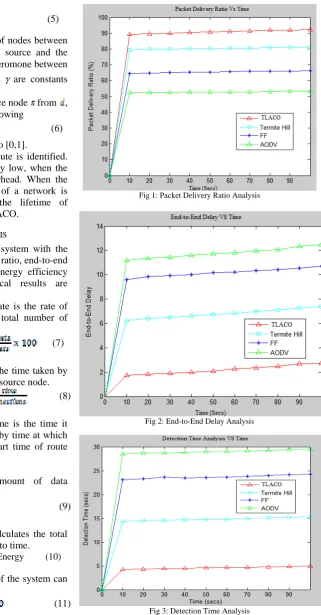
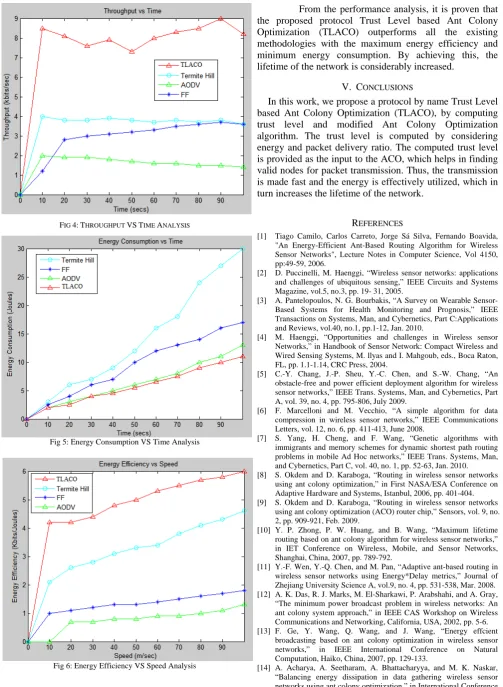
In this work, we compare our system with the existing system in terms of packet delivery ratio, end-to-end delay, path detection time, throughput, energy efficiency and energy consumption. The graphical results are presented from fig 1-6.
1. Packet delivery rate: Packet delivery rate is the rate of packets sent to the destination with the total number of packets.
(7)
2. End-to-end delay: End-to-end delay is the time taken by the packet to reach its destination from the source node.
(8)
3. Detection Time Analysis: Detection time is the time it takes to find an optimal path and is given by time at which the route is found subtracted from the start time of route discovery.
4. Throughput: Throughput is the amount of data transferred per unit of time.
(9)
5. Energy consumption VS time: This calculates the total energy consumed by the node with respect to time.
Energy consumption=Present Energy-Initial Energy (10)
6. Energy Efficiency: Energy efficiency of the system can be calculated by
(11)
Fig 1: Packet Delivery Ratio Analysis
Fig 2: End-to-End Delay Analysis
FIG 4:THROUGHPUT VSTIME ANALYSIS
Fig 5: Energy Consumption VS Time Analysis
From the performance analysis, it is proven that the proposed protocol Trust Level based Ant Colony Optimization (TLACO) outperforms all the existing methodologies with the maximum energy efficiency and minimum energy consumption. By achieving this, the lifetime of the network is considerably increased.
V. CONCLUSIONS
In this work, we propose a protocol by name Trust Level based Ant Colony Optimization (TLACO), by computing trust level and modified Ant Colony Optimization algorithm. The trust level is computed by considering energy and packet delivery ratio. The computed trust level is provided as the input to the ACO, which helps in finding valid nodes for packet transmission. Thus, the transmission is made fast and the energy is effectively utilized, which in turn increases the lifetime of the network.
REFERENCES
[1] Tiago Camilo, Carlos Carreto, Jorge Sá Silva, Fernando Boavida, "An Energy-Efficient Ant-Based Routing Algorithm for Wireless Sensor Networks", Lecture Notes in Computer Science, Vol 4150, pp:49-59, 2006.
[2] D. Puccinelli, M. Haenggi, “Wireless sensor networks: applications and challenges of ubiquitous sensing,” IEEE Circuits and Systems Magazine, vol.5, no.3, pp. 19- 31, 2005.
[3] A. Pantelopoulos, N. G. Bourbakis, “A Survey on Wearable Sensor-Based Systems for Health Monitoring and Prognosis,” IEEE Transactions on Systems, Man, and Cybernetics, Part C:Applications and Reviews, vol.40, no.1, pp.1-12, Jan. 2010.
[4] M. Haenggi, “Opportunities and challenges in Wireless sensor Networks,” in Handbook of Sensor Network: Compact Wireless and Wired Sensing Systems, M. llyas and I. Mahgoub, eds., Boca Raton, FL, pp. 1.1-1.14, CRC Press, 2004.
[5] C.-Y. Chang, J.-P. Sheu, Y.-C. Chen, and S.-W. Chang, “An obstacle-free and power efficient deployment algorithm for wireless sensor networks,” IEEE Trans. Systems, Man, and Cybernetics, Part A, vol. 39, no. 4, pp. 795-806, July 2009.
[6] F. Marcelloni and M. Vecchio, “A simple algorithm for data compression in wireless sensor networks,” IEEE Communications Letters, vol. 12, no. 6, pp. 411-413, June 2008.
[7] S. Yang, H. Cheng, and F. Wang, “Genetic algorithms with immigrants and memory schemes for dynamic shortest path routing problems in mobile Ad Hoc networks,” IEEE Trans. Systems, Man, and Cybernetics, Part C, vol. 40, no. 1, pp. 52-63, Jan. 2010. [8] S. Okdem and D. Karaboga, “Routing in wireless sensor networks
using ant colony optimization,” in First NASA/ESA Conference on Adaptive Hardware and Systems, Istanbul, 2006, pp. 401-404. [9] S. Okdem and D. Karaboga, “Routing in wireless sensor networks
using ant colony optimization (ACO) router chip,” Sensors, vol. 9, no. 2, pp. 909-921, Feb. 2009.
[10] Y. P. Zhong, P. W. Huang, and B. Wang, “Maximum lifetime routing based on ant colony algorithm for wireless sensor networks,” in IET Conference on Wireless, Mobile, and Sensor Networks, Shanghai, China, 2007, pp. 789-792.
[11] Y.-F. Wen, Y.-Q. Chen, and M. Pan, “Adaptive ant-based routing in wireless sensor networks using Energy*Delay metrics,” Journal of Zhejiang University Science A, vol.9, no. 4, pp. 531-538, Mar. 2008. [12] A. K. Das, R. J. Marks, M. El-Sharkawi, P. Arabshahi, and A. Gray,
on Distributed Computing and Networking, Hyderabad, India, 2009, pp. 437-443.
[15] Y. Liang, J. Cao, L. Zhang, R. Wang, and Q. Pan, “A biologically inspired sensor wakeup control method for wireless sensor networks,” IEEE Trans. Systems, Man, and Cybernetics, Part C, vol. 40, no. 5, pp. 525-538, Sept. 2010.
[16] R. Tharmarasa, T. Kirubarajan, and M. L. Hernandez, “Large-scale optimal sensor array management for multi-target tracking,” IEEE Trans. Systems, Man, and Cybernetics, Part C, vol. 37, no. 5, pp. 803-814, Sept. 2007.
[17] R. Tharmarasa, T. Kirubarajan, P. Jiming, and T. Lang, “Optimization-based dynamic sensor management for distributed multitarget tracking,” IEEE Trans. Systems, Man, and Cybernetics, Part C, vol. 39, no. 5, pp. 534-546, Sept. 2009.
[18] C. T. Vu, “Distributed energy-efficient solutions for area coverage problems in wireless sensor networks,” Ph.D. dissertation, Georgia State University, 2009.
[19] B. Wang, H. B. Lim, and D. Ma, “A coverage-aware clustering protocol for wireless sensor networks,” Computer Networks, vol. 56, no. 5, pp. 1599–1611, 2012.
[20] Z. Liu, Q. Zheng, L. Xue, and X. Guan, “A distributed energy efficient clustering algorithm with improved coverage in wireless sensor networks,” Future Generation Computer Systems, vol. 28, no. 5, pp. 780–790, 2012.
[21] L. Zhang, Q. Zhu, and J. Wang, “Adaptive clustering for maximizing network lifetime and maintaining coverage,” Journal of Networks, vol. 8, no. 3, pp. 616–622, 2013.
[22] Dorigo, M., Stützle, T., “Ant Colony Optimization”, ISBN 0262042193, MIT Press, 2004.
[23] Tiago Camilo, Carlos Carreto, Jorge Sá Silva, Fernando Boavida, "An Energy-Efficient Ant-Based Routing Algorithm for Wireless
Sensor Networks", Lecture Notes in Computer Science, Vol 4150, pp:49-59, 2006.
[24] Amandeep Singh, Sunny Behal, "ANT COLONY OPTIMIZATION FOR IMPROVING NETWORK LIFETIME IN WIRELESS SENSOR NETWORKS", International Journal of Engineering Sciences, Vol.8, pp:1-12,2013.
[25] Lin, Y., Zhang, J., Chung, H.S-H., Ip, W.H., Li, Y., and Shi, Y-H, "An ant colony optimization approach for maximizing the lifetime of heterogeneous wireless sensor networks", IEEE Transactions on Systems, Man, and Cybernetics, Vol 42, pp:408-420, 2011.
[26] Anjali & Navpreet Kaur, "Routing Based Ant Colony Optimization in Wireless Sensor Networks", Global Journal of Computer Science and Technology Network, Web & Security, Vol.13, pp.35-40, 2013. [27] K.Saleem, N.Fisal, S.Hafizah, S.Kamilah and Rozeha A. RAshid,
"Ant based Self-organized Routing Protocol for Wireless Sensor Networks", International Journal of Communication Networks and Information Security, Vol.1, pp:42-46, 2009.
[28] Nuria G´omez Blas, Luis Fernando de Mingo L´opez, Alberto Arteta Albert, "Simulation Tools in Wireless Sensor Networks: Ant Colony Optimization of a Local Routing Algorithm", INTERNATIONAL JOURNAL OF COMPUTERS AND COMMUNICATIONS, Vol.6, pp:149-156, 2012.
[29] Sandra Sendra, Jaime Lloret, Miguel García and José F. Toledo, "Power saving and energy optimization techniques for Wireless Sensor Networks", JOURNAL OF COMMUNICATIONS, VOL. 6, pp:439-458, 2011.