Available online: https://edupediapublications.org/journals/index.php/IJR/ P a g e | 1657
Bit Error Rate Analysis of Coded OFDM for Digital Audio Broadcasting
System, Employing Parallel Concatenated Convolution Turbo Codes
PATTI RAJESH
1,
Mr. P.ASWANI KUMAR, k Govinda Rajulu
1
M-Tech(DECS), Department of Electronics & Communication Engineering, Eluru
College of Engineering & Technology, Eluru, AP, India
2
Assistant professor, Department of Electronics & Communication Engineering,
Eluru College of Engineering & Technology, Eluru, AP, India
Hod,Associate professorDepartment of Electronics & Communication Engineering,
Eluru College of Engineering & Technology, Eluru, AP, India
Abstract:
Bit Error Rate (BER), for Digital Audio
Broadcasting (DAB) system, employing
Coded OFDM with different channel coding
schemes. Analysis is carried out for
convolution coded and turbo coded data in
an Additive White Gaussian Channel
(AWGN) based on different constraint
lengths and code generator polynomials
used for coding. A comparative study on the
computational complexity is also done by
applying an audio signal and measuring the
data processing time per frame, on
computers with different processor speeds. It
is
shown
that
a
coding
gain
of
approximately 6 dB is achieved using turbo
coding when compared to convolution
coding, at a cost of higher computational
complexity.
Keywords:
DAB; OFDM; Convolution
Codes; Turbo Codes.
1. INTRODUCTION:
The
requirement
of
mobility
while
connected to network is fueling the growth
of
wireless
communication.
The
conventional analog transmission techniques
do not perform well in mobile environment,
since suitable techniques to mitigate the
effects of multipath propagation induced
fading have not been developed for these
systems. Orthogonal Frequency Division
Multiplexing (OFDM) is one such technique
to combat the effect of multipath fading,
frequency selective fading and Inter symbol
Interference (ISI). OFDM decreases the
amount of hardware implementation since
multiplexing and filtering operations can be
performed by employing the Fast Fourier
Transform (FFT). This eliminates the need
to have multiple oscillators at the transmitter
and synchronizing loops at the receiver. Due
to the cyclic extension of signal period into a
guard interval, OFDM system is suitable for
Single Frequency Networks (SFN).
Available online: https://edupediapublications.org/journals/index.php/IJR/ P a g e | 1658
Digital Audio Broadcasting system using
Coded OFDM is implemented and studied
over an AWGN channel. Bit-Error-Rate
(BER) is measured and compared by
employing error correcting codes like,
Convolution
Code
and
Parallel
Concatenated Convolution Turbo Code. A
good BER for audio is considered to be
10-4. Using turbo coding, it is nearly achieved
with an Eb/No of 3 dB. A coding gain of
nearly 6 dB is achieved using turbo coding,
when cThe channel selected only introduces
Gaussian noise. But problems faced by
fading and multipath can be analyzed by
choosing other channel models. Instead of
QPSK modulation scheme, the same system
can be analyzed using other modulation
techniques like DQPSK and QAM. Instead
of parallel concatenated convolution turbo
codes, serial concatenated convolution turbo
code also can be implemented and analyzed
.ompared to convolution coding, at a cost of
high computational complexity.
3. PROPOSED SCHEME:
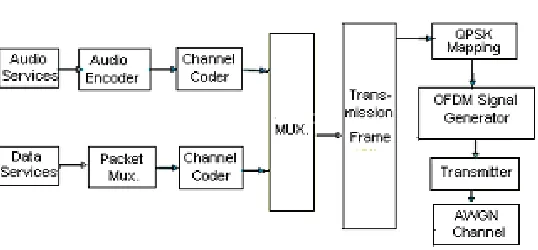
Figure 1 . DAB transmitter – Block Diagram.
OFDM
Conceptually, OFDM is a specialized FDM, the
additional constraint being: all the carrier signals
are orthogonal to each other.
In OFDM, the sub-carrier frequencies are chosen
so that the sub-carriers are orthogonal to each
other, meaning that cross-talk between the
sub-channels is eliminated and inter-carrier guard
bands are not required. This greatly simplifies
the design of both the transmitter and the
receiver; unlike conventional FDM, a separate
filter for each sub-channel is not required.
The orthogonality requires that the sub-carrier
spacing is Hertz, where TUseconds is
the useful symbol duration (the receiver side
window size), and k is a positive integer,
typically equal to 1. Therefore, with N
sub-carriers, the total passband bandwidth will be B
≈ N·Δf (Hz).
The orthogonality also allows high spectral
efficiency, with a total symbol rate near the
Nyquist rate for the equivalent baseband signal
double-Available online: https://edupediapublications.org/journals/index.php/IJR/ P a g e | 1659 side band physical passband signal). Almost the
whole available frequency band can be utilized.
OFDM generally has a nearly 'white' spectrum,
giving it benign electromagnetic interference
properties with respect to other co-channel users.
A simple example: A useful symbol duration TU
= 1 ms would require a sub-carrier spacing of
(or an integer multiple of
that) for orthogonality. N = 1,000 sub-carriers
would result in a total passband bandwidth of
NΔf = 1 MHz. For this symbol time, the required
bandwidth in theory according to Nyquist is
N/2TU = 0.5 MHz (i.e., half of the achieved
bandwidth required by our scheme). If a guard
interval is applied (see below), Nyquist
bandwidth requirement would be even lower.
The FFT would result in N = 1,000 samples per
symbol. If no guard interval was applied, this
would result in a base band complex valued
signal with a sample rate of 1 MHz, which
would require a baseband bandwidth of 0.5 MHz
according to Nyquist. However, the passband
RF signal is produced by multiplying the
baseband signal with a carrier waveform (i.e.,
double-sideband quadrature
amplitude-modulation) resulting in a passband bandwidth
of 1 MHz. A single-side band (SSB) or vestigial
sideband (VSB) modulation scheme would
achieve almost half that bandwidth for the same
symbol rate (i.e., twice as high spectral
efficiency for the same symbol alphabet length).
It is however more sensitive to multipath
interference.
OFDM requires very accurate frequency
synchronization between the receiver and the
transmitter; with frequency deviation the
sub-carriers will no longer be orthogonal, causing
inter-carrier interference (ICI) (i.e., cross-talk
between the sub-carriers). Frequency offsets are
typically caused by mismatched transmitter and
receiver oscillators, or by Doppler shift due to
movement. While Doppler shift alone may be
compensated for by the receiver, the situation is
worsened when combined with multipath, as
reflections will appear at various frequency
offsets, which is much harder to correct. This
effect typically worsens as speed increases,[2]
and is an important factor limiting the use of
OFDM in high-speed vehicles. In order to
mitigate ICI in such scenarios, one can shape
each sub-carrier in order to minimize the
interference resulting in a non-orthogonal
subcarriers overlapping.[3] For example, a
low-complexity scheme referred to as WCP-OFDM
(Weighted Cyclic Prefix Orthogonal
Frequency-Division Multiplexing) consists in using short
filters at the transmitter output in order to
perform a potentially non-rectangular pulse
shaping and a near perfect reconstruction using a
single-tap per subcarrier equalization.[4] Other
ICI suppression techniques usually increase
drastically the receiver complexity.[5]
OFDM extended with multiple access
OFDM in its primary form is considered as a
multi-Available online: https://edupediapublications.org/journals/index.php/IJR/ P a g e | 1660 user channel access method, since it is utilized
for transferring one bit stream over one
communication channel using one sequence of
OFDM symbols. However, OFDM can be
combined with multiple access using time,
frequency or coding separation of the users.
In orthogonal frequency-division multiple access
(OFDMA), frequency-division multiple access is
achieved by assigning different OFDM
sub-channels to different users. OFDMA supports
differentiated quality of service by assigning
different number of sub-carriers to different
users in a similar fashion as in CDMA, and thus
complex packet scheduling or Media Access
Control schemes can be avoided. OFDMA is
used in:
the mobility mode of the IEEE 802.16
Wireless MAN standard, commonly
referred to as WiMAX,
the IEEE 802.20 mobile Wireless MAN
standard, commonly referred to as
MBWA,
the3GPP Long Term Evolution (LTE)
fourth generation mobile broadband
standard downlink. The radio interface
was formerly named High Speed OFDM
Packet Access (HSOPA), now named
Evolved UMTS Terrestrial Radio
Access (E-UTRA).
the now defunct Qualcomm/3GPP2Ultra
Mobile Broadband (UMB) project,
intended as a successor of CDMA2000,
but replaced by LTE.
OFDMA is also a candidate access method for
the IEEE 802.22Wireless Regional Area
Networks (WRAN). The project aims at
designing the first cognitive radio based
standard operating in the VHF-low UHF
spectrum (TV spectrum).
In Multi-carrier code division multiple access
(MC-CDMA), also known as OFDM-CDMA,
OFDM is combined with CDMA spread
spectrum communication for coding separation
of the users. Co-channel interference can be
mitigated, meaning that manual fixed channel
allocation (FCA) frequency planning is
simplified, or complex dynamic channel
allocation (DCA) schemes are avoided.
Idealized system model
This section describes a simple idealized OFDM
system model suitable for a time-invariant
AWGN channel.
Available online: https://edupediapublications.org/journals/index.php/IJR/ P a g e | 1661
An OFDM carrier signal is the sum of a number
of orthogonal sub-carriers, with baseband data
on each sub-carrier being independently
modulated commonly using some type of
quadrature amplitude modulation (QAM) or
phase-shift keying (PSK). This composite
baseband signal is typically used to modulate a
main RF carrier.
is a serial stream of binary digits. By inverse
multiplexing, these are first demultiplexed into
parallel streams, and each one mapped to a
(possibly complex) symbol stream using some
modulation constellation (QAM, PSK, etc.).
Note that the constellations may be different, so
some streams may carry a higher bit-rate than
others.
An inverse FFT is computed on each set of
symbols, giving a set of complex time-domain
samples. These samples are then
quadrature-mixed to passband in the standard way. The real
and imaginary components are first converted to
the analogue domain using digital-to-analogue
converters (DACs); the analogue signals are
then used to modulate cosine and sine waves at
the carrier frequency, , respectively. These
signals are then summed to give the transmission
signal, .
Receiver
The receiver picks up the signal , which is
then quadrature-mixed down to baseband using
cosine and sine waves at the carrier frequency.
This also creates signals centered on , so
low-pass filters are used to reject these. The
Available online: https://edupediapublications.org/journals/index.php/IJR/ P a g e | 1662 using analog-to-digital converters (ADCs), and a
forward FFT is used to convert back to the
frequency domain.
This returns parallel streams, each of which is
converted to a binary stream using an
appropriate symbol detector. These streams are
then re-combined into a serial stream, ,
which is an estimate of the original binary
stream at the transmitter.
Usage
OFDM is used in Digital Audio Broadcasting
(DAB), Digital television DVB-T/T2
(terrestrial), DVB-H (handheld), DMB-T/H,
DVB-C2 (cable), Wireless LAN IEEE 802.11a,
ADSL (G.dmt/ITU G.992.1), Mobile phone 4G.
DOA
In signal processing literature, direction of
arrival denotes the direction from which usually
a propagating wave arrives at a point, where
usually a set of sensors are located. These set of
sensors forms what is called a sensor array.
Often there is the associated technique
of beamforming which is estimating the signal
from a given direction. Various engineering
problems addressed in the associated literature
are:
Find the direction relative to the array where
the sound source is located.
Direction of different sound sources around
you are also located by you using a process
similar to those used by the algorithms in
the literature.
Radio telescopes use these techniques to
look at a certain location in the sky.
Recently beamforming has also been used
in RF applications such
as wireless communication. Compared with
the spatial diversity techniques,
beamforming is preferred in terms of
complexity. On the other hand beamforming
in general has much lower data rates. In
multiple access channels
(CDMA, FDMA, TDMA), beamforming is
necessary and sufficient.
Various techniques for calculating the
direction of arrival, such as Angle of
Arrival (AoA), Time Difference of Arrival
(TDOA), Frequency Difference of Arrival
(FDOA), or other similar associated
techniques.
Available online: https://edupediapublications.org/journals/index.php/IJR/ P a g e | 1663
Available online: https://edupediapublications.org/journals/index.php/IJR/ P a g e | 1664
5. CONCLUSION:
The channel selected only introduces
Gaussian noise. But problems faced by
fading and multipath can be analyzed by
choosing other channel models. Instead of
QPSK modulation scheme, the same system
can be analyzed using other modulation
techniques like DQPSK and QAM. Instead
of parallel concatenated convolution turbo
codes, serial concatenated convolution turbo
code also can be implemented and analyzed.
REFERENCES:
[1] Wolfgang Hoeg, Thomas Lauterbach,
“Digital Audio Broadcasting-Principles and Applications of Digital Radio”, John Wiley &
Sons, Ltd. England, 2003.
[2] Henrik Schulze, Christian Luders, “Theory
and Applications of OFDM and CDMA”, John
Wiley & Sons, Ltd. England, 2005.
[3] Simon Haykin, “Communication Systems”,
4th Edition, John Wiley & Sons, Inc. England,
2001.
[4] BernadSklar, “Digital Communications– Fundamentals and Applications”, 2nd Edition
Pearson Education (Singapore) Pte.Ltd., 2001.
[5] Zimmerman G., Rosenberg M. and Dostert
S., “Theoretical Bit Error Rate for Uncoded and
Coded Data Transmission in Digital Audio
Broadcasting”, Proc. IEEE International
Conference on Communications, Vol. 1, pp.
297-301, June 1996.
[6] Thomas May and Hermann Rohling, “Turbo
Decoding of Convolutional Codes in
Differentially Modulated OFDM Transmission
System”, Proc. IEEE 49th Vehicular Technology
Conference, Vol. 3, pp-1891-1895, July 1999.
[7] Hanjong Kim, “Turbo Coded Orthogonal
Frequency Division Multiplexing for Digital
Audio Broadcasting”, Proc. IEEE International
Conference on Communications, Vol. 1, pp.
420-424, 2000.
[8] A. Burr, “Turbo-Codes: The Ultimate Error
Control Codes?”, Electronics & Communication
Engineering Journal, Vol. 13, pp. 155-165,
August 2001.
[9] R. Maerkle and C-E. W. Sudenberg, “Turbo
Codes for Hybrid In Band On Channel Digital
Audio Broadcasting”, Porc. IEEE Global
Telecommunication Conference, Vol. 2, pp.
941-945, 2001.
[10] Yan Li, Sumei Sun, “Design of
Bit-Interleaved TurboCoded Modulation in
OFDM-Based Wireless LAN Systems”, Proc. 4th
International Workshop on Mobile and Wireless
Communications Network, pp. 549-553, 2002.
[11] Lukas M. Gaetzi and M. O. J. Hawkaford,
“Performance Prediction of DAB Modulation and Transmission Using Matlab Modeling”,
Available online: https://edupediapublications.org/journals/index.php/IJR/ P a g e | 1665 Consumer Electronics”, pp. 272-277, September
2004.
[12] Hector Uhalte Bilbao, “Digital
Transmission System Simulation”, Linkoping
Institute of Technology, Master Thesis August
2004.
[13] SeongChul Cho, Jin Up Kim, Kyu Tae Lee
and KyoungRok Cho, “Convolutional Turbo
Coded OFDM/TDD Mobile Communication
System for High Speed Multimedia Services”,
Proc. Advanced Industrial Conference on
Telecommunications, pp. 244-248, July 2005.
[14] Ibrahim S. Raad and Mehmet Yakan,
“Implementation of A Turbo Codes Test Bed in the Simulink Environment”, Proc. of the Eighth
International Symposium on Signal Processing
and its Applications, Vol. 2, pp. 847-850,
August 2005.
[15] Jorge Ortin, Paloma Garcia., Fernando
Gutierrez and Antonio Valdovinos,
“Performance Analysis of Turbo Deoding Algorithms in Wireless OFDM Systems”, IEEE
Transactions on Consumer Electronics, Vol. 55
pp. 1149- 1154, 2009.
[16] Mohammadnia-Avval M., ChrisSnow C
and Lutz Lampe, “Error-Rate Analysis for
Bit-Loaded Coded MIMOOFDM”, IEEE
Transactions on Vehicular Technology, Vol. 59,
pp. 2340-2351, 2010.
[17] ArunAgarwal and S. K. Patra,
“Performance Prediction of OFDM Based
Digital Audio Broadcasting System Using
Channel Protection Mechanisms” Proc. 3rd
International Conference on Electronics
Computer Technology (ICECT), pp. 57-61,