General Constructions of Rational Secret Sharing with
Expected Constant-Round Reconstruction
Akinori Kawachi The University of Tokushima [email protected]
Yoshio Okamoto
The University of Electro-Communications [email protected]
Keisuke Tanaka
Tokyo Institute of Technology [email protected]
Kenji Yasunaga Kanazawa University [email protected]
April 27, 2015
Abstract
We present a general construction of a rational secret-sharing protocol that converts any rational secret-sharing protocol to a protocol with an expected constant-round reconstruction. Our construction can be applied to protocols for synchronous channels, and preserves a strict Nash equilibrium of the original protocol. Combining with an existing protocol, we obtain the first expected constant-round protocol that achieves a strict Nash equilibrium with the optimal coalition resilience⌈n2⌉ −1, wherenis the number of players.
Our construction can be extended to a construction that preserves the immunity to unex-pectedly behaving players. Then, for any constantm≥1, we obtain an expected constant-round protocol that achieves a Nash equilibrium with the optimal coalition resilience⌈n2⌉ −m−1 in the presence ofmunexpectedly behaving players. The same protocol also achieves a strict Nash equilibrium with coalition resilience 1. We show that our protocol with immunity achieves the optimal coalition resilience among constant-round protocols with immunity with respect to both Nash and strict Nash equilibria.
1
Introduction
Much attention has been paid to the interplay between game theory and cryptography. (For surveys, see [12, 20, 5,10, 15].) One important research problem is to design cryptographic protocols for rational players in a game-theoretic sense. Traditionally, most cryptographic protocols have been designed for participants who are either honest or malicious. There is, however, no guarantee for non-malicious players to behave honestly in real-life situations. It is desirable that cryptographic protocols work for rational players.
strategies [11]. Since their work, rational secret-sharing protocols have been studied with various solution concepts, communication channels, and characteristics of players [9,1,17,13, 14,21,19,
2,7,22] together with several impossibility results [11,14,2].
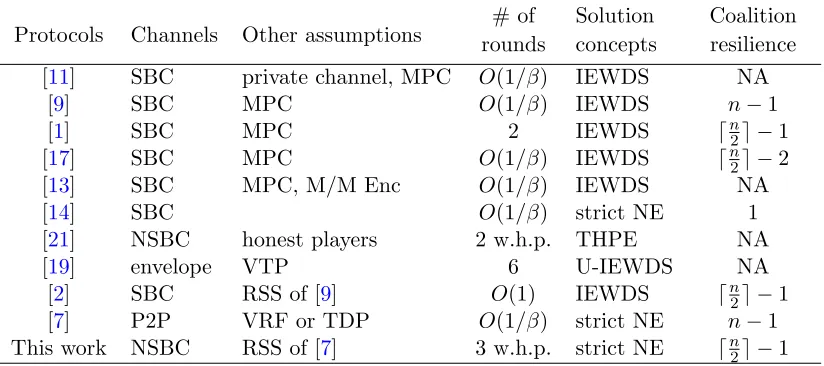
Some previous protocols on rational secret sharing [11,9,1,17,13,14,7] are essentially based on the same underlying idea: The protocol consists of real rounds and fake rounds. Players can learn the secret only in real rounds and cannot learn any information in fake rounds. Since the probability of being a real round is sufficiently small and the protocol halts if some player was silent in fake rounds, the best action players can take is to reveal their shares in every round. As long as relying on this general idea, it seems difficult to construct (expected) constant-round protocols since the players must perform in fake rounds to learn the secret. Indeed, the round complexity of the protocols in [11,9, 13, 14, 7] is O(1/β), where β is a sufficiently small value depending on the payoff values. Since Shamir’s original secret-sharing scheme [25] takes only one round to learn the secret, it is desirable that the round complexity be an expected small constant. Among the previous work, only the protocols in [1,21,19,2] achieve expected constant-round reconstruction. (See Table1 for the comparison with the existing protocols).
In reconstructing the secret, several rational secret-sharing protocols [11,9,1,17,13] require the involvement of the dealer or, to eliminate the on-line dealer, using general multi-party computation. Also, many rational secret-sharing protocols [11,9,1,17,13,14,2] require a simultaneous broadcast channel, which is a relatively strong assumption of the communication channel. Thus, it is desirable to design constant-round rational secret-sharing protocols with low computational cost without the on-line dealer or simultaneous channels.
1.1 Our Results
We present a general construction of a rational secret-sharing protocol. Our construction employs an existing rational secret-sharing protocol as a sub-protocol in a black-box manner. In the protocol obtained by our construction, players can reconstruct the secret in expected three rounds. The communication channel we assume is a synchronous broadcast channel, which is used in [13,14,2,7] and strictly weaker than a simultaneous broadcast channel, which is broadly used in previous work [11, 9, 1, 17, 13, 14, 2]. Our construction works well in both of information-theoretic and computational settings.
Strong solution concepts. For any 3 ≤ t ≤ n, our construction yields a t-out-of-n secret-sharing protocol that achieves a strict Nash equilibrium if so is the sub-protocol. A strict Nash equilibrium, of which an information-theoretic version was introduced in [14] and a computational version was in [7], is a preferable solution concept in rational secret sharing. A lot of rational secret-sharing protocols achieve a concept of Nash equilibrium that survives iterated deletions of weakly dominated strategies [11,1,17,9,2]. However, Kol and Naor [14] showed that this concept is not enough for distinguishing good protocols from bad protocols, and suggested strict Nash equilibrium as a stronger solution concept. While a Nash equilibrium only guarantees that deviations do not increase the payoff, a strict Nash equilibrium guarantees that any deviation strictly decreases the payoff.
Table 1: Comparison with the Existing Rational Secret Sharing Protocols.
# of Solution Coalition Protocols Channels Other assumptions rounds concepts resilience
[11] SBC private channel, MPC O(1/β) IEWDS NA
[9] SBC MPC O(1/β) IEWDS n−1
[1] SBC MPC 2 IEWDS ⌈n2⌉ −1
[17] SBC MPC O(1/β) IEWDS ⌈n2⌉ −2
[13] SBC MPC, M/M Enc O(1/β) IEWDS NA
[14] SBC O(1/β) strict NE 1
[21] NSBC honest players 2 w.h.p. THPE NA
[19] envelope VTP 6 U-IEWDS NA
[2] SBC RSS of [9] O(1) IEWDS ⌈n2⌉ −1
[7] P2P VRF or TDP O(1/β) strict NE n−1
This work NSBC RSS of [7] 3 w.h.p. strict NE ⌈n2⌉ −1
In the table, β is a sufficiently small constant that depends on the players’ payoffs, and the actual value of β may differ in each protocol. The following abbreviations are used. SBC: simultaneous broadcast channel. NSBC: non-simultaneous broad-cast channel. MPC: multiparty computation. M/M Enc: meaningful/meaningless encryption. VTP: verifiable trusted party. VRF: verifiable random functions. TDP: trapdoor permutations. IEWDS: NE that survives iterated elimination of weakly dominated strategies. U-IEWDS: strategy that uniquely survives iterated elimina-tion of weakly dominated strategies. THPE: trembling-hand perfect equilibrium.
players might follow any strategy other than the prescribed one with small probability, there is no better strategy for the player than the prescribed one. Our implication shows that a strict Nash equilibrium is a relatively strong solution concept that captures the stability against any small deviations of players.
Optimal coalition resilience. Since a plain Nash equilibrium only guarantees the stability against deviations by a single player, acoalition-resilient Nash equilibrium, in which multiple players may deviate, is studied [1,13, 2, 7]. Informally, a (strict) Nash equilibrium is called r-resilient if it is a (strict) Nash equilibrium even if deviations by a coalition of r players are considered. Our construction preserves the coalition resilience of the underlying sub-protocol. In our construction, if the sub-protocol achieves anr-resilient strict Nash equilibrium for anyr≤ ⌈2t⌉−1, then the resulting protocol also achieves an r-resilient strict Nash equilibrium. The resilience ⌈t2⌉ −1 is optimal for constant-round t-out-of-n protocols. The optimality can be shown by a similar argument to that of Asharov and Lindell [2] who showed that the resilience ⌈n2⌉ −1 is optimal for constant-round n-out-of-nprotocols.
achieves a strict Nash equilibrium in non-simultaneous channels.
Immunity to unexpectedly behaving players. Furthermore, we also provide a general con-struction that preserves the immunity to “unexpectedly behaving” (or malicious) players. Infor-mally, a protocol is calledm-immune if no unexpected behavior ofm players affects the payoffs of the other players. The immunity has been studied in [1,17], and guarantees certain robustness of protocols. In particular, the immunity is a desirable property for protocols conducted by “rational” players since such protocols rely on the rationality of players, but it seems difficult to understand the rationality of every player precisely. When a protocol does not have any immunity, the protocol may not work well at all even if only a single player behaves unexpectedly. Indeed, several existing protocols including our protocol described above do not work in the presence of such a player.
For any constantm, we give anon-constantround protocol that achieves an (n−m−1)-resilient Nash equilibrium with m-immunity. The protocol is a variant of the protocol of [7]. By applying our general construction to this protocol, we obtain a constant-round protocol that achieves an (⌈n2⌉ −m−1)-resilient Nash equilibrium with m-immunity. The same protocol also achieves a 1-resilient strict Nash equilibrium. Our general construction with immunity requires symmetric-key encryption and pseudorandom functions, and thus fits the computational setting.
We also discuss the optimality of our protocols with immunity regarding the coalition resilience. We show that constant-round protocols with m-immunity cannot achieve an (⌈n2⌉ −m)-resilient Nash equilibrium, and protocols with immunity cannot achieve a 2-resilient strict Nash equilibrium. Thus, our protocol with immunity achieves an optimal coalition resilience with respect to both Nash and strict Nash equilibrium.
Other interesting features. In the protocols obtained by our construction, the players can learn the secret without using the shares of the sub-protocol with high probability. As far as we know, this property is novel among rational secret-sharing protocols. In this sense, our protocol is not obtained by a simple combination of the protocols of [2] and [7]. Because of this property, even if the reconstruction of the sub-protocol needs heavy computation, our construction converts such a protocol to a protocol with efficient reconstruction. In the resulting protocol, the shares of the sub-protocol are used as a “hedge” against the failure in the previous rounds. We believe that this idea of our construction could be applied to other rational cryptographic protocols.
Additionally, our construction can employ any protocol achieving a strict Nash equilibrium in a black-box manner, while the existing protocols [1,2] that need sub-protocols require a certain type of protocols as a sub-protocol.
1.2 Our Approach
We describe the idea of our general construction. The dealer chooses conventional secret-sharing schemes S1 and S2, and a rational secret-sharing protocol S3. The secret is shared by S1 and S3,
but with small probability, the secret for S1 is fake. The information on whether the secret of
S1 is real or fake is shared by S2. In the reconstruction, first, players are requested to reveal the
shares of S1, and then proceed to the next round only ifall the players have honestly revealed the
shares. In the first round, all the players have an incentive to reveal their shares. Let t1 be the
threshold of the secret sharing schemeS1. Then, thet1-th sender in this round can reconstruct the
and if she did not reveal, the protocol halts along with the possibility that the secret is fake. The small probability that the secret is fake poses a “threat” to players so as to reveal their shares in the first round. In the second round, all the players are requested to reveal the shares of S2, and
then proceed to the next round only if all the players have honestly revealed the shares and the reconstructed secret is fake. Let t2 be the threshold of the secret sharing scheme S2. Then, the
t2-th sender in this round will learn whether the secret is real or fake by using her own share. If the
secret is fake, she reveals her share since if not, the protocol does not proceed to the next round and she cannot learn the secret. If the secret is real, then she has no incentive to participate in the protocol, and thus she may not reveal her share, but this action signals to the other players that the secret is real. Therefore, every player can recognize that the reconstructed secret in the previous round is real. If no player deviates in the first two rounds and the reconstructed secret is fake, all the players are guaranteed to learn the secret eventually byS3. The idea of using the secret
sharingS2 as the signal indicating whether a reconstructed secret ofS1 is real or fake is similar to
the idea used in [7] for achieving a strict Nash equilibrium for non-simultaneous channels.
As in [7], our protocol assumes that players have no auxiliary information about the secret. Although this assumption may be inevitable for constructing fair protocols in the non-simultaneous channels [2], we believe that there are settings in which this assumption is valid and that studying this case could lead to the understanding of rational cryptographic protocols. If simultaneous channels are assumed, our protocol works without this assumption.
1.3 Related Work
Constant-round reconstruction for rational secret sharing was achieved by Abraham, Dolev, Gonen, and Halpern [1], Micali and shelat [19], Ong, Parkes, Rosen, and Vadhan [21], and Asharov and Lindell [2]. The protocols in [1,2] achieve a Nash equilibrium with a coalition resilience of⌈n2⌉ −1, and need a certain type of rational secret-sharing protocol such as [9,1,13,14,7] as a sub-protocol. However, their protocols assume a simultaneous broadcast channel and need to perform the sub-protocol to reconstruct the secret several times. The sub-protocol of [19] achieves a strong solution concept. However, their protocol requires a stronger communication channel than the others. The protocol of [21] is quite efficient with respect to both round complexity and computational cost with a weaker communication channel. However, a sufficient number of honest players are assumed to exist. Regarding the solution concept, the protocol in [21] does not satisfy a strict Nash equilibrium. A black-box construction in the literature of rational cryptography has appeared in the study on a novel framework calledrational protocol design [8], where designing protocols itself is modeled as a game between a protocol designer and an attacker. While Garay et al. [8] show general composition theorems in their framework, as far as we know, black-box constructions have not appeared in the literature of rational secret sharing.
1.4 Paper Organization
2
Rational Secret Sharing
2.1 Secret-Sharing Scheme
At-out-of-nsecret-sharing scheme consists of two phases: the sharing phase and the reconstruction phase. In the sharing phase, the dealer holds the secret and distributes shares of the secret to n parties called players. In the reconstruction phase, the players reconstruct the secret from their shares. We consider the two requirements, correctness and secrecy. The correctness guarantees that every subset of t∗ ≥ t players can reconstruct the secret if they perform the reconstruction phase honestly. The secrecy guarantees that no subset oft∗< tplayers can learn the secret beyond what can be learned from the publicly available information.
2.2 Secret-Sharing Reconstruction Game
We assume that the players are rational. In secret-sharing schemes, the reconstruction phase can be considered as a game for the players. Therefore, we see the reconstruction protocol as a pair of a game and a prescribed strategy for the game. The goal is to design a protocol that will result in the desired outcome: all the participants reconstruct the secret. We say a (rational) secret-sharing protocol Π is t-out-of-n if, in addition to the t-out-of-n property of secret sharing, the shares are distributed to nplayers, and the reconstruction protocol can be performed in the presence of t∗ ≥t players. We say that Π is a t-out-of-n secret-sharing “protocol” when we see it as rational secret-sharing, and that Π is at-out-of-nsecret-sharing “scheme” when we see it as a conventional secret-sharing scheme.
Following [7], we model a reconstruction game in a way such that a secretsis chosen uniformly at random from the domain of secrets, and every player finally outputs some value, which the player wants to be the same as the secrets. The advantages of modeling a game in this way are discussed in [7]. LetN ={1, . . . , n}be the set of players in the protocol. The outcome of the game is denoted byo= (o1, o2, ..., on), whereoi is a random variable that equals 1 if the output of playeriiss, and
0 otherwise. The payoff of each player is determined by the outcome of the game.
The tuple of strategies σ= (σ1, . . . , σn) is called a strategy profile for the game, where σi
corre-sponds to the strategy for playeri. LetCbe a subset ofN. We defineσC to be the tuple of strategies
σi fori ∈ C. Following the game-theoretic notation, we defineσ−i = (σ1, . . . , σi−1, σi+1, . . . , σn),
and σ−C = σN\C. For two strategy profiles σ and σ′ = (σ1′, . . . , σn′), we write (σi′, σ−i) =
(σ1, . . . , σi−1, σi′, σi+1, . . . , σn) for i∈ N, and write (σ′C, σ−C) as the strategy profile in which the
strategy of playeriisσi′ifi∈Candσiotherwise. If all actions specified in eachσican be computed
by a probabilistic polynomial-time Turing machine, the strategy profileσ is calledPPT. Letui(σ)
denote the expected payoff of player iwhen the players follow a strategy profileσ.
2.3 Game-Theoretic Notions
For a secret-sharing protocol Π, if the prescribed strategy σ of the reconstruction protocol Π achieves a game-theoretic concept, say A, in the reconstruction game, we say that Π induces A.
parameter of cryptographic primitives. We say a function ϵ : N → R is negligible if for every sufficiently largek,ϵ(k)< k−c for any constantc. A functionδ :N→ Ris called noticeable ifδ(·)
is not negligible.
Definition 1 (Computational Nash equilibrium). A PPT strategy profile σ is a computational Nash equilibrium if for anyi∈N and any PPT strategy σi′ for player i,ui(σi′, σ−i)≤ui(σ) +ϵ(k),
where ϵ(·) is a negligible function.
To define a strict Nash equilibrium, we use the notion of equivalent play, which was introduced in [7]. Letσ be a prescribed strategy profile andσ′ia strategy for playeri. Define the view of player iin the game to include the information given by the dealer to playeri, the random coin of playeri, and all the messages received from playerj̸=i, but not including any messages from playerj after player iwrites to her (write-once) output tape. We say the strategyσ′i yields equivalent play with respect to σ, denoted by σi′ ∈eq σ, if, given the views of all the players j ̸=i in which they follow σ−i and player i follows either σi orσ′i, no PPT machine can distinguish whether playeri follows
σi orσ′i. (See [7] for the detailed definition.) We writeσi′ ̸∈eqσ ifσi′ does not yield equivalent play
with respect toσ.
A strict Nash equilibrium guarantees that if some player deviates from the prescribed protocol, then the payoff of the player decreases by some noticeable amount.
Definition 2 (Computational strict Nash equilibrium). A PPT strategy profile σ is a compu-tational strict Nash equilibrium if (1) σ is a computational Nash equilibrium; and (2) for any i ∈ N and any PPT strategy σi′ for which σ′i ̸∈eq σ, there is a constant c > 0 such that ui(σ)≥ui(σi′, σ−i) +k−c for infinitely many k >0.
The above definitions consider deviations by a single player. We also consider deviations of a coalition of players. A coalition is a subset of the players N. We consider a coalition is a set of players who may be coordinated by some single party. Therefore, we assume that each coalition has one payoff function. LetC ⊂N be a coalition anduC(·) the payoff function of C.
Definition 3(Coalition resilience). A PPT strategy profile σ is an r-resilient computational Nash equilibrium if for anyC ⊂N with|C| ≤r and any PPT strategy σC′ , uC(σC′ , σ−C)≤uC(σ) +ϵ(k),
where ϵ(·) is a negligible function.
We also define the coalition-resilient variant of strict Nash equilibrium. For C ⊂N, we write σC′ ⊂eq σ ifσ′i∈eq σ for all i∈C, and σC′ ̸⊂eq σ ifσ′i̸∈eq σ for somei∈C.
Definition 4. A PPT strategy profile σ is an r-resilient computational strict Nash equilibriumif (1)σ is anr-resilient computational Nash equilibrium; and (2) for anyC⊂N with|C| ≤r and any PPT strategyσ′C for whichσ′C ̸⊂eqσ, there is a constantc >0such thatuC(σ)≥uC(σC′ , σ−C)+k−c
for infinitely manyk >0.
We introduce the notion of immunity to unexpectedly behaving players. The immunity guar-antees that even if some players behave unexpectedly (or maliciously) in the game, the behavior does not affect the payoffs of the other players.
Definition 5 (Immunity). A PPT strategy profile σ is computationally m-immune if for any T ⊂ N with |T| ≤ m, any PPT strategy σ′T, and any player i /∈ T, ui(σ) ≤ ui(σ−T, σ′T) +ϵ(k),
Let {A, B, C} be a partition of N. For strategy profiles σ, ρ, ϕ, we write (σA, ρB, ϕC) as the
strategy profile in which the strategy of player i is σi if i ∈ A, ρi if i ∈ B, and ϕi if i ∈ C. We
define a combination of coalition resilience and immunity. The following is a computational version of the definition of robustness defined in [1].
Definition 6. A PPT strategy profile σ is an (r, m)-robust computational Nash equilibriumif (1) for any C, T ⊂N such that C∩T =∅, 1≤ |C| ≤r, and 0≤ |T| ≤m, any PPT strategy ρT, and
any PPT strategyσ′C, we have uC(σN\(C∪T), σ′C, ρT)≤uC(σ−T, ρT) +ϵ(k), whereϵ(·) is a negligible
function, and (2) σ is computationally m-immune.
The (r, m)-robustness guarantees that even if at mostmplayers behave maliciously, the strategy is still anr-resilient Nash equilibrium, and that the malicious behavior does not affect the payoffs of the other players. Note that an (r, m)-robustness implies both an r-resilient Nash equilibrium and m-immunity. This is because anr-resilient Nash equilibrium is a special case of the first condition thatm= 0, andm-immunity appears as the second condition. We can also define an (r, m)-robust computationalstrict Nash equilibrium analogously.
Finally, we present the notion of the stability with respect to trembles defined in [7]. Intuitively, the stability with respect to trembles guarantees that even if a player believes that other players might follow any strategy other than the prescribed one with small probability, there is no better strategy for the player than the prescribed one. We say a PPT strategy profile ρ−i is δ-close to
σ−i ifρ−i takes σ−i with probability 1−δ and an arbitrary PPT strategyσ−′ i with probabilityδ.
Definition 7 (Stability with respect to trembles). A PPT strategy profile σ is an r-resilient com-putational Nash equilibrium that is stable with respect to tremblesif
1. σ is an r-resilient computational Nash equilibrium;
2. There is a noticeable function δ(·) such that for any C ⊂N with |C| ≤r, any PPT strategy profile ρ−C that is δ-close to σ−C, and any PPT strategy ρC, there exists a PPT strategy
σC′ ⊂eq σ such that uC(ρC, ρ−C)≤uC(σ′C, ρ−C) +ϵ(k), where ϵ(·) is a negligible function.
2.4 Payoff Functions of Players
The payoff function of players in reconstruction games follows the previous studies. First, players prefer to learn the secret. Second, players prefer fewer players to learn the secret. The payoffs for a secret-sharing reconstruction game depend only on the outcome of the game. We write ui(o) as
the payoff of player ifor the outcomeo. For two outcomes oand o′, we assume that (1) if oi> o′i,
thenui(o)> ui(o′); (2) ifoi =o′i and
∑
j∈Noj <
∑
j∈No′j, thenui(o)> ui(o′). In our analysis, we
need the following values forui(o):
1. U+ is the payoff when playerilearns the secret and no other player does. 2. U is the payoff when all the players in the reconstruction game learn the secret. 3. U− is the maximum payoff when player idoes not learn the secret.
It should hold that U+≥U > U−. We assume that there is a noticeable functionδ
1(·) such that
U ≥U−+δ1(k), wherekis the security parameter. We defineUrandom = |S|1 ·U++
( 1−|S|1
)
·U−, whereS is the domain of secrets in the secret-sharing protocol. The valueUrandom is the payoff of
any output or with the wrong outputs. We also assume that there is a noticeable function δ2(·)
such that U ≥ Urandom+δ2(k). This inequality means that players have an incentive to perform
the reconstruction protocol.
Regarding the payoff of coalitions, we also follow the formalization of [7]. We assume the coalitionC outputs a single value in a game. The outcome of a game with the coalitionC consists of the outcome oi of player i ∈ N \C and the outcome oC of the coalition C. The outcome oC
takes 1 ifC outputs the secret, and 0 otherwise. Let uC(o) denote the payoff of the coalitionC for
the outcome oof the game with the coalitionC. Then, we define three values foruC(o):
1. U+ is the payoff when C learns the secret and no player outside C does.
2. U is the payoff when all the players in the reconstruction game learn the secret. 3. U− is the maximum payoff when C does not learn the secret.
It should hold that U+ ≥ U > U−. We also define Urandom as in the case of a single deviation.
Then, we assume that there are noticeable functionsδ3(·) and δ4(·) such that U ≥U−+δ3(k) and
U ≥Urandom+δ4(k).
2.5 Communication Channels
We assume that players can use only a synchronous but non-simultaneous broadcast channel [13,14]. With this channel, the protocol proceeds in rounds, and each round consists of n sub-rounds for each player, where n is the number of players in the protocol. In each sub-round, only a single player can send a message. We assume that if a player does not send any message (within some predetermined time), the other players will receive the special symbol ⊥from her.
3
Cryptographic Primitives
We give definitions of cryptographic primitives used in our protocols.
3.1 Authenticated Secret-Sharing Scheme
An authenticated secret-sharing scheme is a secret-sharing scheme with authentication, which can be obtained by a standard technique [26,23]. The dealer generates shares (ˆσ1,ˆσ2, . . . ,σˆn) of secret
s ∈ {0,1}k by GenSS(s), where ˆσi = (σi, πi, vi). Players can reconstruct the secret if a sufficient
number of σi are collected. Each player i can verify whether a collected share (σj, πj) is valid or
not by using vi.
Definition 8. An m-out-of-n authenticated secret-sharing scheme is a tuple of probabilistic polynomial-time algorithms (GenSS,Rec,VerSS) such that
• On input s∈ {0,1}ℓ and 1k, GenSSoutputs (ˆσ1,σˆ2, . . . ,σˆn), where σˆi = (σi, πi, vi) and ℓis a
polynomial ink.
• Correctness: For any M ⊂ {1, . . . , n} with |M| ≥ m, Rec({σi}i∈M) = s. Also, for any
i, j∈ {1, . . . , n}, VerSS(vi,(σj, πj)) = 1.
• Security: For any s, s′ ∈ {0,1}ℓ, and M ⊂ {1, . . . , n} with |M| < m, two sets of random variables {σi}i∈M and {σ′i}i∈M are identically distributed, where(ˆσ1, . . . ,σˆn)←GenSS(s,1k)
• Authenticity: For anys∈ {0,1}ℓ, i∈ {1, . . . , n}, and algorithm A,
Pr[VerSS(vi,(σ′, π′)) = 1∧σ′ ∈ {/ σj}j̸=i]≤ϵ(k)
for every k, where(ˆσ1, . . . ,σˆn)←GenSS(s,1k), (σ′, π′)←A({ˆσj}j̸=i), andϵ(·)is a negligible
function.
3.2 Symmetric-Key Encryption Scheme
We need a symmetric-key encryption scheme with a standard security, called security against chosen-plaintext attacks. Since we require the security for unbounded polynomially many messages, we consider a computational security, and encryption algorithms need to be probabilistic. An encryption scheme with this security can be constructed from any one-way function.
Definition 9. For a polynomial ℓ(·), an ℓ-bit symmetric-key encryption scheme is a tuple Π = (GenSKE,Enc,Dec) of probabilistic polynomial-time algorithms such that
• On input 1k, GenSKE outputssk.
• Correctness: For any messagem∈ {0,1}ℓ(k),Decsk(Encsk(m)) =m.
• Security: For any polynomial-time oracle algorithm A = (A1, A2), and polynomial-time
algorithmD, there is a negligible function ϵ(·) such that, for all k∈N,
|Pr[D(CPA0(Π, A, k)) = 1]−Pr[D(CPA1(Π, A, k)) = 1]| ≤ϵ(k),
where CPAb(Π, A, k) is the following experiment:
sk←GenSKE(1k)
(m0, m1, θ1)←A1Encsk(·)(1k)
c←Encsk(mb)
θ2 ←AEncsk2 (·)(c, θ1)
Output θ2.
3.3 Pseudorandom Function
A pseudorandom functions is a function that looks like a random function, and can be constructed from any one-way function.
Definition 10. A family of functions F ={fsk :{0,1}|sk| → {0,1}|sk|}sk∈{0,1}∗ is called
pseudo-randomif
• Easy to compute: For any sk ∈ {0,1}∗ and x ∈ {0,1}|sk|, fsk(x) can be computed by a
polynomial-time algorithm.
• Pseudorandomness: For any probabilistic polynomial-time oracle algorithm D, there is a negligible function ϵ(·) such that for all n∈N,
|Pr[Dfsk(·)(1k) = 1]−Pr[DF(·)(1k) = 1]| ≤ϵ(k),
3.4 Verifiable Random Function
A verifiable random function is a pseudorandom function with verifiability, which was introduced by Micali, Rabin, and Vadhan [18]. We need a verifiable random function with unique proofs. The constructions for such stronger verifiable random functions were provided in [4] and [6].
Definition 11. Averifiable random functionis a tuple of probabilistic polynomial-time algorithms (GenVRF,Eval,Prove,VerVRF) such that
• On input 1k, GenVRF outputs (pk, sk).
• Correctness: For any x∈ {0,1}k, VerVRF
pk(x,Evalsk(x),Provesk(x)) = 1.
• Verifiability: There does not exist a tuple (x, y, π, y′, π′) with y ̸= y′ such that VerVRF(x, y, π) =VerVRF(x, y′, π′) = 1.
• Unique proofs: There does not exist a tuple (x, y, π, π′) with π ̸= π′ such that VerVRF(x, y, π) =VerVRF(x, y, π′) = 1.
• Pseudorandomness: Eval is pseudorandom.
4
Our Protocols
For the simplicity of the explanation, we present the n-out-of-nprotocol in Section4.1. A general t-out-of-nprotocol is presented in AppendixA.1 as a generalization of then-out-of-nprotocol. In Section4.2, we present a construction of protocols with immunity to malicious players.
4.1 The n-out-of-n Protocol
Our protocol proceeds as described in Section 1.2. Specifically, we use (⌊n2⌋ + 1)-out-of-n and
⌈n
2⌉-out-of-nsecret sharing schemes as S1 and S2, respectively.
We give a sketch of the proof that our protocol achieves a strict Nash equilibrium. In our protocol, any deviation from the protocol decreases the payoff of players as long as coalitions of size at most ⌈n2⌉ −1 are considered. Note that, in the analysis of the strict Nash equilibrium, we can assume that the players outside a coalition follow the prescribed strategy. In the first round, since the number of players in the coalition is at most⌈n2⌉−1, at leastn−(⌈n2⌉−1) =⌊n2⌋+ 1 valid shares will be revealed. Thus, all the players can learn the secret of S1 regardless of the actions of the
coalition. If some player in the coalition revealed an invalid share in the first round, the players will not proceed to the next round (or equivalently, the protocol will halt) along with the possibility that the reconstructed secret is fake, which decreases the payoff. In the second round, the first
⌈n
2⌉ −1 players (outside the coalition), who do not know whether the reconstructed secret is real
or fake, will reveal a valid share. This is because if any invalid share is revealed, the players will not proceed to the third round and thus there remains the possibility that the real secret cannot be reconstructed. After receiving the ⌈n2⌉ −1 shares, the rest of players can verify that the secret is real or fake by using her own share. If the secret is fake, the rest of players also reveal their valid shares in order to go to the next round for reconstructing the real secret using the shares ofS3. If
to be silent (or reveal invalid shares) in this round if the reconstructed secret is real. This implies that in this round deviations occur only when the reconstructed secret is fake.
To achieve an n-out-of-n property, we employ the masking technique used in [2] at the cost of one additional round in the reconstruction phase. In the sharing phase, the dealer chooses µ uniformly at random and masks the secretsby takingµ⊕s. Then the above protocol is performed in which µ⊕s is considered as the secret. The mask µ is shared by a conventional n-out-of-n secret-sharing scheme S0. In the reconstruction phase, players first are requested to reveal their
shares of S0 to reconstruct µ. If some player deviates, the protocol halts and no player can learn
the secret. Note that if the n-out-of-n property is not required, namely, the only requirement is that the secret can be reconstructed by rational players, then the above additional round can be eliminated.
In order to check the validity of the received shares, we use authenticated secret-sharing to share the secret. Thus, players can generate invalid shares only with a negligible probability.
We give a formal description of our protocol. The protocol employs ann-out-of-nauthenticated secret-sharing scheme S0, an (⌊n2⌋+ 1)-out-of-n authenticated secret-sharing scheme S1, an ⌈n2⌉
-out-of-nauthenticated secret-sharing schemeS2, and ann-out-of-nrational secret-sharing protocol
S3. Note that, in the protocol below, we can choose the probability α to bek−c for any constant
c, wherek is the security parameter.
Sharing phase. To share a secrets∈ {0,1}ℓ, the dealer performs the following:
• Choose µ ∈ {0,1}ℓ uniformly at random, and generate shares (w1, . . . , wn) of S0 with the
secretµ.
• Sets′ = {
µ⊕s with probability 1−α,
fake with probabilityα, , wherefake∈ {0,1}
ℓis chosen uniformly at random,
and generate shares (x1, . . . , xn) ofS1 with the secrets′.
• Set s′′ = 1 if s′ = µ⊕s in the previous step, and s′′ = 0 otherwise, and generate shares (y1, . . . , yn) of S2 with the secrets′′.
• Generate shares (z1, . . . , zn) ofS3 with the secret s. • Send (wi, xi, yi, zi) to player i∈N.
Reconstruction phase. After all the players received the shares, the players perform the fol-lowing:
• For alli∈N (in any order), sendwi.
After all the players broadcasted their messages, if all the shares are valid, reconstructµfrom (w1, . . . , wn) and go to the next round. Otherwise, halt and output a random string in{0,1}ℓ. • For alli∈N (in any order), sendxi.
– After all the players broadcasted their messages, setN∗ to be the set of players j ∈N who sent the valid share. If|N∗| ≥ ⌊n2⌋+ 1, reconstruct s′ from (x1, . . . , xn). Otherwise,
sets′ to a random string in{0,1}ℓ.
– If|N∗|=n, go to the next round. Otherwise, halt and output s′⊕µ.
– After all the players broadcasted their messages, update N∗ to be the set of players j∈N∗ who sent the valid share. If|N∗| ≥ ⌈n2⌉, reconstruct s′′ from (y1, . . . , yn).
– If|N∗|=nand s′′= 0, go to the next round. Otherwise, halt and outputs′⊕µ.
• Perform the reconstruction protocol ofS3 by usingzi to reconstructs.
Then, halt and outputs.
We have the following theorem.
Theorem 1. For any n ≥ 3, the above is an n-out-of-n secret-sharing protocol that induces an (⌈n2⌉ −1)-resilient computational strict Nash equilibrium if S3 induces an (⌈n2⌉ −1)-resilient
com-putational strict Nash equilibrium. The secret is reconstructed in three rounds with probability at least 1−k−c, and the expected number of rounds for reconstruction is 3 +τ ·k−c for any constant c, where k is the security parameter and τ is the expected number of rounds for reconstruction in S3.
Proof: Note that α can be chosen to be k−cfor any constant c. The conditionn≥3 comes from the fact that we need a non-trivial coalition-resilient Nash equilibrium forS3, namely,⌈n2⌉ −1≥1.
First, we claim that our protocol has the n-out-of-n property. Since the secret s is masked by µ, which is shared by the n-out-of-n secret-sharing S0, at most n−1 shares of {wi} reveal
no information on s. Also, at most n−1 shares of {zi} reveal no information on s since each zi
is a share of the n-out-of-n secret sharing S3. The correctness of the protocol follows from the
correctness of the underlying schemes S0, S1,S2, and S3. If all the n players follow the protocol,
they can learn the secret in the third round with probability 1−α, and in the later rounds with probability α. Note that, although we allow players to take any action when the reconstructed secret is real in the third round, this does not affect the fact that the players can learn the secret in the third round if they follow the protocol. Therefore, the secret is reconstructed in three rounds with probability 1−α= 1−k−c, and the expected number of rounds for reconstruction is
3(1−α) + (3 +τ)α= 3 +τ ·k−c.
Next, we prove that the protocol induces an (⌈n2⌉ −1)-resilient computational strict Nash equi-librium. In the analysis, we assume that, when a player is requested to send a share of authenticated secret-sharing schemes, all the actions that the player can take are sending the valid share and be-ing silent. This is because sendbe-ing an invalid share is regarded as bebe-ing silent and the probability of successfully generating another valid share is negligible, which follows from the authenticity of authenticated secret-sharing schemes.
Let C ⊂ N be any coalition with |C| ≤ ⌈n2⌉ −1. Let σ be the prescribed strategy of the protocol. Then it follows from the correctness of the protocol that uC(σ) = U. First, we show
that σ is a computational Nash equilibrium. Namely, for any strategy σC′ of C, we show that uC(σ′C, σ−C) ≤ U +ϵ(k) for a negligible function ϵ(·). Note that, in evaluating the value of
uC(σ′C, σ−C), we can assume that the players inN \C follow the prescribed strategy σ.
In the first round, if some player in C is silent, then the players in N \ C do not proceed to the later rounds. The shares {wi}i∈N only contain the information on µ. Also, the shares {(xi, yi, zi)}i∈C reveal no information on s′ or ssince the thresholds of S1,S2, and S3 are strictly
greater than ⌈n2⌉ −1≥ |C|. Thus, the coalition C cannot learn the secret s. Therefore, the payoff of C is at most max{U−, Urandom}, which is noticeably less than U.
least|N \C| ≥n−(⌈n2⌉ −1) =⌊n2⌋+ 1, which is at least the threshold ⌊n2⌋+ 1 of S1. Note that,
at this point, the coalition C does not learn whether s′ is real or fake. This is because s and s′ are indistinguishable since both sands′ are distributed uniformly at random, and s′′ is shared by
⌈n
2⌉-out-of-n secret sharing. If some player inC is silent in the second round, then the players in
N\C do not proceed to the later rounds, and thus the coalition C cannot learn whethers′ is real or fake. Still, the coalition C cannot learn the secret s from {zi}i∈C. Therefore, since s′ = fake
with probability α, the expected payoff of C isuC(σ′C, σ−C)≤(1−α)·U+α·max{U−, Urandom},
which is noticeably less thanU sinceα=k−c for a constantc.
In the third round, if some player inC is deviated from the protocol, which means thats′′= 0, namely,s′=fake, the players inN \C do not proceed to the later rounds. Then, the coalition C cannot learn the secret ssince the only way to learn sis to use{zi}i∈C, but they are the shares of
the n-out-of-nsecret sharing S3. Therefore, the payoff of C is uC(σC′ , σ−C) ≤max{U−, Urandom},
which is noticeably less thanU.
If no player in C has deviated in the first three rounds and s′ =fake, the players will go to the reconstruction protocol of S3. Since S3 induces an (⌈n2⌉ −1)-resilient computational strict Nash
equilibrium, the expected payoff ofC is at mostU +ϵ(k) for a negligible functionϵ(·) if players in C deviated from the protocol of S3.
Therefore, in any case, the expected payoff is uC(σC′ , σ−C) ≤U +ϵ(k) for any strategy σC′ of
C, and thus the protocol induces an (⌈n2⌉ −1)-resilient computational Nash equilibrium.
To complete the proof of the computational strict Nash equilibrium, we need to show that for any strategy σC′ of C such that σ′C ∈/eq σ, uC(σC′ , σ−C) ≤uC(σ)−k−c
′
=U −k−c′ for a constant c′. The proof follows from the above analysis along with the fact that in the first three rounds, each player has a unique valid share she can send. If the strategyσ′C ∈/eq σ is such that players in C deviate from the protocol in the first three rounds, then it follows from the above analysis that uC(σ′C, σ−C)≤U −k−c′ for some constantc′. If σC′ is such that players in C follow the protocol
in the first three rounds, but deviate in the fourth or later rounds, since S3 induces a strict Nash
equilibrium, we have that uC(σ′C, σ−C) ≤ U −k−c
′
for some constant c′. Therefore, the protocol induces an (⌈n2⌉ −1)-resilient computational strict Nash equilibrium.
Note that our protocol can use an information-theoretic rational secret-sharing as a sub-protocol. Then, the resulting protocol induces an information-theoretic strict Nash equilibrium if the sub-protocol induces a strict Nash equilibrium.
A general t-out-of-n protocol for 3 ≤ t ≤ n is constructed as a simple generalization of the n-out-of-nprotocol.
4.2 The Protocols with Immunity
We provide a general construction of a constant-round secret-sharing protocol that preserves both (strict) Nash equilibria and immunity of underlying protocols. To have the immunity, the protocol must proceed even if some players behave arbitrarily. At the same time, to achieve a strict Nash equilibrium, if some player deviated in the protocol, the payoff of the player must decrease.
player i is essentially excluded from the protocol. More concretely, the dealer generates a secret key skSKE
i for each player i. The set of keys {skjSKE}j∈N\{i} is included in the share of player i.
If the other players detected a deviation of player i, they will encrypt messages by symmetric-key encryption with the keyskSKEi in the later rounds.
In a strict Nash equilibrium, if some player deviated from the prescribed strategy, the payoff of the player must decrease by some noticeable amount. However, if we allow players to sample random strings, it is difficult to show that a subtle deviation from the protocol (e.g., sampling from a high-entropy distribution instead of a uniform one) decreases the payoff. In our construction, we need secure symmetric-key encryption for unbounded polynomially many messages, which requires sampling random strings. To circumvent this problem, we use a pseudorandom function f for generating random strings. When player ideviated, the other players can usefsk(r) as a random
string at roundr if the secret keysk is not known to player i. This is because the stringfsk(r) is
pseudorandom for players who do not know the secret keysk. More concretely, the dealer generates secret keys skPRFi,j for all i, j∈N withi̸=j. The set of keys{ski,jPRF}j∈N\{i} is included in all the shares of playersj∈N withj̸=i. If player ideviated in the protocol, player j̸=iuses fskPRF
i,j (r) for a random string at roundr to encrypt a message. SincefskPRF
i,j (r) is pseudorandom if sk
PRF i,j is
not known, messages are securely exchanged among the playersj∈N withj̸=iwithout sampling random strings.
In the presence of an unexpectedly behaving player, if the shares of players have the standard n-out-of-nproperty that guarantees that any n−1 shares leak no information on the secret, then the players cannot reconstruct the secret if the unexpectedly behaving player does nothing in the protocol. Therefore, in the presence ofm unexpectedly behaving players, we require the (n− m)-out-of-nproperty for a secret-sharing protocol instead of the n-out-of-nproperty.
We construct a constant-round protocol with immunity based on any protocol with 1-immunity. Our protocol employs a symmetric-key encryption scheme Π = (GenSKE,Enc,Dec), a family of pseudorandom functions F ={fsk :{0,1}|sk|→ {0,1}|sk|}sk∈{0,1}∗, an (n−1)-out-of-n
authenticated secret-sharing schemeS0, an (⌊n2⌋+ 1)-out-of-nauthenticated secret-sharing scheme
S1, an⌈n2⌉-out-of-nauthenticated secret-sharing schemeS2, and an (n−1)-out-of-nrational
secret-sharing protocol S3.
Sharing phase
To share a secrets∈ {0,1}ℓ, the dealer performs the following:
• Choose µ ∈ {0,1}ℓ uniformly at random, and generate shares (w
1, . . . , wn) of S0 with the
secretµ.
• Sets′ = {
µ⊕s with probability 1−α,
fake with probabilityα, , wherefake∈ {0,1}
ℓis chosen uniformly at random,
and generate shares (x1, . . . , xn) ofS1 with the secrets′.
• Set s′′ = 1 if s′ = µ⊕s in the previous step, and s′′ = 0 otherwise, and generate shares (y1, . . . , yn) of S2 with the secrets′′.
• Generate shares (z1, . . . , zn) ofS3 with the secret s. • GenerateskiSKE←GenSKE(1k) for eachi∈N.
(skiSKE,{skPRFi,j }j∈N\{i}) for i∈N.
• Send (wi, xi, yi, zi,{ηj}j∈N\{i}) to player i∈N.
Reconstruction phase
After all the players received the shares, the players perform the following:
• For alli∈N (in any order), sendwi.
– After all the players broadcasted their messages, setN∗ to be the set of players j ∈N who sent the valid share.
– If |N∗| ≥ n−1, reconstructµ from (w1, . . . , wn) and go to the next round. Otherwise,
halt and output a random string in{0,1}ℓ.
• For all i ∈ N (in any order), if |N∗| = n, send xi. Otherwise, send c2i =
EncskSKE
i′
(xi;fskPRF
i′,i
(2)), where i′ ∈/ N∗.
– After all the players broadcasted their messages, if |N∗| ̸=n, then decrypt the received ciphertexts using the secret keyskiSKE′ . UpdateN∗ to be the set of players j∈N∗ who sent the valid share. If|N∗| ≥ ⌊n2⌋+ 1, reconstructs′ from (x1, . . . , xn). Otherwise, set
s′ to be a random string in {0,1}ℓ.
– If|N∗| ≥n−1, go to the next round. Otherwise, halt and output s′⊕µ.
• For all i ∈ N∗ (in any order), if |N∗| = n, send yi. Otherwise, send c3i =
EncskSKE
i′
(yi;fskPRF
i′,i
(3)). (Each player is allowed to take any action whens′′= 1.)
– After all the players broadcasted their messages, if |N∗| ̸=n, then decrypt the received ciphertexts. Update N∗ to be the set of players j ∈ N∗ who sent the valid share. If
|N∗| ≥ ⌈n2⌉, reconstructs′′ from (y1, . . . , yn).
– If|N∗| ≥n−1 ands′′= 0, go to the next round. Otherwise, halt and outputs′⊕µ.
• If|N∗|=n, perform the reconstruction protocol ofS3by usingzito reconstructs. Otherwise,
perform the reconstruction protocol of S3 in which player i′ ∈/ N∗ deviates before starting
the protocol, and at each roundr, send cri =EncskSKE
i′
(mri;fskPRF
i′,i
(3)) instead of sending the
message mri.
Then, halt and outputs.
Theorem 2. For any n≥5, the above is an(n−1)-out-of-n secret-sharing protocol that induces an (⌈n2⌉ −2,1)-robust computational Nash equilibrium and a 1-resilient computational strict Nash equilibrium if S3 induces an (⌈n2⌉ −2,1)-robust computational Nash equilibrium and a 1-resilient
computational strict Nash equilibrium, respectively. The secret is reconstructed in three rounds with probability at least 1−k−c, and the expected number of rounds for reconstruction is 3 +τ ·k−c for any constant c, where k is the security parameter and τ is the expected number of rounds for reconstruction in S3.
We prove that the protocol induces an (⌈n2⌉ −2,1)-robust computational Nash equilibrium ifS3
induces an (⌈n2⌉ −2,1)-robust computational Nash equilibrium. Letσ be the prescribed strategy of the protocol. To prove the second condition of the robustness, namely, 1-immunity, we need to show that for anyi∈N, any PPT strategyσ′i, and j∈N \ {i}, we have thatuj(σ)≤uj(σ−i, σi′) +ϵ(k)
for a negligible function ϵ(·). Since the protocol satisfies the correctness, uj(σ) = U. It is not
difficult to see that, since S3 induces 1-immunity, the protocol does not halt even if player i takes
any PPT strategyσi′ in the protocol. Thus, we have thatuj(σ−i, σ′i) =U, which proves 1-immunity
of the protocol.
To prove the first condition of the robustness, we show that when player i∗ takes an arbitrary PPT strategy ρi∗, the payoff of any coalition C ⊆ N of size at most ⌈n2⌉ −2 does not increase
under the assumption that the players in N \(C∪ {i∗}) follow the protocol. Namely, we show that for any PPT strategy ρi∗ of player i∗ and any PPT strategy σC′ of the coalition C, we have
that uC(σN\(C∪{i∗}), σC′ , ρi∗)≤uC(σ−i∗, ρi∗) +ϵ(k) for a negligible function ϵ(·). Note thati∗ ∈/ C
from the definition. Let N⋆ =N \(C∪ {i∗}). Without loss of generality, we assume that ρi∗ and
σC′ are deterministic strategies. Since the protocol induces 1-immunity, the payoff uC(σ−i∗, ρi∗)
is equal to either U or the payoff when all the players in N except player i∗ learn the secret. Hence, uC(σ−i∗, ρi∗)≥U from the definition of the payoff function. We will evaluate the value of
uC(σN⋆, σC′ , ρi∗). Since the protocol induces 1-immunity, the payoff uC(σN⋆, σC′ , ρi∗) differs from uC(σ−i∗, ρi∗) only when at least two players in C∪ {i∗} deviate from the protocol in the strategy
profile (σN⋆, σ′
C, ρi∗). Let i1 and i2 be the first and the second player in C∪ {i∗} who deviates
from the protocol. We consider the following four cases: (1) playeri2 deviates in the first round;
(2) player i2 does not deviate in the first round, but in the second round; (3) player i2 does not
deviate in the first two rounds, but in the third round; (4) player i2 does not deviate in the first
three rounds, but in the fourth or later rounds; We will show that the payoffuC(σN⋆, σ′C, ρi∗) is at mostuC(σ−i∗, ρi∗) in any case. LetUC′ =uC(σN⋆, σ′
C, ρi∗), andUC =uC(σ−i∗, ρi∗).
In case (1), the players inN⋆ do not proceed to the second or later rounds. The shares{wi}i∈N
only contain the information on µ. Also, even if the coalition C could obtain the share of player i∗, the shares{(xi, yi, zi)}i∈C∪{i∗} reveal no information on s′ or ssince the thresholds of S1, S2,
andS3 are strictly greater than⌈n2⌉ −1≥ |C∪ {i∗}|. Thus, the coalitionCcannot learn the secret
s, and the payoff ofC is at most max{U−, Urandom}, which is noticeably less than U.
In case (2), the players in N⋆ do not proceed to the third or later rounds. However, every player in N (or N \ {i1} if player i1 has deviated in the first round) can reconstruct s′ since
the players in N⋆ reveal their valid shares, and thus the number of valid shares revealed is at
least |N⋆| = n−(|C|+ 1) ≥ n−(⌈n2⌉ −1) = ⌊n2⌋ + 1, which is at least the threshold of S1.
Even if the coalition C could obtain the share of player i∗, C cannot learn the secret s from
{zi}i∈C∪{i∗}. Therefore, since s′ = fake with probability α, the expected payoff of C is at most (1−α)·UC +α·max{U−, Urandom}, which is noticeably less than UC.
In case (3), the players inN⋆ do not proceed to the fourth or later rounds. The fact that player i2 deviated in the third round implies that s′ = fake. Then the coalition C cannot learn s since
the only way to learn sis to use{zi}i∈C∪{i∗}, but they are the shares of the (n−1)-out-of-nsecret
sharingS3. Therefore, the payoff ofC is at most max{U−, Urandom}, which is noticeably less than
U.
In case (4), the players in N (or N \ {i1} if player i1 has deviated in the first three rounds)
proceed to the fourth or later rounds, which is the reconstruction protocol ofS3. Since S3 induces
for a negligible function ϵ(·).
In any case, we have shown that the expected payoff of C is uC(σN\(C∪{i∗}), σC′ , ρi∗) ≤
uC(σ−i∗, ρi∗) +ϵ(k) for a negligible function ϵ(·). Thus the protocol induces an (⌈n2⌉ −2,1)-robust
computational Nash equilibrium.
Next we prove that the protocol induces a 1-resilient computational strict Nash equilibrium if S3 induces a 1-resilient computational strict Nash equilibrium. Since we have shown in the above
that the protocol induces a 1-resilient computational Nash equilibrium, we need to show that for any strategyσ′i of playeri such thatσi′ ∈/eqσ,ui(σi′, σ−i)≤ui(σ)−k−c for a constant c.
First, we give an intuitive argument for this fact. If player i deviates in the first round, she cannot understand the messages broadcasted by the other players in the later rounds since they are encrypted by symmetric-key encryption with a key she does not know. Since the other n−1 players can reconstruct the secret s, the payoff ui(σi′, σ−i) is at most max{U−, Urandom}, which is
noticeably less than U. If player i deviated in the second round, although she can reconstruct s′, she cannot understand the messages broadcasted by the other players in the later rounds. Since s′ is fake with probability α, the payoff ui(σ′i, σ−i) is at most (1−α)·U +α·max{U−, Urandom},
which is noticeably less than U. If player i deviated in the third round, which implies that s′ is fake, player i need to participate in the reconstruction protocol of S3 to reconstruct s. However,
player i cannot understand the messages exchanged in the fourth or later rounds since they are encrypted by symmetric-key encryption. Thus, the payoffui(σ′i, σ−i) is at most max{U−, Urandom},
which is noticeably less thanU. If playerideviated in the fourth or later rounds, since S3 induces
a 1-resilient computational strict Nash equilibrium, the payoffui(σi′, σ−i) is noticeably less thanU.
In any case, the deviation of player i decreases her payoff by a noticeable amount. This implies that the protocol induces a 1-resilient computational strict Nash equilibrium.
Now we give a formal proof of the above argument. Although we prove only for the case that player ideviates in the first round, we can prove the other cases similarly.
Claim 1. If a strategy σ′i of player i is such that player i deviates in the first round, then ui(σi′, σ−i)≤ui(σ)−k−c for a constant c.
Proof: It is sufficient to show that if the probability that playeriobtains the secret when playing (σ′i, σ−i) is not negligible, then the security of either the pseudorandom function (PRF) or the
symmetric encryption scheme (SKE) is broken.
Let consider two experimentsE1 andE2. The first oneE1is the experiment induced by playing
the protocol with a strategy profile (σ′i, σ−i). The second oneE2 is the same as the first one except
that a truly random function is used instead of PRF. LetE∗ be the event that playeriobtains the secret. We show that |Pr[E∗|E1]−Pr[E∗|E2]|is negligible. Both in E1 and E2, messages in the
second and later rounds are encrypted by SKE using the secret keyskSKEi , which is distributed for the players other thani. InE1, a message from player jat roundr is encrypted by usingfskPRF
i,j (r) as random bits. Note that the key ski,jPRF is distributed to all the players other than i. Suppose for contradiction that|Pr[E∗|E1]−Pr[E∗|E2]|is not negligible. Then, consider an adversaryAfor
PRF such thatA simulates the experiments E1 or E2. SinceA is given an oracle access, which is
either the PRF oracle or a random function oracle,Acan simulatesE1 orE2 by using the outputs
Next, consider the experiment E3 that is the same as E2 except that the output of the random
function is replaced with truly random bits. Since, inE2, each playerj∈N\ {i} uses the random
function only once per round, the sequence of all the outputs of the random function in E2 is
equivalent to truly random bits. Therefore, we have that Pr[E∗|E3] = Pr[E∗|E2].
Finally, we consider the experiment E4 that is the same asE3 except that the messages that
are encrypted by SKE and broadcasted are replaced with random messages. Then, we show that
|Pr[E∗|E3]−Pr[E∗|E4]| is negligible. Suppose for contradiction that this gap is not negligible.
For j = 0,1,2, ..., consider the experiment E34j that is the same as E3 except that the first j
messages that are encrypted by SKE and broadcasted are the same asE3 and the other messages
are the same as E4. By the hybrid argument, if |Pr[E∗|E3]−Pr[E∗|E4]| is not negligible, then
there is somej such that|Pr[E∗|E34j ]−Pr[E∗|E34j+1]|is not negligible. Consider an adversaryB for SKE that locally simulatesE34j and E34j+1. Specifically, B is an adversary for the chosen-plaintext attack security, in which an adversary can choose two messages, and, given a ciphertexts, tries to distinguish which of the two messages was encrypted. Then, B locally simulateE34j and E34j+1 by choosing two message such that the first one is the j-th message in E3, and the other one is a
random message, and using the given ciphertext and the oracle access to the encryption algorithm. Since |Pr[E∗|E34j ]−Pr[E∗|E34j+1]| is not negligible, B can break the security of SKE by checking whether playeri can obtain the secret, which is a contradiction.
In E4, all the messages that are encrypted by SKE and broadcasted are random messages.
Thus, playerican learn nothing about the secret from these messages, and we have that Pr[E∗|E4]
is negligible.
By the above arguments, we have that Pr[E∗|E1] is negligible. That is, the probability that
player i obtains the secret when playing (σi′, σ−i) is negligible. Therefore, ui(σi′, σ−i) is at most
max{U−, Urandom}+ϵ(k)U+ for a negligible function ϵ(·), which is noticeably less than U =σi(σ),
and thus the statement follows.
We can extend the construction of Theorem2to preserve higher immunity. Specifically, we pro-vide a construction of an (n−m)-out-of-nsecret-sharing protocol that preserves an (⌈n2⌉−m−1, m)-robust computational Nash equilibrium and a 1-resilient computational strict Nash equilibrium, where m is any constant independent ofk such that 1 ≤m ≤ ⌈n2⌉ −1. See Appendix A.2 for the details.
We can also provide a protocol that satisfies the property of S3 in the above protocols. The
protocol is a variant of the protocol given in [7], and is constructed based on the same idea of using symmetric-key encryption and pseudorandom functions. See Appendix A.3for the details.
5
Optimality of the Immune Protocols Regarding Coalition
Re-silience
Our robust protocols presented in Section 4.2achieve the optimal coalition resilience. Specifically, we show that, for constant-round (r, m)-robust protocols, the coalition resilience r=⌈n2⌉ −m−1 is optimal. Also, if a protocol achieves a strict Nash equilibrium, 1-immunity is optimal.