University of South Carolina
Scholar Commons
Theses and Dissertations
2017
Partisan Polarization, Social Identity, and
Deliberative Democracy in the United States
Ryan Strickler
University of South Carolina
Follow this and additional works at:https://scholarcommons.sc.edu/etd
Part of thePolitical Science Commons
This Open Access Dissertation is brought to you by Scholar Commons. It has been accepted for inclusion in Theses and Dissertations by an authorized administrator of Scholar Commons. For more information, please [email protected].
Recommended Citation
PARTISAN POLARIZATION, SOCIAL IDENTITY, AND DELIBERATIVE
DEMOCRACY IN THE UNITED STATES
by
Ryan Strickler
Bachelor of Arts
North Carolina State University, 2005
Master of Public Administration College of Charleston, 2009
Submitted in Partial Fulfillment of the Requirements
For the Degree of Doctor of Philosophy in
Political Science
College of Arts and Sciences
University of South Carolina
2017
Accepted by:
David Darmofal, Major Professor
Charles Finocchiaro, Committee Member
Douglas Thompson, Committee Member
Suzanne Swan, Committee Member
ACKNOWLEDGEMENTS
I could not have completed this project without the support of my family—my
wife, my son, my dogs, my parents, my sister and brother-in-law, and everyone else in
the extended Strickler clan. I also am incredibly grateful for the intellectual, professional,
and personal support I have received from my committee. This project is really a
synthesis of ideas and methods coming from me, David Darmofal, Chuck Finocchiaro,
Doug Thompson, and Suzanne Swan, as well as from Erik Doxtader, Jill Frank, and
others in the Social Advocacy and Ethical Life program. Finally, my friends both in and
out of the USC system were invaluable in helping me get to the finish line, and they will
ABSTRACT
As of late, political theory, research, and practice have taken a deliberative turn,
extolling the benefits of public discourse guided by norms such as inclusion, respect, and
open-mindedness. Can these ideals, though, be approximated in the current era of
partisan polarization? If so, what factors contribute to high quality, productive discourse?
These are the questions this project addresses, assessing how partisanship and
polarization impact the public’s propensity to adopt the key deliberative attitude of
reciprocity (or mutual respect) towards political argumentation. Drawing on social
identity theory, the project conceptualizes partisan attachment as containing interrelated,
yet separate ideological and social identity dimensions. Through a series of survey
experiments, it then shows that partisan social identity attachment—in other words, the
extent to which one views being a Democrat or a Republican as an important part of
“who one is”—weakens one commitment to reciprocity in a variety of ways. Partisans
with strong social identity attachments are more likely to heed party cues, as opposed to
argumentative substance, in considering whether to afford reciprocity towards political
disagreement. Partisans with strong social identity attachments are also less likely to
support displays of reciprocity by an inparty political representative. The same effects,
however, are not present for partisans with strong ideological commitments to their party.
Moreover, the effects are not weaker for partisans who have regular social contact with
Recent research shows that the partisan public has increasingly polarized not
based on ideology or issue positions, but based on growing negative outparty affect and
cross-party social distance. The research here thus shows that mass “social” polarization
is creating a fundamental barrier to productive cross-party discourse, one that will need to
TABLE OF CONTENTS
ACKNOWLEDGEMENTS ... iii
ABSTRACT ... iv
LIST OF TABLES ... ix
LIST OF FIGURES ... xi
CHAPTER 1: OVERVIEW ...1
1.1 DELIBERATION AND RECIPROCITY ...4
1.2 DELIBERATION AND PARTISANSHIP ...9
1.3 SHORTCOMINGS OF EXTANT RESEARCH ...12
1.4 THE DUAL BASES OF PARTISAN IDENTITY ...17
1.5 PLAN FOR PROJECT ...22
CHAPTER 2: RECIPROCITY AND ITS ROLE IN PUBLIC DISCOURSE ...24
2.1 THE CONCEPT AND BOUNDARIES OF RECIPROCITY ...27
2.2 DELIBERATION AND THE PUBLIC ...34
2.3 BENEFITS, AND CRITIQUE, OF DELIBERATION ...37
2.4 RECIPROCITY AND THE POSSIBILITY OF PERSUASION ...42
2.5 CONCLUSION ...47
CHAPTER 3: METHODOLOGICAL APPROACH ...49
3.1 OVERALL APPROACH ...49
3.4 ONLINE SURVEY INSTRUMENT ...59
3.5 TELEPHONE SURVEY INSTRUMENT ...63
3.6 ANALYTICAL STRATEGY ...65
CHAPTER 4: DELIBERATE WITH THE ENEMY? ...67
4.1 PARTISAN POLARIZATION AND SOCIAL IDENTITY...70
4.2 THEORY ...75
4.3 DESCRIPTIVE STATISTICS ...79
4.4 EXPERIMENTAL RESULTS ...83
4.5 DISCUSSION AND CONCLUSION ...97
CHAPTER 5: CAN WE TALK? DELIBERATION, PARTISANSHIP, AND SOCIAL CONTACT ...103
5.1 SOCIAL CONTACT AND THE NATURE OF PREJUDICE ...106
5.2 COMPARING TWO TYPES OF PARTISAN CONTACT ...108
5.3 THEORY ...112
5.4 DATA AND METHOD ...113
5.5 RESULTS ...117
5.6 CONCLUSION ...127
CHAPTER 6: PERSONALITY AND THE PROSPECTS FOR DELIBERATION ...131
6.1 THE FOUNDATIONS OF PERSONALITY ...132
6.2 PERSONALITY AS APPLIED TO POLITICS ...136
6.3 HYPOTHESES ...139
6.4 DATA AND METHOD ...141
6.5 RESULTS ...143
CHAPTER 7: CONCLUSION ...153
7.1 SUMMARY OF PROJECT AND FINDINGS ...153
7.2 DIRECTIONS FOR FUTURE RESEARCH ...157
7.3 THE IMPORTANCE OF (FULLY) PUBLIC DELIBERATION ...160
WORKS CITED ...165
APPENDIX A: PARTISAN SOCIAL IDENTITY AND IDEOLOGICAL PARTISANSHIP MEASURES ...187
APPENDIX B: SURVEY TEXT ...193
B.1 IMMIGRATION INTERPERSONAL VIGNETTE ...193
B.2 CIVIL LIBERTIES VIGNETTE, FOR BOTH SURVEYS ...195
B.3 REPRESENTATIVE VIGNETTE ...198
B.4 DISCUSSANT NAME GENERATOR QUESTIONS ...198
B.5 TEN-ITEM PERSONALITY INDEX (TIPI) MEASURE ...200
APPENDIX C: CHAPTER FOUR ADDITIONAL ANALYSIS ...202
APPENDIX D: CHAPTER FIVE ADDITIONAL ANALYSIS ...207
LIST OF TABLES
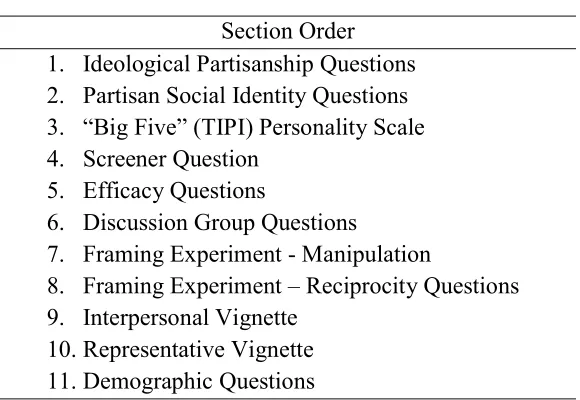
Table 3.1 Structure of Online Survey Questionnaire ...59
Table 4.1 Distribution of Respondents among Partisan Subgroups, Online Survey ...80
Table 4.2 Partisan Respondents’ Attitudes Towards Deliberation, by Social Identity ...82
Table 4.3 Immigration Vignette Results, Online Survey ...85
Table 4.4 Civil Liberties Vignette Results, Online Survey ...88
Table 4.5 Vignette Response by Ideological Partisanship, Online Survey...92
Table 4.6 Liberties Vignette Response by PSI, Telephone Survey ...94
Table 5.1 Number of Named Members in Discussion Network ...114
Table 5.2 Number of Outparty Members in Discussion Network, Online Survey ...116
Table 5.3 Number of Outparty Members in Discussion Network, Past US Surveys ...117
Table 5.4 Immigration Vignette Response by Network Composition ...118
Table 5.5 Liberties Vignette Response by Network Composition ...120
Table 5.6 Vignette Response if First Person Mentioned is Outparty Member ...122
Table 5.7 Vignette Response by Number of Outparty Discussants ...124
Table 6.1 Personality Scores, by Partisanship and Self-Reported Ideology ...142
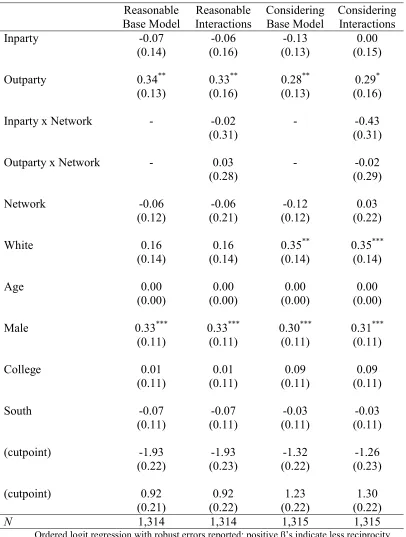
Table 6.2 Response to “Reasonable” Question, by Openness to Experience ...144
Table 6.3 Differences in Response to Immigration Vignette, by Argument Received and Openness to Experience ...147
Table 6.4 Mean PSI Score, by Openness to Experience ...148
Table C.2 Immigration Vignette Results for Democrats Only, Online Survey ...203
Table C.3 Immigration Vignette Results for Republicans Only, Online Survey ...204
Table C.4 Liberties Vignette Results for Democrats Only, Online Survey ...205
Table C.5 Liberties Vignette Results for Republicans Only, Online Survey ...206
Table D.1 Regression Table for Figures 5.2 and 5.3 ...208
Table E.1 Vignette Response by Conscientiousness ...210
Table E.2 Vignette Response by Agreeableness ...211
LIST OF FIGURES
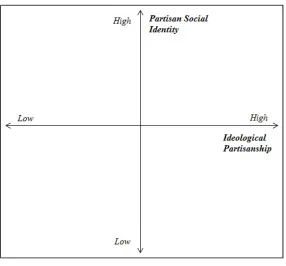
Figure 1.1 Dimensions of Partisan Identity ...21
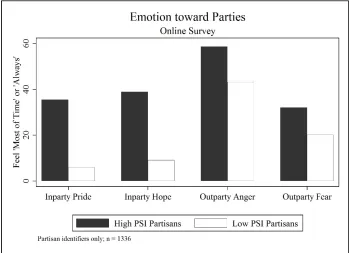
Figure 4.1 Partisan Emotion, by Social Identity Salience ...81
Figure 4.2 Attitudes toward Deliberation by Party, Online Survey ...83
Figure 4.3 Online Immigration Vignette Results, by Social Identity ...86
Figure 4.4 Online Liberties Vignette Results, by Social Identity ...89
Figure 4.5 Online Vignette Results, by Ideology ...93
Figure 4.6 Telephone Vignette Results, by Social Identity ...95
Figure 4.7 Online Representative Vignette Results, by Social Identity ...96
Figure 4.8 Telephone Representative Vignette Results, by Social Identity ...97
Figure 4.9 Telephone Representative Vignette Results, by Party ...98
Figure 4.10 Partisan Emotion over Time, Democrats...101
Figure 4.11 Partisan Emotion over Time, Republicans ...101
Figure 5.1 Response to Immigration Vignette, by Social Contact and Identity ...121
Figure 5.2 Response to Liberties Vignette, by Social Contact and Identity ...121
Figure 5.3 Mean PSI Score by Outparty Network Size, Online Survey ...125
Figure 5.4 Feeling Toward the Parties, by Outparty Social Contact ...126
Figure 6.1 Differences in Response to Counterargument, by Openness to Experience ..145
Figure 6.2 Response to Liberties Vignette, by PSI and Openness to Experience ...149
Figure A.1 Distribution of PSI Measure, Online Survey ...191
Figure A.2 Distribution of Ideological Partisanship Measure, Online Survey ...192
Figure A.3 Distribution of PSI Measure, Telephone Survey ...192
Figure E.1 Openness to Experience Results Across Parties, Immigration Vignette ...212
CHAPTER 1
OVERVIEW
"The political parties created democracy and modern democracy is unthinkable save in
terms of the parties."
- E. E. Schattschneider, Party Government, 1942
“Identification with a party raises a perceptual screen through which the individual tends
to see what is favorable to his partisan orientation. The stronger the party bond, the
more exaggerated the process of selection and perceptual distortion will be.”
- Campbell et al., The American Voter, 1960
During the run-up to the 2012 Presidential Election, the radio show This
American Life produced an episode entitled “Red States Blue State,” where they declare
that “everyone knows that politics is now so divided in our country that not only do the
sides disagree on the solutions to the country’s problems, they don’t even agree on what
the problems are.” The episode then profiles a host of average Americans who have had
their families torn apart and close friendships ruined due to opposing, polarized politics.
In one particularly evocative example from the show, interviewer Lisa Pollack profiles
Frank Mills and Ron Sexton. The two men were close friends who repeatedly discussed
political issues on the phone. This is until, as Pollack describes on-air in their interview,
“Ron urged Frank to support a Republican candidate for Congress. Frank balked. Didn't
Frank Mills: And he (Ron) said, ‘Who did you vote for for president?’ And I said, ‘I
voted for Obama.’
Lisa Pollak: Apparently this had not come up before.
Frank Mills: And then he said, ‘You must be a Socialist.’
Lisa Pollak: He said this seriously or jokingly?
Frank Mills: No, seriously. ‘You must be a Socialist.’ And I said, ‘How can you make
that assumption?’ He says, ‘Well, you voted for Obama. He's a socialist, and
therefore you are.’ And then I took it as if he had called me a dirty name. And we got
into an argument. And then after a while, he said, ‘Well, I'm writing you off my list,
Frank. Don't ever talk to me again. You're no longer a friend of mine,’ is how that
conversation ended,” (Glass 2012).
The story of Frank and Ron may be common in America, and, for many, it is
troubling. With the rise of partisan polarization debated by academic and popular
commentators alike (Abramowitz 2010; Haidt and Hetherington 2012), many point to a
link between divergent political views and an incivility and breakdown of political
discourse (“Civility in America 2013”). Dating back to the ancient Greeks, political
theorists have extoled the virtues of deliberative democracy, predicated on the ability of
the public (or at least their representatives) to see divergent perspectives as legitimate and
to be open to opinion change (Rawls [1993] 2005; Gutmann and Thompson 1996;
Dryzek 2010). The closed-mindedness and lack of consideration evinced by Frank and
Ron calls this possibility into question.
It is also perhaps puzzling, as many public opinion scholars demonstrate that,
based on ideology, the public writ large is as moderate as it has been in the past half
century (Fiorina 2011). The acrimony may be real, but it may be relatively untethered to
ideological or issue position conflict; in other words, it is comprised of “a nation that
agrees on many things but is bitterly divided nonetheless,” (Mason 2015, 128). To help
explain this puzzle, a body of recent research in political psychology (Iyengar, Sood, and
Lelkes 2012; Iyengar and Westwood 2014; Mason 2015; Huddy, Mason, and AarøE
2015) has drawn a distinction between the ideological and social identity bases of
partisanship to suggest that it is not Democrats’ and Republicans’ political views, but
social identities, that are polarizing. Drawing from social psychological theories of
identity (Tajfel et al. 1971; Turner 1987), these authors posit that the motivation to
establish a positive differentiation between one’s inparty and outparty drives the anger
and conflict that is suggested between Frank and Ron.
Drawing on this concept of “social identity” polarization, the goal of this project
is to explain the effect of partisan attachment on the quality of political deliberation in
American democracy. The founding fathers, as well as many modern political theorists,
extol the virtue of open-minded public discussion and consensus building. Both
theoretical and empirical research on deliberative democracy, however, underexplore the
impact of partisanship on the propensity of the public to engage in meaningful,
high-quality deliberation. Moreover, while recent research into “social identity” polarization
examines the impact of partisan identity on emotional responses to politics (Mason
2015), political activism (Huddy, Mason, and AarøE 2015), and even non-political
attitudes such as marriage or hiring decisions (Iyengar and Westwood 2014), it has not
theory prioritizes. Today, there is continued academic and practical interest in fostering
deliberative discourse and institutions. Thus, examining how the social psychology of
partisanship impacts these efforts, and bridging deliberative political theory with research
in political psychology, is of vital importance.
This chapter lays the theoretical groundwork for the project. After a discussion of
deliberative democracy and the key role that the concept of reciprocity plays in
deliberation, the chapter explores the ambivalent role parties play in historical and
modern American political thought. As the academic debate over partisanship and
partisan polarization today has focused on its effect on representation and electoral
accountability, this literature does an inadequate job connecting polarization to its effect
on deliberation and political discourse. In turn, empirical deliberative democracy
research tends to focus on whether deliberation produces normatively positive benefits; it
does not adequately examine prior characteristics (such as partisanship) which encourage
or preclude individuals from engaging in deliberation in the first place. From this point,
the chapter advances social identity theory (SIT) as a way to connect the debate on
polarization with the concerns of deliberative theory. Then, the chapter draws on SIT to
lay out the theoretical expectations guiding the project. Finally, the chapter will conclude
with a plan for the rest of the project.
1.1 DELIBERATION AND RECIPROCITY
In the 21st century, democracy is generally seen as a good thing; Americans take
pride in having the oldest democratic Constitution in the Western world, and both
domestically and internationally, we prefer to see political change that creates more,
“democracy” is a universal good with many and at times conflicting interpretations. For
example, some see democracy as primarily a competition between groups (Dahl 1956),
and others see guaranteeing rights or liberty (Nozick 1974) as essentially “democratic.”
Many scholars and citizens, though, conceptualize democracy primarily in terms of “the
electoral connection.” As one example, both normative theory (Mill [1861] 1991; Pitkin
1967) as well as empirical political science (Miller and Stokes 1963; Ansolabehere and
Jones 2010) view the ideal democratic representative as one who directly enacts the
wishes of his or her constituency. If the representative fails to do so, the constituency
holds him or her accountable come election time. Indeed, from public opinion research
cataloging the “uninformed” and “irrational” voter (Converse 1964; Delli Carpini and
Keeter 1996; Lodge and Taber 2013) to Congressional research discussing the
incumbency advantage (Cain, Ferejohn, and Fiorina 1987; Ansolabehere, Snyder, and
Stewart 2006) and capture by moneyed interests (Gilens and Page 2014), much of the
American politics literature consists of an exploration of the breakdown of the “electoral
connection” as well as institutional changes that could be made to fix it.
The view of democracy as primarily an “electoral connection” has roots in a
“minimalist” conception typified by Schumpeter (1942 [2003]) as well as the assumption
latent in much public opinion research that it would be difficult to demand much more
from the American citizenry. However, democratic theorists have of late increasingly
moved beyond the electoral connection and have considered the discursive requirements
of democracy (Dryzek 2010; Young 2000; Gutmann and Thompson 1996). These
deliberative democratic theorists do not focus on specific institutions or election
connection. They do argue, though, that the quality of political communication that
connects citizens both with each other and the ruling class matters. Dryzek lays out a
complete, succinct definition of the core elements of deliberative democracy:
“A system can be said to possess deliberative capacity to the degree it has structures
to accommodate deliberation that is authentic, inclusive, and consequential. To be
authentic, deliberation ought to be able to induce reflection upon preferences in
noncoercive fashion… and involve communicating in terms that those who do not
share one’s point of view can find meaningful and accept…To be inclusive,
deliberation requires the opportunity and ability of all affected actors (or their
representatives) to participate. To be consequential, deliberation must somehow
make a difference when it comes to determining or influencing collective outcomes,”
(2010, 10).
Thus, at its core, deliberative democracy is about reason giving (Thompson
2008); decisions are not made by fiat, but with collective, interactive discussion, and with
justification towards those disagree. Normative theorists vary in their requirements for
the quality of reasons given, the role (if any) of power or bargaining, the proper site for
this discussion, as well as the place for consensus as a discursive goal (Bächtiger et al.
2010). In a seminal work, though, Gutmann and Thompson (1996) argue that this reason
giving should be guided by a norm of reciprocity, or offering justifications that others,
even if they disagree, can find legitimate. As such, the back and forth of political
discussion comes from a place of mutual respect and open, good faith consideration of
alternate views (Fishkin 1995). While some confine deliberation to power brokers such
the necessity for “everyday talk” of the public to hew to these norms (Dryzeck 2010,
Mansbridge 1999), in a way that places a primacy on inclusion (Young 2000).
The connection between deliberative discussion and democracy has roots in
Athenian democracy, where speechmaking and discussion in the Assemblies was viewed
as integral to decision making processes (Held 1987, Ch. 1). The focus on deliberation in
modern times, though, has only taken in the past few decades. Since, though, it has
become a central focus of political theory (Rawls [1993] 2005; Gutmann and Thompson
1996), empirical social science (Barabas 2004; Mutz 2006), and practical political reform
(Gastil and Levine 2005). Democratic theorists argue that deliberation comes with a host
of benefits for political power and decision making, including a greater normative and
empirical legitimacy, a more informed citizenry, better and more consistent attitude
formation, higher tolerance for diverse viewpoints, greater engagement and social capital
building, and higher quality, more consensual decisions (Mendelberg 2002, 153-4).
While empirical research has shown mixed results (for reviews, see Thompson 2008;
Mutz 2008), and the benefits of deliberation hinge on the individual and environmental
context (Delli Carpini, Cook, and Jacobs 2004), there is enough evidence to suggest that,
at times, the public can buck the assumptions of irrationality and apathy that dominate
public opinion research. For example, while some have found that the public prefers a
low level of political involvement (Hibbing and Theiss-Morse 2002), Delli Carpini,
Cook, and Jacobs (2004, 323-4) find that the public is willing to talk about the issues with
their peers, with 58% of their national survey respondents engaging in at least two
“discursive activities” in the past year. Prior and Lupia (2008), moreover, use a survey
higher levels of political knowledge if given the time and motivation to do so. Many
studies employing “deliberative forums” or “deliberative polls” also show that, with time
and motivation, citizens can engage in “reciprocal” decision making through deliberation1
(Fishkin 1995; Stanford University 2013). For example, Barabas (2004) finds through a
forum on Social Security reform that, even for those with strongly held prior opinions,
deliberation produces opinion change in a way “ordinary discussion” about the issue does
not. Moreover, List et al. (2012), using data from nine deliberative polls, finds that
deliberation can create “meta-agreement” or “single-peakedness” in policy preferences,
particularly for issues that have a natural left-right dimensionality. Thus, they argue,
deliberation can create opinion constraint and avoid social choice problems (Arrow 1951)
that arise with multi-dimensional preferences.
Beyond being simply a theoretical and empirical research endeavor, deliberative
democracy has also made in-roads into real-world politics. Certainly, efforts at fostering
greater public participation in decision making are nothing new; for example, the
Administrative Procedures Act has required that agencies solicit public comments on
rulemaking for half of a century. More recently, though, governments have either
instituted or consulted institutions founded explicitly on deliberative democratic
principles. The most prominent example of this is the “deliberative polling” done by
James Fishkin and Stanford’s Center for Deliberative Democracy. Since 1988, Fishkin
and the Center have organized dozens of deliberative forums across the world focused on
a myriad of issues, where results have been used to inform policy processes (Fishkin
1 With these forums, “the basic design involves interviewing a good-quality random sample; gathering its
1995; Stanford University 2013). Another example is the Australian Citizens’
Parliament. A national convention of 150 citizens modeled on the ancient Athenian
assemblies, the Citizens’ Parliament was tasked with proposing reforms to the Australian
political system through online and face-to-face deliberations. Even beyond the content
of their proposals, Dryzeck argues that it shows that “if you give people the opportunity
to deliberate, they see the political system as something that is theirs and worthwhile,”
(Dryzek 2009, 4). Warren and Gastil (2015), moreover, highlight the potential role of
deliberative “minipublics” in serving as intermediaries bridging complexities in the
policy process and the limited information citizens often bring to bear on political
decisions. They point to the British Columbia Citizens’ Assembly and Oregon’s
Citizens’ Initiative Review—two deliberative institutions comprised of a near random
sample of the citizenry—as successfully serving as impartial, transparent, and
knowledgeable trustees for helping citizen decision making. These are just a few of
many instances of deliberative ideals making inroads into practical political reform.
1.2 DELIBERATION AND PARTISANSHIP
The deliberative ideal of reciprocity extols a “universalization” of political
discourse; at its fullest expression, politics does not consist of winners and losers, but a
community trying to figure out what is in the common good through productive
discussion2. As such, there is a historical concern over the group considerations brought
about by political parties. Prior to the ratification of the Constitution, in Federalist #10
Madison sees political parties as fostering the “mischiefs of faction,” creating “instability,
injustice, and confusion” in popular government ([1787] 2003). Nearly a decade later,
Washington warns in his Farewell Address of “the spirit of party,” as it “agitates the
community with ill-founded jealousies and false alarms, kindles the animosity of one part
against another, (and) forments occasionally riot and insurrection” ([1796] 2008).
Only four years after Washington’s warnings, Jefferson and the
Democratic-Republicans were vying against Adams and the Federalists for control of the new United
States government. And for the two centuries that followed, the two-party system has
been ensconced in the American political landscape. Formal theory suggests that it must
be so; Duverger and others contend that the institutional and electoral structure of the
government drives the creation and maintenance of two broad, national parties (1954;
Cox 1997; Aldrich 2011). What’s more, Downs’ (1957) spatial theory of voting suggests
that, given that the bulk of the United States populace is ideologically moderate (Fiorina
2011), the party system will converge on two parties ideologically near the median voter.
In addition to the formal necessity of two parties in the American democratic system,
many have suggested that they play a normatively positive role in translating citizen
preferences into government action. By establishing a clear, consistent “brand,” they
provide an important cueing function to voters, allowing the average citizen with a low
level of political knowledge (Delli Carpini and Keeter 1996) to effectively participate in
politics (Lupia 1994). Responsible party theorists, moreover, argue that healthy
competition between two parties can serve to offer distinct choices to voters and ensure
that, once voters make their choice, electoral change is translated into policy change.
Indeed, in Southern Politics in State and Nation, V. O. Key shows how the Democratic
various means of voter suppression. Without viable competition from the Republican
party, Key argues that the Southern states did not have a functioning democracy (1949).
Key is correct that competition is necessary for democracy; deliberative theorists,
too, argue that a healthy democratic discourse needs a diversity of competing claims.
They argue, though, that the nature and tone of this competition also matters. As such,
many popular commentators, political activists, and the public writ large, in line with
these theorists and echoing the historical warnings of Washington and Madison, have
expressed concern with the current era of mass partisan polarization. Opinion makers
across media outlets, for example, claim that polarized parties “neither trust nor
understand each other” (Dionne 2013), and that “the number of persuadable voters has
shrunk to a tiny segment of the electorate” (Cohen 2016). A recent Pew Center report,
moreover, claims that “Republicans and Democrats are more divided along ideological
lines – and partisan antipathy is deeper and more extensive – than at any point in the last
two decades,” (2014, 5). The report points to not only more points of policy conflict, but
a partisan-based antipathy “bordering on sense of alarm” as well as an increasing
disinclination to marry, have friendships with, or live near out-partisans. Bishop likewise
reports the public’s increasing aversion to out-party neighbors, arguing that, as
Americans increasingly migrate into ideologically homogenous, “balkanized”
communities, the result is “a growing intolerance for political differences that has made
national consensus impossible” (2008, 14).
Furthermore, the gridlock and disaffection produced by 21st century partisan
politics has prompted political organizations such as No Labels to actively promote
politics, as exemplified by then-Daily Show host Jon Stewart’s 2010 “Rally to Restore
Sanity and/or Fear” (Tavernise and Stelter 2010). While some critiqued the rally as less
of a call for civil discourse and more of a rally for the Democratic party, Stewart himself
saw it as a repudiation of the divisive partisan punditry of all stripes, a divisiveness that
makes one question:
“Why would we work together? Why would you reach across the aisle to a pumpkin
assed forehead eyeball monster? If the picture of us were true, of course, our inability
to solve problems would actually be quite sane and reasonable. Why would you work
with Marxists actively subverting our Constitution or racists and homophobes who
see no one’s humanity but their own? We hear every damn day about how fragile our
country is—on the brink of catastrophe—torn by polarizing hate and how it’s a shame
that we can’t work together to get things done, but the truth is we do. We work
together to get things done every damn day!... Most Americans don’t live their lives
solely as Democrats, Republicans, liberals or conservatives. Americans live their
lives more as people that are just a little bit late for something they have to do—often
something that they do not want to do—but they do it--impossible things every day
that are only made possible by the little reasonable compromises that we all make”
(quoted in Examiner.com 2010).
1.3 SHORTCOMINGS OF EXTANT RESEARCH
In addition to Stewart and other popular commentators, political scientists have
paid increasing attention to partisan polarization; scholars, however, tend to study
polarization as an ideological construct, examining whether Democrats and Republicans
From this literature, there is a clear consensus that political elites – politicians, activists,
donors, and media, are more polarized today than they have been in the past century
(McCarthy, Poole, and Rosenthal 2006; Theriault 2008; Prior 2007). With this
observation, some scholars have argued that the public is now similarly polarized,
harboring homogenous, distinct worldviews and issue positions (Abramowitz 2010;
Abramowitz and Saunders 2008). The majority consensus, though, is that while partisans
in the public may be better “sorted” (Levendusky 2009), they are just as ideologically
unconstrained as Phillip Converse and his colleagues surmised in the 1960’s (Campbell et
al. 1960; Converse 1964). Fiorina contends that much of the hand-wringing over “culture
wars” or “polarized America” incorrectly conflates closely contested elections with deep
public divisions over the issues (2011); the public, instead, is much more centrist and
amenable to compromise than the political class (2009). Hill and Tausanovitch (2015),
moreover, construct a measure of public ideology similar to the NOMINATE scores used
for Congress, based on 67 policy questions asked in the ANES over a 50-year period.
They find that, while the public has always been less ideologically extreme than their
elected leaders, the disconnect has gotten stronger in recent years. Along the lines of this
dialogue, too, scholars debate whether the public is polarized on economic and/or
sociocultural issues (Frank 2004; Gelman et al. 2008; Carsey and Layman 2002) as well
as whether ideological mass polarization has a geographic dimension (Gimpel and
Schuknecht 2003; Gelman et al. 2008; Bishop 2008).
The literature examining ideological mass polarization (or the lack thereof)
provides vital, yet incomplete, insight into the impact of 21st century partisanship on the
concern over the quality of representation in America, and the electoral connection
between representatives and the represented. As Pitkin states, in a representative
government there must be “machinery for the expression of the wishes of the represented,
and that the government respond to these wishes unless there are good reasons to the
contrary,” (1967, 232-3). Given the clear ideological rift between parties in government,
if the public is not similarly split ideologically, there is a clear breakdown in this
machinery. Fiorina (2009, 72-4) argues that this is precisely what is happening today.
He points out that while some theories of representation suggest that the representative is
supposed to be reasonable, moderating the passions of the public, today’s representative
is exaggerating the moderate differences of a reasonable public. If, on the other hand, the
public is ideologically polarized, the electoral connection is then healthy. As
Abramowitz states, “the conditions for responsible party government have largely been
met” (2010, 159), and overcoming governmental gridlock will require either extended
dominance from one party or reforming institutional checks and balances.
Concern for the quality of representation is not misplaced; if Schattschneider says
that American democracy is “unthinkable” without political parties, it is also unthinkable
without representation. Direct democracy is impossible given a large, heterogeneous
society like the United States. However, considering partisan polarization solely in the
context of ideology and representation is incomplete. To do so would presume a
minimalist or aggregate vision of democracy, where public involvement in the
democratic process is limited to an occasional “competitive struggle for the people’s
vote,” (Schumpeter [1942] 2003). Election procedure and outcomes would take
input and justification of policymaking processes between elections. The sites of
democracy would be limited to the polling place, excluding the media, public forums, or
the streets. The citizenry, moreover, would be assumed to be motivated by a “thin and
individualistic form of rationality” (Young 2000, 20), where preferences are immutable
and the collective good (outside of its effect on one’s self interest) is not taken into
account. According to this view, if the ideological elite polarization matches polarization
of the public, democracy “works” as citizen interests are reflected through election. The
concerns voiced by deliberative theorists as well as popular commentators like Stewart—
of incivility, aggression, and a lack of reciprocity in elite and lay political discussion, and
of gridlock and lack of consensus in the policymaking process—do not factor in.
If polarization studies often miss the concerns of deliberative theorists, empirical
and theoretical work in deliberative democracy often glosses over the potential impact of
partisanship on deliberation that our founders worried about. While more attention to
empirical work on deliberation will be paid in Chapter Two, broadly, much of this
literature takes a “forum” approach (eg. Fishkin 1995; Barabas 2004), where a
deliberative situation is carefully constructed out of whole cloth, or a “case based”
approach (eg. Mansbridge 1980; Gastil 2000), where insights are gleaned from observing
real-world deliberative situations. These studies tend to take deliberation as an
independent variable, assessing its effects on dependent variables such as trust, tolerance,
consensus, etc. They also operationalize deliberation holistically, arguing that the
package of conditions theorists prioritize (reciprocity, reason-giving, non-domination,
accurate information, etc.) create the effects they study. There is certainly value in taking
breaking the characteristics of deliberation down to their component parts means
studying something that is not deliberation (Thompson 2008).
This being said, the holistic case based and forum based studies of deliberation
are incomplete. For one, the forum based studies of Fishkin and others suffer from issues
of endogeneity. Is the open-mindedness, opinion change, greater understanding, etc.,
created by the deliberative process in these forums, or is it driven by the type of people
that choose to participate in the extensive forum process? To address this issue, many of
these studies employ random sampling of the population (List et al. 2012), stratified
sampling of the population to ensure that key race, class, and gender subgroups are
represented (Dryzek 2009), or post-hoc statistical adjustment such as matching (Barabas
2004). However, this does not fully deal with the issue, as unobservable characteristics
(such as personality—see Chapter Six) can motivate some, as opposed to others, to
participate even if a random sample of participants is contacted.
What’s more, Ryfe is correct in positing that “researchers have been less
interested in deliberation itself than in measuring its effects” (2005, 54). In other words,
what specifically produces the salutary benefits that case based and forum based studies
of deliberation find? Is it the access to accurate, expert information? The encouragement
of open-mindedness? Social contact with persons of a different opinion? By setting up a
holistic deliberative process and not subjecting each of these components of the process
to scrutiny, Mutz thus contends that deliberation becomes a “moving target,” which
“insulate(s) the theory from falsification” (2008).
Mutz is correct that studying the specific components of deliberation in isolation,
extant holistic research that case based and forum based studies provide. Indeed, her
work (2006) as well as other work (eg. Jackman and Sniderman 2006; Druckman and
Nelson 2003; Hibbing and Theiss-Morse 2002) takes such an approach, using survey
experiments and other experimental techniques to examine isolated characteristics of
deliberation such as interpersonal network diversity or exposure to counterargument.
However, like case based and forum based research, this experimental work, with few
exceptions, takes characteristics of the deliberative setting as independent variables,
examining if they produce the salutary effects theorists contend they do. Less research
from this subfield takes the deliberative setting as the dependent variable, exploring its
preconditions. This is unfortunate, as Thompson argues that “the aspect of deliberation
about which empirical inquiry has potentially the most to say is the set of conditions that
are necessary for, or at least contributory toward, good deliberation,” (2008, 509). He
posits that more research into the cultural and institutional preconditions that lead to
higher-quality deliberation can help to explain the mixed results of the effects of
deliberation studies find. To wit, despite the extended popular and academic debate over
the rise of partisan polarization, little work has examined the role of parties in fostering or
inhibiting deliberation. However, recent work examining the partisan social identity can
provide a useful tool with which this project can do just that.
1.4 THE DUAL BASES OF PARTISAN IDENTITY
Fiorina, Abramowitz, and other polarization scholars tend to work with an
“ideological” concept of polarization, where partisan affiliation is (or is not) linked to
ideological and/or policy preference. In a recent paper, however, Iyengar, Sood, and
difference, is the most important dimension of partisan polarization. They draw on social
identity theory (SIT) to explain how, as partisanship has become an increasingly salient
social identity in American culture, dislike towards, and stereotyping of, partisan
outgroups has increased in survey responses. This phenomenon is not evident for other
groups; there is not a similar antipathy between liberals and conservatives, and outgroup
hatred/stereotyping has increased for partisans even as it has (overtly) decreased for
ethnic, religious, and other traditionally-maligned groups over time. They also show that
ideology is only, at best, a very weak predictor of “affective” partisan polarization, which
suggests that the salience of the partisan social grouping is primary, and it is not caused
by a prior ideological or issue-based difference.
The study of “affective” or “social” partisan polarization, may be relatively novel,
but it ties into a canon of research that suggests partisanship is a long-term, psychological
attachment (Campbell et al. 1960; Green, Palmquist, and Schickler 2002). It also
resonates with psychological research on attitude formation and group identification.
Social identity theory has long posited a “minimal group paradigm,” where even the most
insignificant and arbitrary of group categorizations can have a substantial effect on
cognition and behavior (Brewer 1979; Tajfel et al. 1971). Socially-constructed group
identification is a necessary part of human experience, as “an undifferentiated social
environment makes very little sense and provides no guidelines for action,” (Tajfel et al.
1971, 153). Experimental research has also shown that subjects focus on the relative
difference in resource between one’s ingroup and outgroup, even when alternatives that
“Minimal” groups, however, are not very relevant in real-world settings. Humans
inhabit a dense, overlapping network of group categories (and potential group
categories); a central insight from self-categorization theory (SCT), given this fact, is that
only certain group categorizations will be salient at certain times. In defining SCT
(which builds directly from SIT, and is often used interchangeably)3, Turner emphasizes
that humans do not identify a “personal” self that is independent of group relations;
instead, one’s self-concept is defined by an interrelated continuum of personal and group
self-categorizations (1987, 43-4). One’s group categorization, as opposed to a personal
categorization, becomes a salient self-categorization when the group category is easily
accessible in one’s mind, and environmental stimuli fit well with the categorization (Ch.
6). How much the group category is valued or prioritized by the individual, as well as the
perceived differences between the ingroup and outgroup, also help explain salience of
group categories (Yzerbyt and Demoulin 2010, 1029). With their salient groups, though,
individuals develop a host of behaviors, including engaging in “self-stereotyping” by
changing attitudes and behavior (Terry and Hogg 1996), exaggerating ingroup similarity
and outgroup difference (Brown 2000), and favoring the ingroup and bias toward the
outgroup (Tajfel et al. 1971; Brown et al. 2001).
Iyengar et al. (2012) provide valuable insight into the social psychological nature
of partisan polarization via SIT; it would be wrong, however, to suggest that ideological
polarization is completely irrelevant or unrelated to this affective identity formation
process. If affect is all that matters, it would be difficult to explain how individuals are
increasingly sorting into the “correct” party ideologically (Levendusky 2009). It would
also be difficult to explain how the public is increasingly knowledgeable about partisan
differences in policy, and can place Democrats to the left of Republicans on a variety of
issues (Hetherington 2001; Layman, Carsey, and Horowitz 2006).
Lodge and Taber, moreover, argue that humans are “motivated reasoners,” facing
implicit pressure to bring their ideological worldview in line with their affective feelings
of partisan support (2013; see also Kunda 1990). This pressure is evinced from studies
demonstrating that citizens will change their views on specific policies solely based on
their partisan attachment (Druckman, Peterson, and Slothuus 2013; Carsey and Layman
2006). It is also suggested from SIT research that shows individuals engage in
“self-stereotyping” activities concerning salient in-group norms (Branscombe et al. 2002;
Mason 2015). However, this phenomenon is not universal, as the need for consistency
between affect and ideology varies across personalities, across time, and across culture
(Nisbett et al. 2001; Kitayama et al. 2004)
In short, with regards to partisanship, it is important to look at social identity and
ideology, not one or the other. Figure 1.1 presents a proposed schematic for
individual-level partisanship, which consists of two dimensions of one’s attachment to his or her
party. On the x-axis is “ideological” partisanship, or how close one’s policy views are
from the median individual in his or her inparty. The right side of the axis represents one
who is ideologically similar from his or her inparty, the left side represents one who is
ideologically dissimilar. On the y-axis is “partisan social identity,” or the level of group
identity-based attachment one registers for his or her inparty. The top of the line
represents a strong partisan social identity, and the bottom of the line represents party
Figure 1.1 Dimensions of Partisan Identity
While specific hypotheses drawing from social identity theory will be developed
in Chapters Four through Six, the general argument for this project is that partisan
identity salience is negatively related to deliberative attitudes and the key attitude of
reciprocity in particular. This connects to the insight from SIT that, for salient group
identities, one finds outgroup bias and exaggeration of difference from the ingroup (why
engage in good faith discussion with someone who’s opinion you hold in low regard?). It
also connects to recent research on partisan psychology that suggests that, far from
open-mindedness, one’s partisanship conditions the quality and hue of information that he or
she receives from their environment (Iyengar and Hahn 2009; Ramsay et al. 2010), as
well as how that information is processed and interpreted (Gaines et al. 2007; Lodge and
Taber 2013). I expect separate effects for both partisan social identity and ideological
identity salience (Mackie 1986; Mason 2015), I expect one’s ideological partisanship to
be a secondary contributor to a negative relationship to reciprocity.
1.5 PLAN FOR PROJECT
Chapter Two expands on the discussion of deliberative democratic theory,
including the debate on its possibility and its normative desirability. It also offers a full
conceptualization of reciprocity and its place in political discourse. It further delves
deeper into the empirical literature on deliberation and addresses a key critique from
Mutz (2008) that, even in ideal deliberative situations, rational decision making cannot
result. Chapter Three discusses the methods used to assess the impact of partisan
attachment on reciprocity. This includes a justification of the experimental approach
primarily used, a description of all the data sources used and how the data were collected,
and a discussion of the structure of the original survey instruments used as well as the
operationalization of key concepts such as reciprocity, partisan social identity, and others.
Chapters Four through Six present the empirical results of this project. Chapter
Four explores the impact of the social and ideological aspects of partisan identity on
one’s willingness to engage in reciprocal political discussion with peers, as well as one’s
desire to see reciprocity displayed in his or her elected representative. The experimental
results show that those for whom partisan social identity salience is high are particularly
likely to respond to party cues in determining whether to seek out reciprocity. This is true
both in interpersonal political discussion and for considering whether to support
representatives’ deliberative efforts. These results suggest that the deliberative capacity
of the public is eroding with modern mass “social” polarization. Chapter Five explores
reciprocal attitudes. This chapter builds off the work of Mutz (2002; 2006), who broadly
suggests that cross-cutting political discussion is beneficial for deliberative public
attitudes but detrimental for public political engagement. The chapter will thus see how
Mutz’s insights relate to the “social” and “ideological” dimensions of partisans. Chapter
Six explores the relationship between reciprocity and one’s personality. The theoretical
foundation for this chapter draws largely from Mondak (2010), and it will rely on a
ten-question “Big Five” personality scale (Gosling, Rentfrow, and Swann 2003). In line with
Mondak’s work, here both the direct effect of personality on reciprocal attitudes, as well
as the indirect effect of personality mediated through “social” and “ideological” partisan
identity, will be examined. Chapter Seven concludes, discussing the results in the context
of the academic and popular debate on polarization as well as the theoretical and
CHAPTER 2
RECIPROCITY AND ITS ROLE IN PUBLIC DISCOURSE
“When citizens and accountable officials disagree, and also recognize that they are
seeking deliberative agreement, they remain willing to argue with one another with the
aim of achieving provisionally justifiable policies that they can recognize as such”
- Gutmann and Thompson, Democracy and Disagreement, 1996
According to the New York Times’ David Brooks, American politics today
nothing more than “good-versus-evil bloodsport” (2016a). Echoing sentiments widely
shared across much of the pundit class, the conservative columnist feels that modern
campaigns are marked by “single storyism,” where policy differences are viewed by
others as having “false allegiances” and being “complicit in a system of oppression,”
(2016b). In a similar vein, Frank Bruni argues that current political discourse is imbued
“with a vulgarity that’s absolutely breaktaking,” including “surreal” and “sickening” ad
hominin attacks and red herring references to genitalia size (2016a). For him, American
politics is moreover in an “era of irresolution,” where electoral processes yield “cries of
illegitimacy and a determination to neuter the victor,” not compromise or acceptance
(2016b). What’s more, William Galston contends that the hallmark of politics is now
“legislative gridlock and damage[d] trust and confidence in political institutions,” causing
“observers question America's ability to govern itself as the times require,” (2014).
bellicosity, crudeness, and moral certitude in our political discourse that needs to be
changed.
Changed to what, though? In contrast to the vitriolic rhetoric decried by Brooks,
Bruni, and Galston, the “deliberative polls” developed by James Fishkin (1995; 2011)
and colleagues offer an alternative, seeking to establish a more cooperative tone for
collective political reasoning. Deliberative polls are multi-day forums, where randomly
sampled participants engage in intensive discussion of a set of policy issues. Participants
are given issue briefing materials and access to experts for questioning. Moderators are
trained to facilitate “informed and balanced discussion” and “establish an atmosphere
where participants listen to each other in a safe public space [where] no one is permitted
to dominate the discussion” (Fishkin 2011, 26). The participants are polled both before
and after the deliberative event; the poll results afterwards, Fishkin argues, reflect “the
considered judgment of the public” (1995, 162). In the dozens of deliberative polls he
has conducted, he consistently finds with participants significant opinion change, greater
consensus, more knowledge of the issues at hand, and greater respect for different
perspectives (2011).
Others have constructed similar deliberative forums, with similar discussion
guidelines for participants. For example, in a 1998 deliberative forum entitled Americans
Discuss Social Security, organizer Dr. Carolyn Lukensmeyer articulated that “every
person’s voice is heard who’s in this room,” “everyone is listened to and respected,” and
that participants should adopt a “spirit of open-heartedness and open-mindedness,”
(Barabas 2004, 691, emphasis in original). For another example, in facilitation materials
deliberative forums across the country), moderators are told to instruct participants that
“everyone is encouraged to participate” and “examine the pros, cons, and potential
trade-offs of each approach,” and that “listening is an important as talking” (NIFI 2014).
Fishkin contends that the discursive guidelines give the results of deliberative forums “a
recommending force,” as they “are the conclusions people would come to, were they
better informed on the issues and had the opportunity and motivation to examine those
issues seriously” (1995, 162).
These forum guidelines—inclusiveness, open-mindedness, full examination of an
issue, etc.—all point broadly to the general concept of reciprocity. Reciprocity is a key
discursive ideal in deliberative democratic theory, and reciprocity is the conceptual focus
of this project. Thus, this chapter explores its form, potential, and potential limitations.
After defining the term and situating its role in the expansive literature on deliberation,
this chapter defends a “fuzzy” conceptualization of reciprocity, where debates on how
permissive or strict it should be as a discursive standard need not be completely settled.
From there, it defends the importance of reciprocal norms in particular for citizen
discussion. The chapter then explores the theoretical and empirical literature pointing to
the benefits of reciprocity in political discourse, as well as key theoretical and
empirical-based critiques of the concept. The chapter closes by looking at one particular salient
critique offered by Mutz (2008)—that ideally “reciprocal” discussion does not produce
considered, higher-quality decision making, as proponents of deliberative democracy
believe. Here, a discussion of social psychological literature on persuasion can give us
2.1THE CONCEPT AND BOUNDARIES OF RECIPROCITY
As stated in the previous chapter, deliberative democracy is, at a minimum, about
reason giving. In contrast to an “aggregate” view, where democratic decision making
amounts to individualistic preferences summed through election procedures, deliberative
theory prioritizes collective decision making through processes of claim making,
discussion, and reflection. What’s more, when an empowered entity makes a decision, it
requires justification given to those affected. The normative rationale here is that if Max
Weber is correct that the state is a “monopoly of legitimate physical force” ([1919] 1946,
78), democracy requires some sort of rationale given towards the citizens whom
presumably control and acquiesce to that force.
However, deliberative theorists argue that not just any reason giving or political
discussion will do. “More political talk” is not normatively desirable when, for example,
it is confined to like-minded enclaves, fueling sectarian division rather than consensus
(Sunstein 2003). Neither is more talk beneficial if it reflects existing power dynamics
and further marginalizes minority groups, or if the discourse is effectively ignored once
governmental decisions are made. Instead, political discussion according to these
theorists must be guided by a set of (at times conflicting) values. For example, a basic
discursive prerequisite is the articulation of a diversity of viewpoints. Echoing J.S. Mill’s
contention that intellectual diversity implies that “we have neglected nothing that could
give the truth a chance of reaching us” ([1859] 1978, 20), Manin argues that a clash of
conflicting claims helps citizens “to clarify information,” “sharpen their own
preferences,” and perhaps even “modify their initial objectives, should that prove
argues that political discourse should be as inclusive as possible. She contends that
deliberative theorists should, in fact, relax stringent communicative standards to allow in
debate forms such as “greeting,” “narrative” and “rhetoric” (2000, Ch. 2), in order to
allow voice for individuals and groups that may be disadvantaged by a strict adherence to
rational argumentation. Other theorists spell out the need for additional requirements,
such as that the discussion has a consequential effect on decision making (Dryzek 2010,
Ch. 1), or that decision making be open to further revision if conditions change (Gutmann
and Thompson 2004).
In a seminal work, though, Gutmann and Thompson (1996) argue that the primary
ideal to guide deliberation should be a norm of reciprocity. This basic moral concept
broadly means that “we should return good for good, in proportion to what we receive,”
(Becker 1986, 4). A complete operationalization for this project is given in Chapter
Three, but broadly, Gutmann and Thompson apply it to the realm of democratic politics
by stating that “when citizens deliberate, they seek out agreement on substantive moral
principles that can be justified on the basis of mutually acceptable reasons,” (1996, 55;
see Ch. 2 of same work for a full account). Recognizing the collective nature of
democratic decision making, political reasoning is given in terms that those that disagree
could, at least in theory, accept. A consensus is sought, but in recognizing the reality of
often-intractable moral disagreement (particularly in contemporary American politics; see
Jacoby 2014), reciprocity only requires the honest effort to forge moral agreement, and
mutual respect for competing legitimate viewpoints when consensus fails. There is thus a
balance in reciprocal discourse between pure self-interest and pure altruism. Unlike
ideal does not bar personal morality or self-interest from political reason giving.
However, it must be tempered by the requirement of mutual justification to, and mutual
respect for, other citizens. Furthermore, reciprocity applies to empirical claims, allowing
only those that can be mutually seen as acceptable based on “relatively reliable methods
of inquiry” (56). While (as with decision-making broadly) there is not one single
standard here, it does preclude empirical claims that cannot be verified or are strictly
made on authority.
Beyond Gutmann and Thompson (1996), the idea of reciprocity can be found
across the work of deliberative theorists. Its roots are in Habermas’s work on
“communicative rationality,” where ideal discourse (shorn of power dynamics, exclusion,
and strategic behavior) creates understanding and consensus based on the “unforced force
of the better argument,” (1993, 163; see also Habermas 1983). The idea of mutual
acceptability is also found in Rawls’ concept of “public reason” ([1993] 2005); for
Rawls, political discussion should be confined to areas of “overlapping consensus,”
where claims are offered with reasons that can be seen as justifiable to all4. Dryzek,
similarly, calls for “communicating in terms that those who do not share one’s point of
view can find meaningful and accept,” which encourages “reflection upon preferences in
noncoercive fashion” (2010, 10). Moreover, Mansbridge et al. state that “mutual respect
and equal concern” are “central” to any formulation of deliberative theory (2010, 65-6).
Like Gutmann and Thompson, they also contend that individual values and self-interest,
constrained by principles of reciprocity, can play a role in the deliberative process.
4 This similarity aside, deliberative democrats such as Gutmann and Thompson disagree with Rawls on the
In their work (1996), Gutmann and Thompson situate reciprocity between two
other norms of political decision making—“impartiality” and “prudence.” With
reciprocity, there is not one standard for political agreement; the content of consensus
depends on the particular parties (and their vantage points) involved. With impartiality,
however, decisions are made based on a single moral standard and apply universally. In
other words, it implies that there is a “right answer,” and all we need to do is find it;
anything short of this is a deliberative failure. Following an ideal of impartiality, thus,
requires citizens to have pure altruism and prevents one from drawing on not just
self-interest but also a personal moral worldview with political reason giving. On the other
end of the spectrum, a discursive ideal of prudence acknowledges the reality of moral
pluralism, but it forgoes any effort to explore these differences or forge a consensus on
shared values. While reciprocity requires the acknowledgement of the legitimacy of
moral disagreement, and a good faith consideration of countervailing views, prudence
only asks for us to merely tolerate diverging opinion. Those we disagree with, in other
words, are and remain wrong, and the only concessions given to them (beyond mere
toleration) are through a strategic bargaining process.
Moving too closely to impartiality fails to acknowledge the legitimate differences
in moral values citizens have. With regard to very divisive issues of the day (abortion,
transgender rights, gun control, etc.), it thus asks us to either take a universalistic (and
dogmatic) position, or to not deliberate these issues at all. Gutmann and Thompson do,
though, acknowledge that there is a role for prudence and bargaining in the broad
spectrum of real-world political discourse. When deliberation reveals a pre-existing
disputes on details is appropriate. Moreover, when deliberation reveals irreconcilable
moral claims, such as for very divisive issues, prudential bargaining is again necessary; to
do nothing at that point would arbitrarily privilege the status quo (Warren and
Mansbridge 2013; Gutmann and Thompson 2012). With differences too great to bridge,
Gutmann and Thompson (1996) contend that decision makers should, while maintaining
their moral convictions, seek “an economy of moral disagreement” through negotiation,
and remain open-minded to the possibility for greater future consensus. Likewise, many
deliberative scholars more recently have acknowledged the necessity of “deliberative
negotiation” when reciprocal efforts at forging consensus fail (Mansbridge et al. 2010;
Warren and Mansbridge 2013). They argue that deliberative consensus should always be
the first option, but barring this voting or negotiation procedures are acceptable ways to
resolve disagreement. These “non-deliberative” procedures, scholars now argue, can be
seen as components of a deliberative framework if they are guided by the same
principles—mutual respect, open-mindedness, limiting of power disparities, etc.—that
guide reciprocal moral deliberation.
Indeed, the line between “deliberative” and “not deliberative” is fuzzy at best,
drawn at different places by different scholars. As deliberative democracy is
increasingly being used as a theoretical lens to examine real world communication (Ryfe
2005), many scholars have in turn stretched the concept of deliberation, incorporating
seemingly non-ideal aspects of decision making such as fair bargaining (Warren and
Mansbridge 2013), self-interest, power, and voting procedures (Mansbridge et al. 2010).
Warren even argues that deliberative institutions should not focus on open-minded and
“from the point of view of democratic institutions and systems, we should be more
interested in outcomes of communication than communicative intent” (2007, 278,
emphasis added). In contrast, as Bächtiger et al. (2010) point out, other scholars have
remained truer to the strict standards of communicative rationality that earlier
deliberative theorists posited. An example of this is the Discourse Quality Index, which
is designed to compare legislative deliberation against a counterfactual of discursive
ideals articulated by Habermas. Steenbergen et al. (2003) develop this measure and
envision its use in both assessing how deliberative institutions could be improved as well
as how deliberation affects policy outcomes.
Bächtiger et al. suggest that this “dual tendency to construe deliberation both too
broadly and too narrowly can lead to serious confusion” (2010, 33). More cynically,
some suggest that this makes deliberation a “moving target” and unproductive as a field
of study (Mutz 2008, 527). As such, theorists will continue to develop and refine their
normative standards. That being said, for much of the recent work on deliberative theory,
completely clearing up this confusion is not necessary. Over the past couple of decades,
deliberative democratic theory has “'come of age' as a complete theory of democracy
rather than a simple ideal of legitimacy” (Bohman 1998, 401). Scholars have
increasingly moved beyond a focus on theoretical development, examining empirically
how deliberation manifests in policy forums, governmental institutions, and
communication between citizens (Dryzek 2010, Ch. 1)5. This line of research certainly
must, as Bächtiger et al. insist, avoid the extremes of both over specification and under
specification of deliberative standards. Deliberation cannot be simply “all talk.” At that