Recent CMS Results
Tommaso Dorigo1,afor the CMS Collaboration
1INFN - Sezione di Padova
Abstract. The CMS experiment obtained a large number of groundbreaking results from the analysis of 7- and 8-TeV proton-proton collisions produced so far by the Large Hadron Collider at CERN. In this brief summary only a few of those results will be discussed. The new scalar discovered in 2012 has been studied in detail and all its characteristics have been found in agreement with standard model predictions for a Brout-Englert-Higgs boson. The large sample of top quark events collected in 2011 and 2012 have allowed world-class measurements of its mass; the combination of those results isMt=173.49± 0.36±0.91 GeV. The rare decayB0
s → μμhas been observed and found in agreement with standard model predictions; the search for the rare decayB0 →μμhas allowed to set a 95% CL limit on the branching fraction at 1.1×10⁻⁹. These two results strongly constrain new physics models.
1 Introduction
The observation of the Brout-Englert-Higgs boson in July 2012 has marked a turning point for the CMS experiment: while being the declared main goal of the Large Hadron Collider, the observation of the particle believed to be the manifestation of the mechanism of electroweak symmetry breaking is only the beginning of a long and careful plan of investigations of the physics of hadron collisions at the multi-TeV scale. The planned increase in the beam energies, which will bring the centre-of-mass energy at the design energy of 13-14 TeV in the forthcoming years, keeps hopes alive for the discovery of new physics beyond the standard model.
The investigation of the properties of the newly found boson has been carried out with all the data available from Run 1 of the Large Hadron Collider. The observable characteristics of that particle allow us to say today that it perfectly fits the predictions of the standard model; yet a more precise determination of its couplings and a study of its less frequent decay modes will be possible with the data expected in 2015, with the aim of determining whether anomalies or unpredicted features are hiding in the details of its phenomenology. In parallel with those investigations, CMS has undertook a wide range of studies of standard model physics, extending our knowledge of frontier particle physics with precise measurements of electroweak observables.
The search for new phenomena is of course today the main focus of the CMS experiment. While the first studies of 7- and 8-TeV collisions have revealed no departures from standard model predic-tions, the range of possible signals of new physics hiding in the huge datasets already collected is quite broad, and surprises are still possible. The large amount of results produced in those searches
ae-mail: [email protected] DOI: 10.1051/
C
Owned by the authors, published by EDP Sciences, 2014 /2 01
prevents their discussion in this brief report; a summary can be found in the reports from the parallel sessions in these proceedings.
This document is organized as follows. Section 2 provides a brief description of the experiment. In Sec. 3 is offered a short review of the most interesting results of the investigations of the nature of the new 125 GeV scalar particle. In Sec. 4 a few recent results in standard model measurements are briefly highlighted. Some conclusions are offered in Sec. 5.
2 The CMS Detector
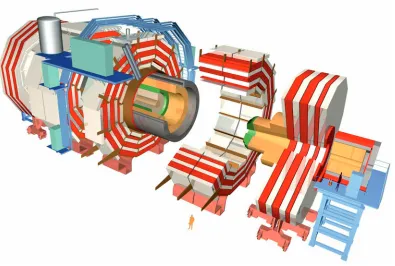
CMS –an acronym for Compact Muon Solenoid– is a multi-purpose magnetic detector designed to study the multi-TeV proton-proton collisions delivered by the CERN Large Hadron Collider. The detector is located in a underground cavern at a depth of 100m at the site of Cessy, near the border of France and Switzerland. Particles emitted in hard collisions at the center of CMS cross in succession a silicon tracker, electromagnetic and hadron calorimeters, a solenoid magnet, and muon drift chambers embedded in the solenoid iron return yoke. A drawing of the CMS detector is shown in Fig. 1.
2.1 Overview of the CMS Detector
The momenta of charged particles emitted in the collisions at the center of the CMS detector are measured using a 13-layer silicon pixel and strip tracker; 66 million silicon pixels of dimensions 100x150 μmare arranged in three barrel layers, and are surrounded by 9.6 million 180μm-wide silicon strips arranged in additional concentric barrels in the central region and disks in the endcap region. In order to allow a precise measurement of charged particle momenta, the silicon tracker is immersed in the 3.8 T axial field produced by a superconducting solenoid. The tracker covers the pseudorapidity range|η|<2.5, where pseudorapidity is defined asη=−lntanθ/2 andθis the polar angle of the trajectory of a particle with respect to the direction of the counter-clockwise proton beam. Surrounding the tracker are an electromagnetic calorimeter (ECAL) composed of lead tungstate crystals and a brass-scintillator hadron calorimeter (HCAL). These detectors are used to measure the energy of incident particles from the produced electromagnetic and hadronic cascades; they consist of a barrel assembly covering the central region, plus two endcaps covering the solid angle for particles emitted at lower angle with respect to the beams direction. The ECAL and HCAL extend within the pseudorapidity range|η| < 3.0; at smaller angles particles emitted in the collision encounter a steel/quartz-fiber Cherenkov forward detector (HF) which extends the calorimetric coverage to|η|< 5.0.
The outermost component of the CMS detector is the muon system, consisting of four layers of gas detectors placed within the steel return yoke. The CMS muon system performs a high-purity iden-tification of muon candidates and a stand-alone measurement of their momentum, and in combination with the inner tracker information provides a high-resolution determination of muon kinematics. More detail on the CMS detector is provided elsewhere [1].
CMS collects data with a two-level trigger system. Level 1 is a hardware trigger based on custom-made electronic processors that receive as input a coarse readout of the calorimeters and muon de-tectors and perform a preliminary selection of the most interesting events for data analysis, with an output rate of about 100 kHz. Level 2, also called "High-Level Trigger" (HLT), uses fine-grained information from all sub-detectors in the regions of interest identified by Level 1 to produce a final decision, selecting events at a rate of about 300 Hz by means of speed-optimized software algorithms running on commercial computers.
2.2 The LHC in 2011 and 2012
The 2011 proton-proton run of the LHC produced collisions at the centre-of-mass energy of 7 TeV. In the course of seven months of data taking CMS acquired a total of 5.3 inverse femtobarns of integrated luminosity; 5.0 of these were collected with all the CMS subdetectors fully operational.
During the 2011 run the instantaneous luminosity reached up to 3.5×1033cm−2s−1. At a bunch crossing rate of 50 ns, the average number of pp interactions per bunch crossing was approximately 10. In such conditions, the rare hard collision which produces the physics objects (electrons, muons, taus, photons, energetic jets, missing transverse energy) recognized by the trigger system and fulfilling the criteria for data acquisition is usually accompanied by several additional pp interactions overlapping with it in the same bunch crossing. These additional collisions, which are typically of low energy but may still produce significant contributions to global event characteristics such as total visible energy or charged particle multiplicity, are denoted as pile-up events. The analysis of the hard collision properly includes the effect of pile-up, which is also modeled in all the necessary Monte Carlo (MC) simulated samples.
centre-of-mass energy of 8 TeV. The LHC in 2012 also ran at higher instantaneous luminosities than in 2011; this produced a still higher pileup of 20 to 50 simultaneous interactions per bunch crossing. CMS responded to the resulting reconstruction challenge with more sophisticated algorithms and calibration procedures, which have allowed to maintain the same physics output despite the harsher experimental conditions. Most of the results discussed in the following sections are based on the full data samples collected in 2011 and 2012.
3 Higgs Boson Physics
Following the July 2012 discovery of a scalar particle at 125 GeV [2], the CMS experiment has used the whole datasets collected in 2011 and 2012 to verify in detail that the observed characteristics of that particle are in effect in agreement with what the standard model predicts for the Brout-Englert-Higgs boson [3–8] (in the following we will refer to it as simply “Brout-Englert-Higgs boson” for brevity). This broad range of investigations has included the measurement of production rate in all the observed decay channels, the determination of its coupling strength to fermions and bosons, a precise measure-ment of the Higgs boson mass from the 4-lepton andγγfinal states, and the study of the spin-parity assignments of the new particle.
After a short review of the predicted phenomenology of Higgs production and decay, we summa-rize below the status of the CMS measurements of Higgs boson mass, cross section, and properties. As appropriate, we refer the reader to the bibliography for articles and preprints describing those measurements in detail.
3.1 Production and Decay
The standard model Higgs boson has a non-zero coupling to all massive particles, and can therefore be produced by several different mechanisms in proton-proton collisions. The reactions studied so far at the LHC include gluon-fusion diagrams, where a Higgs boson is emitted most frequently by a virtual top-quark loop; vector-boson-fusion processes, where the Higgs is produced together with two characteristic high-rapidity hadronic jets resulting from the emission of two virtual W or Z bosons off the initial state quarks; and Higgs-strahlung diagrams where the particle is radiated by a highly-off -shell W or Z boson or a top quark.
At a mass aroundmH=125 GeV, the Higgs boson exhibits also a very rich decay phenomenology. The decays to weak boson pairs (H→WW∗,H→ZZ∗) are possible when one of the two final-state objects is off-mass-shell, but their branching ratios are comparatively small, allowing other decays to be observable. CMS has so far obtained significant signals from five different decay modes of the Higgs boson: the two mentioned above, as well as decays to b-quark pairs,τ-lepton pairs, and photon pairs. The latter, although quite rare (with a predicted branching fraction of 2.3×10⁻³), has in fact been crucial for the first observation of the Higgs boson. Other still rarer decay modes (e.g. H→Zγ, H→μμ) will also become accessible to a direct measurement in the future.
3.2 Determinations of Higgs boson cross section, mass, and properties
The results of these searches are combined by taking into account all statistical and systematic uncertainties and their correlations [14, 15]. The combination is performed by constructing a global likelihood function, with each systematic source assigned to a nuisance parameter; each of these has a corresponding probability density function. Most of the systematic uncertainties are constrained by subsidiary measurements.
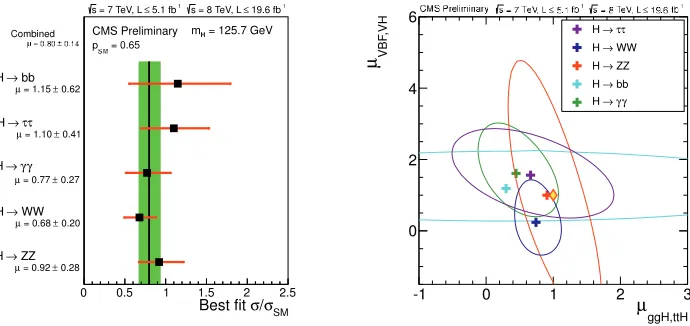
Figure 2. Left: Measured Higgs production cross sections for the studied decay modes, in units of the stan-dard model prediction (a massmH = 125.7 GeV is assumed). The shaded band shows the fitted average of experimental measurements. Right: individual results of fits to the production rate of the Higgs boson in vector-boson-fusion and in production in association with W and Z bosons (vertical axis) and production in gluon-gluon fusion and top pair higgs-strahlung processes (horizontal axis). The five ellipses encompass 68% CL regions and are all in agreement with the predicted production rates (yellow marker at (1,1)).
The different analyses provide rate measurements of Higgs decays in the various considered final states. The individual measurements are shown in the left panel of Fig. 2, where the cross section is measured in units of the standard model expectation. The combined measurement of CMS [16] isμ = 0.80±0.14. A nice recent result is the one obtained in the H → ττfinal state, where tau leptons are identified both from their decay into electrons or muons, and from hadronic decays. The combination of the measurements yieldsμ=1.1±0.4 for the ratio of measured cross section divided by standard model prediction [13].
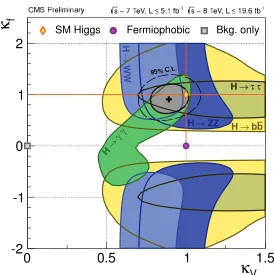
The separation of signals into ones with and without additional “tagging” objects (such as jets, missing transverse energy, and identified leptons) allowed to study in more detail how the production mechanisms agree with model predictions [16]. As shown in the right panel of Fig. 2, the overall compatibility of the production processes is quite good. A more detailed study allows to extract from the signal yields the best-fit value of the coupling-strength modifierskV andkf, defined as multipliers of the standard model couplings of the Higgs boson to vector bosons and fermions, respectively. In this case the custodial symmetry is implicitly assumed, and the coupling to different fermions is assumed to be in the proportions predicted by the standard model. Figure 3 (right) shows that CMS data is in very good agreement with the hypothesis that those couplings be equal to their standard model values.
Figure 3.Results of a fit to the fermionic and bosonic couplings of the Higgs boson from the yields of signal in the five observed decay modes. The grey ellipse shows the combination of the measurements, at 68% CL. The three markers indicate the predicted values of the coupling modifiers for the standard model, for a model with zero Higgs couplings to fermions, and for the no-Higgs hypothesis.
Finally, the angular distribution of the decay products allows to test for the spin-parity assignments of the new particle. Using a matrix-element discriminator in the four-lepton final state ofH → ZZ decay candidates, the pseudo-scalar hypothesis and all tested spin-one hypotheses have been rejected with a confidence level of 99% or higher [10].
4 Precision Measurements of Electroweak Observables
At centre-of-mass energies of proton-proton collisions of 7 TeV and above, electroweak interactions parameters can be determined with unprecedented accuracy by the analysis of CMS data, challenging theoretical predictions. In what follows we summarize only a few of the many new measurements produced by CMS with vector bosons and top quarks.
4.1 Vector Boson Production Cross Sections
production [20], as well as the production rate of WW, WZ, and ZZ pairs [21–25], exclusive WW production [26], and the production of Z bosons with forward jets [27, 28]. In all these measure-ments, W boson candidates have been selected by searching for their decay toeνeandμνμfinal states, and Z bosons by searching for their ee andμμfinal states. In the case of ZZ production the second boson has also been identified in its decay toτ-lepton pairs.
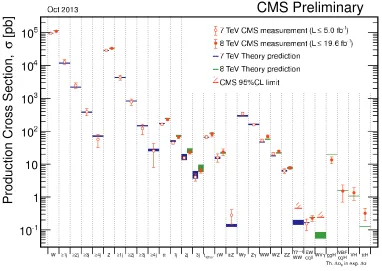
Figure 4. The total production cross section of final states including W and Z bosons, top quarks, and Higgs bosons, in picobarns (red markers) are compared to theoretical predictions at 7 TeV (blue lines) and 8 TeV (green lines). For single boson production are also reported the cross sections of processes including at least one to at least four hadronic jets with transverse energyET >30 GeV and pseudorapidity|η|<2.4.
The general picture that can be drawn is one of excellent agreement with theoretical calcula-tions, which are available at next-to-leading order (NLO) [30–32] and next-to-next-to-leading order (NNLO) [33–37] in perturbative QCD. Figure 4 provides a nice summary of the CMS measurements of these processes, along with ones involving top quark or Higgs boson production.
4.2 Top Quark Measurements
42]. For example, with data corresponding to 5.3 inverse femtobarns the 8-TeV production cross section is measured atσ8t¯tT eV=239±2±11±6pb, where the first two quoted uncertainties are statistical and systematic, while the latter comes from the uncertainty in the total integrated luminosity.
The top quark mass remains a parameter of great interest even after the precise measurements produced by the Tevatron experiments. CMS has produced several measurements using the dilepton, the single lepton, and the all-hadronic topologies, and has also exploited kinematical characteristics that alleviate the impact of the jet energy scale systematic uncertainty on the measurement, such as the use of the measured decay length of B hadrons emitted in top decay. Figure 5 (left) compares the various recent determinations by CMS. By combining all the results listed there, the top quark mass is measured atmt = 173.49±0.36±0.91 GeV [43], where the first uncertainty quoted is the combination of statistical with jet-energy-scale-related systematic uncertainty, and the second is the quadrature sum of all other systematic uncertainties. The total error of this determination is thus of 0.98 GeV, a remarkable achievement !
Figure 5.Left: top quark mass determinations by the CMS experiment. From top to bottom are shown the early measurements in the dilepton and lepton+jets final states employing 2010 data, the analysis results of 2011 data in the three topologies and the result employing the end-point technique, and the 2012 result using the B hadron decay length. Right: output of a boosted-decision tree discriminant for the search of associatedtWproduction. The signal contribution is in orange.
4.3 Search forB0→μμandB0
s →μμdecays
Thanks to its excellent and redundant system of muon detectors, the CMS experiment is capable of competing favourably with dedicated machines in several B physics measurements. This has been shown clearly in the case of the measurement of rareB → μμdecays, which have been a hot topic in the last few years. The decays of theB0 and theB0
s meson to muon pairs are heavily suppressed in the standard model due to the absence of flavor-changing neutral-current diagrams at tree level. Two additional factors further reduce their rate: the ratio m2/m2
B between the squared masses of muons and B mesons implied by the helicity configuration of zero-total-momentum energetic fermion-antifermion final states, and the ratio f2
B/m2B (where fB is the B decay constant) due to the inner annihilation of quarks in the decaying meson. The smallness of the total predicted branching fractions, B(B0
s →μμ)=(3.6±0.3)×10−9andB(B0→μμ)=(1.1±0.1)×10−10[46], constitute an opportunity to search for indirect evidence of new physics, which could intervene in the form of the exchange of new virtual particles, with significant increases in the rate of these decays for specific values of the new physics parameters.
CMS has searched for the rare decays in the full Run 1 statistics of 5 f b−1 of 7-TeV collisions and 20 f b−1 of 8-TeV collisions [47]. The method is a combined fit of the two B species and all backgrounds to the dimuon mass distributions of selected events, separately for 7- and 8-TeV data. Because of the dependence of mass resolution and background levels on the pseudorapidity of detected muons, the data is divided in “barrel” candidates, which have both muons with|η|<1.4, and “endcap” candidates, which include all remaining events. Further, the candidates are divided in different bins depending on the output of a multi-variate discriminant based on the event kinematics and muon quality. MC simulations are used to estimate backgrounds from other B decays, while combinatorial backgrounds are evaluated from the data in suitable mass sidebands. A normalization sample of B+ → J/ψK+decays, with the subsequentJ/ψ→ μμdecay, is collected by a similar trigger to the one used for the rare decay search, and is used to remove the uncertainties of B hadron production cross section and integrated luminosity of the data sample.
The combined likelihood fit evidences an excess ofB0
s →μμdecays corresponding to a branching fractionB = (3.0+1.0−0.9)×10−9. The excess has a significance of 4.3 standard deviations, when 4.8σ were expecteda priorifrom the analysis design and the size of the data sample. No significantB0 signal is instead observed; the signal extracted by the fit corresponds to a significance of 2.0σ(see Fig. 6). An upper limit ofB(B0 →μμ)<1.1×10⁻⁹at 95% confidence level is extracted with theCL
s criterion [48, 49] using the event counts in signal and sideband regions resulting from a simplified event selection.
A recent combination of the above results with the similar ones obtained by the LHCb collabo-ration has been published in [50]. The combined fit yields a branching fraction of theB0
s meson to dimuon pairs of (2.9±0.7)×10−9.
5 Conclusions
Figure 6.Results for theB0
sandB0branching fractions from the combined likelihood fit of the mass distributions of muon pairs in CMS Run 1 data. The insets show the profiled likelihood distribution for the branching fraction of the two B hadron species. The red marker shows the standard model prediction [46].
6 Acknowledgements
(Colombia); MSES and CSF (Croatia); RPF (Cyprus); MoER, SF0690030s09 and ERDF (Estonia); Academy of Finland, MEC, and HIP (Finland); CEA and CNRS/IN2P3 (France); BMBF, DFG, and HGF (Germany); GSRT (Greece); OTKA and NIH (Hungary); DAE and DST (India); IPM (Iran); SFI (Ireland); INFN (Italy); NRF and WCU (Republic of Korea); LAS (Lithuania); CINVESTAV, CONACYT, SEP, and UASLP-FAI (Mexico); MBIE (New Zealand); PAEC (Pakistan); MSHE and NSC (Poland); FCT (Portugal); JINR (Dubna); MON, RosAtom, RAS and RFBR (Russia); MESTD (Serbia); SEIDI and CPAN (Spain); Swiss Funding Agencies (Switzerland); NSC (Taipei); ThEPCen-ter, IPST, STAR and NSTDA (Thailand); TUBITAK and TAEK (Turkey); NASU (Ukraine); STFC (United Kingdom); DOE and NSF (USA).
References
[1] CMS Collaboration, The CMS experiment at the CERN LHC, JINST 3 (2008) S08004.
[2] CMS Collaboration, Observation of a new boson at a mass of 125 GeV with the CMS experiment at the LHC, Phys. Lett. B716 (2012) 30-61; ATLAS Collaboration, Observation of a new particle in the search for the standard model Higgs boson with the ATLAS detector at the LHC, Phys. Lett. B716 (2012) 1.
[3] F. Englert and R. Brout, Broken symmetry and the mass of gauge vector mesons, Phys. Rev. Lett. 13 (1964) 321-323.
[4] P. Higgs, Broken symmetries, massless particles and gauge fields, Phys. Lett. 12 (1964)132-133. [5] P. Higgs, Broken symmetries and the masses of gauge bosons, Phys. Rev. Lett. 13 (1964) 508-509. [6] G. Guralnik, C. Hagen, and T. Kibble, Global conservation laws and massless particles, Phys.
Rev. Lett. 13 (1964) 585-587.
[7] P. Higgs, Spontaneous symmetry breakdown without massless bosons, Phys. Rev. 145 (1966) 1156-1163.
[8] T. Kibble, Symmetry breaking in non-Abelian gauge theories, Phys. Rev. 155 (1967) 1554-1561. [9] CMS Collaboration, Properties of the observed Higgs-like resonance using the diphoton channel, CMS-PAS-HIG-13-016; CMS Collaboration, Updated measurements of the Higgs boson at 125 GeV in the two photon decay channel, CMS-PAS-HIG-13-001.
[10] CMS Collaboration, Measurement of the properties of a Higgs boson in the four-lepton final state, CMS-HIG-13-002-003, arXiv:1312.5353.
[11] CMS Collaboration, Measurement of Higgs boson production and properties in the WW decay channel with leptonic final states, arXiv:1312.1129, CMS-HIG-13-023; CMS Collaboration, Evi-dence for a particle decaying toW+W−in the fully leptonic final state in a standard model Higgs boson search in pp collisions at the LHC, CMS-PAS-HIG-13-003.
[12] CMS Collaboration, Search for the standard model Higgs boson produced in association with a W or a Z boson and decaying to bottom quarks, arXiv:1310.3687.
[13] CMS Collaboration, Search for the Standard-Model Higgs boson decaying to tau pairs in proton-proton collisions at √s=7 and 8 TeV, CMS-PAS-HIG-13-004.
[14] CMS Collaboration, Combined results of searches for the standard model Higgs boson in pp collisions at √s=7 TeV, Phys. Lett. B 710 (2012) 26-48.
[15] ATLAS Collaboration, CMS Collaboration, and LHC Higgs Combination Group, Procedure for the LHC Higgs boson search combination in summer 2011, ATL-PHYS-PUB-2011-818, CMS NOTE-2011/005.
[17] CMS Collaboration, Measurements of the Inclusive W and Z Production Cross Sections in pp Collisions at √s = 7 TeV with the CMS experiment, J. High Energy Phys. 10 (2011) 132, arXiv:1107.4789.
[18] CMS Collaboration, Inclusive W/Z cross section at 8 TeV, CMS-PAS-SMP-12-011.
[19] CMS Collaboration, Jet Production Rates in Association with W and Z Bosons in pp Collisions at √s=7 TeV, J. High Energy Phys. 01 (2012) 010, arXiv:1110.3226.
[20] CMS Collaboration, Measurement of the√ WγandZγinclusive cross sections in pp collisions at s=7 TeV and limits on anomalous triple gauge boson couplings, arXiv:1308.6832.
[21] CMS Collaboration, Measurement of the W+W− cross section in pp collisions at √s = 7 TeV and limits on anomalous WWgamma and WWZ couplings, Eur. Phys. J. C 73 (2013) 2610, arXiv:1306.1126.
[22] CMS Collaboration, Measurement ofW+W−and ZZ production cross sections in pp collisions at √s=8 TeV, Phys. Lett. B721 (2013) 190.
[23] CMS Collaboration, Measurement of WZ production rate, CMS-PAS-SMP-12-006.
[24] CMS Collaboration, Measurement of the ZZ production cross section and search for anomalous couplings in 2l2lfinal states in pp collisions at √s=7 TeV, J. High Energy Phys. 01 (2013) 063. [25] CMS Collaboration, Measurement of the ZZ production cross section and anomalous trilinear
gauge couiplings inlllldecays at √s=8 TeV at the LHC, CMS-PAS-SMP-13-005.
[26] CMS Collaboration, Study of exclusive two-photon production of√ W+W− in pp collisions at s = 7 TeV and constraints on anomalous quartic gauge couplings, J. High Energy Phys. 07 (2013) 116.
[27] CMS Collaboration, Measurement of the hadronic activity in events with a Z and two jets and extraction of the cross section for the electroweak production of a Z with two jets in pp collisions at √s=7 TeV, J. High Energy Phys. 10 (2013) 101.
[28] CMS Collaboration, Measurement of pure electroweak production of a Z boson in association with two forward/backward jets in proton-proton collisions at 8 TeV, CMS-PAS-FSQ-12-035. [29] CMS Collaboration, A Search for WWgamma and WZgamma production in pp collisions at√
s=8 TeV, CMS-PAS-SMP-13-009.
[30] J. Kubar-Andre and F. E. Paige, Gluon corrections to the Drell-Yan model, Phys. Rev. D19 (1979) 221.
[31] G. Altarelli, R. K. Ellis, and G. Martinelli, Large Perturbative Corrections to the Drell-Yan Process in QCD, Nucl. Phys. B 157 (1979) 461.
[32] J. Kubar et al., QCD corrections to the Drell-Yan mechanism and the pion structure function, Nucl. Phys. B 175 (1980) 251.
[33] P. Rijken and W. van Neerven, Orderα2
s contributions to the Drell-Yan cross-section at fixed target energies, Phys. Rev. D 51 (1995) 44.
[34] R. Hamberg, W. van Neerven, and T. Matsuura, A complete calculation of the orderα2scorrection to the Drell-Yan K-factor, Nucl. Phys. B 359 (1991) 343. Erratum-ibid. B 644 (2002) 403. [35] W. van Neerven and and E. Zijlstra, The O(α2
s) corrected Drell-Yan K-factor in the DIS and MS scheme, Nucl. Phys. B 382 (1992) 11. Erratum-ibid. B 680 (2004) 513.
[36] R. Harlander and W. Kilgore, Next-to-next-to-leading order Higgs production at hadron collid-ers, Phys. Rev. Lett. 88 (2002) 201801.
[37] C. Anastasiou et al., High precision QCD at hadron colliders: Electroweak gauge boson rapidity distributions at next-to-next-to leading order, Phys. Rev. D 69 (2004) 094008.
[39] CMS Collaboration, Measurement of thett¯production cross section in the dilepton channel in pp collisions at √s=8 TeV, CMS-PAS-TOP-12-007, axXiv:1312.7582.
[40] M. Campbell and R. K. Ellis, “MCFM for the Tevatron and the LHC”, Nucl. Phys. Proc. Suppl. 205-206 (2010) 10, arXiv:1007.3492.
[41] M. Aliev et al., HATHOR: HAdronic Top and Heavy quarks crOss section calculatoR, Comput. Phys. Commun. 182 (2011) 1034.
[42] N. Kidonakis, Next-to-next-to-leading soft-gluon corrections for the top quark cross section and transverse momentum distribution, Phys. Rev. D 82 (2010) 114030.
[43] CMS Collaboration, Top quark mass combinations using the 2010, 2011 and 2012 data, CMS-PAS-TOP-13-002.
[44] CMS Collaboration, Observation of Associated Production of a Single Top Quark and W Boson in pp Collisions at √s=8 TeV, CMS-PAS-TOP-12-040.
[45] N. Kidonakis, “NNLL thresold resummation for top-pair and single-top production”, arXiv:1210.7813.
[46] A. J. Buras, J. Girrbach, D. Guadagnoli, and G. Isidori, On the Standard Model prediction for B(B0
s,d →μ+μ−), Eur. Phys. J. C 72 (2012), 2172.
[47] S. Chatrchyan et al. (CMS Collaboration), Measurement of theB0
s → μ+μ−Branching Fraction and Search forB0→μ+μ−with the CMS experiment, Phys. Rev. Lett. 111 (2013), 101804. [48] A.L. Read, Presentation of search results: the CLs technique, J. Phys. G: Nucl. Part. Phys. 28,
2693 (2002)
[49] T. Junk, Confidence level computation for combining searches with small statistics, Nucl. In-strum. Meth. A434 (1999) 435-443, arXiv:hep-ex/9902006.
[50] CMS Collaboration and LHCb Collaboration, Combination of results on the rare decaysB0 (s) →