A STUDY OF DATA COMPONENTS AND KNOWLEDGE COMPONENTS FOR PLANT BIODIVERSITY AREA BY USING SPATIO-TEMPORAL DATA
MODEL TECHNIQUES
KAJIAN KOMPONEN DATA DAN KOMPONEN PENGETAHUAN UNTUK KAWASAN TUMBUHAN BIODIVERSITI DENGAN MENGGUNAKAN
TEKNIK MODEL SPATIO-TEMPORAL DATA
Mohd Taib Wahid PM Abd Mannan PM Dr. Harihodin Selamat
Pn Norhidayati Zakaria
Research Vote No: 75164
Jabatan Sistem Maklumat
Fakulti Sains Komputer Dan Sistem Maklumat Universiti Teknologi Malaysia
ii ACKNOWLEDGEMENT
In the name of Allah, the Most Gracious, the Most Merciful, for giving me the determination and will to complete this study.
We would like to express our sincere thanks and appreciation to researcher for their advisors PM Abd Mannan Ahmad, Associate Professor Dr. Harihodin Selamat, and Pn Norhidayati Zakaria for their continuous advice, guidance, support, and have patiently guided me through the steps of this research. We thank them for being co-researchers.
We would like to thank to my research assistant, practical students who work in database lab, colleagues, friends, staff, and lecturers in the Faculty of Computer Science and Information Systems for their help, facilities and for providing who have extended their fullest cooperation and encouragement.
Last not least, We would like to thank to Research Management Centre (RMC) for providing us research grand to carry on the research.
iii Abstract
iv Abstrak
v TABLE OF CONTENT
CHAPTER TITLE PAGE NUMBER
1 Introduction 1
1.0 Introduction 1
1.2 Problem Background 2
1.2.1 Technical Problem I: Large Amount of data 2 1.2.2 Technical Problem II: Biodiversity Data Models 3 1.2.3 Technical problem III: Spatio-temporal Data Models 5
1.3 Specific Objectives 7
1.4 Scope of the project 7
2 Literature Review 9
2.0 Introduction 9
2.1 Malaysian Biodiversity Data 10
2.2 Biodiversity Data and Conservation 12
2.3 Space and Time Factors in Biodiversity Data 13
2.4 Geographical Information System (GIS) 17
2.5 Graphical Interface for Biodiversity 18 2.6 Storage Structure for Biodiversity Data 19 2.7 Query Processing for Biodiversity Databases 21
2.8 Summary 22
vi
3.1.1 Problem Formulation (Phase 1) 26
3.1.2 Data Model Development (Phase 2) 26
3.2 Method Used 27
3.2.1 Pyramid Framework and Event-based Approach 27 3.2.2 Spatio-Temporal Object-Relational Model 30
3.3 Object Relational Model 30
3.4 Modeling BIODI with Classical Characteristics 31
3.4.1 Object Characteristics 31
3.4.2 Object- relation Data Model Techniques 33
3.4.2.1 Objects Types: 33
3.4.2.2 Abstraction mechanism 35
3.4.2.3 Generalization and specialization 35
3.4.2.4 Association 36
3.4.2.5 Aggregation 37
3.4.2.6 Constraint 39
3.5 Modeling Object Behavior of STOP BIODI Model 39 3.6 Spatio-Temporal Abstract Data Types (ADT) 40
3.6.1 Data Type “Date” 41
3.7 Temporal Object System 42
3.7.1 Object in Time 42
3.8 Spatio-temporal Object 42
3.9 Object-relational Features 43
3.10 Object-relational Application Development 48 3.11 Conceptual Biodiversity Data Model Structure 50
4 Experiments and Results 53
4.0 Introduction 53
4.1 Experimental Setup 54
vii
Conclusion 61
References 63
viii LIST OF TABLES
TABLE NO. TITLE PAGE
1 Biodiversity Data Models/ Databases developed since 1992 3
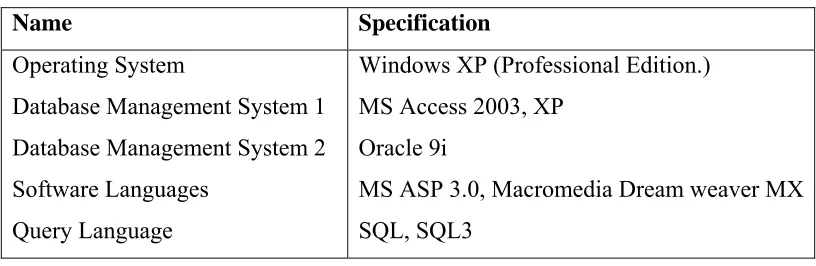
4.1 Specifications of Software’s used in testing 54
4.2 Specifications of Test System 55
ix LIST OF FIGURES
FIGURE NO. TITLE PAGE
1 Pyramid Frame work: Data Component and Knowledge Component 15 2 Pyramid Frame work with three main components; object,
location, theme and time 28
3 From the frame work data transform to the table and time
modified as events 29
4 Object type and spatial data as object 34
5 “Identifies” Relationship 35
6 Generalization and Specialization 36
7 Association 37
8 Aggregations in Stop-BDM data model 38
9 Detailed Structure of Spatio-temporal Object-Relational
x LIST OF ABBREVIATIONS
ADT Abstract Data Type
APASD Asian-Pacific Alien Species Database APMIS
ASC Association for Survey Computing ASEAN Association South East Asian Nation ASP Active Server Page
BCIS Biodiversity Conversation Information System BD Biodiversity Feature
BDBMS Biodiversity Database Management System BF Biodiversity Feature
BODHI Biodiversity Object Database System CBD Convention on Biological Diversity DBMS Database Management System DNA Deoxyribonucleic acid
ESTDM An Event-Based Spatio Temporal Data Model GIS Geographical Information System
GLOBIO Global Methodology for Mapping Human Impacts on the Biosphere IOPI International Organization for Plant Information
IT IS Intergrated Taxonomic Information System
xi MONRE Ministry of Natural Resources and Environment
MOSTI Ministry of Science, Technology and Innovation MS ACCESS Microsoft Access
MS dot net Microsoft dot Net NGO Non Government Organization OBM Object Behavior Model
OID Object Identity
OODBMS Object Oriented Database Management System OR Object Relational
ORDBMS Object-Relational Database Management System ORM Object Relational Model
OSHADHI
RDB Relational Database
RDBMS Relational Database Management System SD Spatial Data
SQL Structured Query Language Stop-BDM
Stop-BIODI Spatio Temporal Object Relational Plant Biodiversity
TD Temporal Data
UKM Universiti Kebangsaan Malaysia
UM Upper Model
VB.net Visual Basic dot Net WWF World Wildlife Fund
XML Extensiblel Markup Languange
INTRODUCTION
1.0 Introduction
Over the last couple of years, there has been phenomenal growth in the area of bio-diversity studies, largely motivated by the economic and humanitarian potential that underlines the understanding of biodiversity dynamics. New area has been arisen which is called Bio-prospecting, which focus is solely on shifting through biodiversity data to locate potentially profitable biological sources (Srikant et al., 2000).
The major difficulty was faced by biodiversity scientist, is the effective management and the access of large amounts and varied types of data arise in their studies, ranging from micro-level biological information (genetic makeup of organism and plants) to macro-level information (including ecological and habitat characteristics of species).
Biological diversity plays an important role in our lives. The interaction of species within highly diverse ecosystems performs ecological functions that are extremely important to many human activities. Ecosystems function to maintain hydrological cycles, regulate climate and recycle essential nutrients in the soil to maintain its fertility.
Biodiversity in Federal Lands by Noss and Cooperrider (1994): Simply put, biodiversity is the assortment of different types of organisms that co-occur in time and space. Biodiversity should facilitate abstract representations of real world objects which are understandable and easy to use.
Despite having this importance, humanity imposes serious negative impacts on biodiversity at multiple scales of time and space. The popular media regales us with stories and reports of the ongoing destruction of natural habitats around the world, impending climate change disasters and other ecological travesties all having potentially dire consequences upon biodiversity. After more than 150 years of scientific study, it is still not clear what factors or process lead to observe patterns of biodiversity. If we are able to mitigate the cost and develop a proper data model with the real or/and potential loss of biodiversity, we must understand the factors or process to design data model of biodiversity.
1.2 Problem Background
1.2.1 Technical Problem I: Large Amount of data
Fourth, most of the data models are relational data model. Rational data model cannot support temporal data, only support spatial data. Fifth, there is no proper biodiversity retrieval system yet to exist. Existed system only provided general information about biodiversity.
1.2.2 Technical Problem II: Biodiversity Data Models
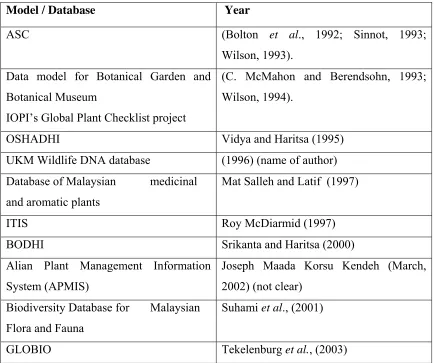
Biodiversity data models or databases have been developed either locally or internationally since 1992.
Table 1: Biodiversity Data Models/ Databases developed since 1992
Model / Database Year
ASC (Bolton et al., 1992; Sinnot, 1993;
Wilson, 1993). Data model for Botanical Garden and
Botanical Museum
IOPI’s Global Plant Checklist project
(C. McMahon and Berendsohn, 1993; Wilson, 1994).
OSHADHI Vidya and Haritsa (1995)
UKM Wildlife DNA database (1996) (name of author) Database of Malaysian medicinal
and aromatic plants
Mat Salleh and Latif (1997)
ITIS Roy McDiarmid (1997)
BODHI Srikanta and Haritsa (2000)
Alian Plant Management Information System (APMIS)
Joseph Maada Korsu Kendeh (March, 2002) (not clear)
Biodiversity Database for Malaysian Flora and Fauna
Suhami et al., (2001)
Relational data models lack the modeling power and extensibility needed for complex objects and operations used in geographic applications. Most current models do not have benefit of fully-fledged DBMS features. Some packages in Banking, commercials GIS marketing use an interface to a relational DBMS to handle spatial and non-spatial data, but temporal data are not in the DBMS. There is a need for DBMS and modeling power better than that of relational DBMS. A few relational and object-oriented GISs come to the market based upon spatial analysis. Recently spatio-temporal object relational data model has been developed based on hydrological data. In relational DBMS, a table is created for each entity type. An entity is something that has a physical or conceptual existence. A row or column in a table column corresponds to an entity and attributes. An attributes is restricted to being a built-in type relation schema ends with many additional or extra tables, making less easy to depict the relationship of complex entities in the real world (Weigand, 1994)
Another problem is temporal pattern of Biodiversity data. There are various aspects of data values with respect to time. Current DBMSs is lack extensibility in providing for special and temporal application needs. There are no provisions in traditional systems for adding new data types and methods, add user-defined code or design new storage methods. Another drawback is that difficult to obtain historical data, often collected at varied intervals and diverse scales, for temporal events can be considered as the smallest entity, not easily detected. As a result, a great need for spatio-temporal data has led to the advent of object-relational spatio-spatio-temporal Biodiversity data, as most existing data models provides only static historical information in a discrete time structure separated from attribute data. The time at which data values effective is called valid time. On the other hand, transaction time represents the time a data value is recorded in the database (R. Snodgrass, 2000). So the time varying data is commonly represented by time-stamping values. The time-stamps can be time points (Adnan Younas
model. Time points, intervals, temporal elements, and temporal sets are used as attribute timestamps. Generally, the end points of an interval are added as two separate attributes to a relation. Time points, time intervals, temporal sets and temporal elements are all needed in temporal query languages. They all added to the expressive power of a temporal data model and its query languages (Tansel A. U, 1997)
Biodiversity data have been collected from different department such as Mardi forest department and also analyzed three databases such as MARDI KUINI database (contains with 86 tables), Arthopod Database (contains with 41 tables) and MARDI
PLANT GENEBANK database (contains with 69 tables). We also have analyzed Pahang and different area from Johor state’s data and their database system. In the Pahang forest database systems are currently storing biodiversity data such as flora and fauna, area, weather and water condition’s data. This system has been storing data with simple designing table. This system contains with 20 tables which are hard to manage and make relationship. Beside that, system is only storing general information about those mentioned data, does not support monitoring, and analysis data for prediction or making decision. From the Johor state, we have collected different year’s data including floara and fauna from Johor Park Corporation, Tanjung Piai, Pulao Kukup national park, Endau-Rompin National park. They have huge amount of biodiversity data which are collected traditional way from different places and different times. After the suggestion from those departments and analyzing biodiversity data, decision has been made which consist of designing of biodiversity data modeling to manage, to store, to analyse and to monitor biodiversity data including spatial and temporal factor.
1.3.3 Technical problem III: Spatio-temporal Data Models
the object-oriented paradigm, an approach that is capable of integrating both vector and raster data into one data model. Most of the spatio-temporal data models have been developed for GIS such as snapshot model (Armstrong, 1988), ESTDM (Peuquet, and Duan, 1995), Spatio-temporal object model with ST-atoms (Worboys, 1992). One of the problems in adopting the proposed models is that they are based on existing commercial GIS. Most of the commercial systems are closed systems, which cannot be extended or modified (Sylvia de Hoop, et al., 1993 as cited by Mioc, et al., 1998).
Research in spatio-temporal data modeling is scattered. Few integrated approaches exist that can treat the spatio-temporal data in a unified manner. Past research provides a basis but not a complete design of a spatio-temporal model (Flor Eugenia, 1999). A spatial data model has been generalized to become spatio-temporal (M. Worboys, 1994). On the other hand, temporal data models have been generalized to become spatio-temporal and include variants of Gadia’s temporal model (A. U. Tansel, et
al., 1993) which are described by (M. H. et al., 1998; T. S. Cheng and S. K. Gadia, 1994). The main drawback of all these approaches is that they are incapable of modeling
continuous changes of spatial objects over time. The definition of a temporal object in general is based on the observation that anything that changes over time can be expressed as a function over time.
indexing and retrieval operations for spatial data (Leonid Stoimenov, et al., 1996). Because of continuously growing demands for temporal Biodiversity Information System (BIS) and GIS, Frank explains any object-oriented approach to a property registration system (1996) and spatial and temporal reasoning (Frank, 1997). More progressive study is contributed by Al-Taha (1992) based on a relational model associated with temporal legal changes. Worboys (1992, 1994) emphasizes spatio-temporal elements using object-oriented techniques. Several geographers (eg, Peuquet, 1994; Yuan, 1994) concentrate on features (what), event times (when) and locations (where) based on relational environments.
1.3 Specific Objectives
The main objective of this research is to design and to develop a data model for efficient management for biodiversity data. This research also aims to achieve the following objectives:
a) To study about data and knowledge component of plant biodiversity and spatiotemporal data model techniques.
b) To find out data conservation and data retrieval issues on plant biodiversity. c) To find out appropriate techniques such as pyramid framework to support
spatio-temporal data for plant biodiversity data model.
1.4 Scope of the project
CHAPTER 2
LITERATURE REVIEW
2.0 Introduction
2.1 Malaysian Biodiversity Data
Malaysia has been endowed with vast amount of natural resources including luxuriant tropical forest which is one of the most diverse and complex ecosystems of the world. Malaysia is undoubtedly one of the richest rain forests in the world with diverse floristic composition and complex ecosystems. Malaysia is thought to have about 40,000 species, which is concludes 12,500 species of flowering plants (Mat Salleh and Latif, 1997), about 1,200 (10%) species of medicinal plants. The flora and fauna of Malaysia are exceedingly rich and unique, has mixture of the greater Malaysian elements, Asiatic elements and Australian Elements as well as the Pacific elements (Keng, 1970). This mixture of plants species itself is benefited to the region as they share many common medicinal species. Malaysia shares many common medicinal plant species with India and Indonesia. Keng (1970) estimated that over 8,019 species of speed plants occur in Peninsular Malaysia. Estimate for the whole country could be about 12,000 species. However, this estimation is still under process and that is area in Sabah and Sarawak has not been actively surveyed botanically. The above estimation has been holding since 16th century by the colonist and recently introduced by plant importers (Mohamad Bin Osman and Zaki, 2002).
University Kebangsaan Malaysia (UKM) launched first online biodiversity information system supported by Malaysia-Japan Tropical Bioresearches Project in 1996. Currently, the server hosts number of databases, which are available and targeted to different segments of biodiversity stakeholders. These include the checklist of Malayan Vascular Plants, the Herbarian UKMB Online, Plant Systematic, Conservation and Ecology Reference Online, Ethnobotany of Malaysia Plants, Native Edible Plants of Sabah, The Flora of Fraser’s Hill & Bangi Permanent Forest Reserve, and UKM’s Wildlife DNA Database (Suhami Napis et al., 2001). In Early 1999, Singapore Botanical Gardens, Forest Research Institute Malaysia and UKM hosted a joint online catalogue of more than 9,000 species of vascular plants. From this database, any one can list the species occurring in the country also possible to query species from any imaged-mapped states in the Peninsular Malaysia and Singapore. Even the basic information can be searched from the menu and others information will display next to pictures or illustration of that particular species.
Ethno-botany of Malaysia Plants online complemented all these databases to develop a comprehensive database for Malaysian (Peninsular Malaysia, Sabah, and Sarawak) medicinal, poisonous, and aromatic plants. These web base systems are having nearly 16,000 native plan names from about 400 species and being updated regularly with new information (Mat Salleh and Latif, 1997; Suhami Napis et al., 2001). Later on, this system was planning to enhance this category with GIS and other data, as it is available (Suhami Napis et al., 2001).
2.2 Biodiversity Data and Conservation
Humanity depends on biological diversity, or biodiversity for the very sustenance of life. Adequate data on species diversity, populations, location and extent of habitat, major threats to different species, etc.; and changes in these aspects over time are not available to design a proper strategy for conservation. Given our extensive diversity, ecological surveys and taxonomic investigations need to be intensified, particularly for plants and insects. For conducting ecological studies, species for such studies can be prioritized including keystone species, large mammals, migratory species, etc. The country's wildlife institutions need to network and coordinate their activities so that priority issues and areas are identified. The Ministry of Environment and Forests through the Botanical Surveys of Malaysia and the Zoological Survey of Malaysia could play a guiding role by preparing a list of priority issues and areas for circulation to relevant institutions, based on a countrywide consultation of experts. Funding for these prioritized projects could be stepped up to ensure that research focuses on these issues. They are organizing seminars, conferences to protect the biodiversity data. Recently, MACRES, MOSTI, KAS and MONRE (write full name one time) organized workshop on various issues. One of the key issues was national spatial biodiversity database development. Those departments must set up a database for the country as a whole. There are many organizations and NGO’s working on biodiversity such as Biodiversity Conservation Information Systems (BCIS) working on information security and decision making on the conservation and sustainable use of living resources, while Asia Specific Alien Species regulate invasive alien species and development database to minimize economic damage. Locally WWF (World Wildlife Fund) Malaysia is working for forest, marine, wetlands, and species education and awareness. In addition, Global Biodiversity Information Facility develops an electronic catalogue for taxonomy names. There are over 486,000 scientific names, 217 common names listed with the word with tentative position taxonomy.
Indochina etc.) has been working on various projects such as forest, marine costal, wetlands, species, education and awareness. ASEAN (write full name one time) regional center for Biodiversity Conservation and ASEAN Review of Biodiversity and Environmental Conservation (CBD) are also working on Conservation, Genetic Resources, Technology, and Bio-technology. CBD is also developing biodiversity smart partnership database. In addition to this, IUCN- Asia Biodiversity Program is the world’s largest and most important conservation network.
After studying and analyses of biodiversity data, we can see that many organizations, NGO’s have been working on biodiversity data and also have been developing database system to store biodiversity data. Those biodiversity data contains only general information about biodiversity data. Some organizations only have 2 tier web systems. Those systems have database systems which are not well designed and do not support analysis and all kind of data. Example is Asian Specific Alien Species (APASD) database system, has developed for all kinds of alien species. This database only contains general information about the species and does not support analysis and monitoring biodiversity data.
2.3 Space and Time Factors in Biodiversity Data
weather change process, etc. The amount of spatial and temporal information is growing very rapidly. To satisfy the need of applications, different systems have been developed for various sub-areas related to multidimensional data. Among them, biodiversity information systems constitute a large field of interest. But existing database techniques couldn’t support spatial temporal information management well (Tryfona and Jensen, 1999).
After almost two decades research, representation of space and time in databases and functional applications are still problematic (Peuquet, 2001). This paper presents a universal object-relational framework for spatial temporal data modeling. Spatial temporal data modeling aims to extend the existing data models to include space and time in order to better describe our dynamic real world.
Numbers of issues and various aspects have been identified by many researchers in the development of biodiversity data model including spatio-temporal data model, query languages and data accessing method. Various issues have been discussed in this thesis with literature review, results and discussion, conclusions and recommendations for future work. After being literature review, it was noted that, to develop a pattern bio-data; is not easy and structural model is not suitable to store the data. There are several spatial (location), temporal (time) data model exists, which are having problem with storing and retrieving data from different location beside that temporal model have time period problem (present, past and future data). According to “statement problem”, it is difficult to retrieve and analyze the data. In the Geographical Information System (GIS), although many data model already existed but those data models are not related to biodiversity and cannot fit with the biodiversity data model and its characteristics.
Taxonomy
Theme
Time Location
Object What is it?
Where is it?
When is it?
What is it made of?
T1 T2 T3
Data Component
X Y
Knowledge Component
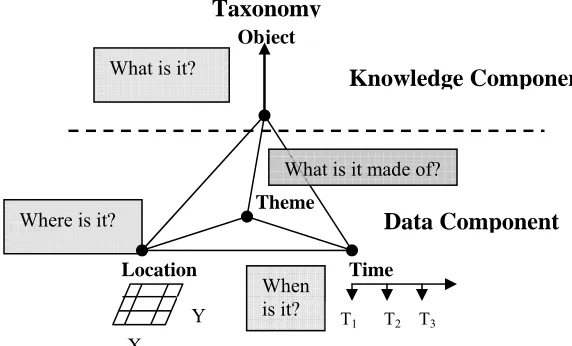
Figure 1: Pyramid Frame work: Data Component and Knowledge Component
there is no data yet to design which can support data analysis, data retrieval, temporal data (time). Early 2000, internet based biodiversity object database system (BODHI) developed also has mentioned above paragraph to handling plant taxonomies. To support spatial and temporal of biodiversity data, one robust data model is required to developed. The purpose of this paper is to develop data model that better facilitates the exploration and analysis of biodiversity data with time factor. The goals of this research, to manage and integrates diverse sets of spatio-temporal plant diversity data together with a county-level geographic information system to build a biodiversity mapping data model and information retrieval system for plant. So that those data may be required, visualized and entered into statistical analysis. Also, allow the explicit representation of plant taxonomies, dynamic process, relationship that compose the biodiversity system in a manner that is intuitive and useful to the researcher. Meeting these goals demands a database model that not only efficiently manages large quantities of biodiversity data, but also retrieve data from data base so that researcher can make analysis.
A conceptual frame work (also know as pyramid frame work) was designed which guide the implementation of the semantic GIS database model [10]. This frame work is interrelated with two separate parts one is data component and another is knowledge component shown in Figure 1. Data component can be divided into three categories: location (position in the spatial three dimensions), time (position alone a time line) and theme (a set of observations, measurements, or attribute values associated with a particular location and time). Data components stores spatio-temporally referenced observational data such as spectral, climate, vegetation and other environmental
attributes.
Data component can be computerized as a multi-dimensional, spatio-temporal referenced ‘hyper-cube’ of observational data that is similar to the ‘feature space’ concept commonly cited in analysis of remote sensing imagery. Knowledge component stores information about higher-level semantic ‘objects’ the geographic entities such as location and space All the objects are also placed within two hierarchical relationship structures central to cognitive knowledge representational and object-oriented modeling, plant taxonomy (generalization). The plant taxonomy structures groups similar objects within a category and stores a rule-base that describes how those objects may be identified within the data space.
However, modeling the spatio-temporal phenomenon remains a complex task due to the large diversity of the entities and phenomena and their possible evolution in the real world. We need a data model and corresponding technologies to depict the dynamic entities and phenomena. Basically, models of this kind should treat an entity as a whole and can provide us as much more rich information as possible, not only data about its current state, but also other data about its past evolution.
Spatiotemporal data models have received much attention in the database research community because of their practical importance and the interesting technical challenges they pose. In the literature review the discussed previous research that most influenced our work on spatiotemporal data modeling. Much previous work focuses on temporal information or spatial information, rather than both.
The main reason for the lack of universal data model is that, models were not originally designed to support time. Researchers have been trying to incorporate the time component in data models while maintaining their original design. The challenge consists in the design of a spatio-temporal biodiversity data model, in parallel with the development of appropriate databases, the development of efficient spatio-temporal biodiversity query languages
2.4 Geographical Information System (GIS)
and presentation of georeferenced data. Georeferenced refers to data about geographic phenomena associated with its location, spatially referenced to the Earth.
Geographical data can represent into following method; points is a single node with NO area (e.g. building), lines is a connection of nodes beginning with a “to” and ending with a “from” (e.g. road, river) and polygon is a series of arc(s) that close around a “label” point (e.g. town, a district). Geographic data component can be classified into three main categories:
2.5 Graphical Interface for Biodiversity
Biodiversity is uniquely characterized by its multi-dimensional attributes, though it has been conventionally prototyped on various plant image or map sheets. To reach a good graphical interfaces and effecting query, and the display of plant data include geographical data should be in multi-dimensional mode and be interacted preferably from various sites.
This aim can be reached by integrating advance in computer graphics and web technology. Advance graphical tools such as ArcInfo, Manifold, ArcView, GIS software digitalize the image and later on stored in database as different image layers makes it possible to develop effective model and increase capability to operate large database on biodiversity. In addition, Andrei Ju, Korolyuk used ArcInfo to evaluate biodiversity in Southern Siberia. Most of the graphical tools (ArcView, ArcSDE) support various RDBMS platforms like DB2, SQL Server, and Oracle 9i. Acquisition of image of plant will be collecting from various places also the temporal data. These images provide digital mosaic of spatial attributes and plant types liable to computer processing.
integrity, query facility and query optimization. GIS systems are not very good at these. However, the strength of GIS lies in its ability to operate on spatial data, and allows analyses that are inherently geographic in nature. A GIS software package like ArcView has powerful but highly flexible tools for map production of both hard and digital types. ArcView combines in various ways the attributes of plant invasion, the management practices in place, with spatial data layers, undertake spatial analysis and produce the results for visualization mostly through maps.
On the other hand, web technology is widely used as a platform to distribute, query, visualize and process taxonomy and geographical data. Integrating graphical software with web technology enables a simultaneous interaction with the display in global and local level.
2.6 Storage Structure for Biodiversity Data
Significant researches have been done to study of storage structure. Existed database only support spatial data not temporal data. Database should efficiently support retrieval of data based on the spatio-temporal extents data. Multi-dimensional access method is required to achieve this database. Many researchers has already initiated their work in this area such as approaches that extended R-trees and Quad tress (Scott, J.M, Davis, F.W, Scuti, 1993) alone with extensive experiments on a variety of synthetic data sets.
From the above discussion, application-oriented discipline of biodiversity mapping and geographic information systems, in particular algorithms, spatial and temporal data structures will have significant practical impact in the near future.
2.7 Query Processing for Biodiversity Databases
There are few processes and optimization has focused on (i) development of efficient strategies for processing biodiversity, spatial, temporal data, (ii) efficient modeling cost for query processing optimization purpose and (iii) study about biodiversity data include spatial and temporal constraint databases.
The query processor of BODHI (Srikant B.J, Jayant R. Haritsa, 2000) integrates the features provided by the service modules through extended ODL/OQL for modeling and querying the database. In addition, it optimizes the queries using the metadata and indexed information, and as part of the Client Index Framework it facilitates transformation of query results into an interchangeable format as request by the user. Example of query is written in the BODHI system, using OQL, as follows:
Select * from species1 in PlantSpecies, species2 in PlantSpecies,
where species1.flowerchar.inflochar=species2.flowchar.inflochar and
species1.georegion overlaps species2.georegion
about parallel and distributed similarity search in a shared –nothing multi-computer architecture, where an R-tree is dispersed among the site of the network (Papadopoulos A. and Y. Monolopoulos, (1996). Similar query processing techniques retaining low response times during query processing. DeokHwan Kim and ChinWan Chung, 2003) proposed content based image retrieval method using adaptive classification and cluster merging to find multiple cluster of a complex image query. In addition, this proposed technique provides significant improvement over the query point movement and the query expansion in terms of retrieval quality.
Query processing is lacking in biodiversity applications, where the data and query objects changes their locations. To support biodiversity data for high retrieval quality, accurate data and without losing time need a robust query processing techniques
2.8 Summary
This chapter discusses details issues related to the undergone research of biodiversity data management, biodiversity data models, spatial and temporal application, spatio-temporal data models and query languages. After analysis proposed models based on biodiversity data, models are designed either spatial or temporal. But most of the models are designed for commercial applications.
Roddick, 1999). Though many researchers have found the necessity of integration of space and time in one environment, by far, little such work has been done.
The structures of space and time are identified as essential for the realization of cognitive systems (Freksa, C., 1998). According to Donna J. Peuquet and her group (Peuquet, D. J., 2001), models of spatial temporal data in geographical database representations must incorporate human cognitive principles. Human knowledge of the dynamic geographical world comprises of three different (and interrelated) subsystems that handle what, where and when aspects of object properties (Mennis, Peuquet et al. 2000), (Sinto 1978). Theme-based model, location-based model and time-based model separately describe one subsystem. From this view, these 3 kinds of model are all single semantic models. According to human cognitive principle, the model we build should cover all of these 3 subsystems. Donna J. Peuquet and her group's pyramid framework show how to incorporate three subsystems of human cognition into data modeling. From above analysis, we should build a unified infrastructure that integrate space and time, mediate discrete and continuous representation, describe when/where/what systematically, and be extensible to various applications. A multi-semantic model cannot ultimately be generated from extension of current single semantic models such as ER model and location/time/theme-based model. Object relational approach with its characteristic of inheritance and aggregation is capable of capturing the various notions of space and time and reflecting them into a single framework extensible to different applications.
Research Methodology
3.0 Introduction
This research framework contains with several phases, which have been identified upon completing this research. Framework also divided into two major phases. In the first phase, consist of literature review on biodiversity data model designing, problem definition can be done after analysis and study behavior of biodiversity data. Data behavior is divided into data pattern, data element and elements which are effective to the data. In the second phase, data model development will be done according to problem statement stated in the first chapter.
3.1 Operational Framework
3.1.1 Problem Formulation (Phase 1)
In this phase, main contribution has been done such as investigation of biodiversity data, behaviors of data pattern, data elements and its effectiveness. Beside the study about biodiversity data, study about spatio-temporal database and architecture of temporal data model.
At this phase, literature review has been done two separate ways. Firstly, researchers need to study about the Biodiversity especially plant data behavior, Biodiversity is the assortment of different types of organisms that co-occur in time and space (spatial and temporal). Time element is very important to analysis in Biodiversity data such as predicting and historical analysis. On the other hand, another issue need to study is complexity of spatial and temporal data. Secondly, researchers need to study about the existed data model if there is any. In this phase, data collects from Pahang forest department, Mardi, Johor Park according to our research requirements.
3.1.2 Data Model Development (Phase 2)
3.2 Method Used
3.2.1 Pyramid Framework and Event-based Approach
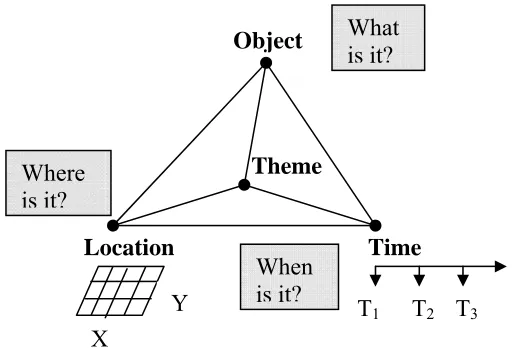
In the design of object-relational biodiversity data model to support spatio-temporal data, pyramid frame can make enhancement to support a biodiversity data model design. A conceptual framework (also known as pyramid framework) was designed which guide the implementation of the semantic geographical information system (GIS) data model (M. Bouzeghoub, 1994). Conceptual frame work is interrelated with two separate parts one is data component and another is knowledge component (Figure 2). Data component can be divided into three categories: location (position in the spatial three dimensions), time (position alone a time line) and theme (a set of observations, measurements, or attribute values associated with a particular location and time). Data components stores spatio-temporally referenced observational data such as
spectral, climate, vegetation and other environmental attributes that maybe queried and visualized to reveal embedded spatio-temporal pattern and relationships. Data component can be computerized as a multi-dimensional, spatio-temporal referenced ‘hyper-cube’ of observational data that is similar to the ‘feature space’ concept commonly cited in analysis of remote sensing imagery.
Knowledge component stores information about higher-level semantic ‘objects’ the geographic entities or process that are describe by the data. Information concerning on object’s location, time and composition. All the objects are also placed within two hierarchical relationship structures central to cognitive knowledge representational and object-oriented modeling, plant taxonomy (generalization) and partonomy (aggregation). The taxonomy structures groups similar objects within a category and stores a rule-base that describes how those objects may be identified within the data space. These rules may be derived from expert knowledge or from inductive analysis of the observation data. In an object-relational data model consists of a set of object classes (of different types or
Figure 2 Pyramid Frame work with three main components; object,location, theme and time
Theme
Time Location
Object What is it?
Where is it?
When is it?
T1 T2 T3
X
Y
attributes with values drawn from certain domains or atomic data types. Of course, there are additional features, such as object valued attributes (Oid), methods, object class hierarchies, etc. Besides objects, attributes describing geometries including time are of particular interest. Hence we would like to define collections of abstract data types, or in fact many-sorted algebras containing several related types and their operations, for spatial values changing over time. This section presents a simple and expressive system of abstract data types, comprising data types and encapsulating operations, which may be integrated into a query language, to yield a powerful language for querying spatio-temporal data.
Theme
Time Location
Object
T1 T2 T3
X
Y
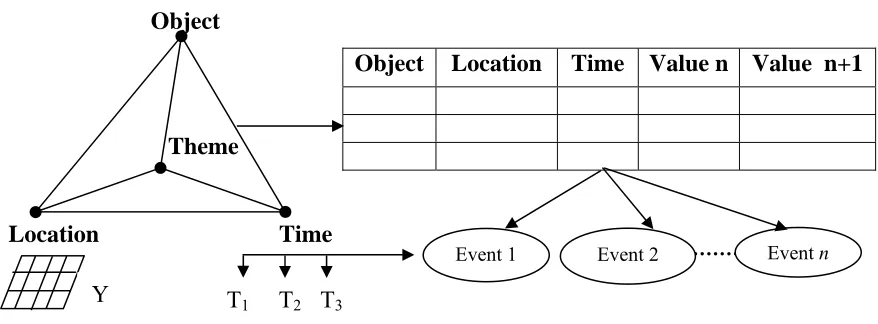
to accessed data from the database. This framework can be converted to table in stated Figure 3.
After the framework conversion as a table, we can see that each object has attributes of theme, space (location) and time. Theme attributes record the information of “what is this object” and other related property information. For example, if the theme of this object is “Forest”, a Forest must have attributes such as Area or Province it belongs to, Forest Size, and Forest Type, etc. Theme can be inherited according to certain classification hierarchy. For example, theme can be classified as natural resources (forest, earth quake, and rainfall), transportation (rail and highway), settlement (country, city), water system (river, lake, and pool), and cadastre etc.
Location attributes record space information of the object, such as whether it is a point, line, or polygon, and its location. Location attributes can be inherited into subclasses such as the point class, line class and polygon class.
Figure 3: From the frame work data transform to the table and time modified as events Object Location Time Value n Value n+1
………
3.2.2 Spatio-Temporal Object-Relational Model
Commercial GIS and Biodiversity related software support spatial object data, some times temporal objects data models based on RDBMS/OODBMS environments. However, temporal data always exists in and around daily life, in business, GIS and forest areas. Since spatio-temporal object-relational model might be new approach to biodiversity area, there are few commercial packages within the full capabilities of temporal object systems. Although there is growing demand for temporal data to be incorporated into biodiversity data, system administrators and system managers experience difficulty n responding to temporal system request because present reliability of working circumstances for temporal applications put time into secondary status.
Biodiversity data is associated with Area, forest, park, marine, flora, fauna, etc. biodiversity data can be interpreted as a digital map/picture that is equivalent to spatial data. This chapter not only examines the objects of flora playing a major role in temporal factors,
This chapter focuses fundamental aspects of the spatio-temporal domain, covering concepts such as objects, properties, relationship, attribute, method, generalization, specialization, association, and aggregation. Based on these, in the object-relational approach, present a small set of constructs aimed at improving the ability to conveniently design a spatio-temporal object relation model for biodiversity. Incorporate the proposed modeling constructs into the object-relation model, resulting in the semantically richer Spatio-temporal Object Relational Plant Biodiversity (STOP Biodi) Data Model.
3.3 Object Relational Model
incorporating the object oriented concept of a user-defined abstract data type (ADT) and associated functions. When using the Object-relational Model (ORM) for a particular system analysis, we introduce the ORM to explain generic characteristics of objects. This model is based upon a bottom up approach. We first present objects and classes and then show how groups of objects and relationships constitute object classes and relationship sets. The ORM consists of objects, object classes, relationships relationship sets, and constraints, only describing common terms of notion of object-orientation.
Object features such as abstract data type and Object relational Database Management System (ORDBMS) is a promising approach to extend the matured feature of Relational Database (RDB). Vendors such as Oracle, Informix, and Microsoft SQL Server have extended their RDBMS to support objects features (R.S. Devarakonda, 2001). Basically, the ORDBMS is the RDBMS with the object-oriented fatures. ORDBMS becomes popular because of the limitations of ODBMSs, such as lack of support for new types and lack of support for composite data values that can prevent it from taking enterprise-wide task. Therefore, by storing objects in the object side of the ORDBMS but keeping the simpler data in the relational side, user may approach the best of both worlds.
3.4 Modeling BIODI with Classical Characteristics
3.4.1 Object Characteristics
There are many definitions of an object. Booch (1991) discusses the state, behavior, and identity of an object: the structure and behavior of similar objects defined in their common class and the interchangeable terms of instance and object. This is a classical language definition, as defined in (Coplien, 1992), where classes play a central role in the object model. Booch also insisted that the term “object” was first formally applied in the Simula language, and objects typically existed in Simula programs to simulate some aspect of reality. Martin (1992) defines an object as anything to which a concept applies and a concept is a shared idea or notion that applies to certain objects within normal awareness. Rumbaugh (1991) notes that an object is defined as a concept, abstraction or thing with crisp boundaries and meaning for the problem at hand. Shlaer and Mellor (1988) define an object as an abstraction of a set of real world things such that: all of the real-world things in the set of the instances have the same characteristics. All instances are subject to and conform to the same rules.
In the face of the increasing complexity of the problems tackled, it was apparent that software systems needed to be better structured. A program is considered to be a set of procedures together with a separate set of data on which the procedures operate. Related design methods consist of “divide and rule”. The splitting up of tasks to be carried out into a set of independent modules is known as black boxes. This is called procedure-oriented programming. However, the slightest change in the data structures can lead to a complete reorganization of these procedures. The idea of information hiding (sometimes called encapsulation) obviates this difficulty because the data and the procedures manipulating it are incorporated into the same entity, namely the object. An object includes a static part, a set of data, and a dynamic part, a set of procedures manipulating this data. An object is defined by its behavior, and represented by the set of its procedures, rather than by its structure.
maintain the hidden internal structures and states of the object. Consequently, procedures may define the only available way to communicate with an object and access its attributes. Procedures are sometimes referred to as functions or methods.
3.4.2 Object- relation Data Model Techniques
The object relational model (ORM) is a way of describing or representing objects, classes of objects, relationships between objects and classes, and real world memberships. The ORM can be considered the static part of object-oriented systems modeling. That is, the ORM describes the “database” of a model: what objects may exists, what objects classes they belong to and what relationships exists between objects. In the object-relational model also consists of object, object classes, relationships relationship sets and constraints.
3.4.2.1 Objects Types:
An object has a set of attributes (Instance variables), and relationship with other objects. An attribute models the state of an object. Spatial and/or temporal information may be associated to objects, independently from the characteristics of their attributes. Consequently, an object type can be plain (neither spatial nor temporal), spatial, temporal, or spatio-temporal. The term object, however, is fundamentally different from the term entity. Entity is concerned merely with data. We typically store a record from each entity. Object concerned with data and the methods with which it is manipulated. For example, in biodiversity data model different object represents the different real world entities as shown in Figure 4.
There are two types of object diagrams: class diagrams and instance diagrams. A class diagram is a schema, pattern, or template for describing many possible instances of data. A class diagram describes object classes. An instance diagram describes how a particular set of objects relates to each other.
Biodiversity Data
Taxonomy Data Geospatial Data Temporal Data
Point Line Polygon
SpatioObject Geo-region
Figure 4: Object type and spatial data as object
3.4.2.2 Abstraction mechanism
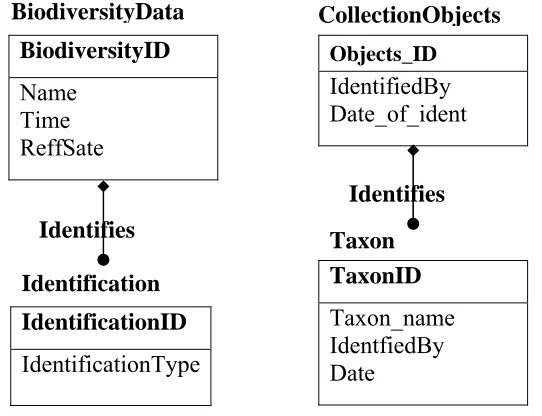
The object-relational data model is built on few basic concept of abstraction: relationship, generalization, association and aggregation. These abstraction concepts may be described by the means of relationship sets. A relationship set is a set of relationships, all of which have the same role to between objects. In an object-relational diagram, a relationship set is represented by lines connecting associated objects. As for objects, relationship may be located in space and time, via two attributes. In this case they are referred to as spatial and/or temporal relationships. Figure 5 shows identify relationship between two objects.
3.4.2.3 Generalization and specialization
Generalization and specialization represents the “Is-a” relationship set, an essential element of object-relational paradigm. The main idea in generalization and specialization is that one object class (specialization) is a subset of another (the generalization). The process of generalization consists of putting classes together in what
BiodiversityID Name Time ReffSate IdentificationID IdentificationType Identification Identifies Objects_ID IdentifiedBy Date_of_ident TaxonID Taxon_name IdentfiedBy Date CollectionObjects Taxon Identifies BiodiversityData
is called a superclass. Generalization enables us to perceive that all instances of more specific concept are also instance of general concept. Specialization, on the other hand, breaks apart a class by differentiation of properties or forms a set of lower class called subclass. Specialization allows us to describe each subclass of a more general class by specifying only the additional details necessary for us define. Subclass describes a specialization of the superclass.
The terms superclass and subclass characterize generalization and specialization. It is important to note that superclass a subclass are abstraction of the same object, and do not describe two different objects. The direction of the “Is-a” relationship goes from the specialization to the generalization (Figure 6), that is, it may be stated as, “Specialization Class is-a Generalization Class”.
3.4.2.4 Association
An association describes a group of links with common structure and common semantics. A link is a physical or conceptual connection between object classes. All the links in an association connect objects from the same classes. Association and links often appear as verbs in a problem. An association describes a set of potential links in the same way that a class depicts a set of potential objects. In fact, the notion of an association is
Biodiversity Data
Taxonomy data Geospatial data Temporal data
Is-a Generalization
Specialization
certainly not a new concept. Associations are widely used throughout the database modeling community for years.
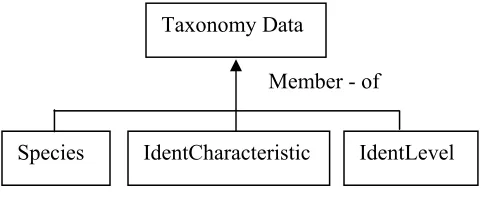
In an object-relational model diagram, association is also known as the “member of” relationship set (Figure 7) For example; clubs and teams are usually modeled using association. Accordingly, an object in the Taxonomy data object class is a set of objects from the PlantSpecies, IdentCharacteristic, IdentLevel. The relationship set is read “PlantSpecies is a member of Taxonomy Data”.
3.4.2.5 Aggregation
An aggregation represent the “a –part-of” or “is subpart of” relationship set, in which objects representing the components of something are associated with an object representing the entire assembly. Aggregation is a strong from of association in which an aggregate object is made of components. Components are part of the aggregate. The aggregate is semantically an extended object that is treated as a unit in many operations, although physically it is made of several lesser objects. A single aggregate object may have several parts: each part-whole relationship is treated as a separate aggregation in order to emphasize its similarity to association.
However, there are may be some discussions of the differences between association and aggregation. Aggregation is a spatial form of association, not an
Taxonomy Data
Species IdentCharacteristic IdentLevel Member - of
independent concept. Aggregation adds semantic connotations in certain cases. If two objects are tightly bound by a part-whole relationship, it is an aggregation.
If the two objects are usually considered as independent, even though they are often linked, it is an association. But, the decision to use aggregation is often arbitrary a being matter of judgment. Often it is not obvious if an association should be modeled as an aggregation (James E. etl., 1991)
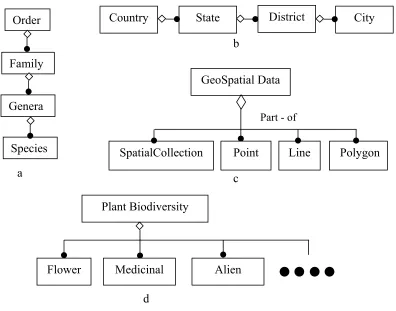
Most of the objects dealt with in biodiversity databases are composite, i.e., they exhibit an aggregation hierarchy. They follows are some of the aggregations in the biodiversity data models:
An order contains several families. A family in turn contains several genus and genus contains closely related species. Since a family cannot belong to two order, the
c b
Figure 8: Aggregations in Stop-BDM data model GeoSpatial Data
SpatialCollection Point Polygon
Part - of
Line Order
Family
Genera
Species
Country State District City
Plant Biodiversity
Flower Medicinal Alien a
order-family relationship is modeled as an aggregation rather han an association. Similar arguments hold for genera and species also. Hence, taxonomy hierarchy is modeled as a four level containment hierarchy in Stop-BDM (figure 8a)
A country contains number of states, each states is made up of districts and districts made up of cities. The relationship is also modeled as a four level containment hierarchy. Similarly, the association between a city and the forest department in the city and the association between a country and a forest are modeled as aggregations (figure 8b).
Figure 8c is an example of an aggregation. Geospatial object in as aggregation of the SpatialCollection, point, line and polygon that are the part of it.
3.4.2.6 Constraint
Most of the system can be model with objects, objects classes, and relationship sets. Constraints are functional relationships between entities of an object relationship model. Constraints provide one certain for measuring the quality of an object relational model. In object relational model, a constraint restricts the membership of one or more object classes and relationship sets. The object relational model allows analysis to express several different types of constraints. However, in the object behavior model and interaction model, it may be useful to use this constraint in order to describe some restricted condition.
3.5 Modeling Object Behavior of STOP BIODI Model
behavior model to document the way objects in a system function, respond or perform. We use the Object Behavior Model (OBM) to describe the behavior of the objects in a system. The OBM is a means of describing the behavior of objects. As we know that a database consists of a set of object classes (of different types or schemas). Each object class has an associated set of objects; each object has a number of attributes with values drawn from certain domains or atomic data types.
In this chapter, thesis describes three steps of object processes pertaining to evolution and relationships of objects, and structural changes of objects. Basic processes of spatio-temporal objects are essential to portray physical phenomena, arising from the fact that object behaviors are unpredictable. These processes prove that objects move and interact with other objects in a specific place at a given time. Object attributes are continuously changed when space interacts with time. In order to depict object process in space and time, we examine five spatio-temporal data models, ranging from a cube model to an object model.
In addition, three kinds of data domain are reviewed to understand current temporal GIS developments and technologies because there is no agreement on a spatio-temporal framework, based upon the three-legged approach to location (where), feature type (what), and event time (when). An event can be describes in two ways one in the field and another within the system. Event change in reality when transaction goes in the field by some one and event change within the system which includes the creation or deletation of object or relationships, the starting or stopping of an activity and the reception of a message from other objects.
3.6 Spatio-Temporal Abstract Data Types (ADT)
These types may be used in the same way as built-in types. For example, columns in relational tables may be defined as taking values of user-defined types, as well as built-in types. A user-defined Abstract Data Type (ADT) definition encapsulates attributes and operations in a single entity. An abstract data type (ADT) is defined by specifying a set of declarations of the stored attributes that represent the value of the ADT, the operations that define the equality and ordering relationships of the ADT, and the operations that define the behavior (and any virtual attributes) of the ADT. ADTs can also be defined as subtypes of other ADTs. A subtype inherits the structure and behavior of its supertypes (multiple inheritance is supported). Instances of ADTs can be persistently stored in the database by storing them in columns of tables. Points, line, and polygons in the Georelational data model are examples of spatial ADT stored in table columns. Spatio-temporal ADT is a research topic that attracts many researchers, and is represented by the Event-based Spatio-temporal Data Model, the STComposite data model, and the Worboys data model.
3.6.1 Data Type “Date”
3.7 Temporal Object System
3.7.1 Object in Time
When describing the modeling of time in temporal database, there have been many efforts to model temporal data. As depicted above, time is a linear and discrete collection of time units, of which the smallest one is considered as chronons. An interval is represented by two chronons (e.g., moment, instant) indicating the beginning and end of the interval. In view of temporal issues, transaction time can be one of multiple past states of an object. Chakravarthy and Kim (1993) argue that there nay be multiple interpretations for the temporal behavior (validity) of class of data objects. Using the idea of temporal validity, they define the notion of history as being a representation of the evolution of an object along a one-dimension time. The significance of temporal validity is associated with each individual property, that an object has its own characteristics as temporal attributes (or data values) related to the temporal behaviors of data objects.
3.8 Spatio-temporal Object
three-D-time is a portion of time that is being viewed on a sufficiently large scale as if it were a volume within which a thing occurred (e.g, in “1996”) rather than a plane on which a thing occurred (e.g, “on that day”). A one-or-two-D-time is a temporal object that is associated with time intervals or smaller scale successions of time instants, e.g, a day (as opposed to a year).
The spatio-temporal sub-hierarchy is organized along a number of dimensions, which combine to form specific categories of relationships between entities and locations in space and time. The Upper Model (UM) (Bateman et al., 1994) delineates that most spatio-temporal subclasses are responsible for the appearance of specific prepositions within prepositional phrases generated by the grammar to express spatio-temporal relationships. According to the UM, spatio-temporal linguistics includes relations associated with time, space, directions, and extents. In principle, there are two level distinctions between locating and extents. In English, the extent-dimension is responsible for the selection of prepositional phrases involving prepositions such as for, along during, as in the prepositional phrases: “for six days”, “for three miles”, “across the bridge”, “along the street”, “during the seminar”, etc.
3.9 Object-relational Features
As we know that within the classic relational database model there are only scalar but no complex data types. With the introduction of object types the definition and composition of abstract data types is possible. An abstract data type can be comprised of a multitude of scalar types and again of user-defined complex types and enhances consistency when creating database models.
create or replace type Address_TY as object ( City VARCHAR2 (30),
Sate VARCHAR2 (30),
Country VARCHAR2 (30));
Here create or replace the Address_TY data type after that create Org_Address_TY by using Address_TY data type.
create or replace type Org_Address_TY as object (
Org_name VARCHAR2 (30),
Address Address_TY, Org_url VARCHAR2 (50), Phone NUMBER (12), Email VARCHAR2 (30));
Data types only represent descriptions of data structures. To ensure persistency a table must be bound to the data type. A relation with column objects can be created that is a set of Observer_ID with Observer_name, Observer_org and Observer_Address as:
create or replace type Observer as object ( Observer_ID VARCHAR2 (15),
Observer_name VARCHAR2 (30),
Observer_org VARCHAR2 (50), Observer_Address Org_Address_TY );
Object views allow user to treat relationally data as they allow synthesizing object from data that continues to be stored in relational tables. Object views have similar functionality like object tables. They can have methods, belongs to collections, reference one another, have object identity and can be accessed from SQL. In addition tables are assigned to object views can be uploaded by using special instead of triggers. Any instance (row) of an object class contains a unique ID called Object_ID (ID). Generally OIDs are system-generated but can also be derived from a primary key column or can be user-defined.
can be selected and dereferenced using the DEREF VALUE operator. Modeling object relationships with OIDs and REFs is often compared with foreign key relationships inside the relational model but implicates some benefits like the ability to distinguish between equal and identical objects. Objects are identical if they have one common OID. They are equal if they have different OIDs but coincide with their attributes and values.
In the classical Entity-Relationship-Model aggregations and compositions are modelled through master-detail-relationships. Object-relational dbms provide collection types that contain multiple elements and thus are suitable to express 1: N relationships directly. Each element or value for a collection has the same substitutable data type. The most popular collection types are varrays and nested tables.
A varying array contains a variable number of ordered elements. Varying array data types can be used as a column of a table or as an attribute of an abstract type. Named table types can be created in an Oracle database using SQL. These table types can be used as nested tables to provide the semantics of an unordered collection. As with varray a nested table type can be used as a column of a table or as an attribute of an object type.
Named table types can be created in an Oracle database using SQL. These table types can be used as nested tablesto provide the semantics of an unordered collection. As with varray a nested table type can be used as a column of a table or as an attribute of an object type.
Create type Address_TY as table of Org_Address_TY;
Multi-Level-Collections that lead to multiple nested tables can be realized if useful for applications but it’s up to the user to balance – a more intuitive representation of data vs. higher complexity of accessing the data.
the function itself (the definition of the method) is in a separate create type body command.
create or replace type Taxon_TY as object ( Taxon_Lname VARCHAR2 (20),
Tanon_Ename VARCHAR2 (20), Taxon_Species Species_TY, Taxon_family Family_TY, Taxon_area Area_TY,
Taxon_description VARCHAR2 (50), Taxon_start_date DATE,
Taxon_end_date DATE,
Member function DURATION (start_date, end_date in Date) return Number);
Names the function that is a “member” of the Taxon_TY datatype. Since Duration will return a value, it is a fuction. To define DURATION function, use the create body command, whose full syntax is shown in the Alphabetic Reference.
Let’s create the Duration function as a member function within the Taxon_TY datatype. The DURATION function will return duration, in days, of the taxon.
create or replace type body Taxon_TY as
member function DURATION (start_date, end_date DATE) return NUMBER is
begin
return totaldays (start_date + end_date ); end;
The following query executes the duration method in the data type Taxon_TY and returns the duration of all collection objects in relation Observation. Values of components of an object (attributes and methods) are accessed with the dot notation.
from Observation O ;
Object types can be mapped to the prevalent OO languages like C++ and Java. Thus object type instances in the database can be accessed and modified to and from C++, Java applications (Lee, G., 2003).
In the current version Oracle database 10g native data types for storing raster and persistent topology data were added to further extend possibilities to model real world objects based on object-relational database structures. The completeness and therefore the quality of spatial features’ descriptions can be further enhanced with the introduction of a new system-defined data type XMLTypethat can be used as the datatype for columns in tables and views to create, extract, and index XML data. A feature’s position and spatial representation is then modeled by using vector resp. raster types, its characteristics are captured by (complex) attributes and any further information on the spatial object, that cannot be structured to be kept in the data types mentioned, is maintained in xml-documents, all stored natively within the database.
For modeling highly dynamic changes of real world objects the SQL type
TIMESTAMP can be used which is a high-precision time and date type that allows storing fractions of a second (Qian, L., 2004). The timestamp values are basically points on a linear time axis. For slower changes in state we can use DATE or create own adapted abstract data types that can express discrete dates or times intervals. The data types can be flexibly extended to meet an application’s accuracy requirements and provide attributes to express the fuzziness of a time record, for instance if a time interval cannot be determined as accurate as the data type could store (Plabst. S., 2001).
create or replace type TIME_TY as object ( year NUMBER (4,0),
month NUMBER (2,0), day NUMBER (2,0), hour NUMBER (2,0));
start_date TIME_TY, end_date TIME_TY,
start_date_per NUMBER (1,0), end_date_per NUMBER (1,0));
3.10 Object-relational Application Development
In terms of Biodiversity data of Malaysia, object-relational database technology can be used to model different applications, e.g. the spatio-temporal process of flora or fauna based on its influencing factors or real time deer tracking.
For the development biodiversity data modelsome major influencing factors have been proved to be crucial. In the model we have judged like data should be natural to human. The structures of space and time are identified as essential for the realization of cognitive systems. Models of spatial temporal data in geographical database representations must incorporate human cognitive principles. Finally model support human knowledge of the dynamic geographical world comprises of three different (and interrelated) subsystems that handle what, where and when aspects of object properties.
create or replace type Position_TY as object ( Map VARCHAR2 (30),
Grid25 NUMBER (4), Grid100 NUMBER (4).
Create or replace type SpatialData as object ( Forest_ID NUMBER (6),
Forest_name VARCHAR2 (30), Forest_area AREA_TY,