Copyright2001 by the Genetics Society of America
Nuclear Gene Dosage Effects Upon the Expression of
Maize Mitochondrial Genes
Donald L. Auger, Kathleen J. Newton and James A. Birchler
Division of Biological Sciences, University of Missouri, Columbia, Missouri 65211 Manuscript received October 6, 2000
Accepted for publication December 21, 2000
ABSTRACT
Each mitochondrion possesses a genome that encodes some of its own components. The nucleus encodes most of the mitochondrial proteins, including the polymerases and factors that regulate the expression of mitochondrial genes. Little is known about the number or location of these nuclear factors. B-A translocations were used to create dosage series for 14 different chromosome arms in maize plants with normal cytoplasm. The presence of one or more regulatory factors on a chromosome arm was indicated when variation of its dosage resulted in the alteration in the amount of a mitochondrial transcript. We used quantitative Northern analysis to assay the transcript levels of three mitochondrially encoded components of the cytochrome c oxidase complex (cox1,cox2, andcox3). Data for a nuclearly encoded component (cox5b) and for two mitochondrial genes that are unrelated to cytochrome c oxidase, ATP synthase ␣-subunit and 18S rRNA, were also determined. Two tissues, embryo and endosperm, were compared and most effects were found to be tissue specific. Significantly, the array of dosage effects upon mitochondrial genes was similar to what had been previously found for nuclear genes. These results support the concept that although mitochondrial genes are prokaryotic in origin, their regulation has been extensively integrated into the eukaryotic cell.
M
ITOCHONDRIA are the cellular sites for many dance of CMS transcripts (reviewed bySchnableand Wise1998).energy conversion processes. Each
mitochon-CMS can also result from divergent nuclear-cyto-drion possesses a genome that encodes a portion of
plasmic interactions. For example, a nuclear genome the components necessary for its own biogenesis and
from the A619 maize inbred in combination withZea functioning. The nuclear genome codes for most of
perenniscytoplasm results in plants that are apparently the mitochondrially localized proteins. Mitochondrial
normal except that they are male sterile (Gracenand transcript levels appear to be subject to cell-specific
reg-Grogan1974). Most other maize inbred lines possess ulation (e.g., Young and Hanson 1987; Singh and
dominant nuclear genes that restore male fertility Brown1993;Mone´geret al. 1994; Smart et al. 1994;
(Gracen and Grogan 1974; Laughnan and Gabay -Liet al. 1996). Although nuclear genes are thought to
Laughnan 1983). Up to three nonallelic dominant control mitochondrial transcript levels by influencing
genes have been identified that each independently re-transcription and RNA processing, few such genes have
stores fertility to Z. perennis cytoplasm (Newton and been identified. Mitochondrial transcription is
accom-Coe1989). plished by nuclearly encoded phage T7-like RNA
poly-CMS is not the only effect resulting from divergent merase and associated transcription factors (Newton
nuclear-cytoplasmic interactions. A combination of any et al.1995;GrayandLang1998).
teosinte cytoplasm from the section Luxurians with the Direct evidence of the interaction between nuclear
maize inbred W23 nuclear genome results in plants that and mitochondrial genes comes from the study of
cyto-are small, pale, and slow growing (Allen et al. 1989). plasmic male sterility (CMS). CMS is an economically
This “teosinte-cytoplasm-associated miniature” (TCM) important plant trait that facilitates the production of
trait also results in reduced kernel size. Two dominant hybrid seed without manual emasculation of plants
(re-nonallelic nuclear genes have been identified that rec-viewed byHansonandFolkerts1992;Levings1993).
tify the TCM trait and result in normal plants (Allen Mitochondrial CMS genes appear to be novel chimeric
et al.1989). DNA sequences whose expression perturbs the
develop-Plants with divergent nuclear-cytoplasmic combina-ment of pollen. Genes involved in restoring fertility (Rf
tions have also demonstrated nuclear-mitochondrial in-genes) are nuclear and often act by reducing the
abun-teractions at the molecular level. InZ. perennisand many maize plants withZ. perenniscytoplasms the most abun-dantcytochrome c oxidase subunit 2 (cox2) transcript is a Corresponding author:James A. Birchler, Division of Biological
Sci-1.9-kb mRNA. If the maize nuclear genome possesses
ences, 117 Tucker Hall, University of Missouri, Columbia, MO 65211.
E-mail: [email protected] the dominantModifier of cox2 transcript(Mct) gene, then
TABLE 1
a novel 1.5-kb transcript predominates and the 1.9-kb
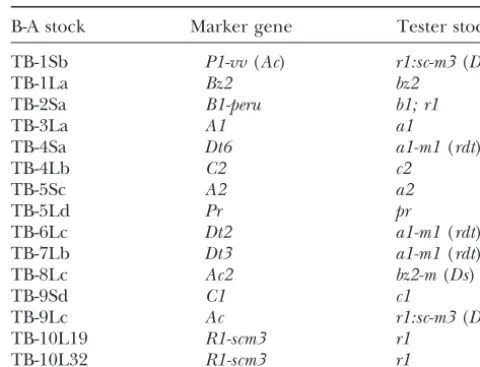
transcript level is reduced (Cooper et al. 1990). The B-A stocks and testers used to produce dosage series novel transcript is due to the activation of a promoter
sequence that had been previously undescribed (New- B-A stock Marker gene Tester stock tonet al.1995). Thus,Mctis a nuclear factor that affects
TB-1Sb P1-vv(Ac) r1:sc-m3(Ds)
the size and abundance ofcox2mRNAs by determining
TB-1La Bz2 bz2
transcription start sites. TB-2Sa B1-peru b1; r1
The purpose of this study was to investigate the interac- TB-3La A1 a1
tion of the nuclear genome with mitochondrial gene TB-4Sa Dt6 a1-m1(rdt)
TB-4Lb C2 c2
expression levels in maize with normal cytoplasm. B-A
TB-5Sc A2 a2
reciprocal translocations were used to create
chromo-TB-5Ld Pr pr
somal dosage series for fourteen chromosome arms.
TB-6Lc Dt2 a1-m1(rdt)
These chromosomal dosage series were used to
deter-TB-7Lb Dt3 a1-m1(rdt)
mine which chromosome arms, when varied in dosage, TB-8Lc Ac2 bz2-m(Ds) affected the level of expression of various mitochondrial TB-9Sd C1 c1
genes. The basis of the chromosomal dosage effects is TB-9Lc Ac r1:sc-m3(Ds)
TB-10L19 R1-scm3 r1
believed to be rate-limiting factors that modify gene
TB-10L32 R1-scm3 r1
expression (GuoandBirchler1994). The effect could
be at the level of transcription or it could involve a post- B-A stocks are named for the translocation present. B-A transcriptional aspect of gene expression, such as RNA chromosomes are marked with either a color factor (A1,A2, B1-peru,Bz1,Bz2,C1,C2,Pr1, orR1-scm2) or an autonomous stability. The dosage effects of 14 chromosome arms
transposable element (AcorDt). Except for the recessive color were determined for RNA in both embryo and
endo-factor indicated above, each tester stock was homozygous for sperm tissue of kernels 30 days postpollination.
A1,A2,b1,Bz1,Bz2,C1,C2,Pr1, andR1-scm2. Several testers Previous studies have indicated an extensive array of had color factors that possessed insertions of a nonautono-trans-acting dosage effects on nuclear genes (Birchler mous transposable element (Dsorrdt).
and Newton 1981; Guo and Birchler 1994). Mito-chondrial genomes, having evolved from a prokaryotic
Fifteen different maize stocks, each possessing a different progenitor, could differ significantly in regulatory
pro-B-A translocation, were used to generate dosage series (Table cesses, so it was of interest to determine whether the
1). Each stock is named for the translocation present. Translo-same types of effects were operative on organellar genes. cations are designated according to which chromosomes are We also examined the degree to which related mito- involved. Maize chromosomes are numbered from 1 to 10, each possessing a long (L) and a short (S) arm. TB-1Sb involves chondrial genes are coordinately affected. Finally, we
a translocation between a B chromosome and the short arm determined the effects upon the expression level of a
of chromosome 1. Each translocation is also given an alphabet-nuclearly encoded mitochondrial protein. The effects
ical or numerical suffix so that it can be distinguished from upon the nuclear gene were compared to the effects other translocations involving the same chromosomes. For upon the mitochondrial genes to determine whether example, we have included both 10L19 and 10L32. 10L19 has all of 10L attached to the B centromere, while TB-they are subject to the same types of modulations.
10L32 has only the most distal 26% of 10L (Maguire1985). To simplify our text we omitted the TB prefix because in each case it is understood that what has been manipulated was a MATERIALS AND METHODS
translocation with a B chromosome.
Each translocation stock had the B-A chromosome marked
Production and identification of aneuploids:Dosage series
were produced using B-A reciprocal translocations. B chromo- with a dominant genetic marker, either an anthocyanin color gene or an autonomous transposable element (Table 1). somes are supernumerary and often nondisjoin at the second
pollen mitosis. This results in one sperm of a pollen grain having Plants with marked B-A chromosomes were crossed onto an appropriate tester plant. Testers possessed either a recessive two B chromosomes and the other having none (Roman1947).
A B-A translocation involves an exchange of part of the B allele of a color marker gene or a reporter gene that produces colored spots in the presence of an autonomous transposable chromosome with one of the 10 chromosomes that make
up the haploid set of maize (i.e., an A chromosome). The element (Table 1). Reporter genes are color factors that are nonfunctional due to the insertion of a nonautonomous trans-translocation chromosome with the B centromere and an arm
of an A chromosome generally behaves like the B chromosome posable element. In the presence of a related autonomous element, the nonautonomous element sporadically excises and regularly nondisjoins at the second pollen mitosis (see
Beckett1978). In that case one sperm has two copies of the from the gene, causing it to become functional.
The marker system allowed for the determination of chro-translocated A chromosome arm and the other has none. This
creates an opportunity to produce aneuploids. Fertilization mosome arm dosage because nondisjunction of the B-A chro-mosome resulted in noncorrespondence of embryo and the of the egg with the sperm that possesses two B-A’s yields
indi-viduals that are hyperploid for the A chromosome arm; fertil- endosperm phenotypes (BirchlerandAlfenito1993). When the sperm with two B-A’s fertilized the egg, the embryo was ization with the deficient sperm results in progeny that are
hypoploid for that same chromosome arm. Euploid progeny hyperploid and colored (or spotted). These colored embryos had hypoploid colorless endosperm because the other sperm are also produced because some of the pollen grains possess
fertil-TABLE 2
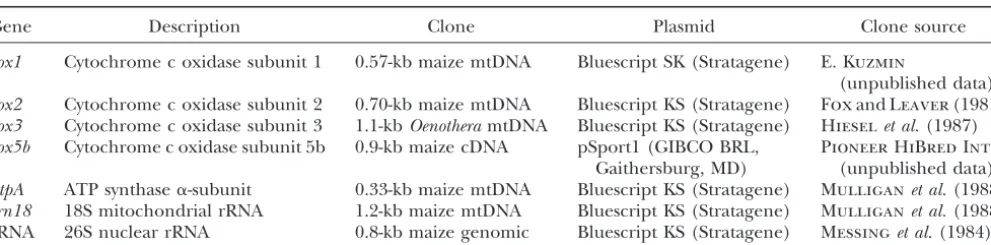
Probes used for Northern analysis
Gene Description Clone Plasmid Clone source
cox1 Cytochrome c oxidase subunit 1 0.57-kb maize mtDNA Bluescript SK (Stratagene) E. Kuzmin
(unpublished data) cox2 Cytochrome c oxidase subunit 2 0.70-kb maize mtDNA Bluescript KS (Stratagene) FoxandLeaver(1981) cox3 Cytochrome c oxidase subunit 3 1.1-kbOenotheramtDNA Bluescript KS (Stratagene) Hieselet al.(1987) cox5b Cytochrome c oxidase subunit 5b 0.9-kb maize cDNA pSport1 (GIBCO BRL, Pioneer HiBred Intl.
Gaithersburg, MD) (unpublished data) atpA ATP synthase␣-subunit 0.33-kb maize mtDNA Bluescript KS (Stratagene) Mulliganet al.(1988) rrn18 18S mitochondrial rRNA 1.2-kb maize mtDNA Bluescript KS (Stratagene) Mulliganet al.(1988) rRNA 26S nuclear rRNA 0.8-kb maize genomic Bluescript KS (Stratagene) Messinget al.(1984)
ized the central cell. Alternatively, when the sperm with two in vitro transcription using T3, T7, or Sp6 RNA polymerase (Promega, Madison, WI). Probes for rRNA were synthesized B-A’s fertilized the central cell, the endosperm was hyperploid
and colored and the embryo was hypoploid and colorless. by PCR using T3 and T7 primers. The hybridization solution was 50% formamide, 5⫻SSC (0.75mNaCl; 0.075msodium Normal disjunction of the B-A at the second pollen mitosis
resulted in both the embryo and endosperm being euploid citrate), 10⫻ Denhardt’s solution, 0.5% SDS, 10% dextran sulfate, and 0.2 mg/ml fragmented salmon sperm DNA. The and having color since each received one copy of the B-A.
Plants were grown and pollinations were made as described blots were washed for 2 hr at 75⬚with four changes of wash solution. The wash solution was 0.2⫻ SSC and 0.05% SDS. byNeuffer(1994). Kernels were harvested 30 days after
polli-nation. Embryos and endosperms were classified, separated, When a double-stranded DNA probe was used to detect rRNA, the prehybridization and hybridization temperature was 55⬚, and immediately frozen in liquid nitrogen. Tissues were stored
at⫺80⬚. the wash temperature was 65⬚, and no dextran sulfate was
used in the hybridization buffer.
RNA isolation:RNA was extracted from frozen tissue.
Typi-cally 10–20 embryos (ⵑ1 g) from the same ear with the same Probe sources:All clones were inserted into plasmids that allowed for in vitro transcription (Table 2). The clone for chromosome arm dosage were pooled. Similarly, 5–15
endo-sperms (ⵑ2 g) were combined. Total RNA was isolated using cytochrome c oxidase subunit 1 (cox1) was obtained from E. Kuzmin(unpublished results), who cloned a 0.57-kbPst1/ a method similar to that used byConeet al. (1986). Tissue
was ground to a fine powder in liquid nitrogen using a mortar ApaLI fragment from a maize CMS-S-library. This fragment covers the 5⬘ portion of thecox1gene. Part of the original and pestle. About 10 ml of lysis buffer was rapidly and
vigor-ously added per gram of frozen ground tissue. The lysis buffer clone for maizecox2(Foxand Leaver1981) was subcloned into pBluescript KS⫹by K. Yamato in the K. Newton labora-was 2% sodium dodecyl sulfate (SDS), 0.1msodium chloride
(NaCl), 50 mmTris-HCl (pH 7.4), 50 mmdisodium ethylenedi- tory. The original clones for cytochrome c oxidase subunit 3 (cox3; Hieselet al. 1987) and mitochondrial 18S rRNA (rrn18; aminetetraacetate (EDTA; pH 8), and 200g/ml proteinase
K. The supernatant was subjected to three extractions: the Mulliganet al. 1988) were subcloned into pBluescriptII KS⫹ by M. Guo in the J. Birchler laboratory. M. Guo also subcloned first two with phenol (pH 7.9):chloroform (1:1) and the last
with pure chloroform. After each extraction the samples were a 0.8-kbXhoI/EcoRI fragment of 26S rDNA into pBluescriptII KS⫹from an original 9-kb clone (Messinget al. 1984). The centrifuged at 12,000⫻gfor 10 min. Total RNA was
precipi-tated with LiCl (2mfinal solution). The RNA was redissolved clone for cytochrome c oxidase subunit Vb (cox5b) provided by Pioneer Hi-Bred Intl.(unpublished results) was an ex-and reprecipitated with 2.5 volumes absolute ethanol ex-and 0.1
volume 3msodium acetate (pH 5.4). The RNA was then redis- pressed sequence tag that was identified by its homology with cox5bof rice (Kadowakiet al. 1996). The clone for ATP syn-solved in formamide and the concentration was determined
by measuring the optical density of a sample at 260 nm. thase␣-subunit (atpA; Mulliganet al. 1988) was provided in pBluescript KS⫹.
Electrophoresis and blotting: Samples were subjected to
electrophoresis in formaldehyde-agarose (1.5%) gels. Each Data analysis:Hybridized transcripts were quantitated using a Fuji (Stamford, CT) phosphorimager. Nuclear 26S rRNA was lane was loaded with 5g of total RNA. RNA was transferred
to uncharged nylon membranes by capillary blotting. The used as the gel-loading control. It was previously demonstrated that rRNA is a reliable loading control that shows no demon-RNA was immobilized on the membranes by UV cross-linking.
Methylene blue staining:Blots were stained with methylene strable fluctuation in expression level for the various chromo-some arm dosage series (GuoandBirchler1994). The signal blue (Herrin andSchmidt 1988). They were immersed in
5% acetic acid and gently agitated for 15 min. The acetic acid strength of the rRNA was obtained either from the methylene blue image or from subsequently probing the blot with a was replaced with a methylene blue staining solution (0.5m
sodium acetate, pH 5.4; 0.04% methylene blue) and allowed radiolabeled rRNA probe. The methylene blue images were quantitated using the same Fuji software that was used for the to agitate for another 10 min. Blots were rinsed in deionized
distilled water. The moist blots were wrapped in clear plastic radiolabeled probes. The relative quantity of the probed RNA was determined from the ratio of the mRNA/rRNA signal and scanned on a conventional flat bed scanner.
Hybridization:Hybridization conditions were essentially the strength.
For each chromosome arm there were three doses: hypo-same as inBirchlerandHiebert(1989) for RNA antisense
probes. The blots were prehybridized for 4 hr at 60⬚. A 32P- ploid, euploid, and hyperploid. Three samples were made for
each tissue at each dosage. Means and standard errors were radiolabeled probe was added and allowed to hybridize for
The data for the expression levels of all six genes are presented in Figure 2 for the embryo tissue and Figure 3 for the endosperm tissue. Although each dosage series is composed of three conditions (hypoploid, euploid, and hyperploid), statistical analysis was performed by pairwise comparisons of aneuploid to the euploid. A shaded box indicates aneuploid expression levels that were significantly different from the euploid (Pⱕ0.05 pert-test). In each pairwise comparison, the effect was considered positive if the sample with the higher dosage had an increased expression level, i.e., hypoploid less Figure 1.—RNA species with multiple transcripts. Three
than euploid or euploid less than hyperploid. The effect genes gave multiple transcripts:cox1, cox2, andatpA. Arrows
was considered negative if the higher ploidy sample had indicate the particular transcripts used in this study. Note that
a lower expression level, i.e., hypoploid greater than whileatpAgave multiple transcripts, only the 2.5-kb transcript
was reliably represented on all blots. A double-headed arrow euploid or euploid greater than hyperploid.
indicates this. There were eight combinations of effects that resulted
from dosage series (Figure 4). In several cases both the hypoploid and hyperploid resulted in effects relative to euploid, the mean of the mRNA/rRNA value for each dose
was divided by the mean of its respective euploid mRNA/ the euploid that were consistent;i.e., both were positive rRNA signal. This resulted in all euploids having an expression or both were negative. These are called series effects. level of one and any variation in the expression level of the
The effect of the 5Lb dosage series upon cox2 in the aneuploid was evident as a deviation from one. Significant
embryo is shown as an example of a positive series effect; differences between aneuploid and euploid expression levels
i.e., the transcript level increases with the copy number were determined byt-tests (Pⱕ0.05).
of 5L. The effect of the 1La dosage series oncox5bin the embryo is shown as an example of a negative series RESULTS
effect. More rare were the mixed effects (Figure 4), where the hypoploid and hyperploid effects were oppo-The expression levels of five mitochondrial genes
site from each other. If both aneuploids had transcript were assayed. Three of them (cox1,cox2, andcox3)
en-levels that were less than the euploid, then the effect code subunits of the cytochrome c oxidase complex of
of hypoploidy was positive and the effect of hyperploidy the mitochondrial electron transport chain. The two
was negative. If both aneuploids had transcript levels other mitochondrial genes encode proteins involved
that were greater than the euploid, then the effect of with the ATP synthase and ribosomal complexes (atpA
hypoploidy was negative and the effect of hyperploidy and rrn18). We also assayed effects upon a nuclearly
was positive. The two types of mixed effects are exempli-encoded component of the cytochrome c oxidase
com-fied by the pattern of 5Sc onatpA and 8Lc oncox2in plex (cox5b).
embryo tissue (Figure 4). More common were the cases Three genes showed a multiple banding pattern
(Fig-where the effect occurs either in only the hypoploid or ure 1). In each case, one band was selected to obtain
the hyperploid. Four examples, all from endosperm data for this study. The cox1 gene produced two
tran-comparisons, are shown in Figure 4 to illustrate these scripts. Our estimated sizes of 2.3 and 2.2 kb were very
cases. close to the published transcript sizes of 2.4 and 2.3 kb
Dosage effects upon mitochondrial genes:The array (Isaacet al.1985a). The data presented in Figures 2 and
of effects upon the mitochondrial genes (Figures 2 and 3 are for the more abundant larger molecular weight
3,cox1,cox2,cox3,atpA, andrrn18) were generally similar transcript. Thecox2gene produces multiple transcripts
to what was found in a previous study on chromosomal ranging from 2.6 to 0.6 kb (Fox and Leaver 1981).
dosage on nuclearly encoded genes (GuoandBirchler Although as many as 11 have been reported (Lupold
1994). All chromosome arms had an effect upon one et al.1999a), 5 bands showed prominently on our blots.
or more gene products but no chromosome arm af-Again, the data presented are for the
highest-molecular-fected all genes in all tissues. All genes were afhighest-molecular-fected by weight transcript, estimated on our blots as 2.7 kb in
more than one dosage series; no gene was affected by size. It was typically the most intense band. Although
all dosage series. Each gene was affected by an average atpAhad multiple bands, only the 2.5-kb band was
con-of seven dosage series per tissue. A notable variant from sistently observed on all blots and it was used for this
this average wasrrn18with half the number of dosage study. It is interesting to note thatIsaacet al.(1985b)
series that affected its expression level. These results described a complex banding pattern with three major
are consistent with the idea that these effects are due transcripts (2.5, 3.0, and 4.5 kb), whileBraunand
Lev-to the action of individual facLev-tors distributed through-ings (1985) indicated two transcripts, a strong 2.6-kb
out the genome (GuoandBirchler1994). band and a much weaker 5.0-kb band. Both of those
sig-Figure 2.—The mRNA lev-els of six genes for 14 dosage series in embryo tissue. Each dos-age series was composed of hy-poploid (hypo), euploid (eup), and hyperploid (hyper) sam-ples. The mRNA level for each member of a dosage series is shown relative to the euploid level (set at 1.00) along with its standard error (SE). The B-A translocation used to create each dosage series is listed on the left under B-A. Values that are significantly different (Pⱕ 0.05, t-test) from the euploid are indicated by shaded boxes.
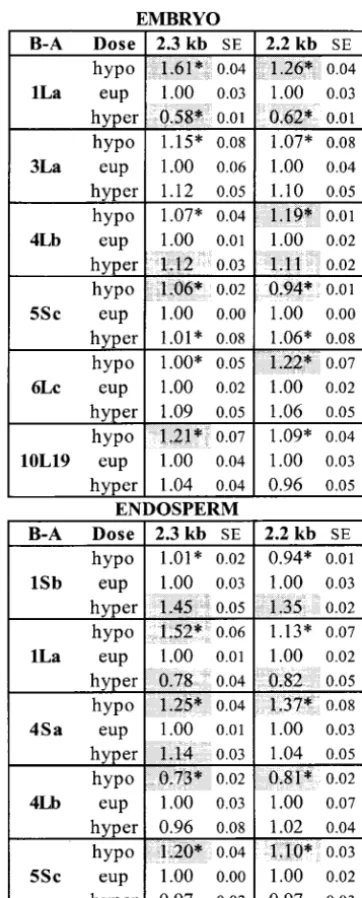
nificant pairwise effects (i.e., hypoploid vs. euploid or Differences in the effects between the 2.3- and 2.2-kb
cox1transcripts:Although the 2.3-kbcox1transcript was euploid vs. hyperploid) were detected in the embryo
tissue. Of these, 14 were positive and 28 were negative. selected for this survey, it was apparent that the 2.2-kb band was affected differently in several dosage series. There were 50 significant pairwise effects detected in
the endosperm tissue. Of these, 21 were positive and The twocox1transcripts result from two transcriptional start sites that are 95 bases apart (Isaac et al. 1985a). 29 were negative. For the most part, effects were tissue
specific; i.e., similar dosage effects upon a gene were Unless the 5⬘regions contribute to a difference in RNA stability, any difference in transcript levels is due to a unlikely to be found in both embryo and endosperm.
Some exceptions were the effects of 1La and to a lesser relative variation in transcription rate from each start site. The two transcripts were rather closely spaced on extent the effects of 6Lc (Figures 2 and 3). Comparison
of the effects of 1La on the mitochondrial genes in the Northern blots. Nevertheless, we were able to detect several instances where a dosage effect upon the 2.3-kb embryovs.endosperm yielded only two differences
be-tween embryo and endosperm. The dosage effects of transcript was significantly different from the effect upon the 2.2-kb transcript. The effect of the 1La dosage 6Lc were less consistent except that, in all cases where
Figure 3.—The mRNA lev-els of six genes for 14 dosage series in endosperm tissue. The data are presented in the same manner as in Figure 2.
2.3-kb band appeared to be subject to a stronger nega- t-test) from the euploid 2.3-/2.2-kb signal ratio. In seven cases, the effect upon the 2.2-kb band was less or none tive dosage effect than the 2.2-kb band. The black bars
represent the 2.3-kb bands and the gray bars represent (embryo 1La hypoploid and hyperploid, 3La hypoploid, 10L19 hypoploid; endosperm 1La hypoploid, 4Lb hypo-the 2.2-kb bands. The 2.3-kb expression levels are shown
relative to the 2.3-kb euploid and the 2.2-kb expression ploid, and 5Sc hypoploid). For five aneuploids, the ef-fect upon the 2.2-kb band was greater (embryo 4Lb levels are shown relative to the 2.2-kb euploid. The 1La
dosage series yielded a similar result in the endosperm hypoploid, 5Sc hyperploid, 6Lc hypoploid; endosperm 1Sb hypoploid, and 4Sa hypoploid). The 5Sc hypoploid (Figure 6).
Thirteen aneuploids had a 2.3-/2.2-kb signal ratio in the embryo was interesting because it resulted in a slight negative effect upon the 2.3-kb transcript and a that was significantly different from the euploid. Dosage
data for these are presented in Figure 6. Shading indi- slight positive effect upon the 2.2-kb band. The actual effects were likely somewhat stronger since the signals of cates that the expression level of the aneuploid was
significantly different (P ⱕ 0.05, t-test) from the eu- the two closely spaced transcripts partially overlapped, reducing the differences.
ploid. Asterisks indicate that the 2.3-/2.2-kb signal ratio
Figure4.—Examples of chro-mosomal effects. Each dosage series was composed of hypo-ploid (hypo), euhypo-ploid (eup), and hyperploid (hyper) sam-ples. Shaded boxes indicate sig-nificant differences from the euploid. Below the numerical values for each example are bar graph representations of the data. Below that the mRNAs and nuclear 26s rRNAs (load-ing control) from the North-ern blots are shown. The gene, dosage series, and tissue of each example are listed at the bottom.
usually atpA; in each case only one band was selected appears to involve recombination of the mitochondrial genome, positioning various promoters upstream of the for this survey of chromosomal dosage effects (Figures
2 and 3). As a rule, the additional transcripts responded gene (Lupoldet al.1999b).
Dosage series effects uponcox5b:Effects uponcox5b to a dosage series in the same way as the selected
tran-script. There were several instances where it was appar- (Figures 2 and 3) were included for comparison. This component of the cytochrome c oxidase complex is ent that one or more of the additional transcripts
re-sponded differently. Unlikecox1, no attempt was made encoded in the nucleus. Because the chromosomal loca-tion ofcox5bis unknown in maize, it is possible that its to measure the other transcripts forcox2 andatpA
be-cause the exact nature of each band is unknown. It is copy number may have been varied in one of the dosage series. Transcript levels ofcox5bwere affected by a num-likely that some of the differences in effects observed
among thecox2 transcripts were due to differences in ber of dosage series, but none of them displayed a struc-tural gene dosage effect. A strucstruc-tural gene dosage effect transcription because this gene has at least five separate
promoters (Lupoldet al.1999a). This could be particu- would have been indicated if expression levels corre-lated to gene dosage;e.g., one dose resulted in an expres-larly interesting because transcriptional control ofcox2
sion level that was 50% of two doses. Failure to detect a structural gene dosage effect does not eliminate the possibility thatcox5bis located on one of the B-A’s used in this study. It appears that in maize many genes are subject to dosage compensation in whole chromosome arm aneuploidies (Guo and Birchler 1994). Dosage compensation occurs when a dosage-dependent nega-tive modifier is varied concurrently with the structural gene (Birchler1981;BirchlerandNewton1981).
In general, the extent and type of effects seen for cox5bappeared to be similar to the mitochondrial genes with one notable difference. Whereas mitochondrial genes mostly experienced negative effects in both em-bryo and endosperm, the effects uponcox5bin the two tissues were different. Embryo effects were mostly nega-tive (five posinega-tive vs. eight negative) while endosperm effects were positive (five positivevs.zero negative). As with the mitochondrial genes, effects were generally tissue specific. Only 10L19 showed similar effects in both the embryo and the endosperm.
Dosage effects of TB-10L32vs.TB-10L19:The dosage series of TB-10L19 involved aneuploidy of the whole Figure5.—Effect of 1La dosage series upon the 2.3- and long arm of chromosome 10 (10L). For comparison we 2.2-kbcox1 transcripts. The expression levels for the 2.3-kb obtained data from a TB-10L32 dosage series, where transcripts (relative to the 2.3-kb euploid level) are shown as
only the distal 26% of 10L was varied in copy number solid bars. The expression levels for the 2.2-kb transcripts
(Maguire1985). Whereas 10L19 affected four genes in (relative to the 2.2-kb euploid level) are shown as shaded bars.
Figure7.—Effects of 10L19 and 10L32 uponcox5bin the embryo and endosperm. The data are presented in a similar manner as in Figure 2. The 10L19 dosage series involves all of 10L. The 10L32 dosage series involves only the distal 26% of 10L.
series indicates the presence of one or moretrans-acting factors on the affecting chromosome arm. Guo and Birchler(1994) conducted a similar study of B-A dos-age effects upon six nuclearly encoded genes. In that study each gene was affected by an average of six dosage series. This number is close to the average of seven for mitochondrial genes, especially considering that there was one less dosage series (9Lc) in the nuclear gene study. As with the mitochondrial genes, most of the effects upon nuclear genes were negative (37 positive vs.53 negative). However, when embryo and endosperm effects were considered separately, the profile of effects differed. While embryo effects were predominantly neg-ative (5 positivevs.33 negative), endosperm effects were mostly positive (32 positivevs.20 negative). The profile of effects upon the nuclearly coded cox5b appears to follow the trend of the other nuclear genes (Table 3). At least in the endosperm, the effects indicate that mito-chondrial genes are subject to a different mode of dos-age-sensitive effects than are nuclear genes, which may indicate a different mode of regulation.
The results demonstrate that there are numerous dos-age-dependent nuclear factors that affect mitochondrial transcript levels; these modulations might result from a Figure6.—Comparison of 2.3- and 2.2-kbcox1transcripts.
variety of mechanisms. Transcript abundance is affected Data are shown for those dosage series where the 2.3-/2.2-kb
not only by transcription and turnover rates, but also transcript signal ratio of an aneuploid was significantly
differ-ent (Pⱕ0.05,t-test) from the euploid (indicated by asterisks). potentially by a change in mitochondrial genome copy Shaded boxes indicate aneuploid expression levels that are number. This could be due to variation in the number significantly different from the euploid (Pⱕ0.05,t-test).
of mitochondria per cell or a change in the copy number of genomes per mitochondrion. In the formation of the maize tapetum, cells can experience up to a 40-fold only one gene (cox5b) and this was in both tissues
(Fig-ure 7). These results indicate that the factor or factors involved with the dosage effects oncox1,cox3, andatpA
TABLE 3
are on the proximal 74% of 10L. The dosage effects on
Summary of pairwise effects
cox5bmay be explained by a factor on the distal 26% of 10L.
Embryo Endosperm
Genes Positive Negative Positive Negative DISCUSSION
Mitochondrial 14 28 21 29
This study establishes that multiple regions of the
cox5b 5 8 5 0
increase in the number of mitochondria per cell (Lee nuclearly encoded mitochondrial RNA polymerase (Uleryet al.1994). Our data offered little evidence that andWarmke1979). Differences in mitochondrial
num-bers have been described in other maize tissues dosage-sensitive factors were involved in the coordinate regulation of the RNA levels in maize. The functionally (ClowesandJuniper1964;JuniperandClowes1965).
However, such copy number differences might be ex- relatedcox1, cox2, and cox3genes were no more likely to have coincidental effects with each other than they pected to result in a global change among all of the
mitochondrial gene transcript levels. No strong global were with atpA. A possible exception was the effect of the 5Sc hypoploid. It had a negative effect upon all effects were apparent.
This result does not rule out the possibility that a three cox genes in the embryo. Coincidentally, it also had a negative effect upon cox1andcox2 in the endo-dosage-sensitive nuclear factor could alter
mitochon-drial gene copy number. A global effect due to a change sperm. The other mitochondrial genes did not share these effects, nor did nuclearly encodedcox5b.
in mitochondrial genome number could be masked if
a second factor on a chromosome arm had a specific A well-characterized dosage phenomenon relating to the kernel concerns endosperm size. Six of the B-A effect upon one of the mitochondrial genes being
as-sayed. Alternatively, changes in gene copy number may chromosomes used to create the dosage series carry endosperm size factors (Ef; Birchler 1993). Endo-not have involved the whole mitochondrial genome but,
instead, some portion of it. The organization of the sperms that are hypoploid for 1Sb, 1La, 4Sa, 5Sc, 7Lb, and 10L19 are markedly smaller than euploid endo-maize mitochondrial genome is complex; subgenomes
are formed through intramolecular recombination sperm. The data were examined as to whether effects upon mitochondrial genes could be responsible for the (Fauron et al. 1995). Differential amplification of a
subgenome would change the copy number of only a reduced size of hypoploid endosperms. The effects de-tected in this study did not correlate withEfs. Although subset of genes.
Mitochondrial ribosomal RNA (rrn18) was included this does not rule out the possibility that one or more Efs may result in reduced kernel size because of a limita-in the study with the expectation that it would be
rela-tively insensitive to modulation. Indeed, of all the genes tion of mitochondrial function or a general reduction in mitochondrial gene expression, it seems unlikely that assayed,rrn18had the least number of effects and most
of those were modest. If a particular aneuploidy affected Efs are primarily due to a modulation of mitochondrial transcript level.
a number of the mitochondrial genes includingrrn18,
it could have been an indication that mitochondrial Nevertheless, it is possible that a limitation of mito-chondrial function contributes to aneuploid syndromes. genome copy number was being affected. Hyperploid
1Sb in endosperm had the same effect upon the RNA Indeed, in plants heteroplasmic for mutant mitochon-dria, the proportion of functional mitochondria corre-levels of all of the mitochondrial genes exceptcox2. Also
in the endosperm, hyperploid 2Sa had negative effects lates with general plant vigor (MarienfeldandNewton 1994). Because there are decreases of gene expression upon all of the tested mitochondrial genes while
hypo-ploid 2Sa had negative effects uponcox1,cox3, andatpA. in both hypoploids and hyperploids, it is conceivable that these reductions become rate limiting on growth. However, the effects of 1Sb or 2Sa were not particularly
strong. If any dosage series affected mitochondrial ge- This can explain the observation that aneuploids have less vigor than do their euploid siblings (Birchlerand nome copy number, it did not appear to contribute
greatly to the effects upon RNA levels. Newton1981;GuoandBirchler1994).
The multitude of effects most likely reflects a hierar-The 6Lc dosage series was interesting in that it may
have indicated a different trend. Although it had no chy of dosage-dependent processes. The molecular identification of individual genes that are responsible effect uponrrn18, the 6Lc hypoploid negatively affected
all of the other tested mitochondrial genes. While the for such dosage effects indicates a heterogeneous collec-tion of regulatory genes as the responsible agents (e.g., 2.3-kbcox1 transcript was not affected in the embryo,
the 2.2-kb transcript was. In addition, the 6Lc hyper- Henikoff 1996;Frolovet al. 1998). It appears, there-fore, that many regulatory mechanisms have evolved to ploid had a negative effect uponcox3 andatpA in the
embryo andcox1in the endosperm. It would be interest- operate in such a manner and at such a level as to be rate limiting on the phenotype. Genes at the top of ing to determine if these effects were the coincidental
result of multiple factors or were due to a single factor the hierarchy will still affect the phenotype because the dosage effect will be transmitted through a series of with a general effect upon mitochondrial mRNA levels.
A related question concerns the possibility of coordi- dosage-dependent steps to the ultimate monitored phe-notype. This concept unifies the polygenic nature of nate regulation of genes that encode functionally
re-lated proteins. In yeast the cytochrome c oxidase com- additive quantitative traits and the extensive effects of aneuploidy on any one characteristic. The large number plex utilizes the various subunits in an equimolar
stoichiometric ratio (Capaldi1990;Drosteet al.1996). of modulations of mitochondrial gene expression found in this study is consistent with this view. Also, this type Transcriptional regulation of these genes is coordinated
Cone, K. C., F. A. BurrandB. Burr, 1986 Molecular analysis of
mitochondrial and nuclear genes despite a
fundamen-the maize anthocyanin regulatory locusC1. Proc. Natl. Acad. Sci.
tally different chromatin configuration; the hierarchy USA83:9631–9635.
Cooper, P., E. ButlerandK. Newton, 1990 Identification of a
potentially operates through a series of steps involving
maize nuclear gene which influences the size and number of
nuclear genes before the ultimate impact on
mitochon-cox2transcripts in mitochondria of perennial teosintes. Genetics
drial expression. 126:461–467.
Droste, M., S. MollnerandT. Pfeuffer, 1996 Localisation of an
In summary, numerous chromosomal dosage effects
ATP-binding site on adenylyl cyclase type I after chemical and
were found that resulted in the modulation of the RNA
enzymatic fragmentation. FEBS Lett.391:209–214.
levels of mitochondrial genes. The array of dosage ef- Fauron, C., M. Casper, Y. GaoandB. Moore, 1995 The maize
mitochondrial genome: dynamic, yet functional. Trends Genet.
fects upon mitochondrial genes was similar to what had
11:228–235.
been previously found with nuclear genes. For the most
Fox, T. D., andC. J. Leaver, 1981 The Zea maysmitochondrial
part modulations were tissue specific. A dosage series gene coding cytochrome oxidase subunit II has an intervening
sequence and does not contain TGA codons. Cell26:315–323.
that affected transcript levels of a gene in embryo tissue
Frolov, M. V., E. V. BenevolenskayaandJ. A. Birchler, 1998 Re-usually had a different effect in the endosperm. Most
gena(Rga), aDrosophilahomolog of the global negative
transcrip-effects were negative;i.e., increased chromosome copy tional regulatorCDC36(NOT2) from yeast, modifies gene
expres-sion and suppresses position-effect variegation. Genetics 148:
number resulted in lower gene expression levels. This
317–329.
similarity in the array of effects indicates that although
Gracen, V., andC. Grogan, 1974 Diversity and suitability for hybrid
mitochondrial genes are prokaryotic in origin, their reg- production of different sources of cytoplasmic male sterility in
maize. Agron. J.66:654–657.
ulation has been extensively integrated into the
eukaryo-Gray, M. W., andB. F. Lang, 1998 Transcription in chloroplasts
tic cell. Even so, the modes of regulation for
mitochon-and mitochondria: a tale of two polymerases. Trends Microbiol.
drial and nuclear genes are not identical. A notable 6:1–3.
Guo, M., andJ. A. Birchler, 1994 Trans-acting dosage effects on
difference was that nuclear genes experienced mostly
the expression of model gene systems in maize aneuploids.
Sci-positive effects in the endosperm while the effects upon
ence266:1999–2002.
mitochondrial genes were mostly negative. There is little Hanson, M. R., andO. Folkerts, 1992 Structure and function of
the higher plant mitochondrial genome. Int. Rev. Cytol.141:
evidence of coordinate regulation of the coxgenes at
129–172.
the RNA level.
Henikoff, S., 1996 Dosage dependent modification of position-effect variegation inDrosophila. BioEssays18:401–409. We thank E. Kuzmin, C. J. Leaver, R. M. Mulligan, R. Hiesel, R.
Herrin, D. L., andG. W. Schmidt, 1988 Rapid, reversible staining of Phillips, and Pioneer Hi-Bred Intl. for sharing clones used in this
northern blots prior to hybridization. Biotechniques6:196–197. study. We thank M. Guo and K. Yamato for subcloning several of the
Hiesel, R., W. Schobel, W. SchusterandA. Brennicke, 1987 The clones into expressible vectors. We also thank M. Guo for her critical
cytochrome oxidase subunit I and subunit III genes in Oeno-review of this manuscript and C. Ostlie for her grammatical Oeno-review.
thera mitochondria are transcribed from identical promoter se-D.L.A. acknowledges support from U.S. Department of Agriculture quences. EMBO J.6:29–34.
Cooperative State Research, Education and Extension Service grant Isaac, P. G., V. P. JonesandC. J. Leaver, 1985a The maize cyto-96-35304-3492 and the University of Missouri Maize Biology Training chrome c oxidase subunit I gene: sequence, expression and re-Program (a DOE/NSF/USDA Collaborative Research in Plant Biology arrangement in cytoplasmic male sterile plants. EMBO J.4:1617–
1623. Program). Research was supported by a grant from the Department
Isaac, P. G., A. Brennicke, S. M. Dunbar and C. J. Leaver, of Energy Biosciences Program (to J.A.B.) and the National Science
1985b The mitochondrial genome of fertile maize (Zea mays Foundation (to K.J.N.).
L.) contains two copies of the gene encoding the alpha-subunit of the F1-ATPase. Curr. Genet.10:321–328.
Juniper, B. E., andF. A. L. Clowes, 1965 Cytoplasmic organelles and cell growth in root caps. Nature208:864–865.
LITERATURE CITED
Kadowaki, K., N. Kubo, K. OzawaandA. Hirai, 1996 Targeting presequence acquisition after mitochondrial gene transfer to the Allen, J. O., G. K. EmenhiserandJ. L. Kermicle, 1989 Miniature
kernels and plant: interaction between teosinte cytoplasmic ge- nucleus occurs by duplication of existing targeting signals. EMBO J.15:6652–6661.
nomes and maize nuclear genomes. Maydica34:277–290.
Beckett, J. B., 1978 B-A translocations in maize. J. Hered.69:27–36. Laughnan, J., andS. Gabay-Laughnan, 1983 Cytoplasmic male sterility in maize. Annu. Rev. Genet.17:27–48.
Birchler, J. A., 1981 The genetic basis of dosage compensation of
alcohol dehydrogenase-1 in maize. Genetics97:625–637. Lee, S. L. J., andH. E. Warmke, 1979 Organelle size and number in fertile and T-cytoplasmic male-sterile corn. Am. J. Bot.60:
Birchler, J. A., 1993 Dosage analysis of maize endosperm
develop-ment. Annu. Rev. Genet.27:181–204. 141–148.
Levings, III,C. S., 1993 Thoughts on cytoplasmic male sterility in Birchler, J. A., andM. R. Alfenito, 1993 Marker systems for B-A
translocations in maize. J. Hered.84:135–138. cms-T maize. Plant Cell5:1285–1290.
Li, X.-Q., M. ZhangandG. G. Brown, 1996 Cell-specific expression Birchler, J. A., andJ. C. Hiebert, 1989 Interaction of theEnhancer
of white-apricotwith transposable element alleles at thewhitelocus of mitochondrial transcripts in maize seedlings. Plant Cell 8:
1961–1975. inDrosophila melanogaster. Genetics122:129–138.
Birchler, J. A., andK. J. Newton, 1981 Modulation of protein Lupold, D. S., A. G. F. S. Caoile andD. B. Stern, 1999a The maize mitochondrialcox2gene has five promoters in two genomic levels in chromosomal dosage series of maize: the biochemical
basis of aneuploid syndromes. Genetics99:247–266. regions, including a complex promoter consisting of seven over-lapping units. J. Biol. Chem.274:3897–3903.
Braun, C. J., andC. S. Levings, 1985 Nucleotide sequence of the
F1-ATPase alpha subunit gene from maize mitochondria. Plant Lupold, D. S., A. G. F. S. CaoileandD. B. Stern, 1999b Genomic context influences the activity of maize mitochondrialcox2 pro-Physiol.79:571–577.
Capaldi, R. A., 1990 Structure and function of cytochrome c oxi- moters. Proc. Natl. Acad. Sci. USA96:11670–11675.
Maguire, M. P., 1985 Effective homologous pairing behavior of a tet-dase. Annu. Rev. Biochem.59:569–596.
Clowes, F. A. L., andB. E. Juniper, 1964 The fine structure of the rasomic chromosome segment in an unusual B-A rearrangement constitution in maize. Caryologia38:121–128.
quiescent center and neighboring tissues in root meristem. J. Exp.
abnor-mal growth mutant has a chimericnad4-nad7mitochondrial gene 1995 Evidence for a novel mitochondrial promoter preceding thecox2gene of perennial teosintes. EMBO J.14:585–593. and is associated with reduced complex I function. Genetics138:
Roman, H., 1947 Mitotic nondisjunction in the case of interchanges 855–863.
involving the B-type chromosome in maize. Genetics32:391–409. Messing, J., J. Carlson, G. Hagen, I. RubensteinandA. Oleson,
Schnable, P. S., andR. P. Wise, 1998 The molecular basis of cyto-1984 Cloning and sequencing of the ribosomal RNA genes in
plasmic male sterility and fertility restoration. Trends Plant Sci. maize: the 17S region. DNA3:31–40.
3:175–180. Mone´ger, F., C. J. SmartandC. J. Leaver, 1994 Nuclear restoration
Singh, M., andG. G. Brown, 1993 Characterization of expression of of cytoplasmic male sterility in sunflower is associated with the
a mitochondrial gene region associated with theBrassica“Polima” tissue-specific regulation of a novel mitochondrial gene. EMBO
CMS: developmental influences. Curr. Genet.24:316–322. J.13:8–17.
Smart, C., F. Mone´gerandC. J. Leaver, 1994 Cell-specific regula-Mulligan, R. M., A. P. MaloneyandV. Walbot, 1988 RNA
pro-tion of gene expression in mitochondria during anther develop-cessing and multiple transcription initiation sites result in
tran-ment in sunflower. Plant Cell6:811–825. script size heterogeneity in maize mitochondria. Mol. Gen. Genet.
Ulery, T. L., S. H. JangandJ. A. Jaehning, 1994 Glucose repression
211:373–380. of yeast mitochondrial transcription: kinetics of derepression and
Neuffer, M. G., 1994 Growing maize for genetic studies, pp. 197– role of nuclear genes. Mol. Cell. Biol.14:1160–1170.
209 inThe Maize Handbook,edited by M.Freelingand V.Walbot. Young, E. G., andM. R. Hanson, 1987 A fused mitochondrial gene
Springer-Verlag, New York. associated with cytoplasmic male sterility is developmentally
regu-Newton, K. J., andE. H. Coe, Jr., 1989 Multiple fertility restorers lated. Cell50:41–49. for EP (Z. p.) cytoplasm. Maize Genet. Coop. Newsl.63:68–69.