MA, RUIQI. Telepresence and Performance in an Immersive Virtual Environment and Sporting Task. (Under the direction of David B. Kaber).
The purpose of this research was to assess the relationship between telepresence and performance in a synthe tic environment. Telepresence is believed to be a mental construct and to enhance task performance in teleoperations and virtual environments. Consequently, it has been identified as a design ideal for synthetic environments. However, there is a limited understanding of telepresence and its relation to task performance. This research involved examination of a range of synthetic environment design features (e.g., viewpoint and auditory cue type) that were suspected to influence telepresence and compared differences in telepresence and task performance caused by manipulations of these factors and task difficulty.
subjects experienced two task difficulty conditions including 2-point and 3-point shots. The order of presentation of the sound, fidelity and difficulty conditions was randomized. Subjective ratings and the objective, attention-based measure of telepresence were
recorded during the experiment, along with task performance and workload. The results of the study provided evidence that the features of a simplistic synthetic environment, which include immersiveness (viewpoint) and auditory cue type significantly influence the sense of subjective telepresence. However, the objective, attention-based measure of telepresence did not prove to be sensitive to the experimental manipulations. Virtual task performance was significantly affected by task difficultly. This study also revealed significant effects of viewpoint and audio cue type on subjective workload. An analysis of trends on changes in telepresence and performance across settings of various virtual reality features provided compelling evidence that telepresence is a predictable experience unique from performance. However, the results of this
analysis cannot be considered conclusive in terms of describing a causal relationship between telepresence and performance, in part, because of mixed findings across
predictors. Beyond the relationship of telepresence and performance, this study provided further evidence of significant positive relations between telepresence and workload. There were no significant interaction effects among the virtual reality factors mentioned above in terms of performance, telepresence and workload. Although counter to
TELEPRESENCE AND PERFORMANCE IN AN IMMERSIVE
VIRTUAL ENVIRONMENT AND SPORTING TASK
by RUIQI MA
A thesis submitted to the Graduate Faculty of North Carolina State University
in partial fulfillment of the requirements for the Degree of
Master of Scie nce
INDUSTRIAL ENGINEERING
Raleigh 2002
APPROVED BY:
______________________________ _______________________________
B
BIIOOGGRRAAPPHHYY
Ruiqi Ma was born in Sichuan province in China in 1971. He was raised in Xuanhan city, Sichuan, where he completed his elementary and secondary education, graduating from Xuanhan First High School in 1989.
Mr. Ma studied Industrial Engineering at Beijing Science and Technology
University, Beijing. Following graduation from BSTU in 1993, he worked as an electrical engineer at CERIS for four years, and ABB China for two years.
In the spring of 2001, the author was accepted by North Carolina Agriculture and Technology State University to study Industrial Engineering in Greensboro North
Table of Contents
List of Tables ...v
List of Figures ...vi
List of Abbreviations ... vii
1 Introduction... 1
1.1 Origin of Telepresence in Teleoperations ... 1
1.2 Factors Influencing Telepresence ... 3
1.3 Telepresence Measure ... 9
1.4 Telepresence and Performance ... 10
1.5 Telepresence in Applications... 13
1.6 Summary... 13
2 Problem Statement ... 15
3 Methodology ... 19
3.1 Objective ... 19
3.2 Tasks and Equipment... 19
3.3 VR Simulation... 22
3.4 Participants ... 22
3.5 Variables ... 23
3.6 Design ... 31
3.7 Training... 33
3.8 Hypotheses... 35
3.9 Procedures... 39
4 Data Analysis ... 41
5 Results ... 44
5.1 Subject ... 44
5.2 Performance Measures... 44
5.3 Telepresence Measures ... 45
5.4 Objective Measure of Telepresence... 49
5.5 Workload Measures ... 51
5.6 Telepresence and Performance in the Virtual Basketball-Shooting Task ... 54
5.7 Correlation Analysis Results ... 59
6 Discussion... 61
6.1 Telepresence in VR... 61
6.2 Workload in VR... 64
6.3 Lack of Interaction Effects on Response Measures... 64
6.4 Correlations among Telepresence and Performance ... 65
7 Conclusion ... 68
8 References ... 71
Appendix A: Instructions for Participants ... 74
I. Introduction ... 74
II. Familiarization ... 76
III. Training... 78
Appendix B: Informed Consent Form ... 88
Appendix C: Anthropometric Data Sheet ... 90
Appendix D: Immersive Tendencies Questionnaire ... 91
Appendix E: Subjective Telepresence and Mental Workload Assessment ... 94
List of Tables
Table 1: Categories of sounds ... 25
Table 2: Subject groupings ... 31
Table 3: Experiment design-complete data collection table ... 32
Table 4: Comparison of training and experiment conditions ... 34
Table 5: Summary of expected telepresence and performance results ... 36
Table 6: Overview of experimental procedure and rough time ... 39
Table 7: F-test results on telepresence rating for various predictors ... 46
List of Figures
Figure 1: General framework of factors that affect virtual presence (Nash et al., 2000) ...4
Figure 2: Equipment setup of the experiment...21
Figure 3: User immersed in virtual basketball task ...21
Figure 4: Simulation with egocentric viewpoint ...23
Figure 5: Simulation with exocentric (behind player) viewpoint...24
Figure 6: Simulation with exocentric (sideline) viewpoint ...24
Figure 7: Simulation with low-fidelity background ...26
Figure 8: Simulation with high-fidelity background ...27
Figure 9: Simulation scene for direct 2-point shot ...28
Figure 10: Simulation scene for direct 3-point shot ...28
Figure 11: Simulation scene for 2-point shot at an angle ...29
Figure 12: Simulation scene for 3-point shot at an angle ...29
Figure 13: Simulation for training participants (exocentric (behind player) view of medium fidelity background) ...34
Figure 14: Average baskets across four training trials ...35
Figure 15: Average number of total baskets across levels of task difficulty (shot distances)...45
Figure 16: Average PQ1 ratings across sound and viewpoint conditions ...48
Figure 17: Average PQ2 ratings across sound and viewpoint conditions ...48
Figure 18: Average detection rate in secondary task in VR across background fidelity conditions ...51
Figure 19: Average detection rate in secondary task in RW across viewpoint conditions ...51
Figure 20: Average workload ratings across viewpoint conditions...53
Figure 21: Average workload ratings across sound conditions ...53
Figure 22: Normalized values of telepresence and performance across viewpoint conditions ...57
Figure 23: Normalized values of telepresence and performance across fidelity conditions ...58
Figure 24: Normalized values of telepresence and performance on shot distance...58
List of Abbreviations
ANOVA Analysis of Variance DOF Degree of Freedom FOB Flock of Birds
HMD Head-Mounted Display IT Information Technology
ITQ Immersive Tendencies Questionnaire MCH Modified Cooper-Harper
PQ Presence Questionnaire
RW Real World
SA Situation Awareness SE Synthetic Environment
SSQ Simulator Sickness Questionnaire VAS Visual Analog Scale
Telepresence, the perception of presence within a physically remote or simulated space, has been identified as a design ideal for synthetic environments (SEs) (Draper, Kaber, and Usher, 1998). A synthetic environment provides computer-mediated human interaction with an environment that is physically separate from the user in order to allow human perceptual, cognitive, and psychomotor capabilities to be projected into normally inaccessible, hostile, or simulated environments (Draper, Kaber, and Usher, 1999). Heeter (1992) identified three different types of presence including environment, social and personal presence. Draper et al. (1998) also identified three types of telepresence extant in the literature including simple telepresence, cybernetic telepresence, and experiential telepresence. These categories of telepresence differentiate the sensation or phenomenon in terms of task circumstances and types of SE users. However, telepresence is often preferred as a general term to describe the sense of presence within a SE. This thesis does not discriminate among types of telepresence or the terminology presence and telepresence, in general.
1.1 Origin of Telepresence in Teleoperations
technologies do not allow for the development of a robot that has all the abilities of a human being (less the human’s physical and psychological limitations), human operators must be involved in the operation of robots at a remote site through computers or other advanced technologies for perceptual and cognitive tasks.
Teleoperators have been identified as a subdivision of SEs along with virtual reality (VR) and telecommunication systems (Draper et al., 1999). Many newly
developing technologies in the area of teleoperation and VR have increased the human’s ability to complete tasks remotely (e.g., Riley, 2001). However, industry and research still seek to limit the possibility of error in teleoperator control loops, improve overall system reliability and ultimately enhance performance results.
The study of the robotics is multi-disciplinary in nature. It is difficult to achie ve great progress in contemporary robotics research without a corresponding advance in understanding of human intelligence and the simulation of intelligence in machine systems. Although some researchers would like to create a “robotic human” that could function autonomously with great reliability, current technology has not provided robots with the capability to act independently and intelligently in complex and unstructured environments. There is an inevitable need for the human to act as a controller or
will improve overall teleoperation (human in-the- loop) task performance. A review of studies on human aspects of information technology (IT) undertaken by Salvendy and his colleagues over the past two decades also reveals this trend in research; that is, a shift from studying ergonomics in robotics system design to studies of human-computer interaction and usability testing for human operator information processing (Fang and Salvendy, 2001).
1.2 Factors Influencing Telepresence
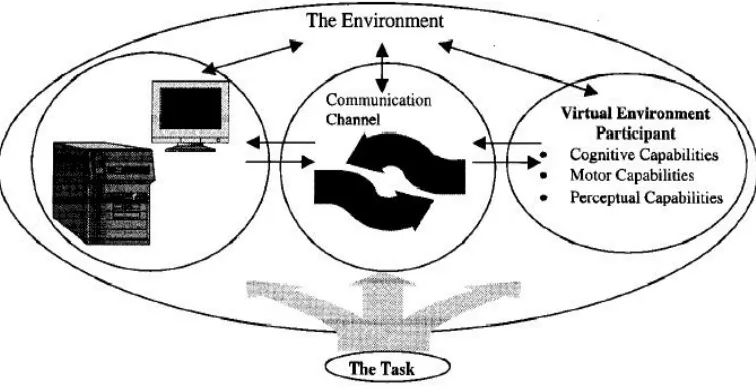
Figure 1: General framework of factors that affect virtual presence (Nash et al., 2000) Sadowski and Stanney (2002) think both individual and system variables influence the level of telepresence experienced in VR. Some specific variables they identified include: (1) ease of interaction; (2) user-initiated control; (3) pictorial realism; (4) length of exposure; (5) social factors; and (6) system factors.
Sheridan (1992) identified five variables that supposedly contribute to inducing a sense of telepresence. Three of them are technological including: the extent of sensory information, control of sensors relative to the environment, and the ability to modify the physical environment. The other two are task, or context based including: task difficulty, and degree of automation.
All of these researchers state that a wide range of factors may influence the sense of telepresence, from the vividness of a VR (similarity to the real world) to the
provide information on operational methods that could be used to control the sense of telepresence in applications (e.g., teleoperation).
It is important to identify ways in which the factors hypothesized to influence the sense of telepresence can be manipulated in an experiment in order to develop more conclusive evidence on the root causes of the phenomenon. If telepresence is to be investigated using VR, Pretlove (1998) states that the basic requirements for humans to operate efficiently in a SE must be met including sufficient visual information for interpreting the synthetic scene. In a teleoperation scenario, basic requirements for performance may extend beyond visual stimulation to include auditory, and tactile feedback from the remote site in order to facilitate a valid and reliable operation. All of these basic features of SEs may influence the sense of telepresence. Unfortunately, it can be very difficult to create high fidelity, multi- modal VRs for use in experiments aimed at manipulating the sense of telepresence.
Some researchers believe VRs for research and application purposes should have basic characteristics including 3-D representation of a virtual environment and 3-D presentation of the VR. In addition, immersion is often identified as a requirement for VR system design (Psotka and Davison, 1993). This means that depth cues should be
provided in the display or interface to the VR and that the users senses should be immersed in stimuli as part of the VR. The intent is to facilitate users’ perception of the VR in a manner similar to their perception of reality. It has been speculated that such a setup will allow for the most accurate assessment of telepresence possible.
to a user, and viewpoint may also have a significant influence on telepresence. An egocentric viewpoint, perceived from the perspective of the user, is typically expected to provide a greater sense of self (Slater, Linakis, Usoh and Kooper, 1996) in a synthetic task environment and awareness of objects in the environment as compared to an exocentric viewpoint, which provides a “third” person perspective. With respect to the visual information of a SE and the vividness of visual displays, different levels of
rendering and texturing are also believed to influence telepresence. A study by Barfield, Hendrix and Bjorneseth (1995) found that the greater the level of visual realism, the greater the sense of telepresence, in general. However, increasing levels of visual detail can be computatio nally expensive and possibly delay VR system responsiveness; thus, increasing the level of visual detail may ultimately reduce a person’s sense of
telepresence. In a study by Dinh, Walker, Song, Kobayashi, and Hodges (1999), no significant influence of different levels of visual fidelity on the sense of telepresence was observed. Given this contradictory evidence, research is still needed to assess the affect of the level of visual detail in a VR on telepresence and ultimately the affect on task performance.
research in VR have also recently received substantial attention. One reason for this is that, when immersed in a VR through the use of a head- mounted display (HMD), if subjects are provided with realistic sensations of touch in interacting with virtual objects, the force feedback has been found to significantly increase the sense of telepresence (Sallnas, Rassmus-Grohn and Sjostrom, 2000). Although this research will not specifically examine the effects of haptics on telepresence experiences in VR, it is important to be aware of, and have a general understanding of, all VR system, task and user characteristics potentially influencing telepresence.
In general, it is possible that information from the haptic sense and other senses may be important to telepresence in SEs simply because contemporary VR technologies are limited in their capability to completely represent physical environments via the dominate senses (vision, audition). Often times, users must be able to use crude visual cues to manipulate objects and reach goals in an environment. Because of incomplete visual and auditory information in a VR, it is possible that information from one sensory channel is used to augment and help disambiguate information from another sensory channel (Biocca, Kim and Choi, 2001). Biocca et al. found that the process of intermodal integration might produce perceptual illusions that enhance the perception of information in one sensory channel (i.e., cross- modal enhancement) or arouse reports of sensations in senses that have not been stimulated by the interface (i.e., cross- modal illusions or synesthesia). It is possible that telepresence experiences may also derive from the
On the basis of the research on potential factors in telepresence, it can be
concluded that VR design should incorporate as many sensory cues as possible in order to motivate the sense of telepresence in investigating its importance to performance in SEs. Although main effects of various types of sensory stimulation on telepresence have been observed, Dinh et al. (1999) showed no significant interaction effect among visual, auditory, tactile, and olfactory cues on telepresence in VR. This suggests that it may be possible to effectively manipulate the sense of telepresence through changing types and various settings of cues independently, for example, visual stimuli. However, since VR is intentionally designed to be rich representation of real environments, a lack of interaction among VR features in affecting telepresence experience does not seem intuitive. For example, cue conflicts can occur (e.g., audio does not match visual information) in VRs just like reality and would be expected to impact or degrade telepresence and
performance. When all of the above discussed factors are considered in VR design and are manipulated to provide subjects with different levels of telepresence in a SE, any relationship between telepresence and task performance can be further investigated.
1.3 Telepresence Measure
Although there has been wide expectation of potential performance benefits of telepresence (Riley, 2001), currently there exist few valid subjective or objective measures of the phenomenon that can be used to describe any structural or causal relationship with performance. As discussed above, the sense of telepresence is determined by many system, task and environmental factors; therefore, it is a complex research challenge to develop valid and reliable measures of telepresence, and there is likely no single index that will adequately assess the experience of telepresence (Stanney, Mourant and Kennedy, 1998). Both subjective and objective measures have been
developed and used over the past decade.
At present, subjective questionnaires and rating scales are the most commonly used telepresence measurement techniques (Nash et al., 2000). However, in almost all scientific studies, objective measures are preferred for quantification of phenomena over subjective measures. Unfortunately, it is very difficult to define and implement an objective measure of telepresence in VR or a teleoperation scenario. Among several proposed subjective measures of telepresence, the Presence Questionnaire (PQ) developed by Witmer and Singer (1994, 1998), which includes many items, has been validated as a reliable technique. Some researchers have also successfully used a few simple questions to measure the sense of telepresence subjectively; for example, Draper and Blair (1996) used two subjective questions in order to measure telepresence in a teleoperation task.
(Nash et al., 2000). Telepresence has also been hypothesized to be related to situation awareness (SA), attentional resource allocation (Draper et al., 1998), and secondary task measures (Riley, 2001), which provide metrics of the amount of residual attentional resources available for information processing beyond resources dedicated to primary task performance. Measures of these cognitive constructs and secondary task measures of attention may represent potential objective measures of telepresence. Draper et al. (1998) also detailed a structured attentional resource model of telepresence including
mathematical expressions for quantifying telepresence, workload and performance in terms of attention. Kaber and his colleagues (2000a, 2001) have conducted a series of studies to investigate the relationship between telepresence and attention to VR. They found a significant correlation between visual attention allocation to VR displays and ratings of telepresence; thus supporting the use of attention allocation as an objective measure of telepresence. Riley and Kaber (2001) provided preliminary results on the utility of measures of attention and SA for explaining telepresence. One limitation of a second ary task measure of telepresence is that the measurement technique itself may be obtrusive to virtual task performance and compromise the sense of telepresence (cause distraction of a VR user) and degrade primary task performance in some cases.
1.4 Telepresence and Performance
Telepresence is believed to be a mental construct and to enhance task
relationship between telepresence and task performance. It is critical to establish states of telepresence that may enhance teleoperation system performance or performance in VRs. It is also important to establish the relation between telepresence and performance in order to develop a model of telepresence for prescribing effective teleoperator designs that may ultimately improve remote task performance (Kaber, 1998).
Studies reviewed by Stanney, Salvendy, et al. (1998) showed a positive
correlation between telepresence and performance on tasks such as tracking, searching, and training of time-constrained sensorimotor tasks. However, these tasks were abstract in nature and the results may not generalize to real-world teleoperation tasks. The studies by Kaber and his colleagues (2000a, 2000b, 2001), in which experiments were run on simulated robotic operations, also revealed a significant positive relationship between subjective telepresence and performance.
Although the results of previous experiments show a positive correlation between subjective and objective measures of the constructs of telepresence and performance, there is no direct evidence of a causal relationship. The question of whether the sense of telepresence in VR is causally related to task performance essentially remains
causation difficult to infer. Furthermore, the causal direction of any found relation may be impossible to infer (Nash et. al., 2000).
The uncertainty of the relationship of telepresence and performance is further complicated by the lack of reliable validated objective measures of telepresence. Although Kaber and his colleagues have provided preliminary results on the utility of measures of attention and SA for explaining telepresence objectively (e.g., Riley and Kaber, 2001), further work is needed to verify the validity and reliability of these measures for practice.
The study and debate regarding the relationship between telepresence and virtual task performance is critical. The importance of telepresence is dependent on its impact (if any) on task performance. Thus, if there is a relationship (causal or just correlational) between them, then there is a need to establish telepresence-based design guidelines for teleopertion and complex human- machine systems. If it is demonstrated that there is no relationship between the two, then the design, or modification, of systems with the goal of increasing the sense of telepresence may not be worthwhile (Riley, 2001).
In any case, it seems that some minimum amount of attentional resources will have to be devoted to any VR or teleoperation task, resulting in some minimum sense of telepresence and an associated level of performance (Nash et al., 2000). It is possible that the influence of telepresence on task performance is nonlinear, or the influence is
1.5 Telepresence in Applications
Teleoperators and VR have a broad range of applications in outer space and deep-sea exploration, remote surgical operations, remote education and training,
teleconferencing, and entertainment. For example, Konesky (2001) proposed exploration of the Hudson submarine canyon using a telepresence system. Freysinger, Gunkel, Thumfart and Truppe (2001) implemented telepresence design considerations in intraoperative orientation of a surgeon during video-endoscopic endonasal procedures. Unfortunately, without a clear understanding of the relationship between telepresence and task performance, continuing research investments may not be made into applications like this, which focus on the goal of increasing the sense of telepresence. Furthermore, we cannot predict telepresence-based design of a complex human-machine system or a VR that optimizes overall performance. In the projects mentioned above, the researchers were only able to provide the minimum, or necessary, telepresence for the remote
observation and control tasks.
1.6 Summary
Telepresence has been identified as a design ideal for SEs. Research has had great expectation for a benefit of telepresence to overall human- machine system
performance. Some studies have been conducted to investigate the origin of telepresence, measurement of telepresence, its underlying factors, and its utility as it relates to
2 Problem Statement
There remains a limited understanding of the concept of telepresence even though many researchers have devised and executed studies in attempts to further knowledge regarding the origin of telepresence, measures of telepresence, its underlying factors, and its relation to performance. Without complete knowledge of the phenomenon, a model of telepresence cannot be developed for prescribing teleoperator designs that may improve remote task performance, and telepresence cannot be used as a predictor of human-machine system performance.
Most researchers believe that teleoperation task performance will improve with increasing telepresence. The potential benefit of telepresence on performance has motivated a lot of research to focus on studies of correlational relationships between telepresence and performance. However, few studies have demonstrated evidence of a direct, causal link between them. Welch (1999) failed to reveal a significant correlation, or causal link, between telepresence and performance in a visual- motor task. The author stated that the differences in subjective telepresence ratings for two VR designs
incorporating either sounds relevant to the virtual task or no sounds were relatively small. Therefore, the utility of the study for assessing the relation of telepresence and
In the previous studies, performance has usually been measured objectively and telepresence has been measured subjectively using rating techniques. Unfortunately, there have been no correlation studies of objective telepresence and objective
measurements of performance. Ultimately, without this type of research, we cannot say whether telepresence is a unique mental construct or if the phenomenon is simply an element of performance.
In the present study, the relationship between objective and subjective measures of telepresence (based on operator attention allocation strategies) and task performance is evaluated in order to establish whether telepresence is a concept unique from
performance and possibly related to task outcomes under certain circumstances. Beyond this, unlike previous experiments, the study examines experimental conditio ns, in which levels of telepresence are held “fixed” and performance is manipulated or vice versa. As mentioned above, any study of this nature needs to control for all potentially influential variables in order to avoid an influence on the relation of telepresence and task
performance by “third variables”. For this reason, many features of VR were controlled in this research including visual cues, auditory cues and virtual task characteristics.
It is believed that SE user access to a broader range of sensory cues promotes a greater sense of telepresence in remote or virtual task performance. Dinh, et al. (1999) created a multi- modal VR to provide users with visual, auditory, tactile and olfactory cues for investigating effects on the sense of telepresence and memory of spatial layout and object location in the VR. It was found that both telepresence and memory
between telepresence and task performance. Furthermore, the simple task of memorizing objects within a VR may not be generalizable to real world tasks.
In the present study, the experimental task was a virtual basketball free-throw task. This task is perceptuo- motor in nature and was varied slightly across test trials with each research participant. We introduced auditory cues in order to facilitate different levels of telepresence. Sound conditions included relevant, irrelevant, both relevant and irrelevant, and no sounds. Sounds were expected to yield different senses of
telepresence, but performance was expected to change in a different way because of feedback and distraction of sounds. Although Dinh et al. (1999) failed to find an effect of varying visual cues (showing different resolution texture maps and different illumination) on the perceived sense of telepresence in their experiment; multiple studies have not been conducted to conclusively demonstrate a lack of effect. We were also interested in the role of visual cues in telepresence and explored two settings of visual background in the present study (rendered or textured). It was expected that visual cues would generate differences in the sense of telepresence, but performance would remain constant. In addition to the auditory cues and the low and high background fidelity, we manipulated levels of telepresence within the VR through changes in viewpoint including egocentric and exocentric while subjects performed the virtual task. Although egocentric views are typically used in VR and telepresence systems, depending upon the nature of the
experiment are provided in the Methodology section. We also varied the level of
difficulty of the task, which was not expected to influence the sense of telepresence, but was expected to impact virtual task performance.
The aforementioned experimental variables were expected to affect telepresence and performance in different ways, if indeed the two constructs are unique. The
3 Methodology
3.1 Objective
The basic objective of this experiment was to study the relationship between telepresence and performance in the SE. The results of previous experiments have shown a positive correlation between subjective and objective measures of these constructs, but there is no direct evidence of a causal relationship (or correlations of objective measures of telepresence and performance). The relationship between telepresence and
performance was evaluated by manipulating levels of telepresence within the VR simulation of the basketball free-throw task through changes in viewpoint, background fidelity, auditory cues, and the position of a user’s self- representation (virtual player) in the VR relative to the virtual basket/goal.
3.2 Tasks and Equipment
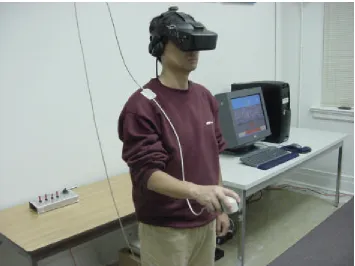
movements recorded by the Flock-of Birds (FOB) motion tracker (see Figure 3). The point of release of the basketball was defined by the computer system at the outset of the experiment. Based on the anthropometry of each subject, when the mouse was held in the hand and the upper arm was held in a horizontal position, the basketball was released by the virtual player when the lower arm achieved a right angle with the upper arm. No mouse click was needed to shoot a ball. Subjects could not control the dribble of the basketball. Initially the virtual basketball player stood in one position. Subjects were not permitted to change this position. After the experimenter calibrated the arm position of the subjects, subjects repeatedly attempted a specific shot in order to score as many goals as possible. In general, the computer recorded task performance automatically.
Figure 2: Equipment setup of the experiment
Figure 3: User immersed in virtual basketball task
expected to provide information on the distribution of subject attentional resources across the VR and RW.
3.3 VR Simulation
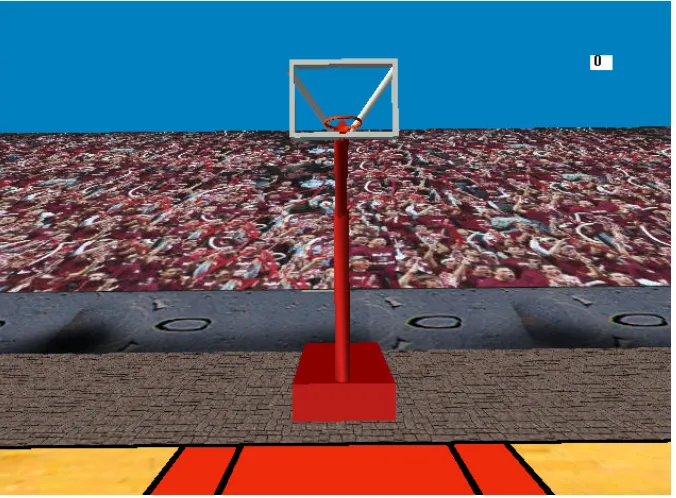
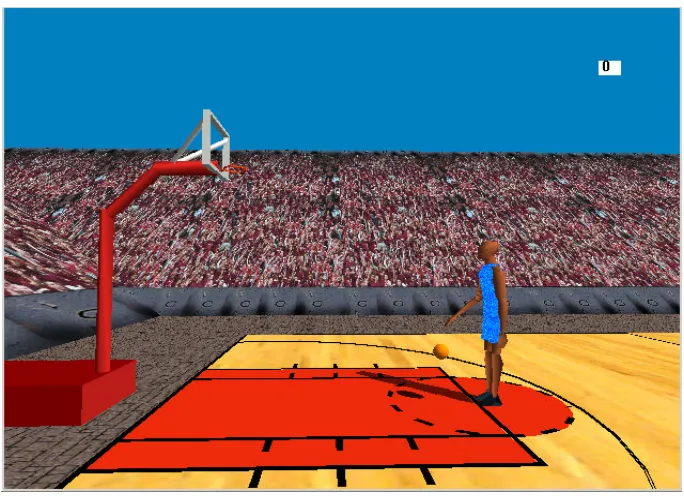
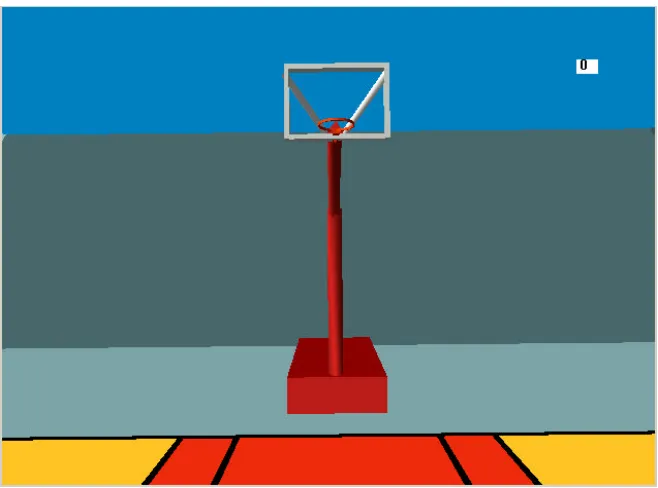
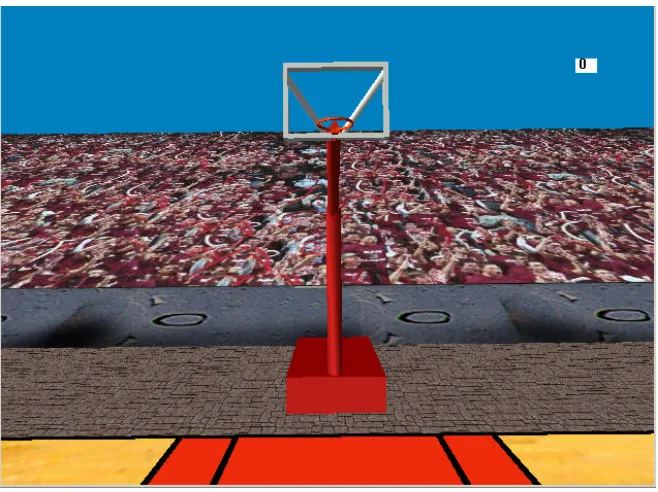
The simulation presented a basketball stadium in which a player makes free-throw and 3-point shots. The basketball court had all of the conventional lines painted on it, and the goal had a backboard with a rim. There were two different backgrounds available in the simulation. One included gray walls, and the other showed a stadium with a crowd watching the player. One view was rendered and the other was textured. The stadium also had a scoreboard.
The proportions of object sizes in the simulation were representative of the proportions that would be expected in a real basketball game (i.e., the size of the court and the player were scaled realistically based on measurements of an actual college basketball court). Different models of the basketball player were presented as part of the simulation to ensure compatibility with the handedness of research participants.
3.4 Participants
prior knowledge was needed for use of the simulation. All subjects were required to have 20/20 or corrected to normal visual acuity. All volunteers were compensated at a rate of $7.5 per hour.
3.5 Variables 3.5.1 Independent
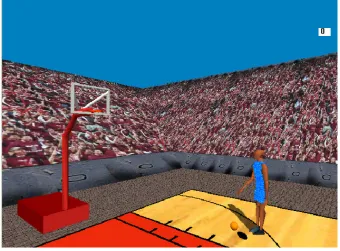
Viewpoints: Each subject experienced one of four viewpoint conditions including an egocentric view (Figure 4), an exocentric view from behind the player (Figure 5), and an exocentric view from the sideline of the court (Figure 6). The fourth viewpoint condition allowed subjects to chose from the other three viewpoints. When using the egocentric viewpoint, subjects were able to see virtual representations of his/her arms when making a shot.
Figure 5: Simulation with exocentric (behind player) viewpoint
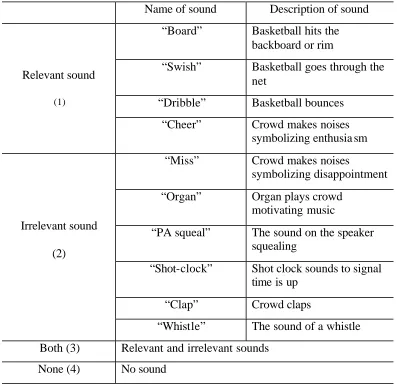
Sounds: Each subject was exposed to four levels of sound including task-relevant sounds, task- irtask-relevant sounds, a combination of task task-relevant and irtask-relevant sounds, and no sound. The relevant sounds included the sounds of the ball bouncing on the floor, bouncing off of the backboard or off of the rim, and cheering. There was also a sound to indicate the success of a shot (“swish”). The irrelevant sounds included sounds of crowd noise, sounds of a shot clock, and arena music. Table 1 presents a list of the specific sounds included in each of the identified categories along with descriptions.
Table 1: Categories of sounds
Name of sound Description of sound “Board” Basketball hits the
backboard or rim
“Swish” Basketball goes through the net
“Dribble” Basketball bounces Relevant sound
(1)
“Cheer” Crowd makes noises symbolizing enthusia sm “Miss” Crowd makes noises
symbolizing disappointment “Organ” Organ plays crowd
motivating music
“PA squeal” The sound on the speaker squealing
“Shot-clock” Shot clock sounds to signal time is up
“Clap” Crowd claps Irrelevant sound
(2)
“Whistle” The sound of a whistle Both (3) Relevant and irrelevant sounds
Background: Each subject experienced two background conditions including a low fidelity stadium, as shown in Figure 7, and high fidelity stadium, as shown in Figure 8. The “poor” background was composed of rendered, plain gray, walls surrounding the basketball court. The “good” background displayed a texture of a crowd watching the game.
Figure 8: Simulation with high- fidelity background
Figure 9: Simulation scene for direct 2-point shot
Figure 11: Simulation scene for 2-point shot at an angle
3.5.2 Dependent
Performance: Virtual basketball performance was measured as the number of successful shots made in a 2- minute period and as the percentage of successful shots to total shots attempted.
Telepresence: Telepresence was measured subjectively using a 2-question telepresence questionnaire developed by Draper and Blair (1996), administered after every trial (see Appendix F). Telepresence was also objectively measured in terms of secondary- monitoring task performance (signal detection rate) during the trials. It has been hypothesized that increases in allocation of attentional resources to remote task information may cause increases in telepresence. Significant correlations have been revealed between telepresence and SA, telepresence and attention to a VR by studies of Kaber and his colleagues (Riley and Kaber, 2001), supporting the use of SA and attention allocation as objective measures of telepresence. In this experiment, the secondary tasks randomly presented visual cues irrelevant to the primary task (camera flashes in the stands of the basketball stadium and strobe light flashes in the research lab).
Telepresence was quantified as the ratio of performance in the camera flash detection and strobe light detection. This measure is similar to the attention allocation measure used by Riley and Kaber (2001). A high ratio will be considered indicative of increased attention allocation to the VR and a greater potential for telepresence.
anchors at opposite ends. Subjects were asked to mark an “X” on the scale at the position they felt best represented the level of task load experienced during a test trial.
3.6 Design
A mixed design was used for this experiment. An equal number of subjects were randomly assigned to groups according to the levels of the viewpoint condition
(egocentric, exocentric from behind the player, exocentric from the sideline, subject-preferred viewpoint), as shown in Table 2. The subjects in the same columns of this table followed the same trial orders, which were generated randomly. The auditory cues and background of the VR were controlled as within subjects’ variables. Each subject completed 2 trials under each of 8 experimental conditions, totaling 16 trials (4 sound levels x 2 backgrounds x 2 trials). The four settings of shot position were balanced across the test trials for two subjects allowing for all combinations of position, sound and background fidelity to be investigated. Each subject experienced half of the test trials at the 2-point distance and half at the 3-point distance. Similarly each subject completed 8 trials with a direct shot to the basket and 8 trials shooting baskets from the right side of the court. This study focused on the shot distance as a task difficulty factor. The entire data collection table for the experiment is presented in Table 3, which included the viewpoint, visual background fidelity, sound and shot distance variables.
Table 2: Subject groupings
Viewpoint Subject#
Egocentric (1) 1 2 3 4 17 18 19 20
Exocentric From Behind
Player (2) 5 6 7 8 21 22 23 24
Exocentric From Sideline
(3) 9 10 11 12 25 26 27 28
Table 3: Experiment design - complete data collection table Between-Subjects Variable Viewpoint Within-Subjects Variables Egocentric (1) Exocentric From Behind Player (2) Exocentric From Sideline (3) Selectable (4) Relevant (1) Irrelevant (2) Relevant + Irrelevant (3) 2-point (1) None (4) Relevant (1) Irrelevant (2) Relevant + Irrelevant (3) Low (1) 3-point (2) None (4) Relevant (1) Irrelevant (2) Relevant + Irrelevant (3) 2-point (1) None (4) Relevant (1) Irrelevant (2) Relevant + Irrelevant (3) Background Fideli ty High (2) Shot Distance 3-point (2) Sound None (4) Subject Number: 1, 2, 3, 4, 17, 18, 19,
20
Subject Number: 5, 6, 7, 8, 21, 22, 23,
24
Subject Number: 9, 10, 11, 12, 25, 26,
Consequently, the design yielded 2 replicates for each fidelity, sound and position condition, 4 replicates for each fidelity, sound, and distance combination, and 8 replicates under each fidelity and sound combination per pair of subjects. The experimental
condition setup was the same for all four viewpoints.
3.7 Training
Before subjects began the experiment, they were provided with a dedicated training session, including learning to control the simulated basketball player and making a shot within the VR by using the Ascension Technologies 6-DOF mouse. Subjects were familiarized with the secondary tasks. In order to not introduce a bias from the training session into the full experiment, the training simulation was a simplistic version of the experimental task, which was repeated for all training trials. The differences between the training and full experiment setups are summarized in Table 4 and an image of the
training simulation is shown in Figure 13.
Table 4: Comparison of training and experiment conditions
Training Full experiment
Viewpoint Same for training and
full experiment Same
Sound Relevant (excluding cheering)
All of the sound conditions (relevant, irrelevant, both, none)
Shot position
From an angle at the left side of the court. One distance was used
between the 2 and 3 point shot distances.
Four positions including 2 and 3 point shots directly in front of the basket and from an angle at the right side of the court.
Fidelity
Textured image of stadium benches(as a
background).
Rendered and fully textured background.
Camera flash and strobe light NO YES
Use of Flock of Birds YES YES
Use of head-mounted display YES YES
0.00 0.10 0.20 0.30 0.40 0.50 0.60 0.70 0.80 0.90 1.00
1 2 3 4
Trials for training
Average baskets
Figure 14: Average baskets across four training trials
3.8 Hypotheses
Table 5: Summary of expected telepresence and performance results
Variable Telepresence Performance
SOUND
No sound Minimum Poor to worst
Irrelevant sound Low Poor to worst (distracting?)
Relevant sound High Good to best (provides feedback as basis for adjusting actions)
Irrelevant + relevant sound Maximum Good to best (but irrelevant sounds may be distracting)
BACKGROUND
Low fidelity Low High fidelity High
No difference in effect, unless too much visual clutter leads to distraction under high fidelity.
VIEWPOINT
Egocentric High to maximum
Poor
Exocentric -behind player Low Worst (cannot see ball at beginning of shot) Exocentric -sidelines Minimum Good to best (better view of z-axis depth) Selectable High to
maximum
Good to best
POSITION
2-point on straight line Best
3-point on straight line Poor to good 2-point on off angle line Poor to good 3-point on off angle line
No difference in effect expected
Worst
In general, it was hypothesized that telepresence is different from performance. It was expected that increases or decreases in performance might occur in conjunction with increases or decreases in telepresence. The specific hypotheses for the experiment included the following:
(1) In regard to auditory cue effects on telepresence, it was expected that the addition of either task relevant or irrelevant stimuli would contribute to the sense of telepresence in the VR. More specifically, it was hypothesized that task relevant
would be perceived as having an impact on the auditory characteristics of the VR. Providing both types of sound was expected to elicit the highest telepresence ratings. The subject would receive the most cues that related to the surrounding environment and to their activities. Telepresence was also expected to be higher under the irrelevant sound condition than no sound whatsoever because the user would receive more cues on what was occurring in the environment.
(2) In regard to the effect of auditory cues on performance, we expected that task irrelevant sound might compromise performance in comparison to both no sound
whatsoever and task relevant sound because of possible distraction from the latter setting. It was also expected that task relevant sounds would improve performance as a result of feedback on subject actions in the simulation. It was expected that presentation of relevant auditory cues and both relevant and irrelevant sounds would produce similar performance results, as they provided the same level of assistance in completing the task. The user received feedback from the relevant sounds in order to adjust his/her actions in future shots.
(4) With respect to viewpoint, the egocentric view was expected to yield the highest telepresence ratings because it provided subjects with the greatest degree of immersion in the environment and performance of the task. Telepresence differences among these conditions might also be attributable to the nature of the task, as dictated by the viewpoint. In regard to performance, the egocentric condition was not expected to produce the highest scores because the user did not have as good of a sense of the distance to the backboard as with the exocentric view from the sidelines. The sideline exocentric view allowed subjects to see the axis that they were working in (z-axis or depth) and enabled them to better visualize the distance between the player and the goal. The selectable viewpoint was expected to provide high performance and telepresence ratings because the subject could exploit the advantages of each viewpoint. It was also hypothesized that the selectable (or dynamic) viewpoint might provide higher
telepresence than the egocentric view because it encouraged a subject’s sense of control. (5) With respect to the interaction of the auditory cues and VR background, it was expected that cue correspondence (interaction) might be important to subjects. That is, the impact of presenting task irrelevant sounds (e.g., fans cheering a “miss”) on
3.9 Procedures
Table 6 presents a list of all the steps in the experimental procedure for each subject along with time estimates.
Table 6: Overview of experimental procedure and rough time
Step in procedure Time (minutes) 1. An Introduction to the experiment, including informed consent (see
Appendix B). 5-10
2. Collection of anthropometric survey data (see Appendix C). 5 3. Familiarization with HMD and the Ascension Technologies 6-DOF
mouse 5
4. Administration of Immersive Tendencies Questionnaire (ITQ) (see
Appendix E) to gauge susceptibility of subjects to telepresence experiences. 10-15 5. Familiarization with experimental conditions (sounds, background, etc.). 20 6. Administering a sim-sickness questionnaire (SSQ) (see Appendix G). 5 7. Familiarization with the telepresence survey and mental workload rating
scale (see Appendix F). 5
8. Completion of 4 training trials. 15-20
9. A 5-minute break including SSQ. 5
10. Familiarization with the secondary tasks. 5-10 11. Completion of 8 trials, each of which were followed by the telepresence
survey and the workload rating. 25
12. A 5-minute break including SSQ. 5
13. Completion of a second set of 8 trials (total of 16 trials), each of which
will be followed by the telepresence survey and the workload rating 25 14. Sim-sickness questionnaires (SSQ) completed after test trial 16. 5
4 Data Analysis
All statistical analyses were performed using SAS (Statistical Analysis Software). They included multi- way analyses of variance (ANOVA) applied to the dependent
variables to investigate the influence of viewpoint, fidelity (level of detail of the VR background), sound, and task difficulty (shot distance) on the sense of telepresence and task performance. The full ANOVA model for the experiment can be written as follows:
Yijklmn = µ + VPi + Fj + Sk + Dl + SUB(VP)m(i) + VP*Fij + VP*Sik + VP*Dil +
F*Sjk + F*Djl + F*SUB(VP)jm(i) + S*Dkl + S*SUB(VP)km(i) + D*SUB(VP)lm(i) +
VP*F*Sijk + VP*F*Dijl + VP*S*Dikl + F*S*Djkl + F*S*SUB(VP)jkm(i) +
F*D*SUB(VP)jlm(i) + S*D*SUB(VP)klm(i) + VP*F*S*Dijkl +
F*S*D*SUB(VP)jklm(i) + εn(ijklm)
where,
Yijklmn = the response variable (e.g., total number of baskets, workload
rating)
VPi = Viewpoint
Fj = Background fidelity
Sk = Sound
Dl = Distance
SUB(VP)m(i) = Subject (nested in VP)
εn(ijklm) = Experimental error
l = 1, 2 m = 1, 2, 3, 4 n = 1, 2
Although the distance manipulation was expected to have the potential to reveal interesting information about the relationship of telepresence to task performance, task difficulty had not been identified as an underlying factor in telepresence as frequently as the other sensory variables controlled in this study. Consequently, if distance did not appear to be significant in the full statistical model, the reduced model presented below was analyzed:
Yijklm = µ + VPi + Fj + Sk + SUB(VP)l(i) + VP*Fij + VP*Sik + F*Sjk +
F*SUB(VP)jl(i) + S*SUB(VP)kl(i) + VP*F*Sijk + F*S*SUB(VP)jkl(i) + εm(ijkl)
where,
Yijklm =the response variable (e.g., total number of baskets, workload
rating)
VPi = Viewpoint
Fj = Background fidelity
Sk = Sound
SUB(VP)l(i) = Subject (nested in VP)
εm(ijkl) = Experimental error
m = 1, 2
An alpha level of 0.05 was used to identify any significant main effects of VP, F, or S and the presence of any significant interactions. Further investigation of significant predictors was conducted using post-hoc tests, specifically Tukey’s Honestly Significant Difference tests with an alpha criterion of 0.05.
Correlation analyses were conducted to identify any potential relationships among the various response measures to be recorded during the experiment, including: (1) primary task performance measures and the subjective and objective (secondary task performance) measures of telepresence; (2) primary task performance measures and the subjective measure of workload; (3) subjective ratings of telepresence and the objective measure of telepresence (ratio of secondary task performance); and (4) subjective
5 Results
5.1 Subjects
Twenty-three males and 9 females participated in the actual experiment. The average age of the subjects was 23.7 years. All persons had 20/20, or corrected to normal, vision. As part of the anthropometric data survey, subjects were asked to rate their prior experience with VR applications, in playing video games, or simply using a PC. They were also asked about any experience playing basketball. With respect to VR experience, the average response (on a scale from 1 = “none” to 5 = “frequent”) was low (1.7). With respect to playing video games, on average subjects indicated moderate experience (3.2). With respect to PC experience, the average subject rating indicated a high frequency of use (4.7). Finally, in regard to playing basketball, on average subjects reported relatively infrequent experiences (2.7).
5.2 Performance Measures
There were no significant interaction effects among the independent variables in terms of performance.
0.00 0.10 0.20 0.30 0.40 0.50 0.60 0.70 0.80 0.90 1.00
Low Difficulty High Difficulty
Average Baskets
Figure 15: Average number of total baskets across levels of task difficulty (shot distances)
5.3 Telepresence Measures
The immersive tendencies of all subjects were recorded at the outset of the experiment using Witmer and Singer’s (1994) ITQ measure. The questionnaire revealed a mean subject score of 60 (out of 126 possible rating points) with a standard deviation of 10.26. This measure is considered later in the results as part of a correlation analysis with telepresence ratings collected at the end of test trials. Initially, a 4 (viewpoint) x 2 (visual fidelity background) x 2 (shot distance, or task difficulty) x 4 (sound) ANOVA was conducted on the ratings on the two telepresence questions, which subjects completed using 7-point scales. Additional ANOVAs were also conducted on the sum of these ratings and the percentage of the maximum telepresence rating ((PQ1+PQ2) / 14 x 100). The ANOVAs on the full statistical model (including the task difficulty variable)
Consequently, this variable was dropped from the model, and the reduced model presented in the Data Analysis section was used to assess the influence of the other VR factors on telepresence ratings. The reduced model revealed significant main effects of auditory cue type, immersiveness (viewpoint) and individual differences on both telepresence ratings (PQ1 and PQ2) and the combined measures, including the sum of PQ1 and PQ2. The relevant F-test results and associated significance levels are presented for each independent variable and response measure in Table 7. There was no significant effect of background fidelity on any of the telepresence rating measures.
Table 7: F-test results on telepresence rating for various predictors Response Measure
Predictor Variable PQ1 PQ2 PQ1+PQ2 (PQ1+PQ2)/14x100 Sound* F(3,63) = 15.26
P<0.0001
F(3,63) = 9.53 P<0.0001
F(3,63) = 13.44 P<0.0001
F(3,63) = 13.16 P<0.0001 Viewpoint* F(3,63) = 4.77
P<0.01
F(3,63) = 6.03 P<0.01
F(3,63) = 4.82 P<0.01
F(3,63) = 4.74 P<0.01 Subject (viewpoint)* F(4,63) = 6.09
P<0.0001
F(4,63) = 5.02 P<0.01
F(4,63) = 4.88 P<0.01
F(4,63) = 4.86 P<0.01 (Note: A asterisk (*) indicate a significant effect at p<0.01.)
basically identical with the combined relevant and irrelevant, relevant, and irrelevant sound conditions producing significantly higher (p<0.05) telepresence ratings than the no sound condition. This correspondence of results across the two telepresence questions was expected based on the original intention of Draper and Blair (1996) to make
observations of the same construct through different phrasing of questions. Tukey’s tests on the PQ2 response also revealed the egocentric viewpoint and selectable viewpoint to produce significantly higher (p<0.05) telepresence ratings than the exocentric view from the sideline, and the exocentric view from behind the player. This made sense as subjects also had access to the more immersive egocentric viewpoint under the selectable, or preferred, viewpoint condition. The pattern of results on the integrated telepresence measures were basically identical to the trends for the PQ1 and PQ2 responses, as the combined measures were merely additive and geometric transformations of the individual ratings. Therefore, the results of post-hoc procedures on these responses are not
0 0.5 1 1.5 2 2.5 3 3.5 4 4.5 5 5.5 6 6.5 7
Sound Viewpoint
Average PQ1 Ratings
1 2 3 4
Figure 16: Average PQ1 ratings across sound and viewpoint conditions
(Note: For sound: 1 = Relevant; 2 = Irrelevant; 3 = Relevant and irrelevant; 4 = None. For viewpoint: 1 = Egocentric; 2 = Exocentric from behind player; 3 = Exocentric from sideline; 4 = Selectable.)
0 0.5 1 1.5 2 2.5 3 3.5 4 4.5 5 5.5 6 6.5 7
Sound Viewpoint
Average PQ2 Ratings
1
2
3
4
Figure 17: Average PQ2 ratings across sound and viewpoint conditions
In general, it appeared that PQ1+PQ2 was the more sensitive of the two
composite measures of telepresence evaluated in this study. Consequently, it was used along with the total number of baskets in additional analyses of the relationship between telepresence and task performance. The trends of normalized telepresence and
performance scores are compared later in this section.
5.4 Objective Measure of Telepresence
An ANOVA on the full statistical model revealed no significant effect of shot distance (task difficulty) on secondary task performance or the ratio of performance in camera flash detection to performance in strobe light detection. Consequently, the reduced statistical model (not including the shot distance variable) was used to investigate the influence of the various VR features on the objective measure of telepresence. However, there appeared to be no significant effects of audio cue type, background fidelity or viewpoint on the objective sense of telepresence. There were also no significant interaction effects. In general, these results were unexpected based on Riley and Kaber’s (2001) finding that a similar attention-based, objective measure of telepresence was significant in explaining variations in subjective ratings of telepresence (PQ scores using Witmer and Singer’s (1994) measure). More will be said about this in the Discussion section.
in the VR and RW secondary tasks. An ANOVA on secondary task performance in VR revealed significant influences of background fidelity (F(1,63) = 11.10, p<0.001) and individual differences (F(4,63) = 2.73, p<0.05). Figure 18 presents a means plot on the hit-to-signal ratio in the camera flash detection indicating substantially better
performance under the low fidelity condition. There was a significantly greater detection rate in the secondary task in VR at the low background fidelity than at the high
background fidelity. The high background fidelity provided more visual demand or noise, and may have distracted subjects from the perception of the camera flashes in the VR.
The reduced statistical model also revealed significant main effects of viewpoint (F(1,63) = 6.58, p<0.001) and individual differences (F(4,63) = 4.46, p<0.01) on the detection rate in the secondary task in the RW (strobe light detection). Figure 19 presents a graph of the average hit-to-signal ratio in strobe light detection for the various
0.90 0.91 0.92 0.93 0.94 0.95 0.96 0.97 0.98 0.99 1.00
Low Fidelity High Fidelity
Average Detection Rate in VR
Figure 18: Average detection rate in secondary task in VR across background fidelity conditions 0.90 0.91 0.92 0.93 0.94 0.95 0.96 0.97 0.98 0.99 1.00
Average Detection Rate in RW
Figure 19: Average detection rate in secondary task in RW across viewpoint conditions
5.5 Workload Measures
An ANOVA on the full statistical model revealed significant effects of viewpoint (F(3,127) = 16.23, p<0.0001) and audio cue type (F(3,127) = 3.28, p<0.05) on subjective workload captured using the uni-dimensional rating scale. Individual differences within
Egocentric Exocentric
from Behind
Exocentric
viewpoint condition were also significant (F(4,127) = 4.65, p<0.01) in effect on workload ratings. There were no significant interaction effects among VR features on workload.
Tukey’s HSD test was used to further investigate the significant workload effects. Results indicated workload to be significantly greater (p<0.05) when subjects used the selectable (or preferred) viewpoint, exocentric view from the sideline and egocentric viewpoint as compared with the exocentric view from behind the player. That is, the lowest ratings (p<0.05) of workload were recorded under the exocentric view from behind the player. With respect to the audio cue type, significantly lower (p<0.05) ratings of workload were recorded under the no cue condition, as compared to the use of relevant, irrelevant, and both relevant and irrelevant sounds in the VR.
0 10 20 30 40 50 60 70 80 90 100
Average Workload Ratings
Figure 20: Average workload ratings across viewpoint conditions
0 10 20 30 40 50 60 70 80 90 100
Average Workload Ratings
Figure 21: Average workload ratings across sound conditions
The independent analyses of each of the secondary task measures may also be considered as evaluations of objective workload in the overall dual-task scenario, as secondary tasks have been found to be valid and reliable indicators of workload
(Wickens, 1992). Interestingly the results on the main effect of viewpoint on strobe light detection generally corresponded with the subjective ratings of workload collected using
Egocentric Exocentric from Behind
Exocentric
from Sideline Selectable
the VAS on mental demand. The exocentric view from behind the player reduced subjective perceptions of load and allowed for improvements in the hit-to-signal ratio in the secondary task. In addition, those viewpoints producing the lowest mean number of strobe detections, including the egocentric viewpoint and exocentric view from the sideline, also produced significantly higher ratings of workload.
5.6 Telepresence and Performance in the Virtual Basketball-Shooting Task
Since the ratio of secondary task performance calculated as part of this study did not appear to be a sensitive indicator of the phenomenon of telepresence, in order to provide further insight into the relationship of telepresence and human performance through SEs, in this section of the analysis, normalized values developed based on the summation of the PQ1 and PQ2 ratings, as well as the total number of baskets made in trials, are related to each other and trends in the data are examined across settings of the various independent variables found to be significant in influencing either of the original response measures. The normalized scores were determined by dividing each
telepresence rating or basket score by the minimum rating or worst score under each cue type condition.
Recall that telepresence ratings were significantly influenced by the users
means and normalized values for the combined telepresence measure (PQ1+PQ2) and total baskets across the various experimental conditions. The table also includes subjective categorizations of the ratings and scores identical to the categories used in Table 5 to summarize the research hypotheses under the various viewpoint, background fidelity, auditory and task difficulty conditions. The categorization of scores in Table 8 (based on relative comparisons of scores) for those independent variables that were significant in effect on telepresence and performance almost completely conforms to the hypotheses reflected through Table 5, save the trend of performance across the various sound conditions.
Table 8: Means and normalized values of telepresence and performance by cue types
PQ1+PQ2 Total Baskets
Cue types
Average
Rating Categories
Normalized value
Average
Score Categories
Normalized value Egocentric 8.73* Maximum 1.13 0.65 Worst 1.00
Exocentric
Behind 7.70* Minimum 1.00 0.79 Good
1.22
Exocentric
Beside 7.99* Low 1.04 0.71 Poor 1.09
Viewpoint
Preferred 8.41* High 1.09 0.80 Best 1.23
Low Fidelity 8.16 Low 1.00 0.81 Good 1.23
Fidelity High Fidelity 8.26 High 1.01 0.66 Poor 1.00
2-point
8.21 1.00 0.93* Good 1.72
Distance 3-point 8.20
No difference
1.00 0.54* Poor 1.00
Relevant 8.47* High 1.19 0.78 Good 1.18
Irrelevant 8.34* Low 1.17 0.83 Best 1.26
Both: Relevant and
Irrelevant
8.89* Maximum 1.25 0.66 Worst 1.00
Sound
None 7.13* Minimum 1.00 0.68 Poor 1.03
The different trends of the normalized results for telepresence and performance can be seen in Figure 22 through 25. Although the difference in the telepresence and performance responses may have resulted from “third variables” (as described by Nash et al., 2000), which were not accounted for in the statistical model, the graphs generally indicate that telepresence is a phenomenon unique from performance. However, caution must be taken interpreting the graphs, as they do not describe a causal link between telepresence and performance, but merely the association of changes in telepresence experiences and performance under various SE conditions. Furthermore, the trends depict the relative relationship of the response measures in the virtual basketball task. It is entirely possible that different trends might occur for other tasks, more or less complex.
1.00 1.10 1.20 1.30 1.40 1.50 1.60 1.70 1.80 1.90 2.00
Viewpoint
Normalized value
PQ1+PQ2 Total baskets
Figure 22: Normalized values of telepresence and performance across viewpoint conditions
The trends on differences in telepresence and performance across the background fidelity conditions are presented in Figure 23. As hypothesized, performance appeared to degrade as the complexity of the background and the levels of visual distractions
increased. Somewhat unexpectedly, telepresence only increased slightly from the low to high fidelity conditions. Based on previous research (Barfield, et al., 1995), it was expected that the level of visual realism and richness of the VR would drive substantial changes in telepresence.
Egocentric Exocentric from behind player
Exocentric from sideline
1.00 1.10 1.20 1.30 1.40 1.50 1.60 1.70 1.80 1.90 2.00 Background fidelity Normalized value PQ1+PQ2 Total baskets
Figure 23: Normalized values of telepresence and performance across fidelity conditions
The trends on normalized telepresence and performance scores for the two settings of task difficulty are presented in Figure 24. As hypothesized, they indicated a substantial decrease in performance with increasing task difficulty without any
corresponding change in telepresence.
1.00 1.10 1.20 1.30 1.40 1.50 1.60 1.70 1.80 1.90 2.00 Shot distance Normalized value PQ1+PQ2 Total baskets
Figure 24: Normalized values of telepresence and performance on shot distance
Figure 25 presents the trends on differences in telepresence and performance across the various sound conditions. In general, the addition of task-relevant sounds to
Low High
the VR increased telepresence ratings, but appeared to degrade performance. Both telepresence and performance decreased in the absence of auditory cues in comparison to the conditions presenting either relevant or irrelevant sounds.
1.00 1.10 1.20 1.30 1.40 1.50 1.60 1.70 1.80 1.90 2.00
Sound
Normalized value
PQ1+PQ2 Total baskets
Figure 25: Normalized values of telepresence and performance across sound conditions
5.7 Correlation Analysis Results
Correlation analyses were conducted according to the Data Analysis plan in order to examine the relatio n of immersive tendencies to actual ratings of telepresence and the overall relation of telepresence to performance across the experimental conditions. In particular, this study was interested in correlation evidence that would corroborate the general findings based on the analysis of trends in normalized scores of telepresence and performance in the virtual basketball task. Correlation analyses were also conducted to establish the degree of agreement among observations on the subjective and objective measures of telepresence and to further assess agreement among the various workload measures, including subjective ratings and performance on each of the secondary tasks.
A Pearson-product moment coefficient revealed a significant positive linear association between immersive tendency scores captured using the ITQ and the
subjective ratings of telepresence (PQ1+PQ2) (r = 0.238, p<0.0001), but not among ITQ scores and the objective measure of telepresence, which was based on secondary task performance (hit-to-signal ratio for the camera flash detection task / hit-to-signal ratio for the strobe light detection task) (r = 0.0349, p<0.5).
Correlation analyses of the telepresence ratings with performance and workload revealed only significant positive associatio ns of subjective telepresence with workload ratings (r = 0.3928, p<0.0001), and the objective measure of telepresence (based on secondary task performance) and perceptions of workload (r = 0.1476, p<0.01). The objective measure of telepresence based on subjective attention allocation to the
secondary tasks was also not significantly correlated with task performance (r = -0.05146, p<0.5).
Pearson correlation coefficients were also used to establish the relation of
workload and performance in the study and the degree of correspondence of the workload ratings and secondary task performance. The mental workload ratings were significantly positively related to performance (total baskets) (r = 0.1158, p<0.05). Subjective
6 Discussion
This section presents a discussion of the observed performance, telepresence and workload effects of the various VR feature manipulations and the correlations among the response measures. With respect to performance, the results of the distance manipulation were consistent with the hypotheses. There was significantly better performance at the 2-point than 3-2-point distance.
6.1 Telepresence in VR