Analysis of Grid Computing Architecture &
Its Real-Time Application
Rahul Kumar1, Arun Kumar Shukla2, Rishabh Shukla3
M.Tech student, Sam Higginbottom Institute of Agriculture, Technology and Sciences, Allahabad, India1, 3
Assistant Professor, Sam Higginbottom Institute of Agriculture, Technology and Sciences: Deemed University,
Allahabad, India 2
ABSTRACT: Grid computing has become another buzzword in IT from last few years. Grid computing is data manipulation engine which involve combination of computer, database and network resources available that perform manipulation of large data set problem. With increase in the complexities of computational problem has forced engineers and scientist to develop the system to get desired data manipulation. In this direction Grid computing is the emerging technology for solving intensive and large scale data set problem. This paper presents an introduction to Grid computing along with its features, architecture, scope, benefits and the challenges of the Grid computing in present time.
KEYWORDS: Grid computing, architecture, applications, benefits, challenges.
1. INTRODUCTION
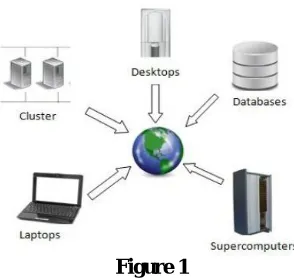
Grid computing uses distributed interconnected computer and resources collectively for achieving high performance computing and sharing of resources. It developed in the Mid 1990’s as an metaphor for making computer power as easy as an electric power Grid. Grid computing can be defined as a collection of parallel and distributes system that allow the sharing of resources for getting rid of complex problem and to enable co-operative working therefore we can say Grid computing emerged as important technique for high performance computing by providing sharing resources. [1] As Ian Foster says Grid computing deals with coordinating resources sharing and solving of problem in dynamic, multi-institutional virtual organizations for faster computing. The Basic concept behind Grid computing is to create illusion of a simple yet large and powerful self managing virtual computer out of a collection of heterogeneous system are sharing various resources [2].Grid computing in turn; provide highly scalable ,highly secure, and extremely high performance mechanism for discovering and negotiating access to remote resources in seamless manner[3]. A grid is a system that helps to manage and sharing of computational resources. Grid works on the idea of parallel and distributed computing.
Figure 1
Grid characteristics: There are several characteristics of Grid and is explained below:
1. Large Scale: A grid must have an ability to deal with number of resources without degradation of performance.
2. Geographical distribution: Resources of the grid may be located at distant places.
Resources Sharing: Resource in grid which belongs to some other organization that allow different users to access them.
3. Resources coordination: Resources in a grid must be coordinated for enhancing the computing power
[4].
4. Multiple administrations: Different organizations have different security and administrative policies under which their owned resources can be accessed and used therefore we can say network security problem is complicated as the need of handling different policies.
Types of Grid: There are different types of grid in grid computing which are described below [5]:
1. Data Grid: Data grid helps in storing data and other data related services like data discovery, data handling etc. Data grid provides controlled sharing and management of distributed data.
2. Network Grid: Network grid helps to achieve high performance communication by the use of data caching between nodes where each nodes behaves like a router.
3. Computational Grid: Provides the ability to perform higher throughput computing. In computational grid large number of computational task is divided among individual run in parallel and return the results.
II. GRID ARCHITECTURE
Grid computing infrastructure resources belongs to and come from physically scattered administrative domain to collectively provide resources (data, computing and network) to the user. In grid, computing nodes which are present at various locations can be independently operated from different locations. Grid offer certain protocol and services at five different layers in the grid protocol architecture. These layers are described below:
APPLICATION
CONNECTIVITY
FABRIC
COLLECTIVE
Fabric Layer: Fabric layer is present at the bottom of this layered architecture and it provides access to different resources type such as computing, storage and network resources, code repository etc. It also provides sharable resources such as network bandwidth, CPU time, memories, scientific instrument like sensor etc. When data received by sensor at this layer are transmitted to other computation node or can be stored in the data base over grid.
Connectivity Layer: This layer defines the protocol for secure access where these protocol is related to communication and authentication required for providing secure network transaction .Data are exchange between resource layer and fabric layer with the help of communication protocol and authentication protocol is used to provide secure cryptographic mechanism for user identification.
Resource Layer: The Resource layer defines the protocol for operating shared resources. In other words we can say it define protocol for publication, discovery, negotiation, monitoring, accounting and payment of sharing operation on individual resources. Grid resources and management (GRAM) protocol is used for allocation and monitoring of resources.
Collective Layer: The collective layer captures interaction across collection of resources, directory services such as MDS (Monitoring and discovery Services) allow monitoring and discovery of VO resources.
Application Layer: This layer is present at the top of the layer architecture. The layer consists of application which the user will implement. In addition, this layer provide interface to the user and administration to interact with grid. [6]
III. REAL-TIME APPLICATION OF GRID COMPUTING
1. Financial Services
With the emergence of a competitive market force, customer satisfaction, and reduction of risk are the most competitive areas financial communities continually strive to achieve. The requirements related to sophistication, accuracy, and faster executions are among the more salient objectives across financial communities. These objectives are now achieved by real-time access to the current and historical market data, complex financial modelling based on the respective data, and faster response times to user queries. Grid Computing provides this sector with advanced systems delivering all the competitive solutions (Jia, 2006). These solutions are dependent upon providing increased access to massive amounts of data, real-time modelling, and faster execution by using the grid job scheduling and data access features. Various grid solutions were offered including, among others, the implementation of the Open Grid Service Environment (Hochreiter, 2005) that provides an abstract service stack used to model large-scale computational financial problems as abstract workflows. Grid computing has been used for developing data mining applications for supplying effective online financial services for both retail and corporate customers. This is useful for intelligent risk management and decision making for financial enterprises and partners (Fan, 2000).
2. Manufacturing
The enormous competitive pressure in the business and industry sectors today afford most engineering and design far less turnaround time. They need mechanisms to capture data, speed up the analysis on the data, and provide faster responses to market needs. These engineering activities and design solutions are inherently complex and include, the analysis of real-time data to find a specific pattern within a problem, the parametric studies to verify different aspects of the systems, the modelling experiments to create new designs and the simulation activities to verify the existing models for accuracy. Here Grid Computing systems provide a wide range of capabilities that address these kinds of analysis and modelling activities. These advanced types of solutions also provide complex job schedulers and resource managers to deal with computing power requirements. In the case of engineering work, virtual collaboration on the design, production and maintenance of products that are described in complex structured product model databases is a major challenge (Turk et al., 2004, Dolenc et al., 2004 &Intel Grid). Existing web service paradigms can weakly support such collaboration (Maad et al., 2005). The potential grid solution lies in an appropriate implementation of the VO concept which provides a robust framework for engineering collaboration due to its flexibility, adaptability, and security.
3. Life Science & Health Care 3.1 Life Science :
There have been dramatic advances in the life sciences sector, which have in turn provided rapid changes in the way that drug treatment and drug discovery efforts are now being conducted. These advances have now presented a number of technical challenges to the information technology sector. These challenges include huge amounts of data analysis, data movement, data caching, and data mining. In addition to the complexity of processing data, there needs to be additional requirements surrounding data security, secure data access, secure storage, privacy, and highly flexible integration. The Grid Computing systems can provide a common infrastructure for data access, and at the same time, provide secure data access mechanisms while processing the data. Today, life sciences utilize the Grid Computing systems to execute sequence comparison algorithms and enable molecular modelling using the above-collected secured data. This now provides the Life Sciences sector the ability to afford world-class information analysis respective to this discussion, while at the same time providing faster response times and far more accurate results. The analytics and system efforts' surrounding genomic, proteomics, and molecular biology efforts provides the basis for many of these Grid Computing advancements in this sector, and especially the Grid Computing disciplines.
3.2 Health Care:
collaboration in e-Hospitals (a virtual network of hospitals that delivers medical training, e-surgery, and medical analysis services).
4. Telecom & Media
4.1 Media:
The major challenge facing media applications is the production, broadcasting, delivery and playout of interactive media content (audio, video, and image) in real time. Grid solutions have been developed for this, these include, the Grid Visualization Kernel (GVK) [7] which allows the visualization pipeline [8] (data enrichment/reduction, followed by mapping of the data to an abstract form, and finally composing the visual image) to be ported to grid resources, and also handles the communication between the simulation generating the data and the visualization of the simulated data; and G-Vid [9] which is based on GVK which allow the production of real time interactive MPEG4 compliant video content on the grid.
4.2 Collaborative Games :
There are collaborative types of Grid Computing disciplines that are involving emerging technologies to support online games, while utilizing on-demand provisioning of computation-intensive resources, such as computers and storage networks. These resources are selected based on the requirements, often involving aspects such as volume of traffic and number of players, rather than centralized servers and other fixed resources. These on-demand-driven games provide a flexible approach with a reduced up-front cost on hardware and software resources. We can imagine that these games use an increasing number of computing resources with an increase in the number of concurrent players and a decrease in resource usage with a lesser number of players. Grid computing gaming environments are capable of supporting such virtualized environments for enabling collaborative gaming (Maad et al., 2005).
5. Government & Education
5.1 Government:
The Grid Computing environments in government focus on providing coordinated access to massive amounts of data held across various agencies in a government. This provides faster access to solve critical problems, such as emergency situations, and other normal activities. These key environments provide more efficient decision making with less turnaround time. Grid Computing enables the creation of virtual organizations, including many participants from various governmental agencies (e.g., local, state and central). The formation of virtual organizations, and the respective elements of security, is most challenging due to the high levels of security in government and the very complex requirements (Maad et al., 2005). Another area of application is e-government, where the major challenge is the development of an e-government infrastructure that supports the shift to a service-oriented e-government model (Maad et al., 2005b).
5.2 Education:
There is a big difference in education sector between first world and developing world. This difference is based on digital learning resources and computing power. Unfortunately all of these resources are geographically distributed all over the world. There is no doubt that ICT is playing a big role for introducing E-learning around the world. But if we really want to overcome these differences we need a revolutionary approach that support mutual use of geographically distributed computing and learning resources as an aggregated environment that will create new ways of flexibility, interoperability and extensibility. Fortunately Grid is the technologies that can integrate all of these resources of knowledge’s and produce super-computing power from those geographically distributed computers to access those knowledge’s without sacrificing local autonomy(GF/117). For example, the Indian Institute of Information Technology and Management, Kerala is heading a Grid project known as Kerala Educational Grid that envisages the linkage of colleges and universities to resource centres that will supply education materials on demand and increase cooperation and networking among the affiliated academics (Sherly, 2005).
5.3 Environment :
7 UK institutions. At an international level, a similar VO was formed involving 21 EU institutions within the CrossGrid consortium (Cross Grid).
5.4 Weather Forecasting:
Another field with huge data generation and processing requirements is weather forecasting. Both local weather data stations and satellites collect and transmit large volumes of data for analysis. Networks of detectors have been placed in the ocean in many locations to detect tsunamis and predict their size and course to permit timely evacuations of coastal areas. Grid Computing has been very extensively used for forecasting of weather and other natural catastrophic events.
5.5 Research Collaboration:
Research-oriented organizations and universities undertaking advanced research collaboration require the analysis of tremendous amounts of data. Some examples of such projects are subatomic particle and high energy physics experiments, remote sensing sources for earth simulation and modelling, and analysis of the human genome sequence. These organizations engaged in research collaboration activities generate petabytes of data and require tremendous amounts of storage space and thousands of computing processors. Researchers in these fields must share data, computational processors, and hardware instrumentation such as telescopes and advanced testing equipment. Most of these resources are pertaining to data-intensive processing, and are widely dispersed over a large geographical area. In these situations the Grid Computing discipline provides mechanisms for resource sharing by forming one or more virtual organizations providing specific sharing capabilities. Such virtual organizations are constituted to resolve specific research problems with a wide range of participants from different regions of the world. constituted to resolve specific research problems with a wide range of participants from different regions of the world.
5.6 Astronomy:
The major challenge facing the field of astronomy is the analysis of tera-bytes of astronomical image data generated by telescopes. Moreover, astronomical image capturing devices can generate several images, each of hundreds of Mbytes, per single shot (Yamamoto, 2004). This necessitates: data intensive computation; scalable file I/O in the order of GB/s; replica management; and parallel / distributed processing of files. Grid computing is essential and has been successfully used for such data intensive computation.
IV. BENEFITS OF GRID COMPUTING
1. Reduction in computation time: Grid computing helps in faster manipulation of complex problem thus reducing the computation time.
2. Parallel computation: Grid computing offer parallel computation this leads to enhancing performance
3. Cost Reduction: By optimizing the existing IT infrastructure and by enabling sharing of data and distributed
workflow leads to faster design process.
4. Resource balancing: The grid computing offer balancing of resources, it can handle job scheduling.
5. Improved Reliability: Grid technology provides an approach to improve reliability. In this parallelization play an important role as multiple copies of jobs run at the same time.
6. Access to additional resources: The grid offer access to other specialized devices such as the cameras and embedded systems.
7. Management of resources: Grid computing manages the resources and effectively controls expenditures for
computing resources.
8. Grid virtualization: Grid computing offer grid virtualization that leads to faster processing and increasing the efficiency of network.
V. CHALLENGES OF GRID COMPUTING
simulation over grid. Moreover, simulation models developed for traditional hardware systems are not valid for the modern systems [10]. No doubt grid computing seems like a promising solution to eliminate the resource islands and to provide resources and services over internet in a transparent way. But to achieve all above, we need to analyse the current barriers and challenges in developing, deploying, promoting and use of grid computing. The various challenges to the grid are the following:
1. Grid reliability
2. Scheduling of tasks
3. Load balancing
4. Resource monitoring
5. Service availability
6. Distributed management
7. Availability of data
8. Uniform user friendly environment.
9. Grid application development
10. Standard protocols
11. Efficient algorithms and problem solving methods
12. Programming models and tools
13. Management and administration of grid
14. Performance analysis and resource monitoring
15. Centralized management
The list of grid challenges is not limited to the above. There are various other challenges to grid like hidden costs, no widely accepted definition and scope of grid computing, lack of significant applications for grid, availability of widely accepted standard protocols to control and manage grid and much more. All these leading to the shift of user’s attention from grid computing to service computing. Above mentioned issues forces to rethink, “for what indeed the grid computing is”.
VI. CONCLUSIONS AND FUTURE SCOPE
In this paper we have described about high speed computing: Grid computing, its architecture as well as we have also covered its benefits and its core security issues. This paper also presents the detailed concepts of Grid computing and its application in various sectors. In future grid computing will play major role as complex algorithm are being developed. We have also speculated that grid computing may change the scenario of broadband by providing bandwidth raging from gigabytes to terabytes.
REFERENCES
[1] I. Foster, C. Kesselman and S. Tueke. “The anatomy of the grid: Enabling scalable virtual organizations,” Int. J.Supercomp.Appl., vol.15 [3],
pp. 200-222, 2001.
[2] Luis Ferreira, ViktorsBerstis, Jonathan Armstrong “Introduction to Grid Computingwith Globus” IBM September 2003
[3] María S. Pérez “Grid and cloud computing” Facultad de InformáticaUniversidad Politécnica de .Madrid .
[4] 1Seyyed Mohsen Hashemi, 2Amid KhatibiBardsiri“Cloud Computing Vs. GridComputing” Dean of the Software Engineering and
Artificial Intelligence Department , Science and Research Branch, Islamic Azad University,Tehran, IRAN.
[5] Ovaise Khan, “Types of Grid”, [Online]Available: http:// thegridweblog.blogspot.in/2005/10/types-of grids.html.
[6] 1,2,3Ian Foster, 4Yong Zhao, 1Ioan Raicu, 5Shiyong Lu “Cloud Computing and Grid Computing
360-Degree Compared” Department of Computer Science, University of Chicago, Chicago, IL, USA.
[7] Thandavan A., Sahin C., & Alexandrov V. N. 2004. Experiences with the Globus Toolkit on AIX and deploying the Large Scale Air Pollution
Modelling application as a grid service 27, Proceeding Cracow'04 Grid Workshop, Crakow, Poland
[8] Turk, Z. M. Dolenc, J. Nabrzyski, P. Katranuschkov, E. Balaton, R. Balder, & M. Hannus. 2004. Towards Engineering on the Grid, in Dikbas
A. and Scherer R. (eds.) Proceedings, ECPPM Conference, Istanbul.
[9] Watkins, R. 2006. IBM Grid Computing & Virtualization, GRID @ Asia Conference, Seoul, Korea, December 11-13
BIOGRAPHY
Rahul Kumar was born in Uttar Pradesh, India, in 1992. He has received B.Tech degree in Computer Science & Engineering in 2012 and then worked as a Guest Speaker in Govt. I.T.I from 2012 to 2014. Currently perusing M.Tech degree in CSE from Sam Higginbottom Institute of Agriculture, Technology & Science, Technology & Science, Deemed-to-be- University in Allahabad (U.P).
Arun Kumar Shukla is currently working as Assistant professor in the Computer Science and IT Department in Sam Higginbottom Institute of Agriculture, Technology & Science, Deemed-to-be- University in Allahabad (U.P). He has done his bachelor of Engineering from Jawaharlal Institute of Technology from Khargone (M.P) in the year 2006 and Master of Engineering from I.E.T. - D.A.V.V., Indore in the year 2011.