IJEDR1602369
International Journal of Engineering Development and Research (www.ijedr.org)2103
An Image reranking model based on attributes and
visual features eliminating duplication
1
Ms.Madhuri Mhaske,
2Prof.Sachin Patil
1 PG Scholar at G. H. Raisoni College of Engineering and Management, Chas, Ahmednagar , 2Professor at G. H. Raisoni College of Engineering and Management, Vagholi, Pune
________________________________________________________________________________________________________ Abstract - An image search on internet is increasing day by day. Users type keywords in various search engines like Google, Yahoo, Bing etc for retrieval of relevant images. These search engines search the images from large pool of database. But as the keywords entered by user are generally short and ambiguous, different kinds of images are retrieved and sometimes these results are irrelevant. In this paper, semantic approach is proposed to solve this ambiguity. An image search reranking is definitely a superior approach over the text based image search. Using single modality for image searching is not sufficient as the different images have different features. This paper considers both the textual features as well as visual features for reranking. Attributes of images are classified into the groups. Based on those attributes from classifiers and the visual features of the images, each image is represented. The ranking score is used to evaluate the relevance of the image with query image. Hypergraph models these images based on the ranking scores .Content based image retrieval (CBIR) technique is used for extracting visual features. CBIR focuses on the content of the images such as color, texture, shape or any other information related with the images. Duplicate images found in search results are detected and eliminated by using SURF (Speeded Up Robust Feature) technique.
Index Terms - Attribute, Hypergraph, CBIR, SURF. Etc
________________________________________________________________________________________________________
I.INTRODUCTION
N
owadays Image search on internet has become very much popular that challenges regarding the same are also increasing. Queries are used as keywords by the Internet image search engines. Users usually type keywords as queries in the hope of finding the images. The search engine returns Hundreds of images ranked by the keywords extracted from similar text.Usually text-based image search is inefficient because of the ambiguity of query keywords. The keywords provided by user are generally ver y short. They fail in describing the image content accurately. The search results are not efficient and include images having different semantic meanings.Because of the success of text based image search, many systems rely entirely on the text based image search for images, audio/video etc. However, the visual systems should not rely entirely on the description of the images for relevance. Instead they should consider the visual content of the images as the text based results may contain ambiguity. They may not describe the content properly. For example, if user wants to search for a red image, the images cannot be evaluated by text based search. Many approaches are under investigation to increase the performance of web image search. One of them is image annotation, which aims to associate several keywords of an image to describe its content based on machine learning and vision techniques. However, although the great progress has been made in the past few years, automatic annotation of large scale web images hardly achieve satisfactory performance due to the semantic gap. The Second approach is web image search reranking. Being different from annotation which aims to enhance the text indexing of web images, reranking approach is applied to adjust search results directly by mining images’ visual content. Visual search reranking is defined as reordering visual documents such as images or video clips based on the initial search results or the auxiliary knowledge to improve the search.
The main motto of visual reranking is to refine the image results based on visual content rather than text based search. We propose the model that combines the visual content with the attributes which best describe the images. Content based image retrieval technique is adopted to monitor the image content. Hypergraph is used to reorder the images based on relevance scores obtained from different image ranking techniques.
1.1 Design Goals
Search-ability: User should be able to generate any trapdoor for searching over any shared file. Compactness must not affect the capability of searching
Optimized Consistency: To optimize the consistency of ranking scores over visually similar images and minimize the inconsistency between the optimal list and the initial list.
Efficient Reranking: To make online image re-ranking efficient. Eliminate Duplication: Duplicate images are avoided.
Accuracy and Reliability: Increase accuracy and reliability.
IJEDR1602369
International Journal of Engineering Development and Research (www.ijedr.org)2104
To consider the visual information is very important to overcome the drawbacks of text based image search. The conventional methods only model the pair wise relationship among the images. The hypergraph technique was invented to solve these problems [2].It is used to establish the relationship among different images as the hyperedge joins multiple image samples. However, the existing Hypergraph learning approach have some drawbacks as generation of hyperedges and handling of the hyper edges[2]. The user query is classified into multiple weight classes defined on the basis of user's search intention. In each class, weight mechanism is provided to associate the visual features along with the images. By the clustering method and the visual information of the user's query, the query is evaluated to draw the user's intent. This evaluation leads the query into different positive samples which makes the similar query to be expanded to improve the CBIR [13].Each attribute has an explicit semantic meaning, e.g., “animals”. Attribute concepts are relatively more general and easier to model, e.g., attributes “animal” and “car” are easier to model and distinguish than the concrete semantic concepts “Husky” and “Gray Wolves”.[12]Thus, attributes are expected to minimize the semantic gap between low-level visual features and high-level semantic meanings. Su. [3] proposed to alleviate the semantic gap between visual words and high level concept, focusing on polysemy phenomenon of particular visual words.
By randomly splitting the training data, Farhadi [4] exhaustively train thousands of classifiers and then chose some of the discriminative ones as attributes(e.g., attributes that “dog” and “cat” have but “sheep” and “horse” do not). Kumar [6] define a set of binary attributes called similes for face verifications. Each attribute detector in smiles are exclusively trained for one specific category, e.g., “the mouth of Angelina Jolie”.
Recently, Parikh and Grauman [7] propose a new strategy to compare the strength of attributes, e.g., “while A and B both are shiny, then A is shinier than B”.Zhan [3] proposed an attribute augmented semantic hierarchy for content-based image retrieval. Such superiority motivates us to exploit attributes for visual reranking.
Baluja and Jing proposed a Visual Rank framework to efficiently model similarity of Google image search results with the graph [9].The framework reorders the images based on the visual information. The graph is constructed based on the relevance scores and the final result is evaluated.
II.PROBLEM STATEMENT
2.1 Existing System
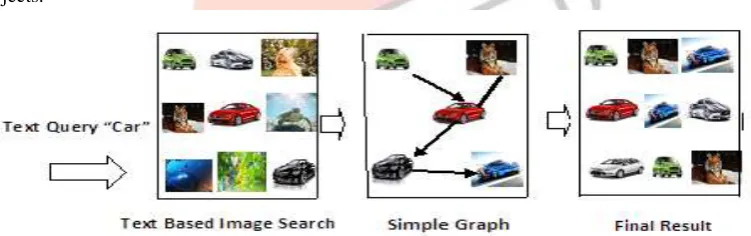
The existing system improves the text based search result by introducing the graph based methods. The graph based methods have emerged as an effective approach for image reranking. In Graph based methods, the relationship among different samples are represented by the way of nodes and edges.
The first step is to draw out the results by text based search. In the next step, the graph is constructed. In the graph, the image samples are represented by vertices and the relationship among them is described by edges. The learning task is also performed on these graphs. Suppose the samples are represented by the feature vectors in a feature space, an undirected graph may be constructed by using the pair wise distances and graph-based semi-supervised learning approaches can be performed on this graph categorize the objects.
Fig -1: Block Diagram for Existing System.
The drawback of this method is that the simple graph cannot describe the high level content. Also the graph links only two vertices by the edge at a given time. These drawbacks are overcome in the proposed system. Hypergraph allows the hyperedge to connect more than two vertices at a given point of time.
As the high order information is not taken into consideration, the final results drawn from this system may contain duplicate, ambiguous data.
2.2 Proposed System
IJEDR1602369
International Journal of Engineering Development and Research (www.ijedr.org)2105
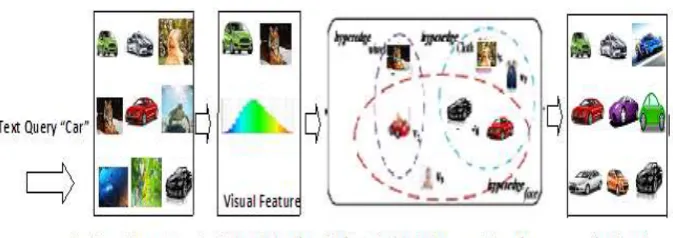
Fig -2: Architectural Diagram of Proposed System.
The Hypergraph is used to order these images considering the ranking scores. The relationship among these images is best described by Hypergraph by considering low level visual features and the attribute features. The regularizer is added on the weights of hyperedge which selects semantic attribute for improvement of the hypergraph approach presented in [11].As a result, the noisy attributes are removed and the opportune samples are selected which makes the system more robust and efficient. Content based image retrieval (CBIR) technique is also used in combination with Hypergraph. Apart from the traditional keyword search systems, CBIR considers the global features as color, edge, LBP etc as well as the local features drawn out from the image samples. CBIR focuses on the content of the images such as colour, texture, shape or any other information related with the image.
Colour - For every pixel, the color descriptors are described as RGB values.
Scale- The scale invariant feature transform (SIFT) descriptors are described for the 8x8 blocks of every pixel of having size as 4. Suppose User submits the textual query as "Car". The first step is to obtain the result based on textual search. The text based search engine outputs the images having "car" in its description. This result may contain duplicate or inconsistent media. Then the content based image retrieval technique is applied to the result. Then the clusters are formed by cluster conditional probability. The images in the clusters are reordered by the cluster membership value. The relevant images are then modeled in the Hypergraph to fetch more refined result. The final result is the consistent result containing no duplicate media.
III.ALGORITHM
3.1 Algorithm for Re-Ranking (Update Y Parameter) Keyword <- Query
Y <-Initialization(Keyword) F[n] <- Feature_generation(Y) W[n] <- modalO
Loop 1: T2 II T2 is random iteration LoopI = I:n
A[I] = mean(sum(W[I])) D[I] = diag(sum(W[I]))
L[I] =I-sqrt(D[I])*W[I]*sqrt(D[I]) total = (total + alpha[I] * L[I]) end Loop
Y <- inv (I + total)*Y llUpdate Y 11t = 1
Loop k =1:T1 II T1 is random iteration A(I+ 1) = A(I)k- 11t8Q8AkIAk=A(I)k If Q(A(I+l) ) < Q(A(I)k )
Then 11t+ 1 = 211t ;
Otherwise A(I + 1) k= A(I)k , 11t+ 1 = 11t 12. End Loop
End Loop
3.2 Attribute-assisted Hypergraph Learning
This algorithm summarizes the implementation of the alternating optimization. Step 1: Initialization.
1.1 Set W as a diagonal matrix with initial values.
1.2 Construct the hypergraph Laplacian Δ and compute the matrices Dv, De and H accordingly. Step 2: Label Update.
IJEDR1602369
International Journal of Engineering Development and Research (www.ijedr.org)2106
Step 3: Weight Update.Update the weights wi with the iterative gradient descent method introduced. Step 4: Update Matrix.
After obtaining W, update the matrix Θ accordingly. Step 5: Quit
Put t=t+1. If T < t, quit from the iteration and output the results, else go to step 2. IV.MATHEMATICAL MODEL
V.Set Theory
Input Set: Request from user to search an image from existing images uploaded by owner. I=Request Set
Image Set: Consider a set of images that are uploaded by owner. A=Attribute Set:
Consider a set of attributes for an image in the image dataset. R=Relevant Set:
Set consists of the images relevant to the query thrown by User. IR=Irrelevant Set:
Set consists of the images irrelevant to the query thrown by User. V=Set of vertices (Images) in Hypergraph.
E=Set of Edges (Relationship among images) in Hypergraph. Output:
O= Output Set
Final Set of Images most relevant to the user’s query.
Fig -3: Venn Diagram.
VI.EXPECTED RESULT
We proposed an image search reranking framework to improve the text based image retrieval results based on the data gained from the highly ranked images.
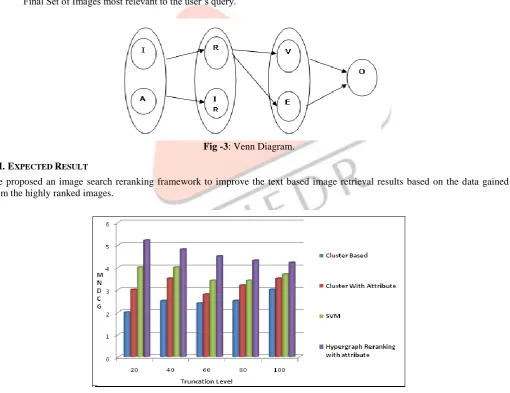
Chart -1: Performance Evaluation of our method with conventional methods.
The performance of our method is the best compared to the traditional methods. They are described as follows. Cluster based Image search:
IJEDR1602369
International Journal of Engineering Development and Research (www.ijedr.org)2107
Cluster based search with attribute:The same strategy is used here which was used with the traditional cluster based method except the image ordering is done based on the attributes of the images. This method gives better result as compared to previous one.
PRF-SVM Method:
In this method, the Pseudo Relevance Feedback(PRF) is used to classify the images into positive training samples and the negative training samples are taken from other images. Then a Binary classification method called SVM(Support Vector Machine) is used to rerank those results. The results from this method are noisy and do not generate the effective result set. Hypergraph Reranking with attribute:
Our proposed method performs better than the conventional methods.
VII.CONCLUSION
The text based image search technique, though simple and easy to implement, is not so effective in many aspects. We propose an image search reranking model based on attribute assisted Hypergraph. The Hypergraph models the relationship among multiple images relevant to the user query. As well the content based image retrieval technique is also used for effective reranking. In CBIR, base of image search is the Content of the image. Content may be considered as Color, Texture, shape or any other information related to the image. CBIR gives the improved result. Images if appeared duplicate are eliminated by the system. The image searching is done in multiple layers. So the final result obtained from Attribute assisted reranking model is more efficient as compared with previous techniques.
VIII.ACKNOWLEDGMENT
I take this opportunity to express my gratitude towards my guide Prof. Sachin Patil for his personnel involvement and technical guidance and model direction, important input and consistent consolation all through the spam venture. Working under him was greatly learned experience for me. For all his help and interest in project come out with best.
REFERENCES
[1] Junjie Cai, Zheng-Jun Zha,Meng Wang, Shiliang Zhang, and Qi Tian,” Attribute Assisted Reranking Model Based on Web Image Search”, In Proceedings of the IEEE Transactions of Image Processing VOL. X, NO. XX, 2015,
[2] Jun. Y, D. Tao and M. Wang.,” Adaptive Hypergraph learning and its application in image classification.”, IEEE Transactions on Image Processing, vol. 21, no. 7, pp. 3262-3272, 2012.
[3] H. Zhang, Z. Zha, Y. Yang, T.-S. Chua, “ Attribute-augmented semantic hierarchy.” In Proceedings of the ACM Conference on Multimedia, 2013.
[4] N. Morioka and J. Wang., “Robust visual reranking via sparsity and ranking constraints.”, Proceedings of ACM Conference on Multimedia,2011.
[5] F. Yu, R. Ji, M-H Tsai, G. Y and S-F. Chang.,” Weak attributes for large-scale image retrieval.” In Proceedings of the IEEE
Conference on Computer Vision and Pattern Recognition, 2012.
[6] W. H. Hsu, L. S. Kennedy and S.-F. Chang.,” Video search reranking via information bottle principle.”, In Proceedings of
ACM Conference on Multimedia, 2006.
[7] R. Yan, A. G. Hauptmann and R. Jin.,” Multimedia search with pseudorelevance feedback.” In Proceedings of ACM
International Conference on Image and Video Retrieval, 2003
[8] X. Tian, L. Yang, J. Wang, Y. Yang, X. Wu and X.-S. Hua.,” Bayesian video search reranking.” Transaction on Multimedia, vol. 14, no. 7, pp.131-140, 2012.
[9] F. Jing and S. Baluja.,” Visualrank: Applying pagerank to large-scale image search.” IEEE Transaction on Pattern Analysis and Machine Intelligence, vol.30, no.7, pp.1877-1890, 2008.
[10] B. Siddiquie, R.S.Feris and L. Davis.,” Image ranking and retrieval based on multi-attribute queries.” In Proceedings of the
IEEE Conference on Computer Vision and Pattern Recognition, 2011.
[11] J. Cai, Z.-J. Zha, W.-G. Zhou, Q. Tian.,” Attribute-assisted reranking for web image retrieval.” In Proceedings of the ACM International Conference on Multimedia, 2012.
[12] N. Kumar, A. C. Berg, P. N. Belhumeur and S. K. Nayar.,” Attribute and simile classifers for face verification.” In
Proceedings of the IEEE International Conference on Computer Vision, 2009.