
The KLOE-2 experiment at DAΦNE
M. Silarski1,
for the KLOE-2 Collaboration
1LNF-INFN, Via E. Fermi 40, 00044 Frascati (RM), Italy
Abstract.The KLOE-2 experiment at the INFN Laboratori Nazionali di Frascati (LNF) is currently taking data at the upgradede+e−DAFNE collider. Present Run II follows a development phase to assess the feasibility of a long term acquisition program, Run I, which successfully ended in July 2015 with 1 fb−1 integrated luminosity collected in less than eight months. KLOE-2 represents the continuation of the KLOE experiment with a new physics program. The KLOE detector has undergone several upgrades in-cluding state-of-the-art cylindrical GEM Inner Tracker, electron-positron taggers for the γγ-physics studies and new calorimeters around the interaction point. In this article we briefly present the overview of the KLOE-2 experiment including the present status and achievements together with the physics plans.
1 Introduction
The KLOE-2 experiment operates at the upgraded DAΦNEe+e−collider in Frascati aiming to com-plete and extend the KLOE physics program with more than 5 fb−1of integrated luminosity collected
in the next 2-3 years [1]. For the first time the "‘Crab-Waist"’ interaction scheme developed in Frascati has been applied in the presence of a high-field detector solenoid, where the transverse dimensions of the beams and their crossing angle are tuned to maximize the machine luminosity [2]. KLOE-2 achieved a record performance in terms of 2 x 1032cm−2s−1peak luminosity and 12 pb−1maximum daily integrated luminosity with this innovative scheme of beam collisions, which will be employed in the upgrade of the B-factory currently under construction at the KEK Laboratory in Japan, and is also considered a valid option in several future projects.
The main components of the KLOE-2 detector are the Drift Chamber, one of the biggest ever built, and a lead-scintillating fiber Electromagnetic Calorimeter, one of the best ones for energy and timing performance at low energies. The KLOE drift chamber provides three–dimensional tracking with perpendicular decay vertex resolution of the order of 1 mm and transverse momentum accuracy better than 0.4% [3]. The electromagnetic calorimeter consists of a 24-module barrel surrounding the drift chamber and two endcap detectors which together cover in around 98% of the solid an-gle. It provides determination of energy and time with accuracies ofσE/E = 5.7%/
√
E[GeV] and σ(t)=57ps/√E[GeV]⊕100 ps, respectively [4]. To improve vertex reconstruction capabilities near the interaction region KLOE-2 was equipped with an inner tracker and it is the first high-energy ex-periment using the GEM technology with a cylindrical geometry, a novel idea that was developed
at LNF exploiting the kapton properties to build a transparent and compact tracking system [5]. To studyγγ-physics the detector has been upgraded with two pairs of electron-positron taggers. The Low Energy Tagger (LET) is a small calorimeter placed inside KLOE near the interaction piont, consisting of LYSO crystals read out by silicon photomultipliers. This subdetector will serve to measure elec-trons and posielec-trons fromγγinteraction with energy up to around 400 MeV [6]. The second tagger is called High Energy Tagger (HET) which provides measurement of the displacement of the scattered leptons with respect to the main orbit. Therefore, it was inserted inside the machine lattice 11 m away from the interaction point. This position sensitive detector consists of 30 small BC418 scintillators 3x3x5 mm3, which provide a spatial resolution of 2 mm (corresponding to momentum resolution of
∼1 MeV/c) [7]. In parallel to the ongoing data taking campaign we have completed several analyses using the old KLOE data sample. Some of these results will be briefly described in the next section.
2 Recent KLOE-2 results
Apart from running the KLOE-2 experiment and activities devoted to commissioning of the new subdetectors there are still several ongoing, or recently finished, physics analyses based on the KLOE data, including search for dark forces at 1 GeV, tests of the CPT and Lorentz invariance in the neutral kaon system and new precision measurements in hadronic physics at low energy.
2.1 CPT tests in the neutral kaon system
An unique feature of theΦ-factory is the production of neutral kaon pairs in a pure quantum state, thus at KLOE we can study quantum interference effects and tag pure monochromaticKS andKLbeams.
Due to the quantum entanglement the kaons double differential rate of decay into two final states f1
andf2takes the following form:
I(f1,f2,Δt)∼ |η1|2e−ΓLΔt+|η2|2e−ΓSΔt−2|η1|2|η2|2e−
(ΓL+ΓS)
2 Δtcos(ΔmΔt+φ2−φ1) (1)
whereΔtdenotes the proper decay times difference andη1andη2are the two decay amplitude ratios:
ηi=|ηi|eiφi = fi|T|KL
fi|T|KS. ΓLandΓS denote the widths ofKLandKS meson, respectively. If both kaons decay to the same final state the interference pattern in Eq. 1 is very sensitive to any deviation from unity of the ratioη1/η2in the interference region ofΔt≈0. Such deviations may be present due to
the CPT violation which in the framework of SME manifests to lowest order only in the parameterδK
exhibiting dependence on the 4-momentum of the kaon [9]:
δK≈isinφS WeiφS WγK(Δa0−βK·Δa)/Δm, (2)
whereφS W is the superweak phase,γK andβK are the boost factor and velocity of kaon and Δm
denotes the difference betweenKLandKS mass. The fourΔaμparameters represent the differences of couplings to valence quark and antiquark of the meson. Since the Earth is rotating the CPT and Lorentz violating parameters are usually considered in the fixed stars reference frame which makes δK dependent also on the sidereal timets. At KLOE a search for the Lorentz and CPT symmetries
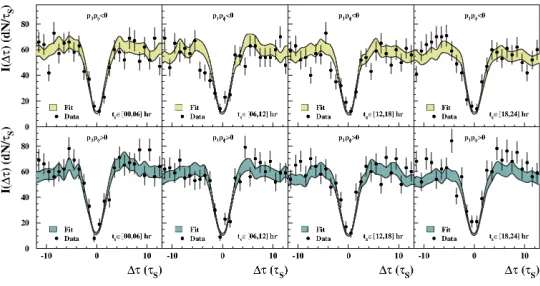
violation have been performed by measurements of the interference pattern for both kaons decaying toπ+π− final states using a sample of 1.7 fb−1 of integrated luminosity [8]. The data sample was divided into two subsets: one containing events where kaon emitted in the forward hemisphere in the KLOE reference frame was moving along with theφmomentum and the second one with events where kaon emitted in the same hemisphere was moving in the opposite direction. Moreover, the data were divided into four bins of sidereal time. For every subset of the data distribution of the decay
DOI: 10.1051/ , 01020 (2016)
130
EPJ Web of Conferences 13001020
MESON 2016
Figure 1.Distributions of the double differential decay rates intoπ+π−, π+π−final states measured with the KLOE
detector. The top panel contains distributions for four bins of sidereal time when kaon emitted in the forward hemisphere (cosθ >0) in the KLOE reference frame was moving along with theφmomentum (i.e.p1(2)·pφ>0). The lower panel shows distributions for a subset of data where kaon emitted in the forward hemisphere was moving in the opposite direction (i.e.p1(2)·pφ<0). Figure taken from [8].
intensity in function ofΔt, expressed in units of theKS lifetime, was determined. The resulting eight
distributions are presented in Fig. 1. The distributions were fitted simultaneously with the interference pattern allowing possible modulation effects induced by the CPT violation. The results of the fit are indicated in Fig. 1 together with uncertainties by colored bands. They do not reveal any CPT or Lorentz symmetries violation and constitute the first estimation ofΔaμparameters in the kaon sector with sensitivity of about 10−18GeV [8].
2.2 Search for dark forces
In the framework of the Dark Matter searches it was postulated, that there may exist a secluded gauge sector mediated by a new vector gauge bosonU, called also the dark photon [10]. The dark photon could couple with ordinary photon via mixing term and subsequently decay into Standard Model particles giving opportunity to be observed in high-energy experiments. Direct searches of these dark matter mediators are performed with several experiments including KLOE-2. We have explored three different processes: Dalitz decays of the φ meson: φ → ηU, U → e+e− withη → 3π [11, 12],
e+e− → UγwithU decaying to lepton or pion pairs [13–15] and the dark Higgsstrahlung process
e+e− → Uh0, U → μ+μ−withh0invisible [16]. Search for the dark photon in theφDalitz dacays were performed using an integrated luminosity of 1.7 fb−1and 1.5 fb−1forη→3π0andη→π+π−π0,
respectively. The irreducible background from theφ → ηγ∗ → ηe+e−decay was directly extracted from the data by a fit to the di-lepton invariant mass distribution parameterized according to the Vector Meson Dominance model. No resonant signal was observed in thee+e−invariant mass distributions for bothη decays. As a result we have estimated upper limit on the kinetic mixing parameter as a function of theUboson mass which is shown in Fig. 2 as the KLOE(1)region.
NA48/2 A1 KLOE(1) aμ KLOE(2) KLOE (3) BaBar KLOE (4) APEX WA SA HADES ae
aμ<| 2σ|
0 200 400 600 800
10−7 10−6 10−5 10−4 ) BaBar )) )) A1 DES ) A APEX A D D 3) KLOE(1)
<|2σ|
)
K
aμ< K < K H H H HAD H HAD HAAD H H H E(3) μ OE K E K K K K K KLLLOE KL KLOE W L KLL KLLLOE K KL K KOE KL K K K aμ K K WA SA K K K
OEE(2) KLOE
MU(MeV)
ε
2
Figure 2.90% CL exclusion plot for theUboson couplingε2as a function of the U-boson mass. The
limits obtained by KLOE-2 are denoted as: KLOE(1)
(φDalitz dacay studies [11, 12]), KLOE(2)
(e+e−→e+e−γ[13]), KLOE(3)(e+e−→μ+μ−γ[14])
and KLOE(4)(e+e−→π+π−γ[15]). The limits from
the A1 [17], APEX [18], the WASA [19], HADES [20], BaBar [21] and NA48/2 [22] experiments are also shown. The gray dashed lines showsUboson parameters that could explain the observed muon anomalous magnetic moment [23]. Figure adapted from [16].
a strong suppression of the resonantφ → π+π−π0 and FSR background. The residual background
components were simulated and fitted to the invariant mass spectra. The measured distributions are in perfect agreement with the simulations done with the PHOKHARA generator [24] and does not show any peak structure. The exclusion limits estimated based on these studies are shown in Fig. 2
as KLOE(2), KLOE(3)and KLOE(4)regions. A natural consequence of massive dark photon would be
the existence of associated Higgs-like particleh, so-called dark Higgs, coupling to U with coupling
constantαD. Thus, the U boson could manifest itself in thee+e−collisions through the Higgsstrahlung
process:e+e−→UhwhereUdecays to theμ+μ−pair. If the mass ofhexeeds mass of theUboson
the transitionh →Uis allowed and one can search for the Standard Model decay products of both
Ubosons produced (e.g. two di-lepton or di-pion pairs) [25, 26]. The KLOE-2 analysis was done
assumingmh <mU, therefore we were looking for the missing mass in the final state ofμ+μ−[16].
The expected signal would show up as a sharp enhancement in the two dimensional distribution of
μ+μ−missing mass versus theμ+μ−invariant mass. In order to better understand backgrounds, two
data samples were analysed: sample gathered at theφmass peak (1.65f b−1) and the off-peak sample
at √s =1000 MeV (0.2 f b−1), where backgrounds are strongly reduced. The 90% confidence level
limits ofαD·ε2obtained by KLOE-2 for combined on- and off-peak data samples are at the level of
10−9−10−8depending on the masses ofUandh[16].
2.3 New results in hadronic physics
Recently KLOE-2 published new, independent result on theη → π+π−π0 Dalitz plot measurement
with the highest statistics in the world (∼ 4.48·106 events) [27]. This isospin-breaking decay is of
particular interest because it provides information about the light-quark mass difference. Moreover,
analysis of theη→π+π−π0Dalitz plot gives possibility to test the charge conjugation symmetry. At
KLOE theηmeson is produced in the radiativeφdecay together with a mono-energetic photon with
energy E∼363 MeV. The candidate events are searched for in a preselected sample with at least three
prompt photons and two tracks with opposite curvature reconstructed. The main background originate
from thee+e−→ωπ0reaction and the Bhabha scattering. The resultingη→π+π−π0Dalitz plot was
bin-by-bin background subtracted and fitted with the decay squared amplitude|A|2parametrized with
a polynomial expansion:
|A(X,Y)|2 N(1+aY+bY2+cX+dX2+eXY+f Y3+gX2Y+. . .), (3)
whereX andY are the normalized Dalitz plot variables expressed by the kinetic energies of all the
particles in the final state [27]. We have obtained the most precise estimations of the Dalitz parameters,
DOI: 10.1051/
, 01020 (2016) 130
EPJ Web of Conferences 13001020
MESON 2016
Figure 3. Left: Fφ ηdistribution as a function of thee+e−invariant mass. The blue curve shows the results of fit of the VMD model parametrization to the data. VMD theoretical expectations are superimposed in pink dashed curve while theFφ ηdependence obtained from the Terschluesen/Leupold model is reported as red points. Right: MeasuredFφ π0in function of modulus of the 4-momentum transfer
q2(black points) and the theoretical predictions based on: the dispersive analysis of Ref. [32] (orange and cyan bands) and Ref. [33] (blue dashed line), the chiral theory approach [34] (green band), and the one-pole VMD model [33] (solid red line).
for the first time including also thegparameter. The final values of the charge asymmetries are all consistent with zero and were obtained with the best sensitivity in the world [27].
Precise determination of the transition form factors (TFF) of mesons is crucial in many fields of particle physics, such as determination of the light-by-light contribution to the anomalous magnetic moment of the muon or understanding the low-energy structure of hadrons. KLOE-2 has obtained new results on TFFs and branching fractions for theφ → ηe+e− → 3π0e+e− and φ → π0e+e−
decays [28, 29]. In the case ofφ → ηe+e− decay the Form Factor Fφ η was extracted from the
e+e−invariant mass spectrum by dividing the measured invariant mass spectrum by the spectrum of reconstructed MC signal events generated with a constantFφ η, after all the analysis cuts. The resulting
Fφ ηdistribution has been fitted as a function of the invariant mass with the Vector Meson Dominance model (VMD) parametrization [30]. The result of the fit is shown in the left panel of Fig. 3 together with theoretical predictions from the VMD (pink dashed curve) and Terschluesen/Leupold mod-els [31]. The value of the TFF slope obtained with the fit amounts tobφη=1.28±0.10+−00..0908GeV−2[28]
and is in agreement with the VMD predictions [30]. An analogus analysis of theφ→π0e+e−decay led to the determination of the modulus square of theFφ π0 Transition Form Factor in a function of the 4-momentum modulus q2below 700 MeV [29] shown in the right panel of Fig. 3 together with
theoretical expectations. As one can see the chiral theory approach [34] is favoured by the data. The TFF slope parameter extracted from this dependence amounts tobφπ0=2.02±0.11 GeV−2.
3 Summary
The KLOE-2 experiment constitute the continuation of KLOE with a new physics program mainly focused on the study ofKs,ηandηdecays as well as on kaon interferometry, test of discrete
sym-metries and search for physics beyond the Standard Model [1]. The new data taking campaign aiming to collect more than 5 fb−1 integrated luminosity in the next 2-3 years, will allow to perform CPT
preci-sion, high precision studies ofγγ-physics processes likee+e− → e+e−π0(γγ→ π0), and the search
for signals of a hidden dark-matter sector, among the fields to be addressed.
This work was supported in part by the EU Integrated Infrastructure Initiative Hadron Physics Project under contract number RII3-CT- 2004-506078; by the European Commission under the 7th Framework Programme through the ‘Research Infrastructures’ action of the ‘Capacities’ Programme, Call: FP7-INFRASTRUCTURES-2008-1, Grant Agreement No. 227431; by the Polish National Science Centre through the Grants No. 2011/03/N/ST2/02652, 2013/08/M/ST2/00323, 2013/11/B/ST2/04245, 2014/14/E/ST2/00262, 2014/12/S/ST2/00459.
References
[1] G. Amelino-Cameliaet al.,Eur. Phys. J. C68, 619 (2010) [2] M. Zobovet al.,Phys. Rev. Lett.104, 174801 (2010) [3] M. Adinolfiet al.,Nucl. Instrum. Meth. A461, 25 (2001) [4] F. Ambrosinoet al.,Nucl. Instrum. Meth. A598, 239 (2009) [5] A. Di Cicco and G. Morello, Acta Phys. Polon. B46, 73 (2015) 73 [6] D. Babusciet al., Acta Phys. Polon. B46, 81 (2015)
[7] F. Archilliet al., Nucl. Instrum. Meth. A617, 266 (2010) [8] D. Babusciet al., Phys. Lett. B730, 89 (2014)
[9] D. Calladay, V.A. Kostelecky, Phys. Rev. D55, 6760 (1997) [10] B. Holdom, Phys. Lett. B166196 (1986)
[11] F. Archilliet al., Phys. Lett. B706, 251 (2012) [12] D. Babusciet al., Phys. Lett. B720, 111 (2013) [13] D. Babusciet al., Phys. Lett. B736, 459 (2014) [14] A. Anastasiet al., Phys. Lett. B750, 633 (2015) [15] A. Anastasiet al., Phys. Lett. B757, 356 (2016) [16] A. Anastasiet al., Phys. Lett. B747, 365 (2015) [17] H. Merkelet al., Phys. Rev. Lett.112, 221802 (2014) [18] S. Abrahamyanet al., Phys. Rev. Lett.107, 191804 (2011) [19] P. Adlarsonet al., Phys. Lett. B726, 187 (2013)
[20] G. Agakishievet al., Phys. Lett. B731, 265 (2014) [21] J. P. Leeset al., Phys. Rev. Lett.113, 201801 (2014) [22] J. R. Batleyet al., Phys. Lett. B746, 178 (2015) [23] M. Pospelov, Phys. Rev. D80, 095002 (2009)
[24] H. Czy˙z, A. Grzeli´nska, J. H. Kühn, G. Rodrigo, Eur. Phys. J. C39, 411 (2005) [25] I. Jaegle, Nucl. Phys. Proc. Suppl.234, 33 (2013)
[26] J. P. Leeset al., Phys. Rev. Lett.108, 211801 (2012) [27] A. Anastasiet al., JHEP1605, 019 (2016)
[28] D. Babusciet al., Phys. Lett. B742, 1 (2015) [29] A. Anastasiet al., Phys. Lett. B757, 362 (2016)
[30] A. Faessler, C. Fuchs, M. I. Krivoruchenko, Phys. Rev. C61, 035206 (2000) [31] C. Terschluesen, S. Leupold, Phys. Lett. B691, 191 (2010)
[32] S. P. Schneider, B. Kubis, F. Niecknig, Phys. Rev. D86, 054013 (2012) [33] I. Danilkin,et al., Phys. Rev. D91, 094029 (2015)
[34] S. Ivashyn, Probl. At. Sci. Tech. 2012 (1), 179 (2012)
DOI: 10.1051/ , 01020 (2016)
130
EPJ Web of Conferences 13001020
MESON 2016
![Figure 2. 90% CL exclusion plot for theexperiments are also shown. The gray dashed linesshowsobserved muon anomalous magnetic moment [23].couplingthe A1 [17], APEX [18], the WASA [19],HADES [20], BaBar [21] and NA48and KLOElimits obtained by KLOE-2 are den](https://thumb-us.123doks.com/thumbv2/123dok_us/8151918.1359476/4.482.59.226.84.218/exclusion-theexperiments-linesshowsobserved-anomalous-magnetic-couplingthe-kloelimits-obtained.webp)
![Figure 3.�predictions based on: the dispersive analysis of Ref. [32] (orange and cyan bands) and Ref](https://thumb-us.123doks.com/thumbv2/123dok_us/8151918.1359476/5.482.54.413.91.211/figure-predictions-based-dispersive-analysis-ref-orange-bands.webp)
