a SpringerOpen Journal
Barekatain et al. EURASIP Journal on Wireless Communications and Networking 2013, 2013:168 EURASIP Journal on http://jwcn.eurasipjournals.eom/content/2013/1/168
R E S E A R C H
Open Access
GREENIE: a novel hybrid routing protocol for
efficient video streaming over wireless
mesh networks
Behrang Barekatain1*, M ohd Aizaini M aarof1, A lfonso Ariza Q u intan a
2
and Alicia Trivino Cabrera3
Abstract
In recent years, video streaming over wireless mesh networks (WMNs) has been of great interest among the users. In WMNs, although node mobility and scalability are the tw o most important well-known advantages by end-users, they can decrease the perceived video quality on receivers with increasing the probability of path failure, especially w hen the num ber of mobile mesh nodes and their mobility speeds increase. Therefore, the necessity of employing an efficient routing protocol to consider the effects of node mobility is inevitable. Moreover, the interference can be sharply increased, especially on the gateways, w hen there are m any mobile mesh nodes in a W M N. Interference does not permit the system to support m any STA and mobile mesh nodes. In order to cope with these challenges, this study introduces and evaluates a good hybrid routing protocol for data dissemination which efficiently and effectively routes packets in a wireless mesh network and intelligently employs proactive and reactive routing protocols based on the node mobility (GREENIE) for efficient video streaming over W M N s and extensively compares it with other routing protocols including hybrid wireless mesh protocol, proactive, reactive, and spanning trees using OMNET++ simulator. GREENIE intelligently distinguishes mobile from static nodes and selects the most stable path between a source and a destination which leads to higher perceived video quality on receivers. The results show the impact of GREENIE on the perceived video quality so that it considerably outperforms other routing protocols in terms of the total num ber of successfully received packets, the end-to-end delay, and the imposed routing overhead on the system. One of the main advantages of GREENIE is that it performs routing in the medium access control layer w ithout applying any change in the functions of the internet protocol layer.
Keyw ords: Hybrid routing protocol, WM Ns, Video streaming, Quality-of-service
1. Introduction
A wireless mesh network (WMN) is a hybrid network built on a mix of fixed and mobile nodes which are intercon nected via wireless links [1,2]. W M N is a subset of ad hoc networks [3] and is envisioned as the economically viable networking paradigm to build up broadband and large- scale wireless commodity networks. In contrast to trad itional wireless local area network (LAN), which can only cover an area of up to hundreds of meters, WM Ns can cover practically tens of kilometers [1,4 ]. This ability has removed the huge costs associated with the provision of expensive infrastructures to enable wide coverage, which
* Correspondence: [email protected] y
1Faculty o f Com puting, Universiti Teknologi Malaysia, Jo h o r Bahru 81310, Malaysia
Fulllist o f author information is available at the end o f the article
is an important requirement in recent years. W M N also removes the constraint of a wired infrastructure. Thus, a wireless mesh network can be easily deployed in hard-to- wire areas, in difficult terrains, in monuments, or in those areas where environmental concerns prohibit wiring. The scenarios where a W M N can be deployed also include cities or commercial areas [5]. In these situations, some nodes in the W M Ns are usually provided with a wired backbone to allow any device in the network to access the Internet. Considering the IEEE 802.11 s standard [4], a W M N has some fixed elements and some mobile nodes. The fixed elements or mesh routers (MR) create a back bone. MRs are mesh points (MP), mesh access points (MAP), and mesh portal points (MPPs) [6]. A MP is a device that communicates with its peer to make a
Barekatain et al. EURASIP Journal on Wireless Communications and Networking 2013, 2013:168 http://jwcn.eurasipjournals.com/content/2013/1/168
Page 2 of 22
forwarding path. It is only used for one hop communi cation to create a peer link.
On the other hand, a MAP is a mesh point that add itionally supports non-mesh nodes or STA nodes. In this way, a node that does not implement any mesh routing protocol can gain access to the WMN. The STA nodes usually have a low mobility degree. The MAP can also allow an internet connection to those non-mesh nodes if the W M N is provided with MPPs. A MPP is a MR that acts as an exit and entry point for data which need to travel outside the mesh or vice versa. Referred as gate ways, the MPPs can also connect to the wired Internet, to a static server, or to any other LAN infrastructures. Taking the performance into account, W M Ns provide wider coverage area and better performance in compari son with WLAN, wireless metropolitan area network (WMAN), and ad-hoc networks [6]. These advantages are mainly due to the capability of a W M N to create optimal forwarding paths, which introduce enough redundancy in the system to make it less prone to failures. Basing on a multi-hop routing paradigm, the paths are composed of multiple nodes. The W M N autonomously discovers and repairs the communication paths.
Although WMNs increase data communication perform ance using the multi-hop technique [7], the overall per formance of the network sharply decreases if the number of nodes, especially mobile mesh nodes, increases. Due to this limitation, W M Ns are suitable for light-traffic applications such as email services. However, they are not appropriate for high-traffic and delay-sensitive ap plications such as video conferencing. This drawback is especially notable when different live streams traverse some common links. Moreover, local congestion due to the traffic dynamic nature and interflow interferences significantly degrades the perceived video quality on re ceivers [8,9]. In summary, the dynamic network condi tions such as number of hops between the source and destination, link stress, contention on the limited available resources, network size, mobility rate, number of nodes, and routing polices have considerable effects on the video quality perceived by the W M N receivers. Therefore, it is necessary to design efficient routing protocols that simul taneously reduce the delays and the losses. Towards this goal, this paper proposes a new hybrid routing protocol which promotes the use of the stable paths in the WMN. The protocol is named GREENIE. GREENIE is a good hybrid routing protocol for data dissemination which effi ciently and effectively routes packets in a wireless mesh network and intelligently employs proactive and reactive routing protocols based on the node mobility. In contrast to previous works, the protocol gives priority to all the stable routes independently of the fact that the gateway is part of the route or not. In this sense, the intra-mesh traf fic will be improved.
In contrast to ad hoc on-demand distance vector- spanning tree (AODV-ST) [10], GREENIE assumes that a stable path is the concatenation of links formed among static routers. The stable paths, which are expected to endure longer, are discovered and maintained by a pro active routing scheme. Conversely, other links are only used and discovered on demand. The main features of the protocol are the following: (1) it combines two routing schemes in the MRs; (2) routing procedures are trans ferred to the link layer; (3) the reactive route discovery process is adapted to promote the use of static routers; and (4) it supports mobile STAs. The efficiency of the protocol has been tested analyzing the performance of video streaming in a WMN. The characteristics of the tested network have been varied so that a comprehensive set of networks has been used in the evaluation process. The evaluation has been carried out using the OMNeT++ simulation tool, which needs to be adapted to support the proposed protocol.
The rest of this paper is organized as follows: video streaming and routing protocols in wireless mesh net works are explained in Sections 2 and 3, respectively. Section 4 provides an overview over the most recent related works, whereas the problem statement is pro pounded in Section 5. GREENIE, the proposed hybrid routing protocol, and the results with 95% confidence interval are explained in great details in Sections 6 and 7, respectively. Finally, remaining issues and future works are discussed in Section 8, and the paper is concluded in Section 9.
2. Video streaming
Video streaming over computer networks is considered to become the most interesting application in the near future [11]. This kind of application needs large band width, efficient routing protocols, and content delivery methods to provide smooth video playback to the re ceivers. Video streaming systems are classified into two categories including live and video on demand (VoD) [12]. Some technical differences exist between live and VoD streaming. In live video streaming, synchronized streams are played back in all nodes, and all users watch the same video frames simultaneously. However, in VoD streaming, users watch different video frames of the same video stream at a given instant of time. In other words, the playbacks of the same video streams on different clients are not synchronized for a VoD streaming.
Barekatain et al. EURASIP Journal on Wireless Communications and Networking 2013, 2013:168 http://jwcn.eurasipjoumals.com/content/2013/1Z168
Page 3 of22
and levels. In particular, several orders of frames can be encoded into a group of picture (GOP). Each GOP con sists of frames I, B, and P as shown in Figure 1. The solid lines in this figure show decoding dependencies among video frames. For example, the successful decoding of all frames is dependent on receiving frame I. Video streams can be encoded using constant bit rate (CBR) or variable bit rate (VBR) [14] techniques. Contrary to CBR technique which encodes the video frames with a predefined data rate, VBR encoding adjusts the data rate between a mini mum and a maximum value according to the required compression rate. The CBR technique is suitable for video streams with the same motion degree during the whole video playback, whereas VBR method is commonly used for video delivery over hyper text transfer protocol (HTTP). Here, this study refers interested researchers in video encoding and compression standards to [13] for more useful information.
3. Routing protocols in wireless mesh networks
The challenge of a routing protocol is selecting the optimum or minimal path to communicate the source (e.g., the video server) and the destination (e.g., the mesh client). Taking advantage from the static backbone, the focus of routing protocols for W M Ns should be on achieving higher throughput rather than saving energy or improving resiliency for mobility [15]. There are three general categories of routing protocols namely: reactive, proactive, and hybrid [16- 18]. Reactive protocols only search for a path between two nodes when there are data to send. This method has the advantage of not wast ing network bandwidth with control messages when data transmission is not required. Reactive protocols are ideally suited to an ad hoc network with mobile nodes where data path may change continuously whereas proactive proto cols actively establish and maintain data paths for nodes whether data are needed to be transferred or not. The advantage of this kind of protocol is a low latency in sending data through the network since an optimized data path is already known before the transmission. Never theless, this comes at a price in terms of higher cost of network overhead associated to both network control messages and computational processing.Considering the scalability, reactive routing protocols are designed to reduce the memory resources necessary for storing the routing information. The reduction is
achieved because only the active routes are determined and maintained in the nodes. In addition, the route dis covery in a reactive protocol usually occurs by flooding a route request packet through the network. Although the route discovery process happens more often in the reactive protocols, this process requires light control overhead traffic compared to the proactive routing algo rithm. Hence, the reactive routing is considered to be more scalable than the proactive routing [19]. The following are examples of proactive routing protocols: destination-sequenced distance vector (DSDV) [20], better approach to mobile ad-hoc networking (BATMAN) [21], and optimized link state routing (OLSR) [22]. Examples of reactive routing protocols include dynamic source routing (DSR) [23], ad-hoc on-demand distance-vector (AODV) [24], and associatively-based routing (ABR) [25].
As a better solution, hybrid routing protocols exhibit both reactive and proactive properties [26]. Such proto cols generally attempt to use reactive and proactive rout ing depending on different circumstances. For instance, the selection of the kind of routing protocol to use may be based on the distance of the destination or its mobil ity degree. In this way, the hybrid routing protocols aim at exploiting both routing strengths and hence can result in higher levels of scalability [27]. Hybrid wireless mesh protocol (HWMP) [28] is introduced as the default and the mandatory routing protocol in W M Ns by the IEEE 802.11 s standard. It is a hybrid scheme based on AODV and the tree-based routing protocols. In AODV, routing tables are maintained by each node. They store the destination and the next hop internet protocol (IP) ad dresses as well as the destination sequence numbers. Each entry in the routing table has a destination ad dress, a next hop, a precursor node list, a lifetime, and the distance to destination (measured as the number of hops). Route request (RREQ) packets are generated in order to initiate a route discovery process. The packet contains the source node's IP address as well as the destination's IP address. Once a RREQ is received by a node, it determines if it is the indicated destination. In this sense, it will reply with a route reply (RREP) to the source and the path will be established.
It is necessary to mention that flat routing protocols are commonly used in ad hoc networks. In contrary to cluster-based schemes, in these kinds of protocols, all the nodes are assigned the same routing tasks. These
‘ I I
1
B B
V
u
Barekatain et al. EURASIP Journal on Wireless Communications and Networking 2013, 2013:168 http://jwcn.eurasipjournals.com/content/2013/1/168
Page 4 of 22
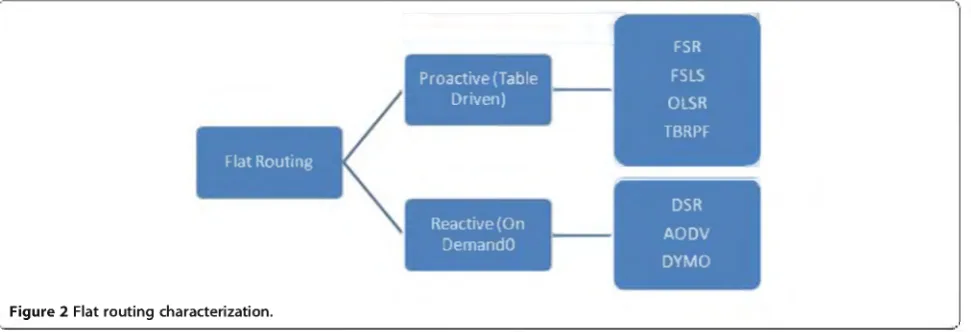
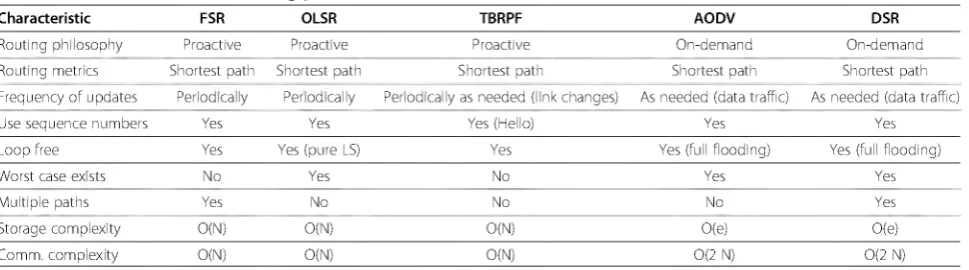
protocols can either belong to proactive or reactive routing protocols depending on their design philosophy as illustrated in Figure 2. Table 1 summarizes the character istics of flat routing protocols based on the performed study in [29]. N and e in this table indicate the number of nodes and communication pairs in the network, respectively.
Altogether, many previous studies such as [2,6,7,17,18,30,31] performed extensive surveys on different routing proto cols for WMNs. Moreover, previous studies such as [32] performed a complete survey of quality-of-service (QoS) routing protocols. Therefore, this study refers interested researchers to such studies for more information about these routing protocols. Actually, the main focus of this study is to introduce a new hybrid routing protocol in W M Ns and compare it with HWMP and reactive, pro active, and spanning tree routing protocols for presenting its comprehensive evaluation when video applications are active.
4. Related works
In order to have a precise overview of the previous stud ies, this section is divided into three subsections. Recent studies on hybrid routing protocols and video streaming over W M Ns are discussed in Sections 4.1 and 4.2, respect ively. Other related works are presented in Section 4.3.
4.1. Recent proposed hybrid routing protocols
Although many previous studies such as [33-36] evaluated the performance of existing routing protocols in ad hoc and wireless mesh networks, few of them considered hy brid methods, especially for video streaming applications. A neural network-based hybrid scheme is introduced by Nenad [37] based on both proactive and reactive routing protocols and mobile agent technology which is controlled by a Hopfield neural network. The Hopfield neural net work is based on some interconnected neurons in which they independently and asynchronously update their ac tivation values. The imposed complexity due to using such method is not cleared in this study. For example,
the effects of using this approach on a delay sensitive video stream need to be studied. Actually, Hopfield neural networks need appropriate hardware which is not access ible on current gadgets such as Smartphones. Although Hopfield networks are really simple in implementation, they can produce fake data. Moreover, this approach re quires more complex nodes and processing elements [38].
On the other hand, AO DV and the spanning tree routing protocols are integrated together in AODV-ST [39] as a hybrid routing protocol. In the proposed hybrid protocol, the spanning tree protocol is used for finding routes to all existing gateways, whereas all nodes use AODV to establish a path among themselves. In con trary to the performed study by Ramachandran [39], the proposed hybrid routing protocol by Le [4 0 ] considers the mobility behaviors of nodes where selecting the routing method. Actually, it uses proactive mode to find the best possible path between a gateway and a fixed router, while the reactive routing protocol is used on mobile nodes. The main advantage of this hybrid routing protocol is that mobile nodes ignore RREQ messages which are periodically sent by gateways in order to con struct the required spanning tree. In this regard, the established path between a node and a gateway consists of static nodes which lead to efficient data dissemin ation among them. However, the proactive routing ex clusively builds proactive routes to the gateways. Our proposed routing protocol extends this approach by allowing the proactive discovery of any route formed by static routers, irrespective of this fact that the gateway is a node on the path or not.
Another hybrid routing protocol is proposed by Amir for multi-homed WMNs. It employs continual connect ivity among mesh nodes using a fast handoff mechanism [41]. The proposed hybrid method integrates wired and wireless connectivity for TCP and UDP data transmission through gateways. The introduced hybrid routing protocol by Peppas considers heterogeneous mobility for mobile nodes [42]. Therefore, the protocol pays attention to the
Flat Routing
■ ■ ■
r ^FSR Proactive (Table FSLS Driven) OLSR TBRPF
L. . - J
r---1
DSR AODV DYMO Reactive (On
DemandO
Barekatain et al. EURASIP Journal on Wireless Communications and Networking 2013, 2013:168 http://jwcn.eurasipjournals.com/content/2013/1/168
Page 5 of 22
T ab le 1 C haracteristics o f fla t ro u tin g protocols
Characteristic FSR OLSR TBRPF AODV DSR
R outin g p h ilo so p h y P ro a ctive P roactive Pro a ctive O n -d em an d O n -d em an d R outin g m etrics Sh ortest path Sh ortest path S h o rte st path S h o rte st path Sh ortest path F re q u e n c y o f up d ates Period ically Period ically Period ically as n e e d e d (link ch an g es ) As n e e d e d (data traffic) As n e e d e d (data traffic) U se s e q u e n c e n u m bers Yes Yes Yes (H ello) Yes Yes L o o p free Yes Yes (p ure LS) Yes Yes (fu llflo o d in g ) Yes (fu llflo o d in g )
W o rs t case exists No Yes No Yes Yes
M u ltip le paths Yes No No No Yes
S to ra g e co m p lex ity O (N ) O (N ) O (N ) O (e) O (e) C o m m . c o m p le x ity O (N ) O (N ) O (N ) O(2 N) O(2 N)
mobility behaviors of nodes so that terrestrial and aerial nodes employ proactive and reactive modes, respectively. However, although this hybrid protocol is similar to GREENIE when classifying the nodes based on their mo bility behaviors, it can be used just for unmanned aerial vehicles (UAV) systems. Thus, it is not applicable for WMNs. In fact, the aerial nodes can access to the WMN through some specific mesh routers. Furthermore, there are some other issues in WM Ns such as the node density and high interference which are not considered in it. In hybrid on-demand distance vector routing (HOVER) [43], a non-optimal path between a source and a destination can be quickly established, then the system tries to find a better path. The results of the HOVER show that it im proves the latency and packet delivery delay in hybrid W M Ns using a modified version of AODV which esti mates link quality using HELLO messages. A new routing metric is proposed for the reactive discovery. The new metric differentiates among node types (static or mobile). The protocol also defines a channel selection with mini mum interference in multi-radio WMNs. However, HOVER does not take into consideration the mobility behavior of nodes and it uses the same routing scheme for both static and mobile nodes. Thus, the stable routes are dis covered and maintained reactively. This behavior is not recommended in other works such as [7].
Another hybrid routing protocol is introduced by Zhang for VoIP traffic transmissions [4 4 ]. It includes both net work and link layer routing and is based on intra- and inter-domain mobility management methods. New rout ing information can be found using address resolution protocol (ARP) messages during intra-domain handoff to prevent location update and re-routing, while the introduced latency is decreased by removing the redun dant tunnel for inter-domain handoff. In these proposals, the imposed complexity by intra-domain and inter-domain handoff has not been studied at all. This cost is expected to be significant. In addition, the protocol needs to send many different messages such as the association control, GARP, and the link control messages. Therefore, the handoff overhead sharply increases when the mobility rate and
speed increase. The previous proposals are not specifically designed to support STA nodes. Moreover, they usually use infrastructure W MN, and there is no multi-hop com munication path in the mobile components. In this solu tion, although the packets forwarded among the mesh routers can use link layer routing to decrease the encapsu lation and decapsulation delay associated to IP datagram, the packets exchange among access routers and mesh clients rely upon the network layer routing. Thus, they inherit the disadvantages of performing routing in the IP layer. In contrast, GREENIE does not use the IP layer for routing at all neither on ARs nor on the wireless clients.
4.2 Video streaming over WMNs
Considering the assumed traffic in our study, in the following, some recent works on video streaming over W M Ns are described. An evaluation of video streaming over W M Ns is performed and the results can help other researchers to understand the efficiency of multi-hop W M N in video dissemination [4 5 ]. In recent years, a lot of improvements have been experienced in video stream ing over multi-hop wireless mesh networks, which results in many commercial products and academic research findings. Some of these works such as [4 6 ] strived to provide better video quality on receivers by modifying the medium access control (MAC) layer, whereas others introduced efficient solutions in the application layer. Altogether, these research findings can be categorized into three categories.
Barekatain et al. EURASIP Journal on Wireless Communications and Networking 2013, 2013:168 http://jwcn.eurasipjournals.com/content/2013/1/168
Page 6 of22
similar to hierarchical web caching where each node caches and sends data to the next hop. However, it in creases the throughput of the wireless network up to seven times more than simple on-path caching. Ditto considers a 3-G B cache size on each node. An import ant result of the proposed system is that the size of the video chunks has enormous effects on the performance of the network so that transferring video chunks with smaller size provides better throughput.
In contrary to Ditto, APPCCM [48] lets MRs and mo bile mesh nodes cache video chunks in order to accelerate data access for mesh nodes and decrease the load on the gateways. In fact, the proposed model makes a precise decision about where to cache a video chunk basing on its two caching mechanisms: client-cache mechanism (CCM) and data-proxy mechanism (DPM). UPAC [49] is a Unified P2P and cache-based framework for VoD dissemination over multi-hop W M Ns. Some selected MRs cache the received video frames. Then, each peer establishes a P2P relationship with a MR and fetches cached frames from it using a client-server-based commu nication. Cache-based approaches are not cost effective due to highly required capacity in each node and maintenance.
Bandwidth-traffic-based approaches are used in the second category. One of the m ost efficient approaches to decrease load on the mesh routers and on the gate ways is to reduce the wireless traffic. Although cache- based approaches reduce the traffic by caching just the received video frames, they cannot save limited valuable resources in WM Ns efficiently. A dynamic stream merge (DSM) method is introduced by Nichols [50] in order to address this problem. The main idea in DSM is to merge at least two similar streams in an intermediate node. A bandwidth-traffic-based method needs intelligent algo rithms in order to efficiently assign bandwidth to data streams. For example, these solutions can be topology dependent when a node needs to receive at least two similar streams in order to merge them as one stream. Exclusive OR (XoR) network coding [51] is one of the most popular bandwidth-traffic-based approaches. In this method, each intermediate node tries to apply XoR logical operation on the received video packets in order to send one encoded packet instead of many original video packets. Although this method can be effective, it is both topology dependent and needs an intelligent algorithm to encode those video packets which can be decoded in the maximum number of receivers.
The third category is based on the path selection ap proaches. Here, each node selects the best path to the destination based on some parameters such as delay, jitter, packet loss rate, and throughput of the links. A grey relational analysis (GRA)-based [52] approach is proposed by Razzaq [53] for selecting the best path for the m ost important layers of a SVC stream. Minimum
interference route selection (MIROSE) [21] is an en hanced network route selection method which finds the best path with the least interference for video dissemin ation. A video agent, which is embedded in the access points between the mesh network and the Internet, re ceives video frame requests from all mesh nodes and chooses a proper path with minimum path contention to send the video flow to them. Moreover, this agent buffers the video stream and adjusts the compression rate regard ing the condition of the path between each mesh node and the gateway using network status-dependent video com pression rate (NSDVCR) algorithm. However, MIROSE imposes a source-routing strategy, which is not possible according to the IEEE 802.11 s standard. Furthermore, the mobility of the source will report a tremendous cost when recomputing the communication paths.
The most significant drawback concerning the previous proposals is that they are specifically designed for video traffic. Other kinds of traffics with different features may get a worse performance because of this adaptation. In particular, the routes used to send the video frames are those that are expected to suffer from a lower number of losses. In this sense, the links established among fixed nodes are preferred to the links with mobile routers. The fixed links can offer a higher throughput as they are not so affected by the disturbance of the mobile elements. In this way, the video quality is improved. Our proposed algorithm follows the last approach but in more realis tic routing conditions that makes it appropriate for dif ferent kinds of traffics (web surfing, video streaming, email access).
4.3 Other related works
Barekatain et al. EURASIP Journal on Wireless Communications and Networking 2013, 2013:168 http://jwcn.eurasipjournals.eom/content/2013/1/168
Page 7 of 22
and channel aggregation are studied in both multi- and single-hop wireless networks [55]. Then, the author in troduced the efficient multi-flow multicast transmission (EM M T) algorithm to apply the mentioned policies. The results show that more multimedia flows can pass through the channels. Finally, an on-demand channel reservation scheme is proposed by Mogaibe for common traffics in order to improve the performance of multi-channel multi radio WMNs [56]. This scheme uses the mesh routers radio interfaces for gateway and local traffic effectively so that intra- and inter-flow interference decrease. Obviously, if the number of nodes which share a channel decreases, the throughput of that channel will be maximized. This is the same for the gateways. Equation 1 clearly shows this assertion. Here, node v has n(v) neighbors and n(x)
number of them have some traffics through a gateway, while n(y) of them have just local traffics. These nodes use channel d which is a member of C non-overlapping channels. In this equation, f t is the throughput function of channel d. As can be seen, the maximum number of nodes which have gateway traffics has a direct relation ship with the minimum number of those which have local traffics.
dm a x(n(x)) = arg M ax Td (n(x)) = M in n(y).
d e C d eC
n( x)
whem Td(n(x)) = n (x ) + n (y)f t(n(x) + n(y))
an d n (x ), n(y)e n(v)d e C
(1)
5. Problem statement
Recent studies show that the performance of routing has been improved by either improving the efficiencies of the current routing protocols or introducing new hybrid methods. However, there are some unresolved issues in efficient data streaming over W M Ns such as the follow ing ones:
1. The performance of a proactive routing protocol considerably decreases in very dynamic networks. In other words, proactive routing protocols select the best possible path based on the pre-calculated routes and some routing metrics. W hen a source node sends a packet to a destination and a link on the considered path fails, the packet will be undoubtedly lost. Hence, this type of routing protocol is not suitable for dynamic networks where links fail or nodes move continually. High path failure rate considerably degrades the video quality on nodes. 2. Contrary to the proactive routing protocol, reactive
routing protocols are less suitable for non-dynamic
networks. In fact, they are more suitable for dynamic scenarios where there are mobile nodes in the network and the probability of link failure is not negligible [57].
3. Certainly, it is not expected that wireless mesh networks present the same behavior along their operation times. Mobility, as mentioned before, is the most attractive feature of wireless networks for end users. However, it causes many problems such as high link failures due to missing neighbors. Due to the mobility and the traffic of the nodes, the conditions of the network vary dynamically. Moreover, time-varying channels considerably heighten this problem. The mentioned problems have been tackled in some previous studies to introduce new protocols or enhance the existing hybrid routing protocols to exploit the benefits of both proactive and reactive schemes simultaneously. However, they inherit the existing challenges in proactive and reactive protocols. Actually, the problem is that they use proactive or reactive protocols in both mobile and fixed (static) nodes simultaneously [1,40] without paying enough attention to their mobility behaviors. Hence, the side effects of proactively broadcasting RREQ in mobile nodes in a high dynamic network cause new challenges to the system such as high traffic, waste of available bandwidth, and more interferences. On the other hand, in fixed nodes, employing reactive protocols leads to perform many routing operations for finding the next hop which means a huge amount of resources will be wasted. As a result, current hybrid routing protocols cannot completely and effectively exploit the benefits of proactive and reactive protocols, because they cannot precisely distinguish between fixed and mobile nodes. In order to clarify this problem, suppose that there are four nodes in the network: nodes A and B are fixed whereas nodes C and D are mobile. Hence, there is no signal difference among links A-B, C-D, and A-C using the current hybrid routing protocols.
4. Any change in the IP layer leads to a high cost into the system. Thus, those routing hybrid protocols which try to change the functions of the IP layer to introduce better routing protocols cause other challenges such as high cost to the system. Consequently, it is better to transfer the routing operation to the M AC layer.
Barekatain et al. EURASIP Journal on Wireless Communications and Networking 2013, 2013:168 http://jwen.eurasipjournals.eom/eontent/2013/1/168
Page 8 of22
network. Moreover, those routing protocols which just try to find a path to the destination without paying attention to the mobility behaviors of the intermediate nodes on the path cannot guarantee efficient end-to-end data transmission, because the mobility behavior of the intermediate nodes has also noticeable effects on the probability of path failure.
6. The use of a routing protocol specifically designed to support only a kind of application restricts the operability of the network. Particularly, WM Ns are expected to be used for heterogeneous applications such as video streaming, web navigation, or email access.
Based on the mentioned challenges and issues, this study aims to introduce an efficient hybrid routing protocol which completely considers these challenges and provides noticeable performance in both low and high dynamic sce narios. Section 6 will explain GREENIE, the proposed hy brid routing protocol, in more detail.
6. GREENIE: the proposed hybrid routing protocol
As mentioned in the previous sections, there are many dif ferent routing protocols for discovering and maintaining paths among the components of the W M N. The con venience of using one of these types of protocols mainly depends on the communication path lifetimes. The path lifetime or route duration is impacted by the relative mobility of the intermediate nodes from the source to the destination [58]. Taking into account this behavior, GREENIE carefully considers the mobility of the nodes in order to associate the different routing tasks to the W M N nodes. In particular, most stable routes, that is, the routes that are expected to endure longer are peri odically updated. In contrast, the unstable routes are only discovered on demand. Conversely to other m en tioned proposals, GREENIE does not exclusively promote the routes to the gateway but all the routes composed of static routers. Among the routes to which GREENIE gives priority, the paths to the gateway are also included. How ever, these routes to the gateway are restricted to the links established between two fixed elements. If we compare GREENIE with AODV-ST, GREENIE shortens the routes which are proactively discovered because mobile links are not considered. In the following, the main features of GREENIE are discussed.6.1 The assignation of the routing tasks depending on the node mobility
The mesh routers, which are fixed, employ two types of routing protocols including proactive and reactive sim ultaneously. They exchange their routing tables among themselves using the proactive routing protocol. Thus,
the backbone is restricted to use just the proactive mode. The main idea is that the conditions of links among MRs do not change drastically so that it is better to use a pro active routing protocol in a stable topology as it occurs in the backbone. On the other hand, the conditions of a link established between a mobile node and a MR or be tween two mobile nodes can change unpredictably and significantly. In fact, routes from a mobile node to the MRs or to the gateways or between any two mobile nodes in the hybrid W M N may include non-stable links. In this regard, a reactive scheme is appropriate for this kind of communication paths. Thus, the static (fixed) mesh nodes, like MRs, run both schemes, while mobile mesh nodes employ a reactive mode. The use of a reactive protocol in the MR even when they are already designed with the proactive one guarantees the compatibility with the mobile nodes. The use of a react ive routing protocol in the mobile nodes provides an efficient self-healing method because the link-layer feedback has been activated. In this sense, the nodes can efficiently identify when an active link to a node is broken.
6.2 Implementation in the MAC layer
Barekatain et al. EURASIP Journal on Wireless Communications and Networking 2013, 2013:168 http://jwen.eurasipjournals.eom/eontent/2013/1/168
Page 9 of 22
6.3 Integration of the proactive and reactive information in the mesh routers
The previous hybrid proposals clearly use a classification of the destination nodes in the source. Thus, when the source needs to know a route to a destination, it already identifies in which routing structure it should look for it. This condition does not hold in GREENIE, because the proactive and the reactive forwarding tables may contain the information associated with the same destination node. GREENIE promotes the use of the most stable links so that the routing information kept in the pro active routing table is preferred.
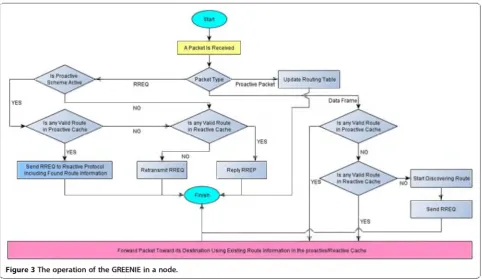
GREENIE uses the proactive and reactive modes derived from the OLSR and the AODV/DYMO [60] routing pro tocols, respectively. W hen a static node receives a frame, it first searches in its proactive routing table for a valid path. If it is found, the frame is sent according to the routing information. Otherwise, the proactive scheme transfers the responsibility of establishing a valid routing path to the reactive protocol. Then, the reactive routing protocol searches for a valid entry in its forwarding tables. If it is found, the reactive routing protocol can transmit the data frame. Alternatively, the reactive protocol triggers the corresponding procedures to discover a path to the destination. The destination or an intermediate node knowing the route to the destination may respond to the message with a RREP. Upon receipt, the source up dates its routing table, and the frames are sent accord ingly. In the data transmission, the bidirectional path is also set.
The RREQ messages generated by the reactive routing protocol as well as all the broadcast messages are gener ated with a sequence number. The sequence number helps a receiving node to detect the message whether it is new or it is a copy of a previous message. In this way, the re ceiving nodes maintain a table to associate the sequence number and the sources which are employing them. Thus, a receiving node only pays attention to the messages with a sequence number which is higher than the one stored for the source. In order to implement this behavior properly when managing multiple routing protocols, in GREENIE, a source just uses one sequence number which is incremented either by the reactive or the pro active routing protocol when a broadcast message needs to be generated.
Figure 3 clearly shows the route discovery process in more detail. In fact, according to the existing feedbacks between these protocols, if a mobile node wants to com municate with a fixed node, it will begin a search using the reactive protocol, and at the moment that the re quest route arrives to a fixed node, it knows a valid route thanks to the proactive protocol. Therefore, the fixed node answers immediately with a route replay packet. This mechanism lets selected paths include more fixed
than mobile nodes which results in considerable per formance in data delivery. Finally, a pure reactive search will only happen if the source and the destination are both mobile mesh nodes. These are the two other advantages of the hybrid routing protocol used in this study. In fact, an important advantage of using GREENIE is that it pro vides an efficient hybrid search method so that each node first searches a stable route using the proactive method and then non-stable routes using the reactive method. In other words, it prefers a path with more fixed nodes and static route to a path consists of more number of mobile mesh nodes. If there is no such a stable route, the node tries to find a new path to the desired destination using reactive method. This not only decreases the search time for the best path, but also provides higher averaged video quality among nodes thanks to the use of more stable links from the source to the destinations.
6.4 Route discovery process modified to promote the use of MRs
All the nodes in the W M N implement a reactive routing protocol, but the MRs also execute the proactive routing scheme. The MRs are able to respond to the RREQ mes sages even with the information derived from their pro active routing protocol. In fact, the routing data kept in the proactive tables should be preferred as they are as sociated to stable routes. In order to promote the use of the stable links, those established between two static routers, GREENIE sets different response intervals in the nodes. In particular, the MRs answer the RREQ messages with a random delay in the 0- to 5-ms interval. In con trast, the mobile nodes postpone their answers with a random delay following a uniform distribution function in the 5- to 10-ms interval. It is necessary to include random delays in order to prevent the broadcast storming [61,62].
6.5. STA location management in the link layer
As stated by Mase, the routing protocol in the W M N needs to know to which MR an active STA is attached [63]. Similarly, we have developed an agent-based scheme but at the MAC layer. This modification is necessary since the routing protocols run in this layer. By means of an in ternal data structure known as the localization table, the static, and the mobile routers know to which MR they should forward the packets whose destination is a STA. W hen the STA moves to another MR, the new MR alerts the other mesh routers about this new attachment so that they can update their localization table. The MR to which the STA is attached is also responsible for an swering to the RREQ on behalf of the STA.
Barekatain et al. EURASIP Journal on Wireless Communications and Networking 2013, 2013:168 http://jwen.eurasipjournals.eom/eontent/2013/1/168
Page 10 of 22
Figure 3 The operation of the GREENIE in a node.
The changes of the localization of the STAs are im me diately announced. However, when the corresponding changes have not taken place, the MR to which the STA was previously attached is able to retransmit the frames to the new localization. This new localization is usually a neighbor so that the retransmissions do not incur in a high cost.
All in all, although previous studies introduced different hybrid routing protocols, the main advantage of the pro posed hybrid routing protocol by this study (GREENIE) is that it logically divides existing nodes in the network based on their functionality. In other words, it generates two routing tables in static routers and fixed nodes. One of these routing tables is for proactive scheme supporting by OLSR, while AODV/DYMO, a reactive scheme, is used for generating the second one. In contrast to all previous proposals, GREENIE can intelligently distinguish between the existing link between two devices including mobile- mesh-node ^ static-node, static-node ^ MR, and mobile-mesh-node ^ MR. Hence, it will select the most stable path including as many as possible static nodes. This does not only decrease the probability of path failure, but also results in better perceived video quality on the receivers by delivering more video packets to them using stable routes. Actually, these considerably degrade the effects of time-varying channels on the perceived video quality on receivers. In other words, it reduces the prob ability of applying any changes in the routing tables pro voked by the time-varying channels due to the motility of the nodes.
7. Simulation results and discussion
In this section, the efficiency of GREENIE is evaluated and compared with the performances of four important routing protocols including HWMP, OLSR as a proactive routing protocol, and DYMO as reactive, and the span ning tree routing protocols. W e disabled the path accu mulation feature in DYMO. Therefore, it was treated like AODV. Moreover, the proactive spanning tree mechanism has been implemented by modifying DYMO. In this case, the root sends a RREQ packet. Then, all the intermediate nodes broadcast it and answer with a RREP at the same time. By comparing this protocol with OLSR and DYMO, we can confirm the benefits of combining both strategies in our proposed protocol. W e have also evaluated our pro posal against two of the most significant hybrid protocols, HWMP and the spanning tree.
Barekatain et al. EURASIP Journal on Wireless Communications and Networking 2013, 2013:168 http://jwen.eurasipjournals.eom/eontent/2013/1/168
Page 11 of 22
Figure 4 Implemented hybrid WMN in OMNET++.
All required information about their positions in the network can be handled by the designed locator in this study. In addition to the employed STA and mobile mesh nodes, this study considered some static (fixed) nodes in the implemented hybrid W M N. The number of mesh nodes varies in the different experiments. These static nodes include mesh capabilities, but they cannot act as an access point. The main purpose of using them is to extend the network using their routing capabilities. The initial positions and the mobility models of the nodes are based on the uniform distribution and the random way point, respectively.
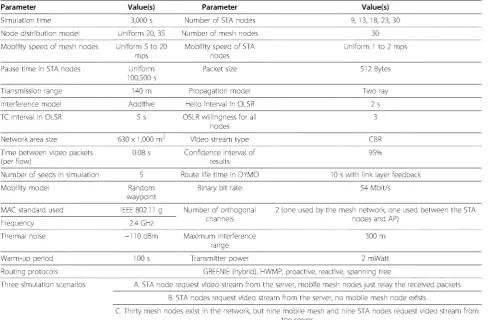
Concerning the traffic, a video server divides the video stream into some 512-byte packets and disseminates them among existing applicant nodes in the network. The video stream is encoded using the CBR technique. Table 2 summarizes all considered conditions and pa rameters in this simulation. This study selects video traffic due to its popularity; however, the application of GRENIEE is not restricted to video traffic.
The efficiencies of the considered routing protocols are evaluated in terms of three performance metrics including total number of successfully received video packets, end- to-end delay, and routing overhead. The first metric indi cates the averaged number of received video packets in the applicant nodes who have requested the video stream from the server. These packets are received on receivers with no error. The second metric, end-to-end delay, states
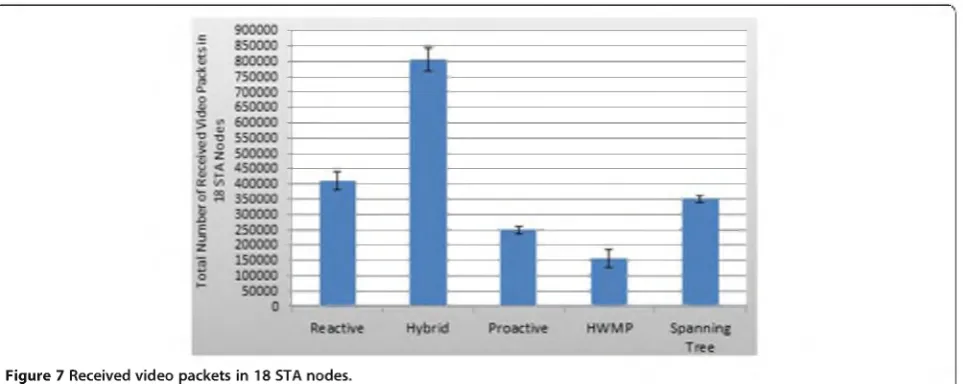
the transmission time between sending and receiving a video packets in the video server and an applicant node, respectively. Moreover, we measured the amount of jitter for all considered routing protocols. The results show that both GREENIE and proactive introduced the lowest amount of jitters, while all other routing protocols pro vided acceptable amount of jitter for video streaming. Finally, the simulation ran for five times, and the aver age obtained results are depicted in Figures 5, 6, 7, 8, 9, 10, 11, 12, 13, 14, 15, 16, 17, 18, 19, 20, 21 with 95% confidence interval (CI). In the following figures, the 'hybrid' word refers to the GREENIE. End-to-end delay in all figures is measured in seconds. The results show that the proposed hybrid routing protocol (GREENIE) considerably outperforms other routing protocols, even if the network consists of several static, mobile mesh, and STA nodes.
Barekatain et al. EURASIP Journal on Wireless Communications and Networking 2013, 2013:168 http://jwen.eurasipjournals.eom/eontent/2013/1/168
Page 12 of 22
T ab le 2 C o n sid e re d c o n d itio n s a n d p aram e te rs in th e sim u latio n
Parameter Value(s) Parameter Value(s)
Sim u la tio n tim e 3,000 s N u m b e r o f STA nodes 9, 13, 18, 23, 30 N o d e distribution m odel U niform 20, 35 N u m b e r o f m esh no des 30 M o b ility sp e ed o f m esh nodes U niform 5 to 20
m ps
M o b ility s p e ed o f ST A n o d es
U niform 1 to 2 m ps
Pause tim e in STA no des U niform 100,500 s
Packet size 512 Bytes
Transm ission rang e 140 m P ro p ag a tio n m odel T w o ray Interferen ce m odel A d d itiv e Hello in te r v a lin O L SR 2 s TC in te r v a lin O L SR 5 s O S LR w illing ness for all
n o d es
3
N e tw o rk area size 630 X 1,000 m 2 V id e o stream ty p e C BR T im e b e tw e e n v id eo packets
(p e r flo w )
0.08 s C o n fid e n c e in t e r v a lo f results
9 5 %
N u m b e r o f seeds in sim ulation 5 R oute life tim e in D Y M O 10 s w ith link layer fe ed b a ck M o b ility m odel R an d om
w a y p o in t
Binary bit rate 54 M bit/s
M A C stand ard used IEEE 802.11 g N u m b e r o f o rtho go nal 2 (o n e used by th e m esh netw ork, o n e used b e tw e e n th e STA F re q u e n c y 2.4 GH z ch an n els no des a n d A P)
T h e r m a ln o is e - 1 1 0 d B m M ax im u m in terference range
300 m
W a rm -u p period 100 s Transm itter p o w e r 2 m W a tt R outin g pro to cols G R E E N IE (hybrid), H W M P , proactive, reactive, sp an n in g tree
T h ree sim ulatio n scenarios A. ST A n o d e req uest v id eo stream from th e server, m o b ile m esh no des ju st relay th e received packets B. ST A n o d es req uest v id eo stream from th e server, no m o b ile m esh n o d e exists
C. Thirty m esh no des exist in th e netw ork, but nine m o b ile m esh a n d nine ST A no d es request v id e o stream from th e server
about the new location of a node. In order to improve the efficiency of this locator, we modify its source code so that it can guarantee that the required information will be known to all nodes in the network. The locator module can be used to maintain the tables using two methods: the first is to send a flooding packet every time
a change occurs in the locator tables (for example, due to a hand over of a node), whereas the locator can ask other locators in its neighbors for completely transferring their tables in the second method. Based on these methods and considered parameters in Table 2, the simulator ran for three scenarios. These scenarios cover all aspects of a
Barekatain et al. EURASIP Journal on Wireless Communications and Networking 2013, 2013:168 http://jwen.eurasipjournals.eom/eontent/2013/1/168
Page 13 of 22
900000
•5 850000 « 800000 « 750000 700000
8 650000 > g 600000 •= -o 550000 i z 500000 § < 450000
CC l/> 400000
0 2 350000 | 300000 1 250000
|
20000075 150000
o 100000
*" 50000
0
I
I
Reactive Hybrid Proactive HWMP Spanning
Tree
Figure 6 Received video packets in 13 STA nodes.
comprehensive evaluation precisely. In the following sub sections, these scenarios and related obtained results are explained in great detail.
7.1 STA nodes request the video stream from the video server, whereas mobile mesh nodes just relay the received packets (Scenario A)
In this scenario, all STA nodes request the video stream from the video server, and 30 mesh nodes just relay the received video packets to other nodes. Therefore, the number of nodes which playback the video stream equals the number of STA nodes. Figures 5, 6, 7, 8, 9 show the total number of successfully received video packets in a different number of STA node using different routing protocols. W hat can be inferred from the following fig ures is that GREENIE provides the highest performance in terms of the total number of successfully received packets in nodes.
Because of mobile mesh nodes, proactive routing proto col cannot provide considerable performance in com parison with others. In fact, nodes need to update their routing tables repeatedly, because links among them fail continually when they move on the network. Moreover, the reactive routing protocol is more robust in dynamic network including mobile nodes. However, using this type of routing protocols for the backbone is not suitable be cause MRs are fixed and using a reactive routing proto col increases the total required time for finding the best path between two MRs. Finally, both HW M P and span ning tree routing protocols are based on tree-based routing. Tree construction always increases the total re quired time for data dissemination and is not robust in high-node mobility and churning. Consequently, neither of these routing protocols can provide considerable per formances in terms of the total number of successfully received packets.
Barekatain et al. EURASIP Journal on Wireless Communications and Networking 2013, 2013:168 http://jwen.eurasipjournals.eom/eontent/2013/1/168
Page 14 of 22
Figure 8 Received video packets in 23 STA nodes.
Figure 10 compares all examined routing protocols in this study for a different number of STA nodes. GREENIE lets STA nodes receive required video packets as many as possible. Like HWM P and reactive routing protocols, the behaviors of spanning tree and proactive routing protocols are the same to that when the number of STA nodes increases. The HWM P protocol is based on AODV which is a reactive routing scheme. Therefore, its behavior may look like the reactive protocols. Spanning tree protocol, like proactive scheme, finds the best path before starting the data transmission. Thus, it might look like the pro active protocol while the number of STA nodes increases. In addition to the total number of received video packets, this study measured the averaged value of end-to-end delay in STA nodes using different routing protocols as illustrated in Figures 11, 12, 13, 14, 15, 16. Contrary to our hybrid routing protocol, end-to-end delay did not remain constant in other routing protocols while the
number of STA nodes increases. As it is expected, both the H W M P and the spanning tree protocols introduced higher end-to-end delays in comparison with other routing protocols; because they use tree-based structure for data transmission. However, the spanning tree method provides path redundancy which allows it to be more robust in dynamic networks including many mobile nodes. The HW M P protocol increases end-to-end delay mod erately, whereas the introduced end-to-end delay by the spanning tree routing protocol is fluctuated for different number of nodes. According to previous studies, 20 ms is an acceptable value for the end-to-end delay in video streaming over W M Ns. Hence, all routing protocols, except HWMP, could deliver video packets to appli cant nodes before their playback time. This shows that an efficient hybrid routing protocol needs to consider many issues for providing considerable efficiency in data dissemination.
Barekatain et al. EURASIP Journal on Wireless Communications and Networking 2013, 2013:168 http://jwen.eurasipjournals.eom/eontent/2013/1/168
Page 15 of 22
As illustrated in Figure 16, although the hybrid and the proactive schemes introduce low end-to-end delay in the system, the hybrid routing protocol provides, on the average, the least amount of end-to-end delay for differ ent number of STA nodes without any fluctuation. In contrary to HWMP, the reactive routing protocol does not impose high end-to-end delay in the system because all packets use the same path and the initial cost of find ing the path (the initial delay) is compensated by the other packets. However, the hybrid scheme considerably outperforms the reactive protocol. According to the obtained results by the HWMP, a hybrid scheme which is based on both reactive and proactive protocols cannot necessarily provide high performances. In other words, many different issues must be considered for designing and implementing an efficient hybrid method.
7.2. STA nodes request the video stream from the video server, but no mobile mesh node exists in the network (Scenario B)
In this scenario, different number of STA nodes is consid ered, but no mesh node exists in the network. It means that there is no mobile node with high mobility speed on the network. Figures 17, 18 show the total number of suc cessfully received video packets and the end-to-end delay provided by different routing protocols for various num bers of STA nodes. As illustrated in Figure 17, GREENIE provides the best performance. Proactive routing protocol introduces the minimum end-to-end delay because it uses a predefined path in the routing tables and there is no mobile node in the network. However, it is not realistic to imagine a wireless network with no mobile nodes. Figures 17, 18 depict that the hybrid and proactive
Barekatain et al. EURASIP Journal on Wireless Communications and Networking 2013, 2013:168 http://jwen.eurasipjournals.eom/eontent/2013/1/168
Page 16 of 22
protocols provide approximately the same performances in terms of the total number of successfully received video packets and the end-to-end delay in non-dynamic net work. This means that the proposed hybrid routing protocol, contrary to the HWMP, efficiently exploits the benefits of proactive protocols in static network.
7.3. Thirty mesh nodes exist in the network, but nine mobile mesh and nine STA nodes request the video stream from the video server (Scenario C)
In the last scenario, 9 STA and 30 mesh nodes exist in the network, but just 9 mesh nodes request video stream from the server. Figures 19, 20 depict the obtained results for the averaged total number of successfully received video packets and the experienced end-to-end delay in nine STA and mesh nodes, respectively. According to the following figures, the hybrid scheme provides the
best performance and introduces low end-to-end delay similar to proactive routing protocol.
7.4. Routing overhead
Finally, this section shows the imposed routing overhead by each of the considered routing protocols in this study. The results are depicted in Figure 21. This figure shows the normalized values of routing overhead for different numbers of STA nodes. It is necessary to mention that all thirty mesh nodes participated in the routing. The hybrid routing protocol shows approximately fixed rout ing overhead with low fluctuation for different number of STA nodes. The HW M P provides the least routing overhead when the number of STA nodes exceeds 18. In this experiment, m ost of the routing packets are lost by collisions. Therefore, those routing protocols such as HWMP which send fewer routing packets provide better performances in terms of routing overhead when there is
Barekatain et al. EURASIP Journal on Wireless Communications and Networking 2013, 2013:168 http://jwen.eurasipjournals.eom/eontent/2013/1/168
Page 17 of 22
Figure 14 Experienced end-to-end delay by 23 STA nodes.
a large number of nodes in the network. In addition, the imposed routing overhead by proactive routing protocol decreases when the number of nodes increases. However, if the number of mobile nodes increases in the network, these types of routing protocols will suffer from high rout ing overhead, because they continually need to find new routing paths. As a result, because of a low introduced overhead to the network, GREENIE (hybrid) is more reli able for providing smooth video playback on receivers. W e can also conclude that the use of hybrid routing pro tocols reduce the energy consumption as a lower number of messages are introduced into the network.
8. Remaining issues and future works
As mentioned in the previous sections, many recent studies have introduced or improved the efficiencies of W MNs for data dissemination. Altogether, there are some important
remaining challenges and issues which can be classified as follows:
1. A trade-off between the cost of the network and the number of routers and interfaces.
2. New solution for the best integration between W M N and other wireless standards in terms of cost and performance.
3. More efficient methods for decreasing the complexity and the cost of some current systems such as multi input multi-output, smart antenna, direct antenna, and frequency agile/cognitive in WMNs.
4. More efficient solutions for providing the necessary level of QoS regarding different types of traffics. 5. Improve the existing or introduce the new solutions
for providing required advanced MAC, network, and physical layer techniques for better mobility capability with nodes.
Barekatain et al. EURASIP Journal on Wireless Communications and Networking 2013, 2013:168 http://jwen.eurasipjournals.eom/eontent/2013/1/168
Page 18 of 22
I Reactive s Hybrid Proactive Spanning Tree
Figure 16 Comparison of experienced end-to-end delay using different routing protocols.
6. Improve the existing or introduce new high- performance algorithms and protocols to cope with security issues in WMNs. Although some recent studies, such as [65] focus on internal attacks due to compromised nodes, the necessity of introducing more efficient algorithms is inevitable.
7. More efficient link metrics are required so that they consider the peculiarities of multi-channel multi radio WMNs.
8. The interactive integration of routing and MAC layer can help maximize their performances.
9. One of the most important open issues in the MAC layer is that a node can access multiple physical rates. In other words, the capacity of the link decreases when the physical rate reduces.
Different data stream types require different exchange policies. Therefore, it is necessary to evaluate and select routing protocols and metrics which consider these factors
completely and precisely. Moreover, some other aspects such as density, coverage area, number of nodes, and the number of mobile nodes need to be considered. For example, proactive routing protocols are more efficient for delay sensitive streams. However, they cannot pro vide good performance in high mobility rate. In addition to selecting a suitable routing protocol, considering effective routing metrics is really important. For example, when the route between two nodes changes frequently due to the selected metric, the performance of the net work degrades sharply. Dynamic metrics provide higher performance, when the number of flows is small and the probability of interference is low.
However, if the network is overloaded, the dynamic metric usually is inefficient. In this case, a simple mini mum hop count metric provides better performance than that of dynamic metrics. Consequently, different metrics for different overload situations should be considered. Al though using the same metrics at the same time can be an
c 1300
3 I 1200
Barekatain et al. EURASIP Journal on Wireless Communications and Networking 2013, 2013:168 http://jwen.eurasipjournals.eom/eontent/2013/1/168
Page 19 of 22
Figure 18 Averaged experienced end-to-end delay in scenario B.
easy solution, it imposes high complexity to the network. Thus, it is better to have different metrics in function of the status of the network. All in all, different routing protocols and metrics provide different levels of perfor mances. These important points warn us that more re search should be performed on the existing routing protocols and metrics in order to provide efficient data dissemination among wireless nodes, even if there are many mobile nodes in the network. Some recent studies such as [66] and [67] considered two other challenges including the required level of QoS and performance in a W M N, respectively.
9. Conclusions
Among all existing applications, video streaming causes a large portion of traffics in computer network, especially in the Internet. Moreover, users are really interested in joining wireless networks. Among all wireless network standards, WM Ns provide the best scalable infrastructure for end users. Therefore, video streaming over WM Ns has
become very popular in recent years. However, there are some challenges in providing smooth video playback in this type of networks. For example, mobility, noise, inter ference, contention for available free channels and limited available bandwidth are some important problems, which need to be considered. Efficient routing protocols can re duce the side effects of these problems on the perceived video quality. Hence, it is important to completely under stand the efficiencies of these routing protocols for video streaming, when mobile mesh nodes exist in the WMN. The present study introduced an efficient hybrid routing protocol and compared it with the most important re cently used routing protocols in WM Ns for video stream ing using OMNET++ simulator. This study considered three scenarios for simulation:
In the first scenario, STA node request video stream from the server, but mobile mesh nodes just relay the received packets. In the second scenario, STA nodes re quest video stream from the server and no mobile mesh node exists in the network. Finally, in the third scenario,