Developing Fuzzy TOPSIS Method based on
Interval valued Fuzzy Sets
Yahia Zare Mehrjerdi
Department of Industrial Engineering, Yazd University, Yazd, Iran
ABSTRACT
Ranking competing alternatives in terms of their overall performance with respect to some criterions in fuzzy environment is possible by the use of fuzzy TOPSIS methodology using interval-valued fuzzy-sets concepts. This author presents an effective fuzzy multi-criteria method based upon the fuzzy model and the concepts of positive ideal and negative ideal solution points for prioritizing alternatives using inputs from a team of decision makers. The fuzzy sets concepts are used to evaluate the performance of alternatives and the importance of criteria. Fuzzy TOPSIS based on the interval-valued fuzzy-sets is fully described and a case study on RFID comprised of four main criteria and five alternatives is constructed and solved by the proposed extended TOPSIS method. The TOPSIS methodology used in this article is able to grasp the ambiguity exists in the utilized information and the fuzziness appears in the human judgments and preferences. TOPSIS technique can easily produce satisfactory results, and hence stimulates creativity and the invention for developing new methods and alternative approaches. This article is a very useful source of information for Fuzzy TOPSIS based on the interval-valued fuzzy sets and extends the area of application of RFID technology in general. Due to the fact that a better management of a system is related to the full understanding of the technologies implemented and the system under consideration, sufficient background on the methodologies are provided and a case study is developed and solved by the proposed method.
Key Words: Fuzzy TOPSIS, Fuzzy sets, Interval-valued fuzzy sets, system selection, Group decision making.
1. INTRODUCTION
The single most important decision faced by management when dealing with multiple objectives is the selection of an appropriate solution, which optimizes the proposed criteria simultaneously. Therefore, it is hardly surprising that much of the literature on operations research focuses on the Multiple Objective Programming Problems. Modeling real world problems with crisp values under many conditions is inadequate because human judgment and preference are often ambiguous and cannot be estimated with exact numerical values (Chen [1]; Chen, Lin, & Huang [2]; Kuo, Tzeng, & Huang [3]). There are ways to rank competitive alternatives but ranking competing alternatives in terms of their overall performance with respect to some criterions in fuzzy environment is possible by the use of fuzzy TOPSIS methodology.
TOPSIS was first introduced by Hwang and Yoon [4] in 1981. The TOPSIS approach is based on the idea that the chosen alternative should have the shortest distance from the positive ideal solution (PIS) and the farthest from the negative ideal solution (NIS) for solving multiple-criteria decision making problems. In short, the ideal solution is composed of all the best criteria, whereas the negative ideal solution is composed of all the worst attainable criteria (Chu et al.[5]). The TOPSIS procedure consists of the following steps (Tzeng et al.[6]): 1. Identify the decision matrix
2. Calculate the normalized decision matrix
3. Calculate the positive ideal (PIS) and negative ideal solutions (NIS)
4. Calculate the distance measures from PIS and NIS 5. Calculate the aggregated distance measures
6. Calculate the closeness coefficients of the alternatives. As a Multi Attribute Decision Making (MADM) tool, TOPSIS has reached to a high level of popularity among the researchers and practitioners for the reasons given below:
1.
It is intuitive, easy to understand, and can be modeled and solve by the consultants and managers using simple computer codes or Lotus/Excel worksheets. These features are fundamentally very important for the implementation of the methodology by the practitioners who are not very deep in the knowledge of MADM.2.
It allows the straight linguistic definition of weights and ratings under each criterion, without the need of cumbersome pair-wise comparisons and the risk of inconsistencies.3.
distances from the positive ideal solution and negative ideal solution points.4.
The performance is slightly affected by the number of alternatives and rank discrepancies are amplified to a lesser extent for increasing values of the number of alternatives and the number of criteria (Zanakis et al. [7]; and Triantaphyllou et al.[8]).5.
It is one of the best methods for addressing rank reversal issue that is the change in the ranking of alternatives when a non-optimal alternative is introduced. This feature is largely appreciated in practical applications (Bottani and Rizzi [9]).The presence of uncertainty and fuzziness in decision making problems had brought to surface the problem of decision makers' unwillingness to provide precise numbers in multi attribute models. Decision makers often feel comfortable providing intervals for specific models as input parameters instead of precise numbers. Grattan [10] had come to this conclusion that the presentation of a linguistic expression in the form of fuzzy sets is not enough for true decision making all the times. Later, Gorzaczany [11] and Turksen [12] have proposed the interval-valued fuzzy sets that can be used instead. Wang and Li [13] defined interval-valued fuzzy numbers and gave their extended operations.
2. FUZZY SETS AND ARITHMETIC
OPERATIONS
Human‘s logic can take the advantages of the concepts and knowledge that do not have well-defined borders (Yen and Langari [14]. Fuzzy logic was first introduced by Zadeh to answer such important challenges (Zadeh [15, 16, and 17]). Fuzzy logic is comprised of a wide spectrum of theories and techniques mainly constructed upon the concepts of fuzzy sets, linguistic variables, probability distribution (membership function), and fuzzy if-then rules (Yen and Langari [14]). Fuzzy sets and linguistic variables are widely used as two fundamental concepts in qualitative assessments.
A fuzzy set is a set that is comprised of elements with the degree of membership of
. When required data are quantitative then those can be expressed in terms of exact numbers but when research is being performed in the qualitative environment and the knowledge associated with that are vague and ambiguous data may not be expressed as exact numbers. Most often, researchers have claimed that managers cannot use an exact number to express their opinion about a situation instead a linguistic assessment is used to represent that specific numerical value (Herrera [18, 19]), and Kacprzyk [20]. As Zadeh [15] has said, a realistic approach is the utilization of linguistic terms such as "true", "highly true", "more true", "less true", "false", "probably false", and… instead of real numbers. Hence, values can be expressed in linguistic terms which present more exact assessment of the situation (Zadeh [15, 16]). Often, a proper linguistic variable is being set up for the explanation of the ambiguity and vagueness associated with the domain of the problem. Then, the concept of the expression would be determined using fuzzy numbers defining through [1, 0] using a membership function. Since linguistic assessment is approximate, triangular and trapezoidal membership functions seem to be more appropriate for responding to the ambiguity of these assessments (Delgado et al. [21].Many researchers have shown that fuzzy membership function can reflect the relative importance of linguistic words in mind (Dyer and Sarin[22]. Therefore, we can apply fuzzy membership function approach for transforming linguistic beliefs into numbers in interval scale. The applicability of such approach have become more and more clear for the users of important fields as such as information retrieval (Bordogna and Pasi [23], medical information gathering and retrieval (Degani and Bortolan [24], education (Law [25], suppliers selection (Herrera [18, 19]), and decision making, in general. While crisp data are inadequate to model the real life situations in MCDM, we apply linguistic variables to specifically describe the degrees of a criterion. In order to facilitate the making of subjective assessment by the decision
makers (DM) using fuzzy numbers, two sets of linguistic terms are used for assessing criteria weights and performance rating on each qualitative criterion respectively. A linguistic variable is a variable which apply words or sentences in a natural or artificial language to describe its degree of value, and we use this kind of expression to compare each criteria by linguistic variables in a fuzzy environment as ‗‗extremely important‖, ‗‗very important‖, ‗‗important‖, ‗‗very unimportant‖, and ‗‗extremely unimportant‖ with respect to a fuzzy five level scale.
A real fuzzy number A is described as a fuzzy subset of the real line R with member function
f
A that represents uncertainty. A membership function is defined from universe of discourse to [0, 1]. A triangular fuzzy number can be defined as a triplet (a, b, c). Therefore, a membership function of the fuzzy number A is defined as(1) Using this representation, we can do arithmetic operations on fuzzy numbers very simple and quick. With the notations given above the arithmetic operations of (+), (-), (x), and (
) on fuzzy numbers are defined as follows:)
,
,
(
)
,
,
)(
)(
,
,
(
a
1b
1c
1
a
2b
2c
2
a
1
a
2b
1
b
2c
1
c
2 (2))
,
,
(
)
,
,
)(
)(
,
,
(
a
1b
1c
1
a
2b
2c
2
a
1
c
2b
1
b
2c
1
a
2 (3))
,
,
(
)
,
,
)(
)(
,
,
(
a
1b
1c
1x
a
2b
2c
2
a
1xa
2b
1xb
2c
1xc
2 (4))
,
,
(
)
,
,
)(
)(
,
,
(
a
1b
1c
1
a
2b
2c
2
a
1
c
2b
1
b
2c
1
a
2 (5)The inversion of a fuzzy number and the multiplication of constant times a fuzzy number are done according to following formula:
)
1
,
1
,
1
(
)
,
,
(
1 1 1 1 1 1 1
a
b
c
c
b
a
(6))
,
,
(
)
,
,
(
a
1b
1c
1ka
1kb
1kc
1kx
(7)The distance between fuzzy numbers of
(
a
1,
b
1,
c
1)
and)
,
,
(
a
2b
2c
2 is calculated as below (Chen [1]):]
)
(
)
(
)
)[(
3
/
1
(
)
,
(
A
1A
2a
1a
2 2b
1b
2 2c
1c
2 2d
3. FUZZY TOPSIS
The studies done by Chen and Hwang [26], and Negi [27] are employed for establishing a prototype fuzzy TOPSIS. Many authors as such as Chen [1]; Chen et al. [2]; Chen & Hwang [26]; Chen & Tzeng [28]; Liang [29]; Wang & Elhag [30]; Wang & Lee [31]; Wang, Luo, & Hua [32]; Yeh, Deng, & Chang [33]; and Yeh & Deng [34] have contributed new materials on the development, extensions and applications of TOPSIS since its early development in 1981. Its general extension for group decision making problems under fuzzy environment was published by Chen [1]. In 2007, Kahraman [35, 36, 37, and 38] and his research team proposed a hierarchical fuzzy TOPSIS method that has ability to consider the hierarchy among the attributes and alternatives. This method provides greater superiority to classical fuzzy TOPSIS methods (Kahraman, et al. [37]. Other researchers have employed TOPSIS and applied that to areas as such as company financial ratios comparison (Deng et al.[39], facility location selection (Chen and Tzeng[40] , assessment of service quality in airline industry (Tsaur et al. [41], manufacturing plant location analysis (Yoon and Hwang [42], Robot selection (Parkan and Wu [43]), and TQM Consultant selection (Saremin et al. et al. [44] to mention some. Chu and Lin[45] have proposed a fuzzy TOPSIS approach for robot selection where the ratings of various alternatives under different subjective attributes and the importance weights of all attributes are assessed in linguistic terms represented by fuzzy numbers. They have presented an integrated fuzzy
group decision-making method in order to deal with the fuzziness of preferences of the decision-makers.
Abo-Sinna [46] extended TOPSIS approach to solve multi-objective dynamics programming (MODP) problems. He has showed that using the fuzzy max–min operator with nonlinear membership functions, the obtained solutions are always non-dominated solutions of the original MODP problems. Deng et al. (2000) [39] formulate the inter-company comparison process as a multi criteria analysis model, and presented an effective approach by modifying TOPSIS for solving such problem. Chen [1] extended the concept of TOPSIS to develop a methodology for solving multi-person multi-criteria decision-making problems in fuzzy environment.
[image:3.595.64.536.391.521.2]A comparison of the fuzzy TOPSIS methods in the literature is given in Table 1. The comparison includes the computational differences among the methods. In this paper, we prefer Hwang and Yoon‘s [4] fuzzy TOPSIS method since the other fuzzy TOPSIS methods are derived from this method with minor changes.
Table 1: A comparison of fuzzy TOPSIS methods from the literature (Kahraman et al.) [37]
Using the concepts of fuzzy sets theory and linguistic values, author presents a systematic decision process based on the TOPSIS method under fuzzy environment. This work extends the concept of fuzzy TOPSIS interval-valued with multi decision makers in the sense that it makes calculations for each decision maker separately and then combines the distances obtained for each decision maker and then uses a combined formula to get the final distance. The practicality of the proposed model is demonstrated using a case study. The rest of this paper is structured as follows: section 4 discusses the interval-valued fuzzy TOPSIS briefly. Section 5 is devoted to the description of the step by step algorithm for interval-valued fuzzy TOPSIS. A case study is discussed in section 6. Author's conclusion is given in section 7.
4. INTERVAL VALUES FUZZY TOPSIS
In many cases the utilization of crisp values is not sufficient enough to model a real world situation. This is mainly because human judgment and preference are often ambiguous and cannot be estimated with exact numerical values (Chen [1]; Chen, Lin, & Huang [2]; Kuo, Tzeng, & Huang)[3].Interval input in multi attribute decision making has been a very active field of research. Methods applying intervals have included,
1. Use of interval numbers as the basis for ranking alternatives (Xanthopulos [48]; Sengupta [49]; and Djellab [50]),
2. Error analysis with interval numbers (Yoon[51]) , 3. Use of linear programming and multi object
programming with feasible regions bounded by interval numbers (Bryson, 1996 [52]; Gonzalez-Pachon[53]; Huang [54])
4. Use of interval number ideal alternatives to rank alternatives by their nearness to the ideal (Zhang and Lui [55]).
Chu and Lin [56] have presented a new algorithm for fuzzy TOPSIS where both the ratings of alternatives under criteria and the importance weights of criteria are normalized into a comparable scale using interval arithmetic of fuzzy numbers. The membership function of each fuzzy weighted rating is developed by using interval arithmetic of fuzzy numbers. The
Source Type of fuzzy numbers
Attribute weight
Normalization Method
Ranking Method
Chen and Hwang [26] Trapezoidal Fuzzy Numbers Linear normalization Generalized mean method
Liang [29] Trapezoidal Fuzzy Numbers Manhattan distance Ranking with maximizing set and minimizing set Chen [1] Triangular Fuzzy Numbers Linear Normalization Positive ideal of (1,1,1) and negative ideal of
(0,0,0) Chu [5] Triangular Fuzzy Numbers Modified Manhattan
distance
Ranking method of total integrated values of
= 0.50Tsaur et al.[41] Triangular Crisp values Vector normalization Center of area method
Zhang and Lu [47] Triangular Crisp values Manhattan distance Fuzzy positive and negative solution as (1, 1, 1) and (0, 0, 0), respectively.
ranking method of the mean of removals is applied to obtain the fuzzy positive ideal solution (FPIS) and the fuzzy negative ideal solution (FNIS) in order to complete the fuzzy TOPSIS. Actually, the method proposed by Chu and Lin extends the applicability of fuzzy set theory to the classical TOPSIS. Ashtiani et al. [57] have proposed an interval-valued fuzzy TOPSIS method to solve MCDM problems in which the performance rating values as well as the weights of criteria are linguistic terms which can be expressed in interval value fuzzy numbers. Interval-valued fuzzy sets have been widely used in real-world applications. In this regard, it can be pointed to the work of Kohout and Bandler [58] for the CLINAID system, Gorzaczany [11] in approximate reasoning, Turksen [59] and [60]) in interval-valued logic and in preference modeling [12]. Based upon the definition of the interval-valued fuzzy set in 1986, an interval-valued fuzzy set A defined on (−∞, +∞) is given as:
)]}
(
),
(
[
,
{(
x
x
x
A
AL
UA (9)]
1
,
0
[
:
),
(
x
UAX
L
A
x
X
,
AL(
x
)
UA (10))]
(
),
(
[
)
(
x
x
UAx
L A
A
(11)
)
,
(
))},
(
,
{(
x
x
x
A
A (12)Where,
AL(
x
)
is the lower limit of degree of membershipand
UA(
x
)
is the upper limit of degree of membership.5. AN ALGORITHM FOR INTERVAL
VALUES FUZZY TOPSIS
Prior to the description of the fuzzy TOPSIS algorithm it is important that readers get familiar with data type, decision matrix, decision making process, variables, and the steps
necessary to go through to make a sound decision. For the sake of space, author describes these key elements while describing the steps of algorithm.
Step 1 (Decision Matrix and Weight development)
The very first step of the TOPSIS algorithm is the determination of the decision matrix. This matrix has m rows and n columns, where m represents the number of alternatives to be ranked, Ai, (i = 1,.., m), and n represents the number of criterions,
C
j(j=1,…,n), that based on that the ranking will be based upon. In the model, it is assumed that there are K decision makers that subjectively assess the weighting vector ofw
(
w
1,
w
2,...,
w
n)
and the decision matrix}
,...,
1
,
,...
1
|
~ {
~
n
j
m
i
x
ijX
(13)The performance of alternative Ai with respect to criterion j
C
is denoted byx
ij~. In this study, eachx
ij~is treated as a triangular interval-valued fuzzy number as it is shown below:
)
,
,
(
)
,
,
(
' 3 ' 2 ' 1
3 2 1 ~
x
x
x
x
x
x
x
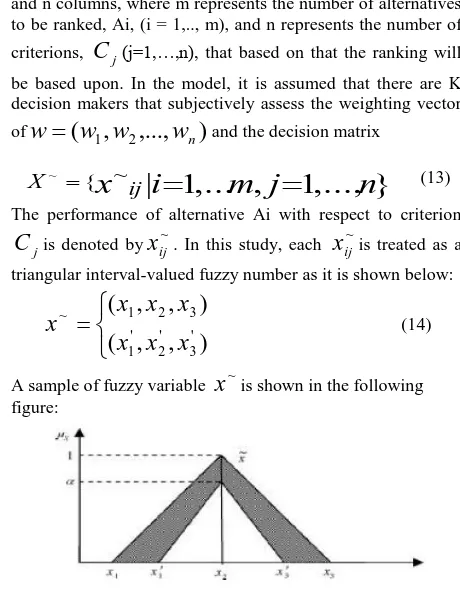
(14) [image:4.595.310.540.148.448.2]A sample of fuzzy variable
x
~is shown in the following figure: [image:4.595.128.464.508.610.2]Figure 1: Interval-valued triangular fuzzy number
Table 2: Fuzzy linguistic terms and corresponding fuzzy numbers for rating
Importance Abbreviation Fuzzy Number
Very Poor VP [(0,0);0;(1,1.5)]
Poor P [(0,0.5);1;(2.5,3.5)]
Medium Poor MP [(0,1.5);3;(4.5,5.5)]
Medium M [(2.5,3.5),5,(6.5,7.5)]
Medium Good MG [(4.5,5.5),7,(8,9.5)]
Good G [(5.5,7.5),9,(9.5,10)]
Very Good VG [(8.5,9.5),10,(10,10)]
[image:4.595.126.464.665.744.2]Definitions of linguistic variables for the importance of each criterion
Table 3: Fuzzy linguistic terms for importance of each criterion
Importance Abbreviation Fuzzy Number
Very low VL [(0,0);0;(0.1,0.15)]
Low L [(0,0.05);0.1;(0.25,0.35)]
Medium low ML [(0,0.15);0.3;(0.45,0.55)]
Medium M [(0.25,0.35),0.5,(0.65,0.75)]
Medium high MH [(0.45,0.55),0.7,(0.8,0.95)]
High H [(0.55,0.75),0.9,(0.95,1)]
Let
X
~
[
x
ij~]
be a fuzzy decision matrix for a multi criteria decision making problem. The performance of alternative Ai with respect to criterion Cj is denoted asx
ij.Step 2
Given
x
ij~
[(
a
ij,
a
ij'),
b
ij,
(
c
ij',
c
ij)]
, the normalized performance rating can be calculated as:
(
,
'
),
,
(
'
,
)
~ j ij j ij j ij j ij j ij ijc
c
c
c
c
b
c
a
c
a
r
for i=1,…,n, andbenefits
j
(15)
)
'
,
(
,
),
,
'
(
~ ij j ij j ij j ij j ij j ijc
a
c
a
b
a
a
a
a
a
r
fori=1,…,n, and
j
costs (16)}
{
max
ij i jc
c
for allj
benefits (17)}
{
min
ij ij
a
a
for allj
costs. (18)Step 3
Identify the weights of
)]
,
'
(
,
),
'
,
[(
w
1jw
2jw
2jw
3jw
3j from each decision maker for theC
jcriterion.Step 4
By considering the different importance of each criterion, we can construct the weighted normalized fuzzy decision matrix as:
V
~
[
v
ij~]
that a matrix with m by nwhere
v
ij~
r
ij~xw
~j . Using the definition given above the multiplier operator does act as follow:)]
,
(,
),
,
[(
)]
,
(,
),
,
[(
1~ 1~ 1~' 1~' 2~ 2~ 3~' 3~' 3~ 3~~ ij ij ij ij ij j ij j ij j ij j ij j ij
ij
r
xw
r
xw
r
xw
r
xw
r
xw
A
B
C
D
E
v
(19)
Step 5
Two ideal solutions points known as positive ideal and negative ideal solution points are of highly concerned in the decision making process. The decision maker feels to stay away as far as possible from the negative ideal solution point and as close as possible to the positive ideal point. Although, these solution points are unreachable in reality they are of very concern and important to the decision maker. Therefore, the positive ideal solution shown by
A
and negative ideal point shown byA
is determined as follows:)
,...,
,
(
1 2
nv
v
v
A
(20))
,...,
,
(
1 2
nv
v
v
A
(21) Where}
{
3max
ij i jv
v
(22)
}
{
1min
ij i jv
v
(23)
The distances from the positive ideal solution and negative ideal solution point are calculated according to the following formula, respectively:
nj
j K ij K
i
d
v
v
d
1)
,
(
(24)
nj
j K ij K
i
d
v
v
d
1
)
,
(
(25)Considering each alternative point as [(A, B), C, (D, E)] and
j j
andv
v
,
as shown below)]
,
(
,
),
,
[(
1 2 3 4 5
j j j j jj
v
v
v
v
v
v
(26)And
)]
,
(
,
),
,
[(
1 2 3 4 5
j j j j jj
v
v
v
v
v
v
(27)then the distance of each alternative from the ideal alternative
]
,
[
d
i1d
i2 can be calculated, where:]
)
(
)
(
)
)[(
3
/
1
(
1 2 3 2 5 21
j ij j ij j iji
A
v
C
v
E
v
d
(28)]
)
(
)
(
)
)[(
3
/
1
(
2 2 3 2 4 22
j ij j ij j iji
B
v
C
v
D
v
d
(29)Similarly, the separation from the negative ideal solution is given by
[
d
i1,
d
i2]
, where:]
)
(
)
(
)
)[(
3
/
1
(
1 2 3 2 5 21
j ij j ij j iji
A
v
C
v
E
v
]
)
(
)
(
)
)[(
3
/
1
(
4 22 3 2 2 2
j ij j ij j iji
B
v
C
v
D
v
d
(31)
Step 6 (Overall distance from positive ideal and negative ideal points)
To derive group preferences provided by multiple decision makers and combine the group synthesis and prioritization stages into a single integrated stage, the geometric mean with the modified TOPSIS approach is employed. The overall separation measure is calculated as:
k k i K k i
d
d
/ 1 1 1 1
i=1,2,…,m (32)
k k i K k i
d
d
/ 1 2 1 2
i=1,2,…,m (33)
k k i K k i
d
d
/ 1 1 1 1
i=1,2,…,m (34)
k k i K k i
d
d
/ 1 2 1 2
i=1,2,…,m (35)
Step 7 (Relative closeness to the ideal)
Now, the relative closeness can be calculated as follows:
)
(
1 11
1
i i i id
d
d
IC
(36))
(
2 22
2
i i i id
d
d
IC
(37)The final values of
RC
i*are calculated as follows:2
/
)
(
1 2 *i i
i
RC
RC
RC
for all i=1,…,m(38)
Step 8 (Rank the alternatives)
A set of alternatives can now be ranked according to the descending order of
RC
i*and the one with the maximum value ofRC
i*is the best.6. CASE STUDY
For various reasons firms are reluctant to adopt RFID as a part of their internal systems. This is because of uncertainty regarding the payoff that will (or might) result from the
adoption (Reyes et al. [61]; Dutta et al.[62]). Central to this uncertainty are risks accompanying adoption that can be grouped into two broad areas – uncertainty with regard to the requirements and capabilities of the technology itself and uncertainty with regard to the effects of the technology on inter organizational relationships (Cannon et al. [63]). Due to the fact that at the present time RFID is still in its early stages of development and acceptance by the management of large and small companies there are large number of questions that are unanswered with regard to its actual or potential use.
This technology can save billion of dollars for the world businesses specially the first world countries that are ready to use that. RFID is used to develop intelligent highways (Legg, [64]), transport construction materials (Naresh et al. [65]), in manufacturing to monitor the factory level (Labs, W. et al. [66]), in agriculture and food industry (Wang, et al.[67]), in supply chain management (Lin et al.[68]), and (Naim et al. [69]), in service sector (Lee et al.[70]), in product design (Repo, [71]), in managing restaurant (Ngai [72]), in supply chain systems with mobile monitoring capability (Ngai [73]), (Wamba [74]), (Wamba [75], in logistic (Chow, et al.[76], and Estifania [77]), in healthcare (Zare Mehrjerdi [78, 79, 80], for Library management and cost control (Zare Mehrjerdi [ 81, 82, 83], and for monitoring and tracking live animals (Wismans, [84]).
With the analysis performed from the articles above it is concluded that the most appropriate types of alternatives that should be taken into consideration are those that relates RFID systems and barcode systems together. This is because of the power of the barcode and its popularity at the present time. Barcode is going to stay for a long time and will not disappear overnight. This is because the barcode system is less expensive to setup, manage, work with, and it is in use all around the world. Hence, this research is up to putting to vote the following RFID-based-mixed-systems as alternative to the team of decision makers:
1. System type 1: a system with 100 percent RFID power and 0% barcode capability
2. System type 2: a system with 70 percent RFID power and 30% barcode capability
3. System type 3: a system with 60 percent RFID power and 40% barcode capability
4. System type 4: a system with 50 percent RFID power and 50% barcode capability
5. System type 5: a system with 40 percent RFID power and 60% barcode capability
This means stage by stage conversion from barcode system into the RFID-based system which gives sufficient time to both producers and consumers to prepare their own RFID-based system for service. The criterions that are of the highest preference to most management through the entire industries are:
1. The hardware and software costs
2. The contribution that system can have on the organization
group of three decision makers of DM1, DM2, and DM3. For this purpose, a list containing five RFID-based systems as shown in table 4 are determined, related criterions are identified and passed to a team of three decision makers. Each decision maker identifies the importance level of each criterion using the fuzzy linguistic terms given in table 2. To determine the decision matrix, the fuzzy linguistic terms provided in table 3 are used by the decision makers. More details on the criterions used and the alternative systems under study are given below. Linguistic terms and fuzzy numbers
used in the following sections are those provided in tables 2 and 3.
6.1 Alternative Systems:
Five RFID-based systems starting with a system of 100 percent RFID and 0% barcode features and ending with a system of 40% RFID and 60% barcode features are under consideration here.
Table 4: Features of five alternative systems
Alternatives RFID-based systems
Barcode based system
System 1 (A1) 100% 0%
System 2 (A2) 70% 30%
System 3 (A3) 60% 40%
System 4 (A4) 50% 50%
System 5 (A5) 40% 60%
6. 2 Criterions:
The criterions used in this study are: 1. The hardware and software costs (C1) 2. The contribution that system can have on the
organization (C2)
3. Changing the current situation for a better one (C3) 4. Expert reliability on the RFID-based system support (C4)
6.3 Criterion classification
These four criterions can be classified into two categories of benefit type and cost type as shown below:
B =
criterion
Type
Benefit
= {Contribution, Level of change, Expert
reliability}
C=
Criterion
Type
Cost
= {Costs of hardware and software}
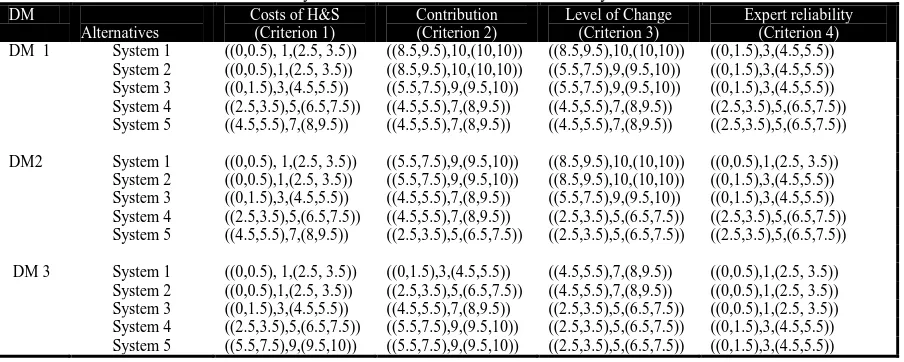
[image:7.595.309.533.197.404.2]Based upon the decision makers ratings of criterions table 5 is developed. Thereafter, the decision matrix presented in table 6 is set up using the ratings provided by three decision makers DM1, DM2, and DM3.
[image:7.595.69.520.479.530.2]Table 5: Criterion rating by decision makers
Table 6: Fuzzy interval-valued based decision matrix by decision makers
DM
Alternatives
Costs of H&S (Criterion 1)
Contribution (Criterion 2)
Level of Change (Criterion 3)
Expert reliability (Criterion 4)
DM 1 System 1 ((0,0.5), 1,(2.5, 3.5)) ((8.5,9.5),10,(10,10)) ((8.5,9.5),10,(10,10)) ((0,1.5),3,(4.5,5.5)) System 2 ((0,0.5),1,(2.5, 3.5)) ((8.5,9.5),10,(10,10)) ((5.5,7.5),9,(9.5,10)) ((0,1.5),3,(4.5,5.5)) System 3 ((0,1.5),3,(4.5,5.5)) ((5.5,7.5),9,(9.5,10)) ((5.5,7.5),9,(9.5,10)) ((0,1.5),3,(4.5,5.5)) System 4 ((2.5,3.5),5,(6.5,7.5)) ((4.5,5.5),7,(8,9.5)) ((4.5,5.5),7,(8,9.5)) ((2.5,3.5),5,(6.5,7.5)) System 5 ((4.5,5.5),7,(8,9.5)) ((4.5,5.5),7,(8,9.5)) ((4.5,5.5),7,(8,9.5)) ((2.5,3.5),5,(6.5,7.5))
DM2 System 1 ((0,0.5), 1,(2.5, 3.5)) ((5.5,7.5),9,(9.5,10)) ((8.5,9.5),10,(10,10)) ((0,0.5),1,(2.5, 3.5)) System 2 ((0,0.5),1,(2.5, 3.5)) ((5.5,7.5),9,(9.5,10)) ((8.5,9.5),10,(10,10)) ((0,1.5),3,(4.5,5.5)) System 3 ((0,1.5),3,(4.5,5.5)) ((4.5,5.5),7,(8,9.5)) ((5.5,7.5),9,(9.5,10)) ((0,1.5),3,(4.5,5.5)) System 4 ((2.5,3.5),5,(6.5,7.5)) ((4.5,5.5),7,(8,9.5)) ((2.5,3.5),5,(6.5,7.5)) ((2.5,3.5),5,(6.5,7.5)) System 5 ((4.5,5.5),7,(8,9.5)) ((2.5,3.5),5,(6.5,7.5)) ((2.5,3.5),5,(6.5,7.5)) ((2.5,3.5),5,(6.5,7.5))
DM 3 System 1 ((0,0.5), 1,(2.5, 3.5)) ((0,1.5),3,(4.5,5.5)) ((4.5,5.5),7,(8,9.5)) ((0,0.5),1,(2.5, 3.5)) System 2 ((0,0.5),1,(2.5, 3.5)) ((2.5,3.5),5,(6.5,7.5)) ((4.5,5.5),7,(8,9.5)) ((0,0.5),1,(2.5, 3.5)) System 3 ((0,1.5),3,(4.5,5.5)) ((4.5,5.5),7,(8,9.5)) ((2.5,3.5),5,(6.5,7.5)) ((0,0.5),1,(2.5, 3.5)) System 4 ((2.5,3.5),5,(6.5,7.5)) ((5.5,7.5),9,(9.5,10)) ((2.5,3.5),5,(6.5,7.5)) ((0,1.5),3,(4.5,5.5)) System 5 ((5.5,7.5),9,(9.5,10)) ((5.5,7.5),9,(9.5,10)) ((2.5,3.5),5,(6.5,7.5)) ((0,1.5),3,(4.5,5.5))
Criterions Decision maker 1 Decision maker 2 Decision maker 3
[image:7.595.64.516.559.740.2]6.4 Results of Calculations for Decision
Maker 3
To follow the methodology proposed for this algorithm, we need to set up the interval-valued based decision matrix for each decision maker separately. In the reminder of this article
[image:8.595.59.541.146.266.2]author presents the results of calculations for decision maker 3. The rest of detailed calculations for DM1 and DM2 are very similar. Using the data provided above, the decision matrix D for decision maker DM3 is shown in table 7.
Table 7: Fuzzy interval based decision matrix (matrix xij) Decision
Maker
Alternati ves
Costs of H&S (Criterion 1)
Contribution (Criterion 2)
Level of Change (Criterion 3)
Expert reliability (Criterion 4)
DM 3 System 1 ((0,0.5), 1,(2.5, 3.5)) ((0,1.5),3,(4.5,5.5)) ((4.5,5.5),7,(8,9.5)) ((0,0.5),1,(2.5, 3.5)) System 2 ((0,0.5),1,(2.5, 3.5)) ((2.5,3.5),5,(6.5,7.5)) ((4.5,5.5),7,(8,9.5)) ((0,0.5),1,(2.5, 3.5)) System 3 ((0,1.5),3,(4.5,5.5)) ((4.5,5.5),7,(8,9.5)) ((2.5,3.5),5,(6.5,7.5)) ((0,0.5),1,(2.5, 3.5)) System 4 ((2.5,3.5),5,(6.5,7.5)) ((5.5,7.5),9,(9.5,10)) ((2.5,3.5),5,(6.5,7.5)) ((0,1.5),3,(4.5,5.5)) System 5 ((5.5,7.5),9,(9.5,10)) ((5.5,7.5),9,(9.5,10)) ((2.5,3.5),5,(6.5,7.5)) ((0,1.5),3,(4.5,5.5))
Weights in interval-valued forms
((0.45,0.55),0.7,(0.8,0.95)) ((0.85, 0.95),1,(1,1)) ((0.55,0.75),0.9,(0.95,1)) ((0.85,0.95),1,(1,1))
[image:8.595.45.553.301.421.2]Using the weight given in the above table the interval-valued normalized decision matrix is determined and shown in table 8. Table 8: Fuzzy interval valued normalized decision matrix (matrix rij)
Decision Maker
Alternati ves
Costs of H&S (Criterion 1)
Contribution (Criterion 2)
Level of Change (Criterion 3)
Expert reliability (Criterion 4)
DM 3 System 1 ((0, 0), 0,(0, 0)) ((0,1.5),0.3,(0.45 ,0.55)) ((0.45,0.55),0.7,(0.80,0.95)) ((0,0.05),0.1,(0.25,0.35)) System 2 ((0, 0),0,(0, 0)) ((2.5,3.5),0.5,(0.65,0.75)) ((0.45,0.55),0.7,(0.80,0.95)) ((0,0.05),0.1,(0.25,0.35)) System 3 ((0, 0),0,(0,0)) ((4.5,5.5),0.7,(0.8, 0.95)) ((0.25,0.35),0.5,(0.65,0.75)) ((0,0.05),0.1,(0.25,0.35)) System 4 ((0, 0),0,(0,0)) ((5.5,7.5),0.9,(0.95, 1)) ((0.25,0.35),0.5,(0.65,0.75)) ((0, 0.15),0.3,(0.45,0.55)) System 5 ((0, 0),0,(0,0)) ((5.5,7.5),0.9,(0.95,1)) ((0.25,0.35),0.5,(0.65,0.75)) ((0, 0.15),0.3,(0.45,0.55))
Weights in interval-valued forms
((0.45,0.55),0.7,(0.8, 0.95))
((0.85, 0.95),1,(1,1)) ((0.55,0.75),0.9,(0.95,1)) ((0.85,0.95),1,(1,1))
The interval valued weighted normalized decision matrix is shown in table 9.
Table 9: Fuzzy interval valued weighted normalized decision matrix (matrix vij)
Decision Maker
Alternativ es
Costs of H&S (Criterion 1)
Contribution (Criterion 2)
Level of Change (Criterion 3)
Expert reliability (Criterion 4)
DM 3 System 1 ((0, 0), 0,(0, 0)) ((0,0.1425),).3,(0.45,0.55)) ((0.25,0.4125),0.63,(0.76,0.95)) ((0,0.05),0.1,(0.25,0.35)) System 2 ((0, 0),0,(0, 0)) ((0.213,0.3325),0.5,(0.65,0.75
))
((0.25,0.4125),0.63,(0.76,0.95)) ((0,0.05),0.1,(0.25,0.35))
System 3 ((0, 0),0,(0,0)) ((0.383,0.5225),0.7,(0.8,0.95) )
((0.14,0.2625),0.45,(0.62,0.75)) ((0,0.05),0.1,(0.25,0.35))
System 4 ((0, 0),0,(0,0)) ((0.468,0.7125),0.90,(0.95,1)) ((0.14,0.2625),0.45,(0.62,0.75)) ((0, 0.14),0.3,(0.45,0.55)) System 5 ((0, 0),0,(0,0)) ((0.468,0.7125),0.90,(0.95,1)) ((0.14,0.2625),0.45,(0.62,0.75)) ((0, 0.14),0.3,(0.45,0.55))
Weights in interval-valued forms
((0.45,0.55),0.7, (0.8,0.95))
((0.85, 0.95),1,(1,1)) ((0.55,0.75),0.9,(0.95,1)) ((0.85,0.95),1,(1,1))
The following table shows the details amount of distance for each alternative and by decision makers and criterions as well.
Table 10: Distances for decision maker DM3
1
i
d
C1 2
i
d
C1 1
i
d
C1 2
i
d
C1 1
i
d
C2
2
i
d
C2 1
i
d
C2
2
i
d
C2 1
i
d
C3
2
i
d
C3
1
i
d
C3 2
i
d
C3 1
i
d
C4
2
i
d
C4 1
i
d
C4
2
i
d
[image:8.595.45.556.456.593.2] [image:8.595.28.572.657.739.2]Table 11 presents the aggregated distances of decision makers DM1, DM2, and DM3 using formulas (32) through (35).
1
i
d
C1
2
i
d
C1 1
i
d
C1 2
i
d
C1 1
i
d
C2
2
i
d
C2
1
i
d
C2 2
i
d
C2 1
i
d
C3
2
i
d
C3 1
i
d
C3
2
i
d
C3 1
i
d
C4
2
i
d
C4 1
i
d
C4
2
i
d
C4 A1 0.7002 0.6764 0 0.0845 0.6647 0.5656 0.6083 0.5949 0.6700 0.5294 0.6825 0.6295 0.6986 0.6220 0.2692 0.1981 A2 0.7002 0.6764 0 0.0845 0.6492 0.5536 0.6929 0.6897 0.6860 0.5352 0.6732 0.6098 0.6956 0.6010 0.3129 0.2477 A3 0.7002 0.6764 0 0.0845 0.6728 0.5408 0.7157 0.6794 0.6893 0.5402 0.6051 0.5374 0.6956 0.6010 0.3129 0.2477 A4 0.7002 0.6764 0 0.0845 0.6806 0.5547 0.7196 0.6814 0.6898 0.5537 0.5195 0.4245 0.6668 0.5503 0.4576 0.4077 A5 0.7002 0.6764 0 0.0845 0.6769 0.5592 0.6555 0.6178 0.6898 0.5537 0.5195 0.4245 0.6668 0.5503 0.4576 0.4077
Table 12: Table of interval distances
]
,
[
d
i2d
i1[
,
]
2
1
i
i
d
d
A1 [2.44,2.698] [1.511,1.740]
A2 [2.36,2.636] [1.601,1.840]
A3 [2.46,2.741] [1.509,1.765]
A4 [2.41,2.677] [1.555,1.827]
A5 [2.46,2.725] [1.502,1.763]
Using formulas (36) through (38), we can calculate the relative closeness to the ideal solution points and then based upon the values of *
RC
we can rank those five alternatives.Table 13: table of relative closeness to the ideal and ranking
1
RC
RC
2*
RC
RankA1 0.417 0.360 0.3878 3
A2 0.438 0.380 0.4081 1
A3 0.417 0.360 0.3862 4
A4 0.431 0.370 0.3992 2
A5 0.417 0.360 0.3862 5
From table 25 we conclude that A4 > A2 > A5 > A3 > A1. This means that an RFID-based system having 50% RFID feature and 50% barcode feature are the most appropriate one as far as this group of three decision makers are concerned.
7. CONCLUSION
Also Cornelis et al.[85] and Karnik and Mendel [86] noted that the main reason for proposing this new concept is the fact that in the linguistic modeling of a phenomenon, the presentation of the linguistic expression in the form of ordinary fuzzy sets is not clear enough. There are ways to rank competitive alternatives but ranking competing alternatives in terms of their overall performance with respect to some criterions in fuzzy environment is possible by the use fuzzy TOPSIS methodology. In this work, researcher has tried to present an effective fuzzy multi-criteria method based upon the fuzzy model and concepts of positive ideal and negative ideal solution points for solving problems with a group of multi decision makers. The fuzzy sets concepts are used to evaluate the performance of alternatives and the importance of criteria. The TOPSIS model used in this article is able to grasp the ambiguity exists in the utilized information and the fuzziness appears in the human judgments and preferences. TOPSIS technique can easily produce satisfactory results, and hence stimulates creativity and the invention for developing new methods and alternative approaches.
By now, there are a number of organizations that implement RFID technology into their management systems to generate a competitive advantage, improving services and product management, enhancing productivity level, improving effectiveness and hence the efficiency. Considering the implementation of RFID into product development system then it is important to know what kind of risk and uncertainty is involved in the process and how management must proceed to make the best out of this technology.
RFID-based system selection is affected by many different factors that each plays a significant role in its success in the long run. Although management is the key thinker in the technology selection and implementation there are always several experts from different parts of the organization that are involved in the selection of new technology and its enforcement. Considering that, a group of managements are those who make decisions on the employment of new technology and its implementation and success as well. This paper presents an extension of the TOPSIS approach of Hwang and Yoon [4] for the RFID-based system selection problem for the reasons given below: (1) a sound logic that represents the rational of human choice; (2) a scalar value that accounts for both the best and worst alternative simultaneously; (3) a simple computation process that can be easily programmed into a spreadsheet and computer codes as well; and (4) the performance measures of all alternatives on attributes can be visualized on a polyhedron, at least for any two dimensions (Shih, Syur,& Lee [87, 88]].
REFERENCES
[1] Chen, C. T. (2000). Extensions of the TOPSIS for group decision-making under fuzzy environment. Fuzzy Sets and Systems, 114, 1–9.
[2] Chen, C.T., Lin, C.T. and Huang, S.F. (2006), ―A fuzzy approach for supplier evaluation and selection in supply chain management‖, International Journal of Production Economics, Vol. 102 No. 2, pp. 289-301.
[4] Hwang, C.L. and Yoon, K. (1981), Multiple Attribute Decision Making Methods and Applications, Springer, New York, NY.
[5] Chu, T.C. (2002), ―Facility location selection using fuzzy TOPSIS under group decisions‖, international Journal of Uncertainty, Fuzziness and Knowledge-Based Systems, Vol. 10 No. 6, pp. 687-701.
[6] Tzeng, G.; Lin, C.; Opricovic, S., (2005). Multi-criteria analysis of alternative-fuel buses for public transportation, Energ. Policy, 33 (11), 1373-1383. [7] Zanakis, S.H., Solomon, A., Wishart, N. and Dublish, S.
(1998), ―Multi-attribute decision making: a simulation comparison of select methods‖, European Journal of Operational Research, Vol. 107, pp. 507-29.
[8] Triantphyllou, E., Lin, C.T., Development and evaluation of five fuzzy multi attribute decision making methods, international journal of Approximate Resoning 14, 1996, 281-310.
[9] Bottani, E. and Rizzi, A. (2006), ―A fuzzy TOPSIS methodology to support outsourcing of logistics services‖, Supply Chain Management: An International Journal, Vol. 11 No. 4, pp. 294-308.
[10]Grattan-Guinness, I., Fuzzy membership mapped onto interval and many-valued quantities, 1975, 149-160. [11]Gorzaczany, M.B., A method of inference in
approximate reasoning based on interval-valued fuzzy sets, Fuzzy Sets and Systems 21, 1987, 1-17.
[12]Turksen, L.B., Interval valued strict preference with Zadeh triples, fuzzy sets and systems 78, 1996, 295-307. [13]Wang, G., Li, X., The applications of interval-values
fuzzy numbers and interval distribution numbers, fuzzy sets and systems 98, 1998, 331-335.
[14]Yen, J., Langari, R., Fuzzy Logic Intelligence, Control, and Information, Prentice Hall Publishing Company, 1999
[15]Zadeh, L. A. (1965). Fuzzy sets. Information and Control, 8, 338–353.
[16]Zadeh, L.A., The concept of linguistic variable and its application to approximate reasoning, Inform. Science I: 8 (1975)199–249; II: 8 (1975) 310–357; III: 9 (1975) 43– 80.
[17]Zadeh, L.A., Fuzzy sets, usually and common-sense reasoning, in: L.M. Vaina (Ed.), Matters of Intelligence, Reidel, Dordrecht, 1987, pp. 289–309.
[18]Herrera, F., Lopez, E., Menda˜na, C., Rodriguez, M., A linguistic decision model to suppliers selection in international purchasing, in: L.A. Zadeh, J. Kacprzyk (Eds.), Computing with words in information=intelligent systems 2. Applications, Physica-Verlag, Schursberg, 1999, pp. 500–524.
[19]Herrera, F., Herrera-Viedma, E., Linguistic decision analysis: Steps for solving decision problems under linguistic information, Fuzzy Sets and Systems 115 (2000) 67–82.
[20]Kacprzyk, J., Group decision making with a fuzzy linguistic majority, Fuzzy Sets and Systems (1986) 18, 105–118.
[21]Delgado, M., Verdegay, J.L., Vila, v, Linguistic decision making models, Int. J. Intel. Systems 7 (1993) 479–492. [22]Dyer, J. S., & Sarin, R. K. (1979). Measurable
multi-attribute value functions. Operations Research, 39, 810– 822.
[23]Bordogna, G., Pasi, G., A fuzzy linguistic approach generalizing Boolean information retrieval: a model and its evaluation, J. Amer. Soc. Inform. Systems 44 (1993) 70–82.
[24]Degani, R., Bortolan, G., The problem of linguistic approximation in clinical decision making. Int. J. Approximate Reasoning 2 (1988) 143–162.
[25]Law, C.K., Using fuzzy numbers in educational grading system, Fuzzy Sets and Systems 83 (1996) 311–323 [26]Chen, S. J., & Hwang, C. L. (1992). Fuzzy multiple
attribute decision making. Berlin: Springer.
[27]Negi, D. S. (1989). Fuzzy analysis and optimization. PhD thesis. Department of Industrial Engineering, Kansas State University.
[28]Chen, M. F., Tzeng, G. H., & Ding, C. G. (2003). Fuzzy MCDM approach to select service provider. IEEE International Conference on Fuzzy Systems, 572–577. [29]Liang, G. S. (1999). Fuzzy MCDM based on ideal and
anti-ideal concepts. European Journal of Operational Research, 112, 682–691.
[30]Wang, Y.M., and T.M.S. Elhag, Fuzzy TOPSIS method based on alpha level sets with an application to bridge risk assessment, Expert Systems with Applications 31 (2005), pp. 309–319.
[31]Wang, Y. J., & Lee, H. S. (2007). Generalizing TOPSIS for fuzzy multiple-criteria group decision-making. Computers and Mathematics with Applications, 53, 1762–1772.
[32]Wang, Y. M., Luo, Y., & Hua, Z. S. (2007). A note on group decision-making based on concepts of ideal and anti-ideal points in a fuzzy environment. Mathematical and Computer Modeling, 46, 1256–1264.
[33]Yeh, C. H., Deng, H., Chang, Y. H. (2000). Fuzzy multi criteria analysis for performance evaluation of bus companies. European Journal of Operational Research, 126, 459–473.
[34]Yeh, C. H., & Deng, H. (2004). A practical approach to fuzzy utilities comparison in fuzzy multi criteria analysis. International Journal of Approximate Reasoning, 35, 179–194.
[35]Kahraman, C., Bu¨yu¨ko¨zkan, G. and Ates¸, N.Y. (2007a), ―A two phase multi-attribute decision-making approach for new product introduction‖, Information Sciences, Vol. 177No. 7, pp. 1567-82.
[37]Kahraman, C., C¸ evik, S., Ates¸, N.Y. and Gu¨lbay, M. (2007c), ―Fuzzy multi-criteria evaluation of industrial robotic systems‖, Computers & Industrial Engineering, Vol. 52 No. 4, pp. 414-33.
[38]Kahraman, C., Ates¸, N.Y., C¸ evik, S., Gu¨lbay, M. and Erdog˘an, S.A. (2007d), ―Hierarchical fuzzy TOPSIS model for selection among logistics information technologies‖, Journal of Enterprise Information Management, Vol. 20 No. 2, pp. 143-68.
[39]Deng, H., Yeh, C. H., & Willis, R. J. (2000). Inter-company comparison using modified TOPSIS with objective weights. Computers and Operations Research, 27, 963–973.
[40]Chen, M.F., and G.H. Tzeng, Combining grey relation and TOPSIS concepts for selecting an expatriate host country, Mathematical and Computer Modeling 40 (2004), pp. 1473–1490.
[41]Tsuar, S. H., Chang, T. Y., & Yen, C. H. (2002). Evaluation of airline service quality by fuzzy MCDM. Tourism Management, 23, 107–115.
[42]Yoon, K. and Hwang, C.L. (1985), ―Manufacturing plant location analysis by multiple attribute decision making: Part I – single plant strategy‖, International Journal of Production Research, Vol. 23 No. 2, pp. 345-59. [43]Parkan, C. and Wu, M. (1999), ―Decision-making and
performance measurement models with applications to robot selection‖, Computers & Industrial Engineering, Vol. 36 No. 3, pp. 503-23.
[44]Saremi, M., S. Farid Mousavi, and Amir Sanayei (2008), TQM consultant selection in SME with TOPSIS under fuzzy environment, Expert Systems with Applications Vol. 36.
[45]Chu, T. C., & Lin, Y. C. (2003). A fuzzy TOPSIS method for robot selection. International Journal of Manufacturing Technology, 21, 284–290.
[46]Abo-Sina, M. A., & Amer, A. H. (2005). Extensions of TOPSIS for multi objective large-scale nonlinear programming problems. Applied Mathematics and Computation, 162, 243–256.
[47]Zhang, G. and Lu, J. (2003), ―An integrated group decision-making method dealing with fuzzy preferences for alternatives and individual judgments for selection criteria‖, Group Decision and Negotiation, Vol. 12, pp. 501-15.
[48]Xanthopulos, Z., E. Melachrinoudis and M. Solomon 2000. Interactive multi-objective group decision making with interval parameters, Management Science 46 (12). [49]Sengupta, A., and T.K. Pal, 2000. On comparing interval
numbers, European Journal of Operational Research 127. [50]Djellab, H., and K. Djellab, Preemptive hybrid flowshop scheduling problem of interval orders, European Journal of Operational Research 137, (2002).
[51]Yoon, K., The propagation of errors in multiple-attribute decision analysis: A practical approach, Journal of Operation Research Society 40 (7), (1989).
[52]Bryson, N., and A. Mobolurin, An action learning evaluation procedure for multiple criteria making
problem, European Journal of Operational Research 96, (1996).
[53]Gonzalez-Pachon, J., M.I. Rodriguez-Galiano and C. Romero, Transitive approximation to pair-wise comparison matrices by using interval goal programming, The Journal of the Operational Research Society 54 (5), (2003).
[54]Huang, Y.F., B.W. Baetz, G.H. Huang and L. Liu, Violation analysis for solid waste management systems: An interval fuzzy programming approach, Journal of Environmental Management 65 (4), (2002).
[55]Zhang, J., and J. Lui, (2002), The study of decision making method to interval number multiple attribute decision making problem, Journal of Forecast 21. [56]Chu, T-C., and Lin, Y-C., An Interval arithmetic based
fuzzy TOPSIS model, Expert Systems with Applications 36, 2009, pp. 10870-10876.
[57]Ashtiani, B., Haghighirad, F., Makui, A., and Montazer, G.A., Extension of Fuzzy TOPSIS method based on interval-values fuzzy sets, Applied Soft Computing 9, 2009, 457-461.
[58]Kohout, L.J., Bandler, W., Fuzzy interval inference utilizing the checklist paradigm and BK-relational products, 1996, pp. 291-335.
[59]Turksen, L.B., Interval valued fuzzy sets based on normal forms, fuzzy sets and systems 20, 1986, 191-210. [60]Turksen, L.B., Interval valued fuzzy sets and
compensatory, fuzzy sets and systems 51, 1992,295-307. [61]Reyes, P.M., Gimenez Thomsen, C., Frazier, G.V. 2006.
RFID attractiveness in the US and Spanish Grocery chains: an exploratory study. CEMS Research Seminar Proceedings.
[62]Dutta, A., Lee, H.L. and Whang, S. (2007), ―RFID and operations management: technology, value and incentives‖, Production and Operations Management, Vol. 16 No. 5, pp. 646-55.
[63]Cannon, A.L., Reyes, P.M., Frazier, G.V., Prater, E.L., RFID in the contemporary supply chain: multiple perspectives on its benefits and risks, International journal of operations and production management, Vol. 28, 2008.
[64]Legg, G. 1994. RFID tags connect smart cars to smart highways, EDN 39 (26), 33-34.
[65]Naresh, A.L., and Jahern, C.T. 1997. Communication and tracking for construction vehicles, Journal of Construction Engineering and Management, ASCE 123, 261-268.
[66]Labs, W. 1998. New scanners, RFID systems help manufacturers keep tracks of products in the marking. Instrumentation and Control Systems 71, pp.80. [67]Wang, L.C., Y.C. Lin and P.H. Lin, Dynamic mobile
[68]Lin, D., Barton, R., Bi, H., Freimer, M. 2006. Challenges in RFID enabled supply chain management. Quality Progress 39, pp.23-28.
[69]Naim et al. 2002. ―A supply chain diagnostic methodology—determining the vector of change‖, Computers and Industrial Engineering 43, pp. 135–157. [70]Lee LS, Kirk DF, and Jeffery SS, 2007. Radio frequency
identification (RFID) implementation in the service sector: a customer-facing diffusion model. International Journal of Production Economics
[71]Repo, P., Kerttula, M., Salmeta, M., Huomo, H. 2005. Virtual product design case study: the Nokia RFID tag reader. IEEE Pervasive Computing 4, PP.95-99.
[72]Ngai, E.W.T., Suk, F.F.C., and Lo, S.Y.Y., Development of an RFID based Sushi management system: the case of a conveyor belt sushi restaurant‖, International journal of production control, 2007.
[73]Ngai, E.W.T., T.C.E. Cheng, S. Au and K.H. Lai, 2007. Mobile commerce integrated with RFID technology in a container depot, Decision Support Systems 43, pp. 62– 76.
[74]Wamba, S.F., Lefebvre, L.A., Bendavid, Y., and Lefebvre, E. 2007. ―Exploring the impact of RFID technology and the EPC network on mobile B2B ecommerce: a case study in the retail industry‖, International Journal of Production Control.
[75]Wamba, S.F., Y. Bendavid, L.A. Lefebvre and E. Lefebvre.2006. RFID technology and the EPC network as enablers of mobile business: a case study in a retail supply chain, International Journal of Networking and Virtual Organizations 3, pp. 450–462.
[76]Chow, H.K.H., Choy, K.L., and Lee, W.B. 2003. ―A dynamic logistics process knowledge-based system – An RFID multi-agent approach‖, Knowledge based Systems 20, 2007, pp.357-372.
[77]Estefania, A., Stefano, Z., and Santiago, M., et al. 2007. ―Flexible tag microlab development: gas sensors
integration in RFID flexible tags for food logistics‖, Sensors and Actuators B, Chemical 127, pp.2-7.
[78]Zare Mehrjerdi, Y." Radio Frequency Identification: The big Player in the Healthcare Management", Journal of Health Organizations Management, Vol. 25 No. 5, 2011, pp. 490-505.
[79]Zare Mehrjerdi, Y. "RFID-enabled Healthcare Systems: Risks and Benefits Analysis", International Journal of Pharmaceutical and Healthcare Marketing, 2011. [80]Zare Mehrjerdi, Y. Multi-Criteria Risk-Benefit Analysis
of Healthcare Management, International Journal of Industrial Engineering & Production Research, March 2012, Vol.23, pp. 23-33. ( to be appeared)
[81]Zare Mehrjerdi, Y. "RFID: The Big Player in the Libraries of the Future", The Electronic Library, Vol. 29 No. 1, 2011 pp. 36-51.
[82]Zare Mehrjerdi, Y. Library Expense Control: A System Dynamics Approach, The Electronic Library (to be appeared).
[83]Zare Mehrjerdi, Y. Hierarchical Multi-Criterion Risk-Benefit Analysis in Fuzzy Environment‖, Applied Soft Computing (to be appeared).
[84]Wismans, W.M.G. 1999. Identification and registration of animals In the European Union, Computers and Electronics in Agricultures 24, pp.99-108.
[85]Cornelis, C., Deschrjver, G., Kerre, E.E., Advances and challenges in interval-valued fuzzy logic. Fussy sets and systems 157, 2006, 622-627.
[86]Karnik, N.N., and Mendel, J.M., Operations on type-2 fuzzy sets, Fuzzy sets and systems 122, 2001, 327-348 [87]Shih, H. S., Syur, H. J., & Lee, E. S. (2007). An
extension of TOPSIS for group decision making. Mathematical and Computer Modeling, 45, 801–813. [88]Shyur, H. J., & Shih, H. S. (2006). A hybrid MCDM
![Table 1: A comparison of fuzzy TOPSIS methods from the literature (Kahraman et al.) [37]](https://thumb-us.123doks.com/thumbv2/123dok_us/8120960.794183/3.595.64.536.391.521/table-comparison-fuzzy-topsis-methods-literature-kahraman-et.webp)