Efficient Threshold Zero-Knowledge
with Applications to User-Centric Protocols
?
Marcel Keller1, Gert Læssøe Mikkelsen2, and Andy Rupp3
1University of Bristol, UK
2Alexandra Institute, Denmark
3AGT Group (R&D) GmbH, Germany
Abstract. In this paper, we investigate onthreshold proofs, a framework for distributing the prover’s side of interactive proofs of knowledgeover multiple parties. Interactive proofs of knowledge (PoK) are widely used primitives of cryptographic protocols, including important user-centric protocols, such as identification schemes, electronic cash (e-cash), and anonymous credentials.
We present a security model for threshold proofs of knowledge and develop threshold versions of well-known primitives such as range proofs, zero-knowledge proofs for preimages of homomorphisms (which generalizes PoKs of discrete logarithms, representations, p-th roots, etc.), as well as OR statements. These building blocks are proven secure in our model.
Furthermore, we apply the developed primitives and techniques in the context of user-centric protocols. In particular, we construct distributed-user variants of Brands’ e-cash system and the bilinear anonymous credential scheme by Camenisch and Lysyanskaya. Distributing the user party in such protocols has several practical advantages: First, the security of a user can be increased by sharing secrets and computations over multiple devices owned by the user. In this way, losing control of a single device does not result in a security breach. Second, this approach also allows groups of usersto jointly control an application (e.g., a joint e-cash account), not giving a single user full control. The distributed versions of the protocols we propose in this paper are relatively efficient (when compared to a general MPC approach). In comparison to the original protocols only the prover’s (or user’s) side is modified while the other side stays untouched. In particular, it is oblivious to the other party whether it interacts with a distributed prover (or user) or one as defined in the original protocol.
Keywords: Multiparty computation, threshold cryptography, distributed provers,Σ-protocols, e-cash, anonymous credentials.
1
Introduction
The general idea of increasing the security of cryptographic primitives by distributing computations is not new. There is a large body of cryptographic literature dealing with threshold digital signatures [1, 22, 23, 26, 33, 44], where the security of a signature scheme is increased by splitting the signer player into several players. In this way one obtains schemes that stay secure even in case one or more (up to a certain threshold) of these players get corrupted.
We believe that in a world where people are expected to participate in more and more different and complex security protocols, there is a need for extending the idea of threshold schemes for users beyond signatures. In particular, the acceptance and deployment of user-centric cryptographic protocols including e-cash [13] and anonymous credentials [14] could profit from strengthening the security guarantees for the human user.
An important work in this vein (which however, still restricts to signatures) is due to Damg˚ard and Mikkelsen [23]. They introduce a model where the human user in the context of a signature scheme is represented not by a single player, as often done in cryptographic literature, but by several players thereby decoupling the user and his actual equipment (e.g., a smart card and a PC). This leads to a more realistic model of the world, and, by using threshold signatures,
it increases the security of the human user against identity theft: If only one of the user’s devices gets corrupted, the adversary is still not able to make signatures on behalf of the user.
A major goal of the work at hand is to extend this approach to the more complex case of user-centric cryptographic protocols. Here, for instance, users need to be protected against loss of credentials, electronic coins, etc. due to corruption, theft, or loss of their devices. Another strongly related goal in this context is to protect agroup of userswho jointly own an e-cash account or hold a credential from misuse by a single member of the group.
To achieve the above goals we need to distribute the user’s part of these protocols in an appropriate way. From an implementation point of view, it is a very important objective for new protocols to work as seamlessly as possible together with existing solutions. If the other players in the protocol, e.g., the shop accepting electronic cash, are oblivious of the fact that the user is distributed, then a distributed-user variant of the protocol can be utilized in already working environments alongside other implementations, without requiring new standardizations and/or implementations of big and system-wide changes. In practice, we aim for distributing the user’s private information betweennplayers, and let these players communicate with some additional player
C
combining these messages and acting with respect to the other party (e.g, the shop) as if it was a single user. For the purpose of implementing distributed-user protocols also on computationally weak mobile devices like smart phones or smart cards, efficiency of the protocols is of great importance.Related Work. Pedersen [41] considersdistributed proversin the context of undeniable signatures. However, while
our goal is to improve the security against theft of the user’s identity, Pedersen’s focus is on robustness. Desmedt et al. [25] propose a model similar to ours. While their model is based on zero-knowledge proofs of knowledge, our model extends the properties ofΣ-protocols. This allows us to easily construct protocols that have arbitrary challenge spaces, which is more difficult to achieve with the general definition of zero-knowledge. In fact, they only present a protocol where the challenge is one bit. Furthermore, our model avoids interaction among the provers, and it preserves the communication pattern of the single-prover protocols. Desmedt [24] introduced the protocol presented in Figure 1. However, he does not give a security proof for his protocol, and he considers neither applications nor more intricate proofs as we do with OR proofs and range proofs.
Further examples of related work are [23] described earlier, and the work of Simoens et al. [47]. The latter work also utilizes threshold cryptography to enhance the security of users. The authors propose threshold signatures and threshold encryption schemes, focusing on very constrained devices. In contrast to our approach they design distributed schemes from scratch where the verifier is aware of the fact that it interacts with a distributed party.
Brands [6] considers a model calledwallet with observers, where the user player of an e-cash scheme is distributed into two different entities. The objective is to protect the bank against double spenders, and this is achieved by using tamper proof hardware. Our objective is to improve the security of the user, and we do not rely on tamper proof hardware.
Our Contribution. This work proposes a framework for threshold zero-knowledge proofs consisting of a security model
as well as techniques and building blocks for constructing threshold user-centric protocols. In particular, we introduce threshold variants of numerous importantΣ-protocols for proofs of knowledge which are frequently used as building blocks: This includes Schnorr’s protocol [45] for discrete logarithms, Okamoto’s [40] protocol for representations, Fiat-Shamir’s [30] and Guillou-Quisquater’s [35] protocols for modular roots, protocols for proving equalities, a protocol for proving correctness of DH keys, protocols for proving multiplicative relations of commitments, and many further protocols which are, e.g., used in e-cash and credential systems. To do so, we consider a generalization of above protocols by Maurer [39] (PoK of a preimage of a homomorphism) instead of treating each protocol individually.
As a further contribution, we develop a threshold version of the OR construction for the generalized PoK mentioned above. While coming up with a distributed PoK for preimages is not too hard, this is not the case for the OR protocol. Here tricky modifications to the computation flow on the prover’s side are required. The OR construction by Cramer et al. [17] is an important building block. For example, it is an efficient way to increase the security of proofs of knowledge: It can be used to obtain awitness hiding[28]Σ-protocol starting from one not having this property. Moreover, by
means of this construction one can turn a witness hidingΣ-protocol into a protocol providing zero-knowledge against
used in various user-centric protocols. For all of our threshold variants of the above protocols we show zero-knowledge under passive as well as active corruption of the verifier and a number of provers.
As a case study to demonstrate the usefulness of our approach we apply it to obtain several distributed user-centric protocols. More precisely, we sketch distributed-user variants of Brands’ e-cash system [6], the pairing-based anonymous credential scheme by Camenisch and Lysyanskaya [10] and an identification scheme by Cramer and Damg˚ard [15]. We note that our primary goal in the context of these applications is to improve the user’s security rather than protecting its privacy (untraceability of transactions) in case the adversary gains control over a device. Nevertheless, in the appendix D we sketch how forward and backward untraceability of users could be achieved if a device becomes temporarily corrupted.
One may ask how our threshold protocols differ from a solution using full-fledged multi-party computation. The key difference is communication efficiency: Our protocols are highly efficient, most of them preserve the three move structure with respect to each prover, which is optimal for single-prover zero-knowledge proofs. We achieve this by avoiding full-featured multiparty computation, instead, we exploit the properties of linear and multiplicative secret sharing schemes. In particular, we use so-called pseudorandom secret sharing [16] to allow the provers to generate secret shared random numbers without communication. Moreover, we combine multiplicative secret sharing with pseudorandom zero-sharing to allow the provers to carry out a multiplication of two secret shared numbers without communication. This approach differs from common multiparty computation [3] involving a resharing round after every local multiplication of shares.
Since the focus of this paper is on efficiency, we refrain from considering complex protocols such as the proof of knowledge of a Hamiltonian cycle [4]. Revealing the Hamiltonian cycle in the last step of this protocol involves branching, which is known to be relatively expensive in multiparty computation. For the same reason, we do not consider universally composable zero-knowledge or related notions like non-malleable zero-knowledge [32]. To the best of our knowledge, these imply the use of techniques that do not allow an efficient implementation as multiparty computation, like hash functions in [32] or converting secret values between different domains in [27].
2
Security Model and Preliminaries
Contrary to the traditional model for user-centric protocols, where the user and his computing equipment is modeled as one player, this equipment can be represented as several players in the model we consider in this work. Computations done by a user are split up among several devices (each representing a player), which the user may carry with him. This could be for example a cell phone, smart cards, but a device might also be a server connected to the Internet.
The protocols we are going to consider in this model arethreshold proofs, a distributed version of protocols for proofs of knowledge (PoK). While the model covers general zero-knowledge proofs of knowledge, this paper mainly considersΣ-protocols. Σ-protocols are a special class of PoK protocols, where the prover
P
starts the protocol by sending a messageato the verifierV
.V
replies with anl-bit stringe. Froma,eand its private inputP
calculates a responsezand sendsztoV
. Froma,eandz,V
is able to verify the proof.Σ-protocols are an important primitive in many cryptographic protocols. For further details we refer to [20].We study how the prover
P
ofΣ-protocols can be distributed such that the private input is shared betweennproversP
1, . . . ,P
n, representing the user’s computing devices. Each of these provers communicates with a player, denotedcombiner
C
, combining the messages in the proof and communicating withV
as ifC
wasP
in the original protocol. The protocol view ofV
has to be indistinguishable from the single-prover protocol.C
could represent one of the user’s devices handling the communication with the verifier, or it could model a device not controlled by the user, e.g., a specially designed terminal for receiving e-cash in a threshold e-cash scheme. Because of this, we specifyC
in our protocols such that it does not store any user-specific data.It should be noted that generallyΣ-protocols do not achieve provable zero-knowledge against a malicious verifier,
2.1 Security Model
We assume that up tot of then provers can be corrupted either passively or actively by an adversary, with some additional control over the verifier
V
and the combinerC
. The degree of control the adversary may have overV
andC
depends on the assumptions made in the original protocols regarding the corruption ofV
. The security property we focus on iszero-knowledge, even in case of some corruptions, andnot correctness, meaning the adversary is not allowed to gain information, but is allowed to prevent proofs from being accepted. It is, however, possible to construct robust protocols, which would lead to a lower threshold. We only consider static adversaries, although most of the protocols are secure against adaptive adversaries. We extend the properties ofΣ-protocols as follows:Definition 1 (Completeness).If all provers and the combiner follow the protocol, the verifier accepts with
overwhelm-ing probability.
Definition 2 (Special soundness).From any two accepting conversations with the same initial message, the witness
can be computed in polynomial time.
Definition 2 is the same as in the single-prover case (e.g., see [20]). Informally speaking, we are not concerned with the question who actually “knows” the witness, e.g., it might be
C
interacting withV
while ignoring the messages from the provers, or it might be just one prover.Definition 3 (Special honest-verifier-combiner zero-knowledge with thresholdt).There exists a zero-knowledge
simulator that, for any given challenge e, can simulate a protocol execution that is perfectly, statistically, or computa-tionally indistinguishable from a real protocol execution with passive corruption of the verifier, the combiner, and up to t provers.
Note that (single-prover)Σ-protocols in general cannot be proven to be zero-knowledge if the challenge is not independent of the initial message, and thus, the verifier and the combiner cannot be actively corrupted in our distributed
Σ-protocols. However, in Definition 4 we allow the combiner to deviate partially, i.e., he is allowed to send differing challenges to the provers. This extension of the adversaries capabilities gives a model in between passive corruption and active corruption. This model is not so interesting by itself, however, we define it because a protocol that ispartial
zero-knowledgecan by standard techniques be transformed into a protocol with fullzero-knowledge.
Definition 4 (Partial zero-knowledge with thresholdt).There exists a zero-knowledge simulator that, for any set of
challenges{e(i)}i∈[n], can simulate a transcript that is perfectly, statistically, or computationally indistinguishable from
a real execution with up to t actively corrupted provers and e(i)being sent to
P
ifor all i∈[n]. To do so, the simulatorcan interact with the corrupted provers in a black-box way.
Definition 5 (Full zero-knowledge with thresholdt).Let an active adversary statically corrupt up to t provers, the
combiner, and the verifier. Then there exists a zero-knowledge simulator that can simulate a transcript that is perfectly, statistically, or computationally indistinguishable from a real execution by rewindable black-box interaction with the corrupted parties.
In Appendix G, we show that any partial zero-knowledge protocol with thresholdtcan be extended to a protocol that implements a UC functionality corresponding to the notion of full zero-knowledge with thresholdt. The extension essentially lets the provers commit the their first messages before they receive the challenge. An adversary computing a challenge dependent on a first message would then break the hiding property of the commitment scheme.
Definition 6 (Witness hiding with thresholdt).Let a computationally bounded, active adversary statically corrupt
up to t provers, the combiner, and the verifier. Then the probability that the adversary can output the witness after a polynomial number of protocol runs is negligible.
2.2 Secret Sharing
To present our protocols in a general way, we briefly introduce here an abstract definition of linear and multiplicative secret sharing schemes. For more details see Appendix A.
Definition 7 (Linear secret sharing).A linear secret sharing scheme for a ring consists of two algorithms:
Share Takes a secret value and some random values as input and outputs one or more shares for every player, using a linear operation on the inputs.
Reconstr Takes all shares given byShareto a qualified set of players as input and outputs the secret, using a linear operation on the inputs.
The shares given to any unqualified set are perfectly or statistically indistinguishable from a sharing of zero.
SinceReconstr is linear, the sum of two share vectors output byShareis a sharing of the sum of the secrets. Therefore, computing a secret sharing of the output of any linear function from a secret sharing of the inputs can be done without communication. Desmedt et al. [25] describe how a linear secret sharing scheme forZmimplies a secret
sharing scheme for a groupGof orderm.
The simplest example of a linear secret sharing scheme is additive secret sharing, where the shares are simply random numbers adding up to the secret. It works for any ring, and can also be defined over a group, where the shares are reconstructed by applying the group operation on the shares. The only qualified set is the set of all players.
Definition 8 (Multiplicative secret sharing).A multiplicative secret sharing scheme is a linear secret sharing scheme
that in addition provides the following algorithm:
Mult Takes all shares of two secrets, given to a certain player, and outputs a value, using a bilinear operation on the
two share vectors. The sum of the outputs of all players is the product of the two secrets.
One of the first and most common linear secret sharing schemes is Shamir’s secret sharing scheme [46] for finite fields. Shamir’s secret sharing with thresholdt<n/2 is multiplicative. Cramer et al. [18] show how to construct a multiplicative integer secret sharing scheme with thresholdt<n/2.
The notion of multiplicative secret sharing schemes can be extended to cyclic groupsG=hgi, in the sense that the sum and the product ofgs andgs0 are defined to begs+s0 andgss0, respectively. Since exponentiation with base gis homomorphic as well asShareandReconstrare linear, those algorithms trivially can be applied in this setting. However,gss0 is in general not computable fromgsandgs0without knowingsors0. Nevertheless, if the exponents of the second input vector are known,Mult0(gsi,s0
i):=g
Mult(si,s0i)can be computed becauseMultis bilinear. Multiplicative integer secret sharing can be used with any cyclic group, whereas Shamir secret sharing overZ|G|can be used ifGhas
prime order.
Pseudorandom Secret Sharing (PRSS) and Zero Sharing (PRZS). Pseudorandom secret sharing was introduced by
Cramer et al. [16]. It is a way for a number of players to generate a secret shared value without communication. PRSS is practical as long as the number of players is relatively small (as we can assume for our applications). We will refer to the sharing of a random number as pseudorandom secret sharing (PRSS) and to the additive sharing of 0 as pseudorandom zero sharing (PRZS). Furthermore, we denote byPRZS0an alternative version of the latter, which outputs a secret sharing of the neutral element 1 of a group. Appendix A provides details on the constructions used in this paper. For the sake of readability of the protocol descriptions, we omit that all the mentioned schemes are given a set of keys when used. We also omit that a variable changing from invocation to invocation (like a counter) is used internally so that, by every invocation ofPRSS(i)orPRZS(i),
P
iobtains its share of a new random number or its new share of 0,Pi C V
Input:w(i)∈G, PRSS keys Input:h=ψ(w)∈H
r(i):=PRSS(i)
a(i):=
ψ(r(i))∈H
a(i)
−−−−−−−−−−−→a:=Reconstr({a(i)}
i∈A) =ψ(r)−−−−−−−−−−−→a e
←−−−−−−−−−−− ←−−−−−−−−−−−e e←$Zq
z(i):=r(i)(w(i))e∈G −−−−−−−−−−−→z(i) z:=Reconstr({z(i)}
i∈A) =rwe
z
−−−−−−−−−−−→ψ(z)=?ahe∈H
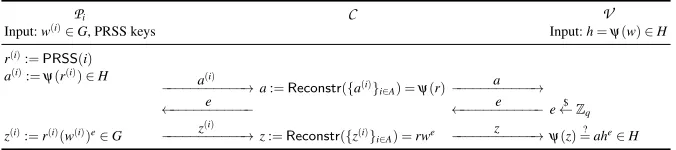
Fig. 1.Distributed proof of knowledge of a preimagew∈Gof an elementh∈Hunder a group homomorphismψ:G→H
3
Threshold Building Blocks
3.1 Proofs of Knowledge of Preimages of Homomorphisms
LetGandH be two finite Abelian groups both written multiplicatively and letψ :G→H be a homomorphism.
Furthermore, leth∈Handqbe a prime such thatu∈Gwithψ(u) =hqis known. IfHhas prime orderq(and thus is
cyclic), this condition is fulfilled foru=1 becauseψ(1) =1=hq. A proof of knowledge of a preimagew∈Gofh
underψworks as follows (cf. Figure 9 in the appendix): The prover starts by sendinga:=ψ(r)for a randomr∈G, the
verifier sends a random challengee∈Zq, the prover responds withz:=rwe, and the verifier checks whetherψ(z) =ahe.
This protocol is due to Maurer [39] and generalizes proofs of knowledge of discrete logarithms,p-th roots, and many more. Usinguof the form mentioned above, Maurer proves special soundness.
Desmedt [24] formulated a distributed version of this protocol (see Figure 1) using a linear secret sharing of the group elementsrandw. Each prover executes the computations as in the original protocol with the only difference that it uses its sharesr(i)andw(i)instead ofrandw. The combiner
C
collects the messagesa(i)andz(i)from the provers and computesaandzby reconstructing as soon as there are enough shares available.Adenotes the qualified set of provers that are the first to send a share. If the linear scheme allows it, the provers are not required to be completely present.Lemma 1. The protocol in Figure 1 achieves completeness, special soundness, and computational partial
zero-knowledge with the same threshold as the utilized secret sharing scheme.
Proof. Completeness follows from the protocol description, and special soundness is proven in the same way as for
the single-prover protocol. The partial zero-knowledge simulator implicitly runs the simulator of the original protocol, adapting to deviating provers and a partially deviating combiner. See Appendix B.1.
3.2 OR Construction for Proofs of Knowledge of Preimages
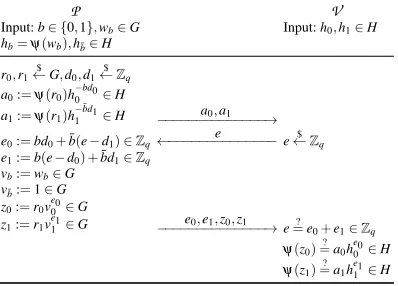
The OR construction is an important basic building block forΣ-protocols. It allows a prover to show that it knows a witness for one out of two given inputsbut withoutrevealing to which input the witness corresponds. The OR construction is itself aΣ-protocol. We consider the OR construction for proofs of preimages as described in the previous section. Figure 2 shows a protocol proving the knowledge of aψ-preimage of one out of two given elements while hiding for which of the elements a preimage is known, i.e., the bitbis hidden.
To obtain a distributed version of this protocol where a prover
P
iis not aware of the secret preimagewbandthe bit b, the first step is to make the computations on the prover’s side uniform. That means the way one computesab,eb, and zbshould not differ from the way to computeab¯,eb¯, andzb¯, where ¯b=1−b. Figure 10 in the appendix shows such analternative version of the protocol but still for the case of a single prover. Secret sharing of the secrets of the prover finally leads to a distributed version of the protocol.
Figure 3 shows our threshold protocol for groups of prime orderq. We use Shamir’s secret sharing overZqwith
thresholdt<n/2 and the abstract notion of multiplicative secret sharing introduced in Section 2.2.b(i), ¯b(i), and 1(i)
denote a secret sharing ofb, ¯b, and 1 overZq, whereb∈ {0,1}and ¯b:=1−b. 1(i)is only needed to convert shares into
P V
Input:b∈ {0,1},wb∈G Input:h0=ψ(w0),h1=ψ(w1)∈H rb,z¯b
$ ←G,e¯b
$ ←Zq
ab:=ψ(rb)∈H
a¯b:=ψ(z¯b)h
−e¯ b
¯
b ∈H −−−−−−−−−−−−−−→a0,a1
e
←−−−−−−−−−−−−−−e←$ Zq
eb:=e−e¯b∈Zq
zb:=rbwebb ∈G −−−−−−−−−−−−−−→e0,e1,z0,z1 e=?e0+e1∈Zq
ψ(z0) ?
=a0h
e0
0 ∈H
ψ(z1)=?a1he1 1 ∈H
Fig. 2.Proof of knowledge of aψ-preimage ofhb, givenh0,h1∈H
Pi C V
Input:b(i),b¯(i),1(i)∈
Zq, PRSS and PRZS keys, Input:h0,h1∈H
v(0i),v1(i)∈G,h0,h1∈H r(0i),r(1i)←$ G d(0i):=PRSS(i)
d(1i):=PRSS(i)
a0(i):=ψ(r0(i))·h−Mult(b
(i),d(0i))
0 ·PRZS 0(i) a1(i):=ψ(r1(i))·h−Mult(¯b
(i),d(1i))
1 ·PRZS 0(i)
a(0i),a(1i)
−−−−−−−−−−−→a0:=∏ia
(i)
0 a1:=∏ia
(i)
1
a0,a1 −−−−−−−−−−−→
e(0i):=Mult(b(i),d(i)
0) +Mult(b¯(
i),1(i))e ←−−−−−−−−−−−e ←−−−−−−−−−−−e e$ ←Zq
−Mult(b¯(i),d(i)
1) +PRZS(i)∈Zq
e(1i):=Mult(b(i),1(i))e−Mult(b(i),d(i)
0 )
+Mult(b¯(i),d(i)
1) +PRZS(i)∈Zq
z0(i):=r0(i)·Mult0(v(i)
0,1(
i))e/Mult0(v(i)
0,d
(i)
1)·PRZS 0(i) z1(i):=r1(i)·Mult0(v(i)
1,1(
i))e/Mult0(v(i)
1,d
(i)
0)·PRZS 0(i) e(i)
0,e
(i)
1,z
(i)
0,z
(i)
1
−−−−−−−−−−−→e0:=∑ie
(i)
0 e1:=∑ie( i)
1 z0:=∏iz
(i)
0 z1:=∏iz
(i)
1
e0,e1,z0,z1
−−−−−−−−−−−→e=?e0+e1∈Zq
ψ(z0)=?a0he0 0
ψ(z1) ?
=a1h
e1
1
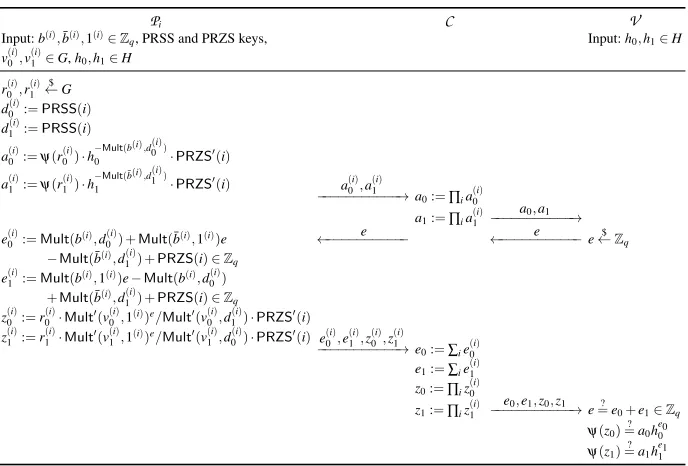
Fig. 3.Distributed version of the proof of knowledge of aψ-preimage ofhb, givenh0,h1∈H. Assumption:Gis is of prime orderq.
share these overGbecause the discrete logarithm ofwbmight not be known in the setup phase.r
(i)
0 andr
(i) 1 can be
understood as an additive secret sharing of some random group elementsr0andr1.
In the following, we show that the view of
V
is the same as in the protocol described in Figure 2.e0,e1are randomnumbers that sum up toe, andz0andz1pass the check by the verifier:
e0+e1=
∑
i
e0(i)+e(1i)= (bd0+be¯ −bd¯ 1) + (be−bd0+bd¯ 1) =
(
(e−d1) + (d1) b=0
(d0) + (e−d0) b=1,
z0=
∏
i
z(0i)=
∏
ir0(i)·Mult0(v0(i),1(i))e/Mult0(v(0i),d1(i))·PRZS0(i) =r0ve0/v
d1
0 =r0ve0−d1
=
(
r0vbd0+ ¯
b(e−d1)
0 =r0ve00 b=0
r0veb¯−d1 =r01e−d1=r01e0=r0ve00 b=1
The same can be proven forz1.
Applying standard multiparty computation secure against a passive adversary [3] would require one communication round among the provers per round of multiplication operations. Multiparty computation secure against an active adversary usually requires even more communication. This is what we save by directly publishing the output ofMult andMult0, re-randomized byPRZSandPRZS0, respectively.
Lemma 2. The protocol for prime order groups as described above achieves completeness, special soundness, and
computational partial zero-knowledge with threshold t<n/2.
Proof. Completeness follows from the protocol description, and special soundness is proven in the same way as for
the single-prover protocol. The partial zero-knowledge simulator implicitly runs the simulator of the original protocol, adapting to deviating provers and a partially deviating combiner. The essence of the proof is a smart combination of multiparty and zero-knowledge simulation techniques. See Appendix B.2.
Lemma 3. The protocol described above is witness hiding with threshold t if the corresponding single-prover OR proof
is witness hiding.
Proof. The proof is done by reduction, i.e., we present a simulator that simulates the set of honest provers by accessing
the honest prover of the single-prover protocol internally. See Appendix B.3.
3.3 Range Proofs
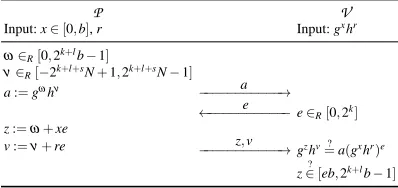
In this section, we will outline how to adapt the range proof by Lipmaa [37] to our distributed setting. All protocols in this section use the Fujisaki-Okamoto commitment scheme [21, 31]com(x,r):=gxhrforg,h∈Z∗
Nandr∈R[0,2sN]
(sis a security parameter). Clearly,comis a homomorphic function fromZ×ZtoZ∗N. Therefore, one might want to construct a proof of knowledge of a preimage as in Section 3.1. However,Z×Zis not finite, and thus, the technique does not apply directly. Nevertheless, Damg˚ard and Fujisaki [21] showed that a similar protocol achieves soundness if the strong RSA assumption holds forZ∗N. The protocol can efficiently be distributed like the protocol in Section 3.1 by
using an additive secret sharing ofxandrover the integers.
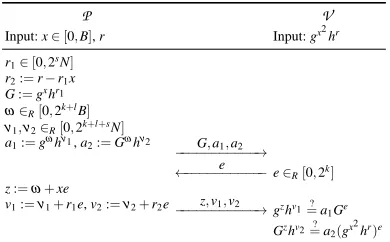
An essential building block of the range proof is the proof that a committed value is a square. However,com(x2,r)
is not a homomorphic function inxandr, and therefore, the approach of the protocol in Section 3.1 cannot be used. The following construction solves the problem:
P
chooses a randomr1, and computesr2:=r−r1xandC:=com(x,r1) =gxhr1. Then,com(x2,r) =gx2hr=gx2hxr1+r2 =Cxhr2. The function(x,r
1,r2)7→(gxhr1,Cxhr2)is a homomorphism;
thus, a zero-knowledge proof can be constructed similarly to the proof of knowledge of a committed value if the strong RSA assumption holds forZ∗N. See Figure 6 in Appendix E for details. Damg˚ard and Fujisaki [21] prove that a more
general version of the protocol (proof that a commitment hides a product of two other committed values) achieves computational soundness and statistical honest-verifier zero-knowledge.
Since the protocol involves products of secret values, linear secret sharing does not suffice to get a distributed protocol. However, one can use the same techniques as for the OR proof, namely multiplicative secret sharing, PRSS, and PRZS. Again, this allows to minimize the communication. See Appendix E for the detailed protocol.
every non-negative integer can be written as the sum of four squares of integers. Together with the proof of a square, this directly allows to implement a range proof. First, the prover computesα1, . . . ,α4,β1, . . . ,β4such that∑4i=1αi2=x−a
and∑4i=1βi2=b−x, and the commitments com(αi2,r1i), com(βi2,r2i)for all i∈[1,4] such that ∑4i=1r1i=r and
∑4i=1r2i=−r. Then he sends the commitments to the verifier and uses the proof of square described above to prove
that all these commitments hide a square. Finally, the verifier checks thatcom(x,r)/ga=∑i4=1com(αi2,r1i)and that gb/com(x,r) =∑4i=1com(αi2,r2i). Lipmaa [37] proposes an optimized proof based on the same ideas.
The proof can be adapted to our distributed setting if the provers hold a multiplicative secret sharing ofα1, . . . ,α4,β1, . . . ,β4.
The distributed generation of these shares using the algorithm in [37] requires very expensive MPC due to branching, but they can be generated in a setup phase because they only depend on the committed value and the range boundaries. Boudot’s range proof described in Appendix F only requires the computation of integer square roots at that point, but has other drawbacks like not being exact.
4
Applications to User-Centric Protocols
4.1 E-Cash with Threshold Wallets
In this section we describe a threshold version of the e-cash scheme by Brands [6]. In the standard version, a user
U
opens an account in a bank
B
. The user can then withdraw electronic money and later use it in a shopS
.S
may then deposit the electronic money to his own bank account. Moreover, even ifB
andS
cooperate they cannot link electronic coins to a specific user. In the threshold version the userU
is split up into several entitiesU
1toU
nand a combinerC
acting as the user with respect to
B
andS
. The global setup of the system and the protocol forS
depositing the e-cash inB
does not include the user and are therefore not changed.Opening an account. The public key of
B
are three generatorsg,g1, andg2∈Gq, whereGqis a cyclic group ofprime orderq. The private key of
B
is a random numberx∈Z∗q. WhenU
wants to open an e-cash account atB
, hesamplesu1 $
←Zqand usesu1as secret key. Fromu1,
U
calculatesI:=gu11, sendsItoB
and proves knowledge ofu1such thatI=gu1
1. If the proof is accepted,
B
calculatesz:= (Ig2)xand sendsztoU
. The bank storesIas the accountnumber of
U
, andU
storesu1andz. This protocol can easily be extended to a threshold protocol, whereu1is generateddistributedly as an additive secret shared value. From the shares ofu1, the players
U
iandC
can calculateIdistributedly.The proof of knowledge ofu1is distributed as in the protocol from Section 3.1 (cf. Figure 1).
Withdrawing coins from the bank. This protocol can be viewed as aΣ-protocol, where
B
acts as prover, provingknowledge of its own secret key to
U
. As a resultU
ends up with a blinded signaturesig(A,B)fromB
on a coin(A,B). This coin along with the signature can later be used for payment. Distributing a verifier might be straightforward, however, in this case the signature contains a hash valueH(·), and most hash functions are far from linear. They can therefore not be distributed easily. Nevertheless, we can still protect the user from theft of coins in case some
U
iiscorrupted, although this might jeopardize the anonymity of
U
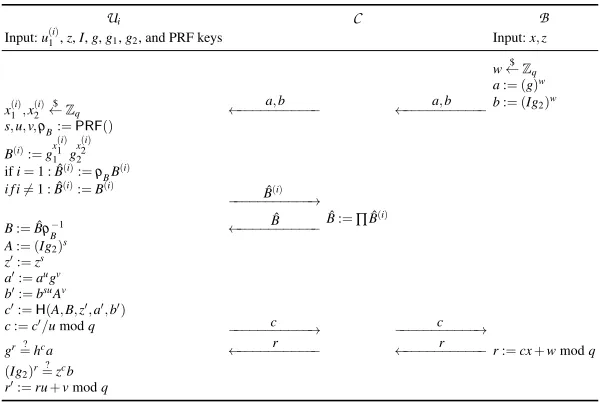
. The threshold protocol is sketched in Figure 4. Some random values used for anonymizing the protocol are generated by a pseudorandom function (PRF). Distributing the PRF key allows generating commonly known pseudorandom values without reconstruction. The valueBhas, due to hashing, to be known by eachU
i, however,Bis computed fromx1andx2, and not by the PRF. Therefore, it has to bereconstructed by
C
. We blindBbyρB to maintain anonymity.If the adversary does not control any of
U
1, . . . ,U
nnor the combinerC
, then the protocol is equivalent to theoriginal protocol, and therefore has the same level of security in that case. In case of corruption, we do not ensure anonymity, nevertheless, no information regarding neitheru1,x1norx2is leaked, and therefore, even after withdrawal
with corrupted players, the adversary still has only negligible chance of paying afterward.
Spending coins. In this part of the original protocol
U
sends the coinhA,B,sig(A,B)itoS
.U
proves that the coin isvalid, obtained by the user with secret keyu1, and that
U
has knowledge ofu1. This is basically aΣ-protocol provingrepresentation ofAwith respect tog1andg2, usingx1andx2for blinding. Therefore, we can distribute it by the protocol
from Section 3.1 (cf. Figure 1). Please note thatBand notB(i)should be sent from each
U
itoC
. Otherwise,ρBwouldbe leaked to
C
, and anonymity is revoked.Ui C B
Input:u(1i),z,I,g,g1,g2, and PRF keys Input:x,z w←$ Zq
a:= (g)w
x(1i),x(2i)←$Zq
a,b
←−−−−−−−−−−− ←−−−−−−−−−−−a,b b:= (Ig2)
w
s,u,v,ρ
B:=PRF()
B(i):=gx (i)
1 1 g
x(2i)
2 ifi=1 : ˆB(i):=
ρBB
(i)
i f i6=1 : ˆB(i):=B(i) ˆ
B(i)
−−−−−−−−−−−→
B:=Bˆρ−1B
ˆ B
←−−−−−−−−−−−Bˆ:=∏Bˆ
(i)
A:= (Ig2)s
z0:=zs
a0:=augv
b0:=bsuAv
c0:=H(A,B,z0,a0,b0)
c:=c0/umodq −−−−−−−−−−−→c −−−−−−−−−−−→c gr?
=hca ←−−−−−−−−−−−r ←−−−−−−−−−−−r r:=cx+wmodq (Ig2)r=?
zcb
r0:=ru+vmodq
Fig. 4.Distributed version of the withdrawal protocol
Theorem 1. The threshold scheme preserves the following properties from the original scheme [6, Section 5]
– Anonymity of
U
:The anonymity of the original scheme [6, Corollary 12] is preserved against a passive adversarycontrolling
C
,B
andS
.– Security against double spenders, and forgery:Security for
B
andS
against double spenders [6, Proposition 10] and against forged coins [6, Corollary 9, Proposition 7 and 13] is preserved.– Security against theft:Security for
U
against theft of electronic coins [6, Proposition 14 and 15] is preservedagainst an adversary passively corrupting n−1of the user players, the combiner
C
,B
andS
.Proof. Security for
B
andS
follows since it is oblivious for them that they execute the threshold version. Sinceu1issecret shared, the adversary cannot steal coins, and anonymity of
U
can be reduced to anonymity in the original scheme. For more details see Appendix B.4.Robustness. To allow payments even in case some of the user players
U
iare not present in the payment protocol, thefollowing changes suffice. First the protocol for opening an account has to generate the users secret keyu1as being
shared with a linear secret sharing scheme that has lower threshold than the additive one. This can be done by using PRSS. The same has to be done with the blinding valuesx1andx2in the withdrawal protocol. In addition,
C
has toreconstruct the value of ˆBtaking into account that it is computed from the shares ofx1andx2, which is possible because
the reconstruction ofx1andx2is a linear operation. This enables a threshold version of the payment protocol where
only a subset of the players
U
iequivalent to the threshold value of the secret sharing scheme needs to be present.4.2 Increasing the Security of Anonymous Credentials
Credentials are certificates of qualification (e.g., driver’s licenses) or authorization of some kind (e.g., e-tickets) that are attached to a specific user. Credential systems allow their users (
U
) to obtain credentials from organizations (O
) and show possession of these credentials to verifiers (V
). In an anonymous credential system different transactions involving the same user cannot be linked.over bilinear group settings. In the following we shortly describe these components and sketch threshold versions of the zero-knowledge protocols.
LetGandGT be two cyclic groups of prime orderq(which are both written multiplicatively in the following). A
pairinge:G×G→GT is a function with the following properties:
– Bilinearity:∀(a,b)∈G2and(x,y)∈Z2q, it holds thate(ax,by) =e(a,b)xy.
– Non-degeneracy:∃a,b∈Gsuch thate(a,b)6=1.
– eis efficiently computable.
The credential system in [10] makes use of Pedersen commitments [42] overG, which are information-theoretically hiding and computationally binding under the DL assumption. Here, given two generatorsg,h∈G, a commitmentMto
m∈Zqis computed by choosingr
$
←Zqand settingM:=gmhr. In the scope of the credential system, a commitment
to a secretmchosen by a user serves as a pseudonym for the user when interacting with an organization. For different organizations, different pseudonyms are used. Usually, all pseudonyms of a user are required to be commitments to the
same m, which is some master secret key (used outside the credential system).
Credentials are signatures on pseudonyms. To this end, the following signature scheme is proposed in [10], which is secure under the LRSW assumption.
– Gensamples a random generatorgofG,x,y,z←$ Zq, and computesX=gx,Y =gy,Z=gz,W =Yz. It returns the
signer’s secret keysk= (x,y,z)and public keypk= (g,X,Y,Z,W).
– Sign(sk,(m,r))choosesα←$ Zqand computesa=gα,A=az,b=ay,B=Ay,c=ax+xymAxyr, where(m,r)∈Z2q
is the given message. It returns the signatureσ= (a,A,b,B,c).
– Verify(pk,(m,r),σ)returns ’accept’, if the following equations are satisfied:e(a,Z) =e(g,A),e(a,Y) =e(g,b),
e(A,Y) =e(g,B), ande(X,a)e(X,b)me(X,B)r=e(g,c).
Let us now consider the protocols described above forming a credential system. For our threshold versions of these protocols we always distribute the user’s side of the protocols over parties
U
1, . . . ,U
n.Proving the equality of two committed values. This is a zero-knowledge proof of knowledge of values(a1,a2,a3)such
thatC=ga1ha2 andC0=ga1ha3, for givenCandC0. Since(a
1,a2,a3)can be viewed as a preimage of(C,C0)under the
homomorphismψ:Z3q→G2whereψ(α1,α2,α3) = (gα1hα2,gα1hα3), Figure 1 immediately yields a threshold version
of this protocol for parties
U
1, . . . ,U
nacting as provers.Obtaining a signature on a committed value (obtaining a credential). This is a protocol between
U
andO
. Theparty
U
holds(m,r)and is givenO
’s public signature keypk as input.O
holds its secret signature keysk and is given commitmentM=gmZr as input. The protocol consists of two steps. First,U
proves in zero-knowledge its knowledge of a representation ofMwith respect togandZ. Again, a threshold version of this subprotocol can be immediately obtained from the protocol in Figure 1. Second, ifO
accepts the previous proof, it generates a signatureσ on(m,r)using the signature scheme described above. Since(m,r)is not given, the componentcof the signature is computed only usingM asc=axMαxy. Then,
U
checks the validity ofσ according toVerify. Note that only forchecking the last equation the knowledge of(m,r)is required. So to distribute the user’s side of this subprotocol over
U
1, . . . ,U
n, we only need to compute the left-hand side of this equation in a distributed way:U
i computes w(i):=e(X,a)e(X,b)m(i)e(X,B)r(i)e(g,g)PRZS(i),wherem(i),r(i)are additive shares ofmandr, respectively. Then itsendsw(i)to the combiner
C
who computes the product of these shares and checks the corresponding equation. It is easy to see that the threshold protocol for obtaining a signature on a committed value is zero-knowledge with respect to adversaries passively corruptingO
,C
, and a static set ofn−1 partiesU
i.Proving knowledge of a signature on a committed value (showing a credential). This is a protocol executed between
a user
U
and a verifierV
.U
is given(m,r), a signatureσon these values, and the public keypkof the signer.V
is only givenpk. The playerU
first re-randomizes the given signature. To this end, it choosesr1,r2$
←Zq, computes
˜
a=ar1, ˜A=Ar1, ˜b=br1, ˜B=Br1, ˆc=cr1r2, and sends ˜σ= (a˜,A˜,b˜,B˜,cˆ)to
V
.V
is now able to verify all equationsUi C V
Input:m(i),r(i),pk,σ,PRSS,PRZSkeys Input:pk
r(1i),r(2i),s(1i):=PRSS(i)
s2(i):=Mult(r2(i),s(1i)) +PRZS(i)
˜
a(i):=aMult(r(i)
1,1(i) )+PRZS(i) ˜
A(i):=AMult(r1(i),1(i) )+PRZS(i)
˜
b(i):=bMult(r(i)
1,1(
i) )+PRZS(i)
˜
B(i):=BMult(r(i)
1,1(i) )+PRZS(i) ˆ
c(i):=cMult(r1(i),r(2i))+PRZS(i) a˜(i),A˜(i),b˜(i),
˜ B(i),cˆ(i),s(i)
2
−−−−−−−−−−−→s2:=∑is( i)
2 ˜ a:=∏ia˜(i)
˜ A:=∏iA˜(i)
˜ b:=∏ib˜(i)
˜ B:=∏iB˜(i)
˜ b,B˜,cˆ,s2
←−−−−−−−−−−−c:ˆ=∏icˆ
(i)
˜ a,A˜,b˜,B˜,cˆ
−−−−−−−−−−−→e(a˜,Z)=?e(g,A˜)
e(a˜,Y)=?e(g,b˜)
t1(i),t2(i),t(3i)←$Zq e(A˜,Y)=?e(g,B˜)
d(i):=e(g,cˆ)t(i)
1e(X,˜b)t( i)
2 e(X,B˜)t( i)
3 d(i)
−−−−−−−−−−−→d:=∏id0(i)
d −−−−−−−−−−−→
z(1i):=t1(i)−Mult(s(1i),1(i))s−1
2 c+PRZS(i) c
←−−−−−−−−−−− ←−−−−−−−−−−−c c←$ Zq
z2(i):=t2(i)+cm(i)
z3(i):=t3(i)+cr(i) z(i)
1,z
(i)
2,z
(i)
3
−−−−−−−−−−−→z1:=∑iz
(i)
1 z2:=∑iz
(i)
2 z3:=∑iz
(i)
3
z1,z2,z3
−−−−−−−−−−−→e(g,cˆ)z1e(X,b˜)z2e(X,B˜)z3
?
=de(X,a˜)−c
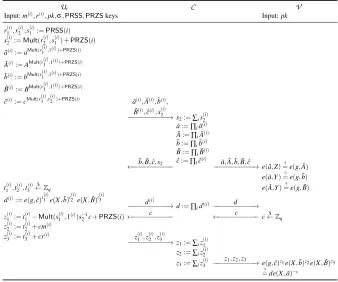
Fig. 5.Distributed version of the protocol for proving knowledge of a signature on a committed value
proves in zero-knowledge the knowledge of(r2−1,m,r)such thate(X,a˜)e(X,b˜)me(X,B˜)r=e(g,cˆ)r2−1. Note that this
is equivalent to proving knowledge of a representation ofe(X,a˜)−1with respect toe(X,b˜),e(X,B˜), ande(g,cˆ). The threshold version of the whole protocol is shown in Figure 5. Note that in order to compute ˆca multiplicative secret sharing (e.g., Shamir’s secret sharing) ofr1andr2is needed. Furthermore, in order to compute an additive sharing of
r−21from a multiplicative sharing ofr2(without reconstructingr2), another trick is used: We choose a random values1
by means of PRSS and computes2:=r2s1in a distributed manner. Note thats2which is reconstructed by the combiner
does not leak information aboutr2. Thens2is given to every
U
iwho uses this value to compute its additive shareMult(s(1i),1(i))s−21ofr−21.
It is easy to see that the protocol in Figure 5 achieves completeness and special soundness. It is also zero-knowledge in the case of adversaries passively corrupting
V
andC
. However, as soon as a singleU
iis passively corrupted, theadversary knowsσand thus it is not a zero-knowledge proof of the signature anymore. But this does only affect the
anonymity of a user, which we do not aim to increase here. More precisely, even ifσ is known, the protocol does not
leak information about(m,r)as long as not more thann−1 of the players
U
iare passively corrupted. So an adversaryis not able to steal a user’s identity or a credential in this case. Theorem 2 (informally) summarizes the properties which can be achieved using the proposed threshold protocols.
Theorem 2. The threshold versions of the protocols described above can be used to build a credential system with the
following main properties:
– Anonymity for users in presence of a passive adversary controlling
C
,O
andV
.– Security of a user’s master secret key against a static adversary passively corrupting n−1of the user players
U
i,the combiner
C
,O
andV
.4.3 Identification
Cramer and Damg˚ard [15] show that OR proofs can be used to construct an identification scheme resilient against man-in-the-middle attacks. Both parties are assumed to have elements in the domain of a homomorphic one-way function as private keys, whereas the public keys are the value of the private keys under the function. The identification protocol is then simply a proof of knowledge of one of the private keys of the two parties. The construction in Section 3.2 directly allows to distribute the private key among a set of provers. On the other hand, having a set of verifiers requires a further assumption. If the challenge is chosen as the sum of challenge shares chosen by the verifiers, a cheating verifier in an asynchronous network could adapt his challenge to the other challenges such that the sum would be a challenge desired by the prover. This problem can be solved be either letting the verifiers commit to their challenge share in advance, or by computing the challenge as the output of a hash function, as in the Fiat-Shamir heuristic [30]. The latter is only secure in the random oracle model.
References
1. Almansa, J.F., Damg˚ard, I., Nielsen, J.B.: Simplified threshold RSA with adaptive and proactive security. In: Vaudenay, S. (ed.) EUROCRYPT. Lecture Notes in Computer Science, vol. 4004, pp. 593–611. Springer (2006)
2. Bellare, M., Goldreich, O.: On defining proofs of knowledge. In: Brickell [8], pp. 390–420
3. Ben-Or, M., Goldwasser, S., Wigderson, A.: Completeness theorems for non-cryptographic fault-tolerant distributed computation (extended abstract). In: STOC. pp. 1–10. ACM (1988)
4. Blum, M.: How to prove a theorem so no one else can claim it. In: Gleason, A.M. (ed.) Proceedings of the International Congress of Mathematicians. pp. 1444–1451 (1986)
5. Boudot, F.: Efficient proofs that a committed number lies in an interval. In: Preneel [43], pp. 431–444
6. Brands, S.: Untraceable off-line cash in wallets with observers (extended abstract). In: Stinson, D.R. (ed.) CRYPTO. Lecture Notes in Computer Science, vol. 773, pp. 302–318. Springer (1993)
7. Brassard, G., Chaum, D., Cr´epeau, C.: Minimum disclosure proofs of knowledge. J. Comput. Syst. Sci. 37(2), 156–189 (1988) 8. Brickell, E.F. (ed.): Advances in Cryptology - CRYPTO ’92, 12th Annual International Cryptology Conference, Santa Barbara,
California, USA, August 16-20, 1992, Proceedings, Lecture Notes in Computer Science, vol. 740. Springer (1993)
9. Camenisch, J., Lysyanskaya, A.: A signature scheme with efficient protocols. In: Cimato, S., Galdi, C., Persiano, G. (eds.) SCN. Lecture Notes in Computer Science, vol. 2576, pp. 268–289. Springer (2002)
10. Camenisch, J., Lysyanskaya, A.: Signature schemes and anonymous credentials from bilinear maps. In: Franklin, M.K. (ed.) CRYPTO. Lecture Notes in Computer Science, vol. 3152, pp. 56–72. Springer (2004)
11. Canetti, R.: Universally composable security: A new paradigm for cryptographic protocols. In: FOCS. pp. 136–145 (2001) 12. Chan, A.H., Frankel, Y., Tsiounis, Y.: Easy come - easy go divisible cash. In: EUROCRYPT. pp. 561–575 (1998)
13. Chaum, D.: Blind signatures for untraceable payments. In: CRYPTO. pp. 199–203 (1982)
14. Chaum, D.: Security without identification: Transaction systems to make big brother obsolete. Commun. ACM 28(10), 1030– 1044 (1985)
15. Cramer, R., Damg˚ard, I.: Fast and secure immunization against adaptive man-in-the-middle impersonation. In: EUROCRYPT. pp. 75–87 (1997)
16. Cramer, R., Damg˚ard, I., Ishai, Y.: Share conversion, pseudorandom secret-sharing and applications to secure computation. In: Kilian, J. (ed.) TCC. Lecture Notes in Computer Science, vol. 3378, pp. 342–362. Springer (2005)
17. Cramer, R., Damg˚ard, I., Schoenmakers, B.: Proofs of partial knowledge and simplified design of witness hiding protocols. In: Desmedt, Y. (ed.) CRYPTO. Lecture Notes in Computer Science, vol. 839, pp. 174–187. Springer (1994)
18. Cramer, R., Fehr, S., Ishai, Y., Kushilevitz, E.: Efficient multi-party computation over rings. In: Biham, E. (ed.) EUROCRYPT. Lecture Notes in Computer Science, vol. 2656, pp. 596–613. Springer (2003)
19. Damg˚ard, I.: Efficient concurrent zero-knowledge in the auxiliary string model. In: Preneel [43], pp. 418–430 20. Damg˚ard, I.: OnΣ-protocols, Course Notes. Aarhus University (2010)
21. Damg˚ard, I., Fujisaki, E.: A statistically-hiding integer commitment scheme based on groups with hidden order. In: Zheng, Y. (ed.) ASIACRYPT. Lecture Notes in Computer Science, vol. 2501, pp. 125–142. Springer (2002)
22. Damg˚ard, I., Koprowski, M.: Practical threshold RSA signatures without a trusted dealer. In: Pfitzmann, B. (ed.) EUROCRYPT. Lecture Notes in Computer Science, vol. 2045, pp. 152–165. Springer (2001)
23. Damg˚ard, I., Mikkelsen, G.L.: On the theory and practice of personal digital signatures. In: Jarecki, S., Tsudik, G. (eds.) Public Key Cryptography. Lecture Notes in Computer Science, vol. 5443, pp. 277–296. Springer (2009)
25. Desmedt, Y., Crescenzo, G.D., Burmester, M.: Multiplicative non-abelian sharing schemes and their application to threshold cryptography. In: Pieprzyk, J., Safavi-Naini, R. (eds.) ASIACRYPT. Lecture Notes in Computer Science, vol. 917, pp. 21–32. Springer (1994)
26. Desmedt, Y., Frankel, Y.: Shared generation of authenticators and signatures (extended abstract). In: Feigenbaum [29], pp. 457–469
27. Dodis, Y., Shoup, V., Walfish, S.: Efficient constructions of composable commitments and zero-knowledge proofs. In: Wagner, D. (ed.) CRYPTO. Lecture Notes in Computer Science, vol. 5157, pp. 515–535. Springer (2008)
28. Feige, U., Shamir, A.: Witness indistinguishable and witness hiding protocols. In: STOC. pp. 416–426. ACM (1990)
29. Feigenbaum, J. (ed.): Advances in Cryptology - CRYPTO ’91, 11th Annual International Cryptology Conference, Santa Barbara, California, USA, August 11-15, 1991, Proceedings, Lecture Notes in Computer Science, vol. 576. Springer (1992)
30. Fiat, A., Shamir, A.: How to prove yourself: Practical solutions to identification and signature problems. In: Odlyzko, A.M. (ed.) CRYPTO. Lecture Notes in Computer Science, vol. 263, pp. 186–194. Springer (1986)
31. Fujisaki, E., Okamoto, T.: Statistical zero knowledge protocols to prove modular polynomial relations. In: Jr., B.S.K. (ed.) CRYPTO. Lecture Notes in Computer Science, vol. 1294, pp. 16–30. Springer (1997)
32. Garay, J.A., MacKenzie, P.D., Yang, K.: Strengthening zero-knowledge protocols using signatures. J. Cryptology 19(2), 169–209 (2006)
33. Gennaro, R., Rabin, T., Jarecki, S., Krawczyk, H.: Robust and efficient sharing of RSA functions. J. Cryptology 13(2), 273–300 (2000)
34. Goldwasser, S., Micali, S., Rackoff, C.: The knowledge complexity of interactive proof-systems (extended abstract). In: STOC. pp. 291–304. ACM (1985)
35. Guillou, L., Quisquater, J.J.: A practical zero-knowledge protocol fitted to security microprocessor minimizing both transmission and memory. In: EUROCRYPT. pp. 123–128 (1988)
36. Keller, M., Mikkelsen, G.L., Rupp, A.: Efficient threshold zero-knowledge with applications to user-centric protocols. In: ICITS 2012. Lecture Notes in Computer Science, Springer (2012)
37. Lipmaa, H.: On diophantine complexity and statistical zero-knowledge arguments. In: Laih, C.S. (ed.) ASIACRYPT. Lecture Notes in Computer Science, vol. 2894, pp. 398–415. Springer (2003)
38. Lysyanskaya, A.: Signature Schemes and Applications to Cryptographic Protocol Design. Ph.D. thesis, Massachusetts Institute of Technology (2002)
39. Maurer, U.M.: Unifying zero-knowledge proofs of knowledge. In: Preneel, B. (ed.) AFRICACRYPT. Lecture Notes in Computer Science, vol. 5580, pp. 272–286. Springer (2009)
40. Okamoto, T.: Provably secure and practical identification schemes and corresponding signature schemes. In: Brickell [8], pp. 31–53
41. Pedersen, T.P.: Distributed provers with applications to undeniable signatures. In: EUROCRYPT. pp. 221–242 (1991) 42. Pedersen, T.P.: Non-interactive and information-theoretic secure verifiable secret sharing. In: Feigenbaum [29], pp. 129–140 43. Preneel, B. (ed.): Advances in Cryptology - EUROCRYPT 2000, International Conference on the Theory and Application of
Cryptographic Techniques, Bruges, Belgium, May 14-18, 2000, Proceeding, Lecture Notes in Computer Science, vol. 1807. Springer (2000)
44. Rabin, T.: A simplified approach to threshold and proactive RSA. In: Krawczyk, H. (ed.) CRYPTO. Lecture Notes in Computer Science, vol. 1462, pp. 89–104. Springer (1998)
45. Schnorr, C.P.: Efficient identification and signatures for smart cards. In: Brassard, G. (ed.) CRYPTO. Lecture Notes in Computer Science, vol. 435, pp. 239–252. Springer (1989)
46. Shamir, A.: How to share a secret. Commun. ACM 22(11), 612–613 (1979)
47. Simoens, K., Peeters, R., Preneel, B.: Increased resilience in threshold cryptography: Sharing a secret with devices that cannot store shares. In: Joye, M., Miyaji, A., Otsuka, A. (eds.) Pairing. Lecture Notes in Computer Science, vol. 6487, pp. 116–135. Springer (2010)
A
Linear Secret Sharing
Definition 9. A setΓ ⊂2[n]is called a monotone access structure on[n]if for all A∈Γ and A0⊃A, A0is also inΓ.
The sets inΓ are called qualified, and sets inΓcare called unqualified. A setA∈Γcis called maximal unqualified
if, fromA0⊃AwithA0∈Γc, it follows thatA0=A.
Definition 10. Let R be a ring andΓ a monotone access structure on[n]. A linear secret sharing scheme on R is defined
by a matrix M∈Rd×e, where every row of M is assigned to a player. We denote by MAthe rows assigned to the players
– If A∈Γ, there is a so-called reconstruction vectorλA∈Rdsuch that MATλA= (1,0, . . . ,0)T.
– If A∈/Γ, there is a so-called sweeping vectorκA∈Rewith first entry 1 such that MAκA=0.
Secret sharing ofsis done by choosing random valuesr2, . . . ,re, computingM·(s,r2, . . . ,re)T, and distributing
the entries of the resulting vector according to the row assignment ofM. The reconstruction vectors ensure that every qualified set of players can reconstruct the secret, and the sweeping vectors ensure that every unqualified set gets only negligible information about the secret if the random values were chosen appropriately. That is, from the entire field for finite fields, and from an interval exponentially larger than any entry in anyκAforZ.
We now describe how a linear secret sharing scheme forZmimplies a secret sharing scheme for a groupGof order m. Letgbe an element ofGandsibe the shares of a secrets∈Zm. Then,gsiis a secret sharing ofgs. For a qualified set A, let{λi}i∈Abe the reconstruction parameters. Reconstruction then works as follows:
∏
(gsi)λi=g∑siλimodm=gsbecausegm=1, i.e., the modulo reduction in the exponent leaves the group element unchanged. It is easy to see that gsigs0i=gsi+s0iis a share ofgs+s0ifsiands0
iare shares ofsands0, respectively, and thatsdoes not have to be known to
secret sharegsbecauseShareis linear. Similarly, a linear secret sharing scheme forZimplies a secret sharing scheme
for any cyclic group. It is straightforward to extend the construction to secret sharing schemes with several shares per player.
A.1 Examples
Shamir’s Secret Sharing. Shamir’s secret sharing works for finite fields and the ringZmif the smallest prime factor
ofmis greater than the number of players. The shares are points on a random polynomial, which evaluates to the secret in 0. Reconstruction works using Lagrange interpolation, and thus, the qualified sets are those strictly bigger than the degree of the polynomial.
Shamir’s secret sharing fulfills the above definition withd=n,e=t+1,Mbeing the Vandermonde matrix of the points assigned to the players, andΓ consisting of all sets in[n]with size at leastt+1 (thresholdt). The reconstruction vectors are defined by the Lagrange interpolation; i.e., the entry ofλAfor playeri∈Ais∏j∈A\{i}
xj
xj−xi. The sweeping vectorκAis defined by the coefficientsαiof a polynomialp(x) =∑i≤tαixievaluating to 0 inxifor alli∈Aand to 1 in
0. Such a polynomial exists for|A| ≤t. Furthermore,α0=1 because of the latter constraint.
It is easy to see that Shamir’s secret sharing with thresholdt<n/2 achieves the properties of multiplicative secret sharing scheme, withShareandReconstrbeing the normal sharing and reconstruction procedures. LetMultbe defined as follows:Mult(si,s0i):=aisis0i, whereaiis defined as the Lagrange interpolation coefficient for a polynomial of degree
2t. Lagrange interpolation is possible because 2t<n.
Multiplicative Integer Secret Sharing. Cramer et al. [18] show how to construct a multiplicative integer secret
sharing scheme with thresholdt<n/2. Roughly speaking, they construct a Shamir-like secret sharing scheme for an extension ring ofZ, and they show that this scheme induces a scheme forZwith the same properties.Zdoes not allow
the direct construction of a Shamir’s secret sharing scheme because{1,−1}are the only invertible elements ofZ, and
Shamir’s secret sharing requiresxi−xjto be invertible for alli6=j∈[n].
A.2 Pseudorandom Secret Sharing
The goal of PRSS is to get a secret sharing of a pseudorandom number without communication. PRSS be can implemented for every linear secret sharing scheme as defined above. For every maximal unqualified set, letrAbe a (pseudo)random number known only toAc.r
AMκAis a secret sharing ofrA, with all shares ofAbeing zero. Thus,
all players can compute their shares ofrAwithout communication. The parties then can compute a secret sharing of r:=∑ArAby summing up the shares of allrA’s because the scheme is linear.ris not known to any unqualified set
because it lacks at least one summand. Usually,rAis computed as output of a pseudorandom function with a secret key
A.3 Pseudorandom Zero Sharing
Here the goal is to get a pseudorandom secret sharing of zero, with the actual sharing being hidden from every unqualified set. In some of our protocols, we need pseudorandom zero sharing with thresholdt<n/2 for additive secret sharing. The threshold for additive secret sharing isn−1, however, we use PRZS to hide the output of multiplicative secret sharing, which has thresholdt<n/2. Additive secret sharing can be defined by then×n-matrix
M=
1
−1 1 . .. . ..
−1 1
1 −1
and the reconstruction vectorλ[n]= (1, . . . ,1)T. The sweeping vectors areκA= (1,0, . . . ,0,1, . . . ,1), where there are i−1 zeros for somei∈/A.
Pseudorandom zero sharing with thresholdt<n/2 can be done as follows: For every maximal unqualified player set
A, the players inAcchoose a (pseudo)random vectorrAof lengthn−t−1, multiply it with then−t×n−t−1-matrix
1
−1 1 . .. . ..
−1 1
−1
,
and define their shares as the entries of the result. Clearly, the shares sum up to zero, and hence, the sum of all sharings is a sharing of zero. Any unqualified set does not know at least onerAand thus cannot derive the shares ofAcifrA
was chosen appropriately. That is, from the entire field for finite fields and from a large enough interval forZ. As with
PRSS,rAusually is computed as output of a pseudorandom function with a secret key known to all players inAcand a
common public input.
The above construction directly extends to any group. Let rA= (r1, . . . ,rn−t−1)T be chosen as vector of
ran-dom elements in a group. Then, let the matrix operate canonically on rA, i.e., with the resulting vector being (r1,r−11r2, . . . ,r−n−1t−1). It is easy to see that the product of all elements of the output vector is 1, and therefore an
additive secret sharing of 1. As above,rAcan be computed using a pseudorandom function. We denote this construction
byPRZS0.
B
Proofs
B.1 Proof of Lemma 1
Completeness follows from the homomorphic property ofψand the linearity ofReconstr: ψ(z) =ψ Reconstr {z(i)}i∈A
=ψ
Reconstr
r(i)· w(i)e i∈A
=Reconstr
ψ r(i) i∈A·Reconstrψ w(i)e i∈A
=Reconstr
a(i)}i∈A
·ψ(w)e=ahe.
1. Run the simulator of the original protocol onhandeto getaandz. 2. Compute a secret sharing ofz:z(i):=Share(z).
3. For the corrupted provers, choosew(i)uniformly at random and computea(i):=ψ(z(i)/(w(i))e).
4. For the honest provers, choose randoma(i)such thatReconstr({a(i)}i∈1,...,n) =a. This is possible by the definition
of linear secret sharing because the set of corrupted provers is not qualified in the secret sharing scheme.
Unlike the simulation, a real execution uses pseudo-random values fora(i) andz(i). Apart from that, the algorithm simulates the protocol with up ton−1 passively corrupted provers because the view of
V
is the computationally indistinguishable to the original protocol,a(i)is a random sharing ofa, andz(i)is a random sharing ofzconsistent witha(i)andw(i)for the corrupted provers. Furthermore, thew(i)given to the (at mostn−1) corrupted provers are random values independent ofw. Therefore, the view of the corrupted provers is also computationally indistinguishable.
The partial zero-knowledge simulator for a setJof actively corrupted provers with|J|<tworks as follows: 1. Choosew(i)uniformly at random for alli∈J.
2. Run the protocol with the corrupted provers to geta(i)andz(i)for alli∈J. The only input to the provers isw(i)and
e(i), which are fixed.
3. Choose{h˜(i)}i∈/Jrandomly inGsuch thatReconstr({h˜(i)}i∈/J∪ {ψ(w(i))}i∈J) =h. This is possible by the definition
of secret sharing. It follows that∏i∈A\J(h˜(i))λ (i)
A =h/∏
i∈J∩Aψ(w(i))λ (i)
A for all reconstruction vectorsλA={λA}i∈A because the reconstruction is unique for a correct sharing.
4. For the honest provers, choosez(i)∈Gat random, and then leta(i):=ψ(z(i))(h˜(i))−e
(i)
.
LetAbe the set of players used by
C
for reconstruction, and letλA={λA(i)}i∈Athe reconstruction vector forA. Thesimulated transcript is accepting for some challengeeife(i)=efor alliand if the corrupted provers stick to the
protocol:
ψ Reconstr({z(i)}i∈A)=ψ
∏
i∈A
(z(i))λA(i)
=
∏
i∈J∩A
ψ (z(i))λA(i)
·
∏
i∈A\J
ψ (z(i))λA(i)
=
∏
i∈J∩A (a(i))λA(i)
ψ (w(i))λ
(i)
A e·
∏
i∈A\J
(a(i))λA(i) (h˜(i))λA(i)e
=
∏
i∈A
(a(i))λA(i)·
∏
i∈J∩A
ψ (w(i))λ
(i)
A ·
∏
i∈A\J
(h˜(i))λA(i)e
=
∏
i∈A
(a(i))λA(i)·
∏
i∈J∩A
ψ w(i)λ (i)
A ·h/
∏
i∈J∩A
ψ w(i)λ (i)
A e
=
∏
i∈A
(a(i))λA(i)·he.
Furthermore, the distribution is computationally indistinguishable from the one of a real execution because the corrupted provers are involved (the randomw(i)reflect that they are independent fromwfrom the point of view of the adversary) and the communication with honest provers is simulated similarly to the 1-prover setting, assumingψ−1(h˜(i))as a share of the witness. However, the latter is not used in the simulation. The assumed shares of the honest provers together with the generated shares of the corrupted provers reconstruct to a preimage ofh. Letλ=λ1, . . . ,λnbe the reconstruction
vector for the set of all players. Then, Reconstr
w(i) i∈J∩A∪
ψ−1 h˜(i) =
∏
i∈J(w(i))λ(i)·
∏
i∈/J
ψ−1 h˜(i)λ (i)
=
∏
i∈J
(w(i))λ(i)·
ψ−1
∏
i∈/J
(h˜(i))λ(i)
=
∏
i∈J
(w(i))λ(i)·
ψ−1
h/
∏
i∈J
ψ w(i)λ (i)
=ψ−1(h).