Clinical, Cosmetic and Investigational Dermatology 2018:11 461–465
Clinical, Cosmetic and Investigational Dermatology
Dove
press
submit your manuscript | www.dovepress.com 461
O r I g I n a l r e s e a r C h
open access to scientific and medical research
Open Access Full Text Article
Can emollients of similar composition be
assumed to be therapeutically equivalent:
a comparison of skin occlusivity and emulsion
microstructure
Milan D Antonijević1
Ovidiu novac1
Barry Mg O’hagan2
1Faculty of engineering and science,
University of greenwich at Medway, Chatham Maritime, Me4 4TB, UK;
2Faculty of life and health sciences,
school of Biomedical sciences, Ulster University, Coleraine, BT52 1sa, UK
Introduction: Emollient therapy is the mainstay for treating skin conditions such as atopic
dermatitis and psoriasis. New emollients have been introduced recently and are assumed to be therapeutically interchangeable with the innovator products because, superficially, they appear to have similar compositions. This study compares a) the ex vivo human skin occlusion performance and b) the visual and microscopic properties of Isomol gel (IMG) and Doublebase gel (DBG).
Materials and Methods: Occlusion was measured gravimetrically by reduction in cumulative
48-hour evaporative weight loss from ex vivo human skin samples following single applications of the two test emollients and Vaseline®. Skin samples from a single donor were mounted in Franz diffusion cells and then the emollients were spread over the skin surface with an applied dose of approximately 2 mg/cm2. The assemblies (four replicates per treatment) were then accurately weighed at baseline (T0) and again after 5-, 24-, and 48-hour postapplication. The quality of the two emollient gel formulations was compared by visual examination of their film-forming characteristics and by microstructural examination using environmental scanning electron microscopy (ESEM).
Results: Occlusivity of the DBG emollient gel formulation was comparable with Vaseline
and substantially better than IMG, with the DBG-treated skin samples losing less than half as much weight as the IMG-treated skin samples over 48 hours and at a much slower rate during the first 5 hours. The film-forming characteristics and microstructure of the gels were also very different. Whereas DBG maintained a smooth, uniform film over 24 hours, the IMG formulation phase-separated. ESEM results showed that the DBG emulsion has a stable structural matrix with uniform oil droplets, whereas for IMG the emulsion system is inhomogeneous with the oil phase coalescing into larger irregular shaped rafts.
Conclusions: We have demonstrated substantial performance differences between two
pre-scribed emollient gels.
Keywords: gel, emollient, occlusion, microscopy, comparison, performance
Introduction
Atopic eczema (AE) is a chronic, relapsing, inflammatory disease affecting up to 20% of children and young adults.1 A key characteristic of this disease is the loss of
skin barrier function leading to generalized skin dryness, with some areas exhibiting redness and inflammation that invariably become itchy.2
Emollients are essential in the treatment and management of dry skin conditions, such as AE, contact dermatitis, and psoriasis.3 Informed selection of emollients is Correspondence: Milan D Antonijević
Faculty of engineering and science, University of greenwich at Medway, Central avenue, grenville Building, Chatham Maritime, Me4 4TB, UK Tel +44 20 8331 8000
Fax +44 20 8331 9805
email [email protected]
Journal name: Clinical, Cosmetic and Investigational Dermatology Article Designation: Original Research
Year: 2018 Volume: 11
Running head verso: Antonijević et al
Running head recto: Skin occlusivity and emulsion microstructure DOI: http://dx.doi.org/10.2147/CCID.S176943
Clinical, Cosmetic and Investigational Dermatology downloaded from https://www.dovepress.com/ by 118.70.13.36 on 21-Aug-2020
For personal use only.
Dovepress Antonijević et al
imperative for effective treatment and tends to be based pri-marily on patient preference and cost.3,4 Innovative and highly
emollient formulations comprising hydrogel oil emulsions with enhanced therapeutic performance and patient appeal4,5
have been developed. For large historical regulatory reasons, these tend to be approved licensed medicines. These emul-sions are highly regarded among prescribers and patients alike because they combine the emollient advantages of ointments with the cosmetic advantages of gels.5 Lately, various
alterna-tive products have been introduced.6 However, many of these
have been developed as self-certified Class I medical devices and are assumed to be therapeutically interchangeable with the innovator products because, superficially, they appear to have similar compositions.
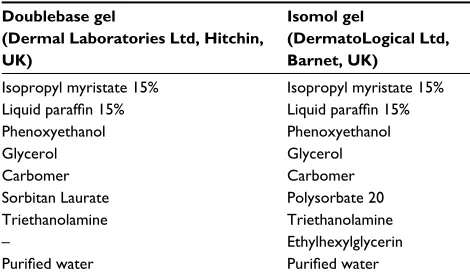
The aim of this study was therefore to compare the perfor-mance of one such Class I medical device, Isomol gel (IMG), with the innovator licensed medicine with which therapeutic equivalence is assumed - based on having similar composi-tions, namely Doublebase gel (DBG) (Table 1).
Materials and methods
skin occlusion
Use of the ex vivo human skin in this work was formally approved by the Research Tissue Bank Ethics Review Board (Cardiff, UK). Written informed consents were obtained from skin sample donors.
Occlusion was measured by reduction in cumulative evapo-rative weight loss from ex vivo samples of abdomen human skin (from a single donor, female, Caucasian) during a 48-hour period, following single applications of the two emollient gels, DBG and IMG, and an ointment-positive control Vaseline®
(pure petroleum jelly; Unilever, Leatherhead, UK). The latter was chosen because, even though cosmetically unacceptable for most atopic dermatitis patients owing to its greasiness on the skin and clothing, etc, it is highly occlusive.7 Full-thickness
ex vivo human skin samples from a single donor were mounted
in standard Franz diffusion cells (unjacketed, 11.28 mm ori-fice, 2 mL receptor volume; SES GmBH – Analysesysteme, Bechenheim, Germany) and secured with Parafilm® Film
(Bemis Company, Inc, Oshkosh, WI, USA) and stainless steel clips. The receptor chambers of the diffusion cells were filled with PBS solution (PBS, pH=7.4; Oxoid Ltd., Basingstoke, Hampshire, UK) to bathe the undersides of the skin. Four assemblies were prepared for each product/control treatment onto which the formulations were applied. Glass rods were used to spread the formulations over the exposed skin surfaces (discs of approximately 1.1 cm diameter) with an applied dose of approximately 2 mg/cm2 surface area of skin to mimic
nor-mal use. The assemblies were accurately weighed immediately after dosing (T0) and again after 5, 24, and 48 hours using an analytical balance (Sartorius Entris 124i-1S analytical balance, Sartorius Corp, Gottingen, Germany Germany).
Formulation quality
The quality of the two emollient gel formulations was com-pared using two methods. First, by observing their visual appearance when spread as thin films across glass petri dishes, and second by microstructural examination using environmental scanning electron microscopy (ESEM).
environmental scanning electron
microscopy
All microscopy-related work was performed at Ulster’s Bio-imaging Core Facility Unit. ESEM was used to escape the limitations imposed by conventional high vacuum SEM. The combination of differential pumping and pressure limiting apertures, in the presence of a gas (water vapor), affords the opportunity to nondestructively image samples at relatively low vacuum without the need for a conductive coating. With Peltier cooling and close control of temperature and pressure, water can be maintained in its liquid state, allowing fully hydrated samples to be imaged at high magnification and spatial resolution.
For ESEM, gel samples were applied in a thin layer onto copper (10 mm diameter) ESEM stubs (Agar Scientific, Stansted, UK), and these onto the Peltier stage within the ESEM. Chamber purge cycle parameters were selected to ensure the samples were at equilibrium at a relative humidity value of 95%. Temperature (2°C–5°C) and pressure (5.0–6.2 Torr) were adjusted in real time to ensure a relative humidity of 95%. Gels were visualized in an FEI (FEI, Eindhoven, Netherlands) Quanta™ ESEM at 30 kV using spot sizes 4–5 in secondary electron mode, using a gaseous secondary electron detector. Images were acquired using the Integrated Imaging software.
Table 1 Doublebase and Isomol gels - composition
Doublebase gel
(Dermal Laboratories Ltd, Hitchin, UK)
Isomol gel
(DermatoLogical Ltd, Barnet, UK)
Isopropyl myristate 15%
Liquid paraffin 15%
Isopropyl myristate 15%
Liquid paraffin 15%
Phenoxyethanol Phenoxyethanol
glycerol glycerol
Carbomer Carbomer
sorbitan laurate Polysorbate 20
Triethanolamine –
Triethanolamine ethylhexylglycerin
Purified water Purified water
Clinical, Cosmetic and Investigational Dermatology downloaded from https://www.dovepress.com/ by 118.70.13.36 on 21-Aug-2020
Dovepress skin occlusivity and emulsion microstructure
Results
skin occlusion
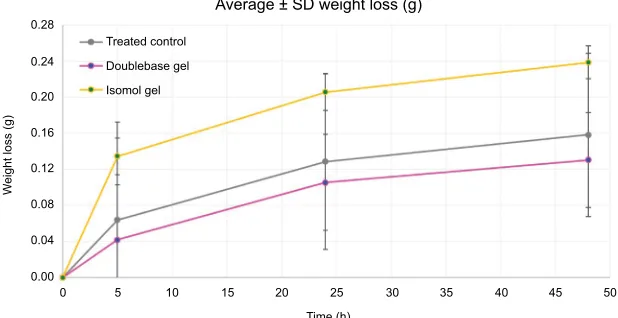
Occlusivity of the DBG emollient gel formulation was com-parable with the positive ointment control and substantially better than IMG, with total weight loss from the DBG-treated skin assemblies over 48 hours being less than half that from IMG-treated skin assemblies (Figure 1).
Considerable weight loss differences between the test products were observed even within the first 5 hours of the study (Table 2), indicating the superior performances of both the Vaseline positive control and DBG by the earliest measurement timepoint. Data obtained at the later 24- and 48-hour timepoints showed similar differences between the test products, with the IMG-treated skin assemblies continu-ing to lose more weight than those for the two other products. Overall, this highly occlusive effect of DBG, commencing soon after initial product application and lasting for at least 48 hours following single applications, was very similar to the performance of the ointment-positive control. Indeed, by expressing the 5-hour weight loss figures as a percentage of the total values measured at 48 hours, it is apparent that by 5 hours the DBG- and Vaseline-treated skin assemblies had lost around 32.3% and 40.4%, respectively, of their total weight, whereas by 5 hours the IMG-treated skin assemblies had already lost as much as 56.5% of their total weight. In other words, the DBG-treated skin assemblies lost less weight over the full 48 hours and at a substantially slower rate during the initial 5 hours. Extrapolating these results to the clinical set-ting, it therefore follows that although the skin moisturizing and barrier effects of DBG are comparable with those of the ointment-positive control, this is unlikely to be the case for IMG, despite its apparent compositional similarity to DBG.
Table 2 Weight loss – skin-treated samples (n=4)
Weight loss (g) Timepoint (hour)
Vaseline DBG IMG
Average SD Average SD Average SD 0 0.0000 0.0000 0.0000 0.0000 0.0000 0.0000 5 0.0641 0.1083 0.0422 0.0609 0.1348 0.0203 24 0.1289 0.0974 0.1057 0.0530 0.2057 0.0202 48 0.1585 0.0905 0.1306 0.0525 0.2388 0.0181
Abbreviations: DBg, Doublebase gel; IMg, Isomol gel.
Figure 1 Weight loss of three studied formulations over 48-hour period (n=4). 0.28
Treated control
Average ± SD weight loss (g)
Doublebase gel Isomol gel
W
eight loss (g
)
0.24
0.20
0.16
0.12
0.08
0.04
0.00
0 5 10 15 20 25
Time (h)
30 35 40 45 50
Film-forming characteristics
The film-forming capabilities of the gels were also very dif-ferent. Whereas DBG maintained a visibly smooth, uniform film over 24 hours, a phase separation occurred in the IMG formulation, producing a clear liquid (subsequently deter-mined to be isopropyl myristate, one of the key occlusive ingredients in the formulation) (Figure 2).
Microscopy
Microscopic examination revealed significant differences between the two emulsion gels. For DBG, the structural matrix stabilizing the oil droplets appeared to be uniform with most of oil droplets being approximately 2–5 µm in diameter (Figure 3). For IMG, however, microscopic examination sug-gested that the emulsion is largely nonuniform, with the oil droplets coalescing into much larger irregular shaped rafts of up to 33 µm in diameter (Figure 4).
Discussion
This study has demonstrated that the human skin occlusiv-ity of the innovator emollient gel formulation, DBG, is very similar to that of the ointment-positive control (Vaseline) and
Clinical, Cosmetic and Investigational Dermatology downloaded from https://www.dovepress.com/ by 118.70.13.36 on 21-Aug-2020
Dovepress Antonijević et al
substantially better than IMG. Weight loss from IMG-treated skin assemblies was much faster than that from DBG during the first 5 hours after application, and the total weight loss over 48 hours was approximately twice than that measured for DBG-treated skin. The results also strongly indicate that the inferior performance of IMG is explained, at least in part, by its inhomogeneous, unstable, and prone to phase-separation emulsion, as confirmed by both visual and microscopic examination.
For topically applied licensed medicines, there is uni-versal acceptance that two pharmaceutically similar formu-lations cannot be assumed to be therapeutically equivalent. The regulatory authorities normally require this to be demonstrated using comparative clinical trials or appropri-ate models, as stappropri-ated in EMA/CHMP/QWP/558185/2014 guidance. In this study, we have compared the occlusive performance of two ostensibly similar formulations and shown them to be very different. We have identified obvious visual and microscopic differences between the products, which are likely a reflection of important qualita-tive and quantitaqualita-tive formulation and production method differences, in part explaining the measured performance difference.8–10
Whereas licensed medicines are subject to rigorous and independent premarketing assessment by the regulatory authorities, no such independent assessment of quality, safety, and performance applies to self-certified Class I medical devices, which are registered on the manufacturers’ sole responsibility. Formulary administrators, health care professionals, prescribers, and patients should bear in mind that not all self-certified Class I medical devices necessarily meet the same standards of quality, safety, and performance independently verified for licensed medicines. Therapeutic equivalence cannot be assumed between topically applied formulations,11,12 even for those that, superficially, may seem
to be very similar.
Regarding the novel method used to measure occlusiv-ity, ex vivo human skin is valid for this purpose because the primary site of action of emollients on the skin is the external stratum corneum, which is nonliving tissue. This therefore allows reliable extrapolation in vivo. In addition, by suc-cessfully mounting samples of skin in Franz cells, this novel technique has allowed us to measure the occlusive effect of applied emollients directly, by measuring the reduction in
Figure 2 (A) Films formed by DBg (pink) and (B) IMg (yellow) after 24 hours of exposure to air. Abbreviations: DBg, Doublebase gel; IMg, Isomol gel.
Figure 3 seM images of (A) DBg and (B) IMg, both at ×4,000 magnification.
Abbreviations: DBg, Doublebase gel; IMg, Isomol gel; seM, scanning electron microscopy.
Figure 4seM images of (A) DBg at ×2,000 and (B) IMg at ×2,400 magnification.
Abbreviations: DBg, Doublebase gel; IMg, Isomol gel; seM, scanning electron microscopy.
Clinical, Cosmetic and Investigational Dermatology downloaded from https://www.dovepress.com/ by 118.70.13.36 on 21-Aug-2020
Dovepress
Clinical, Cosmetic and Investigational Dermatology
Publish your work in this journal
Submit your manuscript here: https://www.dovepress.com/clinical-cosmetic-and-investigational-dermatology-journal
Clinical, Cosmetic and Investigational Dermatology is an interna-tional, peer-reviewed, open access, online journal that focuses on the latest clinical and experimental research in all aspects of skin disease and cosmetic interventions. This journal is included on PubMed. The manuscript management system is completely online
and includes a very quick and fair peer-review system, which is all easy to use. Visit http://www.dovepress.com/testimonials.php to read real quotes from published authors
Dove
press
skin occlusivity and emulsion microstructure
weight loss of full-thickness skin post treatment – in this case by comparison with a positive control. To our knowledge, this direct measurement approach on human skin has not previously been reported and offers a new, objective measure of emollient performance, as an alternative or supplement to corneometry and transepidermal water loss methods which, although well established, are mainly confined to use in time-consuming and costly clinical trials. Using the novel gravimetric method described herein, it may also be possible to compare more products in individual studies than is gener-ally feasible using in vivo methodology. This may usefully encourage more research into this important therapeutic area, as requested by National Institute for Health and Clinical Excellence (NICE).13
Conclusion
For topically applied formulations, it is very important that they are formulated and manufactured such that their full clinical benefit can be realized. By using objective instru-mental measurements, we have demonstrated substantial performance differences between two prescribed emollient gels. Although the DBG and IMG formulations tested here may seem to be similar, they should not be regarded as being therapeutically interchangeable. Class I medical devices are self-certified and have no formal, independent assessment of their quality, safety, or performance. With this work, we have identified important shortcomings that need to be taken into consideration before assuming interchangeability based solely on the list of ingredients.
Acknowledgments
We would like to acknowledge Dermal Laboratories Ltd, Hitchin, UK, for providing product samples for this study. The abstract of this paper was presented at the fifth Annual
International Conference on Chemistry as a conference talk with interim findings. The abstract was published in Abstract Book: 5th Annual International Conference on Chemistry; ISBN: 978-960-598-161-7.
Disclosure
The authors report no conflicts of interest in this work.
References
1. Williams H, Stewart A, von Mutius E, Cookson W, Anderson HR, International Study of Asthma and Allergies in Childhood (ISAAC) Phase One and Three Study Groups. Is eczema really on the increase worldwide? J Allergy Clin Immunol. 2008;121(4):947–954.
2. Kownacki S. The importance of emollients in treating the increasing incidence of atopic eczema. Nurs Times. 2009;105(28):18–22. 3. Moncrieff G, Cork M, Lawton S, Kokiet S, Daly C, Clark C. Use of
emollients in dry-skin conditions: consensus statement. Clin Exp
Der-matol. 2013;38(3):231–238.
4. Cork MJ. Complete emollient therapy. In: Tod D, editor. National
Asso-ciation of Fundholding Practices Yearbook. Thornton Heath, Surrey,
UK: Scorpio Publishing; 1998:159–168.
5. Wynne A, Whitefield M, Dixon AJ, Anderson S. An effective, cosmeti-cally acceptable, novel hydro-gel emollient for the management of dry skin conditions. J Dermatolog Treat. 2002;13(2):61–66.
6. IMS sales data audit, British Pharmaceutical Index (BMI); 2018. Available from: http://earlyinsight.imshealth.com/ei/uk/. Accessed July 03, 2018. 7. Clarke C. Atopic eczema clinical features and diagnosis. Clin Pharm.
2010;2:285–289.
8. Chang RK, Raw A, Lionberger R, Yu L. Generic development of topical dermatologic products: formulation development, process development, and testing of topical dermatologic products. Aaps J. 2013;15(1):41–52. 9. Nalamothu V. Topical delivery - the importance of the right formulation in topical drug development. Drug Development Delivery. 2015:1–4. 10. Nwoko VE. Semi solid dosage forms manufacturing: tools, critical
process parameters, strategies, optimization and validation. Sch Acad
J Pharm. 2014;3(2):153–161.
11. Ersser S, Maguire S, Nicol N, et al. A best practice statement for emol-lient therapy. Dermatol Nurs. 2007;6(4):2–19.
12. Voegeli D. The vital role of emollients in the treatment of eczema. Br
J Nurs. 2011;20(2):74–80.
13. NICE. Management of atopic eczema in children from birth up to the
age of 12 years: National Institute for Health and Clinical Excellence.
London, UK: RCOG Press; 2007:CG57.
Clinical, Cosmetic and Investigational Dermatology downloaded from https://www.dovepress.com/ by 118.70.13.36 on 21-Aug-2020