RAPID AND ECONOMICAL QUANTITATIVE DETERMINATION OF SEVERAL
ANTIHYPERTENSIVE AGENTS IN PRESENCE OF HYDROCHLOROTHIAZIDE BY ISOCRATIC
REVERSED-PHASE HIGH-PERFORMANCE LIQUID CHROMATOGRAPHY IN THEIR
PHARMACEUTICAL PREPARATIONS
PANCHUMARTHY RAVISANKAR
1*, DEVALA RAO G
2, MD. SHAHEEM SULTHANA
1, SUPRIYA K
1, MOUNIKA G,
NAVEENA P
11Department of Pharmaceutical Analysis and Quality Assurance, Vignan Pharmacy College, Vadlamudi, Guntur, Andhra Pradesh, India. 2Department of Pharmaceutical Analysis, KVSR Siddhartha College of Pharmaceutical Sciences, Vijayawada, Andhra Pradesh, India
Received: 25 March 2017, Revised and Accepted: 22 August 2017
ABSTRACT
Objective: Objective of the present investigation is to develop a speedy isocratic reverse phase high-performance liquid chromatography (RP-HPLC) method for the separation and quantitative determination of 5 angiotensin II - receptor antagonists, namely, telmisartan, losartan, valsartan, olmesartan, irbesartan, and atenolol along with thiazide diuretics mostly hydrochlorothiazide (HCTZ).
Methods: RP-HPLC method was evolved using Welchrom C18 column (4.6 × 250 mm, 5 µm) as a stationary phase with the mobile phase comprising a
variety of phosphate buffer with pH-3.3 and acetonitrile in the proportion of 50:50 v/v. The mobile phase was pumped at a current rate of 1 mL/minute. The detection wavelength was carried out at 230 nm.
Results: The total run time was 6 minutes and the elution window of only 3 minutes. The peaks were eluted with decorous resolution. The calibration curves were linear (r2=0.9998) in all cases. The percentage relative standard deviation (RSD%) was <2% and average recovery was above 99.95%.
The method was validated specificity, precision, and accuracy. High recovery values and low RSD% prove that this method is very accurate and reproducible. The developed method was applied to the estimation of the above-said drugs in binary combinations from different manufacturers which were a good agreement with label claim.
Conclusion: The important advantage of developed method was that the five individual drugs can be determined on a single chromatographic system without alteration in detection wavelength and mobile phase composition. This novel method was statistically validated as per ICH guidelines. The optimized method proved to be linear, accurate, and robust. Hence, the above said proposed method was found to be a rapid tool for the routine determination of the above-said drugs in alone or combination with HCTZ in quality control analysis without interference of excipients.
Keywords: Telmisartan, Losartan, Valsartan, Olmesartan, Irbesartan, Atenolol, Reversed-phase high-performance liquid chromatography.
INTRODUCTION
Angiotensin antagonists are the first major innovation in essential hypertension management as a first-line treatment. Antihypertensive agents are a largest drug class and hold a major share of the drug market, as hypertension is a major cause of health problems. Hydrochlorothiazide (HCTZ) acts on both RAS and sympathetic nerve system, thereby creating greater sensitivity to angiotensin receptor blockade (ARBs). This HCTZ is a good selection for use in combination with ARBs. ACE inhibitors are having major problems of cough, when compared to ARBs. All the existing ARBs and atenolol (ATEN) are in fixed-dose combination with HCTZ. According to the available present knowledge, no unique single reversed-phase high-performance liquid chromatography (RP-HPLC) method available for the determination of 5 angiotensin II-receptor antagonists, i.e. ATEN, telmisartan (TELM), losartan (LOSA), valsartan (VALS), olmesartan (OLME), and irbesartan (IRBE) along with thiazide diuretics mostly HCTZ. The present proposed method will help in determination of drugs in a single run, which reduces the analysis time and does not necessarily any separate method for each drug and combined tablet formulation. After a meticulous survey of literature reveals that there were some analytical methods have been reported for the determination of the drugs either individually or in combination with some additional drugs in tablet dosage forms and biological samples based on a wide variety of instruments such as spectrophotometric method [1], capillary
electrophoresis [2], HPLC [3-16], LC-mass spectrometry (MS) [17,18], and LC-MS/MS [19-21]. Keeping in view of the complete evaluation the authors aim to develop a novel, simple, accurate, and sensitive method to determine combinations such as HCTZ with ATEN, HCTZ with TELM, HCTZ with LOSA, HCTZ with VALS, HCTZ with OLME, and HCTZ with IBRE without altering the detection wave length and chromatographic conditions.
METHODS
The above said standard drugs were gifted from Hetero Labs Ltd., Hyderabad, India. All other chemicals used in this method were purchased from Merck Chemical Division Ltd., Mumbai. HPLC grade acetonitrile, water, methanol, and triethylamine were obtained from Merck Pharmaceuticals Private Ltd., Mumbai, India. Commercial tablets of the above said formulation were procured from local pharmacies.
Apparatus and instruments
RP-HPLC was done on an isocratic HPLC (Shimadzu LC-20AT prominence LC) with a LC-20AT pump, manual Rheodyne injector with a loop volume of 20µl, variable wavelength Shimadzu SPD-20 A prominence ultraviolet (UV) detector, and Welchrom C18 Column
(4.6 × 250 mm, 5 µm particle size). The HPLC system was set with “Spin chrome” software. An electronic balance (Shimadzu TX223L), digital PH meter (Systronics model - 802), a sonicator (spectral lab, model © 2017 The Authors. Published by Innovare Academic Sciences Pvt Ltd. This is an open access article under the CC BY license (http://creativecommons. org/licenses/by/4. 0/) DOI: http://dx.doi.org/10.22159/ajpcr.2017.v10i12.18714.
UCB 40), and UV-Visible spectrophotometer (Systronics model-2203) were used in this analysis.
Preparation of pH 3.3 phosphate buffer
A 10 mM phosphate buffer was prepared by dissolving 6.056 g of potassium dihydrogen ortho phosphate in 445 ml of HPLC grade water. To this 55 ml of 0.1 M phosphoric acid was added and the pH was adjusted to 3.3.
Preparation of mobile phase
The above prepared buffer and acetonitrile were mixed in the proportion of 50: 50 v/v and were filtered through 0.45 µm nylon membrane filter and degassed by sonication
Preparation of stock standard solutions and calibration plot
Stock standard solutions containing 1.25, 0.25, 0.4, 0.5, 0.4, 0.8, and 1.5 mg/ml of HCTZ, ATEN, TELM, LOSA, VALS, OLME, and IRBE, respectively, were prepared by dissolving 12.5, 25, 40, 50, 40, 80, and 150 mg of each in the mobile phase in a 100 ml volumetric flask, respectively. It was then sonicated for 20 minutes and the eventual volume of the solutions was filled up to 100 ml with methanol to get stock standard solutions. To construct calibration plots, the stock standard solutions were diluted with the mobile phase to prepare working solutions to get various concentrations ranging from 2.5-12.5, 5-25, 8-40, 5-50, 8-40, 16-80, and 30-150 µg/ml for HCTZ, ATEN, TELM, LOSA, VALS, OLME, and IRBE, respectively.
Sample preparation
Twenty tablets of each sample Atenova-H (25 mg/tab ATEN), Cresar-H (40 mg/tab TELM), Hyzaar (50 mg LOSA), Valfect-H (40 mg VALS), Olmax-H (80 mg OLME), and Irovel-H (150 mg IRBE) and all these samples contains 12.5 mg/tab of HCTZ were weighed accurately and average weight was determined. The contents were ground into a fine powder and the powder equivalent to 100 milligrams of the drug was transferred in to a 100 ml of calibrated flask and dissolved in 70 ml of mobile phase with vigorous shaking and extracted 2 times with 10 ml portions of mobile phase and filtered through Whatman quantitative filter paper grade 41 into a 100 ml volumetric flask and diluted up to the mark with the same. From the above filtrate, 1 ml was further transferred to 100 ml volumetric flask and made up to the mark with mobile phase to obtain 100 µg/ml sample solution in each case. These prepared solutions were utilized as stock sample solutions throughout the work. Subsequent dilution of this solution was prepared with mobile phase to furnish the above-mentioned concentrations. The diluted solutions were analyzed under optimized chromatographic conditions employed and chromatogram is shown in Fig. 1.
Method optimization
When developing a novel method one of the most important goals is to accomplish a consistent reproducible separation. To acquire correct optimized HPLC conditions in the first instance in isocratic mode, copious trails were carried out by varying the different solvent mixtures
such as acetonitrile, methanol, HPLC grade water, with or without buffers in different combinations, C18, C8 columns, and flow rates as well
as pH of were tested. Based on the nature of the drugs eventually C18
column was chosen as a stationary phase. Trials of optimization were made by varying one parameter at a time, keeping all other parameters constant. Ultimately decorous resolution, short run time, excellent peak shape, minimal peak tailing, and good reproducibility results were identified when an analytical column of C18 and a mixture of mobile
phase consisting phosphate buffer with pH 3.3 and acetonitrile in the ratio of 50:50 v/v, using a flow rate of 1mL/min are found to be suitable for most combinations. Optimized chromatographic conditions and system suitability parameters are shown in Table 1. UV overlain spectra of the ATEN and five separations with HCTZ are shown in Fig. 2.
Method validation
The developed method of analysis was validated in pursuance of the guidelines of ICH Q2 (R1) [22,23] to examine the parameters such as system suitability, linearity, specificity, precision, accuracy, and robustness, limit of detection (LOD), and limit of quantitation (LOQ).
RESULTS AND DISCUSSION
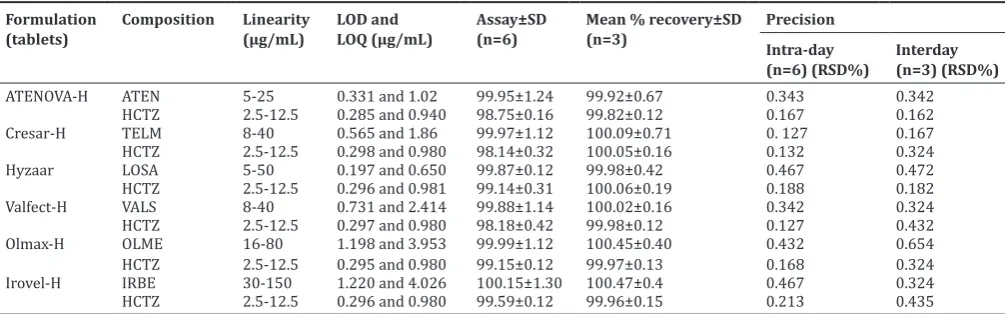
In the present study drug solutions of 10 µg/mL concentration solution of ATEN, HCTZ, TELM, LOSA, VALS, OLME, and IRBE were separately prepared with the mobile phase. All the seven drugs were scanned over the range of 200-400 nm in spectrum mode by applying UV spectrophotometer. By studying the overlain spectra, it was observed that all these four drugs showed optimum absorbance at 230 nm and were selected for further study. Accordingly, system suitability parameters such as retention time, resolution, the number of theoretical plates, efficiency/meter, and tailing factor of the peaks were computed for the optimized chromatographic conditions. As a result retention time of 2.431, 3.077, 3.230, 4.030, 5.243, 4.463, and 5.563 minutes, resolution of --, 3.354, 2.615, 2.755, 2.844, 3.675, and 2.057 for ATEN, HCTZ, TELM, LOSA, VALS, OLME, and IRBE were obtained. Moreover, the plate number of 11987, 12865, 13379, 14567, 15231, 15625, and 16058 was obtained for ATEN, HCTZ, TELM, LOSA, VALS, OLME, and IRBE and tailing factors of 1.164, 1.146, 1.128, 1.164, 1.143, 1.150, and 1.132 were obtained for ATEN, HCTZ, TELM, LOSA, VALS, OLME, and IRBE, respectively. As the results obtained were within the satisfactory limits, this method is apt for the separation and estimation of the above said drugs. Summary of validation parameters linearity, specificity, precision, accuracy, LOD, and LOQ is shown in Table 2.
Linearity
The purpose of this study is to verify that the detector response is directly proportional to the concentration of analyte in the sample. Linearity of developed method was determined by taking five different concentrations. The calibration curves for seven different drugs showed linearity over a concentration range of 5-25, 2.5-12.5, 8-40, 5-50, 8-40, 16-80, and 30-150 µg/mL for ATEN, HCTZ, TELM, LOSA, VALS, OLME, and IRBE, respectively. In ATENOVA - H 25 mg tablet
Fig. 1: A typical chromatogram showing the separation of atenolol and five angiotensin receptor blockade in the presence of
5-25 µg/mL and 2.5-12.5 µg/mL for HCTZ; Cresar - H 40 mg tablet 8-40 µg/mL for TELM and 2.5-12.5 µg/mL for HCTZ; for Hyzaar 50 mg tablet 5-50 µg/mL for LOSA and 2.5-12.5 µg/mL for HCTZ; for Valent-H 80 mg tablet 16-80 µg/mL for VALS and 2.5-12.5 µg/mL for HCTZ; Olmax-H 40 mg tablet 8-40 µg/mL for OLME and 2.5-12.5 µg/mL for HCTZ; Irovel-H 150 mg tablet 30-150 µg/mL for IRBE 2.5-12.5 µg/mL for HCTZ and the correlation coefficients were calculated from the linear regression analysis and it was found to be above 0.9998 in all cases. The obtained results were satisfactory as there exist a significant correlation between concentrations of each drug and their peak areas. The r2 (correlation coefficients) regression was found almost equal to
one in all cases.
Specificity
The purpose of this study is to evaluated by determine the effect of excipients, additives present in the formulations interfered with the analysis or not. As per the ICH guidelines, to test the specificity of the developed method a combination of pure drug samples with proper excipients were injected to the system for quantifying each drug individually and also in combination of two drugs, namely, HCTZ with ATEN and HCTZ with TELM, HCTZ with LOSA, HCTZ with VALS, HCTZ with OLME, and HCTZ with IRBE. In the same way blank solution with only commonly utilized excipients and synthetic mixture solutions were also injected separately. Peak responses for analyte and the blank were compared with each appropriate drug. The present study shows that there is no commonly used excipients are interfering with the drug peaks. Thus, the method clearly proves to be specific for determining the above said drugs.
Precision
To check the reproducibility of the method, the precision of the analytical method was determined by using intraday and interday studies. Triplicate samples of standard quality were taken in varying concentration levels and estimated for the intraday and interday precision of the developed method. For repeatability and intermediate precision the relative standard deviation (RSD%) values for all the drugs were calculated and RSD% of all the combined drugs were shown <2% which explains that the current method is precise.
Accuracy
Accuracy of the present method was evaluated by combining the known quantity of pure standard drugs to pre analyzed samples at three different levels mostly 80%, 100%, and 120%. Then, the recovery levels were observed obviously. The above-mentioned solutions were again prepared and analyzed in triplicate carefully. The same procedure was followed for all the individual drugs and also for drug combinations such as HCTZ with ATEN and HCTZ with TELM, HCTZ with LOSA, HCTZ with VALS, HCTZ with OLME, and HCTZ with IRBE and RSD% calculated was also known to be <2% for each of the drugs. As per ICH guidelines the % recovery must be between 98% and 102%.
Robustness
Small, experimental conditions such as flow rate, detection wavelength, and mobile phase composition are deliberately changed. It was observed in fact no significant variations in these parameters indicating that the method is robust. The RSD% values obtained in all the cases are <2%, hence this method is robust. Table 3 summarizes the robustness, data.
Table 1: Optimized chromatographic conditions and system suitability parameters
Parameter Chromatographic conditions for four sartans and hydrochlorothiazide
Instrument Shimadzu LC-20AT prominence LC Column Welchrom C18 column (4.6×250 mm, 5 µm) Detector Shimadzu SPD-20A prominence UV-VIS detector Mobile phase 10 mM phosphate buffer (pH 3.3): Acetonitrile 50:50, v/v Flow rate 1 mL/min
wave length UV at 230 nm Run time 6 minutes
Temperature Ambient temperature (25°C) Injection volume 20 µL
ATEN HCTZ TELM LOSA VALS OLME IRBE
Retention time (minute) 2.431 3.077 3.230 4.030 5.243 4.463 5.563 Th.Pl (efficiency) 11.987 12.865 13.379 14.567 15.231 15.625 16.058
Resolution - 3.354 2.615 2.755 2.844 3.675 2.057
Tailing factors 1.164 1.146 1.128 1.164 1.143 1.150 1.132
LC: Liquid chromatography, UV-VIS: Ultraviolet-visible, ATEN: Atenolol, OLME: Olmesartan, HCTZ: Hydrochlorothiazide, TELM: Telmisartan, LOSA: Losartan, VALS: Valsartan, IRBE: Irbesartan
Table 2: Summary of validation parameters
Formulation
(tablets) Composition Linearity (µg/mL) LOD and LOQ (µg/mL) Assay±SD (n=6) Mean % recovery±SD (n=3) PrecisionIntra‑day
(n=6) (RSD%) Interday (n=3) (RSD%)
ATENOVA-H ATEN 5-25 0.331 and 1.02 99.95±1.24 99.92±0.67 0.343 0.342 HCTZ 2.5-12.5 0.285 and 0.940 98.75±0.16 99.82±0.12 0.167 0.162 Cresar-H TELM 8-40 0.565 and 1.86 99.97±1.12 100.09±0.71 0. 127 0.167 HCTZ 2.5-12.5 0.298 and 0.980 98.14±0.32 100.05±0.16 0.132 0.324 Hyzaar LOSA 5-50 0.197 and 0.650 99.87±0.12 99.98±0.42 0.467 0.472 HCTZ 2.5-12.5 0.296 and 0.981 99.14±0.31 100.06±0.19 0.188 0.182 Valfect-H VALS 8-40 0.731 and 2.414 99.88±1.14 100.02±0.16 0.342 0.324 HCTZ 2.5-12.5 0.297 and 0.980 98.18±0.42 99.98±0.12 0.127 0.432 Olmax-H OLME 16-80 1.198 and 3.953 99.99±1.12 100.45±0.40 0.432 0.654 HCTZ 2.5-12.5 0.295 and 0.980 99.15±0.12 99.97±0.13 0.168 0.324 Irovel-H IRBE 30-150 1.220 and 4.026 100.15±1.30 100.47±0.4 0.467 0.324 HCTZ 2.5-12.5 0.296 and 0.980 99.59±0.12 99.96±0.15 0.213 0.435
LOD and LOQ
Sensitivity of the analytical method is evaluated by the LOD and LOQ. LOD=3.3 (SD)/S and LOQ=10 (SD)/S. The LOD and LOQ results for combined drugs such as ATEN with HCTZ, TELM with HCTZ, LOSA with HCTZ, VALS with HCTZ, OLME with HCTZ, and IBRE with HCTZ were found to be 0.331μg/mL and 1.026 μg/mL, 0.285 μg/mL and 0.940 μg/mL; 0.565 μg/mL and 1.86 μg/mL, 0.298 μg/mL and 0.980 μg/mL; 0.197 μg/mL and 0.650 μg/mL, 0.296 μg/mL and 0.981 μg/mL; 0.731 μg/mL and 2.414 μg/mL, 0.297 μg/mL and 0.980 μg/mL; 1.198 μg/mL and 3.953 μg/mL, 0.295 μg/mL and 0.980 μg/mL; 1.220 μg/mL and 4.026 μg/mL, and 0.296 μg/mL and 0.980 μg/mL, respectively. The lowest LOD and LOQ values showed that the method is more sensitive.
Assay
The developed method was finally applied for quantification of marketing formulation. Satisfactory results have been obtained. The mean assay values for ATEN with HCTZ, TELM with HCTZ, LOSA with HCTZ, VALS with HCTZ OLME with HCTZ, and IBRE with HCTZ combination of drugs were found to be 99.95±1.24 and 98.75±0.16; 99.97±1.12 and 98.14±0.32; 99.87±0.12 and 99.14±0.31; 99.88±1.14 and 98.18±0.42; 99.99±1.12 and 99.15±0.12; 100.15±1.30 and 99.59±0.12, respectively. The mean assay values were in good agreement with the label claim (Table 2). Hence, by the developed method all the specified drugs were recovered perfectly pharmaceutical dosage forms. Therefore, the method developed was found to be properly suitable for the estimation of the marketed formulations.
CONCLUSION
A simple, precise, accurate, and sensitive isocratic RP-HPLC method have been developed for simultaneous determination of HCTZ, ATEN, TELM, LOSA, VALS, OLME, and IRBE in bulk and combined tablet dosage forms. Statistical analysis lucidly proves that this method is fast, cost effective, highly efficient, and robust than the existing methods hitherto. In addition, to that, the method is free from interferences of the excipients and additives used in the preparation of the above-said combination formulations. This novel method separated all the above-said drugs in 4 minutes and total run time of just 6 minutes and it is also feasible for analysis of said angiotensin receptor blockades with HCTZ in their formulations in a single run without changing the mobile phase composition and chromatographic conditions. Hence, it is correct to conclude that it is effectively used for the application of all the above-said drugs individually or in binary combinations in quality control laboratories.
ACKNOWLEDGMENTS
The authors are thankful to Hetero Labs for providing the samples. We are highly grateful to Dr. L. Rathaiah, Honorable Chairman, Vignan group of institutions and Prof. P. Srinivasa Babu Principal, Vignan Pharmacy College, Vadlamudi, Guntur, for providing the necessary laboratory facilities to carry out this investigation.
REFERENCES
1. Bari S, Sathe S, Jain P, Surana S. Spectrophotometric method for simultaneous estimation of atenolol in combination with losartan potassium and hydrochlorothiazide in bulk and tablet formulation. J Pharm Bioallied Sci 2010;2(4):372-5.
2. Hillaert S, van den Bossche W. Simultaneous determination of hydrochlorothiazide and several angiotensin-II-receptor antagonists by capillary electrophoresis. J Pharm Biomed Anal 2007;31(2):329-39. 3. Ahmed S, Atia NN, Mohamed NA. Dual separation mode for
simultaneous determination of antihypertensive drug combinations by high-performance liquid chromatography. Talanta 2011;84(3):666-72. 4. Ravisankar P, Devi MS, Ravali B, Tejaswini K, Balaji D, Babu PS.
Rapid simultaneous separation of four sartans by isocratic RP-HPLC method: Application to determination of olmisartan in pharmaceutical dosage form. J Chem Pharm Sci 2015;8(1):61.
5. Yadav SS, Rao JR. RP-HPLC method for simultaneous estimation of losartan, hydrochlorothiazide and amlodipine in tablet dosage form.
Asian J Pharm Clin Res 2014;7(1):137-40.
6. Ravisankar P, Swathi J, Kumar KV, Babu PS. Novel RP-HPLC method for simultaneous determination of olmesartan medoxomil, amlodipine besylate and hydrochlorothiazide in tablet dosage form. Int J Biol Pharm Res 2014;5(12):927-36.
7. Kumar MS, Rao JV. Development and validation of stability indicating RP-HPLC method for simultaneous determination of telmisartan and amlodipine in combined dosage form. Asian J Pharm Clin Res 2014;7(1):32-5.
8. Ravisankar R, Vineela C, Koushik OS, Babu PS. Novel simultaneous separation and quantitative determination of telmisartan, losartan, olmesartan and irbesartan in presence of hydrochlorothiazide by isocratic RP-HPLC. Adv J Pharm Life Sci Res 2015;3(4):1-18. 9. Tian DF, Tian XL, Tian T, Wang ZY, Mo FK. Simultaneous
determination of valsartan and hydrochlorothiazide in tablets by RP-HPLC. Indian J Pharm Sci 2008;70(3):372-4.
10. Kollipara S, Bende G, Bansal Y, Saha R. Stability-indicating reversed-phase liquid chromatographic method for simultaneous determination of losartan potassium and ramipril in tablets. Indian J Pharm Sci 2012;74(3):201-10.
11. Wankhede SB, Tajne MR, Gupta KR, Wadodkar SG. RP-HPLC method for simultaneous estimation of telmisartan and hydrochlorothiazide in tablet dosage form. Indian J Pharm Sci 2007;69(2):298-300.
12. Ravisankar P, Manjusha K, Sri VL, Kumar BV,
Rajyalakshmi K, Babu PS. Quantitative estimation of four sartans in presence of hydrochlorothiazide in pharmaceutical preparations by high performance liquid chromatography. Br J Pharm Res 2016;11(4):1-15. 13. Rane VP, Patil KR, Shangshetti JN, Yeole RD, Shinde DB.
Stability-indicating LC method for the determination of olmesartan in bulk drug and in pharmaceutical dosage form. Chromatographia 2009;69(1-2):169-73.
14. Patel UM, Chokshi AB, Desai PR. Development and validation of RP-HPLC method for determination of hydrochlorothiazide, olmesartan medoxomil and their related substances in combined tablet dosage form. Int J Pharm Pharm Sci 2014;6(9):318-23.
15. Indrani B, Ghosh SK. Development and validation of stability
indicating RP-HPLC method for the determination of atenolol and hydrochlorthiazide in combined solid dosage form. Int J Pharm Pharm Sci 2015;7(2):489-92.
16. Shetty SK, Surendranath KV, Radhakrishnanand P. Quantitative application to a polypill by the development of stability indicating LC method for the simultaneous estimation of aspirin, atorvastatin, atenolol and losartan potassium. Am J Anal Chem 2010;2:59-69.
17. Kristoffersen L, Øiestad EL, Opdal MS, Krogh M, Lundanes E, Christophersen AS. Simultaneous determination of 6 beta-blockers, 3 calcium-channel antagonists, 4 angiotensin-II antagonists and 1 antiarrhythmic drug in post-mortem whole blood by automated solid phase extraction and liquid chromatography mass spectrometry. Method development and robustness testing by experimental design. J Chromatogr B Analyt Technol Biomed Life Sci 2007;850(1-2):147-60. 18. Li H, Wang Y, Jiang Y, Tang Y, Wang J, Zhao L, et al. A liquid
chromatography/tandem mass spectrometry method for the simultaneous quantification of valsartan and hydrochlorothiazide in human plasma. J Chromatogr B Analyt Technol Biomed Life Sci 2007;852(1-2):436-42.
19. Tutunji LF, Tutunji MF, Alzoubi MI, Khabbas MH, Arida AI. Simultaneous determination of irbesartan and hydrochlorothiazide in human plasma using HPLC coupled with tandem mass spectrometry: Application to bioequivalence studies. J Pharm Biomed Anal 2010;51(4):985-90.
20. Vaidya VV, Roy SM, Yetal SM, Joshi SS, Parekh SS. LC-MS-MS determination of olmesartan in human plasma. Chromatographia 2008;67(1-2):147-50.
21. Liu F, Zhang J, Gao S, Guo Q. Simultaneous determination of hydrochlorothiazide and valsartan in human plasma by liquid chromatography/tandem mass spectrometry. Anal Lett 2008;41(8):1348-65.
22. Ravisankar P, Gowthami S, Rao GD. A review on analytical method development. Indian J Res Pharm Biotechnol 2014;2(3):1183-95. 23. International Conference on Harmonization Q2 (R1). Validation of