International Journal of Scientific Research in Computer Science, Engineering and Information Technology © 2017 IJSRCSEIT | Volume 2 | Issue 2 | ISSN : 2456-3307
Link Quality Driven Multipath Routing for Route Discovery in
Mobile Ad Hoc Networks for Effective Communication
V. Kalpana, Dr. S. KarthikAssistant Professor, CSE, Jansons Institute of Technology, Coimbatore, Tamil Nadu, India Professor and Head, CSE, SNS College of Technology, Coimbatore, Tamil Nadu, India
ABSTRACT
In Mobile Ad Hoc Networks (MANETs) routing protocols are used to discover routes between a source-destination pair. The traditional routing protocols in MANETs discovery routes based on the shortest hop count metric due to which the routes selected for data transmission may be of low quality. A link on a selected route is low considered as low quality link if it requires more number of re-transmissions to transmit a data packet to next hop. This can be happen due to interference and contention on the link caused by nearby data sessions of high distance between the communication nodes which weakens the signal strength due to which the probability of frame error rate increases. Therefore, we require a routing protocol which uses a route discovery process which is based on other metrics than the shortest hop count to improve the communication process in wireless MANETs. In this thesis, we propose a multipath route discovery algorithm which considers the quality of an intermediate link as a metric for its inclusion in the possible routes selected between a source-destination pair. We can now use the secondary route without causing a new route discovery process due to this the network overhead caused by a route discovery process will be avoided. This increases the network communication performance greatly. The proposed LQMR routing protocol is implemented in the trail version of network simulator called EXata. The simulation results are taken on various network scenarios which are created with varying network loads and network mobility to check the effectiveness of our proposed method. Various performance metrics are used to evaluate the simulation results obtained such as end-to-end network delay, network routing overhead and packet delivery ratio. The performance metrics evaluation and analysis show that the proposed LQMR protocol greatly improves the performance of data transmission in MANETs while effectively handle the topology changes caused by the network mobility.
Keywords :MANET, EXata, LQMR, Ad Hoc Networks, WMNs, WSN, AODV, DSR, ZRP, OLSR, PDA
I.
INTRODUCTION
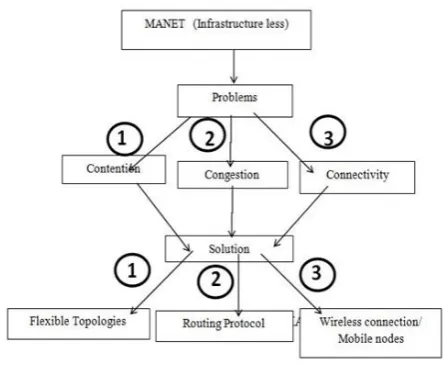
Mobile Ad Hoc Network (MANET) that is connected by wireless links is a self-configuring network of mobile nodes. The devices freely move in any direction and links between these devices are changed frequently. An ad hoc network is basically a collection of wireless nodes without any permanent network and self-organization. They are without any fixed infrastructure like access points or base stations. In ad hoc networks every node is willing to forward data to other nodes, and which node will forward the data is decided dynamically based on the network connectivity. The term “Ad-hoc‟ implies that the network is structured for a special purpose, sometimes exclusive service designed for specific applications (e.g., disaster recovery, battlefield).
II.
METHODS AND MATERIAL
A. Wireless Networks
Wireless networks are of two types first is called infrastructure based wireless networks and second is called Infrastructure less networks. Infrastructure less network is also called Ad-hoc Network. Ad-hoc networks can be classified in three categories based on applications; Mobile Ad-hoc Networks (MANETs), Wireless Mesh Networks (WMNs), Wireless Sensor Networks (WSN). [3]
1. Classification of Wireless Network
Wireless networks are of many types according to their uses, applications and the very important the way in which they are being made and organized. Wireless networks are classified as mentioned in following ways.
2. Infrastructure-less (Ad-hoc) wireless network
In this case a network is formed dynamically through the cooperation of an arbitrary set of independent mobile nodes. Where each node participates in routing by forwarding data dynamically based on the network connectivity.
3. Infrastructure-based wireless network
MANET Application [6]
Tactical network: Mobile ad hoc networks have primarily been used for tactical network related applications such as military communication, operation battlefield communications and survivability.
Commercial environments: E-Commerce example as electronic payments from anywhere.
Home and enterprise networking: Home/office wireless networking (WLAN) example as shared white-board application and use PDA to print anywhere.
Educational application: Use ad-hoc communication during conferences, meetings and virtual classrooms.
B. Motivations
Due to the physical and environmental conditions of wireless networks such as mobile ad hoc network, the underlying radio channel provides very fluctuating channel bandwidth and data capacity during the data transmission through these networks. The wireless networks are unreliable mode of data communication due to their physical channel which is prone to bit error rates caused by the environmental effects such as multipath signal reception, interference by neighbor nodes, path loss etc. Furthermore, the un-centralized communication and dynamically changes network topology due to network or node mobility adds further variations in the link quality of these networks. Therefore, it is very necessary to discover the problems and provide solutions for efficient data communication in such networks. The hop-count is the most common metric that are used by the existing routing protocols such as AODV (Ad-hoc on-demand distance vector), DSR ( Dynamic source routing), OLSR (Optimized link state routing) and ZRP (Zone based routing) etc in MANETs to discover routes for a given source destination pair. In this the routes with the lowest hop count from source to destination is discovered and used for data communication.
C. Objective
Route discovery process. This is done to ensure to avoid any additional routing overhead which could be un-expectable in bandwidth-scarce MANETs.
Challenges in MANETs
As has already been stated in previous sections of this thesis, some characteristics that define ad hoc networks includes resource constrained devices, limited battery power and bandwidth, security concerns and dynamic topologies. Therefore, exemplary design goals can be summarized for routing protocols for ad hoc networks:
Minimal overheads
number of control messages between the nodes. This can help in conserving battery power.
Similarly, processing overheads are also introduced in the ad hoc networks due to algorithms that are computationally complex. This results in using up more resources and hence more battery power is consumed.
Therefore, research studies shows that it is advisable to implement protocols that are lightweight and involve minimal processing cycles so that battery power can be reserved for other useful tasks.
Multihop routing
The mail objective of this work is to provide reliable communication over an unreliable wireless network with the help of using few physical layer metrics that can be used during the route discovery process between a source-destination pair in MANETs. The major objective of this thesis can be viewed as two-folded:
Increase the communication performance of the data session in MANETs in terms of network metrics such as throughput, end-to-end delay, network overhead etc.. This is difficult in MANETs due to network mobility and unreliable wireless bit-error prone communication channel.
Use the existing hop based route discovery protocols to improve the route discovery phase to gain the performance benefit in the MANETs. To do this the rective routing protocol called AODV is used and the physical layer metrics are exploited and provided to the AODV protocol during its
Because of limited transmission range of devices, it is required to use multiple hops to exchange data between source and destination hosts in a Mobile Ad-hoc Network since there is high possibility of them not being within each others‟ direct transmission range.
Therefore, for communication to be possible in the network, routing protocol must effectively be able to detect multihop routes.
Dealing with dynamic topologies
In Mobile Ad-hoc Networks, route breakages are quite common due to unrestricted movement of nodes causing network topology to change continuously. Also, links can break due to devices getting switched off or restarted. So a path must be sustained during the movement of intermediate as well as end nodes.
Since a single channel is shared among multiple nodes, breakages must be treated rapidly with minimum delay and overhead. . This is illustrated in Figure 1.
Suppose, node C wants to communicate with node A. At time t1, the routing path is C→E→A. At time t2 (>t1), node E moves out of range of node C. Because of this, the changed route for node B at time t2 is C→B→A.
Figure 2. Node's Mobility
According to above definition, finding a suitable path from a source to a destination is called routing and that is the important issue in MANET. Due to rapid growth in the use of applications, such as tactical network, online gaming, disaster recovery services, voice-over IP (VoIP), and other multimedia streaming applications in MANETs.
Routing Challenges in MANETs
to explain the developmental goals for an ad hoc routing protocol so that the design choices of the protocols can be better understood. Hence, the following are typical design challenges for wireless ad hoc network routing protocols:
Minimal control overhea Minimal processing overhead Multihop routing capability Dynamic topology maintenance Loop prevention
MANET applications
In this section, we present some from the various applications where ad hoc networks are used on large scale in real world [15]:
Audio or video conferencing
Emergency and rescue operations
Domestic networking and communications
Computing in embedded systems
Wireless sensor networks
D. Related Work
In [1], a Channel Adaptive Probabilistic Broadcast (CAPB) scheme is used to reduce BSP (broadcast storm problem). BSP is generated by excessive redundant routing traffic in flooding while using demand routing protocols, such as AODV (Ad-hoc On-demand Distance Vector) to discover routes in Mobile Ad-hoc Networks (MANETs). Regarding this problem so many other schemes are also proposed earlier but they do not consider thermal noise and interference which exist in real life MANETs. This scheme determines the probability of rebroadcasting RREQ packets on the fly according to the current SINR (Signal to Interference plus Noise Ratio) and node density in the neighbor-hood. This scheme is implemented on the traditional AODV routing protocol and simulation result of this scheme are compared with two previously proposed schemes as a result this scheme outperforms in terms of routing overhead, throughput and end-to-end delay significantly.
In [2] Singal G. presents a multicast routing protocol to improve `Link Stability' in MANETs. `Link Stability' is important because radio links are likely to be unreliable due to node mobility and this increased rerouting which increases the routing overheads. Using multicast routing instead of unicast is one way to reduce the
routing overhead problem. This protocol uses received signal strength as a metric to estimate link stability. Estimated SINR (Signal to Interference plus Noise Ratio) at every node in respect of different senders is used to determine a reliable path that is likely to mitigate link failures and reduce end-to-end delay this also increases the network lifetime. For simulation Exata/Cyber Simulator is used. The improve results of proposed routing protocol over ODMRP (On-Demand
Multicast Routing Protocol) are shown by using metrics like PDR (Packet Delivery Ratio), Routing Overhead and packet drop ratio.
In [3] the author shows the effect of the presence of noise on route discovery mechanism in the ad hoc on demand distance vector (AODV) routing protocol for mobile ad hoc networks. In today‟s life the battery life of mobile devices is very critical factor. The route discovery phase of the routing protocols is attempts to establish a mobile ad hoc network. These routing
In [4] Patil R. proposed a system which eliminates the noisy signals received at the physical layer by comparing the signal to interference noise ratio with the signal to noise ratio threshold value. Interference and noise signal along with actual signal strength parameters are measured at physical layer of OSI reference architecture. Ratio of these two parameters (SINR) is calculated. This SINR is compared with SINRT (signal to interference noise ratio threshold value) which is already maintained at the routing layer. If the received message has less SINR than the threshold value, these types of messages are discarded. If message has higher SINR than SINRT, then it is selected for further processing. For simulation NS2 simulator is used and in results this improved protocol which is named as CLAODV show improvement by increasing the throughput, packet delivery ratio and reducing the delay and overhead in comparison with the base AODV.
(MANETs) is proposed by Taj, Y. In this approach by measuring signal strength changes of neighbor nodes one can identify nodes that have a lot of mobility and causes link failure and then these nodes are not got selected as route nodes due to this now the route which we selected is more reliable and stable which also improves the life time of the network. In the simulation results the performance of the network is improves by using Signal Strength Based Reliability (SSBR) approach.
In [6] The Newton interpolation polynomial is constructed according to several reference points to describe the received signal strength continuously; and then, with the methods of middle value and interception, the optimal reference points are selected reasonable to estimate the link lifetime. The objective of this approach is to reduce the frequent breaks of radio links to select a reliable path that last longer and increases the life time of the network.
In [7] San-Yuan Wang proposed a signal strength-simulation, In results this routing protocol showed superior performance for various system parameters in a Ricean fading environment. Later this protocol is also combined with multi-rate MAC protocol for the better results.
The new Route Stability and Energy Aware based RSEA-AODV [8] protocol is proposed to achieve route stability. This protocol selects the route according to the delay between two communicating nodes, signal strength of received, total remaining energy and draining rate of node and it minimize the chance of route breakage because of two factor i.e. distance between two communicating node and energy depletion. This protocol decides to either add the node in the path or not on the basis of above mentioned four parameters. The value of all these parameters is compared with the predefined threshold values according to which the decision is made. For simulation NS2 simulator is used. The results shows that RSEA-AODV is better than the AODV with respect to network lifetime, normalized routing
overhead, packet delivery ratio, through-put and total number of dead nodes.
In [9] a performance study on link expiration time prediction during routing in MANETs is discussed. This is done by using three prediction algorithms based on either the Global Positioning System (GPS), or the signal strength (SS), or both. In this the mobile nodes predicts the remaining connectivity time with their neighbors in order to avoid disconnections. For simulation Dynamic Source Routing (DSR) protocol is used with several modifications that enable integration of link expiration time metric and the results shows that the approach can improve the network performance.
In [10] a formal model to predict the lifetime of a routing path based on the random walk model is proposed. This model works on the issue of route lifetime which is not frequently considered in MANETs in comparison to other features. Through which we are able to put an insight into issues such as route selection, route maintenance, and network scalability related to MANETs. In this the route lifetime is derived based on a probabilistic model.
E. Link-Quality Driven Multipath Routing
In this Chapter, we propose a reactive link quality driven routing protocol implemented on top of the traditional ad hoc on-demand distance vector routing protocol. The proposed protocol searches more than one link quality routes during its dynamic route discovery process. Due to the discovery of multiple link and node disjoint link quality aware routes in a route discovery process we called our proposed protocol as Link-Quality driven Multipath Routing (LQMR) protocol. The LQMR protocol improves the reliability and efficiency of communication sessions between a source-destination pair in the network in terms of packet delivery ratio, network overhead or routing overhead and end to end delay.
Wireless Network Modeling
TCP/IP stack. In this section we will present the models of five components of the network that are used to create a mobile ad-hoc network. The components are as follows:
Application layer model Mobility model Network Layer model MAC layer model
Algorithm 1 Link-Quality aware Route Discovery Phase of Proposed LQMR Protocol
//Variables used in the Algorithm Src = Source node
Dest = Destination node I_m = Intermediate node
RREQ_BUFFER = RREQ message buffer table LQ_RREQ = link quality of received RREQ message R_t = Routing table of a node
“t” = Period of Timer set with first RREQ stored in
RREQ_BUFFER \\Algorithm
IF1 (Src has a data packet to send) IF2 (Src R_t has route for Dest)
Src send data packet to next_hop based on the entry in R_t of Src
ELSE2
Src initiates LQMR protocols link-quality based route discovery
Src broadcast a RREQ message in the network IF3 (I_m receive RREQ)
At PHY, I_m evaluate the SINR and LQ I_m add the LQ in INFO field of RREQ
At network layer I_m buffer RREQ in its
RREQ_BUFFER
Set TIMER of period “t” if first RREQ at I_m
TIMER expires; extract RREQ that has highest LQ
I_m rebroadcast extracted RREQ; destroy
RREQ_BUFFER
ENDIF3
IF4 (Dest receive RREQ message)
Performs the same first 5 steps as done by I_m
When TIMER expires; extract two RREQ with highest LQ
Create corresponding RREP fro extracted RREQs Unicast the RREPs towards the Src
ENDIF4
IF5 (Src receive RREP)
Src update R_t; start sending the buffered data packet to Dest
ENDIF5 ENDIF2 ENDIF1
Simulation and Performance Evaluation
In this Chapter, we present the performance and result analysis of our proposed link-quality driven routing protocol with the help of simulations performed over a large set of various MANET scenarios. The proposed LQMR protocol is compared with the traditional AODV and a similar approach called BER-AODV presented in []. This is done to show LQMR effectiveness in data communication process. The results shown in this chapter are the average results taken on a set of simulation runs to ensure that the final results are stable one.
Network Simulation Parameters:
Parameters Values
Simulator EXata Trial
Network Size 1000 x 1000 meter square Simulation time 1000 Seconds Application Layer Constant Bit Rate (CBR)
Program
Transport Layer User Datagram Protocol
Protocol (UDP)
Number of Nodes 50 Mobility model Random way point Node pause time 15 Seconds
Mobility speed 0 to 25 meters/sec MAC specification IEEE 802.11 Network Bandwidth 2 Mbps
Performance Metrics Packet delivery Ratio, End-to- end delay and Routing
Control Overhead PHY Specification 802.11b
The network scenarios used for performing the simulations consist of various node mobility speeds and the numbers of source-destination pairs are also varied to increase the traffic so that the performance and effectiveness of our proposed LQMR protocol can be measured in terms of increased network mobility and network speed. The implementation of LQMR protocol is done over the EXata network simulator. EXata has an inbuilt code for the traditional AODV which we have used for comparing our proposed protocol with the AODV. The network scenario used for the performing the simulations exhibits the following values for the specified parameters as given in Table 1.
III.
RESULTS AND DISCUSSION
In order to analyze, compare and evaluate performance of the three protocols (AODV, BER-AODV and LQMR protocols) in various network scenarios, following parameters are changed during simulation process to change the network conditions:
Network Load (It can be varied by varying the number of communication (or data) sessions in the network)
Node mobility (This can be achieved by using different node velocity and node pause time)
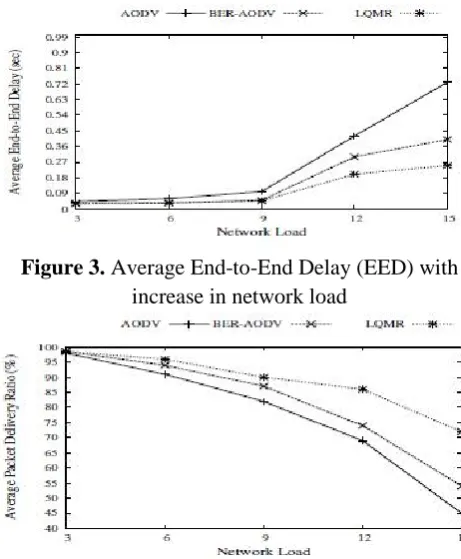
In the first simulation scenario, the multiple simulations will be performed on different network loads (i.e., data sessions). In these network scenarios, the number of data sessions are increased (by adding 3 new data sessions every time until it reaches upto 12 data sessions) in the consecutive scenarios while the mobility configurations in the network are kept constant (i.e., 10m/s node velocity with a pause time of 5 seconds).
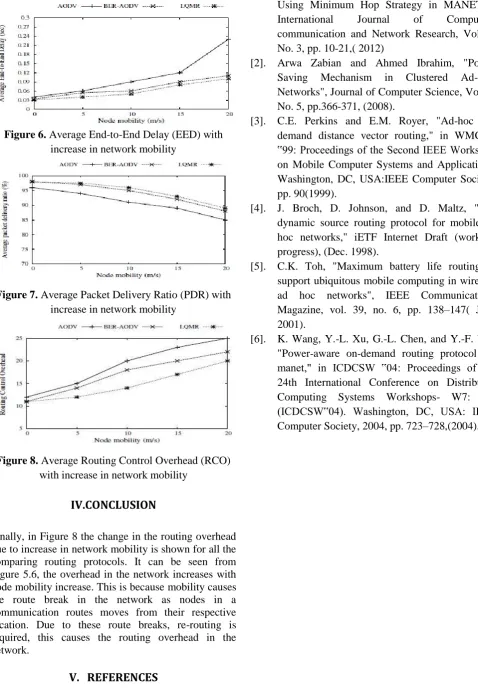
In the second type of scenarios, we keep the number of data sessions in the network constant (i.e., 5) while keep on changing the network mobility by varying the
mobility parameters (change the node velocity from 0 to 20 m/s with an interval of 5m/s).
Figure 3. Average End-to-End Delay (EED) with increase in network load
Figure 4. Average Packet Delivery Ratio (PDR) with increase in network load
Figure 5. Average Routing Control Overhead (RCO) with increase in Network Load
Effect of Network Mobility
Figure 6. Average End-to-End Delay (EED) with increase in network mobility
Figure 7. Average Packet Delivery Ratio (PDR) with increase in network mobility
Figure 8. Average Routing Control Overhead (RCO) with increase in network mobility
IV.CONCLUSION
Finally, in Figure 8 the change in the routing overhead due to increase in network mobility is shown for all the comparing routing protocols. It can be seen from Figure 5.6, the overhead in the network increases with node mobility increase. This is because mobility causes the route break in the network as nodes in a communication routes moves from their respective location. Due to these route breaks, re-routing is required, this causes the routing overhead in the network.
V.
REFERENCES
[1]. Shivashankar, G. Varaprasad, "Study of Routing Protocols for Minimizing Energy Consumption
Using Minimum Hop Strategy in MANETS", International Journal of Computing communication and Network Research, Vol. 1, No. 3, pp. 10-21,( 2012)
[2]. Arwa Zabian and Ahmed Ibrahim, "Power Saving Mechanism in Clustered Ad-Hoc Networks", Journal of Computer Science, Vol. 4, No. 5, pp.366-371, (2008).
[3]. C.E. Perkins and E.M. Royer, "Ad-hoc on-demand distance vector routing," in WMCSA ‟99: Proceedings of the Second IEEE Workshop on Mobile Computer Systems and Applications. Washington, DC, USA:IEEE Computer Society, pp. 90(1999).
[4]. J. Broch, D. Johnson, and D. Maltz, "The dynamic source routing protocol for mobile ad hoc networks," iETF Internet Draft (work in progress), (Dec. 1998).
[5]. C.K. Toh, "Maximum battery life routing to support ubiquitous mobile computing in wireless ad hoc networks", IEEE Communications Magazine, vol. 39, no. 6, pp. 138–147( June 2001).